
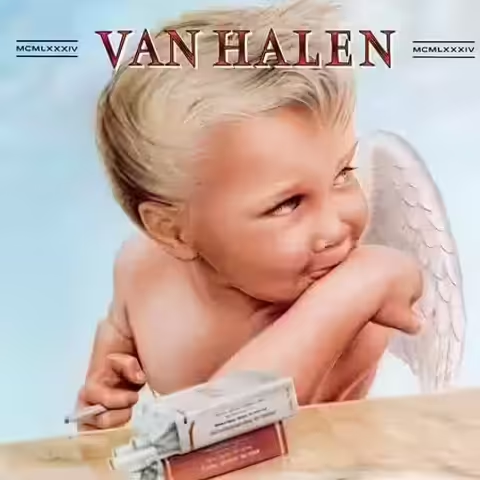
The argument that produced 1984 was not about a song. It was about a synthesiser. Eddie Van Halen wanted to write on keys. David Lee Roth wanted Eddie to keep his hands on a guitar where the audience could see them, and producer Ted Templeman, the man who had captured the band's lightning since the 1978 debut, agreed with the singer. So Eddie did the only thing left to him. He stopped arguing, dug a hole behind his Studio City house, and built a studio of his own.
The room he and engineer Donn Landee finished in 1983 was christened 5150, after the California police code for an involuntary psychiatric hold. The joke was sharper than it looked. For the first time in six albums, Eddie could chase any idea he wanted, on any instrument, for as long as he wanted, with nobody to wave him off. The result was a record of nine tracks, thirty-three minutes long, that opens with a one-minute synth instrumental and goes on to outsell every Van Halen album bar the debut. 1984 kept Roth in the band for one more cycle, ended his Roth-era tenure forever, and, almost incidentally, made Van Halen the only act of the year capable of holding a number two position on the Billboard 200 for five straight weeks while Michael Jackson sat above them, partly thanks to Eddie's own guitar solo.
| Field | Detail |
|---|---|
| Artist | Van Halen |
| Album | 1984 (stylised MCMLXXXIV) |
| Release date | 9 January 1984 |
| Label | Warner Bros. Records |
| Producer | Ted Templeman |
| Engineer | Donn Landee |
| Studio | 5150 Studios, Studio City, California |
| Recording dates | June to October 1983 |
| Genre | Hard rock, glam metal, synth rock, arena rock |
| Track count | 9 |
| Total runtime | 33:22 |
| Billboard 200 peak | 2 (five consecutive weeks) |
| UK Albums Chart peak | 15 |
| RIAA certification | Diamond (10 million units) |
| Singles | Jump, I'll Wait, Panama, Hot for Teacher |
The band after Diver Down
By the spring of 1982 Van Halen were on a treadmill. Five albums in five years, each cut in two weeks at Sunset Sound, each pushed onto the road behind a tour that ran almost without break. Diver Down, the fifth, had been thrown together in a fortnight after Roth and Warner Bros. seized on the chart success of an Orbison cover, "(Oh) Pretty Woman", and demanded a full record around it. Half of Diver Down is covers. Eddie, who had wanted minor-key originals on Fair Warning the year before and lost most of those battles too, came off that session privately seething.
The friction was not new. It had a shape: Roth wanted hooks, parties, covers and the broadest possible stage personality; Eddie wanted darker harmony, longer instrumental passages and, increasingly, keyboards. Templeman tended to side with the singer because the singer's instincts had built the band's audience. After Diver Down Eddie quietly reached his limit. The band's manager Noel Monk later wrote that the guitarist had simply decided he was finished making concessions in someone else's room.
"There were no presets. He would just twist off until it sounded right."
Ted Templeman, Rolling Stone, 2011
What Eddie did instead, through 1982 and into early 1983, was hire Landee, the engineer he had worked with since the debut, and break ground on a barn-shaped tracking room next to his Coldwater Canyon house. The plan was small at first: a private writing space. By the time the boards and the tape machines were being installed, Eddie was already on a borrowed Oberheim, working out chord patterns that would still be sitting unused when the band reconvened. One of them was the keyboard line that became Jump.
Building 5150 Studios
5150 Studios opened for business in 1983. It was a modest barn-room with an MCI console, a 24-track tape machine and a control room small enough that Landee could touch the patchbay from his chair. There was no clock and there was no front desk. Eddie Van Halen owned it and Donn Landee ran it, and that was the entire org chart. For a band whose previous five LPs had been recorded against label deadlines in two-week blasts at Sunset Sound, the change was seismic.
The making of 1984 took roughly three months in the new room, longer than any earlier Van Halen album. Templeman drove up from Burbank for sessions, but the calendar belonged to the brothers. Eddie could chase a tone for an afternoon. He could leave a synth running through the night and come back to it at noon the next day. He could record a solo, sleep on it, throw it away and cut it again. The shift was psychological as much as logistical: a band that had always recorded under siege was now, for the first time, recording at home.
"If I want to play Bavarian cheese whistle, I will do it."
Eddie Van Halen, on the synthesiser argument, quoted in MusicRadar, 2023
The room itself fed the record. The drums went into the live area at the back of the barn. Eddie cut most of the guitars in the control room itself, with his amp at the far end of the live space. For Panama, when the song needed an engine note, the band literally backed Eddie's 1972 Lamborghini Miura S up to the studio door, ran microphones to the exhaust and recorded him revving it. None of that would have happened on the clock at Sunset Sound.
Recording and the keyboard question
Sessions ran from June to October 1983. Templeman, to his credit, walked back into a project that he and Roth had spent the previous albums steering, and let Eddie keep the wheel. The producer's compromise was practical: keyboard tracks were welcome if they did not eat the record. The result was a careful split. Side one is keyboard-heavy and pop-leaning. Side two is more recognisably the Van Halen of Fair Warning: drum-led, riff-driven, full of guitar exhibitions.
The signal flow stayed simple by Eddie's standards. The Frankenstrat through a 1968 Marshall plexi, often through his MXR Phase 90 and an Echoplex, with the cabinet miked close. Synth duties were handled almost entirely on the Oberheim OB-Xa, with a borrowed OB-8 standing in for the broken OB-Xa during the I'll Wait sessions. Michael Anthony's bass went mostly direct. Alex Van Halen's drums, including a thunderous double-kick set up for Hot for Teacher, were tracked live with a mix of close mics and a single overhead pair to capture the room.
"Engineer Donn Landee and Ed put the track down alone in the middle of the night. We recut it once in one take for sonic reasons. Dave wrote the lyrics that afternoon in the backseat of his Mercury convertible."
Ted Templeman, on the recording of Jump
The Jump session is now part of the band's mythology and Templeman's account is the cleanest version of it. Eddie had been sitting on the synth riff since at least 1981; Roth had refused to write to it for two years. Templeman finally pushed Roth into a car with a cassette and a roadie, Larry Hostler, behind the wheel. Roth sketched the lyric in the back seat of his 1951 Mercury, riffing off a TV news report he had seen the night before about a man on a ledge. Vocals went down that afternoon. The mix was finished that evening. The track took, in total, less than a day.
Other songs took longer. Girl Gone Bad began in a hotel-room closet, where Eddie had been working out the riff at low volume to avoid waking his then-wife Valerie Bertinelli. Top Jimmy was named for James Paul Koncek, the Los Angeles club singer the band had grown up watching. House of Pain, the album closer, had been kicking around their Pasadena club sets since the mid-1970s and was finally given a proper studio reading.
The songs track by track
For a record that has stood as a hard-rock landmark for forty years, 1984 is short. Nine tracks, no skits, no instrumentals beyond the title overture. The sequencing is careful and the contrast between sides is deliberate.
1984
A one-minute synth overture. According to Anthony's longtime bass technician, Kevin Dugan, the piece grew out of a Roland bass-synth passage Anthony had developed for his live solos, which Eddie then redeveloped on the Oberheim. The pad-and-arpeggio combination is pure 1980s, but the piece sets up Jump rather than fighting it.
Jump
The lead single. C major, 129 beats per minute, an Oberheim OB-Xa hook over a four-on-the-floor beat. Eddie's guitar solo, in B-flat minor, is the bridge that reminds the listener whose record this is. Released in December 1983, Jump topped the Billboard Hot 100 for five weeks in February 1984 and became the band's only number one single. It picked up a Grammy nomination, lost the Best Rock Performance category to Prince's Purple Rain, and won Best Stage Performance at the inaugural MTV Video Music Awards.
Panama
Roth said in interviews he wrote it because a journalist accused him of only writing about women, partying and fast cars, and he realised he had never actually written a song about a fast car. The title comes from a Las Vegas-spotted dragster called Panama Express. The riff is straight three-chord rock, AC/DC-shaped, and the Lamborghini-exhaust drop in the middle eight is one of rock production's purest pieces of theatre.
Top Jimmy
A tribute to the Los Angeles bar-band singer of the same name. The intro guitar figure is one of Eddie's quietest moments on the record, harmonics and tap-fed runs over a clean tone. The Quietus's Michael Hann would later compare its lattice of guitar lines to Talking Heads, which sounds extreme until you actually hear the song.
Drop Dead Legs
Slow, grinding, more Fair Warning than Diver Down. The riff is unmistakably modelled on AC/DC's Back in Black template, which Eddie freely admitted. Roth's vocal is one of his most leering on the record.
Hot for Teacher
The opener of side two and the song most often cited as the album's true tour de force. Alex's introduction is a 30-second double-kick half-time shuffle, openly modelled on Billy Cobham's Quadrant 4, that resolves into Eddie's tap-and-pull-off lead. Roth speak-sings the verses. The single peaked at only 56 on the Hot 100 in late 1984, but the Pete Angelus and David Lee Roth video, shot at John Marshall High School with Phil Hartman voicing the bullied protagonist Waldo, became one of MTV's most-played clips of the era.
I'll Wait
The album's second single and, in many ways, its most polarising track. Built on Eddie's borrowed Oberheim OB-8, it stalled in the writing stage until Templeman brought in Doobie Brothers vocalist Michael McDonald to help Roth find a melody and lyric. McDonald is credited as a co-writer on the UK release; the US single omits him, but the ASCAP entry restores him. I'll Wait reached number 13 on the Billboard Hot 100.
Girl Gone Bad
Riff written, as noted, in a hotel-room closet. Five-and-a-half minutes of churn and a guitar solo Eddie himself rated among his strongest on the record. Roth's vocal lives high in his range throughout.
House of Pain
The closer is a holdover from the band's mid-1970s club days. Templeman and Eddie cleaned it up and pushed the tempo. It is the most metallic thing on the album, a deliberate side-two anchor reminding anyone who had complained about Jump that this was still the band that had put Eruption on side one of their debut.
Personnel and credits
| Role | Player | Notes |
|---|---|---|
| Van Halen | ||
| Lead vocals | David Lee Roth | All tracks |
| Guitars, keyboards, backing vocals | Eddie Van Halen | Oberheim OB-Xa on most synth parts; OB-8 on I'll Wait |
| Bass guitar, backing vocals | Michael Anthony | Synth bass on I'll Wait |
| Drums and percussion, backing vocals | Alex Van Halen | Double-kick feature on Hot for Teacher |
| Production | ||
| Producer | Ted Templeman | Drove sessions from Burbank to 5150 |
| Engineer | Donn Landee | In-house at 5150 throughout |
| Engineer (additional) | Ken Deane | |
| Mastering | Chris Bellman, Gregg Geller | |
| Guest writing | ||
| Lyric and melody co-writer (uncredited US) | Michael McDonald | I'll Wait; credited on UK single and in ASCAP |
| Artwork | ||
| Cover painting | Margo Nahas | Existing painting of a putto with cigarettes |
| Cover model | Carter Helm | Child of a friend, photographed holding a candy cigarette |
| Art direction | Richard Seireeni, Pete Angelus | Seireeni was Warner Bros. Creative Director |
Two details on the personnel list keep generating arguments. The first is McDonald: he was an active Templeman client and his uncredited contribution on the US single fed years of fan-forum speculation before ASCAP confirmed it. The second is Anthony: songwriting credits on every 1984 track originally listed all four members, but after a 1996 royalty dispute between Roth and the band, post-1996 compilations quietly dropped Anthony's name from the writer credits, including on the end titles of the 2007 film Superbad. The original 1984 LP credits remain unchanged.
The cover and packaging
Margo Nahas was approached by Warner Bros. art director Richard Seireeni with a brief to produce four chrome women dancing. She turned it down and showed the band a portfolio of existing pieces instead. They picked a small painting of a putto, a cherubic Renaissance figure, sitting on a cloud holding a half-empty pack of cigarettes. The model for the painting was Carter Helm, a child of one of Nahas's closest friends, photographed clutching a candy stick.
The image was designed to be misread. From a record-shop browser bin it reads as innocence; up close, the smoking child reads as transgression; in Roman-numeral framing on the green back cover, it reads as a deliberate Orwell echo. Several territories disagreed about the joke. In the United Kingdom, retailers shipped 1984 with a sticker over the cigarette pack; the painting was sometimes reproduced with the cigarettes airbrushed out altogether for early UK pressings.
- The original Nahas painting was a small standalone piece, not a commission for the band.
- Carter Helm has reappeared in retrospective features as the cherub model.
- The Warner Bros. green-and-cream back cover lettering (the typeface Cristal, by French designer Remy Peignot) drove the band's tour merch design across 1984.
- The Roman-numeral stylisation MCMLXXXIV is the form Eddie preferred when signing the artwork.
Release and reception
Warner Bros. released 1984 on 9 January 1984. Jump had been at radio since the previous month and was already climbing. The album debuted high and peaked at number two on the Billboard 200 in the week of 21 April, where it stayed for five consecutive weeks behind Michael Jackson's Thriller, an album whose Beat It guitar solo had been recorded, gratis, by Eddie Van Halen during a single late-night Westlake Studios session. The irony was not lost on anyone, least of all Eddie.
Reviews were broadly positive and, more importantly for a band that had until then been treated by the rock press as a Roth-driven party act, surprised. J.D. Considine in Rolling Stone gave it four stars and called it "the album that brings all of Van Halen's talent into focus". Robert Christgau, who had been allergic to most of their previous output, gave it a B-plus and conceded that "side one is pure 'up', and not only that, it sticks to the ears". Billboard, in its first-week notice, called the album "funnier and more versatile than most of their metal brethren".
"The album that brings all of Van Halen's talent into focus."
J.D. Considine, Rolling Stone, March 1984
Outside the United States, the picture was patchier. The album reached number 1 in Canada, number 4 in Sweden and Japan, number 11 in Australia and West Germany, and a comparatively modest number 15 in the United Kingdom. The UK chart history of Van Halen was always a half-step behind their American one, partly because their touring outside North America had been thin since 1980.
The retrospective rerating has been kinder still. Rolling Stone placed 1984 at number 81 on its 100 Greatest Albums of the 1980s list at the close of the decade. AllMusic's Stephen Thomas Erlewine eventually awarded it five stars, and the album was included in 1001 Albums You Must Hear Before You Die. Following Eddie's death from cancer on 6 October 2020, the record returned to the upper reaches of the US Top Rock Albums chart, where it sat at number seven for the first week after his death.
Singles and the MTV machine
Four singles came off the record over twelve months. Jump in December 1983, I'll Wait in March 1984, Panama in June 1984, and Hot for Teacher in October 1984. All four had videos, and the videos almost certainly mattered more to the album's commercial life than the radio plays did. MTV had launched in August 1981, was approaching peak cultural reach by early 1984, and was actively starved of guitar-band content with both reach and humour.
| Single | Released | US Hot 100 | UK Singles | Director(s) | Notes |
|---|---|---|---|---|---|
| Jump | December 1983 | 1 | 7 | Pete Angelus, David Lee Roth | Performance clip; won Best Stage Performance at 1984 MTV VMAs |
| I'll Wait | March 1984 | 13 | Did not chart | Pete Angelus, David Lee Roth | Co-written with Michael McDonald |
| Panama | June 1984 | 13 | 61 | Pete Angelus | Footage from The Spectrum, Philadelphia, with a customised 1951 Mercury |
| Hot for Teacher | October 1984 | 56 | Did not chart on first release | Pete Angelus, David Lee Roth | Filmed at John Marshall High; Phil Hartman as the voice of Waldo |
The Jump video, by Roth and Pete Angelus's own admission, was made on no budget. Angelus has said in interviews they spent more on pizza delivery than on the production itself, and the entire concept was built around Roth's high-kicking karate energy and what would now be called personality-led performance footage. It earned three MTV VMA nominations and won Best Stage Performance at the inaugural ceremony in 1984, beating clips with budgets several orders of magnitude higher.
The Hot for Teacher promo was the inverse, an expensive narrative piece with choreography by Vincent Paterson, two named-pageant models cast as the chemistry and Phys Ed teachers, and the band performing in three identities at once. Friday Night Videos on NBC briefly censored the chorus crotch-grab with a black box before relenting; Angelus later admitted he and the team had also slipped a deliberate fake urine stain onto Roth's costume in the closing game-show scene, which made it past the network and the label without comment.
Beyond the videos, Warner and MTV ran the Lost Weekend with Van Halen contest in mid-1984, in which more than a million postcards were mailed in by viewers hoping to win a chaperoned trip with the band. The contest was won by a Pennsylvania man named Kurt Jeffries, who was flown to Detroit, hauled on stage during the 1984 Tour, hit in the face with a sheet cake and doused in champagne. Even by the standards of mid-1980s music marketing, the operation was outsized. It worked.
The 1984 Tour
The 1984 Tour ran from 18 January 1984 in Jacksonville, Florida, through to 14 September at Nuremberg's Monsters of Rock festival. It was the band's biggest production to date, with a custom rig that drew the contract-rider obsessions Van Halen were already famous for, including the now-mythologised brown-M&M clause that manager Noel Monk had built into the technical rider as a quick visual check that promoters had read the document properly.
The set leaned hard on the new album. Jump usually closed the main encore. Hot for Teacher and Panama anchored the middle of the show. Eddie's solo extended out to fifteen minutes most nights, and a synth solo built around the title track's opening was nightly evidence that the keyboard argument had been won decisively. The brothers, by Anthony's later account, were enjoying themselves; Roth, by his own account, was already beginning to look outwards.
- Tour opener: 18 January 1984, Jacksonville Memorial Coliseum.
- European leg headlined the 1 September Monsters of Rock festival at Donington Park, with AC/DC, Ozzy Osbourne, Gary Moore and Y&T on the bill.
- Final show: 14 September 1984, Nuremberg.
- Highest-paid single appearance: $1.5 million for the 1983 US Festival, the previous summer, was still the band's record.
The departure of David Lee Roth
The end was already visible by the autumn of 1984. Roth had recorded a solo EP, Crazy from the Heat, during the back end of the tour cycle. It was released on 28 January 1985 and produced a US number 3 single in his Beach Boys cover California Girls and a US number 12 medley of Just a Gigolo and I Ain't Got Nobody. CBS Pictures offered Roth a $20 million development deal for a film of the same name. Eddie, at the same point, was beginning to talk publicly about playing on records by other artists. Each of them read the other as drifting.
By the spring of 1985 the situation had hardened. Roth gave a series of interviews in which he made clear he wanted Van Halen to slow down. The brothers and Anthony, who had spent the previous decade running flat out, declined. In April 1985 Roth left the band, or was fired, depending on whose telling you trust. He maintained for years that he was forced out; Eddie maintained that Roth quit. The film deal collapsed in 1986 when CBS Pictures was reorganised. By that summer Sammy Hagar, introduced to Eddie via a shared car mechanic, had stepped in, and Van Halen returned in 1986 with 5150, named for the studio in which 1984 had been built.
"I'd love to make a studio record. Depends on everybody's timing. I don't know what Dave Lee Roth is up to now."
Eddie Van Halen, Rolling Stone, 2015
It would be twenty-eight years between Roth's last Van Halen studio album with that lineup and his next. A Different Kind of Truth, released in 2012, finally reunited Roth with Eddie and Alex; Wolfgang Van Halen replaced Anthony on bass. Eddie died in October 2020 from cancer, ten days after the death of original Van Halen bassist Mark Stone. Roth's tenure as the singer of 1984-era Van Halen, in retrospect, ended on a small German stage on 14 September 1984.
Legacy and influence
The legacy of 1984 has aged in two directions at once. Among hard-rock and metal fans of a certain vintage, the album's keyboard-driven moments were briefly heretical; Julian Cope famously dismissed the record as "curious" for asking listeners to accept "the wholesale metaphor change from Guitar Eddie to Synth Eddie". Among everyone else, including the generation of musicians who came up listening to MTV in the second half of the 1980s, 1984 normalised the synth-and-guitar coexistence that Bon Jovi, Def Leppard's Hysteria and a hundred lesser hair-metal acts would build their careers on.
The album's commercial trajectory is its own argument. 1984 reached Diamond status in the United States, with shipments certified at over ten million units, a figure matched among Van Halen's catalogue only by their 1978 self-titled debut. They are one of only five rock acts ever to have achieved Diamond status with two separate studio albums in the United States. In Canada the album went five-times platinum; in Germany, platinum; in the United Kingdom, gold. The royalty dispute between Roth and the band, which surfaced in 2003 and 2004, was rooted in the post-1996 renegotiation of these very recordings.
Songs from 1984 have outlived their context with unusual reach. Jump is now the goal song at AC Milan's San Siro, the entry music at Olympique de Marseille's Stade Velodrome since December 1986, and a fixture at Detroit Pistons jump-balls. Panama soundtracks the title sequence of Sega's Gran Turismo 4 and made its way into the broadcast use that the United States Army employed to flush General Manuel Noriega out of his Vatican refuge during the 1989 invasion. Hot for Teacher remains a high-school cliche, in part because the video set the template. 1984 was, in retrospect, the first Van Halen album that operated as a piece of cross-platform media as much as it did as a record.
Things you might not know
| Fact | Detail |
|---|---|
| The studio's name | 5150 is the California police-code section for an involuntary 72-hour psychiatric hold; Eddie thought the joke fit the room. |
| The Lamborghini in Panama | Eddie's 1972 Lamborghini Miura S was reversed up to the studio with microphones taped near the exhaust to record the engine for the bridge. |
| Jump's borrowed riff | Daryl Hall has said Eddie told him directly that the Jump synth riff was lifted from Hall and Oates' Kiss on My List, and that Hall did not mind in the slightest. |
| Jump as suicide note | Roth wrote the lyric after seeing a TV news report about a man on a ledge; the song's "go ahead and jump" was the kind of line, he said, that a heckler in the crowd would inevitably yell. |
| I'll Wait's secret co-writer | Doobie Brothers vocalist Michael McDonald helped Roth finish the lyric; he is credited on the UK single but not the US. |
| Girl Gone Bad in a closet | Eddie wrote the riff in a hotel-room wardrobe to avoid waking his wife Valerie Bertinelli. |
| The Beat It session | Eddie's solo on Michael Jackson's Beat It, recorded uncredited and unpaid, helped keep Thriller at number one and held 1984 at number two for five weeks. |
| House of Pain's age | The closing track was a club-set holdover from the band's mid-1970s Pasadena days, finally cut properly almost a decade later. |
| Lost Weekend with Van Halen | An MTV mail-in contest drew over a million postcards; winner Kurt Jeffries was flown to Detroit and had a sheet cake smashed in his face on stage. |
| The cigarette sticker | Initial UK pressings of the cover were shipped with a sticker covering the smoking putto's cigarette; some retailers airbrushed it out completely. |
| Anthony's vanishing credit | Post-1996 Van Halen compilations quietly dropped Michael Anthony's songwriting credit from 1984's tracks following a royalty renegotiation. |
| The 1984 overture's bass | The instrumental opener grew out of a Roland bass-synth passage Anthony had written for live solos with his bass tech Kevin Dugan. |
| Templeman's verdict | The producer later said simply that "Eddie Van Halen discovered the synthesiser", and that the discovery was the reason 1984 finally won the band a wider audience. |
1984 is the album in which Van Halen finally became, on their own terms, the band Eddie Van Halen wanted them to be: still riff-driven, still recognisably American, but now built around a private studio, a working keyboard rig and a guitarist confident enough to keep both hands off the fretboard for sixty seconds at a time. It is also the album that ended the original lineup. Both things are true. For nine months in the spring and summer of 1984 it sat one place below Thriller and made that look like the natural order of the universe. Forty years on, it still does.
Comments