
Pearl Jam went into Binaural determined to dismantle the machinery they had spent a decade building. They sacked the producer who had midwifed every record since Vs., hired a man whose chief reputation was for putting microphones in dummy heads, then handed him a singer who could not write a lyric and a lead guitarist on his way to rehab. The result, finished in January 2000 and released on 16 May, was a sixth studio album that no longer sounded like the biggest grunge band of the previous decade and was no longer trying to.
It is the record on which Pearl Jam stopped chasing the audience that Ten had built and started writing for the one that had stayed. It is also the last of their albums made before Roskilde, the festival accident on the supporting tour that killed nine of their fans in a single Friday-night crowd surge and changed everything that came after. Binaural is the sound of a band experimenting because experimenting is the only thing left to do.
| Field | Detail |
|---|---|
| Artist | Pearl Jam |
| Album | Binaural |
| Release date | 16 May 2000 |
| Label | Epic Records |
| Producers | Tchad Blake and Pearl Jam (with Brendan O'Brien remixing seven tracks) |
| Studio | Studio Litho, Seattle (recording); Sunset Sound Factory, Los Angeles (initial mix); Southern Tracks, Atlanta (O'Brien remix) |
| Recording dates | September 1999 to January 2000 |
| Genre | Post-punk, folk rock, neo-psychedelia |
| Track count | 13 |
| Total runtime | 52:05 |
| Billboard 200 peak | 2 |
| UK Albums Chart peak | 5 |
| Other notable peaks | 1 in Australia and New Zealand; 2 in Italy and Norway; 4 in Germany |
| Certifications | Gold (RIAA, Canada, NZ), Platinum (ARIA), Silver (BPI) |
| Estimated US sales | 850,000 (Nielsen SoundScan, as of 2013) |
| Singles | Nothing as It Seems; Light Years |
The band after Yield
By the autumn of 1999, Pearl Jam were five albums into a career that had begun with one of the fastest-selling debuts in rock history and had spent every record since trying to slow that momentum down. Vs. was deliberately less radio-friendly than Ten. Vitalogy was deliberately less radio-friendly than Vs. The Ticketmaster boycott had cost them tours. No Code had cost them fans. Yield, released in February 1998, had sounded like a peace offering, and the long Yield Tour that followed had left the band rested, road-tight and, for the first time, stable in the rhythm section.
That stability was new. Drummer Jack Irons, who had played on No Code and Yield, had left mid-tour citing the strain of the road on his health. His replacement was Matt Cameron, the former Soundgarden drummer who had been on Pearl Jam's radar since the Temple of the Dog days. Cameron took the kit for the US Yield dates as a stand-in. By the time the tour ended he was a member. He arrived at Studio Litho the following autumn writing music as well as playing it, an unusual contribution from a Pearl Jam drummer and one that would shape the album's most jagged track.
The other change was harder to put on a press release. Brendan O'Brien, who had produced or co-produced every Pearl Jam record since Vs., was not invited back. The split was amicable. Stone Gossard later told Total Guitar that the band "felt like it was time to try something new" and were "ready for a change." What that change was, exactly, none of them could yet articulate.
"We'd rather challenge our fans and make them listen to our songs than give them something that's easy to digest. There is a lot of music out there that is very easy to digest but we never wanted to be part of it."
Eddie Vedder, NY Rock interview, August 2000
Bringing in Tchad Blake
The producer they hired was, on paper, a strange fit. Tchad Blake was best known for the records he had made with Mitchell Froom: Latin Playboys, Los Lobos, Suzanne Vega, Crowded House, Sheryl Crow's eponymous second album. He had also produced Soul Coughing and Bonnie Raitt and worked with Peter Gabriel. He was not a hard-rock producer. His signature was a kind of sonic claustrophobia, drums boxed in close, vocals sat low in the mix, the room sounding more present than the band. He liked tape. He liked compression. He liked, above all, the binaural microphone.
Binaural recording uses a pair of microphones positioned roughly where a listener's ears would be, often inside a moulded dummy head, to capture sound the way the brain processes it in three dimensions. Played back on headphones the effect is uncanny: instruments do not sit in the stereo field so much as walk around the listener. Blake had been using the technique for years. Pearl Jam, intrigued, had picked up his name from a magazine and rung him.
Sessions began at Studio Litho in Seattle, a converted machine shop in the Fremont district that Stone Gossard owned. Recording ran from September 1999 to January 2000. Engineer Matt Bayles, who had cut his teeth at Litho with Brad and would go on to become a Mastodon and Isis producer in his own right, manned the desk. Adam Samuels and Ashley Stubbert assisted. Blake set up his binaural rig for around half the album, the songs marked on the sleeve with a small asterisk. The rest were tracked conventionally.
The working method was the one the band had used on Yield: members brought in finished demos and the group worked on them individually before convening as a five-piece. Vedder later described the making of the record as "a construction job," and the phrase fits. Binaural was not jammed into existence; it was assembled, often by people who were not in the room together.
Vedder's writer's block
Eddie Vedder could not write a lyric. He had music, plenty of it: drafts of what would become Insignificance, Grievance and several others sat on tape with no words. He could not finish them. He banned himself from picking up a guitar in the hope that not writing music would force him to write words instead, and it almost worked. Almost.
The block produced one of the album's most-told stories. Drifting around the studio one afternoon, Vedder spotted a ukulele a friend had left lying around. He picked it up, and within an hour had written Soon Forget, a thirty-line satire on dying rich and unloved set to a brisk strum so close to the Who's Blue, Red and Grey from The Who by Numbers that Vedder thanked Pete Townshend on the lyric sheet and, in a 2011 Rolling Stone India interview, called it "thirty seconds of plagiarising." It is the only Pearl Jam song with no other instrument on it.
The block also produced the album's hidden track. Stitched into the back end of the closing song Parting Ways, beginning at 6:49, is a fragment titled Writer's Block. It is sixty seconds of typewriter clatter, a self-aware joke about the very condition that had derailed the sessions. By the end of recording Vedder had written lyrics for seven songs on the album. The other six came from his bandmates: Ament wrote two, Gossard three, Cameron one. It was the most evenly distributed Pearl Jam album to date.
McCready in rehab
While Vedder fought lyrics, Mike McCready fought a longer battle. Midway through the sessions the lead guitarist checked into rehab to treat an addiction to prescription painkillers, a dependency he had managed for years and was no longer willing to manage. He returned, but his absence was felt: Gossard later told the Australian paper The Standard that "everyone wasn't on the same page" because of McCready being away and the band still feeling out how to work with Cameron.
McCready's playing on the record reflects the upheaval. He is mostly economical, ceding solos and showy parts in ways he had not on the previous three albums. On Light Years he and Vedder rebuilt the song almost from scratch after deciding the original arrangement, which he had brought in titled Puzzles & Games, sat too close to Given to Fly. "We changed the tempos," Vedder told Revolver in 2000, "and then one night Mike and I, after working on it all day and getting frustrated, just flipped it backwards, and in about 35 minutes it became Light Years, with words and everything."
"It sounded nothing like what it sounds like now. Mike had a couple of riffs, and Ed really sat down and tried to write to it. He initially had some problems, and one day he came in on his own and had some lyrics that were really heartfelt. He ended up completely rearranging the song. It got played a million different tempos and a million different angles on the drums. That was a hard song; probably more so on Matt's end just because it took so long."
Jeff Ament, Billboard, March 2001
The mixing row
By Christmas the band had thirteen tracks they liked. They moved to Sunset Sound Factory in Los Angeles to mix with Blake. The mixes did not work. McCready told Guitar World that Blake's atmosphere suited the album's slower, more textural pieces, like Nothing as It Seems and Sleight of Hand, but lost the punch in the louder material. The opening triplet of Breakerfall, Gods' Dice and Evacuation, designed to slap the listener awake, sounded too small. The band were pleased with about half the album. The other half they could not release.
The compromise broke the rule the band had set themselves. Brendan O'Brien, the producer they had pointedly not hired to make the record, was called in to remix the seven tracks Blake's mixes had not solved. O'Brien did the work at his own facility, Southern Tracks in Atlanta. He also helped sequence the album in its final form. It was with him, not Blake, that Pearl Jam decided what Binaural would be.
The credits told the story plainly. The sleeve listed Tchad Blake as mixer of tracks 5, 6, 9 and 11 to 13: Nothing as It Seems, Thin Air, Grievance, Sleight of Hand, Soon Forget and Parting Ways. Brendan O'Brien was credited with mixing tracks 1 to 4, 7, 8 and 10: Breakerfall, Gods' Dice, Evacuation, Light Years, Insignificance, Of the Girl and Rival. Two records, in effect, mastered into one.
The songs
The album's structure is unusual for Pearl Jam. The first three tracks are the shortest and the most aggressive, a kind of overture played at sprint pace. The middle eight songs roam: a Pink Floyd-leaning ballad, a folk-rock lament, a song about Columbine that nobody knew was about Columbine, and a string-quartet meditation on regret. It closes with a seven-minute lullaby and a hidden joke. There is no obvious single between tracks four and twelve, which is partly the point.
Side one
Breakerfall opens the record with a riff so close to the Who's I Can See for Miles that Stone Gossard has cheerfully admitted the lift in interviews. Vedder wrote it about a girl falling apart in a city that had stopped noticing. Gods' Dice is Jeff Ament's only piece on the album to bear his lyric as well as his music, an unusually direct broadside against organised religion that he later said was about "judging anybody who has any sort of belief system whether they believe in God or not." Evacuation is Matt Cameron's Pearl Jam debut as a writer, all shifting time signatures and drum tom-rolls landing in unexpected places, a song that announces the new drummer's vocabulary inside three minutes.
Light Years follows, the rebuilt-from-backwards mid-tempo ballad. Onstage at the Pinkpop festival in June 2000, Vedder dedicated the song to Diane Muus, a Sony Music friend of the band who had died at thirty-three in 1997. "If you've got good friends," he told the crowd, "love them while they're here." The song peaked at number 17 on the Mainstream Rock Tracks chart and is now one of the album's most-played live cuts.
Nothing as It Seems closes side one of the original LP. Written and sung by Ament, with the bassist's upright bass at the front of the mix and McCready's slow, treated guitar lines floating in behind, it is the song Tchad Blake produced as fully as he was allowed to. Ament has said the lyric was inspired by his childhood in rural Montana. Critics reached straight for the Pink Floyd comparison.
Side two
Thin Air is a Stone Gossard song with a Stone Gossard lyric, a love song that arrives almost without warning. Insignificance is Vedder's nuclear-anxiety vignette, a couple dancing in a bar as bombs drop somewhere overhead, written in the long shadow of the late-1990s Balkan wars. Of the Girl is a Gossard noir built on Mitchell Froom's harmonium, the producer-Froom partnership leaking an unmistakable Latin Playboys mood into the record.
Grievance is the album's most political song, written in direct response to the November 1999 World Trade Organization protests in Seattle that became known as the Battle of Seattle. Vedder spent the riot week watching the city he lived in turn into a televised running fight. The song earned the album's only Grammy nomination, for Best Hard Rock Performance, at the 43rd ceremony in 2001. It lost to Cult of Personality by Living Colour, performing live.
Rival was Stone Gossard's response to Columbine. He has said in interviews that the lyric is his attempt to think about what produces a school shooter, and the song's snarling spoken verses, distorted vocals and dog-bark coda (credited on the sleeve to "Dakota, canine vocal") were intended to feel disturbed rather than sympathetic. Sleight of Hand is the album's most haunted track, all drift and reverb. Soon Forget is the ukulele anomaly. Parting Ways closes the record with strings by April Cameron and Justine Foy, a Vedder lyric about a marriage in collapse, and the typewriter coda hidden in its run-out.
| # | Title | Length | Lyrics | Music | Notes |
|---|---|---|---|---|---|
| 1 | Breakerfall | 2:19 | Vedder | Vedder | Riff modelled on the Who's I Can See for Miles |
| 2 | Gods' Dice | 2:26 | Ament | Ament | Ament's only Binaural lyric on his own song |
| 3 | Evacuation | 2:56 | Vedder | Cameron | Cameron's first Pearl Jam composition |
| 4 | Light Years | 5:06 | Vedder | Vedder, McCready, Gossard | Originally titled Puzzles & Games; rebuilt overnight |
| 5 | Nothing as It Seems | 5:22 | Ament | Ament | Lead single; binaural recording; upright bass lead |
| 6 | Thin Air | 3:32 | Gossard | Gossard | Binaural recording |
| 7 | Insignificance | 4:28 | Vedder | Vedder | Couple dancing as bombs drop |
| 8 | Of the Girl | 5:07 | Gossard | Gossard | Binaural recording; Mitchell Froom harmonium |
| 9 | Grievance | 3:14 | Vedder | Vedder | Inspired by 1999 WTO Seattle protests; Grammy nominated |
| 10 | Rival | 3:38 | Gossard | Gossard | Binaural recording; written in response to Columbine |
| 11 | Sleight of Hand | 4:47 | Vedder | Ament | Binaural recording |
| 12 | Soon Forget | 1:46 | Vedder | Vedder | Binaural recording; solo ukulele; nods to the Who |
| 13 | Parting Ways | 7:17 | Vedder | Vedder | Strings by April Cameron and Justine Foy; hidden track Writer's Block at 6:49 |
Who actually played on it
The personnel list is shorter than on most Pearl Jam albums but includes some surprising hands. Mitchell Froom, Tchad Blake's regular production partner, plays keyboards and harmonium across several tracks. Pete Thomas, drummer of Elvis Costello and the Attractions, drops in on percussion. Wendy Melvoin, of Wendy & Lisa and prince's Revolution, adds further percussion. April Cameron and Justine Foy, Seattle-based string players, scored Parting Ways. And, in one of the more genuinely unusual sleeve credits in Pearl Jam's catalogue, the album credits "Dakota, canine vocal," a dog whose barks closed Rival.
| Role | Player | Notes |
|---|---|---|
| Pearl Jam | ||
| Lead vocals, guitar, ukulele | Eddie Vedder | Ukulele on Soon Forget; credited as "Jerome Turner" for album concept |
| Guitar | Stone Gossard | Owner of Studio Litho |
| Bass, inside photography | Jeff Ament | Upright bass on Nothing as It Seems |
| Guitar | Mike McCready | Recovered from rehab mid-sessions |
| Drums | Matt Cameron | First Pearl Jam studio album; co-wrote Evacuation |
| Additional musicians | ||
| Keyboards, harmonium | Mitchell Froom | Frequent Tchad Blake collaborator |
| Viola | April Cameron | Strings on Parting Ways |
| Cello | Justine Foy | Strings on Parting Ways |
| Percussion | Wendy Melvoin | Wendy & Lisa; Prince's Revolution |
| Percussion | Pete Thomas | Elvis Costello and the Attractions |
| Canine vocal | Dakota | Closing barks on Rival |
| Production and engineering | ||
| Producer, mixer (5, 6, 9, 11 to 13), portraits | Tchad Blake | Latin Playboys, Suzanne Vega, Los Lobos, Crowded House |
| Producers | Pearl Jam | |
| Mixer (1 to 4, 7, 8, 10) | Brendan O'Brien | Brought in late at Southern Tracks, Atlanta |
| Engineer | Matt Bayles | Studio Litho house engineer |
| Second engineers | Adam Samuels, Ashley Stubbert | |
| Artwork | ||
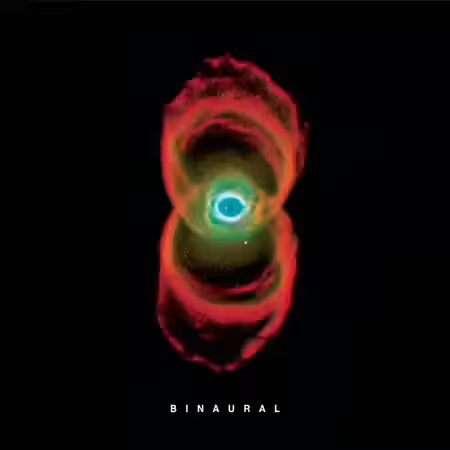
| Front cover (Hourglass Nebula) | R. Sahai, J. Trauger, WFPC2 science team, NASA | Hubble Space Telescope image of MyCn 18 |
| Inside cover (Helix Nebula) | K.P. Handron, R. O'Dell, NASA | |
| Booklet cover (Eagle Nebula) | J. Hester, P. Scowen, NASA | |
| NASA liaison | Liz Burns | |
The sleeve and the nebula
The artwork is, even now, one of the strangest sleeves in mainstream rock. The front of Binaural is a Hubble Space Telescope photograph of MyCn 18, the planetary nebula popularly known as the Hourglass Nebula. Two interlocking rings of orange gas surround a luminous central eye, the dying gasp of a star a few thousand light years away. The inside cover features the Helix Nebula. The booklet uses the Eagle Nebula. NASA gave Pearl Jam permission to use all three.
Ament has explained the choice as a scale gag at the band's expense. "One of the themes that we've been exploring," he told Vancouver radio station CFOX-FM in May 2000, "is just realising that in the big scheme of things, even the music that we make when we come together, no matter how powerful it is, it's still pretty minuscule." There are, he noted, thirteen light years across four inches of one of the booklet pictures. The album credits Vedder, under his alias Jerome Turner, with the concept.
Release and the charts
Epic released Binaural on 16 May 2000. It sold 226,000 copies in its first week in the United States and entered the Billboard 200 at number two, blocked from the top by Britney Spears's Oops!... I Did It Again, which had moved 1.3 million copies in its own debut week. It topped the charts in Australia and New Zealand, reached number two in Canada, Italy and Norway, and number five in the United Kingdom and the Netherlands. It was the band's first studio album not to be certified Platinum in the United States. It has sold around 850,000 copies stateside according to Nielsen SoundScan, and is certified Gold by the RIAA, Platinum by ARIA in Australia and Silver by the BPI in the United Kingdom.
Two singles were issued. Nothing as It Seems came out on 25 April 2000, three weeks before the album. It entered the Billboard Hot 100 at number 49 and climbed to number three on the Mainstream Rock chart, an unexpected showing for a five-and-a-half-minute upright-bass-led ballad. Light Years followed on 10 July, peaking at number 17 on Mainstream Rock and number 26 on Modern Rock; it stalled outside the Hot 100 entirely. There were no other singles, and no third video.
| Single | Released | Hot 100 | Mainstream Rock | Modern Rock | UK | B-sides |
|---|---|---|---|---|---|---|
| Nothing as It Seems | 25 April 2000 | 49 | 3 | 17 | 22 | Insignificance (live), Education (later released on Lost Dogs) |
| Light Years | 10 July 2000 | did not chart | 17 | 26 | 52 | Grievance (live), Soon Forget (live), all from Bellingham 10 May 2000 |
Reviews
The reviews were warmer than the band probably expected. Metacritic has the record at 69 across sixteen reviews, "generally favourable" by its scale. NME gave it nine out of ten and called it "a seething, furious album, a declamatory statement against cynicism and passivity and the simple injustices of everyday life." Stephen Thomas Erlewine at AllMusic awarded four stars and pronounced it "their finest album since Vitalogy." Time magazine's Christopher John Farley wrote that "Pearl Jam, rather quietly, is building a long-term career to rival the rock legends of the past."
Other reviews were colder. The Guardian gave it three stars and called Pearl Jam "dignified, musicianly, sincere and a teensy bit dull," with "Vedder's affecting vocal angst drown[ed] in a sea of pessimistic riffola." Q magazine, also at three stars, allowed only that "grunge may have died, but Pearl Jam it seems will never be slayed." The most-quoted review came from Jon Pareles in Rolling Stone, who awarded three and a half stars and described the record as "part of an extended conversation among the five band members and fans loyal enough to check in for Pearl Jam's latest musings on love, death and social responsibility."
"Apparently as tired of grunge as everyone except Creed fans, Pearl Jam delve elsewhere: jumpy post-punk and somber meditations, tightly wound folk rock and turbulent, neopsychedelic rockers that sound like they boiled out of jam sessions."
Jon Pareles, Rolling Stone, June 2000
Ament himself remains a sceptic.
"We look back and think we didn't put some of the best songs on it. I think there are some beautiful things that came out of it, but we're never going to remember that record as one of the greats."
Jeff Ament, The Standard, 2011
B-sides, outtakes and lost songs
The Binaural sessions left a long shadow on the official-bootleg shelf. Six songs recorded for the album were dropped from the final sequence and parked, eventually surfacing on the 2003 rarities collection Lost Dogs. They include:
- Sad (originally titled Letter to the Dead, which Ament called "a great pop song" but felt did not fit the record)
- Hitchhiker
- In the Moonlight
- Education (later issued as a B-side on the Nothing as It Seems CD single)
- Fatal (which Tchad Blake reportedly named as his own favourite from the entire sessions)
- Sweet Lew, an Ament composition about Kareem Abdul-Jabbar
Two further songs from around the sessions, Strangest Tribe and Drifting, appeared first on the band's 1999 fan-club Christmas single before turning up on Lost Dogs. Three instrumentals from the early sessions, Thunderclap, Foldback and Harmony, were used as score on the 2001 Touring Band 2000 DVD. The original track list submitted to Yahoo Music in late March 2000 was substantially different from the final running order: Letter to the Dead, Rival and Fatal were on it, Gods' Dice was not, and Education and In the Moonlight were both pencilled in for the album proper.
The tour and Roskilde
The tour started on 23 May 2000 in Lisbon. The European leg was twenty-six dates long. It ended on 30 June at the Roskilde Festival in Denmark, in front of an audience of fifty thousand on a wet evening, with Pearl Jam headlining the Orange Stage. Around the fourth song, the front of the crowd surged. Bodies went down. Vedder noticed within minutes that something was wrong and stopped the show. Nine fans were dead by the end of the night, suffocated underfoot. The dead were:
- Allan Tonnesen, 17, Denmark
- Frederik Pedersen, 19, Denmark
- Henrik Bondebjerg, 24, Denmark
- Carsten Nielsen, 17, Denmark
- Anthony Hurley, 24, Australia
- Jakob Svenson, 19, Sweden
- Sander Klous, 19, Netherlands
- Marc-Andre Theriault, 19, Canada
- Lars Berner Sorlie, 22, Norway
The band cancelled the next two European dates and flew home. They considered breaking up. They later said the only thing that pulled them back was committing, after a month off, to a North American tour that began in Virginia Beach on 3 August and ran until 6 November in Seattle. Vedder told the Seattle Post-Intelligencer that "playing, facing crowds, being together" on that tour was what "enabled us to start processing it." Roskilde shaped how Pearl Jam staged shows for the rest of their career: barriers, sightlines, the singer's eye on the front rows, and his readiness to halt a song mid-bar if anyone in those rows looked unsafe.
The tour also produced a logistical experiment that became a Pearl Jam trademark. Every show on the European and North American legs was professionally recorded and released in retail-grade packaging as an "Official Bootleg." Seventy-two of these live albums hit shops in 2000 and 2001. In the week of 7 March 2001, five of them entered the Billboard 200 simultaneously, breaking the band's own record for the most albums to debut on that chart in the same week. The series, designed to undercut the bootleg trade, became a model later copied by the Grateful Dead's heirs, the Allman Brothers, Phish and Bruce Springsteen.
Touring Band 2000, a DVD compiled from the North American leg, followed in 2001 and remains the canonical document of the era's live show.
Awards and aftermath
Grievance was nominated for Best Hard Rock Performance at the 43rd Grammy Awards, the album's only nomination. It lost. Binaural never made a year-end critics' top ten and is rarely placed at the front rank of the Pearl Jam catalogue when fans rank the records. It does, however, anchor the band's mid-period and is regularly cited in retrospective deep dives as the moment Pearl Jam stopped being a grunge act and started being whatever it is they have become since: a long-running, restless, slightly contrary American rock band content to play to the audience that comes back.
The band returned to Studio Litho for Riot Act in 2002, this time with O'Brien back in the chair as primary producer. They have performed Binaural as a complete album once, on 10 May 2016 at the Air Canada Centre in Toronto, where it formed the first set of the show. McCready stayed sober. Cameron stayed in the band until 2025. Vedder stopped having writer's block and has not stopped writing since.
Legacy
The reputation of Binaural has slowly improved. The fan base has spent twenty-five years arguing about which Pearl Jam record is the underrated one and the answer, in any given conversation, tends to be either No Code or this. Light Years has settled into the live setlist as one of the band's most-played songs of the post-1996 era. Nothing as It Seems is a fixture too. Soon Forget gets dusted off as an encore curio. The album's experimental impulse, particularly the binaural-microphone gimmick, has been picked up by the immersive-audio crowd: Binaural is one of the more obvious candidates for an Atmos remix that the band have so far declined to authorise. Tchad Blake's mixes still sound like a Tchad Blake record. Brendan O'Brien's mixes still sound like Pearl Jam.
Things you might not know
| Fact | Detail |
|---|---|
| Vedder's alias | The album credits Jerome Turner with concept and design. Jerome Turner is Eddie Vedder, a pseudonym he has used on Pearl Jam packaging since the early 1990s. |
| Light Years was Puzzles & Games | Mike McCready's original demo of the song was set aside as too close to Given to Fly. Vedder and McCready rewrote the entire arrangement in roughly thirty-five minutes of one late-night session. |
| The hidden typewriter | Sixty seconds of typewriter clatter sit inside the closing track Parting Ways from 6:49 onwards. Vedder titled the segment Writer's Block and used it to acknowledge the lyrical dry spell that nearly derailed the sessions. |
| The dog on Rival | The barks at the end of Rival are credited on the sleeve to "Dakota, canine vocal." Dakota was a real dog brought into Studio Litho during the session. |
| NASA on the cover | The Hourglass Nebula on the front, the Helix Nebula on the inside cover and the Eagle Nebula in the booklet are all real Hubble Space Telescope photographs licensed directly from NASA. |
| Pete Townshend gets a thank-you | Vedder thanks Pete Townshend on the Soon Forget lyric sheet because the song borrows so closely from the Who's Blue, Red and Grey that he later called it "thirty seconds of plagiarising." |
| Soundgarden in absentia | Binaural is the first Pearl Jam album with Matt Cameron, who had drummed in Soundgarden until that band's 1997 split and joined Pearl Jam in 1998 mid-Yield Tour to replace Jack Irons. |
| Sweet Lew, the Kareem song | One of the album's discarded outtakes, Sweet Lew, is a Jeff Ament song about basketball player Kareem Abdul-Jabbar. It was cut for not fitting the album and surfaced on Lost Dogs in 2003. |
| Tchad Blake's favourite was rejected | Producer Tchad Blake's favourite track from the sessions was Fatal, which the band cut from the final sequence. It eventually appeared on Lost Dogs. |
| Five live albums in one week | On 7 March 2001 Pearl Jam set a Billboard 200 record by debuting five different official-bootleg live albums on the chart at the same time, all drawn from the Binaural Tour. |
| Wendy Melvoin played percussion | Wendy Melvoin of Wendy & Lisa, formerly of Prince's Revolution, contributed percussion to the album, an unusual cameo on a Pearl Jam record. |
| Played whole, only once | Pearl Jam have performed Binaural in its entirety only once, at the Air Canada Centre in Toronto on 10 May 2016, as the first set of a longer show. |
Comments