Let It Bleed is the sound of the 1960s catching up with The Rolling Stones. Recording started in February 1969 with a fading founder member who could no longer hold a session together, and finished in November with a different guitarist, a producer pulling everyone back from the edge, and a body in a swimming pool at Cotchford Farm. The album landed in shops on 5 December 1969. The day before, Mick Jagger had stood on a stage at Altamont Speedway watching Hells Angels stab Meredith Hunter to death twenty feet from the microphone. Almost no other record in rock history is bracketed by a real-life set of bookends that grim.
The astonishing thing about Let It Bleed is that none of that disaster bleeds into the playing. The album sounds tighter, looser, drier and more confident than Beggars Banquet, the record it was meant to follow up. Jimmy Miller had stopped trying to make a Stones record sound like a Stones record and had started letting it sound like the room: an old church hall in Barnes with a Helios desk, a piano nobody had tuned in months, and Charlie Watts in the corner refusing, as always, to play a fill he did not absolutely need.
This is the record where Mick Taylor arrives, where Brian Jones leaves, where Keith Richards finally takes a lead vocal, where a gospel singer woken at midnight bursts a note and is left in the mix anyway, and where the London Bach Choir get themselves talked into singing the chorus of a song they later asked to be removed from. It is the bridge between Beggars Banquet and Sticky Fingers, and the moment the band stopped being a 1960s pop group with blues credentials and became the imperial-phase Rolling Stones the world spent the next decade trying to catch up with.
| Field | Detail |
|---|---|
| Artist | The Rolling Stones |
| Album | Let It Bleed |
| Release date | 5 December 1969 (UK), 29 November 1969 (US) |
| Label | Decca (UK) / London (US) |
| Producer | Jimmy Miller |
| Engineers | Glyn Johns, Bruce Botnick, Vic Smith, George Chkiantz |
| Studios | Olympic Studios, London; Elektra Sound Recorders, Los Angeles; Sunset Sound Studios, Los Angeles |
| Recorded | 16 February to 2 November 1969 |
| Genre | Rock, blues rock, country rock |
| Track count | 9 |
| Total runtime | 42:21 |
| UK Albums Chart peak | 1 (one week, December 1969) |
| Billboard 200 peak | 3 |
| Certifications | 2x Platinum (RIAA), Gold (BPI) |
| Singles | Honky Tonk Women / You Can't Always Get What You Want (July 1969, non-album A-side with album B-side) |
| Cover art | Robert Brownjohn (concept), Don McAllester (photo), cake by Delia Smith |
The end of Brian Jones, the arrival of Mick Taylor
By the time the band booked Olympic Studios for the first Let It Bleed session in February 1969, Brian Jones had become a problem nobody in the room knew how to solve. The drug bust at Redlands in 1967 and his own conviction the following year had gutted his work permit; he could no longer easily tour the United States, which the Stones had to do. The harder problem, though, was that Jones could no longer reliably play. Sessions for Beggars Banquet had already shown him drifting in and out of focus, picking up sitars and Mellotrons because a six-string was too much trouble. On Let It Bleed he managed almost nothing. He plays autoharp on You Got the Silver and shakes percussion on Midnight Rambler. That is the sum of his contribution to the record that bears his last credit.
On 8 June 1969 Jagger, Richards and Charlie Watts drove down to Jones's home at Cotchford Farm in Sussex, the house once owned by A. A. Milne, and told him he was no longer in The Rolling Stones. The cover story for the press was mutual; the truth was a sacking. Less than a month later, on 3 July, Jones was found at the bottom of his swimming pool. The coroner's verdict was death by misadventure. Two days later, on 5 July, the band played a free concert in Hyde Park that had been booked as Mick Taylor's debut and now became a memorial. Jagger read from Shelley's Adonais and released several thousand white butterflies into the London afternoon, most of which were already dead from the heat in their cardboard boxes. It was a Stones gesture: theatrical, slightly botched, unforgettable.
"Brian had become a passenger. We loved him, but you can't carry a man who won't even pick up the instrument. Mick Taylor walked in and within an hour you knew the band had a guitarist again."
Keith Richards, Life (Weidenfeld and Nicolson, 2010)
Mick Taylor was twenty years old, the lead guitarist of John Mayall's Bluesbreakers, and the cleanest blues player in England not called Eric Clapton. Jagger had asked Mayall for a recommendation; Mayall had said Taylor; Taylor was invited to Olympic in May 1969, told they were jamming, and discovered halfway through the night that he was auditioning. He plays slide on Country Honk and lead on Live with Me, the two tracks he was in the room for. Everything else on the album that needed a guitar, Keith Richards covered himself, often playing both rhythm and bass. The transitional nature of the record is hidden in plain sight on the credits sleeve: there are two guitarists in the band, neither of whom plays much of it.
Olympic, Elektra and Jimmy Miller
The Stones had begun working with Jimmy Miller on Beggars Banquet in 1968. Miller was a transplanted New Yorker who had produced Spencer Davis Group, the first two Traffic albums and Spooky Tooth's Spooky Two. He played drums himself, well, and could explain a groove to Charlie Watts in a way Andrew Loog Oldham never had. Miller's gift, as the late writer Robert Greenfield put it, was that he understood that a Stones record had to sound slightly broken to sound right.
The bulk of Let It Bleed was cut at Olympic Studios in Barnes, where the band had been working since A Saturday Club session in 1963. The desk was a custom Helios console designed by Dick Swettenham; the room was Studio One, the big tracking room, with a wood-and-stone live area that gave the Stones their characteristic mid-frequency punch. Glyn Johns engineered most of the album, with George Chkiantz, Vic Smith and Andy Johns on assistant duties. Bruce Botnick took over for the Los Angeles sessions at Elektra Sound Recorders on La Cienega Boulevard, where the band overdubbed the Gimme Shelter vocals and the Country Honk fiddle.
Miller's signature production tricks across the album are the same ones that defined Beggars Banquet:
- Acoustic guitars miked very close, often a Martin D-28 with a Neumann KM 84, panned hard so the strum sits as a percussion part rather than a chord pad.
- Charlie Watts's drums recorded dry, with a Shure SM57 on the snare and an AKG D19 above the kit, almost no room ambience added at the desk.
- Keith Richards's open-G tuning on a five-string Telecaster, which arrived properly on Honky Tonk Women and would dominate the band's recorded sound from this point onwards.
- A willingness to leave Miller's own drum and percussion takes in the mix when Watts was unavailable. Miller plays the cowbell and woodblock that drive Honky Tonk Women, the maraca on You Got the Silver and the drums on You Can't Always Get What You Want.
The sessions ran from 16 February 1969 to 2 November 1969, with breaks for the Hyde Park concert, the American tour and Brian Jones's funeral. The budget has never been published. Miller's fee was a flat producer's advance plus points; he later said he never saw most of the points. Engineer Glyn Johns described the atmosphere in his memoir Sound Man as professional, focused and almost domestic. The mythology of Stones sessions as drug-fuelled psychodrama belongs more to the Exile on Main St. period than to Let It Bleed. This was a working record made by a band that knew it was running out of room for error.
"Jimmy was the best drummer in the room when Charlie wasn't there, and the second best when Charlie was. He had a feel for the back of the beat that locked everything in. He produced Let It Bleed by playing on it."
Bill Wyman, Stone Alone (Viking, 1990)
Personnel and credits
| Role | Player | Notes |
|---|---|---|
| The Rolling Stones | ||
| Lead vocals, harmonica, percussion | Mick Jagger | Acoustic guitar on You Got the Silver and Country Honk |
| Guitars, bass, backing and lead vocal | Keith Richards | Lead vocal on You Got the Silver, bass on Live with Me, Monkey Man, Let It Bleed and Country Honk |
| Drums, percussion | Charlie Watts | Absent from Honky Tonk Women and You Can't Always Get What You Want |
| Bass, autoharp, vibraphone | Bill Wyman | Vibes on Monkey Man |
| Slide guitar, lead guitar | Mick Taylor | Country Honk and Live with Me only |
| Autoharp, percussion | Brian Jones | You Got the Silver and Midnight Rambler only; sacked June 1969, died 3 July 1969 |
| Guest musicians | ||
| Backing vocal | Merry Clayton | Gimme Shelter |
| Choir | The London Bach Choir | You Can't Always Get What You Want intro, conducted by Jack Nitzsche |
| French horn | Al Kooper | You Can't Always Get What You Want; also organ and piano on the same track |
| Slide guitar, mandolin | Ry Cooder | Love in Vain (mandolin) |
| Fiddle | Byron Berline | Country Honk, recorded on a Hollywood pavement to capture traffic |
| Saxophone | Bobby Keys | Live with Me |
| Tenor saxophone | Jim Price | Live with Me |
| Piano | Nicky Hopkins | Monkey Man, You Can't Always Get What You Want, Live with Me, Let It Bleed |
| Piano, organ | Ian Stewart | Honorary sixth Stone; piano on the title track |
| Backing vocal | Madeline Bell, Doris Troy, Nanette Newman | You Can't Always Get What You Want |
| Production | ||
| Producer | Jimmy Miller | Drums and percussion on several tracks |
| Engineer | Glyn Johns | Olympic Studios sessions |
| Engineer (Los Angeles) | Bruce Botnick | Elektra Sound Recorders |
| Assistant engineers | George Chkiantz, Vic Smith, Andy Johns | Olympic |
| Choir conductor, arranger | Jack Nitzsche | French horn arrangement and London Bach Choir on You Can't Always Get What You Want |
| Artwork | ||
| Cover concept | Robert Brownjohn | Designer who had also done Goldfinger title sequence |
| Cover photograph | Don McAllester | Studio shot of the assembled sculpture |
| Cake | Delia Smith | Then a 28-year-old jobbing food stylist for hire |
The songs
Side one
Gimme Shelter. Keith Richards wrote the riff alone in his flat at 3 Cheyne Walk during a London thunderstorm in early 1969, watching Anita Pallenberg leave for the set of Performance, the film whose love scenes with Mick Jagger he was already convinced were not entirely acted. Anger, weather and jealousy braided into the same descending arpeggio. The intro on the record is a Maton EG240 Supreme, a cheap Australian electric Richards happened to own; he later said the guitar fell to pieces during the take and was thrown across the studio in disgust.
The vocal that defines the song was an emergency. Bonnie Bramlett had been the band's first choice and was unavailable. Producer Jack Nitzsche phoned Merry Clayton, a 21-year-old gospel singer married to saxophonist Curtis Amy, around midnight Los Angeles time. Clayton was pregnant and asleep. She arrived at Elektra in curlers and a fur coat over her pyjamas, sang three takes, and was paid scale. The break in her voice on the second "murder" of the third take is the take that made the record. Clayton miscarried that night. For decades she said the album cost her a child. In a 2013 Vanity Fair interview she said the song had also given her one: a career.
"They wanted me to sing it harder, sing it harder. I sang it so hard I lost my baby. But that's the song people remember me for. So I made my peace with it."
Merry Clayton, Vanity Fair (October 2013)
Love in Vain. A Robert Johnson song from 1937, originally Love in Vain Blues, here credited on first pressings to Trad. Arr. Jagger/Richards because Decca's lawyers had not yet worked out who actually owned the publishing. Subsequent pressings credit Robert Johnson once Eric Clapton's lawyers had pointed out his estate existed. Ry Cooder plays the mandolin. Mick Taylor is not on it; the slide is Keith Richards in open-G, his earliest recorded use of the tuning that defined the next decade.
Country Honk. The acoustic original of Honky Tonk Women, recorded in Los Angeles with Byron Berline's fiddle taped on the pavement outside Elektra to capture passing traffic. The car horn is real; an engineer drove past at the right moment. The single version, with electric guitars, Charlie Watts joined by Jimmy Miller on cowbell, and a different second verse, was a non-album A-side released in July 1969. Country Honk is what the song was when it was written in Brazil in late 1968. Honky Tonk Women is what it became after Mick Taylor walked into the studio.
Live with Me. The first track on the album to feature Mick Taylor playing lead guitar and the only track on the album where he properly plays it. Bobby Keys, the Texan saxophonist who had grown up next door to Buddy Holly, plays the solo. Keith Richards plays bass, looser than Wyman's normally would be, sliding into the chord changes a beat late in a way Wyman himself never did.
Let It Bleed. A barrelhouse blues with Ian Stewart on piano, a slide guitar that sounds like Ry Cooder and is in fact Keith Richards, and a lyric about cocaine, knife wounds and parasitism delivered in the voice of a man enjoying all three. Stewart, the original Stones pianist who had been demoted from the official line-up by Andrew Loog Oldham in 1963 because his face was too square, plays on this song and on three others. He never asked for a credit and never got one for years.
Side two
Midnight Rambler. Written by Jagger and Richards on holiday in Positano in early 1969, partly inspired by the Boston Strangler trial. Eleven minutes long in Stones live sets by 1972, six and three quarters here. The studio take is a single performance with no edit, a near-impossibility for a Stones track of the period. The harmonica is Jagger; the lead guitar is Richards; the percussion is Brian Jones, his last contribution to the band before being sacked. Jones can be heard on tambourine in the right channel of the second movement, the slow blues, the part where Jagger growls about pulling out the knife.
You Got the Silver. Keith Richards's first solo lead vocal on a Rolling Stones record. Brian Jones plays autoharp, the only audible instrument he contributed to the album. The song is an unironic country-soul ballad written for Anita Pallenberg, performed in a voice that is entirely unguarded. Richards has said he was terrified during the take; you can hear the catch in his throat on the second verse. The track was originally going to feature Mick Jagger; Jagger's vocal was wiped after Richards delivered his.
Monkey Man. Bill Wyman's vibraphone intro, Nicky Hopkins's tumbling piano, and a Keith Richards riff that sits halfway between rock and nursery rhyme. The lyric is one of the few Jagger admissions, in code, of how much fun heroin was. Used twenty-five years later by Martin Scorsese to soundtrack the smash cut to "Layla" in Goodfellas; the Stones would not let him use Gimme Shelter twice in the same film, so they kept Monkey Man for the basement scene with the bodies in the trunks.
You Can't Always Get What You Want. The closing track and the album's defining argument with itself. Jack Nitzsche persuaded the London Bach Choir to come to Olympic on 16 November 1969 and sing the chorus, conducted by Nitzsche over a click that Al Kooper had played on French horn. The choir's secretary later wrote to Decca asking for the choir's name to be removed from the credits because the lyric was deemed unsuitable; Decca declined. Charlie Watts could not lock into the song's shuffle, so Jimmy Miller took over the kit. Al Kooper plays organ, piano and the French horn intro. The drug references in the second verse, "Mr Jimmy" being Jimmy Miller, locate the song precisely in the room it was made in.
Tracklist
| # | Title | Writer(s) | Length | Notes |
|---|---|---|---|---|
| 1 | Gimme Shelter | Jagger / Richards | 4:31 | Merry Clayton co-vocal |
| 2 | Love in Vain | Robert Johnson, arr. Jagger / Richards | 4:19 | Originally credited Trad. Arr. |
| 3 | Country Honk | Jagger / Richards | 3:09 | Acoustic original of Honky Tonk Women |
| 4 | Live with Me | Jagger / Richards | 3:33 | Bobby Keys saxophone solo |
| 5 | Let It Bleed | Jagger / Richards | 5:26 | Ian Stewart on piano |
| 6 | Midnight Rambler | Jagger / Richards | 6:52 | Single take, no edit |
| 7 | You Got the Silver | Jagger / Richards | 2:51 | Keith Richards's first lead vocal |
| 8 | Monkey Man | Jagger / Richards | 4:12 | Vibraphone intro by Bill Wyman |
| 9 | You Can't Always Get What You Want | Jagger / Richards | 7:28 | London Bach Choir, Al Kooper, Jimmy Miller on drums |
Singles, B-sides and the cover
Decca's UK singles strategy for The Rolling Stones in 1969 was, by long-standing Stones policy, to release no track from the album as an A-side. The big single of the campaign was Honky Tonk Women, a non-album song co-produced from the Country Honk template, released on 4 July 1969 with You Can't Always Get What You Want as the B-side. It hit number one in the United Kingdom on 23 July, spent five weeks there, and reached number one in the United States in late August. The B-side was edited down by ninety seconds for the seven-inch and is the version most American radio stations played. Album buyers in December got the full version with the choir intact.
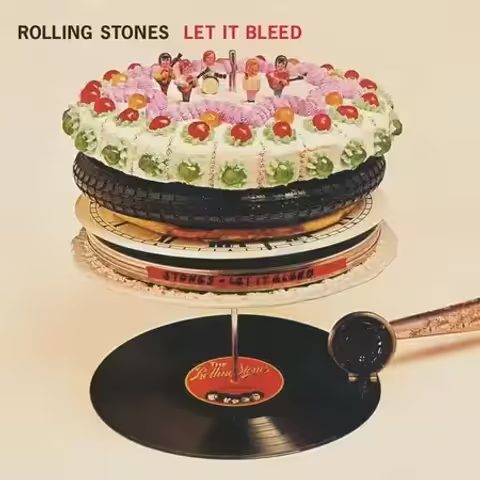
The album cover is one of the most physical pieces of design in the rock canon. Robert Brownjohn, who had cut his teeth on the title sequences of From Russia with Love and Goldfinger, was hired by manager Allen Klein in late summer 1969. The brief was the album's working title, Automatic Changer. Brownjohn built a literal record-changer spindle and stacked objects on it, each one referring obliquely to a song: a record, a film canister, a clock face, a pizza, a tyre, and a cake decorated with the band members in figurine. The cake was made by Delia Smith, then a 28-year-old food stylist who had not yet published a cookbook. The photographer was Don McAllester, who shot the sculpture in a London studio in October 1969. Brownjohn collapsed and died of a heart attack in 1970, aged 44; Let It Bleed is among his last finished works.
"Robert wanted the cover to look like the album felt: ridiculous, indulgent, slightly rotten, and utterly delicious. The cake was the joke. The tyre was the threat."
Designer Mark Boxer, recalling Brownjohn for The Sunday Times Magazine (1979)
The back cover shows the same sculpture after being smashed, the cake half-eaten, the figurines toppled, the tyre off. It was Brownjohn's idea to photograph both states; the band paid the studio for an extra day to do it. The gatefold inner sleeve carries the lyrics, a Stones first, set in a Letraset font that Brownjohn picked out the night before deadline.
Release, charts and reception
Let It Bleed was released on 28 November 1969 in the United States by London Records and 5 December 1969 in the United Kingdom by Decca, with the Hyde Park memorial and the American tour both already in the rear-view mirror. It went straight to number one in the UK Albums Chart on 13 December 1969, briefly ending the eight-week reign of Abbey Road, before being knocked off the top by the same Beatles record on 27 December. In the United States it peaked at number three on the Billboard 200, blocked by Abbey Road and Led Zeppelin II. Both UK and US chart runs lasted into the spring of 1970; combined initial sales topped half a million by the end of the first quarter.
| Territory | Peak | Weeks on chart | Certification |
|---|---|---|---|
| UK Albums Chart | 1 | 29 | Gold (BPI) |
| US Billboard 200 | 3 | 61 | 2x Platinum (RIAA, certified retroactively in 1986) |
| Australia (Kent Music Report) | 1 | 22 | |
| Canada (RPM) | 2 | 19 | Gold (Music Canada) |
| West Germany | 5 | 17 | |
| France | 3 | 23 | |
| Netherlands | 1 | 15 |
The reviews at release were unusually warm by Stones standards. Greil Marcus, writing in Rolling Stone in February 1970, called the album the band's best work and said You Can't Always Get What You Want was "the closest thing to a hymn this band has ever recorded, and they recorded it with a choir, which suggests they were aware of the fact." Lester Bangs, then writing for Creem, was almost the only dissenter, complaining that the album was a retreat from the militancy of Beggars Banquet. Bangs later changed his mind in print.
"This is murder music, but it is also gospel music, and it is the only rock and roll record I know that sounds like the apocalypse already happened and the survivors decided to throw a party in the ruins."
Greil Marcus, Rolling Stone (7 February 1970)
Retrospective placements have been remarkably consistent. Rolling Stone's revised 500 Greatest Albums of All Time has placed Let It Bleed within the top forty in every iteration since 2003, ranking it 32 in 2020. The NME placed it 17 in its 2013 list. MOJO has had it in its top fifty rock albums every time it has run that list. The album was inducted into the Grammy Hall of Fame in 1998.
Touring and Altamont
The 1969 American Tour ran from 7 November 1969 at the Forum in Los Angeles to 30 November in West Palm Beach, Florida, with 23 shows in eighteen cities. Mick Taylor was the new guitarist; Ian Stewart was on piano; Bobby Keys joined on saxophone for the Madison Square Garden run. The tour was filmed by Albert and David Maysles for the documentary that became Gimme Shelter (1970), which is also a film about the album it was named after. The footage of Mick Jagger listening back to the song in Muscle Shoals while overdubbing Wild Horses, midway through the tour, is one of the most-cited scenes in concert documentary history.
The tour ended at Altamont Speedway in northern California on 6 December 1969, the day after the album was released in the UK. The free concert had been organised in two weeks; the Hells Angels chapter of San Francisco was paid in beer to handle stage security; Meredith Hunter, an 18-year-old African American man, drew a revolver during the band's performance of Under My Thumb and was stabbed five times by Angel Alan Passaro, who was later acquitted of murder on grounds of self-defence. Three other people died at the concert that day, two from a hit-and-run, one from drowning. The Maysles brothers caught the stabbing on film. Jagger watched the playback of his own footage at the editing suite the following month, said "It's so horrible," and stood up and left the room. The Stones never played Sympathy for the Devil live again until 1975.
In film, TV and culture
Songs from Let It Bleed have been used in dozens of films, but the placements are unusually consistent in a way most catalogues are not. The big four sync placements are:
- Gimme Shelter, used by Martin Scorsese in Goodfellas (1990), Casino (1995) and The Departed (2006). Scorsese has said in interviews he chooses it whenever a scene needs to be about America going wrong.
- You Can't Always Get What You Want, used in The Big Chill (1983) over the funeral of a friend, and in House M.D. as the opening title for several seasons.
- Monkey Man, used in Goodfellas (1990) over the basement scene with the bodies in the trunks of the cars.
- Midnight Rambler, used in Phantom Thread (2017) and in the 2007 Todd Haynes Bob Dylan film I'm Not There.
Gimme Shelter was used as the opening cue for the 2006 Adam Curtis BBC documentary The Trap. The British Conservative Party tried to license You Can't Always Get What You Want for the 2017 election; the band's publishing company refused. Donald Trump used the song without permission at his 2016 rallies, including the night of his nomination at the Republican National Convention; the band issued a cease and desist, which Trump ignored, and have continued to do so at every campaign since.
Reissues, anniversaries and bootlegs
Let It Bleed has been reissued on every format the music industry has invented since 1970. The 1986 Columbia Records CD remaster, supervised by Bob Ludwig, replaced the muddy original Decca CD. ABKCO's 2002 SACD/CD hybrid, mastered from the original analogue tapes by Bob Ludwig and Bernie Grundman, is the first version most listeners under fifty have heard, and is the basis for every streaming master since. The 2019 fiftieth anniversary box set added a mono LP pressing, a hardback book of session photography by Ethan Russell, and a seven-inch of the Honky Tonk Women single in its original UK Decca sleeve. Crucially the box did not include unreleased takes; ABKCO's policy under Allen Klein and his estate has been to keep the Stones outtake archive locked.
The bootleg market has filled the gap. The Track Talk session reels from Olympic, recorded by an assistant engineer onto a domestic Revox in 1969 and circulated since the early 1980s, contain alternative vocal takes of Gimme Shelter and a slow, almost gospel arrangement of You Can't Always Get What You Want with Jagger on piano. Whether they are genuine or, as Bill Wyman has argued, fakes assembled from soundcheck reels, has never been settled.
Legacy and influence
The trio of Beggars Banquet, Let It Bleed and Sticky Fingers are the records that turn The Rolling Stones from a 1960s singles act into the 1970s album band almost every other rock group spent the next two decades imitating. The open-G five-string Telecaster sound that Keith Richards finalised on these sessions is the rhythm guitar of every Faces, Black Crowes and Primal Scream record made since. The Jimmy Miller approach to drums, where the producer plays them as often as the drummer does, is the unspoken template for the Stones' own Sticky Fingers and Exile on Main St., for Traffic's John Barleycorn Must Die, for Spooky Tooth, and for everything Don Was has produced since 1989.
The album also inaugurates the imperial-phase Rolling Stones in narrower commercial terms. Every Stones record from Sticky Fingers to Tattoo You went either to number one or number two on both sides of the Atlantic. Let It Bleed is the album where the band figured out how to do that. Its songs are the foundation of every Stones live set since 1969: Gimme Shelter has opened the band's shows almost continuously since the 1989 Steel Wheels tour, and You Can't Always Get What You Want has closed at least one show on every tour since 1972.
The dedication on the inside gatefold reads "for Brian." It was added at Mick Jagger's insistence at the last minute, after the cover was already at the printers, and a separate insert was printed for it. Most copies in the wild today still carry the slip.
Things you might not know
| Fact | Detail |
|---|---|
| The cake on the cover | Was baked by Delia Smith, who at the time was a 28-year-old jobbing food stylist; she had not yet published her first cookbook and would not become a household name in the UK until BBC One's Family Fare in 1973. |
| The choir wanted out | The London Bach Choir's secretary wrote to Decca asking the choir's name to be removed from the credits of You Can't Always Get What You Want; the request was politely declined. |
| Country Honk's car horn | Is the engineer Bruce Botnick driving past the open studio door at Elektra Sound Recorders in Los Angeles, captured deliberately on the same take as Byron Berline's fiddle, which had been miked outside on the pavement. |
| Merry Clayton's fee | Was American Federation of Musicians scale plus double-time for the after-midnight call: roughly $60 for the session that produced one of the most-cited backing vocals in rock history. |
| The working title | Was Automatic Changer; Brownjohn's cover sculpture is built around a real record-changer spindle that the title refers to. The band changed the album title late in the process to match the song they thought was strongest. |
| Honky Tonk Women started in Brazil | Jagger and Richards wrote the original acoustic version, the one that became Country Honk, on a December 1968 holiday at a ranch in Mato Grosso. The electric arrangement was Mick Taylor's first contribution to the band, in May 1969. |
| Brian Jones is on two tracks | Autoharp on You Got the Silver and percussion on Midnight Rambler. He plays no guitar on the album that bears his last credit. |
| Robert Johnson got his credit late | First UK pressings credit Love in Vain to Trad. Arr. Jagger / Richards. Subsequent pressings, after Eric Clapton's lawyers pointed out that the Robert Johnson estate existed, credit Johnson directly. |
| Keith plays bass on most of it | Bill Wyman is the credited bassist but Richards plays bass on Live with Me, Monkey Man, Let It Bleed and Country Honk. Wyman plays vibraphone on Monkey Man and autoharp on You Got the Silver. |
| Charlie Watts isn't on two tracks | The drumming on You Can't Always Get What You Want is Jimmy Miller, who also plays drums and percussion on Honky Tonk Women. Watts could not lock into the shuffle. |
| The dedication was a last-minute insert | "This album is dedicated to the memory of our beloved friend Brian Jones" was added at Jagger's insistence after the gatefold had already been printed; a separate slip was inserted into the sleeve at the binders. |
| Mick Taylor only plays two tracks | Country Honk and Live with Me. Everything else that needed lead guitar, Keith Richards covered himself, often double-tracked. |
Closing
Let It Bleed is the Stones record where the band stopped being a 1960s pop group and became something darker, leaner and more durable. It was made by a fading founder member, a producer who played drums when the drummer could not, a 21-year-old gospel singer who lost a child the night she sang for them, a choir that asked for its name to be taken off, and a guitarist on his way in who plays on two tracks. The result is the bleakest party record of 1969, recorded in a year that ended at Altamont and a decade that ended a month later. It still sounds like that.
Comments