By June 1980, Rush had finished a ten-month tour for Permanent Waves, banked their first profit as a band, and quietly cancelled the live album their label had penciled in for autumn. Cliff Burnstein, the Mercury A&R man who had signed them, had pulled Geddy Lee aside in New York and suggested they ignore the schedule, ignore the plan to make another double-live record, and go straight back into a studio while the new sound they had stumbled onto was still warm.
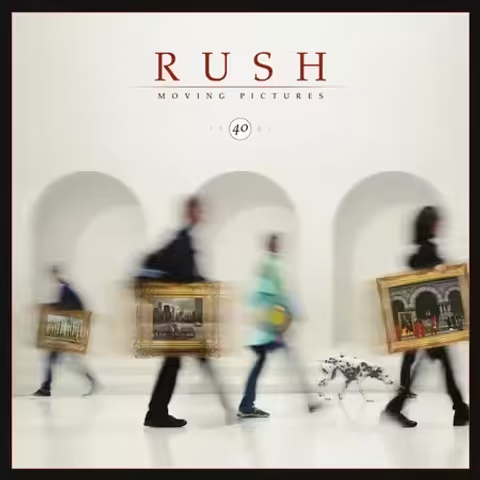
They listened. The result, recorded over six weeks at Le Studio in the Laurentian Mountains in late 1980 and released on 12 February 1981, was Moving Pictures. Seven songs, forty minutes, a Fender Jazz Bass that Geddy Lee was using for the first time, an instrumental named after an airport, a vigilante mob taped on a frozen Quebec driveway, and a cover image that puns on its own title three times over. Forty-five years later it is still the best-selling album in Rush's catalogue, and the record almost every other progressive rock band of the eighties spent the rest of the decade trying to answer.
| Field | Detail |
|---|---|
| Artist | Rush |
| Album | Moving Pictures |
| Release date | 12 February 1981 |
| Label | Anthem (Canada) / Mercury (rest of world) |
| Producers | Rush and Terry Brown |
| Studio | Le Studio, Morin-Heights, Quebec |
| Recording dates | October to November 1980 |
| Engineer | Paul Northfield (assistant: Robbie Whelan) |
| Mastering | Bob Ludwig; digital mastering by Peter Jensen |
| Genre | Progressive rock, hard rock |
| Track count | 7 |
| Total runtime | 40:03 |
| US Billboard 200 peak | 3 |
| UK Albums Chart peak | 3 |
| Canada Top Albums peak | 1 |
| Certifications | 5x Platinum (US), 4x Platinum (Canada), Gold (UK) |
| Singles | Limelight, Vital Signs, Tom Sawyer |
Where Rush stood in 1980
The five years between 2112 and Permanent Waves had transformed Rush from a band that nearly got dropped by Mercury into a band their label was begging not to take a year off. 2112 in 1976 had been the album the label expected to be their last; instead it went gold and, eventually, triple platinum. A Farewell to Kings and Hemispheres followed it, both ambitious, both full of long suite-form pieces, both increasingly difficult for the trio to actually play live. By 1979 Lee, Lifeson and Peart had decided that the next record would compress those instincts rather than spread them out.
Permanent Waves, released in January 1980, was the result. The Spirit of Radio and Freewill were on the radio inside a fortnight, the album went top five in three countries, and the tour that followed was the first in their career to actually make the band money rather than break even on equipment. They were ready to coast on a live album. Burnstein talked them out of it.
"We were scheduled to do this big live album after Permanent Waves, and at the last minute we said, 'You know what? Fuck this, we're not going to do a live album. We're going to go back into the studio and do our next album.' And that's how Moving Pictures came to be. And it turned out to be the most important decision of our careers. Or the second most important decision, the first one being 2112, because without 2112 there would be no Rush."
Alex Lifeson, Prog magazine, 2023
Writing in a barn at Stoney Lake
The summer of 1980 was spent in a converted wooden barn on Ronnie Hawkins's estate at Stoney Lake, in Peterborough County in central Ontario. The Hawkins property sat on the edge of a glassy lake fringed by fir trees; the band's writing sessions ran from late morning into the orange light of August evenings. They were broken up, by Geddy Lee's recollection, mostly by Alex Lifeson's relentless model aeroplane hobby and by Terry Brown's attempts to compete with him.
Brown, the band's co-producer since Fly by Night in 1975, was running a tethered aeroplane on lines that flew in tight, accelerating circles around him while Lifeson laughed in the grass and Lee hit the deck to avoid the propellor. Peart, the third corner of the writing triangle, tended to be off in another part of the estate with a notebook, scratching at lyric ideas while Lee and Lifeson tried out riffs on a tape machine that was never switched off.
The always-on tape was a deliberate decision. Lifeson played impulsively and forgot what he had played within seconds; Lee had finally stopped trying to ask him to repeat anything and instead let the reels run while they jammed.
"Al would play some amazing thing and I would say, 'Holy shit, that was so great! Can you play it again?' And he'd go, 'Huh? No.' I just sort of impulsively play that way and it just keeps moving forward."
Geddy Lee and Alex Lifeson, Prog magazine, 2023
One afternoon Lee turned on the tape, heard Lifeson stumble through a half-formed phrase, and rewound the reel until he found it again. The phrase was the opening riff of Limelight, intact, polished and bright. The Camera Eye was the first song the band built into a rough shape that summer, followed by Tom Sawyer, Red Barchetta, the not-yet-named instrumental that became YYZ, and Limelight. By late August they had returned to Phase One Studios in Toronto with Brown and were cutting full-band demos. In September they took the new material onto a sixteen-show warm-up tour of the United States, played Tom Sawyer and Limelight live for the first time, and then drove north to Le Studio.
The Pye Dubois poem that became Tom Sawyer
Tom Sawyer arrived from a side door. Earlier that summer, before Stoney Lake, Rush had spent two days at Phase One playing on Battle Scar, a track for Max Webster's Universal Juveniles. Pye Dubois, Max Webster's lyricist, brought a poem along to the session that he thought was no use to Max Webster but might suit Rush. Peart took it, kept the central idea of a modern-day Tom Sawyer who refuses to be flattered or pushed, and rebuilt the words around it. The lyric is the only one on Moving Pictures that does not credit Peart alone.
The song was supposed to be a quick win once they got to Le Studio. It almost broke the record.
"When we were working on Tom Sawyer, actually for the longest time, it was the worst song on the record. We had more trouble with that song than almost any other song. I had real doubt about whether the song was working at all."
Geddy Lee, Prog magazine, 2023
Lee could not get a bass tone he liked. He had used a Rickenbacker 4001 on every Rush record up to that point; on Tom Sawyer it sat dull in the track no matter what he tried. He finally reached for a 1972 Fender Jazz Bass that had been knocking around the studio, and the bottom end of the song fell into place. The Jazz would become his main studio bass from Counterparts in 1993 onwards. The guitar solo, too, had to be rescued: engineer Paul Northfield rigged stereo speakers and miked them in a wide spread, which gave Lifeson's solo the tubular, panning quality that became its signature. Even at the mix stage, the studio's brand-new SSL desk was throwing electronic glitches at them and the band had to operate the faders by hand, each member taking a section of the console because nobody trusted the computer.
Le Studio and a leap to 48 tracks
Le Studio was already familiar territory by autumn 1980. Rush had cut Permanent Waves there and would record seven albums in the place between 1980 and 1993, when sessions for Counterparts finally drew to a close. The complex sat on the shore of Lac Perry in the Laurentians, with floor-to-ceiling picture windows that looked straight out over the lake; in summer the band ate barbecue on a volleyball court and went out on the water in a paddle boat, in winter they snowshoed and skied between sessions, and there was a French chef on site for the duration.
"Le Studio was a revelation in the way we worked as a band. It was such a charming spot. All of a sudden, we're in this really beautiful studio room and it has these giant picture windows and this insane view. The lake, the mountains, and you're banging away at Freewill, or whatever it might be."
Geddy Lee, Prog magazine, 2023
Three things made the recording technically different from anything Rush had done before. The first was the move to 48-track recording. Brown and the band would lay basic tracks for drums and bass onto one 24-track reel, transfer a stereo mix of those basics to a second 24-track reel, then overdub everything else on the second reel. The original backing tape went into storage and never got played again until mixdown, which kept the masters from degrading.
The second was a pressure zone microphone, a kind of boundary mic that picks up direct sound but rejects reverb, taped to Neil Peart's chest while he played the kit. The signal captured the ambient hum of the room around him and was folded into the final mix; Peart can be seen wearing the mic in the Vital Signs music video. The third was the mixdown itself, which was committed not to analogue tape but to a Sony digital mastering machine, an unusually early use of digital recording for a major rock album. The Sony unit broke down enough times to delay the album by two weeks; Brown took it in stride.
"It's to be expected when you're pushing the latest gear to its limits."
Terry Brown, Loudersound, 2023
The notable signal-chain pieces, drawn from the album's contemporary press and from Lee and Lifeson's later interviews:
- Geddy Lee: Rickenbacker 4001 on most tracks; 1972 Fender Jazz Bass on Tom Sawyer; Moog Taurus bass pedals; Oberheim OB-X synthesiser, principally for the sequencer riff on Vital Signs.
- Alex Lifeson: Gibson ES-355 and Hiwatt amplifiers, with chorus and short delay on the cleaner parts; an early Roland guitar synthesiser on Tom Sawyer's instrumental break.
- Neil Peart: Tama Artstar kit with Avedis Zildjian cymbals, glockenspiel, orchestra bells, timbales, gong, wind chimes, bell tree, crotales, cowbell and, credited on the sleeve, plywood.
- Front of house: a brand-new SSL 4000 desk that suffered grounding faults as the building's earth shifted with the winter freeze.
Personnel and credits
| Role | Player | Notes |
|---|---|---|
| Rush | ||
| Bass, vocals, keyboards, bass pedals | Geddy Lee | Fender Jazz on Tom Sawyer; Rickenbacker 4001 elsewhere; Oberheim OB-X. |
| Electric and acoustic guitars, bass pedals | Alex Lifeson | Six- and twelve-string electrics, acoustic on Red Barchetta and Limelight intro. |
| Drums, percussion | Neil Peart | Drums, timbales, gong, orchestra bells, glockenspiel, wind chimes, bell tree, crotales, cowbell, plywood. |
| Additional musicians | ||
| Synthesiser on Witch Hunt | Hugh Syme | The cover designer wrote and played the song's main synth motif. |
| Production and engineering | ||
| Production, arrangements | Rush, Terry Brown | Brown's seventh consecutive Rush album. |
| Engineering | Paul Northfield | Devised the stereo-speaker mic setup that gave Tom Sawyer's solo its tubular sound. |
| Assistant engineer | Robbie Whelan | Le Studio's house assistant. |
| Digital mastering and editing | Peter Jensen | Worked the troubled Sony digital mastering unit. |
| Mastering | Bob Ludwig | Cut the lacquers at Masterdisk in New York. |
| Artwork | ||
| Art direction, cover concept, graphics | Hugh Syme | Cost approximately 9,500 dollars; Anthem refused to cover the full bill. |
| Photography | Deborah Samuel | Also appears on the front sleeve as the Joan of Arc figure. |
The songs, side one
Tom Sawyer
The first song heard, the one that nearly did not make the album, and the one that became Rush's most recognisable opening fanfare. The verses sit on a four-on-the-floor backbeat in 4/4; the instrumental break and the closing run shift into 7/8 without breaking stride. The instrumental section grew out of an idea Lee had been playing on his synthesiser at soundchecks for months and had nearly forgotten about; Peart pulled it back into the writing room and the band built the middle of the song around it. Tom Sawyer was used, of all things, as the theme music for the Brazilian dub of the spy series MacGyver in the eighties, which is why Rush were unaccountably enormous in Sao Paulo when they finally toured South America.
Red Barchetta
Peart's lyric is a near-direct adaptation of Richard S. Foster's short story A Nice Morning Drive, published in Road & Track in November 1973. The narrator visits his uncle's farm and takes a Ferrari 166 MM Barchetta, hidden away from the authorities, on an illegal high-speed run, pursued by hovering "alloy air-cars". Foster wrote the story as a satirical objection to American crash-safety regulation; Peart heard a small dystopia. He and Foster finally met in 2007 over a shared interest in BMW motorcycles. The arrangement is one of the most subtle on the record: Lifeson opens with chiming harmonics on an acoustic, Lee's bass line wanders the verses, and the chorus opens up only when Peart turns the beat around.
YYZ
Named for the IATA code of Toronto Pearson International Airport. The introductory pulse, which Lee plays on bass and Peart shadows on cowbell and toms, is the letters Y-Y-Z in Morse code. The story Lifeson tells is that Lee was flying back to Toronto in a friend's small plane during a writing break, and as the plane lined up on Pearson the navigation beacon was clicking out that same dot-dash pattern in his headphones. Peart suggested they use it as the song's opening; the rest of the instrumental was assembled in the barn at Stoney Lake from a riff Lee had been jamming and a quieter middle section he could fill in on keys. It earned the band their first Grammy nomination, for Best Rock Instrumental Performance, and is generally regarded as the most-imitated bass exercise in progressive rock.
Limelight
Peart's most directly autobiographical lyric. He had spent the Permanent Waves tour realising he disliked the social cost of fame in a way the other two did not, and he had begun retreating from fans at venues. The chorus self-quotes: "Living in a fish-eye lens, caught in the camera eye" points to the next song on the record, while "All the world's indeed a stage, and we are merely players" rewrites the line from As You Like It that had given Rush's first live album its title. Lifeson's solo, played over a brisk 7/8 figure, is regularly cited as the best of his career; he records solos in five takes or fewer and lets the band edit between them.
The songs, side two
The Camera Eye
At eleven minutes, The Camera Eye is the last track over ten minutes Rush ever included on a studio album. It is split unofficially into a New York City half and a London half; Peart had taken long walks in both cities, written prose impressions of each, then reshaped them into lyrics. The title is borrowed from short interstitial sections in John Dos Passos's U.S.A. trilogy. The opening crowd-noise montage includes a snippet of dialogue from Richard Donner's 1978 Superman, which the band had been watching at the studio; Lee remembers little about how the song came together but vividly recalls layering the soundtrack collage at the start and end.
"It needed a different approach to, say, something like Limelight, which was a much more obvious beast: verse, chorus, verse, chorus. That all bleeds into our decision to stop the concept album thing. We started to look at writing as a series of individual concepts, a series of smaller movies, in a way."
Geddy Lee, Prog magazine, 2023
Witch Hunt
The only song on Moving Pictures that the band did not write at Stoney Lake. The riff was supplied by Hugh Syme, the album's cover designer, on a synthesiser; Peart wrote the lyric as a study in mob psychology and the band built the arrangement around Syme's motif. The opening crowd noise was recorded on the driveway of Le Studio in sub-zero temperatures one December night, with the band, the engineering staff and a bottle of Scotch standing in for an actual mob.
"We put microphones on the driveway. We got bundled up and went outside. We all started grunting and shouting stupid shit. We overdubbed over the top of ourselves over and over again until we created a vigilante mob. If you listen really carefully, you can hear some of the stupid things we said."
Geddy Lee, Prog magazine, 2023
Lifeson's contribution to the mob, at the right point in the mix, is reportedly the words "fucking football". Witch Hunt was retroactively designated Part III of a four-song "Fear" cycle that began with The Enemy Within on Grace Under Pressure (1984), continued with The Weapon on Signals (1982), and was finally closed out by Freeze on Vapor Trails in 2002. Released, in other words, in reverse order, then forward.
Vital Signs
The last song written for the album, pieced together at Le Studio rather than at Stoney Lake. The pulse comes from an Oberheim OB-X sequencer programmed by Lee; the rhythm is borderline reggae, picked up from Permanent Waves and pushed further on Signals the following year. Vital Signs ended up being a quiet hinge point in the band's history.
"It was the last song we wrote on the record, and we wrote it in the studio. After labouring the songs for a few months, just to go in as the three of us and see if we can just write a song, that's a thing. Vital Signs really kicked us off towards Signals without us even knowing it."
Geddy Lee, Prog magazine, 2023
| # | Title | Writers | Length | Single |
|---|---|---|---|---|
| 1 | Tom Sawyer | Lee, Lifeson, Peart, Dubois | 4:34 | Yes (May 1981) |
| 2 | Red Barchetta | Lee, Lifeson, Peart | 6:10 | No |
| 3 | YYZ | Lee, Peart | 4:26 | Promo |
| 4 | Limelight | Lee, Lifeson, Peart | 4:20 | Yes (February 1981) |
| 5 | The Camera Eye | Lee, Lifeson, Peart | 10:58 | No |
| 6 | Witch Hunt | Lee, Lifeson, Peart | 4:46 | No |
| 7 | Vital Signs | Lee, Lifeson, Peart | 4:46 | Yes (March 1981) |
Lennon, the mob and the blizzard
The recording sessions ran from October into November 1980. Mixing and overdubs continued into December. On the night of 8 December, while the band were at Le Studio working on overdubs, news arrived from New York that John Lennon had been shot and killed outside the Dakota. The Witch Hunt mob session happened that same week of overdubbing, on the studio driveway, in sub-zero temperatures, with Scotch in hand. Whether the timing of those two things was coincidence or unspoken acknowledgement is not something the band has ever directly stated; Lee in 2022 simply remembered the cold and the laughing.
The grounding fault on the brand-new SSL 4000 desk got worse as winter deepened and the moisture in the ground around the studio shifted. The desk's automation began running spurious moves on its own, the displayed faders jumping at random, until someone finally diagnosed it as an electrical earth problem rather than the band's own exhaustion. Lee left Le Studio on the last night of mixing in a Porsche with Terry Brown in the passenger seat, drove into a heavy snowstorm on the way back to Toronto, and remembered the trip mostly as snow ricocheting off the windscreen at speed.
Hugh Syme's triple pun
The cover, by long-time Rush art director Hugh Syme, is a triple entendre. The front shows three movers in white overalls and ties carrying framed paintings past a row of columns. On the right-hand wraparound, onlookers wipe their eyes because the pictures passing by are emotionally moving. On the back, a film crew stands shooting the entire scene as a moving picture; the still on the front is a single frame from the actual film they shot, a reveal Syme later sprang on Rush concertgoers when the projector behind the band suddenly came to life as the still ran on as motion footage.
The location is the Ontario Legislative Building at Queen's Park in Toronto. The three paintings being carried are not random: one is the Starman silhouette from the inner sleeve of 2112; one is a copy of A Friend in Need, the most famous of C. M. Coolidge's Dogs Playing Poker; the third is a Joan of Arc tied to a stake. The figures are not professional models; Syme cast friends and neighbours, including, in some accounts, his hairdresser's parents. Photographer Deborah Samuel, who shot the cover, plays the Joan of Arc figure herself. Mover Mike Dixon, on the far left, also appears as the Starman and the man in the hat on the Hemispheres sleeve. Syme estimated the artwork cost about 9,500 dollars. Anthem refused to cover the whole bill, leaving Rush to settle the rest themselves.
Release and reception
The album was previewed in full on Toronto radio station CHUM-FM on the evening of 11 February 1981, with Lee in the studio with DJ Rick Ringer playing the record from start to finish for the first time on air. It was released the next day. Limelight had already gone to radio in February as the lead single, with Vital Signs following in March and Tom Sawyer in May.
The commercial reaction was almost immediate. Moving Pictures hit number one in Canada, number three on the Billboard 200 in the United States, and number three on the Official Albums Chart in the United Kingdom. The RIAA certified the album platinum on 27 April 1981, two and a half months after release; it has since been certified five times Platinum in the US for five million copies sold, four times Platinum in Canada, and Gold in the UK. It is the fastest-selling album in Rush's catalogue and has remained the band's commercial high-water mark.
| Territory or list | Position |
|---|---|
| Canada (RPM Top Albums) | 1 |
| US Billboard 200 | 3 |
| UK Albums Chart | 3 |
| Germany (Offizielle Top 100) | 22 |
| Netherlands (Album Top 100) | 19 |
| Sweden (Sverigetopplistan) | 32 |
| Norway (VG-lista) | 34 |
| Rolling Stone 500 Greatest Albums (2020) | 379 |
| Rolling Stone 50 Greatest Prog Albums (2015) | 3 |
| Kerrang! 100 Greatest Heavy Metal Albums | 43 |
Critically the album was treated kindly at the time and generously in retrospect. Rolling Stone's David Fricke profiled the band in May 1981 under the headline "Power From the People". AllMusic's Greg Prato later gave it a perfect five stars, calling it the high-water mark of Rush's career. Pitchfork, reviewing the 40th-anniversary box in April 2022, scored it 9.2 and bracketed it with King Crimson's Discipline as the bookend that closed the first great progressive rock era. Rolling Stone has placed Moving Pictures at number 379 on its 2020 list of the 500 Greatest Albums of All Time, at number 10 in a 2012 reader poll of favourite prog albums, and at number 3 on its 2015 critics list of the 50 greatest prog albums, behind only The Dark Side of the Moon and In the Court of the Crimson King. Kerrang! once placed it at number 43 in its hundred greatest heavy metal albums; the magazine's reviewers regularly cite Peart's drumming on YYZ as the moment heavy rock drumming took its modern shape.
Touring the album
The Moving Pictures Tour ran from February to July 1981, taking in arena dates across the United States, Canada, the United Kingdom and Europe. Rush played sold-out runs at Madison Square Garden in New York and Wembley Arena in London, and recorded their second double-live album, Exit... Stage Left, across two nights at Maple Leaf Gardens in Toronto on 24 and 25 March 1981, plus a Glasgow Apollo show in June. Exit... Stage Left was released in October 1981 and itself went platinum.
The album was not played in full live until almost three decades later. On the 2010 to 2011 Time Machine Tour, marking the album's thirtieth anniversary, Rush opened the second set of every night with all seven Moving Pictures tracks in album order, including The Camera Eye, which had not been played live in any form since 1983. The Time Machine setlist also reinstated some side-two material that the band had retired decades earlier.
Notable live milestones for the songs on the record:
- Tom Sawyer was played live for the first time on a sixteen-show US warm-up tour in September 1980, four months before the album was released.
- YYZ became a fixture of every Rush tour from 1981 onwards and was almost always paired with a Peart drum solo.
- The Camera Eye was retired after the 1983 Signals tour and not played again until the Time Machine Tour in 2010.
- Witch Hunt was performed live for the first time on the 2002 Vapor Trails tour, more than two decades after the studio version was recorded.
- The complete album was performed in sequence on every show of the 2010 to 2011 Time Machine Tour.
Legacy and reissues
Moving Pictures has been remastered repeatedly. Mercury issued a CD remaster in 1997 with the original gatefold artwork and the band photo restored. Andy VanDette did a fresh remaster for the Sector 2 box set in 2011, and the same year a 30th-anniversary deluxe edition appeared with a stereo plus 5.1 surround mix on DVD-Audio and Blu-ray. In 2015, as part of Rush's "12 Months of Rush" promotion, Sean Magee remastered the album from an analogue copy of the original digital master at 192 kHz; because the album was originally mixed at 16-bit/44.1 kHz on the troubled Sony unit, no audio above 22 kHz exists in any of these remasters, which is why digital stores generally cap the high-resolution version at 48 kHz.
The 40th-anniversary edition arrived on 15 April 2022, a five-disc set that pairs the 2015 remaster with two discs of previously unreleased live recordings from Maple Leaf Gardens on 24 and 25 March 1981, mixed by Terry Brown himself between December 2020 and February 2021 and mastered by Peter Moore. Classic Rock's Neil Jeffries called the box "a goddamn treasure"; Pitchfork's Alfred Soto used the reissue review to argue that Rush were always more progressive in their politics than their fans wanted to admit.
The album's influence is harder to bracket. Dream Theater built an entire career around the post-Tom Sawyer template; Primus, Tool, Mastodon and Coheed and Cambria have all named YYZ or Red Barchetta in interviews as the song that taught them what a rhythm section could be. Peart, voted most influential prog drummer in a 2014 Rhythm magazine reader poll and the most influential drummer in any genre in countless others, died on 7 January 2020 of glioblastoma; Lee and Lifeson have continued to make music together intermittently, but Rush as an active band ended with Peart's retirement from touring in 2015 and effectively closed with his death.
Things you might not know
| Fact | Detail |
|---|---|
| Tom Sawyer's hidden lineage | Pye Dubois wrote the original poem for Max Webster, not for Rush, and offered it during the Battle Scar sessions for Universal Juveniles in summer 1980. |
| The bass that nearly didn't happen | Geddy Lee only used his 1972 Fender Jazz Bass on Tom Sawyer because the Rickenbacker tone refused to sit in the mix; the Jazz became his main studio bass twelve years later. |
| The mic taped to Peart's chest | A pressure zone microphone was strapped to the drummer to capture room ambience; he can be seen wearing it in the Vital Signs music video. |
| An early digital mixdown | The album was mixed onto a Sony digital mastering machine, one of the first major rock records to be finished digitally; the unit kept breaking down and pushed the sessions two weeks over schedule. |
| Hugh Syme played on it | The cover designer wrote the synthesiser motif on Witch Hunt and played it on the record; he is the only credited additional musician. |
| The mob was drunk | Witch Hunt's opening crowd was the band, the studio staff and a bottle of Scotch shouting on the driveway of Le Studio in sub-zero December weather. |
| Lifeson's hidden line | The phrase "fucking football" can reportedly be picked out of the Witch Hunt mob if you listen carefully; it is Alex Lifeson. |
| Joan of Arc is the photographer | The woman tied to the stake in the third painting on the cover is Deborah Samuel, the photographer who shot the sleeve. |
| The Brazilian MacGyver mystery | Tom Sawyer was used as the theme for the Portuguese-dubbed Brazilian version of MacGyver, which is why Rush were astonishingly popular in Brazil for years before they understood why. |
| Witch Hunt is Part III of four | It was the first piece written in a "Fear" cycle that the band kept adding to over the next twenty-one years, with parts I, II and IV released in 1984, 1982 and 2002 respectively. |
| The cover bill went unpaid | Anthem Records refused to cover the full 9,500 dollar cost of the Hugh Syme sleeve; Rush paid the difference themselves. |
| Initial CDs were faulty | The first CD pressings of Moving Pictures were missing the first beat of Tom Sawyer; later runs were silently corrected. |
What came next
Vital Signs had already pointed Rush toward a different palette: more keyboards, tighter song forms, a sequenced pulse. Signals followed in 1982 with Subdivisions and New World Man, then Grace Under Pressure in 1984, and an entire decade in which Lee leaned harder into synthesisers and Lifeson learned to fight for guitar space inside the arrangements. The "Fear" series begun on Witch Hunt picked up new instalments on each of those records. The band would record three more albums at Le Studio, including 1993's Counterparts, before finally moving on. Terry Brown produced his last Rush album, Signals, before parting ways with the band amicably; Peter Henderson took over for Grace Under Pressure.
Lifeson's reading of Moving Pictures, more than four decades on, is the most honest summary on offer. The two records that bracket it, Permanent Waves and Moving Pictures itself, were the moment Rush stopped trying to be what they thought a progressive rock band was supposed to be and started writing as themselves.
"Permanent Waves and Moving Pictures are always connected for me, because one spurred the other in so many ways. They were both really a culmination of all the trial and error that had gone on a lot of the records before it. After Exit... Stage Left, it was time for something else. I guess what I'm trying to say is that after Moving Pictures, I don't think we were ever the same band again."
Geddy Lee, Prog magazine, 2023
Comments