By the autumn of 1992, Trent Reznor had a problem most musicians would kill for. Nine Inch Nails' 1989 debut Pretty Hate Machine had gone platinum, the Broken EP had detonated on radio and at Lollapalooza, and a major-label bidding war was crashing out around him. He was also locked in a feud with TVT Records, hated Cleveland, hated his life, and had no idea what his second album was supposed to sound like. The solution, when it arrived, was both petty and grandly theatrical: he would rent the most notorious house in Los Angeles, drag a mixing console and two Studer multitracks through the door, scrawl "Le Pig" on the front of it as a joke, and spend the next eighteen months recording an album about a man destroying himself from the inside out.
The house was 10050 Cielo Drive in Benedict Canyon, where Sharon Tate and four others were murdered by members of the Manson Family on 9 August 1969. The album was The Downward Spiral. It came out on 8 March 1994, debuted at number two on the Billboard 200, sold close to 119,000 copies in its first week, and dragged industrial rock out of the underground and into MTV's daytime rotation. It was also, in Reznor's own words during a 1997 Rolling Stone interview, the moment "the whole thing kind of slapped me in the face."
| Field | Detail |
|---|---|
| Artist | Nine Inch Nails |
| Album | The Downward Spiral |
| Release date | 8 March 1994 |
| Label | Nothing / Interscope (US), TVT (catalogue), Island (Europe) |
| Producers | Trent Reznor, Flood |
| Studios | Le Pig (10050 Cielo Drive, Benedict Canyon), Record Plant (Los Angeles), A&M Studios (Hollywood) |
| Genre | Industrial rock, industrial metal, alternative rock |
| Track count | 14 |
| Total runtime | 65:02 |
| Billboard 200 peak | 2 (debut, week ending 26 March 1994) |
| UK Albums Chart peak | 9 |
| Other notable peaks | Australia 12, Canada 13, Scotland 8, New Zealand 23 |
| Certifications | 4x Platinum (RIAA, 28 October 1998), 3x Platinum (Music Canada), Gold (BPI, 22 July 2013), Gold (ARIA) |
| Estimated sales | 3.7 million US (Dec 2011); over 4 million worldwide |
| Lead singles | "March of the Pigs" (25 February 1994), "Closer" (May 1994) |
A snapshot of 1994
The week The Downward Spiral hit shelves, the American album chart was ruled by Soundgarden's Superunknown, Counting Crows' August and Everything After, and the soundtrack to Philadelphia. Kurt Cobain was still alive but barely, having survived a Rome overdose on 4 March; he would be found dead in Seattle exactly a month after Reznor's album was released. Green Day were preparing to release Dookie's third single, Pearl Jam were finishing Vitalogy, and Britpop was a few weeks away from announcing itself with Blur's Parklife. In the heavier corners of the market, Soundgarden's Superunknown, Pantera's Far Beyond Driven and Korn's debut were all due within months.
Industrial music had been bubbling up for nearly a decade through Throbbing Gristle, Cabaret Voltaire, Skinny Puppy and Ministry, but it was still largely a basement concern. Ministry's Psalm 69 and Nine Inch Nails' own Broken had both gone gold in 1992, and Lollapalooza had dragged the aesthetic into amphitheatres, but no industrial record had cracked the top of the mainstream pop chart. The Downward Spiral was about to change that, and to do so on its own bleak, hostile terms.
Reznor's road to Cielo Drive
Reznor had spent 1991 and 1992 in a slow detonation. The Lollapalooza tour with Jane's Addiction in 1991 had made Nine Inch Nails a household name in alternative circles and pushed the live show toward an almost theatrical violence: smashed instruments, blood, mud, members hurling themselves into each other on stage. Off stage, Reznor was feuding bitterly with TVT Records founder Steve Gottlieb, whom he accused of trying to control the band's output. He extracted himself by co-founding Nothing Records with his manager John Malm Jr. as a subsidiary of Jimmy Iovine and Ted Field's Interscope, and used his new freedom to release the deliberately abrasive Broken EP as a fuck-you exit note to TVT.
Broken sold nearly a million copies on its way to a Grammy. The pressure to follow it as a full-length album, on a brand new label, with the industry watching, was enormous. So was the temptation to repeat the formula. Reznor decided early that he would do the opposite.
"I wanted the record to be the antithesis of Broken. Broken was very direct, very abrasive. I wanted this to be more about texture, mood, restraint, and subtlety. The kind of thing you have to live with for a while."
Trent Reznor, Hot Metal Magazine, April 1994
His reference points were not industrial records at all. He cited David Bowie's Low, Pink Floyd's The Wall, and the dread-soaked atmospheres of Brian Eno's ambient work as his lodestars. He also told Rick Rubin, in passing, that his motivation for making the record was simply to get it finished. Rubin's response, which Reznor has retold for thirty years, was that he probably would not finish until he allowed himself to make music that was actually allowed to be heard. It was the kind of comment that lodges.
Le Pig: building a studio inside a crime scene
Reznor's original plan was to record in New Orleans. He scrapped that and moved to Los Angeles in late 1992, working with John Malm Jr. to find somewhere he could install a permanent studio rather than burn cash on hourly rates. The estate agent showed him a glass-walled house at the dead end of Cielo Drive, half-hidden by trees above Benedict Canyon. Reznor knew exactly which house it was.
10050 Cielo Drive had been Roman Polanski and Sharon Tate's home in the summer of 1969. On the night of 8 August, four members of Charles Manson's group, led by Tex Watson, scaled the perimeter and murdered Tate (eight and a half months pregnant), Jay Sebring, Voytek Frykowski, Abigail Folger and the gardener Steven Parent. Susan Atkins wrote "PIG" on the front door in Tate's blood. The house had stood largely vacant in the years since. Reznor signed an eighteen-month lease, scrawled "LE PIG" on a wooden plaque, and turned the living room and an adjoining wing into a studio with a Studer A800 24-track, a Studer A820, an Amek Mozart console and racks of outboard gear. He stayed in the master bedroom.
The decision was, by his own later admission, a mix of curiosity and provocation. The first night he and Malm slept there, Reznor said, was "terrifying". By the second week it had become a workspace, and by the time recording began in earnest in early 1993 it had also become the album's central metaphor: a house, a head, a man in there alone, slowly losing the plot.
"While I was working on The Downward Spiral, I was living in the house where Sharon Tate was killed. Then one day I met her sister Patti Tate. It was a random thing, just a brief encounter. And she said, 'Are you exploiting my sister's death by living in her house?' For the first time, the whole thing kind of slapped me in the face. I went home and cried that night."
Trent Reznor, interviewed by Mikal Gilmore, Rolling Stone, 6 March 1997
The house was demolished in 1994, weeks after Reznor moved out and the album was finished. The address was changed to 10066 Cielo Drive and a new estate built in its place. The Studer console and the Le Pig hardware moved with Reznor to New Orleans, where they would eventually become the heart of his Nothing Studios.
Inside the sessions
Reznor wrote and demoed throughout 1992 in Los Angeles, then recorded properly through 1993, often working alone for weeks at a time. The methodology was deliberately inverted from how a rock record was usually made. Rather than tracking band performances, Reznor would sit at a Macintosh running Studio Vision and Pro Tools, recording 20- to 25-minute hard-disc improvisations on guitar, bass or modular synth, then carving sample-length fragments out of those takes and arranging them into songs. Drummers Chris Vrenna and the visiting Stephen Perkins would similarly record long live takes that were then chopped, looped and processed beyond recognition.
Adrian Belew, the King Crimson and Bowie guitarist, flew in for a single intense visit. Reznor handed him an instruction that was almost a dare: do not play parts, do not think melodically, react to what is around you and use noise. Belew's first session produced the squalling layers that open Mr. Self Destruct and the ring-modulated guitar that runs through The Becoming. He left telling interviewers that Reznor had "command of technology" and was making music in a realm Belew himself had been chasing for years. Reznor, in turn, said working with Belew completely re-energised his confidence with the guitar.
The gear list reflects the hybrid approach: a Marshall JMP-1 preamp routed through a Zoom 9030 effects unit doing most of the heavy guitar lifting, with Digidesign's TurboSynth and an Eventide H3000 Harmonizer handling the deeper distortions; an Oberheim OB-Mx, Minimoog, Sequential Prophet VS and Roland TR-808 and R-70 drum machines, with acoustic kits sampled through Akai S1000s. Vocals went through the Zoom 9030 as often as a microphone.
- Studer A800 and A820 multitrack tape machines
- Amek Mozart mixing console
- Marshall JMP-1 preamp, Zoom 9030 effects unit, Eventide H3000 Harmonizer
- Digidesign Pro Tools and TurboSynth, Studio Vision sequencer
- Akai S1000 samplers, Roland TR-808 and R-70 drum machines
- Oberheim OB-Mx, Moog Minimoog, Sequential Circuits Prophet VS
- Various Jackson and Gibson guitars; later, a Kurzweil K2000
Flood, who had co-produced Pretty Hate Machine and Broken with Reznor and was simultaneously working with Depeche Mode on Songs of Faith and Devotion, was brought back to produce eight of the fourteen tracks. The collaboration was tense by design. Flood pushed back when Reznor went too far, most famously vetoing a song called Just Do It that Reznor had written as a deliberate provocation about suicide. Flood's verdict, which Reznor included in his own liner notes years later, was a flat "you've gone too far". The song was scrapped and never officially released.
By late 1993, the bulk of the album was tracked but not closing. Reznor moved the operation to A&M Studios in Hollywood for the final stretch, where the last two tracks, Big Man with a Gun and Hurt, were recorded as what he later called "an afterthought". Hurt was the very last song he wrote for the record. Mixing went to Alan Moulder at Record Plant and A&M, with Sean Beavan and Bill Kennedy handling Big Man with a Gun, Reznor mixing Hurt himself, and Tom Baker mastering. It was the last Nine Inch Nails album Flood would work on.
Personnel and credits
| Role | Player | Notes |
|---|---|---|
| Core band | ||
| Vocals, almost everything else | Trent Reznor | Producer on all tracks; programming, arrangement, drum treatments on track 8, mix on track 14 |
| Drums | Chris Vrenna | Live drum performance on Hurt; programming and continuity throughout; left the live band after the Self Destruct tour to form Tweaker |
| Guest and session musicians | ||
| Guitar | Adrian Belew | Texture-generating guitar on Mr. Self Destruct, ring-modulated guitar on The Becoming |
| Drums | Stephen Perkins | Drum performance on I Do Not Want This; on loan from Jane's Addiction / Porno for Pyros |
| Drums | Andy Kubiszewski | Drums on the title track |
| Additional guitar | Danny Lohner | Big Man with a Gun; Lohner joined the live band for the Self Destruct tour |
| Programming | Charlie Clouser | Continuity and programming; would become a long-term Nine Inch Nails collaborator |
| Production and engineering | ||
| Producer | Flood (Mark Ellis) | Tracks 1, 2, 5, 6, 7, 10, 11, 12; ARP 2600 on The Becoming; hi-hat programming on Closer |
| Mixing engineer | Alan Moulder | Mixed all tracks except 9 and 14 |
| Mixing engineer | Sean Beavan and Bill Kennedy | Big Man with a Gun |
| Additional engineering | John Aguto, Brian Pollack | |
| Mastering | Tom Baker | Original 1994 master |
| High-resolution remaster | Bob Ludwig | 2004 deluxe SACD reissue |
| Artwork | ||
| Cover painting | Russell Mills | Mixed-media work titled Wound |
| Photography | David Buckland | |
| Package design | Gary Talpas | Long-running Reznor collaborator |
| Departed mid-sessions | ||
| Live guitar | Richard Patrick | Quit during the writing/early sessions in 1993; formed Filter; widely believed to be the subject of Piggy, an interpretation Reznor has rejected |
The songs
The fourteen tracks of The Downward Spiral trace the protagonist from contemptuous self-mythologising on Mr. Self Destruct through addiction, sex, religion, violence and emptiness, to the suicidal stillness of Hurt. A small chromatic piano motif first heard in the second verse of Piggy recurs across Heresy, Closer and the title track, knitting the record together. The repeated lyric "nothing can stop me now" appears on Piggy, Ruiner and Big Man with a Gun, mutating in tone from triumphant to deranged.
| # | Title | Writer | Length | Single? | Notes |
|---|---|---|---|---|---|
| 1 | Mr. Self Destruct | Trent Reznor | 4:31 | Opens with sampled prison-beating audio from THX 1138 | |
| 2 | Piggy | Trent Reznor | 4:24 | Promo | Live drum outro is Reznor himself, tracked while testing mic placement |
| 3 | Heresy | Trent Reznor | 3:54 | "Your god is dead and no one cares" | |
| 4 | March of the Pigs | Trent Reznor | 2:59 | Yes | 3/4 bars in 7/8 followed by one in 8/8; reached 12 on Modern Rock Tracks |
| 5 | Closer | Trent Reznor | 6:14 | Yes | Bass-drum sample lifted and warped from Iggy Pop's Nightclubbing; Mark Romanek video |
| 6 | Ruiner | Trent Reznor | 4:58 | Mid-album hinge | |
| 7 | The Becoming | Trent Reznor | 5:31 | Adrian Belew on ring-modulator guitar; sampled screams from the film Robot Jox | |
| 8 | I Do Not Want This | Trent Reznor | 5:41 | Stephen Perkins on drums | |
| 9 | Big Man with a Gun | Trent Reznor | 1:36 | Cited by Senator Bob Dole and William Bennett in 1995 hearings | |
| 10 | A Warm Place | Trent Reznor | 3:22 | Instrumental respite, lifts a chord progression from Bowie's Crystal Japan | |
| 11 | Eraser | Trent Reznor | 4:53 | ||
| 12 | Reptile | Trent Reznor | 6:52 | Contains samples from The Texas Chain Saw Massacre and the cargo loader in Aliens | |
| 13 | The Downward Spiral | Trent Reznor | 3:58 | Andy Kubiszewski on drums; the protagonist pulls the trigger | |
| 14 | Hurt | Trent Reznor | 6:16 | Promo | Last song written for the record; later covered by Johnny Cash in 2002 |
Closer is the song that broke the album commercially and the song Reznor has spent thirty years explaining. The hammering kick drum that runs the length of it is a sample of Iggy Pop's Nightclubbing from 1977's The Idiot, slowed and ring-modulated until the source is unrecognisable. Buried in the mix is a sped-up, reversed snippet of Roxy Music's Take a Chance with Me. Lyrically, the song is a flat declaration of self-loathing wrapped around its now-unprintable hook. Reznor watched it become a strip-club anthem with visible pain.
"It's super-negative and super-hateful. It's, 'I am a piece of shit, and I am declaring that, and if you think you want me, here I am.' I didn't think it would become a frat-party anthem or a titty-dancer anthem."
Trent Reznor on "Closer", quoted in Martin Huxley, Nine Inch Nails: Self Destruct, 1997
Hurt, the album's quiet, dissonant closer, was the very last thing Reznor wrote and tracked. He has said in multiple interviews that he assembled it in his bedroom at Cielo Drive in a single night, with no expectation that it would even make the record. The song's signature B5#11 dyad creates a tritone tension Reznor leans into every time he hits the word "I". When Rick Rubin asked, in 2002, whether Johnny Cash could cover it for what would become American IV: The Man Comes Around, Reznor agreed but worried it would sound gimmicky. Mark Romanek's video for the cover, filmed shortly before Cash's death, ended that worry permanently.
"Tears welling, silence, goose-bumps. Wow. I just lost my girlfriend, because that song isn't mine any more. Then it all made sense to me. It really made me think about how powerful music is as a medium and art form."
Trent Reznor on Johnny Cash's "Hurt", interviewed by Geoff Rickly, Alternative Press, September 2004
B-sides, outtakes and lost songs
The Halo numbering scheme that runs through every Nine Inch Nails release means The Downward Spiral is Halo 8, but the singles around it are Halo 7 (March of the Pigs), Halo 9 (Closer to God) and the 1995 remix album Further Down the Spiral as Halo 10. Each carried genuinely strong material that did not make the album: A Violet Fluid, Underneath the Skin, the seven-minute Closer to God mix that became the de facto extended version of the song. The 2004 deluxe edition rounded these up alongside demos of Ruiner, Heresy and Liar (the working title for Reptile).
The biggest casualty was the song Just Do It, written and demoed during the Le Pig sessions and rejected by Flood. Reznor has only ever played fragments of it in interviews and has refused to release it. Burn, contributed to Oliver Stone's Natural Born Killers soundtrack later in 1994, was written during the same period and uses the same sonic palette. Japanese pressings of the album also include a cover of Joy Division's Dead Souls, recorded at Le Pig and originally given to The Crow soundtrack.
Album artwork and packaging
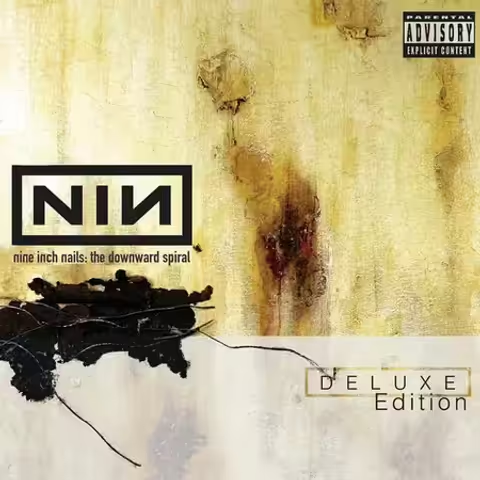
The cover is a photograph of a single mixed-media work by the British artist Russell Mills. Titled Wound, the piece is built from plaster, oils, acrylics, rusted metals, insects, moths, wax, varnishes, surgical bandaging and Mills's own blood, on a wooden panel. It looks, depending on the angle, like a flayed animal, a slow corruption, a wound being dressed. Mills exhibited the original alongside companion pieces titled Committere at the Glasgow School of Art.
"I had been thinking about making works that dealt with layers, physically, materially and conceptually. I wanted to make beautiful surfaces that partially revealed the visceral rawness of open wounds beneath."
Russell Mills on creating Wound, the cover painting for The Downward Spiral, 2006
The booklet, designed by Gary Talpas with photography by David Buckland, deliberately avoids any photograph of Reznor. Lyrics appear in fragmented, washed-out type. The whole package was a quiet rejection of the practice that demanded a frontman's face on every record sleeve. It would set the visual template for everything Nine Inch Nails released for the next decade.
Release and reception
The album shipped on 8 March 1994 and entered the Billboard 200 at number two the following week, blocked from the top spot only by the soundtrack to Philadelphia. It moved 118,000 copies in seven days, the strongest week Interscope had ever managed for a rock release. It peaked at number nine on the UK Albums Chart, eight on the Scottish Albums Chart and twelve on the ARIA Albums Chart in Australia. The RIAA certified it 4x Platinum on 28 October 1998. The BPI awarded it a UK Gold disc as late as 22 July 2013, on the back of nineteen years of catalogue sales.
Critical opinion was split, but the reviews that mattered were ecstatic. Jonathan Gold's lead review in Rolling Stone landed on 24 March 1994 and remains the most quoted piece on the record.
"Nine Inch Nails achieve a new kind of loud on The Downward Spiral: accessible hard-rock moves overlaid with a scrim of electronic racket, white noise, screams. It's a new frontier in rock and roll: music that pins playback levels far into the red. You have only two options with this album: play it too softly, or play it too loud."
Jonathan Gold, Rolling Stone, 24 March 1994
Jon Pareles, writing in The New York Times, noted that unlike Ministry or Nitzer Ebb, "Reznor writes full-fledged tunes" with stronger melodies than riffs. J.D. Considine in The Baltimore Sun called the record a "terrible beauty" with explicit reference to W.B. Yeats. Robert Christgau, characteristically, gave it a two-star honourable mention and dismissed it in one sentence as "musically, Hieronymus Bosch as post-industrial atheist; lyrically, Transformers as kiddie porn." NME ran an outlier 4 out of 10. Kerrang!, Mojo and the Los Angeles Times all ran four-star raves. Tom Sinclair in Entertainment Weekly nailed the record's contradictions in a single image.
"Reznor's pet topics, sex, power, S&M, hatred, transcendence, are all here, wrapped in hooks that hit your psyche with the force of a blowtorch."
Tom Sinclair, Entertainment Weekly, 18 March 1994
Awards followed: Grammy nominations for Best Alternative Music Performance (the album) and Best Rock Song ("Hurt"), with the band ultimately winning Best Metal Performance at the 1996 Grammys for the live Happiness in Slavery recorded at Woodstock '94. Spin placed the record at number eleven on its 90 Greatest Albums of the '90s list. Rolling Stone has revisited it three times for its 500 Greatest Albums of All Time, ranking it 200 in 2003, 201 in 2012, and a career-high 122 in the 2020 revision.
Singles and music videos
Only two songs were issued as commercial singles. March of the Pigs arrived on 25 February 1994, two weeks before the album, with a music video directed by Peter Christopherson of Throbbing Gristle and Coil. Christopherson actually shot the video twice; the first cut was scrapped at Reznor's insistence, and the released version is a single live-band take in a white room. It was cheap, ugly, perfect for the song.
Closer followed in May 1994 with a Mark Romanek video that became one of the most heavily censored clips in MTV history. Filmed on damaged 16mm with a deliberately decayed, antique-medical-photography look, it stitches together a nude woman in a crucifix mask, a monkey tied to a cross, a spinning pig's head, Reznor in a ball gag and dozens of other sequences MTV would not show. The network ran a heavily blurred edit and cut to "scene missing" frames over the worst of it. The Museum of Modern Art in New York later acquired the video for its permanent collection.
| Single | Released | Director | Notable chart positions |
|---|---|---|---|
| March of the Pigs | 25 February 1994 | Peter Christopherson | US Modern Rock Tracks 12 |
| Closer | May 1994 | Mark Romanek | US Modern Rock Tracks 9, UK Singles Chart 25 (1995 reissue) |
| Piggy (promo) | December 1994 | none | US Modern Rock Tracks 19 |
| Hurt (promo) | 1995 | none | Promo only at original release |
The Self Destruct tour and Woodstock '94
The Self Destruct tour ran from March 1994 through September 1995 across more than 130 dates. Reznor reshaped the live band almost completely: Robin Finck replaced Richard Patrick on guitar, James Woolley took over keyboards, Danny Lohner joined on bass, and Chris Vrenna stayed behind the kit. Marilyn Manson, freshly signed to Nothing Records, opened most of the main US legs. The bass player in Manson's band was a young Jeordie White, performing as Twiggy Ramirez; he would later play bass with Nine Inch Nails himself between 2005 and 2007.
The tour's defining moment came at Woodstock '94 on 13 August 1994, broadcast on pay-per-view to 24 million homes. The band took the stage caked head to toe in mud, having either rolled in a rain-soaked backstage area or, as backstage footage that surfaced on YouTube in 2024 confirmed, deliberately requested "five minutes for mud" beforehand. The mud was less an aesthetic choice than an accident that the band leant into; Reznor later admitted it stung his eyes throughout the set and ranked the show as one of his least favourite performances. Audiences and critics disagreed. Entertainment Weekly's verdict, that "Reznor unstrings rock to its horrifying, melodramatic core, an experience as draining as it is exhilarating", became the consensus.
The tour's final phase, the Dissonance leg in autumn 1995, paired Nine Inch Nails as opener for David Bowie's Outside Tour. The two acts shared the stage every night, with Nine Inch Nails playing a full set, then Bowie joining them for a transitional run of songs that included Hurt, Reptile, Bowie's own Scary Monsters (And Super Creeps), and Hallo Spaceboy. Crowds split between the two fanbases were not always receptive, but Rolling Stone readers later voted the pairing one of the ten best opening-act runs in rock history.
- Self Destruct tour: 8 March 1994 to 8 September 1995, more than 130 shows
- Support acts: Marilyn Manson, Pop Will Eat Itself, Jim Rose Circus Sideshow, Prick
- Woodstock '94 set, 13 August 1994: pay-per-view to 24 million homes
- Dissonance leg with David Bowie's Outside Tour, autumn 1995, 26 co-headlined dates
- Three-night Nights of Nothing showcase at New York's Roseland in late 1995, briefly reuniting Reznor with Richard Patrick on Head Like a Hole
In TV, film and media
Reznor used the album's profile to push Nine Inch Nails into film and television in a way no industrial act had managed. Burn, written during the Le Pig sessions, anchored the Natural Born Killers soundtrack, which Reznor also compiled and produced. Closer and The Becoming appeared on the soundtrack to David Fincher's Se7en in 1995. The Perfect Drug, recorded in 1996 in the same sonic register, soundtracked the title sequence of David Lynch's Lost Highway. Hurt alone has since been licensed into The West Wing, The Last of Us Part II, and dozens of memorial montages.
The album's compositional language, sample-heavy, distorted, structurally restless, became the template for film scoring as Reznor and Atticus Ross moved into that work full-time after 2010. The Oscar-winning score for The Social Network, the BAFTA-winning score for Soul and The Girl with the Dragon Tattoo all begin in the same place: a man with a Macintosh, a Studer and the patience to chop a 25-minute take to pieces.
Controversy, censorship and the Cleveland fight
The album drew sustained fire from American social conservatives. Senator Bob Dole, William Bennett and the activist C. Delores Tucker met Time Warner executives in early 1995 and demanded that they recite the lyrics to Big Man with a Gun on the spot. Robert Bork later quoted from the same song repeatedly in his 1996 book Slouching Toward Gomorrah. Reznor's response was that the song was a parody of gangsta-rap braggadocio, a position the local Cleveland press agreed with, even though Cleveland's The Plain Dealer had given the album one of its only outright pans on release.
"When Downward Spiral came out it got almost universally good reviews, except for the scathing, scathing reviews in Cleveland."
Trent Reznor, Rolling Stone, September 1994
The album surfaced again in 1999 when one of the Columbine High School shooters, Dylan Klebold, was found to have referenced its lyrics in his journal. The Senate Commerce Committee held a hearing on 4 May 1999 in which the record was named alongside Marilyn Manson and the film The Matrix as supposed contributors. Reznor declined to testify and addressed the matter only in a 2005 Spin interview, calling the connection "the cheapest possible way to talk about the actual problem".
The smaller controversies are also worth noting. In 2009 Apple rejected the official Nine Inch Nails iPhone app over an audio sample from the title track, then approved it days later without explanation. The original 1994 first Australian pressing was misindexed at the factory, leaving every track from Big Man with a Gun onwards starting 41 seconds too early; the disc plays correctly as a continuous album, but selecting individual tracks remains broken on those copies. Collectors prize them.
Covers, samples and tributes
Johnny Cash's 2002 cover of Hurt for American IV: The Man Comes Around, with its Mark Romanek video filmed at Cash's Tennessee home shortly before his death, is the most famous cover of any Reznor composition and arguably the most famous cover of the 21st century. NME named the video the greatest music video of all time in 2011. Leona Lewis released a UK Christmas EP version in 2011. Closer has been covered by the Ataris, sampled by countless hip-hop and electronic producers, and turned into a Saint Motel-style swing arrangement on Postmodern Jukebox. Mr. Self Destruct opens with a sample from the 1971 Lucas film THX 1138; Closer samples Iggy Pop's Nightclubbing and Roxy Music's Take a Chance with Me; Reptile contains audio from Aliens and The Texas Chain Saw Massacre; Big Man with a Gun opens with a snippet credited to Tommy Lee under the pseudonym "Steakhouse" and consists of a heavily processed recording of a porn-film orgasm.
Reissues, remasters and anniversaries
The first major reissue was the Halo 8 Deluxe Edition on 23 November 2004, a tenth-anniversary release in both SACD (with stereo and 5.1 surround layers) and DualDisc formats. Bob Ludwig handled the high-resolution remaster, James Brown produced the 5.1 mix and Reznor approved every step. The bonus disc collected B-sides, the Closer to God material, and three previously unreleased demos: Ruiner, Liar (the early Reptile) and Heresy. The 1995 remix album Further Down the Spiral, with contributions from Coil, Aphex Twin, Rick Rubin and Dave Navarro of Jane's Addiction, peaked at 23 on the Billboard 200 and remains one of the better remix records of the era. Cold Spring Records issued Recoiled in 2014, collecting Coil's archival remixes.
The album's 30th anniversary in March 2024 came and went without an official boxset, although Reznor and Ross have repeatedly hinted in interviews that one is being assembled from the Le Pig session tapes, which Reznor has said survive intact in his archives. A half-speed-mastered double vinyl edition was released by Interscope in late 2024.
Legacy and influence
The most direct heirs to The Downward Spiral are obvious. Marilyn Manson's Antichrist Superstar, recorded with Reznor co-producing in 1996, is essentially the album's louder, sleazier sibling. Filter's debut Short Bus, made by the departed Richard Patrick, ploughs the same furrow without the conceptual weight. Stabbing Westward, Gravity Kills and even Mötley Crüe's much-derided 1997 album Generation Swine all reached for the same sonic register. By the late 1990s and early 2000s, the album's sound, processed guitars, distorted vocal whispers, samples played as drum kits, was shorthand for "modern rock" on every Hollywood film trailer.
The deeper influence is structural rather than sonic. The Downward Spiral argued that an industrial album could carry a single sustained narrative, that a producer could write everything alone in a haunted house and assemble it from pieces, and that an act with no recognisable lead-guitar riff could sit at number two on the Billboard 200. Linkin Park's Hybrid Theory, How to Destroy Angels, Deftones' White Pony, Kanye West's Yeezus (which Rick Rubin produced and which Reznor publicly praised) and the entire post-2010 Nine Inch Nails catalogue all owe it something specific.
Things you might not know
| Fact | Detail |
|---|---|
| The bass drum on Closer | Is a single hit lifted from Iggy Pop's 1977 song Nightclubbing, slowed and ring-modulated until almost nothing of the original Carlos Alomar / Bowie production remains. |
| Hurt was a last-minute addition | Reznor wrote and tracked it in a single night at A&M Studios after the rest of the album was finished. He has called it "the very last song" written for the record. |
| The lost song | A track called Just Do It, written about suicide, was vetoed by Flood with the verdict "you've gone too far". It has never been officially released and Reznor has only played fragments in interviews. |
| Adrian Belew was told not to play parts | The King Crimson and David Bowie guitarist was instructed to react, use noise, ignore melody. His first day in the studio produced the squalling textures on Mr. Self Destruct. |
| The cover painting contains real blood | Russell Mills built Wound from plaster, oils, rusted metals, insects, moths, wax, surgical bandaging and his own blood on a wooden panel. |
| The Australian first pressing is broken | An indexing error at the factory means tracks from Big Man with a Gun onwards start 41 seconds too early when selected individually; the disc plays correctly as a continuous album. |
| Patti Tate's confrontation | Sharon Tate's youngest sister visited Reznor at the house in December 1993 and asked if he was exploiting her sister's death. Reznor cried that night and moved out within months. |
| The Closer video lives at MoMA | Mark Romanek's heavily censored 1994 video for Closer was acquired by the Museum of Modern Art in New York for its permanent collection. |
| Big Man with a Gun's opening sample | Is credited in the booklet to "Steakhouse", a pseudonym for Tommy Lee, and is in fact a heavily altered recording of a porn-film orgasm. |
| The house was demolished | Weeks after Reznor moved out in 1994, 10050 Cielo Drive was torn down and the address renumbered 10066 to break with its history. |
| Reznor mixed Hurt himself | Alan Moulder mixed almost the entire record except Big Man with a Gun (Sean Beavan and Bill Kennedy) and Hurt (Reznor alone). |
| The Woodstock '94 mud was planned | Backstage video that surfaced on YouTube in 2024 captures Reznor asking the stage manager to give the band "five minutes for mud" before walking on. |
| Halo 8 was its catalogue number | Every Nine Inch Nails release carries a "Halo" number; The Downward Spiral is Halo 8, sat between the March of the Pigs single (Halo 7) and Closer to God (Halo 9). |
| Grammys in unexpected places | The album itself lost Best Alternative Music Performance, but the live recording of Happiness in Slavery from Woodstock '94 won Best Metal Performance at the 1996 Grammys. |
Listen to the Riffology Podcast
If reading about Trent Reznor turning the most haunted address in Los Angeles into a recording studio has put you in the mood to go deeper, the Riffology podcast is the place. New episodes drop weekly on Apple Podcasts, Spotify, Pocket Casts, Overcast and every other podcast app worth using, with the team digging into the records, the rows and the producers behind the music that actually mattered. Subscribe, leave a rating if you can spare a minute, and let us know what album we should pull apart next.
Comments