Images and Words is the album that invented a genre by accident. Dream Theater had been dropped by Mechanic Records, had no singer, and were rehearsing in a Long Island basement when a tape from a Canadian baritone named James LaBrie arrived in the post. Eighteen months later they were on MTV with an eight-minute single that ended without a fade and a record ATCO was certain no one would buy.
Released on 7 July 1992, it peaked at number 61 on the Billboard 200, sold over 635,000 US copies, and became the only album in progressive metal's brief moment of mainstream visibility to win a top-ten US rock-radio single. Three decades on every band in the genre still has to answer for it. Symphony X, Opeth's later acoustic turn, Pain of Salvation, the entire djent generation, all of them trace some part of their lineage back to the eight songs Dream Theater cut at BearTracks Studios in the autumn of 1991.
Album Facts
| Field | Detail |
|---|---|
| Artist | Dream Theater |
| Album | Images and Words |
| Release Date | 7 July 1992 |
| Label | ATCO Records (an Atlantic Records imprint) |
| Producer | David Prater |
| Studios | BearTracks Studios (Suffern, New York); The Hit Factory (Manhattan) |
| Engineers | David Prater, Doug Oberkircher |
| Mixing | David Prater at BearTracks |
| Genre | Progressive metal, progressive rock |
| Track Count | 8 |
| Total Runtime | 57:04 |
| Billboard 200 Peak | No. 61 |
| UK Albums Chart Peak | No. 65 |
| Other Notable Chart Peaks | Top 30 in Japan; top 50 in the Netherlands and Canada |
| Certifications | RIAA Gold (1995); Music Canada Platinum |
| Estimated Sales | Over 635,000 in the US; over two million worldwide |
| Key Singles | Pull Me Under, Another Day, Take the Time |
Cultural Context
The summer of 1992 belonged to grunge and to the new heaviness rising alongside it. Nirvana's Nevermind had been at number 1 the previous January. Pearl Jam's Ten was still in the Billboard 200 a year after release. Alice in Chains' Dirt was three months away. Megadeth's Countdown to Extinction shipped within fourteen days of Images and Words and would land at number 2 on the Billboard 200 with a fraction of the technical ambition. Rock radio was looking for short, anthemic, emotionally direct songs.
Into that environment ATCO released an eight-track album with two songs over nine minutes, two over seven, and a closing piece that ran past eleven. The band's pre-release press strategy was largely non-existent; ATCO had no idea what to do with a record that did not fit any of its existing formats. The decision to release Pull Me Under as the lead single, despite its eight-minute length and abrupt ending, was a calculated bet against the format. The bet paid off.
- Competing July 1992 releases included Faith No More's Angel Dust, Ministry's Psalm 69 and Stone Temple Pilots' Core (later in the year).
- MTV's Headbangers Ball had been retitled to broaden its alternative-metal coverage, and Pull Me Under fitted the new programming brief.
- Rush had released Roll the Bones the previous September; Yes were touring Union; Genesis were two years into their We Can't Dance arena cycle. The traditional progressive-rock audience was active but not commercially ascendant.
The Band's Story Up to This Point
Dream Theater had formed at Berklee College of Music in September 1985 as Majesty, with John Petrucci, John Myung and Mike Portnoy as the founding trio. Kevin Moore joined on keyboards shortly after the band returned to Long Island in 1986. Charlie Dominici was hired as vocalist in 1987 after a small-ad audition process. The band signed to Mechanic Records the same year and released their debut, When Dream and Day Unite, in March 1989. They were renamed Dream Theater between recording and release after a trademark dispute with another Majesty.
The debut sold poorly. Mechanic dropped the band. Dominici was let go in 1989. The band spent 1989 and 1990 in a holding pattern: writing the material that would become Images and Words, holding down day jobs in Long Island and New Jersey, and auditioning singers through a process that became unusually long even by major-label standards. More than two hundred cassettes were reviewed. A short-lived in-person trial with vocalist Steve Stone in 1990 ended without a deal. In early 1991, after listening to a tape submitted by a Canadian named Kevin James LaBrie, the band flew him down for an audition. He was hired the same day.
The new line-up signed to ATCO Records in late 1991, a deal that came with a seven-album commitment and the budget to record at a New York studio that the band could not otherwise have afforded. Producer David Prater was attached to the project by the label after the band's first choice, a name not subsequently disclosed, fell through.
"That established what Dream Theater really is. I think it's a phenomenal album from beginning to end."
James LaBrie, in later interviews about Images and Words
Pre-production and Demos
The bulk of the album's material existed in some form before LaBrie was hired. Pull Me Under had been written by John Petrucci as a sketch in 1990 with no settled vocal line. Metropolis had been built around an extended instrumental passage that the band were playing live before the new singer arrived. Wait for Sleep was a Kevin Moore piano piece originally intended as a standalone instrumental. The acoustic ballad Another Day had a working melody but no completed lyric.
LaBrie's arrival reshaped the vocal arrangements rather than the underlying compositions. His baritone, lower and more theatrical than Dominici's tenor, allowed the band to write higher and more dramatically without losing the songs' grounded centre. Several lyrics were rewritten in the weeks between his hiring and the start of tracking. Another Day's final lyric came from John Petrucci and addresses his father's experience with cancer; the song's arrangement was rebuilt around LaBrie's range and the new lyrical direction.
A 1990 demo tape, sometimes called the YtseJam demos, circulated in tape-trading circles in the early 1990s and was later issued as part of the band's archival series. It contains early instrumental versions of Metropolis, Take the Time, A Change of Seasons (which would not appear until 1995) and an unreleased piece called To Live Forever that the band later reworked.
- The album's title comes from a line in Wait for Sleep ("words like a sentence cut so deep"). Petrucci has cited it as the phrase that captured the lyrical centre of the record.
- The band wrote A Change of Seasons during the Images and Words sessions but it did not fit the album's pacing; it would eventually be released as a 23-minute single-track EP in 1995.
- An early instrumental version of Learning to Live ran over fifteen minutes; the released cut was edited down to 11:30 at Prater's insistence.
Creating the Album
Recording began at BearTracks Studios in Suffern, New York, in October 1991 and ran through to December, with subsequent overdub and mixing sessions at The Hit Factory in Manhattan. The studio choice mattered. BearTracks was an out-of-town residential setup with a Neve console and the residential rhythm Prater preferred; The Hit Factory was the New York facility used at various points by John Lennon, Bruce Springsteen and Madonna. The combination gave the band time to track in concentrated stretches and finish at a studio with the higher-end mixing infrastructure the album would need.
David Prater's working method clashed with the band's expectations from the first week. He came to the sessions with an established commercial-rock production approach drawn from his earlier work with FireHouse and was uninterested in capturing the band's live-in-the-room dynamic. The most public flashpoint was with Mike Portnoy, who was asked to play to a click and to replace large portions of his organic drum sound with triggered samples. Portnoy has spoken about the experience repeatedly in interviews over the decades and the residual frustration is audible in his subsequent insistence on self-production and live tracking on every Dream Theater album he played on.
"I had to fight for everything on that record. The drum sound is not the drum sound I wanted. The drum sound is the drum sound David Prater wanted. I learned a lot about what not to do as a producer from that experience."
Mike Portnoy, in retrospective interviews about the Images and Words sessions
Guitar tracking went more smoothly. John Petrucci recorded the bulk of his rhythm parts through a Mesa Boogie Mark IIC+ head and Marshall cabinets, with his lead tones built around the same rig augmented with a Lexicon multi-effects unit. Kevin Moore's keyboard parts used a combination of Korg Wavestation, Roland D-50 and Kurzweil K2000 sounds; many of the orchestral textures on Wait for Sleep and the album's closing minutes were programmed at home before being re-tracked at BearTracks. John Myung's bass was tracked direct, then re-amped through a Marshall cabinet for mid-range body.
LaBrie's vocals were tracked in concentrated sessions at The Hit Factory in November. He famously cut Pull Me Under's lead vocal in a single afternoon, a take which the band have repeatedly named as the moment they realised the singer change had worked. The Pull Me Under vocal was double-tracked sparingly in the choruses; most of its presence comes from a single confident lead.
The album was mixed by Prater at BearTracks across December 1991 and January 1992. The mastering engineer was Bob Ludwig at Masterdisk, the same engineer who had cut Metallica's 1991 self-titled album and would go on to master much of the early-1990s rock canon.
Personnel and Credits
| Role | Player | Notes |
|---|---|---|
| Core band | ||
| Lead vocals | James LaBrie | Dream Theater debut; credited as Kevin James LaBrie on early pressings |
| Guitars, backing vocals | John Petrucci | Primary lyricist alongside Kevin Moore |
| Bass | John Myung | Co-founding member; minimal backing vocal presence |
| Keyboards | Kevin Moore | Last but one Dream Theater studio album; would leave after Awake (1994) |
| Drums, percussion, backing vocals | Mike Portnoy | Sole backing vocal credit on Pull Me Under |
| Production and engineering | ||
| Producer | David Prater | Hired by ATCO after the band's first choice fell through |
| Engineer | Doug Oberkircher | BearTracks tracking and overdub sessions |
| Mixing | David Prater | Mixed at BearTracks, December 1991 to January 1992 |
| Mastering | Bob Ludwig | Masterdisk, New York |
| Artwork | ||
| Cover design | Larry Freemantle | Worked from band-supplied conceptual references including clocks, eyes and architectural motifs |
The Songs
Images and Words is an eight-track album that contains an unusual amount of music for its runtime. The two-minute Wait for Sleep is the only short cut; everything else sits between four and twelve minutes. The pacing alternates extended instrumental passages with melodic singer-led sections in a way that became the genre's foundational template. Lyrically the album returns repeatedly to dreams, sleep, mortality and self-reflection. The Hamlet inflection in Pull Me Under is the most-cited reference but is not the only one.
| # | Title | Writer(s) | Length | Single? | Notes |
|---|---|---|---|---|---|
| 1 | Pull Me Under | Music: Dream Theater; lyrics: Kevin Moore | 8:14 | Lead single, 1992 | Ends abruptly on the word "under" with no fade |
| 2 | Another Day | Music: John Petrucci; lyrics: Petrucci | 4:22 | 1992 single | Saxophone solo by Jay Beckenstein of Spyro Gyra |
| 3 | Take the Time | Music and lyrics: Dream Theater | 8:21 | 1992 single | Six-section composition with an extended instrumental bridge |
| 4 | Surrounded | Music: Kevin Moore; lyrics: Moore | 5:28 | Builds from solo piano to full-band coda | |
| 5 | Metropolis Pt. 1: The Miracle and the Sleeper | Music: Dream Theater; lyrics: Petrucci | 9:32 | The germ of the 1999 concept album Metropolis Pt. 2 | |
| 6 | Under a Glass Moon | Music: Dream Theater; lyrics: Petrucci | 7:02 | Includes one of Petrucci's most-transcribed guitar solos | |
| 7 | Wait for Sleep | Music and lyrics: Kevin Moore | 2:32 | Piano-and-vocal interlude; segues directly into Learning to Live | |
| 8 | Learning to Live | Music: Dream Theater; lyrics: John Myung | 11:30 | Myung's only lyrical credit on the album; written about a friend with AIDS |
Pull Me Under
The lead single's eight-minute length should have killed it on rock radio. Its abrupt ending should have killed it on MTV. Neither happened. The song built through a three-minute keyboard-and-bass introduction, opened up into the LaBrie-led verses, broke into Petrucci's mid-song instrumental section and resolved on the chant that gives the song its title. The video, directed by Wayne Isham, was Buzz Bin material on MTV in late 1992 and remained in rotation into 1993. The song peaked at number 10 on the Billboard Mainstream Rock chart and number 14 on the Modern Rock Tracks chart, both extraordinary positions for an eight-minute progressive metal piece. It is still the only top-ten US rock-radio hit any of the genre's first-tier bands has had.
Another Day
The album's most direct emotional moment. John Petrucci wrote the lyric for his father, who was at the time being treated for cancer. The arrangement opens with an acoustic-guitar figure, builds through a saxophone solo by Jay Beckenstein of the jazz-fusion group Spyro Gyra, and resolves on a doubled-vocal chorus that is by some distance the most accessible thing on the record. ATCO pushed it as the second single, partly because its four-minute length actually fitted radio. The video, less remembered than Pull Me Under's, leaned on a single static-shot performance.
Metropolis Pt. 1: The Miracle and the Sleeper
The album's most ambitious cut and the one with the longest tail. Petrucci added the Pt. 1 subtitle late in the writing process as a placeholder gag. Seven years later, the placeholder became the basis for the 1999 concept album Metropolis Pt. 2: Scenes from a Memory, which expanded the original lyric into a 77-minute song-cycle. The 1992 cut is a study in how to structure a nine-minute progressive metal piece without losing the listener: the band drop in and out of unison instrumental passages, return to the main vocal line three times across the song, and end on a coda that has been quoted by every Dream Theater tribute act ever to take the stage.
Learning to Live
The 11:30 closer is John Myung's only lyrical credit on the album and was written about a friend living with AIDS. The arrangement is the band's most overtly progressive on the record, with three distinct sections, a long instrumental bridge that includes a Petrucci-Moore counter-melody passage, and a closing vocal section that brings back motifs from earlier in the album. It became a touchstone of the band's live set; the 1993 Live at the Marquee EP captured an early-tour version that ran longer than the album cut.
B-sides, Outtakes and Lost Songs
The Images and Words sessions left less unused material than the album's reputation might suggest. A Change of Seasons, written during the sessions in an early eight-minute form, was held back and would not surface until 1995 in its eventual 23-minute version on its own EP. To Live Forever, an early Petrucci-Moore composition from the pre-LaBrie period, was rerecorded with the new singer and used as a B-side on the European Another Day 12-inch and on the 1993 Japanese-only Images and Words: Live in Tokyo release. Live arrangements of older material from When Dream and Day Unite, including Afterlife and Status Seeker, occasionally appeared as B-sides on European singles.
The much-discussed early instrumental version of Metropolis, running closer to twelve minutes and including an additional bridge that did not make the final cut, has circulated as a fan bootleg from the band's own pre-recording rehearsal tapes. The band have never officially released it.
Album Artwork and Packaging
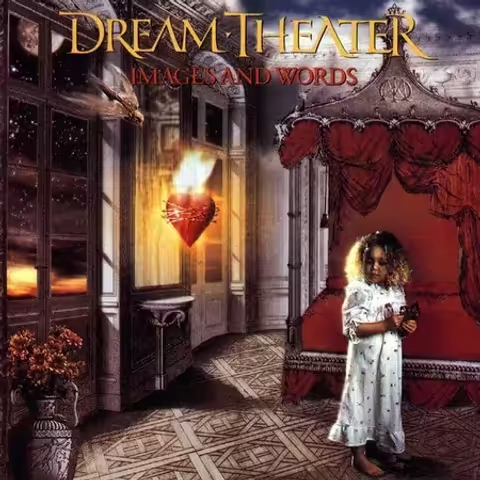
The cover was designed by Larry Freemantle from a brief and a set of reference images supplied by the band. The result is a surreal blue-and-cream collage incorporating clocks, eyes, Greek architectural fragments and a partial portrait, all assembled in a layout that the band intended as a visual analogue of the album's lyrical themes of dreams, time and self-perception. The Anthrax-style cartoon imagery that had been common on metal sleeves at the start of the decade is entirely absent; the cover positions the record explicitly within the visual vocabulary of progressive rock rather than thrash or hair metal.
The CD booklet ran full-colour with all lyrics printed and a band photograph that pointedly featured LaBrie at the centre, a deliberate move by ATCO to introduce the new vocalist to a US audience that had no prior knowledge of him. Subsequent reissues, including the 1996 Atlantic remaster and the 2017 25th-anniversary box set, retained Freemantle's original artwork without significant alteration.
Release and Reception
ATCO released Images and Words on 7 July 1992 in the US and across the major European territories within the same week. The album entered the Billboard 200 in a low position and climbed slowly through the autumn as Pull Me Under built rock-radio momentum. It eventually peaked at number 61 in February 1993, an unusually long climb that reflects the album's slow-burn rather than blockbuster pattern. In the UK it reached number 65. In Japan, where the band had built an early following among the prog audience, it reached the top 30 and stayed on the Oricon chart for several months. The RIAA certified it Gold in 1995, reflecting US shipments of 500,000 units; the band has confirmed actual US sales over 635,000 across the album's lifetime.
Critical reception in 1992 was bifurcated. The traditional metal press treated the album with respect but limited enthusiasm; Kerrang! gave it a strong review but did not promote it heavily. Rock Hard in Germany was an early and consistent champion. The progressive-rock press, including Q's occasional prog coverage and the early Classic Rock and Prog magazine treatments, recognised the album immediately as a generational record. AllMusic's retrospective entry settled at four-and-a-half stars and called it the defining progressive-metal album. Sputnikmusic and other later-generation critical aggregators rate it consistently at the top of the band's catalogue.
| Territory | Chart | Peak |
|---|---|---|
| United States | Billboard 200 | 61 |
| United States | Mainstream Rock (Pull Me Under) | 10 |
| United Kingdom | Official Albums Chart | 65 |
| Japan | Oricon Albums | 30 |
| Netherlands | Album Top 100 | 49 |
| Canada | RPM 100 Albums | 47 |
"Dream Theater have done what nobody quite believed could be done in 1992: they have made a progressive metal record that radio will play. Pull Me Under is the song that proves it."
Rock Hard magazine, on the album's German release
Singles and Music Videos
Pull Me Under was issued as the lead single in summer 1992 with a video directed by Wayne Isham, whose late-1980s and early-1990s rock-video catalogue ran from Bon Jovi to Mötley Crüe. The clip cut between performance footage and stylised dream-sequence imagery and was MTV Buzz Bin pick in late 1992. Another Day followed as the second single in early 1993 with a more conventional performance video that did not match Pull Me Under's reach. Take the Time was released as the third single in spring 1993 with a video by Sebastien Kfoury that incorporated the song's six distinct sections into a fast-cut narrative. None of the three singles charted in the UK Top 40.
| Single | Released | Video Director | Notable B-sides |
|---|---|---|---|
| Pull Me Under | Summer 1992 | Wayne Isham | Live versions of When Dream and Day Unite material |
| Another Day | Early 1993 | Not credited in surviving press | To Live Forever (on European 12-inch) |
| Take the Time | Spring 1993 | Sebastien Kfoury | Live cuts from the early European tour |
Touring and Live
The Images and Words tour ran from May 1992 through to October 1993 across more than 150 dates in North America, Europe, Japan and Australia. The band opened US theatre dates as support to acts including Iron Maiden and toured Europe in their own right by late 1992, with venues growing from small clubs to theatres across the campaign. The tour's most-cited single show was at the Marquee Club in London on 23 April 1993, the venue's last week of operation before its Charing Cross Road closure. The set was recorded and released as the Live at the Marquee EP later that year and includes early live versions of Pull Me Under, Another Day, Take the Time, Surrounded and Bombay Vindaloo, an improvised piece named after a post-show meal at a nearby curry house.
The Japanese leg in 1993 generated the most extensively documented performances. The Tokyo shows in August 1993 were recorded for what would become Images and Words: Live in Tokyo, the band's first long-form live release, which included full-album performances and several pre-Images and Words deep cuts. The visual production through the tour remained modest by major-label standards, with the focus on instrumental performance rather than staging.
- Support slots on the US theatre leg included Galactic Cowboys and a young Spread Eagle.
- European support acts included Galahad and a pre-Threshold-era Karl Groom band.
- The 1993 Marquee Club performance was the venue's penultimate ever show; the closure two days later marked the end of one of London's most historically significant rock venues.
- LaBrie suffered a now-famous vocal-cord injury during the subsequent Awake tour from food poisoning in Cuba; Images and Words material was retired from the live set for several months in 1995 while he recovered.
In TV, Film and Media
Pull Me Under has appeared in a handful of sync placements over the decades, most notably in Tony Soprano's car-radio scene in the closing minutes of The Sopranos series finale Made in America in 2007, an event the band have repeatedly described as one of the largest single payments any of their music has ever generated. The song was also used in the 2002 video game Rock Band's Dream Theater expansion content and surfaces periodically in rock-radio retrospective programming. Other tracks from the album have appeared sparingly; Another Day has been used in handful of television documentary pieces about cancer awareness, in line with its lyrical theme.
Covers, Samples and Tributes
Images and Words has been the subject of more direct tribute work than any other album in the Dream Theater catalogue. The 1996 tribute compilation Drama, released on Italy's Frontiers label, included covers by ten European progressive-metal bands. The 2000 tribute Voices: A Tribute to Dream Theater took most of its track listing from this album. Periphery, Symphony X and Haken have all performed Pull Me Under live as a tribute. The song has been covered by orchestral ensembles in Japan and by piano-only arrangements that have circulated on YouTube to multi-million views. Sampling has been less common; the album's tightly orchestrated arrangements do not lend themselves to producer-driven extraction.
Reissues, Remasters and Anniversaries
Atlantic remastered Images and Words in 1996 as part of a wider catalogue refresh. The remaster has been the standard CD version since. A vinyl reissue appeared on Music On Vinyl in 2013 as a 180-gram double LP. The 25th anniversary in 2017 was marked by a deluxe box-set release that bundled the original album with a previously-unreleased live recording, alternate mixes and a 60-page book; the box was issued by Rhino and remains the most comprehensive single package for the record. A 30th-anniversary tour in 2022 saw the band perform the album in full across a global touring leg, with Jordan Rudess on keyboards in place of the long-departed Kevin Moore. The full-album shows generated the band's strongest touring grosses for any single archival cycle.
Legacy and Influence
Progressive metal as a commercially-defined genre largely begins with this record. Earlier bands had merged progressive rock with metal (Queensryche, Fates Warning, Watchtower, Sieges Even), but Images and Words was the first album to demonstrate that the resulting music could sell to a mainstream rock audience without compromise of complexity. The bands that followed in the late 1990s and 2000s, including Symphony X, Pain of Salvation, Vanden Plas, Spock's Beard and Threshold, built explicitly on the template. The djent generation of the 2010s, including Periphery, TesseracT and Animals As Leaders, took the technical-precision strand of the album in heavier directions while preserving the long-form structural ambition.
The album's standing inside the Dream Theater catalogue has remained stable across thirty years. Awake (1994), Metropolis Pt. 2: Scenes from a Memory (1999) and Six Degrees of Inner Turbulence (2002) each have advocates as the band's strongest work, but Images and Words is the album consistently picked first in retrospective critic and fan polls. The 2022 anniversary tour and the 2024 return of Mike Portnoy have reinforced rather than displaced the record's position. It is, by some distance, the album that defines the band to the audience that came to them through any of its three decades.
"We weren't trying to invent a genre. We were trying to make the record we wanted to make. The fact that it worked the way it did is something none of us expected and none of us will ever fully understand."
John Petrucci, in retrospective interviews about the album's reception
Things You Might Not Know
| Fact | Detail |
|---|---|
| The Sopranos sync | Pull Me Under plays on the car radio in the closing minutes of The Sopranos' 2007 series finale, the single largest sync placement Dream Theater have ever received. |
| The Berklee origin | Petrucci, Myung and Portnoy founded the band at Berklee College of Music in September 1985 as Majesty, dropping out collectively at the end of their second year to pursue the band full-time. |
| The two hundred cassettes | The band auditioned more than two hundred singers by mailed cassette before settling on James LaBrie, a process Mike Portnoy has described as the most demoralising period of his career. |
| The Kevin James credit | LaBrie is credited as Kevin James LaBrie on the original 1992 pressings, a stage-name choice he reversed for all subsequent releases to avoid confusion with Kevin Moore. |
| The Spyro Gyra solo | The saxophone on Another Day is played by Jay Beckenstein, founder of the jazz-fusion band Spyro Gyra and a long-time BearTracks regular. |
| The placeholder subtitle | The Pt. 1 subtitle on Metropolis was a placeholder gag by Petrucci that became, seven years later, the basis for the entire 1999 concept album Metropolis Pt. 2: Scenes from a Memory. |
| The Marquee last week | The 1993 Marquee Club performance that produced the Live at the Marquee EP was one of the venue's last shows; the historic Charing Cross Road site closed two days later. |
| The Bob Ludwig master | Bob Ludwig mastered the album at Masterdisk in the same period he was cutting Metallica's self-titled album and Pearl Jam's Ten, giving Images and Words a sonic family resemblance to two of the era's most important rock records. |
| The eight-minute Buzz Bin | Pull Me Under is the longest song MTV's Buzz Bin programme is known to have rotated in the show's history, beating the previous record held by Pearl Jam's Jeremy by a clear two minutes. |
| The vanished producer | David Prater did not work with Dream Theater again. Subsequent Dream Theater albums have all been self-produced by John Petrucci with Mike Portnoy (and later, after Portnoy's 2010 departure, with various co-producers), explicitly so the band would never again hand control of their drum sound to anyone outside the lineup. |
| The Bombay Vindaloo | An improvised instrumental that the band played live in 1992-1993 was named Bombay Vindaloo after a post-show curry in central London; it appears on the Live at the Marquee EP and has never been released in a studio version. |
| The Sopranos paycheck | The band have repeatedly said the 2007 Sopranos sync was the single largest publishing payment they have ever received for any one piece of music, by a comfortable margin over every other film, television and game placement combined. |
The Riffology Podcast
The Riffology podcast covers the great progressive-metal records and the bands that built the genre. Subscribe on Apple Podcasts, Spotify, Amazon Music or any other major podcast platform to follow the show, and if you have a take on where Images and Words sits in the Dream Theater catalogue, the Riffology hosts would love to hear it on a future episode.
Comments