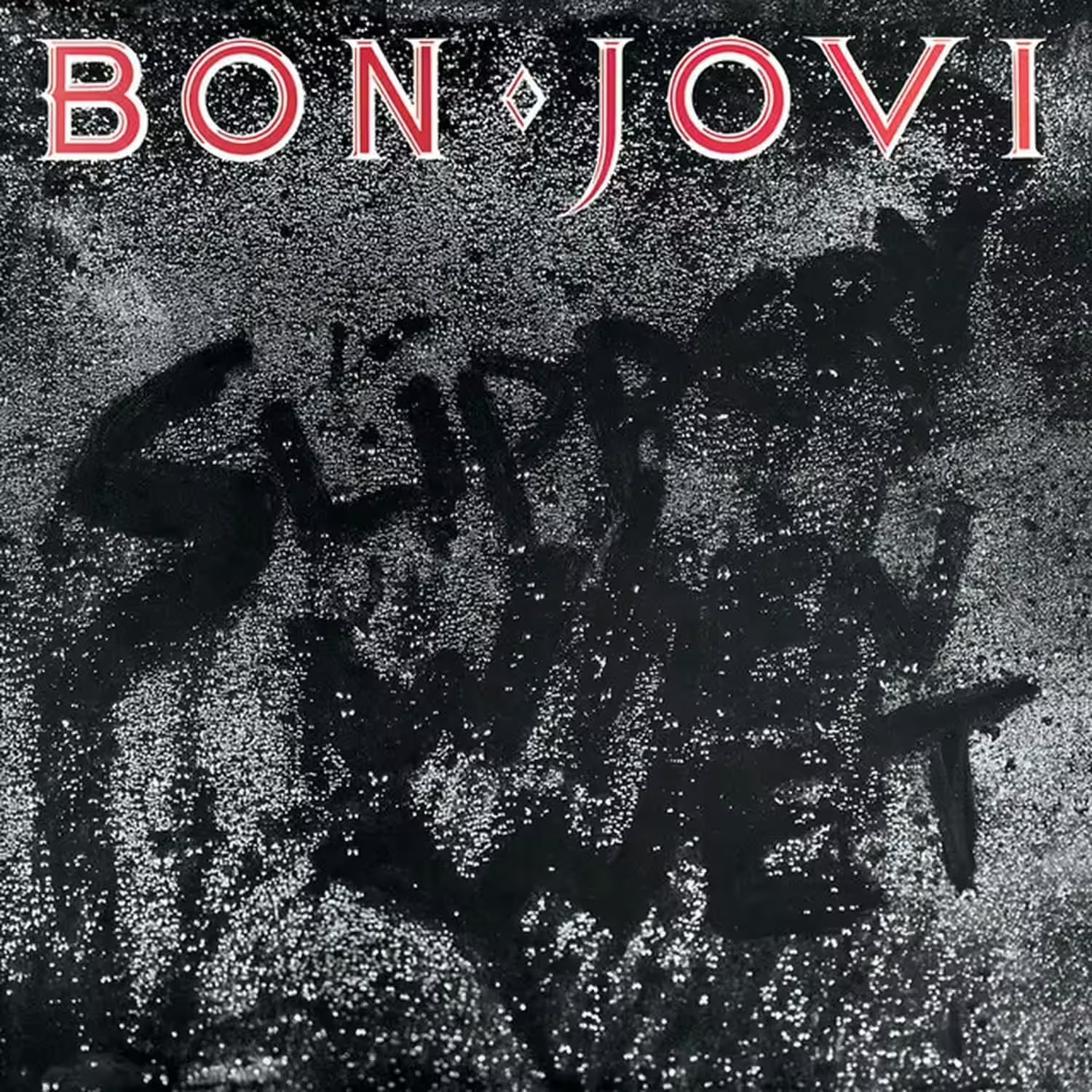
The album was meant to be called Wanted Dead or Alive and the cover was meant to be a busty model in a wet yellow T-shirt with the words across her chest. The band were meant to come back after the modest sales of 7800 Fahrenheit and put out the same kind of record as before, only slightly better. Instead Jon Bon Jovi and Richie Sambora flew to Vancouver in January 1986, sat down at Little Mountain Sound with a producer who had just made a Black 'n Blue album they happened to like, hired the most successful pop-rock songwriter in New York to co-write the hits, and then went home to New Jersey and auditioned the demos in front of groups of actual teenagers to see which ones made the kids cheer. Bon Jovi did not make Slippery When Wet by accident. They engineered it, focus-grouped it, swapped the sexist cover for a black bin-liner at the eleventh hour because the record-store chains wouldn't stock the original, and then released it knowing exactly what they had.
What they had was the biggest rock record of the late eighties. Slippery When Wet went to number one on the Billboard 200 for eight weeks, ended 1987 as the best-selling album in America, threw off two number-one singles and a top-ten ballad, eventually shipped over 15 million copies in the United States alone, and became the album that anyone trying to sell hard rock to a stadium audience for the next ten years had to either copy or argue against. Slippery When Wet is the record that, more than any other single release, defined the second-half-of-the-eighties commercial peak of American hair metal. The fact that nobody in 1986 was prepared to call it a calculated record (because it sounded so spontaneous, so good-natured, so much like Jon Bon Jovi smiling on a stage) is the album's masterstroke.
Album Facts
| Field | Detail |
|---|---|
| Artist | Bon Jovi |
| Album | Slippery When Wet |
| Release Date | 18 August 1986 |
| Label | Mercury Records (North America); Vertigo Records (international) |
| Producer | Bruce Fairbairn |
| Studio | Little Mountain Sound Studios, Vancouver, Canada (January to July 1986) |
| Genre | Glam metal, arena rock, hard rock, pop metal |
| Track Count | 10 |
| Total Runtime | 43 min 49 sec |
| Billboard 200 Peak | No. 1 (eight weeks); Billboard year-end No. 1 album of 1987 |
| UK Albums Chart Peak | No. 6 |
| Other Notable Chart Peaks | No. 1 Australia (Kent), Canada (RPM), Finland, New Zealand, Norway and Switzerland; No. 2 Austria; No. 3 Sweden; No. 5 Netherlands; No. 10 Japan (Oricon); No. 11 Germany |
| Certifications | 18x Platinum (RIAA, US); Diamond (Music Canada); 6x Platinum (ARIA, Australia); 3x Platinum (BPI, UK); Platinum or higher in Germany, Netherlands, Spain, Switzerland, Finland and more |
| Estimated Sales | Over 15 million in the US alone; widely placed at 28 million worldwide |
| Key Singles | You Give Love a Bad Name (US No. 1); Livin' on a Prayer (US No. 1); Wanted Dead or Alive (US No. 7); Never Say Goodbye |
Cultural Context
The summer of 1986 was the high-water mark of a particular kind of American rock-radio sound. MTV had been on the air for five years and was a programmable platform run by its own internal logic, with Headbangers Ball-style heavy-rotation playlists and a clear preference for big choruses, big hair and big-budget video clips. The Sunset Strip glam scene that had begun with Quiet Riot and Motley Crue earlier in the decade had matured into a fully commercialised genre: Ratt's Out of the Cellar (1984) had sold three million copies, Bon Jovi's own 1984 debut had broken modestly, and Cinderella, Poison and Warrant were either already released or queueing up behind them.
Slippery When Wet landed into that scene from the East Coast rather than from Hollywood. New Jersey instead of the Strip. The record's commercial competition in the second half of 1986 included an unusually loaded set of releases:
- Metallica, Master of Puppets (March 1986)
- Van Halen, 5150 (March 1986, the first Hagar-era record)
- Peter Gabriel, So (May 1986)
- Genesis, Invisible Touch (June 1986)
- Madonna, True Blue (June 1986)
- Megadeth, Peace Sells but Who's Buying (September 1986)
- Bruce Springsteen, Live/1975-85 (November 1986)
- Janet Jackson, Control (still selling from February 1986)
Slippery When Wet outsold all of them in the United States across 1987. Bon Jovi did this without being any of the things that made each of those records distinctive: they were neither thrash nor singer-songwriter nor prog nor pop, neither critically respectable nor underground. They simply made the most efficient possible version of an arena hard-rock album. The cultural significance of Slippery When Wet is that it gave the music business a blueprint. By the end of the eighties almost every major-label hard rock signing (Whitesnake's 1987 self-titled comeback, Def Leppard's Hysteria in 1987, Aerosmith's Permanent Vacation also in 1987, Kiss's Crazy Nights, the entire late-eighties Skid Row, Warrant and Winger emergence) had absorbed parts of the formula. Hire a Vancouver hit producer. Hire a New York hit co-writer. Lead with a melodic guitar-rock first single. Follow with a power ballad. Follow that with an MTV-friendly mid-tempo. Then tour for eighteen months.
The Band's Story Up to This Point
Bon Jovi (the band) had formed in Sayreville, New Jersey in 1983 around the singer John Francis Bongiovi Jr. The original lineup that recorded Slippery When Wet was set early: Jon Bon Jovi on lead vocals, Richie Sambora on guitar (replacing Dave Sabo, who would later form Skid Row), David Bryan on keyboards (a childhood friend of Jon's who had moved over from Atlantic City lounge work), Alec John Such on bass, and Tico Torres on drums.
Their self-titled 1984 debut had produced one Top 40 single (Runaway, originally cut as a solo demo by Jon before the band existed) and modest sales. The follow-up, 7800 Fahrenheit (1985), was generally regarded as a stumble: it produced no significant US hits, did not break the band beyond the radio rock audience they already had, and left Mercury Records nervous about whether they had a long-term proposition or another mid-card New Jersey rock act. The Black 'n Blue album Without Love, produced by Bruce Fairbairn in 1985, was what changed the equation for Jon: it had a punch and a polish that he wanted on the next Bon Jovi record.
The band came off the 7800 Fahrenheit touring cycle exhausted and on the verge of being dropped. The decision to fly to Vancouver to work with Fairbairn was framed inside the band as a make-or-break exercise. Mercury's A&R man Derek Shulman (the former vocalist of Gentle Giant, then running Polygram/Mercury's New York A&R operation) was the one who pushed Jon towards Desmond Child as a co-writer once Bryan Adams was not available for the duet idea Jon had originally been chasing. Shulman's two interventions (Fairbairn and Child) shaped the album that emerged.
Pre-production & Demos
The pre-production sessions for Slippery When Wet are the part of the story most modern Bon Jovi profiles skip past, but they are the reason the record sounds the way it sounds. The band wrote around 30 songs between late 1985 and early 1986. Most of them were Jon-and-Richie compositions worked up at home in New Jersey. Four of the eventual album's strongest tracks (You Give Love a Bad Name, Livin' on a Prayer, Without Love, I'd Die For You) were co-written with Desmond Child, who came out to New Jersey from New York City and worked the songs out with Jon and Richie in Richie Sambora's mother's basement. Child had already had hits with Kiss (I Was Made for Lovin' You, 1979), but Slippery When Wet was the launching pad for what became his late-eighties run as the most prolific hit songwriter in pop-rock.
The auditioning-the-songs-with-teenagers story is well documented and worth taking literally. The band invited groups of local New Jersey and New York teenage music fans (variously remembered as the children of friends, kids hanging around the band's neighbourhoods, and at least one organised listening session at a local pizza parlour) and played them cassette demos of all 30 songs. The teenagers ranked them. The running order of the final album was based heavily on that ranking, and at least one song that the band had initially intended to lead the record (Edge of a Broken Heart, ultimately dropped) was removed because the teenagers preferred others.
The Livin' on a Prayer story is the central pre-production anecdote. Jon Bon Jovi was initially uncertain about the song, considered it not good enough to record, and lobbied to leave it off. Sambora was the one who insisted the song had hit potential, and Sambora was the one who got Jon to go back and re-record it from scratch once the first attempt had been cut. The first version of Livin' on a Prayer (the one Jon was unhappy with) was eventually released decades later as a hidden track on the 1998 box set 100,000,000 Bon Jovi Fans Can't Be Wrong. The released version is the second cut, the one with Sambora's talkbox figure that opens the song and the Hugh McDonald bass line that drives it.
The Edge of a Broken Heart story is the second key pre-production anecdote. The song, co-written by Jon, Richie and Desmond Child, was strong enough that the band considered it for the album right up to the final running order. It was pulled at the last moment in favour of other songs the teenagers had ranked higher. The song eventually appeared on the 1987 soundtrack to the comedy film Disorderlies and as the B-side on the twelve-inch single of Livin' on a Prayer, and Jon has subsequently described the omission as a mistake.
Creating the Album
Recording proper began in January 1986 at Little Mountain Sound Studios in Vancouver and continued through to July. Little Mountain was, by this point, the studio at the centre of what was becoming an identifiable Pacific-Northwest pop-metal sound. Bruce Fairbairn had been working there as a house producer since the late seventies (his most prominent earlier work was with the Canadian band Loverboy and with Black 'n Blue). His engineer and mixer Bob Rock would, within four years, leave Little Mountain to produce Metallica's Black Album (1991), Motley Crue's Dr. Feelgood (1989) and the Cult's Sonic Temple (1989), but in 1986 he was Fairbairn's right-hand man in the room.
The production approach was deliberately layered and polished, with a level of overdubbing and arrangement work that would have been alien to the Alice Cooper band records Fairbairn had once admired. Fairbairn himself played horns and percussion on the record. Tom Keenlyside (a Vancouver session saxophonist) added saxophone parts. The Little Mountain control room ran a long working day: tracking in the morning, overdubs in the afternoon, mixing in the evening. The signature production touches that made the record sound like a Bruce Fairbairn / Bob Rock production included:
- Tightly compressed gated drum sound on Tico Torres's kit, with prominent tom fills and a snare that sits high in the mix
- Stacked, doubled, harmony-rich backing vocals on every chorus, recorded with the whole band plus guests singing into a single microphone in a circle
- Sambora's talkbox figure on Livin' on a Prayer (the moog-and-guitar-through-tube sound that opens the song), an idea Sambora had brought back from listening to Peter Frampton's mid-seventies records
- Twin overdubbed acoustic guitar layers on Wanted Dead or Alive, with Sambora playing a twelve-string Ovation in one stereo channel and a six-string in the other
- David Bryan's keyboard arrangements treated more as orchestrating colour than as featured solos, with layered string-synth pads and Hammond organ doubling guitar lines
- The uncredited Hugh McDonald bass parts on Livin' on a Prayer (and reportedly other tracks), brought in by Fairbairn as a session player when the band's own Alec John Such was struggling with the precise fills the song needed
The Hugh McDonald story is the most awkward Slippery When Wet anecdote and the one the band did not publicly confirm for years. McDonald, a New Jersey bass player who had been on Jon Bon Jovi's original Runaway demo back in 1982, was brought in to cut the bass on Livin' on a Prayer (and, depending on which source you read, on at least some other tracks). Alec John Such, the band's official bassist, was not credited as the player on those parts on the released sleeve. The wider Bon Jovi machine treated the matter as an open secret for years. When Such left the band in 1994, McDonald replaced him without fanfare and has been Bon Jovi's bass player ever since, becoming an official member of the touring band in 2016. He is in many practical senses the only bassist Bon Jovi has ever had on record.
"I liked what Bryan Adams had done with Tina Turner, so I suggested we do something similar. Our A&R guy came up with Desmond's name. He hasn't tried to change what we are, but to refine it slightly; to suggest extra ways that we could wring a bit more out of what we had."
Jon Bon Jovi, Classic Rock magazine, July 2006
Recording wrapped in July 1986. George Marino at Sterling Sound in New York mastered the album. The total tracking and mixing time, from January to July, was unusually long for a Fairbairn record (his Aerosmith albums in subsequent years would be cut faster) and reflected both the number of songs the band were sifting through and Fairbairn's iterative approach to arrangements.
Personnel & Credits
| Role | Player | Notes |
|---|---|---|
| Bon Jovi | ||
| Lead and backing vocals | Jon Bon Jovi | Co-writer on every track |
| Electric and acoustic guitar, guitar synths, talkbox, backing vocals | Richie Sambora | Co-writer on every track except Wild in the Streets; the talkbox figure on Livin' on a Prayer is his |
| Keyboards, backing vocals, "various noises" | David Bryan | Co-wrote the Japan-only single Borderline with Jon |
| Bass, backing vocals | Alec John Such | Credited on every track, although Hugh McDonald played bass on at least Livin' on a Prayer |
| Drums, percussion | Tico Torres | |
| Additional and uncredited musicians | ||
| Bass (uncredited) | Hugh McDonald | Played the bass parts on Livin' on a Prayer (and reportedly elsewhere); joined Bon Jovi officially in 1994 |
| Backing vocals on Livin' on a Prayer (uncredited) | Joani Bye, Nancy Nash | Both were Vancouver session vocalists working through Fairbairn |
| Possible backing vocals on Livin' on a Prayer (uncredited) | Mike Reno | The Loverboy frontman; confirmed his contribution in a 2022 Loudwire interview |
| Saxophone | Tom Keenlyside | Vancouver session saxophonist |
| Horns and percussion | Bruce Fairbairn | The producer played horn parts himself |
| Songwriting (four tracks) | Desmond Child | Co-writer on You Give Love a Bad Name, Livin' on a Prayer, Without Love, I'd Die For You |
| Production and engineering | ||
| Producer | Bruce Fairbairn | Died May 1999, aged 49, before his ongoing Aerosmith and AC/DC projects could be completed |
| Engineer and mixer | Bob Rock | Within four years would move from Little Mountain into producing Metallica's Black Album |
| Assistant engineer | Tim Crich | |
| Digital remastering | George Marino | At Sterling Sound, New York |
| Artwork | ||
| Art direction | Bill Levy | |
| Photography | Mark Weiss | Shot both the rejected wet-T-shirt cover and the eventually released bin-liner cover |
| Design | George Corsillo | |
The Songs
| # | Title | Writer(s) | Length | Single? | Notes |
|---|---|---|---|---|---|
| 1 | Let It Rock | Bon Jovi, Sambora | 5:26 | Opens with a long Hammond-organ intro from David Bryan that became a permanent live show opener | |
| 2 | You Give Love a Bad Name | Bon Jovi, Sambora, Desmond Child | 3:43 | A-side, July 1986 | First single; US No. 1 on Hot 100; lyric originally written by Child for Bonnie Tyler as If You Were a Woman (And I Was a Man) |
| 3 | Livin' on a Prayer | Bon Jovi, Sambora, Child | 4:11 | A-side, October 1986 | Second single; US No. 1; Tommy and Gina; Sambora's talkbox riff; Hugh McDonald (uncredited) on bass |
| 4 | Social Disease | Bon Jovi, Sambora | 4:18 | Aerosmith reportedly tried to take the song for themselves; Bon Jovi kept it | |
| 5 | Wanted Dead or Alive | Bon Jovi, Sambora | 5:09 | A-side, March 1987 | Third single; US No. 7; cowboy-on-a-steel-horse ballad with the twin acoustic guitar arrangement |
| 6 | Raise Your Hands | Bon Jovi, Sambora | 4:17 | Permanent show-opener fixture from 1986 onwards | |
| 7 | Without Love | Bon Jovi, Sambora, Child | 3:31 | Fourth co-write with Child; not a single but a long-time live staple | |
| 8 | I'd Die For You | Bon Jovi, Sambora, Child | 4:31 | The third co-write with Child; B-side of the Wanted Dead or Alive single | |
| 9 | Never Say Goodbye | Bon Jovi, Sambora | 4:49 | A-side, June 1987 | Fourth single; the band's first true power ballad, with a Sambora acoustic intro |
| 10 | Wild in the Streets | Jon Bon Jovi | 3:56 | The only solo Jon Bon Jovi composition on the record; closes the album |
You Give Love a Bad Name
The chorus that opens the album proper is one of the most famous in eighties hard rock. The four-bar drop into "Shot through the heart and you're to blame" sets the entire commercial premise of Slippery When Wet inside the first eight seconds. The melodic line was repurposed by Desmond Child from an earlier song he had written for Bonnie Tyler (If You Were a Woman (And I Was a Man), released by Tyler in early 1986 to limited success). Child had brought the chorus into the New Jersey writing sessions with Jon and Richie, where it was reworked into the Bon Jovi version. The single went to number one on the Billboard Hot 100 in November 1986, becoming the band's first US number-one single.
Livin' on a Prayer
The album's signature song and one of the most recognisable American rock recordings of the eighties. The narrative (Tommy works on the docks, Gina works the diner all day) has often been read as a Springsteen tribute by way of the New Jersey suburbs. The production highlights are the Sambora talkbox figure that opens the track (played on a Heil Talkbox he had bought specifically for these sessions after years of listening to Peter Frampton), the modulation up a key in the final chorus (an idea Fairbairn pushed in the studio when the band had originally written the song in one key throughout), the Hugh McDonald bass line, and the layered backing vocals tracked in Little Mountain's main room. The song hit number one on the Billboard Hot 100 in February 1987 and spent four weeks at the top.
Wanted Dead or Alive
The album's third single and the closest thing to a stylistic departure on the record. Sambora's twin-acoustic guitar arrangement (a twelve-string Ovation in one channel, a six-string in the other) gave the song an open Western feel that read on radio as Bon Jovi doing a cowboy ballad. The lyric (a touring band as a band of outlaws on horseback) was a Jon Bon Jovi conceit that survived multiple lyric revisions. The single peaked at number seven on the Billboard Hot 100 and gave the album its third top-ten single. The accompanying music video, shot in black and white on the band's then-current tour, became a perennial MTV fixture.
Social Disease
One of the album's overlooked tracks, despite Jon Bon Jovi telling Classic Rock at the time that Aerosmith had been keen to record it themselves. The song is built on a swaggering Sambora riff with a horn arrangement (Fairbairn playing) layered into the chorus. Jon's published quote in 1986 was that Aerosmith would have been ideal for it but he was not going to give it away because it was even better for Bon Jovi.
Never Say Goodbye
The album's fourth and final single, released in June 1987 as the touring cycle peaked. The song is the album's purest power ballad: Sambora's slow-arpeggiated acoustic intro, a long Jon vocal verse, a slow-build to the full-band chorus with David Bryan's piano carrying the harmonic weight. The single's video was filmed during the Slippery When Wet tour in early 1987 and intercut concert footage with a high-school dance narrative.
Wild in the Streets
The album closer is the only song on the record credited solely to Jon Bon Jovi. The arrangement is the simplest on the album (one verse, one chorus, a brief bridge, a long outro) and the lyric is the closest the record gets to straight-ahead street-rock posturing. Wild in the Streets has had a strange afterlife: it has been used as a touring opening number repeatedly, was recut as a Wembley live version on the 1995 tour, and appeared as a single in some European territories.
B-sides, Outtakes & Lost Songs
The recording sessions yielded several songs that did not make the final ten-track album. The two most significant outtakes are Edge of a Broken Heart (a Jon, Richie, Child co-write that was originally intended for the album but pulled in favour of others after the teenager-listening sessions, eventually appearing on the soundtrack to the 1987 film Disorderlies and as a twelve-inch B-side) and Borderline (a Jon and David Bryan co-write that was released only in Japan, as both a single and a short EP, in 1986). Borderline has never been issued in its studio form outside Japan and remains the rarest Slippery When Wet-era recording.
The original first attempt at Livin' on a Prayer (the one Jon Bon Jovi wanted to leave off the record before Sambora pushed him into recutting it) sat in the vaults for twelve years before appearing as a hidden track on the 1998 box set 100,000,000 Bon Jovi Fans Can't Be Wrong. The first version is slower, less polished, and missing the talkbox intro entirely, and is best heard as an instructive negative example of what the second version got right.
The 2014 New Jersey deluxe edition and the 2024 Thank You, Goodnight box set have surfaced an alternate mix of Livin' on a Prayer (different vocal take, drier mix), an extended version of Raise Your Hands (an Obie O'Brien mix that runs 5:38) and three live recordings from the 1987 tour (Cobo Arena Detroit in March, Cincinnati Gardens in March, Nassau Coliseum in April). The Nassau Coliseum Let It Rock runs to almost twelve minutes and is the longest officially released version of any Slippery When Wet song.
Album Artwork & Packaging
The original cover for Slippery When Wet was photographed by Mark Weiss and showed a busty model in a wet yellow T-shirt, with the words "Slippery When Wet" stretched across the chest. The shoot was carried out as planned, the artwork was finalised, the original record sleeves were proofed. American record-store chains then made it clear they would not stock the album. Walmart, K-Mart and the suburban shopping-mall record chains that dominated American physical music retail in the mid-eighties had a strict policy on overtly sexual album covers, and the wet-T-shirt cover would have meant either a refusal to stock the album or a sticker over the artwork that the band found embarrassing. Jon Bon Jovi has separately said he had grown to dislike the pink border the design team had put around the photograph.
The replacement cover was put together in a hurry. Mark Weiss photographed a black bin-liner (or a black trash bag, as the American liner notes had it) with water beads on it, and the album title was drawn into the water by a finger, then re-shot. The result is one of the most stripped-back covers ever to grace a multi-million-selling rock record: a flat black background, water droplets, a finger-drawn title, the Bon Jovi logo in red across the top. Sambora has described the new cover with characteristic honesty as "so simple, and not very impressive". Audiences, on the evidence of the sales, did not care.
The original wet T-shirt cover was retained for the Japanese release, which is still the most collected of the album's first-pressing variants. The proposed alternative title, Wanted Dead or Alive, was abandoned at the same time as the original cover was pulled, but a cowboy-themed cover that had been mocked up for that version was later used on the seven-inch single sleeve of the song Wanted Dead or Alive when it was released in March 1987.
The interior gatefold (in vinyl pressings) and CD booklet contained black-and-white band shots taken by Weiss during the same Vancouver session that produced the cover, together with the lyric sheet. The Polish-American designer George Corsillo (later best known for designing several Disney film campaigns) handled the layout.
Release & Reception
Mercury Records released Slippery When Wet across North America on 18 August 1986, with Vertigo Records handling international markets the same week. The lead single You Give Love a Bad Name had gone to radio four weeks earlier (23 July 1986) to set the album up, and the radio response was strong enough that the album debuted on the Billboard 200 the week of its release and climbed steadily across the autumn. Livin' on a Prayer, released on Halloween 1986, was the single that took the album to number one on the Billboard 200 in early 1987, where it remained for eight weeks.
Contemporary critical reception was sharply split, and the split aligned almost exactly along the rock-establishment fault line of the mid-eighties. Rolling Stone, in a notoriously hostile retrospective review by Jimmy Guterman in November 1990, dismissed the album as a fourth-generation metal smudge. AllMusic's Andrew Leahey, working with the benefit of more distance, gave the album four and a half stars and credited it with effectively defining its genre. Robert Christgau, writing in the Village Voice in September 1987, gave the album a B− but admitted (in a sentence that has been quoted by every Bon Jovi defender since) that he was not in fact immune to Livin' on a Prayer.
"Sure seven million teenagers can be wrong, but their assent is not without a certain documentary satisfaction. Yes, it proves that youth rebellion is toothless enough to simulate and market. But who the hell thought youth was dangerous in the current vacuum? And are you really immune to 'Livin' on a Prayer'?"
Robert Christgau, The Village Voice, September 1987
"Jon Bon Jovi and his band serve up condescending sentiment, reducing every emotional statement to a barefaced cliche, either because they think that's all their audience can comprehend or because that's all they can comprehend. On Slippery When Wet, Bon Jovi sounds like bad fourth-generation metal, a smudgy Xerox of Quiet Riot."
Jimmy Guterman, Rolling Stone, November 1990
"Slippery When Wet effectively defined hair metal for years to come. The hooks are big enough to fill an arena, the production gleams, and Jon Bon Jovi's vocals are some of the finest of his career. It is the perfect distillation of everything that made the genre work."
Andrew Leahey, AllMusic, four-and-a-half-star retrospective review
The commercial picture, by contrast, was unanimous. The album spent eight weeks at number one on the Billboard 200, 38 weeks inside the top five, and ended 1987 as Billboard's number-one album of the year. It went to number one in Australia, Canada, Finland, New Zealand, Norway and Switzerland, number two in Austria, number three in Sweden, number five in the Netherlands, number six in the UK, number ten in Japan and number eleven in Germany. The album has been certified 18x Platinum by the RIAA (corresponding to 15 million-plus US sales), Diamond by Music Canada, 6x Platinum by ARIA in Australia, 3x Platinum by the BPI in the UK, and Platinum or higher in Germany, Netherlands, Spain, Switzerland and Finland. Global sales have been variously placed at between 20 and 28 million, with the higher figure quoted by Bon Jovi's own management.
Singles & Music Videos
| Single | Released | Territory | Chart peak | Notes |
|---|---|---|---|---|
| You Give Love a Bad Name | 23 July 1986 | Worldwide | No. 1 US Hot 100; No. 14 UK | Video directed by Wayne Isham; concert performance shot in Indianapolis |
| Livin' on a Prayer | 31 October 1986 | Worldwide | No. 1 US Hot 100 (4 weeks); No. 4 UK | Two videos: the original "rehearsal" black-and-white clip and the famous live-tracked video from the 1986-87 tour; both directed by Wayne Isham |
| Wanted Dead or Alive | 2 March 1987 | Worldwide | No. 7 US Hot 100; No. 13 UK | Black-and-white tour-footage video by Wayne Isham; included footage of the band's stage entry rituals |
| Never Say Goodbye | 15 June 1987 | Worldwide | No. 28 US Hot 100; No. 21 UK | Concept video by Wayne Isham; a high-school dance narrative intercut with concert footage |
Wayne Isham's music videos for the four singles defined the visual language of Bon Jovi for the next several years. Isham was an LA-based video director who had previously worked with Motley Crue and Aerosmith and would go on to direct most of Bon Jovi's video output through the early nineties. The Livin' on a Prayer video is the most-played: the second version of the clip, shot in colour on a stadium stage with backstage and tour-bus footage cut in, is the version that ran on MTV throughout 1987 and was responsible for cementing the band's visual identity (Jon's hair, Sambora's hat, the talkbox in close-up) in popular memory.
Touring & Live
The Slippery When Wet Tour ran from October 1986 (a club-and-theatre warm-up leg in North America) through October 1987 (the final stadium leg in Australia and New Zealand), with intermediate legs across Europe in early 1987, North American arenas through spring 1987, the UK and Ireland in May 1987, and Japan in July 1987. The total tour was around 130 shows over 14 months. The band were on stage almost every night, opening with Pink Floyd's "We don't need no education" sample looping into Let It Rock, and closing with extended versions of Wanted Dead or Alive and Livin' on a Prayer.
Tour milestones included:
- Opening for ZZ Top on the first US arena leg in autumn 1986 (the band were the support act on a Slippery When Wet tour leg that was nominally not even theirs)
- Headlining Hammersmith Odeon in London in May 1987 for two sold-out nights
- Three sold-out nights at the Cobo Arena in Detroit in March 1987, recorded for later live release
- Headlining the closing night of the Monsters of Rock festival at Castle Donington in August 1987 (above Dio, Metallica, Anthrax, W.A.S.P. and Cinderella), Bon Jovi's debut at the festival
- An Australian and New Zealand stadium leg in September and October 1987 that drew the band's largest audiences to date in either country
- Jon Bon Jovi being treated for vocal-cord damage at multiple points across the tour; the band were forced to reschedule several dates
The Monsters of Rock 1987 headlining slot was the moment Bon Jovi crossed from "hair metal commercial peak" into "biggest hard rock band in the world". The festival audience, which had only the year before sat through Ozzy Osbourne headlining, accepted the band as the natural top-of-the-bill act, and the band's set list (drawing entirely from Slippery When Wet and the previous two albums) became the template for arena tours by every American rock band that followed them through the decade.
In TV, Film & Media
Slippery When Wet's afterlife in TV, film and other media is unusually rich for an eighties hard rock album, because Livin' on a Prayer and You Give Love a Bad Name have become baseline cultural reference points that any film or TV show set in or about the eighties has reached for at one point or another. Livin' on a Prayer in particular has appeared in dozens of high-profile productions: as a recurring needle drop in The Sopranos, as the karaoke choice in Mark Wahlberg's Rock Star (2001), as wedding-reception comedy fodder in How I Met Your Mother and Friends, as a pivotal plot moment in Glee, and on dozens of other shows. It has been used in trailers for everything from action films to RomComs. The song has been a fixture in American sports stadiums since the late eighties.
Wanted Dead or Alive has been similarly heavily licensed: it has been used in Young Guns II (1990) without the band's permission, was eventually settled out of court, became a sports-arena fixture in the western United States, and has been used as the entrance music for at least three professional wrestlers. You Give Love a Bad Name has been used in television commercials for everything from car insurance to fizzy drinks.
The 2024 documentary series Thank You, Goodnight: The Bon Jovi Story (Hulu) devotes substantial time to the making of Slippery When Wet and includes the only on-camera footage to date of the original Little Mountain sessions, plus a long Sambora-on-Sambora reflection on the talkbox part of Livin' on a Prayer. The series is also the primary source for the official confirmation, decades after the fact, of Hugh McDonald's bass work on the album.
Controversy & the Cover Row
The two notable controversies attached to Slippery When Wet are the rejected wet-T-shirt cover (covered in the Artwork section above) and the Hugh McDonald credits row. The band were not the first rock act to have a cover rejected by American chain retailers, but they were one of the most visible, and the speed with which they swapped the artwork (essentially overnight) became a case study in how the late-eighties American music industry could be steered by Walmart and K-Mart's stocking decisions.
The Hugh McDonald story has never developed into a full controversy because Alec John Such did not publicly object to the credit arrangement at the time, and because his subsequent 1994 departure from the band was framed around different issues (his retirement from touring rather than a session-musician dispute). The story has nevertheless been a recurring source of fan discussion since the truth began to leak through Premier Guitar interviews in the mid-2010s and was finally given official Bon Jovi confirmation in the 2024 Hulu documentary.
Beyond those two issues the album has not attracted the kinds of legal, religious or political controversies common to its hard-rock contemporaries. There are no banned-in-particular-markets stories, no sampling lawsuits, no parental advisory-sticker history. The album was widely covered by Tipper Gore's PMRC complaints in the late eighties as part of the wider hair-metal moral panic, but Slippery When Wet specifically was not on the PMRC's Filthy Fifteen list.
Covers, Samples & Tributes
The songs on Slippery When Wet have been covered extensively across genres, often in ways that test the assumption that the album is too eighties to translate. Notable covers and reinterpretations include:
- Livin' on a Prayer covered by the Newton Brothers as a slow-tempo ballad for the soundtrack to the 2007 film Smokin' Aces
- You Give Love a Bad Name covered by Blake Lewis on American Idol (2007), and later by Korean girl group Loona on their 2018 Hi High EP
- Wanted Dead or Alive covered by Chris Daughtry as the song that broke him on American Idol's fifth season in 2006
- Livin' on a Prayer mashed-up with One Direction's What Makes You Beautiful by the Hollywood Undead-adjacent Vibe Kid as a viral TikTok recut in 2021
- An entire 2014 tribute album, Lost Highway: A Tribute to Bon Jovi, on which Living Colour cover You Give Love a Bad Name and Halestorm cover Wanted Dead or Alive
- Wanted Dead or Alive being covered live by Bon Jovi themselves with Jon swapping his vocals out for an extended Tico Torres drum break at the famous 1995 Wembley shows captured on Live from London (1996)
The album itself has not been heavily sampled in the hip-hop sense (largely because Bon Jovi's publishing has historically been protective of synchronisation rights and because the songs are not particularly riff-loop-friendly), but Livin' on a Prayer has been interpolated into several charting pop singles, most prominently by Pitbull and Christina Aguilera on the 2014 single We Are One (Ole Ola), the official song of that year's FIFA World Cup, which lifts a vocal melody from the Slippery When Wet song without sampling the original recording.
Reissues, Remasters & Anniversaries
The album's reissue history has been unusually modest given its commercial stature. The major editions are:
- 1986 original CD pressing alongside vinyl and cassette (Mercury 830 264-2)
- 1998 inclusion in the four-disc box set 100,000,000 Bon Jovi Fans Can't Be Wrong, which surfaced the first attempted version of Livin' on a Prayer as a hidden track
- 2005 DualDisc reissue (CD side with a newly remastered version; DVD side with the original stereo mix, a 5.1 surround sound mix, all five music videos, and several extended-runtime versions of songs)
- 2014 vinyl reissue on heavyweight vinyl as part of Mercury's catalogue Bon Jovi reissue programme
- 2024 inclusion in the Thank You, Goodnight: The Bon Jovi Story box set (in conjunction with the Hulu documentary series), which surfaced an alternate Livin' on a Prayer mix and the Obie O'Brien extended Raise Your Hands
The 40th anniversary in 2026 has prompted persistent rumours of a definitive super-deluxe edition with the unreleased outtakes, the Borderline Japan single, and full sets from the Cobo Arena and Cincinnati Gardens 1987 dates. As of late 2026 no such release has been confirmed. The 2005 DualDisc 5.1 mix remains the best-sounding officially released version of the album for home-cinema listening.
Legacy & Influence
The two clearest legacies of Slippery When Wet are commercial and methodological. Commercially, the album set the template for late-eighties American hard rock success: Def Leppard's Hysteria (1987), Whitesnake's self-titled comeback (1987), Aerosmith's Permanent Vacation (1987), Cinderella's Long Cold Winter (1988) and the entire Skid Row, Warrant, Winger and Firehouse wave that followed all owe direct debts to the Slippery When Wet formula. Most of them used the same Bruce Fairbairn and Bob Rock at Little Mountain Sound team. Several worked with Desmond Child. All of them studied the Bon Jovi singles cycle (lead with a hard-rock first single, follow with a power ballad, follow that with a mid-tempo, follow that with another power ballad) and copied it.
Methodologically, the album normalised the use of an external hit-songwriter on a rock record. Before Slippery When Wet, the prevailing assumption in American hard rock was that the band wrote the songs in-house and the producer simply captured them. After Slippery When Wet, hiring a Desmond Child (or a Diane Warren, or a Holly Knight, or a Jim Vallance) became standard practice for any rock band looking for a commercial breakthrough. Aerosmith's late-eighties resurgence was built directly on this template. Cher's late-eighties pop-rock makeover was built on the same template. Even Joan Jett, Kiss and Alice Cooper turned to Child for material in the late eighties and early nineties on the strength of his Bon Jovi work.
"What Bon Jovi did on Slippery When Wet changed the rules. We were no longer just rock bands making records. We were rock bands making singles, multiple singles, and we had to think about each one. Desmond Child changed that. Bruce Fairbairn changed that. Bon Jovi proved it could be done."
Sebastian Bach, interviewed for Decibel Geek podcast, 2014
The album's standing in retrospective genre lists has been consistently high. Rolling Stone ranked it number three on its 2019 list of the 50 Greatest Hair Metal Albums of All Time. Loudwire's Top 30 Hair Metal Albums put it at number five. Loudwire's Best Hard Rock Album of Each Year Since 1970 named it the top hard rock album of 1986. The Rock and Roll Hall of Fame's Definitive 200 Albums list (compiled in 2007) placed Slippery When Wet at number 44. The album's chart durability in catalogue terms has also been notable: it has continued to chart on the Billboard Top Catalog Albums chart almost every year since the late nineties, has never been out of print, and is one of a small handful of mid-eighties hard rock albums that streams strongly on Spotify in the 2020s.
Things You Might Not Know
| Fact | Detail |
|---|---|
| The teenagers ranked the songs | The band wrote around 30 songs for the album and then auditioned cassette demos for groups of local New Jersey and New York teenagers, using the teenagers' rankings to choose the final ten and set the running order. |
| The strip-club title | The album is named after The No. 5 Orange strip club in Vancouver, where the band became regular visitors during the Little Mountain sessions; a dancer descended from the ceiling on a pole and was the inspiration Richie Sambora has credited for the title. |
| The rejected cover | The original cover, photographed by Mark Weiss, was a busty model in a wet yellow T-shirt with the album title across the chest; American chain retailers refused to stock it and the band swapped it for the black bin-liner cover at the eleventh hour. |
| The Japanese exception | The original wet-T-shirt cover was kept for the Japanese release of the album, making the Japanese pressing the most collected first-pressing variant. |
| Hugh McDonald's bass | The bass on Livin' on a Prayer (and reportedly other tracks) was played by Hugh McDonald, not by the band's then-bassist Alec John Such; McDonald was uncredited on the original sleeve and only officially joined the band in 1994, becoming a full member in 2016. |
| The first Livin' on a Prayer | The band cut Livin' on a Prayer twice: Jon Bon Jovi was unhappy with the first version, Sambora pushed him to recut it, and the discarded first take was released as a hidden track on the 1998 box set 100,000,000 Bon Jovi Fans Can't Be Wrong. |
| The Bonnie Tyler chorus | The "Shot through the heart" chorus of You Give Love a Bad Name was rewritten by Desmond Child from a chorus he had previously written for Bonnie Tyler's 1986 single If You Were a Woman (And I Was a Man). |
| Mike Reno on backing vocals | Loverboy's Mike Reno told Loudwire in 2022 that he was one of the uncredited backing vocalists on Livin' on a Prayer; the song was tracked in the same Vancouver studio Loverboy were working out of at the time. |
| The Aerosmith near-miss | Jon Bon Jovi told Classic Rock in 1986 that Aerosmith had been keen to record Social Disease themselves but he refused to give the song away because it was even better for Bon Jovi. |
| The Japan-only single | Borderline, co-written by Jon Bon Jovi and David Bryan during the Slippery When Wet sessions, was released only in Japan as a single and short EP and has never officially appeared anywhere else. |
| The seven-month Vancouver sessions | Recording stretched from January to July 1986 at Little Mountain Sound, an unusually long tracking and mixing time for a Bruce Fairbairn record, reflecting both the volume of songs the band were sifting through and Fairbairn's iterative arrangement approach. |
| The Sambora talkbox | Richie Sambora bought a Heil Talkbox specifically for the Slippery When Wet sessions after years of listening to Peter Frampton; the instrument's signature appearance on Livin' on a Prayer launched a brief late-eighties hard-rock revival of the device. |
| The Donington crown | Bon Jovi headlined the Monsters of Rock festival at Castle Donington in August 1987 above Dio, Metallica, Anthrax, W.A.S.P. and Cinderella; it was their first appearance at the festival and effectively the moment they were crowned the biggest hard rock band in the world. |
| Bob Rock's launchpad | Bob Rock engineered and mixed Slippery When Wet as Bruce Fairbairn's right-hand man; within four years he had moved into the producer's chair himself, where his first major production was Motley Crue's Dr. Feelgood (1989), and his most famous was Metallica's Black Album (1991). |
| The wedding-reception law | Livin' on a Prayer has been the single most-played song at American wedding receptions every year since the early 2000s according to multiple Spotify and DJ-trade-publication surveys; the song has become a non-negotiable late-evening standard. |
Podcast
Slippery When Wet is one of those records that pays back any amount of close attention you give it, and the Riffology podcast loves to dig into the engineering choices and the studio anecdotes that turned a mid-card New Jersey hair-metal band into the biggest rock act in the world for a couple of years. Find us on Apple Podcasts, Spotify, Amazon Music and Pocket Casts, subscribe and rate, and let us know which Bon Jovi record (New Jersey? Keep the Faith? Crush? These Days?) you would like to hear us break down next.