Bill Steer played every rhythm guitar on Necroticism – Descanting the Insalubrious. He had just spent the back end of the Symphonies of Sickness tour breaking in a new four-piece lineup with Michael Amott, the Swedish lead guitarist poached from Carnage; the press releases all promised Carcass's "new twin-guitar attack"; and yet when the band walked into Amazon Studios in Simonswood with Colin Richardson in 1991, Steer tracked every riff himself and let Amott contribute exactly one rhythm part to the whole record. The album that came out of those sessions, with its eight long-form tracks of harmonised leads, medical-dictionary lyrics and surgical mid-paced grooves, is the record that turned grindcore into technical death metal. It just wasn't, mostly, twin-guitar.
Released through Earache Records on 30 October 1991 (Relativity handled the US issue the following February), Necroticism is the album where Carcass stopped sounding like a band whose drummer used to play in a thrash group called Disattack and started sounding like a band that medical and forensic students would namecheck for the rest of their lives. The full title, sometimes shortened to Necroticism: Descanting the Insalubrious, with a colon rather than an en-dash, was invented by drummer Ken Owen, who handled the bulk of the riffs as he had on the first two records. Eighteen months later it would be in the Decibel Hall of Fame queue. Thirty-five years on, you can still trace a direct line from Necroticism through Arch Enemy, The Black Dahlia Murder, Cattle Decapitation and most of the bands now headlining the European death metal festivals.
Album Facts
| Field | Detail |
|---|---|
| Artist | Carcass |
| Album | Necroticism – Descanting the Insalubrious |
| Release date | 30 October 1991 (Europe, Earache) · 11 February 1992 (North America, Relativity) |
| Label | Earache Records · Relativity Records |
| Producer | Colin Richardson (production, mixing); Carcass (mixing) |
| Engineer | Keith Hartley (with Ian McFarlane and Dave Buchmann assisting) |
| Studio | Amazon Studios, Simonswood, Lancashire, UK |
| Genre / subgenre | Technical death metal, progressive death metal |
| Track count | 8 (plus 3 bonus tracks on 2008 reissue) |
| Total runtime | 48:03 |
| Billboard 200 peak | Did not chart |
| UK Albums Chart peak | Did not chart |
| Other chart peaks | UK Indie Albums Chart (Earache mid-1991 release window) |
| Certifications | None reported |
| Estimated sales | Not officially disclosed; one of Earache's top-selling early-1990s catalogue titles |
| Key singles / videos | "Corporal Jigsore Quandary" (promo video) |
Cultural Context
October 1991 was a strange month for heavy music. Nirvana had released Nevermind a fortnight earlier. Metallica's Black Album was about to spend a fifth week at the top of the Billboard 200. Pearl Jam's Ten was creeping up the back end of the same chart, and Guns N' Roses had just put out two albums on the same day. The mainstream was, in other words, busy being colossal.
Death metal was having a parallel, smaller and much louder year. Death's Human, Morbid Angel's Blessed Are the Sick, Entombed's Clandestine, Sepultura's Arise and Obituary's Cause of Death had all landed in the same twelve-month window. Earache Records, the Nottingham label that had signed Carcass on what Jeff Walker once described as a gentleman's agreement, was at the centre of the British end of that scene, running the Grindcrusher tour and being courted by major labels who couldn't quite believe how many copies of a Bolt Thrower record could move off Indie Chart shelves.
Into that thirty-day window dropped a record by four Liverpool lads, with eight songs, an average length around six minutes, harmonised twin-lead guitar parts, and a sleeve printed in pale clinical greens with no gore at all. Critically, it landed in two camps at once. Old Carcass fans heard a band that had cleaned itself up beyond recognition. New death metal converts heard the album that justified the whole subgenre.
- Released in the same month as Nirvana's Nevermind, Pearl Jam's Ten and Soundgarden's Badmotorfinger.
- Earache stablemates Bolt Thrower and Napalm Death were both UK Indie Chart fixtures that autumn.
- Death's Human, the other big "technical" death metal record of 1991, came out three weeks before Necroticism.
- Carcass's first two albums had been championed on BBC Radio 1 by John Peel, a level of national-network endorsement no other goregrind act ever got.
The Band Up to This Point
Carcass were a school project before they were a band. Bill Steer and Ken Owen had played together as teenagers in Liverpool, and Steer had moonlighted as a guitarist in Napalm Death long enough to record half of the side-A blast on Scum. Bassist and lyricist Jeff Walker arrived from the Electro Hippies, the British anarcho-grindcore band that had practically invented the eighteen-second song. Their 1988 debut Reek of Putrefaction, recorded in four days for next to nothing, was so sonically degraded that Walker has spent the rest of his career disowning the production while admitting the songs were good. John Peel adored it.
1989's Symphonies of Sickness changed the trajectory. Earache paired the band with producer Colin Richardson, the Manchester-based engineer who would go on to mix everyone from Machine Head to Bullet for My Valentine, and the result was an audible Carcass for the first time. Songs grew past a minute, riffs became identifiable, and the medical-dictionary lyric style that Owen and Steer had been workshopping in the sleeve notes started to land. By the end of that year the band were on the road across Europe with Napalm Death, Bolt Thrower and Morbid Angel on the Earache "Grindcrusher" tour.
The second leg of the Symphonies tour added Michael Amott on second guitar. Amott was the lead guitarist of fellow Earache act Carnage, the Swedish group that included the future Dismember and Entombed members and was already half-disbanded. He was twenty-one, sober, schooled in Thin Lizzy and UFO harmonies as much as in Slayer riffs, and he gave Carcass for the first time a player who could write the kind of melodic guitar lead that Necroticism would soon need on every track.
"Reek was written equally between me, Bill and Ken. Symphonies was mostly Ken's riffs and my lyrics. Necroticism was Ken, Bill and Mike Amott who had joined the band, and my lyrics. So the musical axis was constantly changing."
Jeff Walker, Mindrot webzine, 1995
Pre-production and Demos
The Symphonies tour finished in spring 1990 and Carcass disappeared back into a Liverpool rehearsal room as a four-piece for the first time. Owen, who had handled most of the riff-writing on the previous two albums, kept his pencil sharp and arrived at rehearsals with a stockpile of riffs that were noticeably longer and more structurally ambitious than anything on Symphonies. Steer, who had spent two years touring his own breakneck rhythm parts, started writing in the same direction. By his own account on the Pathologist's Report documentary years later, the songs were arranged in the rehearsal room with everyone bouncing parts off each other, then taken to Owen to glue together with drum patterns that were beginning to incorporate jazz-inflected fills he had been quietly working on.
Amott's role at this stage was the smallest of the four. He sat with Steer and worked out lead guitar lines over the finished rhythm sections, contributed the riff that became part of "Corporal Jigsore Quandary" (the song he is co-credited on, alongside Steer and Owen), and otherwise let the riff-writing happen around him. He also took a chunk of "Incarnated Solvent Abuse", the other Steer/Amott co-credit on the tracklist.
A demo for the album was recorded for John Peel's BBC Radio 1 show as the band's second Peel Session, with the band performing under the medical-pseudonym credits ("K. Grumegargler", "J. Offalmangler", "W.G. Thorax Embalmer") that had become a Carcass running joke. These early versions reveal songs that were almost finished structurally, with some of the harmonised leads already in place; the studio versions tightened the drumming and added the production sheen that became one of the album's defining qualities.
Creating the Album
Carcass booked Amazon Studios in Simonswood, Lancashire, for the summer of 1991. The choice was practical. Colin Richardson worked there regularly; the rates suited Earache's budget; and the room was used to bands that wanted a clear, dry, midrange-rich rock sound rather than the cavernous reverb that Florida death metal records were drowning in. Keith Hartley engineered, with Ian McFarlane and Dave Buchmann assisting.
The session set-up was unusual for a death metal record of the era. Steer tracked every rhythm guitar himself, double-tracking each riff for the wall-of-sound thickness the songs needed. Richardson then handed the leads over to Amott, who layered the harmonised twin solos that became the album's calling card, the spiralling, melodic, almost Wishbone Ash co-leads on "Corporal Jigsore Quandary", the bluesy bend at the head of "Incarnated Solvent Abuse", the mournful counterpoint on "Forensic Clinicism". Walker tracked bass clean and brought it forward in the mix, with the dry, trebly tone that has been his trademark ever since. Owen recorded a full drum kit with no triggers and no samples, at a time when most of the band's American peers were starting to lean on tape-replaced bass drums to keep the blastbeats audible.
Walker and Steer split the lead vocals as they had on the previous records, with Walker handling the higher rasp and Steer the lower guttural growl, often within the same line. Owen and Amott contributed backing vocals. The medical-Latinate lyric sheets were Walker's work alone, a shift from earlier records, where Owen and Steer had been heavily involved in lyric writing. Walker has explained in interviews that he ended up "the sole vocalist/lyricist" because the band's interests had moved on and "the whole 'gore' thing had run thin"; he kept the medical vocabulary but bent it towards forensic procedure and pathology rather than the splatter-film imagery of Reek.
Richardson and the band shared the mixing credit. The remastering for the 2008 Earache reissue was handled by John Paul at Mine Music, with no major intervention beyond bringing the level up to modern standards. Crucially, no one has ever re-mixed Necroticism: the version on the reissue is the version Richardson and Carcass walked out of Amazon with in mid-1991.
"Despite the addition of Amott to the ranks, Steer still handled all rhythm guitar duties, with Amott only contributing leads and one riff."
Carcass biographical entry, paraphrasing Steer's own admission, Blabbermouth interview, 2013
Personnel and Credits
| Role | Player | Notes |
|---|---|---|
| Core band | ||
| Bass, lead vocals | Jeff Walker | All lyrics. Dry, trebly bass tone now a Carcass trademark. |
| Guitars, vocals | Bill Steer | Every rhythm guitar on the album; co-wrote the bulk of the music with Owen. |
| Guitars, backing vocals | Michael Amott | All lead solos and harmonies; one rhythm riff. Joined from Carnage. |
| Drums, backing vocals | Ken Owen | No triggers, no samples. Wrote large portions of the riff material. |
| Production and engineering | ||
| Producer, mixer | Colin Richardson | Returning after Symphonies of Sickness (1989). |
| Mixing | Carcass | Shared credit with Richardson. |
| Engineer | Keith Hartley | House engineer at Amazon Studios. |
| Assistant engineers | Ian McFarlane, Dave Buchmann | |
| Remastering (2008) | John Paul | At Mine Music for the Earache dualdisc reissue. |
| Artwork | ||
| Cover art concept | Carcass | Stark medical-illustration aesthetic, deliberate break from Reek and Symphonies photo-collage covers. |
| Layout | Tom Warner | |
| Studios | ||
| Recording | Amazon Studios, Simonswood, Lancashire | |
| Remastering | Mine Music | For the 2008 reissue only. |
The absence of "guest musicians" or string arrangers is itself notable. Necroticism is the sound of four people in a room with a producer who knew how to capture them. Owen, in particular, refused to use the triggered-snare and sampled-kick approach that would dominate death metal production by 1993. The drums on this record sound like drums.
The Songs
| # | Title | Writer(s) | Length | Single? | Notes |
|---|---|---|---|---|---|
| 1 | Inpropagation | Steer, Owen | 7:07 | Opens the record with one of Owen's longest structures. | |
| 2 | Corporal Jigsore Quandary | Steer, Owen, Amott | 5:48 | Promo video | The album's signature song and Amott's only co-write on a riff. |
| 3 | Symposium of Sickness | Owen | 6:56 | Solo Owen composition; the album's most labyrinthine arrangement. | |
| 4 | Pedigree Butchery | Steer | 5:17 | Mid-paced, grooving; close to a Carcass single in feel. | |
| 5 | Incarnated Solvent Abuse | Steer, Amott | 5:00 | Carries the album's most-quoted melodic lead. | |
| 6 | Carneous Cacoffiny | Steer | 6:43 | Title is a Walker pun on "carnal cacophony". | |
| 7 | Lavaging Expectorate of Lysergide Composition | Steer | 4:03 | Shortest track. Title parses as "spitting up LSD". | |
| 8 | Forensic Clinicism / The Sanguine Article | Steer | 7:16 | A two-part closer that pivots from forensic procedure into a slow, almost doom passage. |
"Inpropagation" is the album's mission statement. After the briefest tape-rolling clatter the band drops into a midtempo riff that takes a full minute to resolve into anything resembling a verse, a deliberate piece of bait-and-switch for anyone expecting the opening blast of Symphonies. Owen's drumming inside the track is what makes it work; the patterns rotate and modulate through three or four different feels without the song losing momentum.
"Corporal Jigsore Quandary" is the single, even if Carcass would have laughed at the word. It is the only song from the album to receive a promotional video, which Earache rented a budget for in late 1991 and which has since become one of the iconic clips of British extreme metal. It is also the song that most clearly justifies Amott's hire: the twin-lead harmony that drops in halfway through is pure Iron Maiden filtered through a Sunlight Studios fuzz, and you can hear it under every Arch Enemy chorus he has written since.
"Symposium of Sickness" is the deep-cut musicians' favourite, a sole-Owen composition where the riffs change so often that the song reads more like a suite than a song. The drum part underneath it is Owen's most ambitious piece of writing on any Carcass record, and it is the clearest hint of the prog-jazz vocabulary he had been quietly absorbing alongside the death metal.
"Pedigree Butchery" is the closest the album gets to a hook. The chorus drops on a mid-paced grinding riff that, in a parallel universe where Carcass had been signed to a major in 1991, would have been the song the label asked for an edit of. It is also the song that most clearly previews Heartwork, which Carcass would record at Parr Street in 1993.
"Incarnated Solvent Abuse" is the other essential cut. It opens with one of Amott's most-quoted lead guitar lines, a bluesy, harmonised bend that has been air-guitared at Bloodstock for thirty years, and rides on a Steer/Amott co-written riff that the band still wheel out at reunion shows. It is also the lyric where Walker's clinical pun-making is at its sharpest.
"Carneous Cacoffiny" takes the longer-song template and adds a section in the middle that sounds almost like a doom band having a quiet moment, before flipping back into a Steer riff at the seven-minute mark. Walker's vocal here is one of his most varied on the record.
"Lavaging Expectorate of Lysergide Composition" is the album's only sub-five-minute track and the closest Necroticism gets to its grindcore roots, although even at 4:03 it is twice as long as anything on Reek of Putrefaction. The title parses, with the lyric sheet in front of you, as a clinical description of vomiting up LSD.
"Forensic Clinicism / The Sanguine Article" closes the record with a two-part epic that pivots from a relatively straightforward Carcass riff into a slow, almost mournful coda. It is the single most ambitious piece of writing on the album, and it telegraphs the direction the band would push further on Heartwork two years later.
B-sides and Outtakes
Carcass did not release a contemporary 7" single from Necroticism. The only physical-format extras from the era are the three songs that surfaced on the 1992 Tools of the Trade EP, recorded at the same Amazon sessions, and which Earache appended to the 2008 dualdisc reissue as bonus tracks:
- "Tools of the Trade" (Steer / Amott, 3:05), the only short, blast-driven track from the sessions; closer to the Reek-era band than anything on the album proper.
- "Pyosisified (Still Rotten to the Gore)" (Steer / Walker, 3:08), a self-aware nod back to the band's goregrind years, with Walker writing lyrics that the band on Necroticism would have considered beneath them.
- "Hepatic Tissue Fermentation II" (Steer, 6:38), a rerecording of a Symphonies of Sickness track at Necroticism's production standard.
There has never been any official acknowledgement of unreleased material from the Amazon sessions. The Pathologist's Report documentary later confirmed that the band essentially recorded the album as planned, with the Tools of the Trade EP being the only surplus. Bootleg recordings of the second Peel Session circulate in the trading communities; they capture early versions of "Pedigree Butchery", "Tools of the Trade" and "Incarnated Solvent Abuse" before the final arrangements.
Album Artwork and Packaging
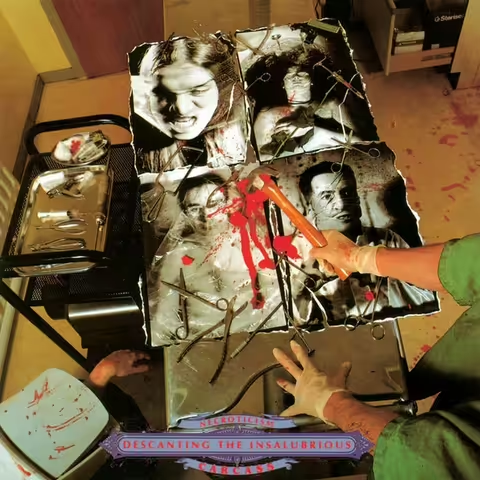
The cover of Necroticism is the moment Carcass's visual identity flipped. The first two records had used the band's now-infamous photo-collage sleeves, composites of pathology textbook plates, butcher-counter offcuts and forensic photography that retailers refused to display face-out. For Necroticism, the band designed a deliberately clinical replacement: a stark medical-illustration aesthetic in pale, almost sickly greens, with the album title set in a Victorian apothecary typeface and a single carefully composed surgical image at the centre. The credit reads simply "cover art by Carcass", with layout by Tom Warner.
The shift was as much commercial as aesthetic. The previous covers had been banned in several territories and stickered in others; Necroticism's sleeve was the first Carcass cover that could sit in the racks at HMV without an under-the-counter sticker. Walker has acknowledged in interviews that the change was deliberate: the band wanted a record that could be sold, not hidden.
The 2008 Earache reissue presented the album in a twelve-panel digipak with full lyrics, four art cards and the option of either a dualdisc (album one side, documentary the other) or separate CD and DVD configurations. The reissue retained the original artwork unchanged.
Release and Reception
Necroticism arrived in European shops on 30 October 1991 and in North America on 11 February 1992 through Earache's then-distributor Relativity Records. Reviews split sharply by audience. Old-guard Carcass fans wrote letters to the metal weeklies complaining that the band had abandoned grindcore. Critics, almost without exception, called it a masterpiece.
Xavier Russell, reviewing for Kerrang! in issue 364 on 26 October 1991, gave the album the magazine's maximum five-K rating. Götz Kühnemund at the German monthly Rock Hard filed an 8.5 out of 10 review under the magazine's "Dynamit" recommendation banner in the December 1991 issue. Jason Birchmeier's later AllMusic write-up settled on four stars out of five and called it "an excellent guitarist's album", explicitly crediting the addition of Amott. The Swedish webzine Metal Storm later scored it 9.6 out of 10 and called it "a masterpiece every metalhead should own".
"The next album, Necroticism: Descanting the Insalubrious, was pure death metal with intricate dynamics, complex structured songs, and refined guitar solos."
Natalie J. Purcell, Death Metal Music: The Passion and Politics of a Subculture, McFarland, 2003
Commercially the album did not chart on the Billboard 200 or the UK Albums Chart, extreme metal records simply didn't, in 1991, but it sat near the top of the UK Indie Chart for several weeks and became one of Earache's best-moving early-1990s catalogue titles. It set the table for Carcass's leap to a major-label deal: by the time Heartwork came out in 1993, Columbia were handling the North American distribution.
In 2005, Rock Hard's "500 Greatest Rock & Metal Albums of All Time" list ranked it at number 294. In September of the same year, Decibel magazine inducted it into the Decibel Hall of Fame as the eighth album ever featured in the series, a peer-voted process that asks every contributing band member to be interviewed about every song on the record. It remains, with Heartwork, one of two Carcass records in the Hall.
Singles and Music Videos
There were no commercial 7" or CD singles lifted from Necroticism. Earache shot exactly one promotional video, for "Corporal Jigsore Quandary", filmed on a low budget in late 1991 and serviced to Headbangers Ball on MTV and Channel 4's Raw Power in the UK. The clip is performance-only, the band miming the song in a studio rigged with hospital-green lighting that picks up on the sleeve aesthetic. MTV played it sparingly; Raw Power aired it more regularly across 1992.
The Tools of the Trade EP that Earache released in 1992 was effectively the closest the band came to a single-format spin-off, a four-track 12" with the title track plus three others from the Amazon sessions, timed to coincide with the Gods of Grind tour. The EP did not produce its own video.
Touring and Live
Carcass spent the eighteen months after the release of Necroticism almost continuously on the road. The headline-grabbing run was the 1992 Gods of Grind tour, an Earache package tour that paired Carcass with labelmates Cathedral, Entombed and Confessor and ran across both Europe and the United States. The American leg was the band's first proper US tour; promoters who had refused to book them in 1989 were now able to put them in 800-capacity venues on the strength of Necroticism's reviews.
That summer, Earache also released the Tools of the Trade EP to coincide with the tour. Later in 1992 the band rolled into the Campaign for Musical Destruction tour with Napalm Death, Cathedral and Brutal Truth, Carcass's second full pass through North America inside twelve months.
Notable live appearances from the era:
- Gods of Grind, UK and Europe, spring 1992, Carcass / Cathedral / Entombed / Confessor.
- Gods of Grind, US, summer 1992, the band's first full North American tour.
- Campaign for Musical Destruction, US, autumn 1992, with Napalm Death, Cathedral, Brutal Truth.
- BBC Radio 1 Peel Session, second Carcass session, the band performing under the medical pseudonyms.
- 1992 Gods of Grind Brixton Academy filming, later included on the Wake Up and Smell the… video, with Walker himself calling the mix "unmixed".
The album's songs have stayed in the Carcass live set across every era of the band. "Corporal Jigsore Quandary" and "Incarnated Solvent Abuse" are setlist anchors at the reunion shows since 2008; "Inpropagation" and "Symposium of Sickness" appear in rotation; the longer two-part closer is occasionally cherry-picked for festival main-stage slots.
In TV, Film and Media
Carcass have never had a song sync on a major American film or television soundtrack, the medical-Latinate lyric sheets do not lend themselves to drama placements, but the band's pop-culture footprint is, against all odds, real. Bill Steer and Jeff Walker appear as members of the fictional band "Smeg and the Heads" in the Red Dwarf episode "Timeslides", a piece of Carcass trivia that has outlived most contemporary reviews of the album. In a 2001 episode of Friends, "The One with the Cheap Wedding Dress", Megan tells Monica that her fiancé wants Carcass to play at their wedding, a one-line gag that brought a wave of confused Friends viewers to Earache's mail-order catalogue.
Within the metal world the album has been a fixture of "Greatest Death Metal Albums" features in Decibel, Loudwire, Metal Hammer and Worship Metal. Chris Jennings's 2017 Worship Metal feature, "The 10 Greatest Old School UK Death Metal Albums", placed it at the top of the list.
Controversy, Censorship and Lawsuits
Carcass's earlier records had been the subject of retailer bans, customs seizures and the kind of parental-advisory hand-wringing that comes with sleeve photography of butcher-counter offcuts. Necroticism sidestepped most of that by design: the new clinical artwork was deliberately less retailer-hostile, the song titles were obscure enough to fly under the radar of high-street stickering, and the lyric sheet was Latinate enough that picket lines never formed.
There were no plagiarism suits, no sampling disputes, and no banned territories of note. The closest the album came to controversy was a long-running argument inside the death metal community about whether Carcass had "sold out" by writing songs over six minutes long with audible solos, an argument that, with hindsight, looks faintly absurd given the directions Death, Atheist and Cynic were taking the genre in the same year.
Covers, Samples and Tributes
The most quoted covers and tributes drawn from Necroticism:
- The Black Dahlia Murder's late vocalist Trevor Strnad named Carcass, and the Necroticism-era vocal style in particular, as his single biggest vocal influence, in multiple interviews across the 2010s.
- Bring Me the Horizon's Matt Nicholls cited Carcass as an influence in his 2013 MusicRadar interview, with several of the band's deathcore-era riffs explicitly modelled on the album's harmonised leads.
- Ben Weinman of The Dillinger Escape Plan named Carcass (alongside Morbid Angel and Death) as a defining early influence on the band's sound.
- Travis Ryan of Cattle Decapitation listed Carcass as one of "Five Heavy Albums That Changed My Life" in a 2018 Decibel feature.
- The black metal project Botanist named Carcass as the precedent for its medical-dictionary lyric-writing approach, only with botanical rather than pathological vocabulary.
No major tribute album has ever been dedicated solely to Carcass, but Necroticism tracks appear on multiple genre tributes and Earache catalogue compilations. There are no documented samples used on the album itself.
Reissues, Remasters and Anniversaries
Earache reissued Necroticism in 2008 as part of the band's catalogue reissue programme around the reunion. The reissue was presented either as a dualdisc (album on one side, DVD content on the other) or as separate CD and DVD discs depending on the territory, with a twelve-panel digipak, full lyrics, four art cards and the third part of the band-sanctioned Pathologist's Report documentary series, subtitled Mass Infection. A separate 23-minute interview with Walker and Amott, recorded on the Gods of Grind tour in 1993, was also included.
The remaster was handled by John Paul at Mine Music. By later reissue standards it is a relatively conservative job, the levels are brought up, the highs sweetened slightly, but the original Richardson mix is left intact.
No deluxe-edition box set has been issued to mark a major anniversary, despite obvious milestones at 20, 25 and 30 years. The bonus content on the 2008 dualdisc, the documentary and the additional Tools of the Trade tracks, remains the most expansive Necroticism package on the market.
Legacy and Influence
Necroticism's legacy is double-edged. On the one hand, it is the album the entire melodic-death-metal scene that Amott would soon define in Arch Enemy traces directly back to. On the other, it is the album that prompted a generation of grindcore purists to write Carcass off as having sold out, only for those same critics to declare the next two records masterpieces with hindsight.
For the genre, the influence is direct. Death's Individual Thought Patterns and Atheist's Elements took technical death metal further down the prog road in 1993, but it was Necroticism that made longer, more structured death metal viable as a commercial proposition. The harmonised twin-lead vocabulary Amott contributed has been borrowed by every melodic death metal band from In Flames to Insomnium. The medical-dictionary lyric style has been picked up by everyone from Cattle Decapitation to Cattle Decapitation's many imitators.
For the band, Necroticism is the pivot between two careers. The Carcass that recorded Reek of Putrefaction would have laughed at the idea of writing a seven-minute song with a harmonised solo. The Carcass that recorded Heartwork two years later was already most of the way to writing a major-label record. Necroticism is the bridge, and unlike most bridges, it stands as a destination in its own right.
"Beginning with their third album Necroticism – Descanting the Insalubrious (1991), Carcass began to incorporate progressive and technical influences, and while they continued in this direction on the follow-up album Heartwork (1993), it was the band's first foray into melodic death metal."
Jon Wiederhorn, "Death Metal 101: The History of Death Metal", Loudwire, 2017
In Loudwire's 2016 staff-voted "Top 50 Metal Bands of All Time" feature, Carcass placed at number 21, a ranking that put them alongside bands two and three orders of magnitude larger in commercial terms. Necroticism is the single record most often cited as the reason.
Things You Might Not Know
| Fact | Detail |
|---|---|
| Owen named the album | The title was drummer Ken Owen's idea, not Walker's. "Ken came up with that," Walker told Mindrot webzine in 1995. "It's just through having some imagination in a very worn-out genre, plus having a dictionary helps out." |
| Amott wrote exactly one riff | Despite the press push around the new "twin-guitar attack", Bill Steer tracked every rhythm guitar at Amazon. Amott contributed all the lead solos and exactly one rhythm riff to the whole record. |
| The pseudonyms were the band | The Peel Session credits "K. Grumegargler", "J. Offalmangler" and "W.G. Thorax Embalmer" are Ken Owen, Jeff Walker and Bill Steer respectively. |
| No triggers, no samples | Owen tracked his entire drum performance without triggered samples, at a point when most of the band's Tampa peers were already leaning on tape replacements to keep blast beats audible. |
| The album never charted | Despite the Kerrang! five-K review and the Decibel Hall of Fame induction, Necroticism never made the UK Albums Chart or the Billboard 200. |
| The Friends connection | In the Friends episode "The One with the Cheap Wedding Dress", Phoebe and Megan briefly discuss Carcass, Megan's fiancé wants the band to play at their wedding. |
| Red Dwarf cameo | Walker and Steer appeared as members of Lister's fictional childhood band "Smeg and the Heads" in the Red Dwarf episode "Timeslides". |
| Eighth into the Decibel Hall | Necroticism was the eighth album ever inducted into the Decibel Hall of Fame, in September 2005. |
| Rock Hard 500 | The album ranked number 294 in Rock Hard magazine's 2005 book of The 500 Greatest Rock & Metal Albums of All Time. |
| Recorded in Lancashire, not Liverpool | Amazon Studios is in Simonswood, just outside Kirkby in Lancashire, a thirty-minute drive from the band's Liverpool base, not in the city itself. |
| Trevor Strnad's North Star | The Black Dahlia Murder's late vocalist named Carcass as his primary vocal influence in multiple interviews; the Necroticism-era Walker rasp is the model. |
| The Bjork connection (later) | Three years on, Carcass would remix Björk's "Isobel" during the Swansong sessions. The track surfaced on her 1996 Hyperballad single. |
| Amott would form Arch Enemy | Michael Amott left Carcass after Heartwork. The melodic death metal band he founded next, Arch Enemy, has spent thirty years building on the harmonic vocabulary he first stretched out on Necroticism. |
The Podcast
If this deep-dive has put you in the mood to spend an hour with the Riffology hosts pulling apart the riffs of Necroticism in real time, the Riffology podcast is on every major platform, Apple Podcasts, Spotify, Pocket Casts, Amazon Music and the rest. Subscribe, leave a rating if you have a spare second, and let us know which song on the record you would have nominated for the promo video instead of "Corporal Jigsore Quandary".
Comments