
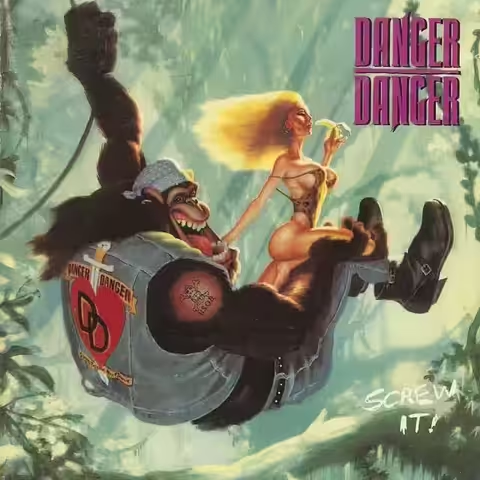
Danger Danger spent the autumn of 1991 in the worst possible place at the worst possible time. Their second album, Screw It!, was a fifteen-track Aqua Net manifesto recorded in a Florida studio for a New York glam-metal band signed to Epic, mixed for MTV's Headbangers Ball, and released into the same record-shop racks that had just received [Nevermind](/posts/the-making-of-nevermind-by-nirvana/), Use Your Illusion I and II, Soundgarden's Badmotorfinger and Skid Row's nastier [Slave to the Grind](/posts/the-making-of-slave-to-the-grind-by-skid-row/).
It is the rare album where the back story is more dramatic than the songs. The fifteen tracks of Screw It! would, within eighteen months, fracture the band, trigger litigation that buried their third album for nearly a decade, free Andy Timmons to become one of the most respected technical guitarists in America, and turn singer Ted Poley into hair metal's longest-running comeback story. None of that is on the sleeve. What is on the sleeve is a cartoon-pink come-on, a fifty-seven-minute runtime and one of the cleaner glam-metal mixes of the era.
Album Facts
| Field | Detail |
|---|---|
| Artist | Danger Danger |
| Album | Screw It! |
| Release date | October 1991 |
| Label | Epic Records |
| Producers | Bruno Ravel, Steve West |
| Studio | New River Studios, Fort Lauderdale, Florida |
| Genre | Hard rock, hair metal, glam metal |
| Track count | 15 |
| Total runtime | 57 minutes 30 seconds |
| Billboard 200 peak | No. 123 |
| Oricon (Japan) peak | No. 67 |
| UK Albums Chart peak | Did not chart |
| Notable singles | Monkey Business; I Still Think About You; Comin' Home |
| UK Singles peaks | Monkey Business No. 42; I Still Think About You No. 46; Comin' Home No. 75 |
New York, When Glam Was Still King
Queens in the mid-1980s was less a hair-metal scene than a distant New York satellite of one. The action was on the Sunset Strip, and the New York bands tended to be either heavier (Anthrax, Overkill, Type O Negative's predecessors) or artier (Sonic Youth, the Ramones in elder-statesman mode). Glam, when it travelled east, mostly turned up out of [New Jersey](/posts/bon-jovi-new-jersey/) via Bon Jovi or out of Long Island via Twisted Sister.
Into that gap stepped a Queens covers act called Hotshot, formed in 1986 around bassist Bruno Ravel, drummer Steve West and a rotating cast of hopefuls. Their first stable singer was Mike Pont. Their first stable guitarist was Al Pitrelli, later of Savatage, [Megadeth](/posts/megadeth-by-megadeth-album-review/) and the Trans-Siberian Orchestra. Their keyboard player was Kasey Smith. The band rebranded as Danger Danger in 1987 when Pont was replaced by a former Prophet drummer named Ted Poley, and started writing originals built around Poley's high, gleaming tenor. The demos were good enough to land them a deal with Epic Records.
From the Debut to Andy Timmons
The 1989 self-titled debut, produced with a heavier outside hand and pushed hard at MTV, did the job a debut needs to do. Naughty Naughty became a Headbangers Ball staple, Bang Bang reached No. 49 on the Billboard Hot 100 and No. 39 on the Mainstream Rock chart, and the band toured behind Kiss, Alice Cooper, Extreme and Warrant. The line-up that finished the record, however, was not the line-up that started it. Pitrelli had left in 1988 and was briefly replaced by Saraya guitarist Tony Bruno Rey, who tracked part of the debut and then went home.
His successor changed the band. Andy Timmons, born July 1963 in Evansville, Indiana, had studied jazz guitar at the University of Miami and was already a working session player when his audition tape reached New York. He played on roughly a third of the debut and toured the rest of it. By the time the band reconvened to write a follow-up, he was a full member, and his fluency, his clean string-bending and his pop-sense vibrato gave Danger Danger a guitar voice that was technically a match for anyone in their bracket.
The Band Builds Its Own Record
The decisive choice on Screw It! happened before a note was tracked. Rather than hand the album to a name producer, as Bon Jovi had done with Bruce Fairbairn or Cinderella with Andy Johns, Danger Danger produced themselves. The credits read: produced by Bruno Ravel and Steve West. Every song on the record is also written by Ravel and West, save Slipped Her the Big One, which adds Timmons as a co-writer. It is the rare second album that, in songwriting and production terms, is more of a band album than the debut was.
That choice cuts both ways. It allowed Ravel and West to indulge themselves: the album is fifteen tracks long, includes two short instrumental skits and a near six-minute closer, has a string quartet credited to Ravel's family, and lets Timmons stretch into bluesier territory than a hit-chasing producer would have allowed. It also meant nobody in the room was telling them when to stop.
Cutting in Fort Lauderdale
Recording took place at New River Studios in Fort Lauderdale, Florida, during the early months of 1991. New River was a regional facility that had hosted Saigon Kick and Stranger among others, and its draw for a New York band was the simple one: Florida in winter is not New York in winter. The decision also gave the sessions a sealed-off quality. Without a producer commuting in from a label office, and a long drive from any New York scenester wanting to drop by, the band could grind through fifteen songs, dozens of overdubs and a string-quartet date at their own pace.
The mix is glossy without being sterile. Timmons's guitars are tracked layered but uncluttered. Smith's keyboards are noticeably busier than on the debut, sometimes carrying a chorus on their own. Ravel doubles on cello on one track and four- and twelve-string basses elsewhere. West's drums are panned wide and dry by the standards of 1991, with reverb tails kept short. None of it is as compressed as the Mutt Lange end of the genre, and the playing rewards the relative restraint.
October 1991, the Month the Ground Moved
Hindsight makes it look like Danger Danger walked into a buzzsaw. They more or less did. Within a six-week window in late September and October 1991, the racks took delivery of:
- Nirvana, Nevermind (24 September)
- Guns N' Roses, Use Your Illusion I and II (17 September)
- Soundgarden, Badmotorfinger (8 October)
- Red Hot Chili Peppers, Blood Sugar Sex Magik (24 September)
- Pearl Jam, Ten (out a month earlier and gathering speed)
- U2, Achtung Baby (19 November)
Even within their own genre the competition was murderous. Slave to the Grind by Skid Row had landed in June 1991, debuted at No. 1 and made every other glam record sound prim by comparison. Bon Jovi's New Jersey tour was over and the band had retreated to write what would become Keep the Faith. Def Leppard were finishing Adrenalize. The genre's audience was being told, repeatedly and from every direction, that this was no longer the year for hair-metal album number two.
Cover Art and the Title
The sleeve is the kind of pink-and-yellow cartoon come-on the era was already starting to get sued over. The title font is an exclamation, the layout is a parody of a 1950s pulp paperback, and the tone announces the record's sense of its own naughtiness before a single song plays. It is also entirely consistent with a band who would put a porn-star vocal cameo on track fourteen and call track six Get Your Shit Together. Whatever it is, it is not coy.
The title itself is the only one the band have ever used that the label could not put on a billboard intact. Screw It! in 1991 was on the safe side of the parental-advisory line in a way the same phrase would not be five years later, but it set the tone: this was a band winking at its own commercial position, releasing a record so out of step with what was about to happen that the title doubled as a shrug.
Personnel and Credits
| Role | Player | Notes |
|---|---|---|
| Core band | ||
| Lead and backing vocals | Ted Poley | Second studio album as frontman. |
| Electric and acoustic guitars, backing vocals | Andy Timmons | His first full studio album with the band. |
| Keyboards | Kasey Smith | Would leave after the supporting tour. |
| Bass (4- and 12-string), backing vocals, cello | Bruno Ravel | Co-writer on every song; co-producer. |
| Drums, backing vocals | Steve West | Co-writer on every song; co-producer. Credited on the sleeve as "out of tune vocals" as a self-deprecating gag. |
| Guest musicians | ||
| Backing vocals (Monkey Business); rap (Find Your Way Back Home) | Gary Cherone, Nuno Bettencourt, Pat Badger | Three quarters of Extreme. |
| Voice (Yeah, You Want It!) | Ginger Lynn | Adult-film actress; non-singing vocal cameo. |
| Percussion | Eddy Conard | Session percussionist. |
| Additional | Todd "T-Boy" Confessore, Koen VanBaal | Credited supporting players. |
| Strings | Ravel String Quartet | Sleeve notes credit "Mom" and "Dad" on violin alongside Bruno; the family unit doubles as the string section. |
| Production | ||
| Producers | Bruno Ravel, Steve West | Self-produced. |
| Recording studio | New River Studios | Fort Lauderdale, Florida. |
| Label | Epic Records | Their second album for the major. |
Tracklist
| # | Title | Writer(s) | Length | Single? | Notes |
|---|---|---|---|---|---|
| 1 | Ginger Snaps (Intro) | Ravel, West | Spoken-word skit. | ||
| 2 | Monkey Business | Ravel, West | 5:22 | Lead single (1992) | Backing vocals by Cherone, Bettencourt, Badger. |
| 3 | Slipped Her the Big One | West, Timmons | 5:32 | Only Timmons co-write on the album. | |
| 4 | C'est Loupe (Prelude) / Beat the Bullet | Ravel, West | 4:53 | Two-part track with a French-language intro. | |
| 5 | I Still Think About You | Ravel, West | 4:36 | Single (UK No. 46) | Long-distance ballad. |
| 6 | Get Your Shit Together | Ravel, West | 4:41 | ||
| 7 | Crazy Nites | Ravel, West | 4:14 | ||
| 8 | Puppet Show | Ravel, West | 1:20 | Instrumental skit. | |
| 9 | Everybody Wants Some | Ravel, West | 4:15 | ||
| 10 | Don't Blame It on Love | Ravel, West | 3:58 | ||
| 11 | Comin' Home | Ravel, West | 4:39 | Single (UK No. 75) | Final UK single from the record. |
| 12 | Horny S.O.B. | Ravel, West | 3:22 | ||
| 13 | Find Your Way Back Home | Ravel, West | 6:14 | Guest rap by Cherone, Bettencourt and Badger. | |
| 14 | Yeah, You Want It! | Ravel, West | 3:34 | Ginger Lynn vocal cameo. | |
| 15 | D.F.N.S. | Ravel, West | 0:50 | Closing skit. |
Monkey Business, the Lead Single
Monkey Business was the obvious choice to lead. It opens on a syncopated Timmons riff that sits somewhere between Aerosmith and Extreme, drops into a Poley vocal more swaggering than anything on the debut, and brings the chorus in fortified by Cherone, Bettencourt and Badger's stacked harmonies. The song was issued as a single in early 1992 and crept into the UK Singles Chart at No. 42, the highest position any Danger Danger single ever managed in Britain. In the United States it received MTV airplay but no Hot 100 placing, the chart having effectively closed its door to glam by this point.
The video, lit in primary colours and shot on the kind of MTV-block budget that 1992 could no longer reliably justify, is the band at their most cartoonishly self-aware. It is a glam-metal video that already knows it is from the past tense.
I Still Think About You, the Power Ballad
Every album of this kind needed a ballad, and on Screw It! the ballad does most of the heavy lifting. I Still Think About You is built around a piano figure from Smith and a Timmons clean-tone hook, and is sung by Poley in a register a half-step higher than is comfortable, which is precisely the genre's preferred vocal tactic. Lyrically it is a long-distance song, addressed to a partner left behind while the band tours, and the second verse leans hard on the road-romance trope.
It charted higher than Monkey Business in some territories: No. 46 on the UK Singles Chart, modest US adult-rock airplay, and remains the song most often requested at Danger Danger live shows three decades later.
Comin' Home, the Third Single
The album's third single is also its most conventional. Comin' Home is a mid-tempo road song with a bell-clean Timmons solo and an extended outro that, on the album version, runs to nearly five minutes. It reached No. 75 on the UK Singles Chart in 1992 and was the last new Danger Danger single any major label put behind a video budget. By the time it was released, the band were already deep into writing the album that would become Cockroach, and Epic's enthusiasm had visibly cooled.
The Extreme Connection
Three quarters of Extreme appear on Screw It!: Gary Cherone on backing vocals, Nuno Bettencourt on harmony stacks and Pat Badger on bass-friendly low harmonies. The two bands had toured together off the back of the Danger Danger debut, recognised each other as fellow technical-pop-metal practitioners, and had become friends. The Extreme guys appear most prominently as the gang vocal on Monkey Business and as the rapped guest verse on Find Your Way Back Home, six minutes of glam-metal pomp that, before the rap drops in, is one of the album's most sincere pieces of writing. Bettencourt's Pornograffitti had come out a year earlier and the harmonic vocabulary on Monkey Business borrows from that record's wider stack-heavy approach.
Ginger Lynn and Yeah, You Want It!
Track fourteen is the kind of decision a self-producing band makes that nobody else would let them make. Yeah, You Want It! is built around a heavy mid-paced riff and a chorus that does not pretend to be anything but a come-on. The cameo, credited on the sleeve simply as "Ginger Lynn: voice", is the adult-film actress Ginger Lynn Allen contributing breathy non-verbal vocalisations across the track. The Chicago Tribune's reviewer in October 1991 took one look and called the song "an offensive, date-rape anthem", a line which has chased the record for thirty years. Whatever else it is, the cameo also gives the album its most conspicuous bit of guest casting.
"An offensive, date-rape anthem."
Brenda Herrman, Chicago Tribune, 17 October 1991, on Yeah, You Want It!
The Deep Cuts
Strip out the singles and the skits and the album still has a working spine. Slipped Her the Big One, the only Timmons co-write, is the closest the record comes to a Mr Big-style guitar showcase, with a long unaccompanied bend at the head of the solo. Crazy Nites is the most efficient straight rocker on the album, three minutes of nothing but verse-chorus-solo-chorus, and exists as proof that the band could still write to a length when they felt like it. Get Your Shit Together is the most traditional Bruno Ravel ballad-with-teeth, in line with what New Jersey hair metal had been doing for half a decade. Find Your Way Back Home, at six minutes plus, is the longest track on the album and the one that gives Smith his most expansive keyboard role.
B-sides, Edits and Rarities
The era's twelve-inch single market generated a thicket of Screw It! formats that even the band's own discography pages have struggled to keep tidy. The Monkey Business single, in its UK CD format, included a non-album live version of Naughty Naughty recorded on the 1990 Down and Dirty Live EP run, plus an edited radio mix of Monkey Business itself trimmed to four minutes flat. The I Still Think About You CD single carried an acoustic remix of the title track that has only ever appeared on that release. The Comin' Home single bundled a shortened single edit and a cassette-only B-side. None of these have been collected on a deluxe edition, and most are now eBay-only objects.
Release and Chart Performance
Epic released Screw It! in October 1991. It debuted on the Billboard 200 in November, peaked at No. 123 and slid out of the chart inside ten weeks. Japan was kinder, with Oricon registering a peak of No. 67, and the album outperformed in territories that took longer to swing toward grunge. The UK Albums Chart did not register the LP at all, although the three singles all appeared on the UK Singles Chart in 1992, the latest a Danger Danger album would ever appear on a British chart of any kind.
The numbers were a measurable step down from the debut, which had peaked at No. 88 on the Billboard 200 and shifted past the 500,000-unit mark. Screw It! by contrast never received a US gold certification. Inside Epic's offices, that drop made the album an immediate problem. The label had picked up the band's option for a third record before the second one had a chance to chart; six months later they were trying to work out whether that option had been a mistake.
Critical Reception
The reviews were the kind that confirm rather than create a verdict. The Calgary Herald in November 1991 graded the album a "C" and complained that "most of the music and pedantic lyrics tend to irritate instead of stimulate." The Chicago Tribune was harsher, isolating Yeah, You Want It! as the offending track and writing the rest off as boilerplate. Germany's Rock Hard, true to a market still receptive to the genre, scored it 8/10. AllMusic's Greg Prato, reviewing in retrospect, judged that the album was largely a hybrid object aimed at two audiences at once, which by 1991 was no longer the asset it had been a year earlier.
"The music overall appears to have been constructed in hopes of pleasing both the mainstream pop audience and hair-sprayed headbangers."
Greg Prato, AllMusic
"Most of the music and pedantic lyrics tend to irritate instead of stimulate."
Glen Miller, Calgary Herald, 3 November 1991
Ted Poley as a Frontman
It is worth pausing on Poley specifically, because the singer is the figure most often underestimated when this album is discussed. Born in 1965 in New Jersey, he had been a drummer first, in the band Prophet, and switched to lead vocals only when his bandmates decided he was the best singer in the room. By the time he reached Danger Danger his range was set: a high tenor with a gravel edge that could swing toward Bret Michaels in the verses and Sebastian Bach in the choruses, with the kind of pop sensibility for melody that, on a different timeline, could have made him a Bryan Adams type rather than a glam frontman. On Screw It! he is more disciplined than on the debut. The high notes are still there, but they are spent more carefully, and the ballad performances reward repeated listening in a way the more carnival vocals on Naughty Naughty did not. The story of his next two years would be a story about that voice and a contract; the album in front of it is Poley at his most controlled.
Touring With Kiss, Again
The supporting tour reunited the band with Kiss, who had taken them out behind the debut and were now in the middle of their Revenge cycle. The pairing was a rare sustained run for a Danger Danger live show and gave the band their biggest stages: arena slots across North America through the first half of 1992, plus a short European leg that included UK shows attached to the Monkey Business single push. The Kiss audience was still receptive in a way the wider rock audience was not. After the tour, Kasey Smith left to form Shock with former Get With It drummer Michael Bellusci, and the line-up that made Screw It! began to come apart.
Cockroach and the Poley Firing
The third album was finished by mid-1993. It was titled Cockroach. Inside the writing and recording process, however, relations between Poley and the rest of the band had broken down. Ravel and West fired their singer. Poley's response was to file lawsuits that prevented the album being released at all. Epic, watching the storm and reading their own quarterly numbers, decided the safest commercial decision was to shelve the record entirely.
The lost album bears directly on Screw It! because, in commercial terms, Screw It! would for nearly a decade remain Danger Danger's last major-label release. Epic and the band parted company in 1994. Andy Timmons left to start a solo career. Bruno Ravel and Steve West, the only constants, started their own indie label, Low Dice Records, and hired a Canadian singer called Paul Laine, who re-recorded the entire Cockroach vocal in 1994. Even that version did not see commercial release for years.
Paul Laine and the 2001 Resolution
The Laine era produced new material, a 1995 release called Dawn, a 1997 follow-up called Four the Hard Way, and a 2000 album titled The Return of the Great Gildersleeves. None reached an audience approaching the size of the one that had bought Screw It!. Cockroach finally appeared in 2001 in a unique double-disc form: one disc with Laine's vocals and one with Poley's, packaged together so listeners could pick. By that point Poley and Laine had been alternating in the band as singers; in 2004 Laine left and Poley returned permanently. The classic Screw It! line-up of Poley, Ravel, West, Timmons and Smith reunited only once, for a one-off twenty-fifth-anniversary set at Firefest in Nottingham in October 2014.
Andy Timmons After Danger Danger
Of everyone involved, Timmons had the most decisive afterlife. He played on both of Kip Winger's solo albums, did session work for Olivia Newton-John, Paula Abdul and Paul Stanley, formed the Pawn Kings in Dallas, became a long-running Ibanez signature-model artist, and from the late 1990s onwards built a parallel career as an instrumental rock guitarist. The 2011 Andy Timmons Band album Plays Sgt. Pepper was reviewed as a serious technical achievement; his 2022 album Electric Truth was named the sixth-best guitar album of the year by Guitar World readers. To anyone whose introduction to him is Screw It!, it is a striking discography, and it sits at an angle to the glam-metal context his rock career started in.
Reissues and Afterlife
Unlike most of its peers, Screw It! has never received a deluxe reissue. There has been no twentieth-anniversary edition, no twenty-fifth-anniversary remaster, no archival release of the 1991 demos, no Atmos remix. The original CD master remains in print on streaming services, and the band's official Frontiers-era catalogue includes their later work but not a remastered version of the Epic-era records. The 2003 compilation Rare Cuts, released independently, gathered early demos including some pre-debut Pitrelli-era recordings, but stayed away from Screw It!-period outtakes. The vacuum has left collectors trading the Japanese first pressing on Discogs at premium prices.
Legacy
The legacy of Screw It! is mostly the legacy of its release date. Albums released by smaller hair-metal bands in the autumn of 1991 had a habit of being filed by listeners and broadcasters as the last gasp of a dead genre, regardless of their actual content. Whether that was fair to Screw It! is a debatable question. The musicianship is high, Timmons is one of the best guitarists in the genre, the Cherone, Bettencourt and Badger guest stack is one of the era's best, and the songwriting is sharper than the debut. None of which mattered in the late autumn of 1991, when an audience that had been fed a steady diet of glossy compressed major-label rock for half a decade was suddenly being told, by every cool gatekeeper at once, that the new sound was a Soundgarden riff and a flannel shirt.
The album's place in the wider 1991 conversation is not the place a Stones or a Queen record gets. It sits alongside the season's other glam-aligned releases as documentation: this is what an Epic-priority hair-metal band who had done everything right was making in the moment Nevermind changed the rules. As an MTV-format glam record it is one of the genre's better second albums. As a 1991 release it is a record that history dropped a curtain on within weeks of its release. Both of those statements are true, and the tension between them is what keeps fans coming back to it.
Things You Might Not Know
| Fact | Detail |
|---|---|
| The Megadeth connection | Original Danger Danger guitarist Al Pitrelli, who played the demos that landed the band their Epic deal, would later join Megadeth and the Trans-Siberian Orchestra. He plays no notes on Screw It! but the band's existence was largely his work. |
| The Saraya cameo | The guitarist who briefly replaced Pitrelli, Tony Bruno Rey, was lent out from Saraya for part of the 1989 debut and then returned to his day job, opening the seat that Andy Timmons took. |
| An adult-film vocal cameo | The "voice" credit on Yeah, You Want It! belongs to Ginger Lynn Allen, one of the most recognisable adult-film performers of the 1980s, in a non-singing role on the song's vocal hook. |
| "Mom" and "Dad" on the credits | The album's string quartet is credited as the Ravel String Quartet and includes "Mom" and "Dad" on violin alongside Bruno: the bassist's parents play on the record. |
| An Extreme rap verse | Find Your Way Back Home, the album's six-minute closer-before-the-skits, contains a rapped guest verse delivered by Gary Cherone, Nuno Bettencourt and Pat Badger of Extreme together. |
| An out-of-tune drum credit | The sleeve credits Steve West not only for drums but for "out of tune vocals", a self-deprecating gag that the AllMusic database has duly preserved as canonical metadata. |
| The cello bassist | Bruno Ravel plays four-string bass, twelve-string bass and cello on the album. The cello shows up on Find Your Way Back Home as part of the Ravel String Quartet's chamber arrangement. |
| Two skits in fifteen tracks | Of the fifteen track entries, two (Ginger Snaps Intro and D.F.N.S.) are sub-minute skits, and a third (Puppet Show) is a 1:20 instrumental interlude. Subtract those and the album proper is twelve songs across roughly fifty-five minutes. |
| Inside a forty-five-day window | Screw It! shipped roughly three weeks before Achtung Baby and roughly three weeks after Nevermind, putting it inside the same forty-five-day window as the three records most commonly cited as the inflection point of 1990s rock. |
| One Timmons writing credit | Andy Timmons, the most technically virtuosic player on the record, has only one songwriting credit across the album: Slipped Her the Big One, co-written with Steve West. Bruno Ravel and West share the other fourteen. |
| The album the lawsuit blocked | The follow-up to Screw It! exists. It was finished in 1993, called Cockroach, and was suppressed for nearly a decade by litigation between Ted Poley and the rest of the band, before finally appearing in 2001 as a dual-vocalist double album. |
| A Florida record by a Queens band | Nothing on the album was recorded in New York. The Queens band tracked the entire LP at New River Studios in Fort Lauderdale, Florida, more than a thousand miles from the scene that birthed them. |
| A reunion that took twenty-three years | The classic Screw It! line-up of Poley, Ravel, West, Timmons and Smith did not share a stage again until October 2014, when they played the Firefest festival in Nottingham, England, to mark the band's twenty-fifth anniversary. |
The Riffology Podcast
If this is the kind of deep dive that scratches the right itch, the Riffology podcast covers album stories of exactly this shape every week, available on Apple Podcasts, Spotify and every major podcast platform. Screw It! by Danger Danger is the sort of record the show was built for: a competent, well-played, technically adept hair-metal album landed at the precise moment the audience for hair-metal albums stopped showing up to the record shop. Subscribe and the next episode will be in your feed.

Comments