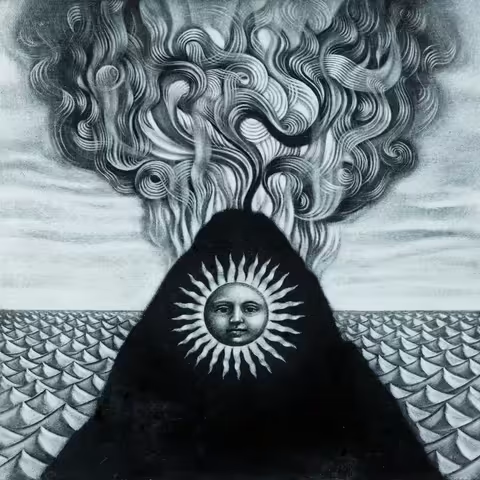
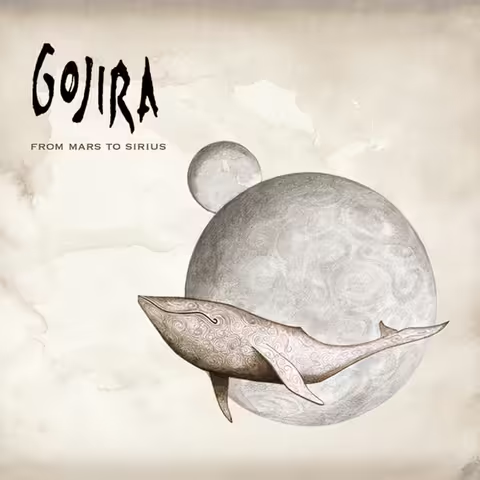
From Mars to Sirius peaked at number 44 in France, spent three weeks on the chart, and did not go gold until 31 December 2024, and even then only on France's export list, for sales made outside the country. Gojira made it almost entirely themselves. It was recorded in a derelict barn in the pine forest of the Landes that the band had bought and spent two years rebuilding into a studio, engineered and effectively produced by singer Joe Duplantier, mixed with bassist Jean-Michel Labadie and engineer Laurent Etchemendy, and wrapped in a sleeve Duplantier drew by hand: a whale covered in spirals, floating in space in front of a dead grey planet.
Twelve tracks, sixty six minutes and fifty two seconds, issued on 27 September 2005 by the small French label Listenable Records, with no American release at all for the best part of a year. It contains Flying Whales, The Heaviest Matter of the Universe and Backbone, it turned Gojira from a French band into an international one, and Rolling Stone eventually placed it at number 97 on its 100 Greatest Metal Albums of All Time. This is how it was written, how four men with no producer taught themselves to make it, what is actually on it, and why it kept growing for two decades after most of the world had stopped paying attention.
Album Facts
| Field | Detail |
|---|---|
| Artist | Gojira |
| Album | From Mars to Sirius |
| Release date | 27 September 2005 (France); 2006 (North America, Prosthetic Records) |
| Label | Listenable Records, licensed to Prosthetic Records for North America |
| Producer | Gojira, credited on sleeve as Gabriel Editions |
| Studios | Le Studio des Milans, Ondres; Le Florida, Agen (drums) |
| Genre | Progressive metal, technical death metal, groove metal, post-metal |
| Tracks | 12 |
| Runtime | 66:52 |
| Billboard 200 peak | Did not chart |
| UK Albums Chart peak | Did not chart |
| Other chart peaks | France number 44, three weeks on chart |
| Certifications | Gold on the SNEP export list, 31 December 2024, for 50,000 equivalent sales outside France; no French domestic certification |
| Estimated sales | Around 15,000 shipped to French shops on release; reported past 40,000 in France and abroad by late 2006 |
| Key tracks | Flying Whales, The Heaviest Matter of the Universe, Backbone, To Sirius |
What Metal Sounded Like in 2005
Metal in 2005 was busy and loud and mostly pointed somewhere else. Louder later described the year as "disproportionately stacked with top-shelf releases", and noted how much good work got "cast to the wayside" as a result. A French band on a French independent label, singing in English about whales, was not near the front of that queue. The competition in the months either side of release included:
- Trivium, Ascendancy, March 2005
- Meshuggah, Catch Thirtythree, May 2005
- Opeth, Ghost Reveries, four weeks before Gojira
- Avenged Sevenfold and Bullet for My Valentine, soaking up what was left
The album's subject matter was also early. The Kyoto Protocol had only entered into force on 16 February 2005. Hurricane Katrina made landfall a month before the album's release. Al Gore's An Inconvenient Truth, the film that pushed climate change into multiplexes and dinner-party conversation, did not appear until 2006. When Gojira released a record whose closing song is called Global Warming, the phrase was still a policy term rather than a cultural one.
From Godzilla to Gojira
Brothers Joe and Mario Duplantier started playing together after school in Ondres, a small town near Bayonne in the south west of France. In 1996, with Joe at 19 and Mario at 14, they formed a band with guitarist Christian Andreu and bassist Alexandre Cornillon and called it Godzilla, after the 1954 film, as a symbol of overwhelming power. They played bars in Bayonne and put out their own demos. Cornillon left in 1998 and Jean-Michel Labadie replaced him, completing a lineup that has not changed since.
In 2001 legal pressure over the name forced a change, and Godzilla became Gojira, the Japanese original of the same word. The band's debut, Terra Incognita, came out that year, self-funded and self-released through their own imprint Gabriel Editions after donations from friends and family paid for the pressing. They shipped 1,500 copies to a single record shop in Bayonne. Joe had written much of it while living in a cabin he built himself, sharing it with his girlfriend for two years with no income and no electricity.
The Link followed on 18 April 2003, and the concert film The Link Alive arrived on 16 April 2004, shot with seventeen camera operators at a sold-out Bordeaux show and creeping to number 174 on the French albums chart. By then Gojira had played hundreds of shows in France and almost none anywhere else. They were, in every commercial sense, a regional band with a very good live reputation and nothing resembling an international career.
Pre-production and the Barn
In late 2002 Joe and Mario decided to do up the dilapidated barn next to the family house, and turn it into Le Studio des Milans, milan being the French word for the kites that circle over that part of the country. They sank the band's savings into it, borrowed from the banks, and got their father Dominique to borrow more and help with the heavy lifting. Engineer Laurent Etchemendy built it with them. They rebuilt it themselves over roughly two years, in the gaps between tours and recording. The Link was cut there while the work was still going on. From Mars to Sirius was the first album made in a room the band had actually finished.
The concept arrived while they were touring The Link. Joe Duplantier had begun reading about whales, in particular about their intelligence and about migration routes that scientists could not fully explain, and the idea of an interplanetary journey from a dying Earth grew out of that. Mars would stand for war, Sirius for peace, and the album would travel between the two.
The writing itself was a change of gear. Where the band had previously rehearsed at weekends and, in Mario's words, only played heavy death metal, this time they met every day for six months and wrote nothing else, to the point where some mornings he did not feel like playing anything bludgeoning at all. Listenable Records came in during that period, at the end of 2004, with the album half-built. Gojira had other offers on the table, including one from Roadrunner. They took the smaller label on the grounds that it was the keenest.
"It all started when I had this spiritual revelation around the age of 20. I began to look at the planet differently."
Joe Duplantier, Guitar World, 2025
One of the record's most-copied sounds also came out of that touring period rather than the studio. The scraped, screaming slide that runs through Gojira's catalogue was an accident, discovered on stage during the campaign for The Link when Duplantier tried to reproduce a left-hand slide from the song Embrace the World using his right hand instead. He has since described the moment as happening "somewhere in Switzerland", and the technique arrived at Les Milans already road-tested.
Creating From Mars to Sirius
Recording ran across 2004 and 2005. Most of the album was tracked at Les Milans, though the credits place Mario Duplantier's drums at a separate location, Le Florida in Agen. Mastering was finished in the middle of July 2005 by Jean-Pierre Chalbos and Seb Dupuis. Laurent Etchemendy engineered and mixed with Joe Duplantier and Jean-Michel Labadie, and the sleeve credits production to Gabriel Editions, which is to say the band paid for it and made it themselves.
Duplantier has been blunt about what that involved. There was no producer to defer to and no budget to hire one, so he taught himself the job by taking apart records he admired, among them Metallica, Morbid Angel and Fear Factory, and working out how they had been assembled.
"We put weird reverb, EQs and panning on the guitars. Everything sounded unorthodox."
Joe Duplantier, Guitar World, 2025
Some of those decisions he would take differently now, though he has said that "when you talk about art, the word 'mistakes' shouldn't exist". Decibel, inducting the album into its Hall of Fame in 2018, characterised the record as the sound of a band winging it and not really knowing what they were doing, which is close to how the band tell it themselves. The unorthodoxy is the point, though Duplantier insists it was never the plan.
"We were not trying to be original... we just wanted to sound fat and modern. The album ended up original because we were weird French guys from a village with no scene."
Joe Duplantier, Guitar World, 2025
The gear was similarly make-do, and the choices that defined the record were as much about restriction as ambition:
- Jackson SLS guitars, given to the band free when they could not afford instruments
- A switch from Mesa/Boogie amplifiers to Peavey 5150s, chasing a harder, more crushing tone
- Octave shapes in place of conventional power chords across much of the album
- Deliberately unorthodox reverb, EQ and stereo panning on the guitar tracks
- Whale sounds worked into the record, tying the arrangements to the concept
That last harmonic decision is the one Duplantier rates above every other trick on the album, above even the scrape everybody copied.
"I wanted it to sound like an alarm; an uncomfortable thing like a truck going backwards."
Joe Duplantier on the album's octave riffs, Guitar World, 2025
Personnel and Credits
| Role | Player | Notes |
|---|---|---|
| Core band | ||
| Vocals, guitars | Joe Duplantier | All lyrics; also mixing and artwork |
| Guitars | Christian Andreu | Lead guitar |
| Bass | Jean-Michel Labadie | Also credited on the mix |
| Drums | Mario Duplantier | Tracked at Le Florida, Agen |
| Production and engineering | ||
| Engineer, mixing | Laurent Etchemendy | Third man in what Joe called a three-man operation |
| Mixing | Joe Duplantier, Jean-Michel Labadie | With Etchemendy |
| Mastering | Jean-Pierre Chalbos, Seb Dupuis | Completed mid-July 2005 |
| Production credit | Gabriel Editions | The band's own imprint |
| Artwork | ||
| Sleeve art and design | Joe Duplantier | Drawn by hand |
That table is strikingly short. There are no guest vocalists, no string sections, no session players and no outside producer anywhere on the record. Music is credited to Gojira collectively and all lyrics to Joe Duplantier, and no credible source has ever suggested an uncredited hand on the record. Contemporary French reporting from the sessions does single out Christian Andreu twice, crediting him with the closing riff of Where Dragons Dwell and the central arpeggio of World to Come.
The Songs
| # | Title | Writer(s) | Length | Single? | Notes |
|---|---|---|---|---|---|
| 1 | Ocean Planet | Gojira | 5:32 | No | Opens the journey from a poisoned Earth |
| 2 | Backbone | Gojira | 4:18 | No | Played at French shows before release |
| 3 | From the Sky | Gojira | 5:48 | No | Arrival of help from elsewhere |
| 4 | Unicorn | Gojira | 2:09 | No | Instrumental interlude |
| 5 | Where Dragons Dwell | Gojira | 6:54 | No | Descending riffs likened to cliff faces |
| 6 | The Heaviest Matter of the Universe | Gojira | 3:57 | No | Shortest full song, longest afterlife |
| 7 | Flying Whales | Gojira | 7:44 | No | Homage to whale intelligence and migration |
| 8 | In the Wilderness | Gojira | 7:47 | No | Second-longest track on the album |
| 9 | World to Come | Gojira | 6:52 | No | The rebuilt planet in view |
| 10 | From Mars | Gojira | 2:24 | No | First half of the title, hypnotic and repetitive |
| 11 | To Sirius | Gojira | 5:37 | Video | The album's only music video |
| 12 | Global Warming | Gojira | 7:50 | No | Closes the record on the panspermia idea |
Flying Whales is the song that carried the album, and it is the clearest statement of what Duplantier had been reading about on tour: whales as intelligent, weightless, unknowable creatures moving along routes nobody has fully explained. It is nearly eight minutes long, it takes almost two of those to properly begin, and it has since been placed at number 70 on Rolling Stone's 100 Greatest Heavy Metal Songs and included in Loudwire's 66 Best Metal Songs of the 21st Century. Its author is not a fan.
"It starts with a super-duper long intro that, honestly, if I'm going to listen to the song, I skip. It's such a drag!"
Joe Duplantier on Flying Whales, Metal Hammer, 2022
He has been just as unsentimental about the rest of it, calling the lyrics not among his favourites and admitting the band still cannot explain the riff that made their name. Mario has theories, the favourite being that the song sits at the perfect tempo because it matches the average human heartbeat.
The Heaviest Matter of the Universe is the album's shortest proper song at 3:57 and arguably its most quoted, described by one retrospective as a mechanically perfect tour de force of straight heavy metal riffing. Backbone was one of the songs Gojira were already playing at French shows before anyone could buy the record, which tells you which pieces the band trusted first, and Everything Is Noise later pointed out that this explosive four-minute thing is really only built from four parts.
Where Dragons Dwell is the deep cut, nearly seven minutes of descending figures that Everything Is Noise once compared to "the contours and craggy angles of steep mountains and cliff faces". Unicorn, at 2:09, is the album's only instrumental and its breathing space.
The rest moves the story along. Ocean Planet opens on a poisoned Earth, From the Sky brings help from elsewhere, and World to Come puts the rebuilt planet in view. From Mars and To Sirius work as a pair, hypnotic and repetitive before opening out into the album's most straightforwardly progressive passage.
Global Warming closes the record and does the summing up. Its lyrics start from panspermia, the theory that life was carried to Earth from somewhere else, run through the damage humans have done since, and end on the image of children growing. Duplantier reportedly cut the studio version because the song's subject had become too important to leave off. For a record this bleak about what we have done to the planet, it finishes on hope, and the last word on an album about war and peace is the latter.
B-sides, Outtakes and Lost Songs
There is almost nothing here, which says something about how the album was made. With no singles there were no B-sides, and a band paying for its own studio time does not record material it cannot use. The one extra anybody can name is Escape, a five-minute Metallica cover from Ride the Lightning, long described as a Japanese-edition bonus track though no Japanese pressing of the album appears anywhere in its discography.
No demo tapes have been officially released, no alternate mixes have surfaced on any reissue, and no member has publicly described a song written for the record and then abandoned. If shelved tapes exist, twenty years of anniversary editions have not produced them.
Album Artwork and Packaging
Joe Duplantier drew the cover, as he has drawn most of Gojira's sleeves. The background is an aged, parchment coloured wash, mottled and stained like old paper or a damaged map. The band's name sits top left in a jagged hand-inked logo, with the album title beneath it in small, plain capitals. To the right hangs a large pale sphere rendered in pencil, its surface covered in faint spiral patterns, with a smaller sphere behind and above it.
In front of the planet, filling the lower half of the sleeve, is a baleen whale, drawn in fine pencil and ink, its body covered with the same spiral markings that mark the planet. It has no water, no context and no scale. There is no photograph of the band anywhere on the front, no colour beyond sepia and grey, and no metal iconography of any kind. In a year of blood-spatter fonts and Photoshop, Gojira put out a record that looked like a page from a naturalist's notebook.
Release and Reception
Listenable released the album on 27 September 2005. It entered the French chart at number 44 and lasted three weeks. It did not touch the Billboard 200 or the UK Albums Chart, which is unsurprising given it had no American release at all until Prosthetic Records signed the band in May 2006 and put it out in North America later that year.
The reviews were another matter. AllMusic's Eduardo Rivadavia gave it four stars out of five and singled out the balancing act at the centre of the record.
"The fluidity with which utmost heaviness and delicate melodies were made to coexist within the scope of single songs like Where Dragons Dwell, Flying Whales, and World to Come, was truly astonishing."
Eduardo Rivadavia, AllMusic
Blabbermouth's Keith Bergman went to 9 out of 10 and called it "a masterpiece on par with anything Meshuggah or Mastodon have released", describing the sound as "dark, churning and hypnotic, massively heavy but varied and surprising, never monotonous". The scores elsewhere were just as warm.
| Publication | Score |
|---|---|
| Hard N'Heavy | 5 out of 5 |
| Blabbermouth | 9 out of 10 |
| Rock Hard | 8.5 out of 10 |
| Decibel | 8 out of 10 |
Phoenix New Times, catching up with the band on tour in 2007, summed up the appeal in a sentence: "Quite simply, in a genre that usually sounds crunchy and confined, Gojira sounds huge, like the conscientious monster it is." What actually moved the record, though, was neither press nor radio. Released on an underground label and too monolithic for rock radio, it spread through the live show, and Duplantier has never dressed that up: "We record albums and then we just tour, tour, tour. We never said no to a tour for 20 years." Sales in France and abroad were reported past 40,000 copies by late 2006, an enormous figure for a self-produced record on an independent French label.
Singles and Music Videos
There were, strictly, no singles. Wikipedia's Gojira discography lists none from the album, nothing from it charted anywhere as a standalone release, and the tracks that functioned as calling cards did so through radio play, press coverage and the live set rather than through a seven inch or a CD single. The label's own audio uploads of Backbone, Flying Whales and The Heaviest Matter of the Universe only reached YouTube years later.
The album's one video was for To Sirius, and Blabbermouth reported it as completed on 28 February 2006. It was made by the French photographer Alain Duplantier, and it contains no conventional film footage at all: the entire clip is built from still photographs, shown one after another at varying speeds. Blabbermouth called it "a technical wonder". Listenable made it available to download from its own website and pushed it to music video channels, which in 2006, for a band at this level, was the whole marketing plan.
Touring and Live
The touring that followed was slow, unglamorous and relentless, and it is the reason the album kept selling. Gojira spent the back end of 2005 and most of 2006 playing sold-out dates in France, added a Dutch run in late May 2006 with their Listenable labelmates Textures, then took the European festival circuit in a single summer: Download, Graspop, Hellfest, Eurockeennes, Tuska, Dour, Brutal Assault and Summer Breeze. By the time Prosthetic signed them in May 2006 the band had roughly 300 French concerts behind them.
North America came last, which is the reverse of how most bands break that market. Prosthetic's 2006 release finally gave American fans a record they could buy, and their first shows there followed it, supporting Children of Bodom and Amon Amarth through the closing months of 2006. That November they played the Unholy Alliance date at Bercy in Paris, second on the bill in an arena. Then came the run that mattered: Lamb of God's Sacrament tour in early 2007, which happened because Randy Blythe had made From Mars to Sirius his album of the year and emailed Joe Duplantier to ask.
Twenty years on, the album is still the live set. Setlist.fm's tally has Backbone as the most-played song in Gojira's entire history at more than 980 performances, with Flying Whales second and The Heaviest Matter of the Universe third, all three ahead of anything from any later record. What the band will not do is play it end to end. The most From Mars to Sirius songs logged in any single show is seven of the twelve, managed twice in early 2006, and From Mars appears never to have been played at all. Duplantier's explanation is characteristically flat: they tried it in rehearsal, and it did not work.
In TV, Film and Media
This is the thinnest chapter in the album's story. No film, television or advertising placement has been credibly reported for any song here. The album's reach came through other musicians and the live set, not a soundtrack.
Covers, Samples and Tributes
The most notable cover connected to the album is that one Gojira played themselves, and it is a funnier choice than it first looks. Escape started life under the title The Hammer, it exists because Metallica's record company wanted something more radio friendly, and James Hetfield has never hidden his dislike of it. Of all the songs on Ride the Lightning, Gojira reached for the one its own author would rather forget.
Going the other way, there is remarkably little. No famous cover version of a From Mars to Sirius song has entered general circulation and the album has not been meaningfully sampled. Its influence travels as technique rather than repertoire, which is a rarer and arguably more flattering kind of theft: a generation of guitarists took the scraped slide and the octave-shape riff and built careers on them.
"I can't believe the pick scrape became a thing. It was born by mistake."
Joe Duplantier, Guitar World, 2025
Reissues, Remasters and Anniversaries
| Edition | Year | Detail |
|---|---|---|
| Listenable CD | 2005 | Original French release, 27 September |
| Prosthetic CD | 2006 | North American issue, under licence from Listenable |
| First vinyl | 2011 | 500 copies; the album had no vinyl edition at all for six years |
| Vinyl reissues | 2012 onward | Repeated limited pressings, in print on vinyl ever since |
| 10th anniversary box set | 2016 | Issued by Listenable on 12 February |
| Zoetrope picture disc | 2026 | Double gatefold, 31 July, limited to 3,000 worldwide |
The album has never stopped being repackaged. The most recent is the 20th anniversary edition of 31 July 2026: a double gatefold zoetrope picture disc, where the art animates as the record turns, packaged with previously unseen band photography and limited to 3,000 copies. The band also marked the anniversary with a three-song studio session filmed at Silver Cord Studio in Queens and released on 31 October 2025, playing Ocean Planet, From the Sky and Where Dragons Dwell. Flying Whales, the one everybody expected, was left out. What has never appeared is a remaster or an expanded edition with session material. The record still exists in exactly the form the four of them mixed in a barn.
Legacy and Influence
What happened next happened fast. The Way of All Flesh in 2008 got Gojira onto the Billboard 200 for the first time. L'Enfant Sauvage reached number 34 there in 2012. Magma, released on Roadrunner on 17 June 2016 and recorded in the shadow of the Duplantier brothers' mother's death the previous July, debuted at number 24, was named Metal Hammer's album of the year and earned the band their first Grammy nominations, for Best Rock Album and for Silvera in Best Metal Performance. Fortitude reached number 12 in 2021. On 26 July 2024 they became the first metal band to perform at an Olympic Games, playing Ah! Ça Ira from the windows of the Conciergerie in Paris alongside mezzo-soprano Marina Viotti. In February 2025 that performance won them Best Metal Performance at the Grammys, their first win after three nominations.
From Mars to Sirius is where all of that starts, and the lists eventually caught up with it. Alongside the Rolling Stone placing, Metal Hammer put it at number 15 on its 100 Greatest Metal Albums of the 21st Century, MetalSucks at number 9 on its 21 Best Metal Albums of the 21st Century, and Loudwire at number 15 among progressive metal albums ever made and second-best metal album of 2005. Decibel inducted it into its Hall of Fame in 2018. That is a long, slow accumulation of respect for a record made by four men in a rebuilt barn who were still paying the building off.
Things You Might Not Know
| Fact | Detail |
|---|---|
| Gold, but not at home | Its only certification is a 2024 SNEP export gold, for sales outside France. Magma, L'Enfant Sauvage and Fortitude all hold French domestic golds; this one does not. |
| Godzilla's lawyers | The band were called Godzilla from 1996 until legal pressure in 2001 forced them to switch to the Japanese spelling, Gojira. |
| The cabin years | Joe Duplantier built a cabin at 24 and lived in it for two years with his girlfriend, with no income and no electricity. |
| 1,500 copies | Debut album Terra Incognita was funded by donations from friends and family and shipped to a single record shop in Bayonne. |
| Free Jacksons | Jackson gave the band guitars at a point when they could not afford instruments, which is why Joe played SLS models on the record. |
| Not power chords | The album's signature riffs are octave shapes, chosen because Duplantier wanted an alarm-like discomfort rather than conventional metal weight. |
| The accidental scrape | Gojira's trademark scraping slide was discovered on stage during the previous album's tour, in Switzerland, while trying to fake a left-hand slide. |
| Drums elsewhere | The band owned the studio the album was made in, yet the credits still place Mario Duplantier's drum tracking at a separate room, Le Florida in Agen. |
| A video with no film | The To Sirius clip, finished in February 2006, contains no moving footage at all: it is entirely still photographs shown at varying speeds. |
| Seventeen cameras | The band's 2004 concert film The Link Alive was shot with seventeen camera operators at a sold-out show in Bordeaux. |
Listen to the Riffology Podcast
The Riffology podcast covers Gojira on the episode above, digging into Magma, the album that took the band from metal favourites to Grammy nominees a decade after the barn in the Landes. Episodes are available on all major platforms, so subscribe wherever you get your podcasts and come back for more records worth the argument.
Comments