
Seattle 1989: a scene about to be discovered
By the second half of 1989 the Seattle scene was attracting major-label A&R attention for the first time. Soundgarden had signed with A&M, Mother Love Bone with Polygram, and the Sub Pop singles club had primed national-press fascination with the city for a year. The cover stories had not yet broken, but the scouts were on the I-5, the publicists were calling, and a handful of bands were a few months away from contracts that nobody in town had thought were available to them.
Alice in Chains were the local outlier. They were heavier than Soundgarden, more conventional in song structure than Mudhoney, more melodic than Tad and considerably more disciplined than the Melvins. Their frontman, Layne Staley, had a voice that carried both grunge weight and the traditional hard-rock range that Seattle had spent half a decade pretending to despise. Jerry Cantrell, the band's guitarist and principal writer, had grown up on Black Sabbath, on Heart, on the Scorpions and on Metallica, and he made no apology for it. While most of the city was busy stripping out the things that connected it to mainstream rock, Alice in Chains were leaning into them.
That stylistic position would, within eighteen months, turn into the band's commercial advantage. It was the reason metal radio took them seriously when nobody at metal radio would touch Nirvana, and it was the reason MTV's Headbangers Ball would put them on rotation before MTV daytime would. In the autumn of 1989, though, it just meant they were the band in town that the Sub Pop loyalists were least sure about.
From the Music Bank raid to a Columbia contract
Alice in Chains had spent 1988 grinding out demos at the Music Bank rehearsal complex on the southern edge of Seattle. The Music Bank was the kind of building that the city's working musicians lived in as much as worked in: cheap rooms, cheap power, a relaxed attitude to the unofficial economy that funded most of its tenants. The band had a local promoter, Randy Hauser, who offered to pay for their first proper demo session.
The night before they were due to record, the police shut the Music Bank down in what was at the time the largest marijuana raid in Washington state history. The band rerouted, finished what would become The Treehouse Tapes demo at a different room, and the tape eventually reached Kelly Curtis and Susan Silver, the management partnership that already handled Soundgarden. Silver passed it to Nick Terzo at Columbia's A&R department; Terzo passed it up to Don Ienner, the label's president; and Columbia signed Alice in Chains in 1989. They were the first of the second-wave Seattle bands to be picked up by a major outside the Pacific Northwest publicity bubble, and they were picked up by a label that was looking for hard rock rather than for the alternative wave that nobody had yet named.
That distinction matters. Columbia did not sign Alice in Chains as a grunge act. There was no grunge act to sign in 1989. Columbia signed them as a metal-leaning rock band with an unusually strong frontman, and the label's first decisions about how to market them flowed directly from that reading.
The We Die Young EP and the audition that hired Dave Jerden
The first of those decisions was to rush a promotional EP out ahead of the album. The We Die Young EP appeared in July 1990, six weeks before Facelift. Its title track, a two-and-a-half-minute burst of urgent metal written entirely by Cantrell, was sent to metal radio in the United States and treated by Columbia as a positioning shot. It worked. We Die Young got serious airplay across the metal stations that mattered, and by the time the album sessions wrapped, the band had a small but real radio profile in a genre that respected musicianship and rewarded heaviness.
Producer Dave Jerden was hired on the strength of the EP's metal-radio reception, but more specifically on the strength of a single conversation. Jerden had produced Jane's Addiction's Ritual de lo Habitual the same year, and earlier in his career had worked with Talking Heads and Herbie Hancock. He was not the obvious choice for a metal-adjacent record. He got the gig with one sentence to Cantrell, quoted in interviews ever since:
"I told Jerry Cantrell, 'Metallica took Tony Iommi and sped him up. What you have done is you have slowed him down again.' He looked at me and said, 'You got it.' That is how I got the gig."
Dave Jerden, on hiring himself onto Facelift
That reading of the band, that they were Sabbath slowed down even further rather than Metallica sped up, would shape every choice Jerden made over the next four months. It told him where to put the microphones, how to time the drums, when to layer Cantrell's guitars and when to leave them dry. It became, in effect, the production brief for the record.
Inside London Bridge Studio
London Bridge Studio had been opened in 1985 by brothers Rick and Raj Parashar in Seattle's South of Downtown district. By 1989 it had quietly become the favoured tracking room for the city's emerging scene. Soundgarden's Louder Than Love had been cut there earlier in the year. The Parashars knew how to record a loud band in a small room without losing the bottom end, and they knew how to manage the temperaments of bands who had never been in a real studio before.
The Facelift sessions ran from December 1989 through April 1990. The bulk of the tracking was done at London Bridge, with additional time booked at Capitol Studios in Hollywood for finishing work and overdubs. Jerden produced, recorded and mixed the record himself. Ron Champagne supplied additional engineering. Leslie Ann Jones, later the chief engineer at Skywalker Sound and at the time still moving between assistant and lead credits, took the assistant engineering credit. Bob Lacivita assisted on the mix. Eddy Schreyer mastered. It was, by Columbia's standards in 1990, a small and tightly run team, and the budget reflected that. There were no string sessions, no horn overdubs, no flown-in guests. The record on the tapes was almost entirely the four-piece in a room with the producer.
Sean Kinney's broken hand
The story Sean Kinney has told more often than any other about the Facelift sessions, most notably to Greg Prato for the book Grunge is Dead: The Oral History of Seattle Rock Music, is the story of his hand. With the sessions imminent, Kinney broke it. The label briefly considered hiring Greg Gilmore of Mother Love Bone as a session replacement and finishing the album on schedule.
Jerden arrived for what was supposed to be Kinney's first day, watched Gilmore play through the parts with Kinney coaching him from the side, and pulled the plug on the substitute idea inside an afternoon. His verdict, according to Kinney, was blunt: this was not going to be the same record without the band's own drummer on it. The session was paused briefly to let Kinney heal, but only briefly. He then cut his own cast off in the studio, kept a bucket of ice next to the kit between takes and finished the record with the broken hand.
"Screw it, pull the plug. This is not going to be the same."
Dave Jerden, recounted by Sean Kinney in Grunge is Dead, 2009
Kinney's own assessment of the experience, given to Prato, is the line that has been quoted in Alice in Chains write-ups ever since. "I tried not to do that again," he said. "Your first big break, and you mess it up." The decision to keep him on the stool, broken hand and all, is one of the under-examined reasons Facelift sounds the way it does. Kinney's slower, swung shuffle, with its slightly behind-the-beat snare placement, is in part the sound of a drummer playing within the limits a recent injury has imposed on him. A faster, cleaner, double-kick-heavy approach by a hired hand would have produced an entirely different album, and very nearly the album Alice in Chains spent the next decade trying not to be.
Dave Jerden's production approach
Jerden's instinct on the sessions was to treat the four-piece live wherever possible, with Staley's vocals and Cantrell's overdubs handled separately. He liked the wet, dragging room sound that the Parashars' tracking space produced and refused to gate the drums tightly the way most metal producers of 1990 would have done. The brooding atmosphere Cantrell would later describe as a direct result of the feel of Seattle was in part Jerden's instinct to leave the room in.
The producer's reading of the band as Sabbath slowed down rather than Metallica sped up shaped the entire sonic identity of the record. The Lombardo-school double-kick aggression that defined Slayer's contemporaneous work was avoided in favour of Kinney's slower swung pulse. Cantrell's overdub guitars were layered in wide stereo pairs rather than chugged in a single dry mono track. The bass and kick were allowed to bloom into each other rather than being separated. The result was a record that sounded heavy not because it was fast or precise but because it was patient. By 1990 standards that was a counter-intuitive choice for a metal-radio-targeted debut, and it is the choice that has kept Facelift listenable in a way that most of its 1990 contemporaries are not.
Cantrell's guitars and the band's gear in 1990
Jerry Cantrell's main rig through the sessions was a Gibson G&L Rampage, the model he would later make his signature, running through a Bogner Fish preamp into Marshall power amps. A Lab Series L5 combo handled the cleans. Mike Starr's bass rig was a Spector NS-2 through SWR amplification. Kinney's kit was a Tama Granstar, set up with double bass for selective use rather than constant sixteenth-note kicks. The kit configuration matters: the same kit set up for blast-beat work would have pushed the record towards the thrash sound that Jerden had explicitly decided to avoid.
The most-discussed piece of equipment on the record arrived almost by accident. Jerden heard Bon Jovi's Livin' on a Prayer on his car radio on the way to the studio one morning. He brought a Heil Talk Box in that afternoon, and Cantrell tracked the descending vocal-effect lead that opens Man in the Box through it. The story is a useful reminder that the sonic signature of one of the most-recognised rock songs of the early Nineties came from a producer's commute, not a band's masterplan.
Layne Staley and the harmony stack
By the Facelift sessions Layne Staley had begun to develop the multi-tracked vocal harmony style that would become Alice in Chains' single most identifiable signature. He and Cantrell harmonised in tight thirds and fifths across the record, with Staley taking the central melody and Cantrell shadowing him a third above. On Facelift the technique was less developed than it would become on Dirt two years later. Only Man in the Box, Sea of Sorrow, I Can't Remember and Love, Hate, Love feature the full Staley-Cantrell harmony stack across choruses and verses. The rest of the record sits Staley alone in a more traditional metal tessitura, somewhere between Rob Halford and Geoff Tate, with the Cantrell harmony reserved for the climactic lines.
It is worth listening to the record specifically for the way the harmony technique gets introduced and refined across its running order. By the time Real Thing closes side two, the band have moved a long way from the straightforward Staley lead vocal that opens We Die Young, and the path between the two is a quiet preview of what the band would become.
Side one: We Die Young through Love, Hate, Love
We Die Young opens the album in two and a half minutes flat. Cantrell wrote both the music and the lyric. He has explained the lyric in interviews many times: it came from his commute to rehearsal. "Riding the bus to rehearsal and seeing all these nine, ten, eleven year old kids with beepers dealing drugs," he said. "The sight of a ten year old kid with a beeper and a cell phone dealing drugs equalled We Die Young to me." The Columbia EP release in July 1990 had been chosen precisely because the song was the shortest, hardest and most metal-radio-friendly cut on the album. It still works that way on the LP, dropping the listener straight into the band's voice without any of the slow burns that follow.
Man in the Box, the second track, is the song that broke the album wide open. Staley wrote the lyric, Cantrell wrote the music, and the Heil Talk Box that Jerden had brought in supplied the verses with their descending warble. Staley's lyric is about censorship in the mass media; his on-record explanation, given to MuchMusic USA in 1991, was characteristically deflective: "I was really stoned when I wrote it." The song reached number 18 on Billboard's Album Rock Tracks chart, earned a 1992 Grammy nomination for Best Hard Rock Performance with Vocal (losing to Van Halen's For Unlawful Carnal Knowledge) and got the video a Best Heavy Metal/Hard Rock Video nomination at the 1991 MTV Video Music Awards.
Sea of Sorrow is five minutes and forty-nine seconds of mid-tempo doom-tinged grunge, written entirely by Cantrell. Sean Kinney's piano contribution on this track is the album's only acoustic-keyboard moment, a small detail that gives the song its faint art-rock undertone. Sea of Sorrow was released as a promotional single after Man in the Box had broken through and climbed to number 27 on the Album Rock Tracks chart.
Bleed the Freak, another Cantrell sole-writer credit, takes the album back to riff-led metal at four minutes flat. Cantrell on the lyric, in a contemporaneous interview: "the song is us against the world, those people who put you down." Rocky Schenck shot the Bleed the Freak music video in late 1990; Columbia released it as a promotional single and MTV ran it on Headbangers Ball rotation through the early months of 1991.
I Can't Remember, with lyrics by Staley and Cantrell and music by Cantrell alone, sits in the middle of side one at three minutes forty-two seconds. Cantrell has credited the song in interviews with helping the band find its studio sound, the moment in the sessions at which the four-piece stopped reaching for the demo arrangements and started writing in the room.
Love, Hate, Love closes side one at six minutes twenty-six seconds, the longest cut on the album. Staley wrote the lyric, Cantrell wrote the music, and Cantrell has been on the record about its importance since at least the 1999 Music Bank box set: "the masterpiece of that record." He picks Staley's vocal on it as the album's best and his own solo on it as one of the leads he is proudest of having recorded. Lyrically it reads now as a possessive-obsession narrative that anticipates the addiction-relationship metaphors Staley would deploy on Dirt and Jar of Flies.
Side two: It Ain't Like That through Real Thing
It Ain't Like That opens side two at four minutes thirty-seven seconds, with the music co-written by Cantrell, Mike Starr and Sean Kinney and the lyric by Cantrell. The central riff, Cantrell has said, came out of what he initially heard as a mistake during a rehearsal. "A cool mistake," he called it, and the song built outwards from that moment.
Sunshine is the most personal lyric on the record. Cantrell wrote it about the death of his mother, and the whole of Facelift was dedicated to her memory in the original Columbia 1990 liner notes. The song runs four minutes forty-four seconds. Its placement at track eight, in the middle of side two, was deliberate: the band wanted the song's weight to land in the album's emotional centre rather than its opening or closing positions.
Put You Down is the album's most direct hard-rock-radio cut at three minutes sixteen seconds, with a chorus structure that owes more to late-Eighties Los Angeles hard rock than to the rest of the record. It is a useful reminder of the band Columbia thought it was signing in 1989: the cut sits comfortably alongside the Warrant, Skid Row and early Mr. Big records that were still selling in serious numbers when Facelift went to mastering.
Confusion, at five minutes forty-four seconds, is the album's most unusual arrangement. Staley wrote the lyric; Cantrell and Mike Starr wrote the music. Extended instrumental passages and a heavy late-song breakdown carry it, and Mike Starr's bass writing is the most prominent he gets on the record. Starr takes lead-backing vocals on the track too. It is the song on which the original four-piece is most visibly a four-piece, with no member buried.
I Know Somethin (Bout You), at four minutes twenty-two seconds, is the album's funkiest groove and another Cantrell sole-writer credit. The syncopated mid-tempo cut points forwards towards the genre-bending Alice in Chains would do on the Sap and Jar of Flies EPs in 1992 and 1994. In the context of Facelift's release in 1990 it is a quietly experimental moment, the cut that signalled the band had ambitions beyond the metal-radio frame Columbia had built around them.
Real Thing closes the record at four minutes three seconds. Staley wrote the lyric; Cantrell wrote the music. The detail listeners remember from the song is Staley's "Sexual chocolate, baby!" scream at the end, a direct reference to the 1988 Eddie Murphy film Coming to America, in which Murphy's character fronts a fictional band called Sexual Chocolate. The Eddie Murphy reference broke the album's gloom in its final seconds; Cantrell has confirmed in interviews that the deflation was deliberate, a closing wink to the listener after fifty minutes of weight.
Rocky Schenck and the cover that named the album
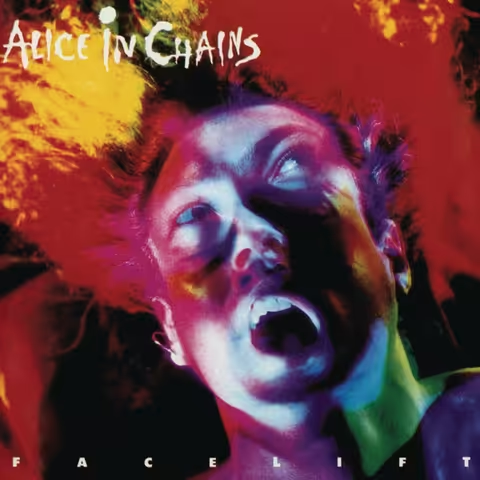
The Facelift cover is one of the most reproduced grunge-era sleeve images, and one of the most misunderstood. The concept Cantrell originally pitched to photographer Rocky Schenck was, in his own phrase, "an embryonic-type thing" representing the birth of the band. The first shoot took place on 2 May 1990 at the swimming pool of the Oakwood Apartments in Burbank, California. The pool was covered with a thin sheet of plastic; the band swam under it, rose to the surface and breathed in as they emerged, so the plastic distorted their faces. Columbia's photography budget extended to a single day at the location. Schenck liked the band enough to stretch the shoot across three days at his own cost.
One of the underwater frames eventually became the cover of the We Die Young EP. The album cover came from an entirely different technique that Schenck had been developing in his portrait work for years: in-camera multiple exposures, in which he distorted a single frame of film by exposing different parts of it one at a time. The face on the Facelift sleeve is Mike Starr, photographed using that technique. The bassist's features have been multiplied and warped on a single piece of film, before any darkroom or digital intervention. The band saw the result, agreed it was the cover, and chose the album's title directly from the warped portrait. There is no Facelift without the sleeve. The sleeve named the record.
Release, slow burn and the MTV breakthrough
Facelift was released on 28 August 1990. It did not chart immediately. It sold under 40,000 copies in its first six months, a result that, by the standards of a major-label debut on Columbia's roster in 1990, was a quiet disappointment. The label kept the band on the road through that autumn and winter as opening act for whoever would take them, and waited.
The break came in March 1991, when MTV added the Man in the Box video to regular daytime rotation. The decision had been argued for from inside the channel by programmers who had been playing the video on Headbangers Ball for months and had watched the call-in response build. Within six weeks of the daytime add, Facelift sold a further 400,000 copies in the United States. The album peaked at number 42 on the Billboard 200 across the summer of 1991, hit number 41 on the German Albums chart and entered the UK market on the back of the Man in the Box single.
On 11 September 1991, the RIAA certified Facelift gold. That made it the first grunge album to reach gold certification, ten weeks before Nirvana's Nevermind reached the same milestone on 27 November. The record has since been certified 3x Platinum in the United States, representing three million units shipped, Silver in the United Kingdom by the BPI, and Gold in New Zealand. The slow burn turned into one of the steadiest sellers in the Columbia hard-rock catalogue of the era.
Reviews, charts and the first grunge gold record
Contemporaneous reviews in 1990 and early 1991 treated Facelift as the bridge between hard rock and what was about to be called grunge. Most of the metal press read it as a slightly slower Soundgarden record with better hooks; most of the rock press read it as an unusually heavy hard-rock record with an unusually good frontman. The reading that has stuck is AllMusic's later one. The site's Steve Huey called Facelift "one of the most important records in establishing an audience for grunge and alternative rock among hard rock and heavy metal listeners," and the description has been quoted by every retrospective on the album since.
The retrospective reappraisals have been broadly generous. Classic Rock ran a 4.5 out of 5 reappraisal in September 2019. Rolling Stone placed Facelift at number 14 on its 50 Greatest Grunge Albums list in April 2019. Ozzy Osbourne listed Facelift among his 10 Favourite Metal Albums in June 2017, a placement that says as much about the album's reception inside metal as anything written by a critic. Soundgarden's Kim Thayil has named it as one of his favourite grunge records on multiple occasions in interviews across the 2000s.
"One of the most important records in establishing an audience for grunge and alternative rock among hard rock and heavy metal listeners."
Steve Huey, AllMusic, retrospective review of Facelift
The achievement that survives best is the simplest one. Facelift was the first grunge album certified gold. The bands the city would become famous for a year later were still mixing their major-label debuts when Alice in Chains hit the certification. That sequencing has been forgotten by general audiences but never by the bands themselves, and it is the reason the album has retained a reputation across both grunge and metal canons that is unusual for a debut.
On the road with Clash of the Titans
Alice in Chains landed the opening slot on the second North American leg of Clash of the Titans in 1991, the high-profile thrash-metal package tour headlined by Anthrax, Megadeth and Slayer. They were the odd band out by some distance. Thrash-purist crowds, who had paid for an evening of Slayer and Megadeth, were not expecting a band whose drummer swung and whose vocalist sang in harmony. The booing was real and consistent, and Staley dealt with it the way Staley dealt with everything else on tour: he went to find the heckler.
Anthrax bassist Frank Bello later recalled to Metal Underground that "if there was a guy starting trouble, Layne would jump into the audience and beat that guy up," using considerably more colourful language about the period than appears in print. Michael Christopher of PopMatters captured the same dynamic in writing: "With 1990's Facelift, before Nirvana blew the scene wide open, Seattle's Alice in Chains were getting a metal push, thrown on tour with the likes of Slayer and Megadeth, repeatedly booed off stage in a genre where they didn't belong."
Other 1990 and 1991 support slots were less openly hostile. The band opened for Iggy Pop, for Van Halen, for Poison and for Extreme in successive runs, picking up audiences from each. The Live Facelift video compilation, filmed at Seattle's Moore Theatre in December 1990, remains the most-watched live document of the touring band from this period and is the easiest place to see what the album looked like on stage with the original four-piece intact.
Legacy: the bridge album, Mike Starr and Layne Staley
Facelift's commercial importance is the bridge it built. The Headbangers Ball viewership that took Alice in Chains to gold in September 1991 is the audience that, six months later, was ready to take Nirvana's Nevermind to diamond. Alice in Chains were the only Seattle band that broke first on metal radio rather than college radio. The MTV breakthrough on Man in the Box preceded the Smells Like Teen Spirit video debut by half a year, and Facelift's singles stayed ahead of Nevermind's through the autumn of 1991 because they had been on rotation for months by the time Nirvana's video arrived.
Cantrell himself has acknowledged the album's bridge function in interviews across the 2000s and 2010s. Facelift, in his own framing, "set the table" for the Seattle wave commercially but stylistically remained more metal than grunge. The band would only fully synthesise the two sounds on 1992's Dirt, the album most fans now treat as Alice in Chains' definitive statement. Facelift is the road in.
Two losses sit over any current reading of the record. Mike Starr, the bassist whose face is on the sleeve and whose writing anchors Confusion, left the band in 1993 and was replaced by Mike Inez. Starr died of an accidental prescription drug overdose on 8 March 2011. He was the only original bassist Alice in Chains had, and Facelift is the only studio LP on which he played. Layne Staley died on 5 April 2002 of a heroin and cocaine overdose. By the time of his death the Staley narrative had become inseparable from the band's late catalogue, with Dirt and the 1995 self-titled album read primarily as documents of his addiction.
That reading does not really fit Facelift. The album was made before heroin became part of the Staley story. The lyrical territory it covers, anger at media, anger at exploitation, grief for Cantrell's mother, reads now as the calmest and most outward-looking of the original-lineup catalogue. It is the only Alice in Chains album that does not need to be heard through the filter of what came later. That fact, more than the gold certification or the chart peak, is the reason Facelift remains the band's most replayable debut.
The Facelift cuts most often kept in Alice in Chains' live set through the William DuVall era from 2006 onwards are Man in the Box, essentially every show, We Die Young, frequent, Sea of Sorrow, occasional in the early Nineties and rarer since, Bleed the Freak, frequent through 1990 to 1993 and occasional since, and Love, Hate, Love, a Cantrell-pick deep cut he restores for tour rotations when the mood takes him. The album has been reissued on 180-gram vinyl multiple times since 2010 and remains in print across formats.
Personnel
- Alice in Chains: Layne Staley (vocals); Jerry Cantrell (guitar, backing vocals, talkbox on Man in the Box); Mike Starr (bass, backing vocals on Confusion, additional backing vocals); Sean Kinney (drums, percussion, additional backing vocals, piano on Sea of Sorrow).
- Additional personnel: Kevin Shuss (additional backing vocals).
- Production: Dave Jerden (producer, recording, mixing); Ron Champagne (additional engineering); Leslie Ann Jones (assistant engineering); Bob Lacivita (assistant mix engineering); Eddy Schreyer (mastering).
- Cover photography: Rocky Schenck.
Tracklist
| # | Title | Length |
|---|---|---|
| 1 | We Die Young | 2:32 |
| 2 | Man in the Box | 4:46 |
| 3 | Sea of Sorrow | 5:49 |
| 4 | Bleed the Freak | 4:01 |
| 5 | I Can't Remember | 3:42 |
| 6 | Love, Hate, Love | 6:26 |
| 7 | It Ain't Like That | 4:37 |
| 8 | Sunshine | 4:44 |
| 9 | Put You Down | 3:16 |
| 10 | Confusion | 5:44 |
| 11 | I Know Somethin (Bout You) | 4:22 |
| 12 | Real Thing | 4:03 |
Things you might not know
| Fact | Detail |
|---|---|
| The Music Bank raid | Police shut the Music Bank rehearsal complex down the night before the band were due to record what would become The Treehouse Tapes demo, in what was then the largest marijuana raid in Washington state history. |
| Susan Silver passed the tape | The demo reached Columbia via Susan Silver, Soundgarden's manager, who handed it to Nick Terzo in the label's A&R department. |
| Jerden's hiring pitch | Dave Jerden got the producer job by telling Cantrell, "Metallica took Tony Iommi and sped him up; what you have done is you have slowed him down again." |
| The broken-hand album | Sean Kinney played the entire album with a broken hand, cut his own cast off in the studio and kept a bucket of ice next to the kit between takes. |
| The substitute who didn't get the gig | Greg Gilmore of Mother Love Bone was briefly considered as Kinney's session replacement before Jerden pulled the plug after a single afternoon's rehearsal. |
| A Bon Jovi commute | The talkbox on Man in the Box came from Jerden hearing Bon Jovi's Livin' on a Prayer on the car radio on the way to the studio. |
| The cover is one face | The Facelift sleeve is a single in-camera multiple-exposure portrait of bassist Mike Starr, shot by Rocky Schenck on the same Burbank trip as the underwater band photographs. |
| The cover named the record | The band picked the album title Facelift directly from the warped portrait on the sleeve, not the other way round. |
| First grunge gold | The RIAA certified Facelift gold on 11 September 1991, ten weeks before Nirvana's Nevermind earned the same certification on 27 November. |
| The slow start | The album sold under 40,000 copies in its first six months before MTV daytime rotation of the Man in the Box video pushed it to gold inside another six weeks. |
| Dedicated to a mother | The album is dedicated to Jerry Cantrell's late mother in the original 1990 Columbia liner notes, with Sunshine written specifically about her death. |
| The only Mike Starr studio LP | Facelift is the only Alice in Chains studio album to feature original bassist Mike Starr, who left the band in 1993 and died on 8 March 2011. |
How to listen now
The original 1990 Columbia LP and CD remain in print and are the canonical version of the record. The 1999 Music Bank box set is the best place to hear Facelift in context with the band's other early work, with demos and outtakes from the period included. A 2010 vinyl reissue on 180-gram brought the album back into print on the format it sounded best on, and subsequent vinyl pressings have kept it in catalogue ever since. Alice in Chains' official streaming pages on Spotify, Apple Music and Tidal, run through the band's BMG and Columbia partnership, carry the standard album in high-quality audio. For the touring band of late 1990, the Live Facelift video filmed at Seattle's Moore Theatre in December 1990 remains the single best document and is still available on the Music Bank: The Videos DVD.
If this kind of long-form album breakdown is your thing, the Riffology podcast goes even deeper on records like Facelift, with new episodes available on Spotify, Apple Podcasts, Amazon Music and every other major platform. Find the show wherever you get your podcasts.

Comments