
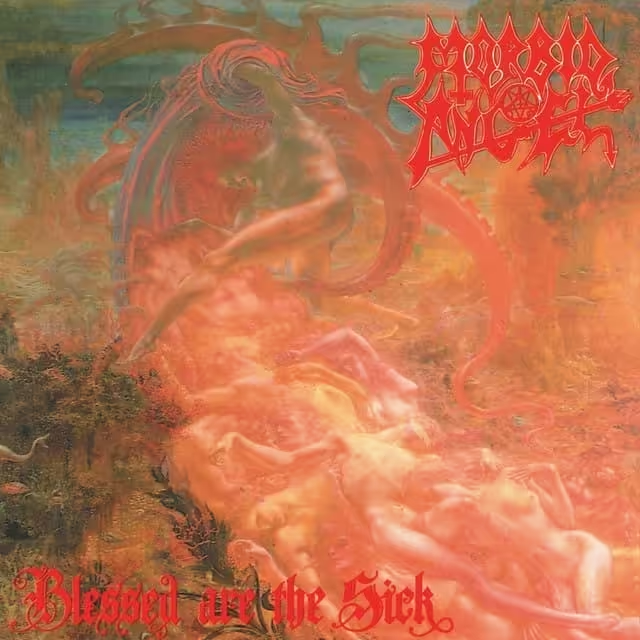
Trey Azagthoth dedicated Morbid Angel's second album to Mozart. That single fact, printed in the sleeve of a record released by an Earache band in the year of Cannibal Corpse's Butchered at Birth and Death's Human, tells you most of what makes Blessed Are the Sick the strange and pivotal album it is. The reigning champions of Florida death metal, the band whose debut had effectively defined the speed ceiling of the genre, chose for their second statement to slow down, write acoustic interludes, dedicate the whole thing to an eighteenth-century court composer, and put a Belgian symbolist painting on the front.
Released on 22 May 1991, Blessed Are the Sick is the bridge between Altars of Madness and Covenant, the record where Morbid Angel stopped trying to outrun every other extreme band on the planet and started trying to out-compose them. It is also, by some distance, the most baroque album the Tampa scene produced in its imperial phase.
Two years on the road behind Altars of Madness
To understand why Blessed Are the Sick sounds the way it does, it helps to understand how exhausted Morbid Angel were when they started writing it. Altars of Madness had come out in May 1989 on Earache, and the band spent the best part of two years on the road behind it. The European campaign began in November 1989 on the Grindcrusher Tour, an Earache package put together with Napalm Death, Carcass and Bolt Thrower that took the new sound of British grindcore and Tampa death metal through the UK and continental Europe in a single van.
The North American touring that followed put Morbid Angel on bills with a remarkable cross-section of the era's heavy music: Pantera, Obituary, Atheist, Death Angel, Forbidden, Sanctuary, Ripping Corpse and Deicide all shared stages with them at one point or another. A South American leg, then a rarity for any death metal act, was supported by Sarcofago, Sextrash and Cambio Negro. By the time the touring cycle wound down in late 1990, the four players had been hammering through the Altars set, more or less continuously, for the best part of eighteen months.
That kind of road work has two effects on a band. It sharpens the playing, especially the rhythm section, to a point where complexity stops feeling difficult. And it leaves the songwriters desperate to do something other than what they have just spent two years doing. Both effects show up plainly on Blessed Are the Sick.
There was also a commercial reality. Altars of Madness had outperformed Earache's expectations, and the label was in the middle of its first attempt to push death metal beyond a strictly underground audience. The American licensing deal with Relativity, which had distributed the debut, was renewed for the follow-up. That gave the band a slightly larger budget than they had previously enjoyed, although by mainstream rock standards the figures involved were still negligible. What it bought, more than anything else, was studio time. Where Altars had been recorded under serious time pressure, Blessed Are the Sick was allowed to spread out across two months, which is the single most important practical difference between the two records.
The Tampa scene at the dawn of 1991
By the start of 1991, Tampa was effectively the world capital of death metal. Death, Obituary, Deicide, Cannibal Corpse (recently relocated from Buffalo) and Morbid Angel were all within driving distance of Morrisound Recording, a commercial studio on North Nebraska Avenue that engineers Tom Morris and Jim Morris had built up through the 1980s. The room had originally tracked country, gospel and the occasional rock record. By 1991 its diary was full of extreme metal more or less continuously.
The reasons were practical as much as musical. Morrisound offered a Trident console, a respectable live room, in-house engineers who could track double-kick drums without complaining about the bleed, and rates that Earache and Roadrunner were willing to underwrite. The scene's geographic concentration meant musicians ran into each other constantly. Tracks were swapped, line-ups overlapped (Pete Sandoval had previously drummed in Terrorizer, James Murphy and others moved between bands several times in a year), and the studio became a meeting room as much as a workplace.
It was into this very busy, very small world that Morbid Angel arrived in January 1991 with a record that was deliberately designed not to sound like any of their neighbours.
The other bands in the Morrisound diary that winter were almost all chasing speed, gore or a combination of the two. Cannibal Corpse were tracking Butchered at Birth a few rooms over. Obituary were preparing material that would become The End Complete. Deicide had only just released their self-titled debut and were on the road. Morbid Angel had already won the speed argument with Altars, and there was nothing to be gained by repeating it; the gap in the local market was for a record that took the genre somewhere else, and the band knew it.
Trey Azagthoth and the dedication to Mozart
The Mozart dedication is the headline, and it is not a joke. Trey Azagthoth, born George Emmanuel III in Tampa, had been an obsessive student of Wolfgang Amadeus Mozart for years before Blessed Are the Sick. The interest was not the obvious romantic-myth fascination with the doomed genius; it was technical. Azagthoth was drawn to Mozart's economy, to the speed at which themes were stated and varied, and above all to the formal ambition of music that could be both immediately physical and architecturally complex.
That set of priorities maps almost directly onto what Blessed Are the Sick attempts. The interludes (Doomsday Celebration, Desolate Ways, In Remembrance) are not filler; they are structural. They function the way a slow movement functions in a classical sonata, giving the heavy material somewhere to push off from and somewhere to land. The longer songs (Fall from Grace, Blessed Are the Sick / Leading the Rats, The Ancient Ones) are written in distinct movements rather than as the verse-chorus loops the genre had largely settled on. None of that was accidental.
Azagthoth's interest in Mozart also fed into the way he wrote lead guitar. The lead breaks on Blessed Are the Sick are less concerned with shred-style velocity than with motivic development. A short figure is stated, varied, inverted and then released, often inside a window of fifteen or twenty seconds, and the choice of notes is more chromatic than the pentatonic-blues vocabulary that most metal lead playing of the era still defaulted to. The famous whammy-bar abuse is still there, but it is a colour rather than the whole picture.
The dedication itself is a single line in the small print of the sleeve, easy to miss. It has nevertheless become one of the most quoted pieces of paratext in extreme metal history, partly because it is the only piece of paratext on the record that points clearly away from the genre's usual frame of reference. Pointing toward a Catholic court composer of the 1780s, on a record otherwise garlanded in symbolist occult imagery, is a contradiction that the band have never bothered to resolve. It is the point.
Writing the songs: from the demo vault to new compositions
Three of the album's thirteen tracks were not new. Unholy Blasphemies, Abominations and The Ancient Ones had all appeared on the 1986 Abominations of Desolation demo, the unreleased first attempt at a Morbid Angel album recorded at Morrisound when the line-up was different and the deal had collapsed before release. By 1991 that demo had become a circulated tape-trader artefact and a piece of unfinished business for the band, and Earache had begun preparing it for an official release later in the year.
Re-recording three of those songs gave Blessed Are the Sick a deliberate continuity with the band's pre-history. The 1986 versions had been written by a teenage Azagthoth alongside drummer Mike Browning and vocalist Sterling von Scarborough; the 1991 versions are the same songs played by the rebuilt line-up of Vincent, Azagthoth, Brunelle and Sandoval, with David Vincent re-writing the lyrics on Unholy Blasphemies (in collaboration with Azagthoth) and Abominations (Azagthoth alone). They are, in effect, the old songs forced through the playing standard the band had reached after Altars.
The new material was written across late 1990 and the opening weeks of 1991. Azagthoth wrote almost everything musically; David Vincent wrote almost all of the lyrics. The exception, and a telling one, is Desolate Ways, the acoustic instrumental that opens the second half of the running order. That piece was written by Richard Brunelle, the band's second guitarist, and is the only Morbid Angel composition credited solely to him on any studio album.
Pre-production at the rehearsal room
Pre-production was done in the band's rehearsal space rather than the studio. By 1991 Pete Sandoval was widely regarded as the fastest and most accurate double-kick drummer in extreme metal, but the songs on Blessed Are the Sick demanded something other than raw velocity. Where Altars had been built around the assumption that Sandoval would blast through almost every section, the new material was deliberately written with passages of half-time groove, with starts and stops, and with extended ride-cymbal patterns that required a different kind of stamina.
Azagthoth's solos were also worked out in advance to a much greater degree than they had been on the debut. The whammy-bar dives, harmonic squeals and pinched bends that became his signature were not all improvised, despite the way they sound; many of the gestures on Fall from Grace and Day of Suffering had been refined across the long Altars touring cycle and then mapped onto the new compositions before the band loaded into Morrisound.
Inside Morrisound Recording
The sessions ran across January and February 1991. Morrisound by then had a workflow honed by months of back-to-back death metal records. Drums were tracked first in the main live room, with Sandoval set up in a relatively dry configuration so the speed of the kicks would translate to tape without smear. Bass went down next, then the two guitars, then leads, then vocals, then keyboard overdubs. The pattern is unremarkable for a 1991 studio; what mattered was how quickly the room could run that loop.
Budgets at this end of the genre were not large. Earache was not a major-label operation in 1991, and the album was tracked and mixed in a window that would have struck a mainstream rock band as impossibly compressed. The compensation was that everyone in the room, band and engineer alike, was deeply familiar with the conventions of the style. Decisions did not have to be explained.
The keyboard parts that thread through Doomsday Celebration, In Remembrance and several of the heavier songs were tracked by Azagthoth himself rather than by an outside player. They are deliberately synthetic rather than orchestral; nothing on the record pretends to be a real orchestra, even though the references being made are unambiguously classical. That decision keeps the album rooted in the texture of an early-1990s metal record while still letting the wider compositional ambitions breathe.
Vocal tracking was the last major piece of the puzzle. David Vincent's delivery on Blessed Are the Sick is a step on from his Altars performance: lower, more measured, with the diction noticeably clearer. The aim was that the lyrics, dense with symbolist and pseudo-liturgical imagery, would actually be parseable on the record rather than smeared into pure texture. The trade-off was that Vincent had to perform many of the vocal takes more slowly than the rhythm tracks behind them, which is one of the small reasons the album holds together as well as it does at lower volumes.
Tom Morris and the engineering approach
The engineer and mixer on Blessed Are the Sick was Tom Morris, one of the two brothers who ran Morrisound and the man most associated with the studio's death metal output of the period. Morris's signature on the record is in the clarity of the kit and the room around the guitars: the kicks are forward but distinct from each other, the snare cracks rather than thuds, and the rhythm guitars sit with enough mid-range presence that the riffs read even at the densest tempos.
It is worth flagging a piece of folk wisdom that often gets repeated about this album: the idea that Scott Burns engineered or produced it. He did not. Scott Burns was the other dominant Morrisound name of the era, and his discography in 1991 alone includes Cannibal Corpse's Butchered at Birth, Sepultura's Arise and Obituary's Cause of Death, but Blessed Are the Sick is a Tom Morris record. The credit on the sleeve is unambiguous, and the sound itself, slightly drier and more dynamic than Burns's house style on the same console, is consistent with that credit.
The cover: Jean Delville's Les Tresors de Satan
The sleeve image is not a Dan Seagrave painting (the other inevitable assumption people make about a 1991 Earache death metal record). It is Les Tresors de Satan, an 1895 oil painting by the Belgian symbolist Jean Delville, currently held by the Royal Museums of Fine Arts of Belgium in Brussels. Delville was part of the late nineteenth-century symbolist movement that ran in parallel with French symbolism and overlapped with the broader esoteric currents of the period (Theosophy, Rosicrucianism, decadent literature).
The painting depicts a central reclining figure surrounded by entwined nude bodies in a deep red and gold register, half luxurious and half hellish. The choice fits Blessed Are the Sick in a way a freshly commissioned cover could not have done. The album is not, despite the imagery, a straightforwardly satanic record; it is a record that uses the visual and verbal vocabulary of decadence and occultism to talk about ambition, decay and aesthetic excess. A nineteenth-century symbolist painting carries that thematic weight in a single image without any of the cliches that death metal cover art had already started accumulating by 1991.
Tracklist sequencing and the instrumental interludes
The thirteen-track sequence is unusual for a death metal album of the period, and it is not an accident. Three of those thirteen tracks are short instrumentals: Intro, Doomsday Celebration and In Remembrance. A fourth, Desolate Ways, is an acoustic guitar piece. That is four pieces of effectively non-metal material out of thirteen, a ratio that would have been thought commercially suicidal by most extreme metal bands of the era and was almost unheard of on a death metal record.
The interludes do specific structural work. Intro and Doomsday Celebration prepare the listener for the heavier material that follows, slowing the pulse before each onslaught. Desolate Ways sits as a kind of intermission between the first and second halves of the album, marking a break in the running order without disturbing the mood. In Remembrance closes the record with an extended cool-down rather than a hard-stop, leaving the album feeling more like a finished work than a collection of tracks.
The sequencing also obeys a tempo logic that is unusual for the period. The opening third of the record (Fall from Grace, Brainstorm, Rebel Lands) gradually accelerates after the slow build of the first song; Doomsday Celebration then resets the pulse before Day of Suffering hits as the fastest piece on the album; the title suite drops the tempo again before Thy Kingdom Come pushes it back up. By the time Desolate Ways arrives in the eleventh slot, the listener has been moved through several distinct pace regimes, and the acoustic interlude functions as a genuine release rather than as a novelty. Few death metal records of the early 1990s thought this carefully about pacing.
Album facts
| Field | Detail |
|---|---|
| Artist | Morbid Angel |
| Album | Blessed Are the Sick |
| Release date | 22 May 1991 |
| Labels | Earache Records (UK), Relativity Records (US) |
| Producer | Morbid Angel |
| Engineer and mixer | Tom Morris |
| Studio | Morrisound Recording, Tampa, Florida |
| Recording dates | January to February 1991 |
| Genre | Death metal |
| Track count | 13 |
| Total runtime | 39:24 |
| Cover art | Les Tresors de Satan by Jean Delville, 1895 |
| Notable reissue | 3 November 2009 DualDisc digipak with one-hour documentary |
The songs
Fall from Grace is the album's calling card. After the brief Intro, it announces the second-album version of Morbid Angel with a slow, deliberate riff, a long instrumental build, and only then a verse. The arrangement runs over five minutes, which on a death metal record in 1991 was not common, and the song uses its length to move through three distinct sections rather than to repeat the same idea. Azagthoth's lead break, full of whammy dives and tritone bends, is one of the most quoted single performances in the early death metal repertoire.
Brainstorm and Rebel Lands follow as shorter, more conventionally aggressive workouts, reminding the listener that the band have not lost any of the velocity that Altars was famous for. Doomsday Celebration is a synthesiser interlude that drops the temperature before Day of Suffering, the album's most concise piece of straight-ahead extremity at one minute fifty-four seconds.
The title track is a two-part suite (Blessed Are the Sick / Leading the Rats) and one of the album's heaviest pieces. Thy Kingdom Come is built around a stop-start riff that mid-1990s Morbid Angel would return to in spirit on Domination. Unholy Blasphemies, Abominations and The Ancient Ones are the three re-recorded demo tracks, played at a level of precision the 1986 band could not have managed; The Ancient Ones in particular, at almost six minutes, demonstrates how far the songwriting had moved on. Desolate Ways and In Remembrance close out the album's quieter half, the former a Richard Brunelle acoustic piece, the latter a synthesised farewell.
A few specific moments are worth marking. The transition out of the Intro into the slow first riff of Fall from Grace is one of the most-imitated openings in death metal: a held synth chord, a drop, then a single guitar line that takes its time before the band crashes in. The mid-section of the title suite, where Leading the Rats arrives as a kind of second movement, is a textbook example of how Morbid Angel built drama out of arrangement rather than dynamics. The closing run of The Ancient Ones, with its descending chromatic figure repeated four times before the song collapses into silence, is the most overtly classical passage on the record.
The lyrical content across the album is more coherent than the artwork might suggest. David Vincent is largely writing about loss of grace and the aesthetics of decay, themes that the symbolist movement had already worked through a century earlier and that the album's cover painting points to directly. The pieces that re-use 1986 lyrics (Abominations, The Ancient Ones) sit slightly apart from this; they are older material from a more straightforwardly transgressive period of the band's writing. The contrast is deliberate, and it gives the second half of the record a slightly different temperature from the first.
Reception in the metal press
The contemporary press response to Blessed Are the Sick was, like most death metal coverage in 1991, scattered across fanzines and the metal columns of the British and European music weeklies, with the underground tape-trader network amplifying it from below. The reception in retrospect has been markedly stronger than the reception at the time, as the album's structural ambitions have become easier to see in the wider context of where extreme metal went next.
The AllMusic retrospective, written by Bradley Torreano, places the album firmly in what he calls the upper class of death metal bands, treating it as one of the records that defines the genre's ceiling rather than its floor. Chad Bowar, writing for About.com, singled out Richard Brunelle for praise, citing his outstanding axework on the record; Brunelle's contribution is often overlooked in favour of Azagthoth's lead playing, and the comment is a useful corrective. Encyclopaedia Metallum, the central fan database for the genre, lists the album near the top of its Morbid Angel review tally, with a body of user reviews running into double figures.
"The upper class of death metal bands."
Bradley Torreano, AllMusic
Touring in support of the album
The touring cycle for Blessed Are the Sick was extensive even by the standards Morbid Angel had set themselves on the previous record. The band stayed on the road for most of 1991 and 1992, working through Europe, North America and beyond, and consolidating the audience that the Altars campaign had built. Setlists from the period mixed the second-album material with by-now standard Altars songs (Chapel of Ghouls, Immortal Rites, Maze of Torment), with the new instrumentals occasionally used as transitions in the live set rather than as standalone pieces.
It was during this touring cycle that the band's reputation as one of the most reliable live extreme metal acts of the era was cemented. Sandoval's stamina behind the kit became the stuff of legend in tour-bus stories; the rhythm guitar tightness between Azagthoth and Brunelle held up night after night; and David Vincent, even on a stage with no theatrical production to speak of, was a commanding front man in a sub-genre that did not always specialise in front men.
Legacy and influence on death metal
Blessed Are the Sick is the record that opened the door to a more compositional version of death metal. The choice to slow songs down without softening them, to use instrumental interludes as structural devices, and to write longer pieces with movements rather than verses, fed almost directly into what bands like Immolation, Incantation and (later) Nile, Behemoth and Gojira would do with the form. Without this record, the move from the speed-and-brutality template of the late 1980s to the more architectural death metal of the mid-1990s would have happened more slowly, and possibly not at all in the same form.
It is also the record that gave permission for classical reference to live inside extreme metal without being treated as a gimmick. The dedication to Mozart, the use of a nineteenth-century symbolist painting on the sleeve, and the simple fact that an acoustic guitar piece sits two-thirds of the way through a death metal album, all helped redraw the boundary of what the genre would accept.
The album's influence is visible most plainly in the technical death metal that emerged from the late 1990s onward. The pacing and the use of interludes find their way into Nile's catalogue, where short instrumental pieces are similarly used to structure long records. The willingness to write longer pieces in movements is foundational for what Behemoth eventually did on The Satanist. Even the production approach (dry kicks, clear rhythm guitars, distinct vocal placement) became one of the templates that the Polish death metal scene would later refine to a shine. None of these bands would necessarily cite Blessed Are the Sick as a direct model, but the line of inheritance is unambiguous.
The 2009 DualDisc reissue and other formats
The most substantial reissue arrived on 3 November 2009, when Earache released the album as a DualDisc digipak. The CD side carries the original 1991 audio; the DVD side carries a one-hour documentary on the making of the record. The DualDisc format itself was unusual by then (the format had been quietly discontinued by the major labels several years earlier), and the choice to use it for an archival metal release rather than a current pop record gave the reissue a slightly curio quality.
The album has also gone through a long run of vinyl pressings, both standard black and limited coloured variants, and is part of the Full Dynamic Range Edition reissue programme that Earache rolled out across its catalogue in the 2010s. Streaming masters of the album are taken from those later remasters rather than from the original 1991 CD master.
Where Blessed Are the Sick sits in the Morbid Angel arc
In the Morbid Angel catalogue, Blessed Are the Sick is the second of what is now generally accepted as the imperial run: Altars of Madness, Blessed Are the Sick, Covenant, Domination. Of those four, it is the most internally varied. Altars is pure speed, Covenant is more polished and more directly in the house Morrisound style, and Domination is the moment the band started to flirt with groove. Blessed Are the Sick is the album where the band tried to do everything they could imagine doing inside the genre at once, and very nearly succeeded.
It is also the last album before the band's first major line-up shift; Richard Brunelle, who plays here in the form he is best remembered for, would soon after find his role contracting and be out of the band by the Domination sessions, and David Vincent would depart after Domination, ending the original four-piece configuration. For that reason, Blessed Are the Sick is sometimes treated as the last document of the band before its character started to change. It is a reasonable framing. It is also, more importantly, the record that did the most to expand what death metal could attempt.
Listened to in 2026, what stands out most is the confidence of the thing. A band only just out of its early twenties, working on a second album for a label that was still figuring out how to sell death metal to anyone outside the tape-trader network, decided to dedicate the record to Mozart, hand the sleeve over to a Belgian painter dead since 1953, and write four pieces of non-metal material into the thirteen-track running order. None of those decisions had to be made. All of them were made deliberately. The result is the most ambitious record the Tampa death metal scene produced in its imperial decade, and one of the small number of early-1990s extreme metal records that still rewards repeated listening on its own terms rather than as a historical artefact.
Personnel and credits
| Role | Player | Notes |
|---|---|---|
| Core band | ||
| Bass and lead vocals | David Vincent | Wrote nearly all lyrics |
| Lead guitar and keyboards | Trey Azagthoth | Wrote nearly all music; dedicated the album to Mozart |
| Rhythm guitar | Richard Brunelle | Composed the instrumental Desolate Ways |
| Drums | Pete Sandoval | Previously of Terrorizer |
| Production and engineering | ||
| Producer | Morbid Angel | No outside producer credit |
| Engineer and mixer | Tom Morris | House engineer at Morrisound Recording |
| Artwork | ||
| Cover painting | Jean Delville | Les Tresors de Satan, 1895, Belgian symbolist oil painting |
| Label | ||
| UK release | Earache Records | 22 May 1991 |
| US release | Relativity Records | 22 May 1991 |
Tracklist
| # | Title | Writer(s) | Length | Notes |
|---|---|---|---|---|
| 1 | Intro | Azagthoth | 1:27 | Instrumental |
| 2 | Fall from Grace | Azagthoth (music), Vincent (lyrics) | 5:13 | Album opener proper |
| 3 | Brainstorm | Azagthoth, Vincent | 2:34 | |
| 4 | Rebel Lands | Azagthoth, Vincent | 2:41 | |
| 5 | Doomsday Celebration | Azagthoth | 1:49 | Instrumental interlude |
| 6 | Day of Suffering | Azagthoth, Vincent | 1:54 | |
| 7 | Blessed Are the Sick / Leading the Rats | Azagthoth, Vincent | 4:47 | Two-part title suite |
| 8 | Thy Kingdom Come | Azagthoth, Vincent | 3:24 | |
| 9 | Unholy Blasphemies | Azagthoth (music), Azagthoth and Vincent (lyrics) | 2:10 | Re-recorded from the 1986 Abominations of Desolation demo |
| 10 | Abominations | Azagthoth (music and lyrics) | 4:27 | Re-recorded from the 1986 demo |
| 11 | Desolate Ways | Brunelle | 1:40 | Acoustic instrumental, only Brunelle composition |
| 12 | The Ancient Ones | Azagthoth (music and lyrics) | 5:53 | Re-recorded from the 1986 demo |
| 13 | In Remembrance | Azagthoth | 1:25 | Instrumental closer |
Total runtime: 39 minutes 24 seconds. All lyrics by David Vincent except as noted; all music by Trey Azagthoth except Desolate Ways by Richard Brunelle.
Things you might not know
| Fact | Detail |
|---|---|
| The Mozart dedication | Trey Azagthoth dedicated Blessed Are the Sick to Wolfgang Amadeus Mozart, citing the eighteenth-century composer's economy and formal ambition as a model. |
| Not a Scott Burns record | Despite the persistent assumption, Scott Burns did not engineer this album. Tom Morris engineered and mixed it; Burns was busy down the corridor with Cannibal Corpse, Sepultura and Obituary in the same period. |
| The cover is from 1895 | The sleeve is Les Tresors de Satan, an oil painting by the Belgian symbolist Jean Delville, completed almost a century before the album was recorded. |
| Three songs predate the band | Unholy Blasphemies, Abominations and The Ancient Ones first appeared on the 1986 Abominations of Desolation demo, with an entirely different vocalist and drummer. |
| Brunelle's only solo composition | Desolate Ways is the only studio Morbid Angel piece credited solely to rhythm guitarist Richard Brunelle, and the only acoustic piece in the band's discography to that point. |
| Four non-metal pieces in thirteen | Intro, Doomsday Celebration, Desolate Ways and In Remembrance account for nearly six minutes of the 39-minute runtime, a remarkably high proportion of non-blast material for a 1991 Earache release. |
| Two labels in two territories | The album was issued by Earache in the UK and by Relativity in the US, the same split that Earache used for several of its higher-profile bands of the era. |
| The 2009 DualDisc reissue | Earache reissued the album on 3 November 2009 as a DualDisc digipak, with the original audio on the CD side and a one-hour documentary on the DVD side. |
| The South American leg | Touring for the previous album had taken Morbid Angel to South America with Sarcofago, Sextrash and Cambio Negro, an unusually long reach for a late-1980s death metal band and one of the early signs of the genre's global pull. |
| The Sandoval connection | Pete Sandoval had drummed in Terrorizer, the Los Angeles grindcore project that recorded the cult World Downfall album for Earache at the end of 1989. By 1991 he was Morbid Angel's full-time drummer. |
| Brunelle gets the last new song | Although Desolate Ways is the only Brunelle composition on the record, it is sequenced eleventh out of thirteen, immediately before the longest piece on the album; the running order treats it as a deliberate breath before The Ancient Ones. |
How to listen now
Blessed Are the Sick is available on all major streaming services in its Full Dynamic Range Edition remaster, which is generally regarded as the best-sounding version of the album for modern playback. The 1991 CD master is still in circulation on second-hand copies and is preferred by some listeners for its slightly drier presentation of the kit. Vinyl reissues, including limited coloured pressings, surface regularly through Earache's mail order; the 2009 DualDisc, with its one-hour documentary, is the most rewarding physical edition for anyone interested in the album's making.
If this deep dive has sent you back to the record, the Riffology podcast covers the death metal canon in detail across its catalogue and is available on Apple Podcasts, Spotify, Pocket Casts and every other major platform. Worth a listen alongside the album itself.

Comments