By the early months of 1988 Iron Maiden had spent almost a decade refusing to slow down. Six studio albums, half a dozen continent-spanning tours and a steady upgrade in stage production had taken them from Soho pubs to arenas, but the band that walked into Musicland Studios in Munich that February did so carrying the bruises of Somewhere in Time, a 1986 album on which Bruce Dickinson had submitted songs only to see every one of them rejected. The record that came out of those Munich sessions, Seventh Son of a Seventh Son, was the answer to that quiet humiliation: a seventh studio album, the band's first proper attempt at a concept record, the first Maiden number one in the United Kingdom since The Number of the Beast six years earlier, and the closing chapter of the classic line-up's first run together.
It was also the album on which Maiden, for the first time, made keyboards a genuine part of the arrangement rather than a guide-track trick, leaning into a textural, almost progressive sound that some critics at the time read as a betrayal of NWOBHM principles. The same record drew comparisons in the British rock press to Tommy and Dark Side of the Moon, broke the band wider open in mainland Europe than ever before, and produced three top-six UK singles in a row from a band who, only a few years earlier, had been almost allergic to the format.
This is the story of how that record came together, the songs that filled it, the painting on the front, the Charlotte and the Harlots warm-ups, the 107,000 people in a field at Donington and the line-up changes that followed almost immediately afterwards.
The state of Iron Maiden in 1987
Iron Maiden ended the Somewhere on Tour trek in May 1987 a richer and more popular band than they had been when it began, and an internally frustrated one. The album behind it, Somewhere in Time, was the first Maiden record to use guitar synthesisers and the first on which Bruce Dickinson had been comprehensively shut out of the writing credits. He had arrived at pre-production with a clutch of songs leaning into acoustic textures and more melodic structures; Steve Harris, the band's bass player, principal songwriter and de facto leader, had turned all of them down. The decision was a sound commercial one, since the resulting album sold in huge numbers, but it left the singer wondering aloud whether he had a creative future inside Maiden at all.
That same summer, on a break from the road, Harris read Orson Scott Card's 1987 novel Seventh Son, the first book in Card's Tales of Alvin Maker series. The conceit of a seventh son of a seventh son being born into magical gifts was old folklore, but Card's framing of it as the basis for a long supernatural narrative caught Harris's imagination immediately. He brought the idea to Dickinson, who responded, in his own later words, with a flat and grateful: "What a great idea! Brilliant!" The singer had been writing fragments on his own that had nowhere to go, including the acoustic verses that would eventually bookend the finished album. With Harris pushing him to bring whole songs to the table again, the writing logjam broke almost immediately.
The other three members were in a healthier creative state. Adrian Smith had emerged on Somewhere in Time as a serious composer in his own right, with Wasted Years and Stranger in a Strange Land both his work. Dave Murray, still the band's lead-line specialist, was happy to follow the songwriting wherever it went. Nicko McBrain, four years into his stint as Maiden's drummer, was at the peak of his physical powers. None of them had any reason to push back when Harris and Dickinson started talking about a record built around prophecy, fate and clairvoyance.
The concept and writing sessions
The concept that Harris and Dickinson sketched out borrowed the seventh-son framing from Card and from older European folklore but built nothing as rigid as a stage musical around it. There is a narrator who is born with prophetic gifts, a struggle between good and evil that runs through his visions, and a final reckoning in which he dies young; everything else, including any clear timeline, is left for the listener to assemble. Dickinson, looking back on the album years later, was generous and honest about the limits of what they had done. He had wanted, he said, to write something that genuinely tracked a story across an entire record. What they produced, in his view, "almost did" reach that, but in the end "was only half a concept album. There was no attempt to see it all the way through." His verdict on the finished record was characteristically blunt: "Seventh Son... has no story. It's about good and evil, heaven and hell, but isn't every Iron Maiden record?"
What the concept did do, very practically, was give Harris a reason to invite Dickinson back into the writing room. Five of the eight finished tracks are co-writes, four of them with the singer's name on them. On a Maiden record this was a significant shift; in the preceding two albums Dickinson had two credits to his name, both as a contributor to longer pieces. On Seventh Son he is on Moonchild, Can I Play with Madness, The Evil That Men Do and Only the Good Die Young, with the unmistakable Smith / Dickinson partnership reasserting itself on the openers.
Writing took place between the end of the Somewhere on Tour dates in 1987 and the start of recording in early 1988, in the band's usual pattern of demos worked up at Steve Harris's home studio and at rented rehearsal rooms in England. The first song to fall into place was The Clairvoyant, which Harris had begun after reading the news of the death of the British psychic medium Doris Stokes in May 1987. Stokes was one of the best-known clairvoyants in the country, with a long-running run of theatre shows and television appearances, and Harris was struck by the obvious question her sudden death raised. As he put it, he wondered whether "she could foresee her own death." That single thought became the structural seed for the entire album: a song about a man who can see what is coming for everyone else but is unsure he can see what is coming for himself.
Recording at Musicland with Martin Birch
Sessions began at Musicland Studios in Munich in February 1988 and ran into March, a tight schedule by the standards of any band aiming for a 43-minute record. Musicland, built by Giorgio Moroder in the basement of the Arabella-Hochhaus hotel, had been used by Queen, Deep Purple, the Rolling Stones and Led Zeppelin in the previous decade and had a reputation for a warm, room-led sound that suited heavy guitars without making them sound brittle. It was also far enough away from the band's homes that the usual domestic distractions did not intrude.
Producer Martin Birch had worked on every Iron Maiden studio album since Killers in 1981 and was, by 1988, as much a member of the band's working unit as any musician on the record. On Seventh Son he is credited not only as producer but as engineer, mixer and tape operator, the latter a rare role for a producer of his standing to take on personally. The credit Birch listed for himself on the sleeve, as on so many of his Maiden records, was "Disappearing Armchair", an in-joke he had been running since the late 1970s that nobody outside the inner circle has ever fully explained. He was assisted in the room by Stephane Wissner and Bernd Maier, with George Marino handling mastering at Sterling Sound in New York after the mixes were done.
Birch's working method was unfussy and quick. He preferred to capture the band playing together as a unit in the early stages, then spend his time on guitar overdubs, vocals and the layering of the keyboards rather than on elaborate drum sounds. Nicko McBrain's kit was set up in the live room with minimal screening, Steve Harris recorded his bass direct to the desk through his familiar Marshall amplification, and the guitars went down with the band's usual marriage of Marshall heads and a small army of effects pedals. The whole record was tracked on analogue tape, mixed to half-inch, and turned around inside roughly six weeks.
"Iron Maiden have given rock music back its direction and its pride."
Chris Welch, Kerrang!, 16 April 1988
Keyboards without a keyboardist
The single biggest sonic difference between Seventh Son and any previous Iron Maiden album is the prominent use of keyboards: lush pads under the verses of Infinite Dreams, sustained chordal beds beneath The Prophecy, the synthesised orchestral swell that opens Moonchild. On Somewhere in Time the band had used guitar synthesisers, an attempt to keep the synthetic textures inside the guitarists' hands; for Seventh Son they accepted that what they actually wanted was a keyboard, and then declined to hire a keyboardist.
Instead, the parts were played, in turns, by whoever happened to have a free finger. Adrian Smith took on most of the more melodic figures, which is why he is the only band member with an explicit synthesiser credit on the sleeve alongside his guitar. Steve Harris is credited with string synthesiser, a separate line of work that mostly involved laying down sustained beds under the longer pieces. Martin Birch and the engineers chipped in for textural overdubs when the band could not be bothered to leave the control room. Dickinson, asked later how a band famously dismissive of keyboards had ended up with so many of them on a record, gave one of the better-known quotes from the sessions: the keyboard parts, he said, were "mainly one-finger stuff from Adrian, Steve, the engineer or whoever had a finger free at the time."
The deliberate amateurism of that approach is part of what gives the album its distinctive sound. The keyboards never play a virtuoso line; they sit underneath the guitars as a texture, occasionally surfacing for a hook in the choruses, but they are never asked to do anything a guitarist could not also do. It is also why the band were able to take the record on the road without compromising on the line-up: when they needed a real keyboard player on stage, they reached for Steve Harris's bass technician.
Personnel and credits
| Role | Personnel |
|---|---|
| Iron Maiden | |
| Vocals | Bruce Dickinson |
| Guitars, synthesiser | Adrian Smith |
| Guitars | Dave Murray |
| Bass, string synthesiser | Steve Harris |
| Drums | Nicko McBrain |
| Production | |
| Producer, engineer, mixer, tape operator | Martin Birch (credited as Disappearing Armchair) |
| Assistant engineers | Stephane Wissner, Bernd Maier |
| Mastering | George Marino, Sterling Sound, New York |
| Recording studio | Musicland Studios, Munich, West Germany |
| Sleeve | |
| Cover painting | Derek Riggs |
| Management and creative direction | Rod Smallwood, Sanctuary Music (Overseas) Ltd |
| Touring | |
| Keyboards on stage (as The Count) | Michael Kenney, Steve Harris's bass technician |
Tracklist
| # | Title | Writer(s) | Length | Note |
|---|---|---|---|---|
| 1 | Moonchild | Smith, Dickinson | 5:38 | Opens with an acoustic verse |
| 2 | Infinite Dreams | Harris | 6:08 | Later released as a live single |
| 3 | Can I Play with Madness | Smith, Dickinson, Harris | 3:30 | Lead single, UK number three |
| 4 | The Evil That Men Do | Smith, Dickinson, Harris | 4:33 | Second single, UK number five |
| 5 | Seventh Son of a Seventh Son | Harris | 9:52 | Title track and centrepiece |
| 6 | The Prophecy | Murray, Harris | 5:04 | Only Murray co-write on the record |
| 7 | The Clairvoyant | Harris | 4:26 | First song written for the album |
| 8 | Only the Good Die Young | Harris, Dickinson | 4:40 | Closes with the same acoustic verse that opens Moonchild |
The songs, track by track
Moonchild opens the record with the first of the two acoustic interludes Dickinson wrote to bookend the album, a soft fingerpicked figure under his unaccompanied voice that lasts only seconds before the full band drops in. The song proper is a fast Smith / Dickinson collaboration whose title is borrowed loosely from Aleister Crowley's 1917 novel Moonchild, a book about a magical battle for the soul of an unborn child. Dickinson uses the imagery as a way into the album's wider story, with the narrator addressing the seventh son before he is born, warning him of what awaits. Smith's main riff is one of the more aggressive things on the record, and Murray's lead break, doubled in harmony, is one of the album's most quoted guitar moments.
Infinite Dreams is the first of three Harris solo writes on the record and the one in which the keyboards take their most prominent role. Built around the image of a character who implores a spiritualist to unlock the meaning behind his tortured dreams, it moves through three distinct sections: a long, atmospheric verse over sustained string-synthesiser beds, a chorus that lifts with the entire band, and an extended instrumental passage in which Smith and Murray trade leads. Dickinson's vocal is unusually restrained, often sitting in the middle of his range rather than reaching for the high notes, which makes the moments where he does push the chorus that much more effective. A live version recorded at the NEC in Birmingham later became a UK top-ten single in November 1989.
Can I Play with Madness began its life as something else entirely. Adrian Smith had brought it into pre-production as a slow ballad called On the Wings of Eagles, a piece much closer in feel to the more pop-leaning material he had written on the previous record. Dickinson took the song home, rewrote the lyric around the new chorus hook that gave it its title, and brought it back at a faster tempo. Harris then made a further structural intervention, adding the time-change instrumental passage in the middle of the song, complete with a Murray lead break, which broke the verse-chorus-verse pop shape into something more recognisably Maiden. Dickinson later described the negotiation around that addition with characteristic bluntness: it caused "a big row," he said, in which "Adrian absolutely hated it." Released on 14 March 1988, four weeks ahead of the album, it became the band's biggest single since Run to the Hills and what Dickinson described as Smith's "first proper hit single." It reached number three on the UK Singles Chart.
The Evil That Men Do takes its title and its first line from Mark Antony's funeral speech in Shakespeare's Julius Caesar, where Antony tells the crowd that "the evil that men do lives after them; the good is oft interred with their bones." It is the second of the three Smith / Dickinson / Harris writes on the record and the one that translated most easily to a single. The riff is a circular, mid-tempo figure with a strong chorus hook; the lyric folds Antony's idea into the album's wider concern with prophecy and fate. Released on 1 August 1988 as the second single, it reached number five in the UK and became a permanent fixture in Maiden's live set, surviving line-up changes, tour reinventions and the singer's temporary departure from the band in the 1990s.
Seventh Son of a Seventh Son, the title track, is the centrepiece of the album and at 9:52 the longest song on it. Written entirely by Harris, it is the one piece on the record that actually attempts a narrative arc within itself. Long sections of slow, almost orchestral chordal writing alternate with riff-driven uptempo passages and a long mid-song instrumental in which Smith and Murray each take an extended solo. The lyric, addressed to the seventh son in the second person, walks him through his powers and his fate. It is structurally closer to the long-form Harris pieces on previous albums, Rime of the Ancient Mariner and Alexander the Great, than anything else on Seventh Son, and it sits exactly in the middle of the running order as a kind of pivot from the more accessible singles material on side one to the darker, denser writing on side two.
The Prophecy opens side two and is the only song on the record co-written by Dave Murray, in collaboration with Harris. The lyric continues the narrative in the first person, with the seventh son foreseeing a disaster and warning his village, only to be ignored and then blamed when the disaster comes. The arrangement is one of the most progressive on the album, with several distinct sections, a long acoustic interlude in the middle and a closing instrumental in which a classical guitar figure plays the song out over fading studio chatter. It has the feel of a fragment from a larger work, which suits a song about a prophecy nobody wants to hear.
The Clairvoyant, written first and arguably the song around which the rest of the album organised itself, is one of the most economical and immediate pieces on the record. Harris opens it with a bass figure that became one of his most recognisable signatures, a galloping run that sits high on the neck and carries the verse on its own before the guitars join. The lyric folds his Doris Stokes question into the album's narrator, asking whether a man who can see everyone else's future can see his own death coming. A live recording made at the NEC during the November 1988 dates was released as the third single on 7 November 1988 and reached number six in the UK, making it three consecutive top-six singles from the same record.
Only the Good Die Young closes the album and the storyline, returning the listener to the bookending acoustic verse that opened Moonchild, this time placed at the end of the song to close the loop. The seventh son dies, having seen what was coming and failed to prevent it, and the record ends quietly. The full band track in between is one of the faster things on the record, with a chorus designed for an arena audience to sing back, and is part of the reason the song was picked up by the American TV series Miami Vice, which used it in a 1988 episode. The two acoustic fragments, both written by Dickinson, are the simplest writing on the record and probably the most important structural decision on it, since they are the things that turn eight discrete songs into something a listener experiences as a whole.
Cover artwork by Derek Riggs
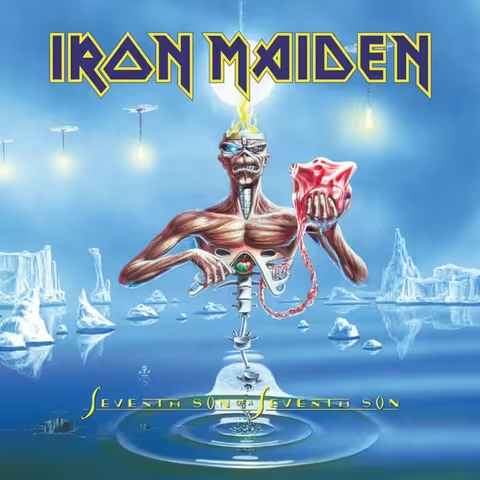
Derek Riggs had been painting Maiden's covers since the band's debut album in 1980 and was, by 1988, as much a part of the Iron Maiden identity as any of the musicians. The brief he received from manager Rod Smallwood for Seventh Son was, by Riggs's own account, one of the more open ones he had been given. Smallwood asked, he said, for "simply something surreal and bloody weird." Riggs took that as licence to assemble something that operated on as many symbolic levels as he could fit on the front of a record sleeve.
The painting itself shows Eddie, the band's long-running mascot, split in two and floating over a polar landscape, a frozen white plain that extends to a low horizon. The upper half of Eddie's head is on fire, an image Riggs has said he "stole" from the British psychedelic singer Arthur Brown, whose 1968 single Fire was famously performed with a flaming metal helmet, and which Riggs used as a visual shorthand for inspiration. Eddie's face still carries the lobotomy scar from the Piece of Mind cover and the cyborg enhancements from Somewhere in Time, threading the new image into the band's existing visual continuity rather than starting from scratch. In his lower left hand he holds a small naked baby curled in utero, the seventh son himself; in his lower right hand he holds an apple, an obvious nod to the Garden of Eden, with a red and green yin-yang at its centre standing in for the album's preoccupation with the balance of good and evil.
Smallwood made a single additional request for the back cover, which Riggs has often repeated as something close to a direct quote: "Could you stick all the other Eddies in the ice?" Riggs duly embedded the previous album mascots, from the debut sleeve onwards, in the frozen plain behind the central figure, a small piece of self-referential continuity for fans paying close attention. The cold landscape itself has more than one origin story. Dickinson has cited a Gustave Dore illustration of Dante's Inferno, in which the worst traitors are frozen in ice in the ninth circle of hell, as the obvious classical reference. Riggs, asked separately, has given a more mundane account: he had recently watched a television documentary about the North Pole, and the imagery had stuck.
Release and singles
The album was released on 11 April 1988 on EMI in the United Kingdom and Capitol Records in the United States, with parallel European pressings on EMI and a Japanese pressing on Toshiba EMI. The lead single, Can I Play with Madness, had been released four weeks earlier on 14 March and was already in the UK top five by the time the album shipped, which gave EMI a clear run at retail. The Evil That Men Do followed on 1 August 1988, while the third single, a live version of The Clairvoyant recorded later in the tour, was released on 7 November 1988.
| Single | Released | UK Singles Chart |
|---|---|---|
| Can I Play with Madness | 14 March 1988 | 3 |
| The Evil That Men Do | 1 August 1988 | 5 |
| The Clairvoyant (live) | 7 November 1988 | 6 |
For a band whose first three singles in the early 1980s had been brief riff-led blasts, the run of three top-six singles in eight months was a commercial peak that Maiden have not repeated. It was also the moment at which the band's audience visibly broadened beyond the long-haired denim and leather constituency that had carried them through the early NWOBHM years.
Promotion and the Seventh Tour of a Seventh Tour
The promotional campaign began before release with a press preview event at Castle Schnellenberg in Attendorn, West Germany, where the band played the album to international journalists in surroundings deliberately chosen to match the cover painting's sense of gothic mystery. The European music press were given the record almost a month in advance, with embargoes that mostly held, and the reviews that followed in early April were unusually long and unusually generous.
Before the proper tour opened the band ran a pair of secret warm-up shows under the alias "Charlotte and the Harlots," a nod to the early Maiden track Charlotte the Harlot. The first was at the Empire in Cologne, the second at L'Amour in Brooklyn, New York. Both were small-club shows announced too late for any but the most local fans to attend, and both functioned as full-band rehearsals for the new material in front of an audience that did not, in theory, know who was on stage.
The main run, branded the Seventh Tour of a Seventh Tour, opened in May 1988 and ran for over seven months and more than a hundred shows, playing to a cumulative audience the band's own management put at more than two million people. The stage production was the largest Maiden had yet attempted, designed around the cover painting's icy palette and built to fill arenas and festival fields. For the keyboard parts on stage Steve Harris's bass technician, Michael Kenney, was recruited to play them under the stage name "The Count," dressed in a black cape and mask so that nobody could quite be sure who was up there. For the title track he was placed on a forklift truck and raised slowly above the band as he played, a piece of theatrical staging that became one of the tour's most-discussed moments.
The high point of the tour, by some distance, was the band's first headline appearance at the Monsters of Rock festival at Donington Park on 20 August 1988. The crowd, officially recorded at 107,000 people, was the largest in the festival's history and remains the largest crowd Maiden have ever headlined to in the United Kingdom. The bill that day, with Kiss, David Lee Roth, Megadeth, Guns N' Roses and Helloween supporting, was one of the strongest in Monsters of Rock's run, and the day was overshadowed by the deaths of two fans crushed in the crowd during Guns N' Roses' afternoon set. Maiden's own performance was caught on multitrack and partially released over later years.
The PA system Maiden brought to Donington that day was extreme enough to earn the band an entry in the 1990 edition of the Guinness Book of Records (p. 155), which listed it as the largest front-of-house PA used at a concert: 360 Turbosound cabinets, a system capable of 523 kilowatts of audio power, with an average sound pressure level at the mixing tower of 118 decibels that peaked at 124 decibels during Maiden's headline set. The rigging took five days to put together. A separate stop at the National Exhibition Centre in Birmingham in November 1988 was filmed and released as the Maiden England concert video, capturing the full tour show with its proper production and a sympathetic British audience.
Critical reception
British rock press reaction at release was the strongest the band had ever received. Chris Welch's review in Kerrang! on 16 April 1988 gave the record a full five out of five, called the band's choice to attempt a concept record "a brave and clever move" and made the comparison that ended up framing the album's reputation for years: Seventh Son, he predicted, "will eventually be hailed alongside such past milestones as Tommy, Tubular Bells and Dark Side of the Moon." The line was widely quoted, both admiringly and, by some sections of the press, mockingly. Geoff Barton at Sounds noted in his own coverage that a section of the British rock critical establishment was using the keyboards and the longer arrangements as ammunition to accuse Maiden of "having regressed into Genesis-style prog rockers from the 70s," an accusation Barton himself was inclined to dismiss but reported on as a real strand of opinion at the time.
Mainland European reviews were uniformly strong. Rock Hard in Germany, reviewed by Gotz Kuhnemund, gave the record nine out of ten and identified the album as the band's most musically ambitious to date. In the United States the rock press was more divided, with publications more attuned to the emerging thrash and glam scenes treating the record as somewhat old-fashioned even as Maiden's sales climbed.
Retrospective re-evaluation has been kinder still. Steve Huey's AllMusic review awarded four-and-a-half stars out of five, praised the record for the way it "restores the crunch that was sometimes lacking in the shinier production of the previous album," and concluded that it "ranks among their best work." Mike Stagno, writing for Sputnikmusic on 4 June 2006, gave the album four out of five and identified it as the strongest record of the Bruce Dickinson 1980s run. Martin Popoff in his Collector's Guide to Heavy Metal was more reserved, awarding six out of ten, the lowest score among major review sources. In 2005 the German magazine Rock Hard ranked the album at number 305 in its book-length list of the 500 Greatest Rock and Metal Albums. In a 2017 feature for Loudwire on the top twenty-five progressive metal albums, John Hill placed Seventh Son at number eleven, ahead of records by Tool, Mastodon and Opeth. The biographer Paul Stenning, surveying the band's career in book form, was unequivocal that "this line-up of the group hit its peak in 1988." Writing in 2024, the critic Jeff Giles described the record as sounding like "a more aggressive version of Yes or Kansas," which is closer to the contemporary backlash framing than the band would once have welcomed but reads now as a compliment.
Charts and certifications
On release Seventh Son entered the UK Albums Chart at number one, the band's first chart-topper since The Number of the Beast in 1982 and only the second of their career to that point. It topped the chart in Finland and reached number two in Switzerland and the Netherlands, number three in New Zealand, Norway and Sweden, number four in West Germany, number six in Austria, number eight in Italy, number twelve in Canada and the United States, number fourteen in Spain, number sixteen in France, number nineteen in Australia and number twenty-two in Japan. It was the band's strongest performance to date in continental Europe and re-established them as a number-one act at home.
| Territory | Certifying body | Certification |
|---|---|---|
| United States | RIAA | Gold (500,000) |
| United Kingdom | BPI | Gold |
| Germany | BVMI | Gold (250,000) |
| Canada | Music Canada | Platinum (100,000) |
| Italy | FIMI | Platinum (200,000) |
| Switzerland | IFPI | Gold (25,000) |
Legacy and reissues
The success of the Seventh Tour of a Seventh Tour and the album behind it papered over what was actually a fraying internal situation. Adrian Smith had begun the writing sessions for the follow-up record, No Prayer for the Dying, in late 1989 and quickly found himself at odds with the direction Harris and Dickinson wanted. The pair were reacting against the lushness of Seventh Son and pushing for a deliberately stripped-back, more aggressive record made in a barn rather than in a Munich studio. Smith disliked the new material, felt that his own writing was being marginalised again, and in January 1990, during pre-production, he left the band. He was replaced by Janick Gers and would not return to Maiden until 1999, ahead of the Brave New World reunion record in 2000. The Smith / Murray / Harris / Dickinson / McBrain line-up that made Seventh Son was therefore the last classic-era Maiden line-up until that reunion, with the album standing as the closing statement of the band's first peak.
The record itself has been reissued repeatedly. In 1995 Castle and EMI released a two-disc edition that paired the original album with a bonus disc collecting B-sides and live material from the era: Black Bart Blues (Harris / Dickinson, 6:43), a cover of Thin Lizzy's Massacre (Lynott / Gorham / Downey, 2:52), reworkings of Prowler '88 (Harris, 4:07) and Charlotte the Harlot '88 (Murray, 4:11), and live versions of Infinite Dreams (6:03), The Clairvoyant (4:27), The Prisoner (Smith / Harris, 6:09), Killers (Harris / Di'Anno, 5:03) and Still Life (Murray / Harris, 4:39). A 1998 EMI Enhanced CD reissue, designed by Hugh Gilmour, retained the bonus disc and added video content. The album was remastered again in 2015 as part of EMI and Sanctuary's catalogue programme, and it is the cover from that 2015 remaster, with the colours slightly refreshed, that appears at the top of this page.
Between 2012 and 2014 Iron Maiden mounted the Maiden England World Tour, a worldwide trek built explicitly around revisiting the Seventh Son material, named after the 1988 concert video and with a stage design that drew heavily on the album's iconography. By that point all five members of the 1988 line-up were back in the band, and the tour played to crowds that in many cases dwarfed the original Seventh Tour of a Seventh Tour's audiences. It served as a long, well-mounted vindication of the record, and of the line-up that made it.
Things you might not know
| Fact | Detail |
|---|---|
| Birch as tape op | Martin Birch is credited not only as producer, engineer and mixer but as tape operator on Seventh Son, the only Iron Maiden album on which he took the tape op role himself rather than handing it to a junior. |
| Disappearing Armchair | Birch's standing in-joke sleeve credit, used across most of his Maiden records, appears here as well; the band have never publicly explained what an actual Disappearing Armchair is. |
| Charlotte and the Harlots | The band ran two secret warm-up club shows under the alias Charlotte and the Harlots, at the Empire in Cologne and L'Amour in Brooklyn, before the main tour opened. |
| The Count on a forklift | Live keyboards were handled by Steve Harris's bass technician Michael Kenney, performing as The Count, in a black cape and mask, and lifted above the band on a forklift truck for the title track. |
| The Donington Guinness record | The 1990 Guinness Book of Records (p. 155) listed Maiden's Monsters of Rock 1988 PA, 360 Turbosound cabinets capable of 523 kilowatts, as the largest concert PA ever assembled at that point, with an average level of 118 decibels at the mix tower and peaks of 124 decibels. |
| Doris Stokes as inspiration | The Clairvoyant, the first song written for the record, came directly out of Steve Harris reading about the death of the British psychic Doris Stokes in May 1987 and wondering whether she could foresee her own death. |
| On the Wings of Eagles | Can I Play with Madness began as a slow Adrian Smith ballad called On the Wings of Eagles; Dickinson rewrote the lyric, Harris added the time-change instrumental passage, and Smith reportedly hated the addition. |
| Bookending acoustic verses | The two acoustic fragments that open Moonchild and close Only the Good Die Young are both written by Bruce Dickinson and are identical, looping the album back on itself. |
| First UK number one since Beast | Seventh Son was Iron Maiden's first UK number-one album since The Number of the Beast in 1982, a six-year gap during which they had released four studio records. |
| Miami Vice sync | Only the Good Die Young was used in a 1988 episode of the American television series Miami Vice, an unusually high-profile sync placement for a Maiden track of the period. |
| Shakespeare in the singles | The Evil That Men Do takes its title and first line from Mark Antony's funeral speech in Shakespeare's Julius Caesar. |
| Aleister Crowley reference | Moonchild borrows its title loosely from Aleister Crowley's 1917 novel of the same name, a story about a magical battle for the soul of an unborn child. |
And after
For Iron Maiden, Seventh Son of a Seventh Son was the end of something as much as a triumph in its own right. The line-up that walked into Musicland in February 1988 walked out with a UK number one, a top-twenty album in most of Europe and the United States, three consecutive top-six UK singles, the largest crowd in Monsters of Rock's history, a Guinness PA record and a stage production they could only barely fit through the doors of a British arena. Within two years of the album's release the guitarist who had written its lead single was gone, the band were making a deliberately rough country-house follow-up, and the era that Seventh Son closed was over. The reunion of that line-up in 1999 makes the 1988 record look in hindsight less like a one-off conceptual experiment and more like a hinge: the last word of one Maiden, and the template that the second Maiden, twelve years later, would reach back for.
The Riffology podcast covers this album, the rest of Iron Maiden's catalogue and the wider story of British heavy metal in long-form episodes, available on all major podcast platforms.

Comments