Introduction

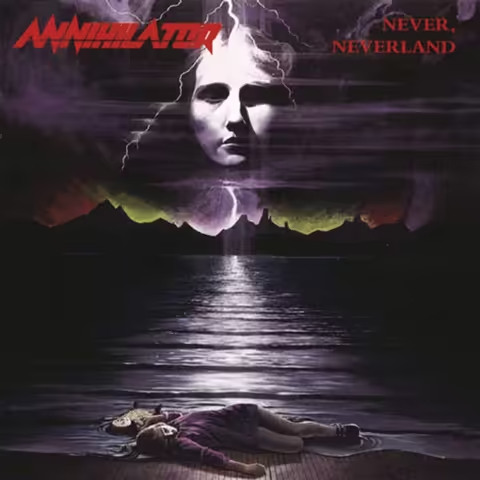
By the time Annihilator wheeled out of the rehearsal room and into Vancouver Studios in the wet, dark February of 1990, Canadian thrash metal had already produced its share of cult records but very few crossover hits, and the band that guitarist Jeff Waters had assembled to record his second album was about to deliver something that would do both at once. Never, Neverland was the album that took a difficult, technical, often furious style of music and gave it a melodic edge sharp enough to push the band onto the UK Albums Chart for the first and, as it would turn out, the only time in their entire career.

For a record that has spent more than three decades being filed alongside the heavyweight thrash releases of 1990, Never, Neverland sits in a strange position in the genre's history. Megadeth, Anthrax and Slayer all put out era-defining albums that same year. Roadrunner Records, the band's label, was simultaneously breaking Sepultura, Obituary and Death. And yet Annihilator, with a new singer recruited from a defunct American power metal band, no original-lineup bassist on the album cover and a frontman who composed not only the guitars but the drum parts as well, walked away with a record that critics would later call one of the strongest metal releases of the year and that the band themselves would spend the next thirty years trying to follow.

From Ottawa garage to Vancouver studio: the Annihilator origin story

Annihilator began in Ottawa in 1984, founded by Jeff Waters and original vocalist John Bates. The band's name was lifted, with a teenager's irreverence, from a piece of military hardware in the Eddie Murphy comedy Best Defense, released the same year, a film in which the character Wylie Cooper drives an experimental tank called the Annihilator. The choice was almost an accident, decided quickly during the band's earliest rehearsals, but it would prove far more durable than the film that inspired it.

Waters spent the mid-1980s building the band through a succession of cassette demos that quietly circulated through the tape-trading underground. Welcome to Your Death arrived in 1985, followed by Phantasmagoria in 1986 and the twin 1987 demos Wicked Mystic and Word Salad. None of them sold in any commercial sense, but they were enough to mark Waters out among collectors and a few sympathetic A and R scouts as a guitarist who could write riffs and arrangements far more elaborate than the usual demo fare. By the end of 1987 he had relocated west to Vancouver, a long distance from Ottawa both geographically and culturally, and set about putting together the lineup that would make the first Annihilator record.

In Vancouver, Waters recruited drummer Ray Hartmann and the singer who would deliver the band their breakthrough, Randy Rampage, then best known as the original bassist and live presence of the Vancouver hardcore institution D.O.A. Rampage's snarl carried a rawness that suited the half-hardcore, half-thrash hybrid Waters had been writing toward. With the lineup in place, the band signed to Roadrunner Records in 1988 and released their debut Alice in Hell in April 1989. The record landed in a busy thrash year but, on the strength of the songwriting and the production values Waters had insisted on, made enough noise for Roadrunner to send them out on a world tour. Annihilator spent the rest of 1989 opening for Onslaught on the In Search of Sanity dates, Testament on the Practice What You Preach run and a string of co-headlining dates with Exodus.

The tour was, by every later account, exhausting. By the time the band came off the road in late 1989 the working relationship between Waters and Rampage had soured to the point where carrying on together was no longer realistic, and Rampage, never the most settled member, was out. With a follow-up album already contractually due, Waters needed a new vocalist and, ideally, one capable of delivering the more technical, more melodic material he had been writing on tour.

Enter Coburn Pharr: a new voice from Omen

The singer who walked into the auditions was Coburn Pharr, an American with a strong, slightly old-school power metal pedigree. Pharr had been the frontman of Omen, the Los Angeles power metal band whose mid-1980s records Battle Cry and Warning of Danger had built a small but loyal following on the European festival circuit. By the time Annihilator came calling, Omen had effectively dissolved and Pharr was available, looking for a band with a label, a tour budget and a future. The fit, on paper, looked a little unusual. Pharr's voice was cleaner, higher and noticeably more melodic than Rampage's hardcore yelp. In practice that turned out to be exactly what Waters needed for the songs that became Never, Neverland.

Where Rampage had pushed Alice in Hell toward a raw, almost punk-flavoured thrash, Pharr's delivery sat the melodies on top of the riffing rather than fighting them for space. The title track, in particular, was written in a register that Rampage would have struggled to carry, and the slower passages of Imperiled Eyes asked for a singer who could hold a note long enough to make the silence around it matter. Pharr could do both. Waters has said, in interviews around the period, that he wrote much of the album with the new singer in mind once Pharr's audition tape had arrived, tailoring the choruses to his strengths rather than asking him to copy his predecessor.

The relationship was productive but, as it would turn out, short. Pharr stayed with the band through the recording, the touring cycle and the European Painkiller dates with Judas Priest before parting ways with Waters in the spring of 1991. He never returned to a band of comparable stature, though he made one celebrated guest appearance with Annihilator on the 70000 Tons of Metal cruise in January 2015, performing five Never, Neverland-era songs in front of an audience that had come, in many cases, specifically to hear him. Pharr died on 25 February 2025 at the age of 62. The Annihilator album he sang on remains his most widely heard work.

Writing the songs: Jeff Waters as auteur

All ten songs on Never, Neverland are credited to Jeff Waters alone, and the credit is not a polite fiction. Waters wrote the riffs, the lead lines, the bass parts and, distinctively for a metal album of the period, the drum parts as well. Ray Hartmann was the executor of those drum arrangements in the room, a player capable of interpreting and refining what Waters had sketched, but the architecture of every fill and every double-kick pattern came from the guitarist. It is an unusual way to run a band, and it explains some of the friction that would erupt in the Annihilator lineup over the following two decades. It also explains the unity of the record itself.

The songs Waters brought into Vancouver Studios were, in aggregate, more melodic and more compositionally ambitious than the material on Alice in Hell. The debut had relied on shock value and breakneck speed; the follow-up reached for something that could survive repeated listening. Imperiled Eyes is the most obvious example, a slower, more emotionally weighted song that gives Pharr room to phrase, but the same impulse runs through the title track, with its haunting central riff, and through Stonewall, the album's most concise commercial moment and the song that Roadrunner would eventually select as the single.

There is also a Canadian sense of humour woven through the running order that the international press tended to miss. Kraf Dinner, the under-three-minute burst that arrives seventh, is a sideways nod to Kraft Dinner, the boxed macaroni and cheese product that has been a Canadian student staple for two generations. The joke would not have landed in Hamburg or Cleveland but it landed in Vancouver, and its inclusion is a small reminder that, for all the technical seriousness of the album, Waters was still a young man writing for an audience that included his own friends.

The themes of the lyrics, where they go beyond the standard thrash repertoire of war and persecution, sit on the darker, more psychological end of the genre. The Fun Palace describes an institution that is rather less fun than its name suggests. Imperiled Eyes is a study in helpless observation. The title track wraps a Peter Pan reference around a meditation on never quite growing up, a theme Waters has revisited more than once in the band's later catalogue.

Recording at Vancouver Studios (February to April 1990)

The album was tracked between February and April 1990 at Vancouver Studios, an establishment that did not carry the international cachet of the Quebec or Los Angeles facilities of the period but which had become Waters's home base. The producer's chair was shared, in name and in practice, between Glen Robinson and Waters himself. Robinson, an experienced Montreal producer whose later work would include records with Voivod and Gwar, brought the discipline of an outside ear to a project that might otherwise have collapsed entirely into Waters's perfectionism. Steve Royea engineered alongside Robinson. Monte Conner, Roadrunner's increasingly influential A and R man, took an executive producer credit and was a regular voice on the telephone throughout the sessions.

The recording lineup tells its own story. Waters tracked the guitars, which was expected, and a great deal of the bass, which was not, even though Wayne Darley would appear on the album cover and in the personnel credits as the band's bassist. Darley was the live bassist, the player who took the parts on the road. In the studio, on the timetable Roadrunner had agreed, Waters preferred to handle most of the low end himself, layering the bass directly with the rhythm guitars to get the tightness he wanted. It is a working method he has used on most Annihilator records since.

Hartmann played drums, taking Waters's pre-written parts and inflecting them with the kind of feel that no chart can specify. Dave Scott Davis was brought in for two specific guitar solos, on the opener The Fun Palace and on the reworked Phantasmagoria, providing a contrasting voice to Waters's own lead playing. The decision to bring in a guest soloist on what was otherwise a tightly controlled session is, in its small way, revealing: even at his most authorial, Waters knew when an outside hand would serve a song better than another pass from his own fingers.

The sessions themselves, by accounts Waters has given in various interviews since, were long and detail-obsessive. Each rhythm guitar layer was tracked, retracked and edited until the attack on every chord was as precise as Waters could make it. Vocal sessions with Pharr ran in concentrated blocks once the backing tracks were in place. By early April the basics were complete and the album was ready to leave Vancouver for its mixing destination on the far side of the country.

Mixing at Le Studio, Morin Heights

Le Studio in Morin Heights, Quebec, was, by 1990, one of the most storied recording facilities in North America. Built in the 1970s on a lakeside property an hour north of Montreal, the studio had hosted Rush across the run of records that defined their commercial peak, The Police during the Synchronicity period, David Bowie's Tonight, Sting's The Dream of the Blue Turtles, Queensryche's Operation: Mindcrime and Voivod's Nothingface. To take a thrash album there for mixing in April 1990 was a statement of intent on Roadrunner's part, and the bill confirmed that the label expected Never, Neverland to do better than its predecessor.

Glen Robinson took the mixing chair himself rather than handing it off to a specialist mixer, which was the more common arrangement for metal records of the period. The result is an album whose sound is unmistakably his: bright, percussive, with the snare and kick well forward in the mix, the rhythm guitars stacked but separated, and Pharr's vocals sitting high enough above the riffing to carry the melodies without disappearing into them. The lead tones, in particular, benefit from Le Studio's room acoustics, gaining a clarity that the Vancouver tracking had set up but that the final mix was responsible for delivering.

From Morin Heights the album moved to Sterling Sound in New York City, where George Marino took on the mastering. Marino, by 1990 already one of the most respected mastering engineers in American music, had cut records for Led Zeppelin, AC/DC and a long roster of rock and metal acts. His work on Never, Neverland gives the album the loudness and the consistency across the running order that it would carry through to the CD, cassette and vinyl pressings that hit stores that August.

Track-by-track

No.TitleWriterLengthNotes
1The Fun PalaceJeff Waters5:51Lead solo by Dave Scott Davis
2Road to RuinJeff Waters3:42
3Sixes and SevensJeff Waters5:20Singled out by Select for praise
4StonewallJeff Waters4:50Released as a single, January 1991
5Never, NeverlandJeff Waters5:29Title track
6Imperiled EyesJeff Waters5:27Slower, melodic centrepiece
7Kraf DinnerJeff Waters2:41Canadian-humour interlude
8PhantasmagoriaJeff Waters3:59Title shared with the 1986 demo; lead solo by Dave Scott Davis
9Reduced to AshJeff Waters3:09
10I Am in CommandJeff Waters3:34Title later supplied the name of the 1996 in-concert compilation In Command

The Fun Palace opens the record with a deliberately uneasy mid-tempo riff that delays the album's first proper gear change for almost a minute, then accelerates without warning into one of the fastest sections on the entire record. Dave Scott Davis's first contribution as guest soloist arrives in the second half, a fluid, vocal-feeling solo that contrasts with Waters's more chopped rhythm phrases. As an opener it tells you what the rest of the record will sound like without giving away its best ideas.

Road to Ruin is lean, direct and unusually concise by Annihilator standards. Where many of Waters's songs from this period stretch past five minutes to accommodate an extra solo trade or a bridge, Road to Ruin sits at three minutes and forty-two seconds and uses every one of them, with Pharr pushing the chorus into a higher register than he attempts anywhere else on the record. It is the closest the album comes to a single in the traditional sense, even though Stonewall is the song that Roadrunner eventually picked.

Sixes and Sevens is one of the album's most musically ambitious pieces, a five-and-a-half-minute construction with multiple riff changes, a long instrumental middle and a chorus that takes its time to arrive. Nick Griffiths, writing for Select magazine in his unimpressed two-out-of-five review of the album, nevertheless picked Sixes and Sevens out as the track that showed what the band might be capable of when their reach matched their ambition. It is still cited by Annihilator fans as a hidden highlight.

Stonewall, the album's eventual single, arrives at track four and slows the tempo down to something close to a mid-paced groove. The riff is one of Waters's most direct, the chorus is built to be sung back to the band by a festival audience and the lyric, which deals with stubborn refusal in the face of pressure, gave Roadrunner a clear hook to push to radio. It is also the song around which the album's only music video was built.

Never, Neverland is the album's title track and, for many listeners, its emotional core. The central riff is haunting in the literal sense, slightly off-balance and built around an interval that resists resolution, and the verse melody hands Pharr one of the most expressive lines of his career. The Peter Pan reference is treated with more care than thrash bands of the era typically afforded their literary borrowings, and the song's slow climb out of its opening passage to its climactic solo trade is one of the record's most carefully built moments.

Imperiled Eyes is the slowest track on the record and the one that asks the most of its singer. The arrangement is sparser than anything else on the album, leaving space around Pharr's phrasing that a less assured singer would have struggled to fill. The lyric describes the position of a witness who cannot intervene, a theme that Waters has occasionally returned to in later Annihilator catalogue. As a piece of writing it is closer in spirit to the long-form material on Queensryche records of the same period than to the average 1990 thrash song.

Kraf Dinner is the album's joke, and a good one. Under three minutes long, mostly instrumental, built around a riff that sounds like it was written in fifteen minutes because it more or less was, the track is the band's domestic Canadian wink to a national food product. International listeners have spent decades trying to work out what the title is referring to. Canadian listeners understood immediately. Live, the song was rarely played in full, but the title alone has become a piece of Annihilator folklore.

Phantasmagoria reuses the title of the 1986 cassette demo Waters had recorded with the late Paul Malek in the band's pre-Vancouver period, though the song itself is largely a fresh composition. Davis contributes the second of his two guest solos. The track sits at just under four minutes and benefits from one of the album's tighter arrangements, with no wasted bars and a hook that turns out to be more durable than its modest running time suggests.

Reduced to Ash is the album's shortest fully thrash piece at three minutes and nine seconds. It is also, by some distance, its most aggressive moment, with Hartmann pushing the double-kick patterns to the upper limit of what the song can support and Pharr abandoning the cleaner phrasing he uses elsewhere on the record for something closer to a shout. As a piece of pacing within the album it functions as the gust of pure speed that the rest of the running order has been holding back.

I Am in Command closes the record with a song whose title would, six years later, become the name of the band's 1996 in-concert compilation In Command (Live 1989-1990). The closing track is built around a marching, declarative riff and a chorus that hands Pharr the album's final extended vocal line. As closers go it is unfussy, confident and slightly louder than it needs to be, which is exactly what an album of this kind requires.

Stonewall: the single and the music video

Stonewall was released as the lead and, as it turned out, only single from Never, Neverland on 25 January 1991, roughly five months after the parent album. Roadrunner backed the release with a music video, shot in the visual idiom that defined early-1990s thrash promo clips: black backgrounds, low-angle band performance shots, intercut with stylised narrative footage and the kind of treated-camera effects that read at the time as cutting-edge and now read as a period piece. As a piece of marketing it did its job, putting the band in front of MTV's Headbangers Ball viewers and the various European metal magazine readerships that paid the closest attention to Roadrunner's roster.

The song itself, with its mid-tempo groove and its anthem-shaped chorus, was the obvious choice from the album for radio. The lyric's theme of stubborn defiance translated easily across markets, and the running time of four minutes and fifty seconds was short enough to fit comfortably into the rock-radio formats of the period. More than three decades later it remains one of the most regularly cited Annihilator tracks in retrospectives. Dead Rhetoric, in a 2015 piece on the band's catalogue, described it as a "blast from Annihilator's storied past" and noted its continuing presence in the band's live sets, where Waters has reached for it as one of his most reliable audience moments.

Reviews and chart performance

The critical reception of Never, Neverland was, like much thrash criticism of the period, divided along predictable lines. Alex Henderson, reviewing the record retrospectively for AllMusic, awarded it four and a half stars out of five and described it as "one of 1990's strongest metal releases", praising in particular the songwriting balance and Waters's production touch. The German magazine Rock Hard, the most influential metal title in continental Europe at the time, rated it nine out of ten. Those were the highs.

The lows were sharper. Jerry Ewing, writing for Classic Rock in a 2000 retrospective, gave the album two out of five stars and questioned whether the Annihilator project had ever quite delivered on the promise of its early demos. Nick Griffiths, reviewing the album for the British style-and-music magazine Select at the time of its release, was even more dismissive, scoring it two out of five and calling it "a patchwork of half-fulfilled promises". The Griffiths review is worth noting because Select was not, in any meaningful sense, a metal magazine, and the band's appearance in its pages at all was a measure of how much attention the album was attracting outside the genre press.

Commercially, the record outperformed Alice in Hell on most metrics, and crucially it reached number 48 on the UK Albums Chart. That position remains, as of the album's thirty-fifth anniversary, the only time an Annihilator record has ever placed on a British chart. In a metal year that produced Megadeth's Rust in Peace, Anthrax's Persistence of Time and Slayer's Seasons in the Abyss, all of which charted significantly higher in the United Kingdom and the United States, a peak of number 48 might sound modest. For a Canadian band on Roadrunner Records, with a new singer and no prior UK chart history at all, it was a meaningful breakthrough.

The European response generally, and the response in Japan, ran ahead of the album's performance in North America. That pattern, established with Alice in Hell and confirmed with Never, Neverland, would define Annihilator's commercial geography for the rest of their career. The band has, ever since, drawn the great majority of their concert and record-sale revenue from outside the country in which they were formed.

Tour 1990 to 1991 and the lineup collapse

Touring behind Never, Neverland began in late summer 1990 and ran through to the spring of 1991. Annihilator played a series of dates with Reverend and Pantera in North America, then crossed paths repeatedly with Xentrix in the United Kingdom, the two bands sharing both stages and audience demographics. The most prominent slot of the entire cycle, however, was the European leg of Judas Priest's Painkiller tour in 1990 and 1991, where Annihilator opened for one of the most influential British metal acts at the moment Priest were themselves enjoying a significant commercial resurgence.

The Painkiller dates, played in arenas across Europe and the United Kingdom, were the largest venues Annihilator had performed in to date. They were also, with the benefit of hindsight, the last shows the Never, Neverland lineup would ever play together. By the end of the tour cycle in spring 1991 both Coburn Pharr and Ray Hartmann were out of the band. Hartmann would be replaced by Mike Mangini, the future Dream Theater drummer who at the time was still building his reputation in Boston. Pharr was replaced by Aaron Randall.

The reasons for the lineup collapse have been described in interviews in the years since as a combination of personality strain, tour exhaustion and the inevitable centripetal force of any band in which one member writes everything. Waters has spoken with some regret about the speed of the changes, and about the difficulty of building a new live show around a new singer for the third time in three years. The album that followed, Set the World on Fire (1993), moved Annihilator in a noticeably more radio-friendly direction, in part because the writing had to accommodate yet another new voice and in part because Roadrunner, encouraged by the UK chart performance of Never, Neverland, was pushing the band toward a more conventionally rock-oriented presentation.

Legacy

Never, Neverland's reputation has been kinder to it than its initial commercial peak might have predicted. The album has been reissued more than once, most notably in 1998 with three bonus demo tracks, and again in 2003 when Roadrunner packaged it with Alice in Hell as the two-disc compilation Two from the Vault. In every retrospective ranking of 1990s thrash records that has appeared in the European metal press since, Never, Neverland has reliably surfaced in the upper half of the list, and it remains, for many fans, the album by which Annihilator are most often introduced to new listeners.

The band itself has come to occupy a particular cultural position in Canadian heavy music. Alongside Sacrifice, Voivod and Razor, Annihilator is routinely named in lists of the Big Four of Canadian thrash, a designation that has gradually replaced the looser earlier framing of the country's metal scene. Annihilator are also, by accumulated sales over a forty-year recording career, the highest-selling Canadian heavy metal act, though as with the album-by-album sales pattern established in 1990, the great majority of those sales are international rather than domestic.

The Pharr-era material has had its own quiet afterlife. In January 2015, on the 70000 Tons of Metal cruise out of Florida, Pharr made a one-off guest appearance with the touring Annihilator lineup, performing five songs from the Never, Neverland period: Reduced to Ash, The Fun Palace, I Am in Command, Road to Ruin and Stonewall. The set was warmly received and was, as it turned out, his only public performance with the band in the final decade of his life. Pharr died on 25 February 2025, aged 62. His death prompted a wave of retrospective coverage that brought new attention to the album he had sung on thirty-five years earlier.

Among the metal magazines and online publications that have reassessed the album in the years since, the consensus is settled. Never, Neverland is regularly described as a "hidden gem" of the 1990 thrash class, an album that did not achieve the chart positions or the marketing budgets of the Big Four American thrash records of the same year but that has aged, by most accounts, better than several of them. For a record made by a Canadian band with a borrowed singer and a leader who insisted on writing the drum parts, it is a long and unusual legacy. It is also a fitting one for the album that gave Annihilator the only chart hit of their career.

Personnel and credits

RolePersonNotes
Band
Lead vocalsCoburn PharrFormerly of Omen; only Annihilator album
Guitars, bass, drum arrangements, songwritingJeff WatersWrote all ten songs; co-producer; cover concept
BassWayne DarleyCredited and touring bassist; Waters tracked most studio bass
DrumsRay HartmannPlayed the parts Waters had written
Lead guitar solosDave Scott DavisSolos on tracks 1 (The Fun Palace) and 8 (Phantasmagoria)
Production
Co-producer, engineer, mixerGlen RobinsonMixed at Le Studio, Morin Heights, April 1990
Co-producerJeff Waters
EngineerSteve RoyeaVancouver Studios sessions
MasteringGeorge MarinoSterling Sound, New York City
Executive producerMonte ConnerRoadrunner Records A and R
ArtworkNick Gilman
DesignLen Rooney CreativeCover concept and design

Things you might not know

FactDetail
The band nameAnnihilator is named after the experimental tank piloted by Eddie Murphy's character in the 1984 comedy Best Defense, picked by Jeff Waters and John Bates in the band's earliest Ottawa rehearsals.
The only UK chart entryNever, Neverland's peak of number 48 on the UK Albums Chart remains the only time any Annihilator record has ever placed on a British chart.
Coburn Pharr's previous bandPharr had been the frontman of the Los Angeles power metal band Omen, whose 1980s records Battle Cry and Warning of Danger built a small but loyal European following before the band dissolved.
Le Studio's neighboursThe Quebec studio where Never, Neverland was mixed had hosted Rush, The Police, David Bowie, Sting, Queensryche and Voivod's Nothingface, among many others, by the time Annihilator arrived in April 1990.
The Kraf Dinner jokeThe under-three-minute seventh track is a Canadian-humour nod to Kraft Dinner, the boxed macaroni and cheese product that has been a national student staple for two generations.
The recycled Phantasmagoria titleTrack eight's title was first used by Waters on a 1986 cassette demo recorded with the late Paul Malek, though the 1990 song itself is largely a fresh composition.
I Am in Command's afterlifeThe closing track's title was reused six years later as the name of the band's 1996 in-concert compilation In Command (Live 1989-1990).
George Marino's other clientsThe mastering engineer who finalised Never, Neverland at Sterling Sound in New York City also cut records for Led Zeppelin and AC/DC, among many other rock and metal acts.
Pharr's final Annihilator setCoburn Pharr's last public performance with the band was on the 70000 Tons of Metal cruise in January 2015, where he performed five Never, Neverland-era songs. He died on 25 February 2025, aged 62.
The Big Four of Canadian thrashAnnihilator is routinely grouped with Sacrifice, Voivod and Razor as the four most important bands of the Canadian thrash scene, a designation that has gradually replaced earlier framings of the country's metal history.