Lemmy Kilmister wrote the most famous song in heavy metal as a word-exercise on gambling clichés, then sang the wrong card in it for two years before anyone in Motörhead noticed. By his own admission in Mojo, he was glad they got famous for "Ace of Spades" rather than "some turkey", but he never thought it was a particularly good song, and quietly preferred fruit machines to cards. The riff Eddie Clarke hammered out behind him, a downstroke gallop that would go on to license itself to a hundred speed-metal records, was just the latest in a run of overdriven Strat-into-Marshall noise the three of them had been making for four years. The drummer on it had spent the previous summer trying not to set fire to a hire car. None of the three thought they were inventing anything. None of them realised the modest fourth album they were tracking with a soft-spoken diabetic producer in a converted house in Rickmansworth would still be the first sentence in their obituaries.
This is the complete story of Ace of Spades, the record that took Motörhead from a touring concern with a cult following to a UK top-five act, the album that gave them a single they could not escape, and the high-water mark of the trio that fans still call the classic line-up.
Album Facts
| Field | Detail |
|---|---|
| Artist | Motörhead |
| Album | Ace of Spades |
| Release date | October 1980 in the UK, widely cited as 8 November 1980 |
| Label | Bronze (UK), Mercury (US) |
| Producer | Vic Maile |
| Engineer and mixing | Vic Maile |
| Studio | Jackson's Studios, Rickmansworth, England |
| Recording dates | 4 August to 15 September 1980 |
| Genre | Heavy metal, speed metal, hard rock |
| Track count | 12 (UK and international), 12 with different running order (US) |
| Total runtime | 36:42 |
| UK Albums Chart peak | 4 |
| Other notable peaks | Germany 10, Canada 29, Norway 37, Belgium 50, Finland 40, Switzerland 39 |
| Certifications | UK Gold (BPI, March 1981, 100,000) |
| Lead single | "Ace of Spades", released 17 October 1980, UK Singles Chart 15 |
| Sleeve design | Photographs by Alan Ballard, sleeve concept and Snaggletooth artwork by Joe Petagno |
Motörhead before Ace of Spades
Motörhead were not supposed to be the future of anything. The band had been put together in 1975 by Ian Fraser Kilmister, the former Hawkwind bassist whose taste for amphetamines had finally exhausted the patience of his bandmates after a 1975 border bust in Canada. Sacked on the spot, Lemmy carried his Rickenbacker and his nickname back to London and set about forming a power trio of his own. The original line-up did not survive. The first recordings, made for United Artists in 1976 at Rockfield with Dave Edmunds and then Fritz Fryer, were shelved as commercially unviable and only crawled out in 1979 under the title On Parole once the band had become famous enough for the label to risk it.
By the time Lemmy settled on the line-up that mattered, drummer Phil "Philthy Animal" Taylor and guitarist "Fast" Eddie Clarke, the brief had narrowed considerably. Clarke had come up through London pub bands and a brief stint with Curtis Knight's Zeus, where Taylor had also briefly played. Lemmy heard Clarke audition for a different guitarist's job in 1976, decided he liked the noise he made, and reorganised Motörhead around him. The trio's self-titled 1977 debut, recorded for the small Chiswick label after United Artists had washed their hands of the band, did enough to convince Bronze Records, Gerry Bron's medium-sized independent best known for Uriah Heep, to sign them up.
Bronze put out Overkill in March 1979 and Bomber in October the same year, an extraordinary release schedule by any standard. Both made the UK top forty, both produced singles, and both demonstrated the same set of virtues: Taylor playing twin bass drums at a tempo most rock bands would not have attempted, Clarke playing solos that sounded as if he was sawing the strings off the guitar, and Lemmy growling about violence and women through a microphone he insisted on pointing down at his face from above. By the time the band came off the road from the Bomber tour in early 1980, Bronze had a clear sense that the next record needed to be bigger.
The classic line-up: Lemmy, Eddie Clarke, Philthy Animal Taylor
The chemistry of Motörhead between 1976 and 1982 has been picked over to the point of cliché, but the basic facts still bear repeating. Lemmy played bass like a rhythm guitarist, treating chords as the default unit and the lead as a kind of constant overdriven snarl underneath the song. He sang in a damaged baritone slightly off-mic, the microphone pointed down at him because he refused to stand up straight and look at it. Clarke played a Stratocaster, usually through Marshall stacks, with the volume and the gain wound up far enough that the line between rhythm and solo all but disappeared. He was the band's most natural musician, the one who could turn a riff into a song, and the one who would eventually find the trio's working culture intolerable.
Taylor was the engine. He had taken his nickname from a stage-dive injury during one of his first shows with the band, and the lifestyle implied by that name turned out to be entirely accurate. He played a punk-derived single-bass-drum gallop on most of the band's mid-tempo material and switched to a two-bass-drum machine-gun pattern for the fast songs, often inside the same track. The combination of Taylor's tempos, Clarke's chord-shape leads and Lemmy's distorted bass effectively wrote the rule book for what would later be called speed metal. None of them, asked at the time, would have described it that way. As far as Lemmy was concerned, Motörhead were a rock and roll band who happened to be loud.
"I like Iron Maiden and Saxon out of the new mob, and that's about it, really. We were too late for the first metal movement and early for the next one. Motörhead don't fit into any category, really. We're not straight heavy metal, because we're a rock 'n' roll band, which no-one knows how to market anymore."
Lemmy Kilmister, quoted in Joel McIver's Overkill: The Untold Story of Motörhead, 2011
The producer: Vic Maile and the Pye mobile
The decision that turned Ace of Spades from another good Motörhead record into a great one was the choice of producer. Vic Maile was a quiet, slightly built man from Hayes in west London, born in February 1943, who had begun his career at Pye Records as an engineer on the company's mobile studio. The mobile was one of the first of its kind in Britain, and Maile spent the second half of the 1960s recording the bands Pye sent it to: the Animals (he is credited with the original engineering of "We Gotta Get Out of This Place"), Jimi Hendrix, the Who, the Move, Manfred Mann. He worked, uncredited, on much of the recording for Live at Leeds in 1970, the project for which he is still most often name-checked.
By the late 1970s Maile had moved into full production. He had cut Tom Robinson's "2-4-6-8 Motorway", produced Masterswitch's Action Replay, and was developing a reputation as a sympathetic ear for British rock and roll bands who wanted to sound like themselves on tape. Lemmy already knew him from Hawkwind days, when the Pye mobile had been hired to capture the live recordings that became Space Ritual. When Bronze suggested Maile for Ace of Spades, Lemmy was happy to agree.
"He used to own a mobile studio. Hawkwind hired it out to do Space Ritual and he came with it. Vic was a great man and a great producer, really brilliant. Those were good times; we were winning, we were younger, and we believed it."
Lemmy Kilmister, White Line Fever, 2002
The band took to calling him "Turtle" because they thought he looked like one. He was diabetic, did not drink, did not smoke, and ate a packet of Ryvita at six o'clock every evening. By any normal measure he should have been the wrong producer for Motörhead. In practice, he was the only one who could get them to do as they were told. As Clarke later put it to John Robinson at Uncut, the band were genuinely worried that if they pushed too hard the producer might die at the desk, so when Maile asked them in his quiet voice to play something differently, they tended to play it differently. Maile died of cancer in July 1989 at the age of 45, a fact that gives the diabetes anecdote a sadder weight in hindsight.
Jackson's Studios, Rickmansworth, August 1980
Jackson's Studios was not a fashionable address. It was a converted house off Rickmansworth High Street in Hertfordshire, owned by Malcolm Jackson, with a control room built into what had been a front room and a live area in what had been the lounge. It was cheap, it was close to London, and the booking diary suited Bronze's modest budgeting. The band moved in on 4 August 1980 and worked through to 15 September, a six-week block that was generous by their previous standards but well short of the open-ended sessions that contemporaries like AC/DC and Black Sabbath were getting at Compass Point or Criteria.
The working method was straightforward. The band rehearsed the songs in the studio live area, the rhythm tracks were cut more or less as a three-piece performance, and Clarke would overdub the lead breaks once Maile was satisfied with the basics. Lemmy's vocals were recorded last, often in one or two takes. Maile did almost all of the engineering himself, and crucially, he kept exclusive control of the mix. On the previous Motörhead records the band had been allowed into the mixing room and had made their preferences felt; on Ace of Spades Maile sent them home and worked alone.
"You can finally hear everything that's going on."
Eddie Clarke on the Ace of Spades mix, quoted in Classic Albums: Motörhead, 2005
The most-told anecdote from the sessions concerns the woodblock on the title track. Maile wanted a percussive click underneath the verses, and when no studio instrument produced exactly what he was hearing, he had the band hit two pieces of wood together into a microphone with reverb behind it. Clarke remembered, with affection, that they would have told any other producer in the building to go away, but because it was Maile, they did as they were asked. The "dang dang dang dang dang CLACK" buried in the mix of "Ace of Spades" is two of the loudest men in British rock holding bits of two-by-four together because their quiet diabetic producer told them to.
- The band were not allowed in the mixing room. Maile worked alone.
- Lemmy tracked his vocals in one or two takes, often the same day Clarke finished the lead overdubs.
- The studio was a converted house off Rickmansworth High Street, not a purpose-built recording facility.
- Total session length: 4 August to 15 September 1980, roughly six weeks.
- Maile mixed every track himself and submitted finished masters to Bronze.
Personnel and credits
| Role | Player | Notes |
|---|---|---|
| Core band | ||
| Lead vocals, bass | Ian "Lemmy" Kilmister | Rickenbacker bass through Marshall stacks; vocal mic pointed down at his face from above |
| Lead guitar | "Fast" Eddie Clarke | Fender Stratocaster into Marshall amplifiers |
| Drums | Phil "Philthy Animal" Taylor | Single and twin bass drum patterns; punk-derived gallop |
| Production | ||
| Producer, engineer, mixer | Vic "Chairman" Maile | Recorded and mixed at Jackson's Studios; took sole control of the final mix |
| Artwork | ||
| Sleeve concept and Snaggletooth | Joe Petagno | Designed the band's logo in 1976 and oversaw the cover concept |
| Sleeve photography | Alan Ballard | Cowboy session shot at a sandpit near Barnet, north London |
| Sleeve design | Martin Poole | Per the 1980 LP liner notes |
| Later editions | ||
| 2005 remaster mastering | Giovanni Scatola | For the Sanctuary 2CD deluxe edition |
| 2005 sleeve notes | Malcolm Dome | Bronze and NWOBHM specialist |
| 2005 cover design | Curt Evans | Re-skin for the Sanctuary edition and Classic Albums DVD |
The songs
The international and UK pressings of Ace of Spades share the same twelve tracks in the same order. Mercury's US pressing kept the running order but rearranged the sides, opening side one with "The Chase Is Better Than the Catch" and putting "Ace of Spades" at the head of side two. All twelve tracks are credited to Kilmister, Clarke and Taylor.
| # | Title | Writer(s) | Length | Single? | Notes |
|---|---|---|---|---|---|
| 1 | Ace of Spades | Kilmister, Clarke, Taylor | 2:48 | Yes (17 Oct 1980) | UK Singles 15; woodblock buried in the mix |
| 2 | Love Me Like a Reptile | Kilmister, Clarke, Taylor | 3:23 | No | One of three Lemmy lyrics about sex on side one |
| 3 | Shoot You in the Back | Kilmister, Clarke, Taylor | 2:39 | No | Western imagery; links thematically to the sleeve |
| 4 | Live to Win | Kilmister, Clarke, Taylor | 3:37 | No | Mid-tempo declaration of the band's working philosophy |
| 5 | Fast and Loose | Kilmister, Clarke, Taylor | 3:23 | No | BBC Radio 1 session of this song appears on the 2005 deluxe disc |
| 6 | (We Are) The Road Crew | Kilmister, Clarke, Taylor | 3:13 | No | Written by Lemmy in ten minutes as a thank-you to the crew |
| 7 | Fire, Fire | Kilmister, Clarke, Taylor | 2:44 | No | One-chord verse; deliberate compression of the band's sound |
| 8 | Jailbait | Kilmister, Clarke, Taylor | 3:33 | No | The lyric that has aged worst; drew criticism on release and since |
| 9 | Dance | Kilmister, Clarke, Taylor | 2:38 | No | Closest thing on the album to a straight rock and roll track |
| 10 | Bite the Bullet | Kilmister, Clarke, Taylor | 1:38 | No | Segues directly into "The Chase Is Better Than the Catch" |
| 11 | The Chase Is Better Than the Catch | Kilmister, Clarke, Taylor | 4:18 | No | Longest track; opens the US pressing |
| 12 | The Hammer | Kilmister, Clarke, Taylor | 2:48 | No | Closing speed-metal blast |
Ace of Spades
Two minutes and forty-eight seconds long, in the key of E, built on a downstroke bass figure that any beginner can play and almost nobody can play with the same feel as Lemmy. The song opens with the most famous solo bass-and-drum intro in heavy metal, a fact made stranger by Lemmy's claim that he initially sang the wrong card title for two years of live shows and only realised when somebody at Bronze finally checked the lyric sheet. The lyric stacks gambling clichés on top of one another: the dead man's hand of aces and eights from Wild Bill Hickok's poker game in Deadwood in 1876, the seven and the ace of spades, the readers, the weepers, the queen of spades. None of it is autobiographical. Lemmy, as he liked to point out, preferred slot machines.
The song's enduring strangeness is the gap between how much Lemmy disliked playing it by the end of his life and how thoroughly it had come to stand for the band. He told Mojo in 2011 that he was sick to death of it, but kept it in the set on the same logic that drove him to expect "Long Tall Sally" at a Little Richard concert. There are versions on every Motörhead live record from 1981 onwards and a substantial number of bootlegs in between.
(We Are) The Road Crew
The song most often cited as the album's other masterpiece is the one Lemmy wrote in ten minutes. Lemmy had worked as a roadie for Jimi Hendrix and for the Nice before he picked up a bass himself, and he wrote "(We Are) The Road Crew" as a thank-you to the people loading Motörhead's gear in and out of British and European venues in 1979 and 1980. The lyric reads as a list of road-life observations: another town, another place, another girl, another race, another truck, another ride. In the 2005 Classic Albums documentary on the album, both Lemmy and Clarke remembered the song's first playback. Road manager Ian "Eagle" Dobbie had a tear in his eye.
"They were a good crew, and they were proud of how good they were. I would put them up against any crew in the world."
"Fast" Eddie Clarke, Classic Albums: Motörhead, 2005
Love Me Like a Reptile, Jailbait, The Chase Is Better Than the Catch
Three of the album's songs explicitly trade in sexual subject matter, and the most uncomfortable of them is "Jailbait", a lyric whose title has not improved with the decades. Clarke, asked about the album's preoccupations in the Classic Albums film, did not try to mount a defence so much as describe a stance: the band only thought of themselves as a good-time rock and roll outfit, with no message other than to have a good time, get drunk, get stoned and sleep with somebody. "The Chase Is Better Than the Catch", the album's longest track, is the most musically expansive of the three, opening on a slow blues figure before breaking into the gallop that defines the rest of the record. "Love Me Like a Reptile" is the most economical, a riff and a chorus in three and a half minutes. The 2020 reissue restored alternate, longer versions of both, demos that demonstrate how much Maile cut from the finished masters.
Shoot You in the Back, Live to Win, Fast and Loose, Fire, Fire, Dance, Bite the Bullet, The Hammer
The remaining seven tracks are the muscle of the album. "Shoot You in the Back" lines up with the sleeve's cowboy iconography, a kind of Spaghetti Western set to the same tempo as everything else on side one. "Live to Win" and "Fast and Loose" are mid-paced anthems whose choruses survived into the live show for the rest of the band's career. "Fire, Fire" and "Dance" are short, sharp B-side material elevated by Maile's mix. "Bite the Bullet" is a minute and thirty-eight seconds of segue that runs straight into "The Chase Is Better Than the Catch", an old Motörhead trick. "The Hammer" closes the record at speed metal's notional ground zero, two and a half minutes of double-kick gallop with Lemmy growling over the top. None of them were singles. All of them appear on the bootleg live recordings of the Ace Up Your Sleeve tour that followed.
B-sides, outtakes and lost songs
The Ace of Spades sessions produced more material than fit on the album. The B-side of the "Ace of Spades" single was a track called "Dirty Love", a slow blues figure unlike anything on the LP, which the Godfathers' Chris Coyne would later cite as the reason his band hired Vic Maile to produce Birth, School, Work, Death. "Dirty Love" eventually surfaced in 1989 on a Receiver Records compilation of the same name, credited solely to Clarke even though it was the three of them playing on it. The Castle 1996 CD reissue added it to the album proper, along with "Please Don't Touch" and "Emergency" from the St. Valentine's Day Massacre EP cut with Girlschool the following spring.
The 2005 Sanctuary 2CD deluxe edition went further, gathering session demos of "Ace of Spades", "Love Me Like a Reptile", "Shoot You in the Back", "Fast and Loose", "(We Are) The Road Crew", "Fire, Fire", "Jailbait" and "The Hammer", along with three live tracks from the BBC Radio 1 Dave Jensen Show at Maida Vale 4 on 1 October 1981. The 2020 BMG 40th-anniversary box, the most exhaustive presentation of the album to date, also unearthed three songs that never made any pressing of the record: "Hump on Your Back", "Waltz of the Vampire" and "Bastard", along with a curiosity called "Godzilla Akimbo". A separate 10-inch EP in the box collected seven instrumental demos under the title A Fistful of Instrumentals, a nod to the album cover's Spaghetti Western tribute.
Album artwork and packaging
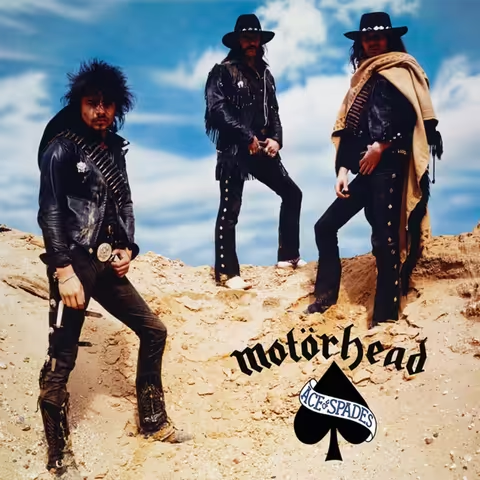
The cover of Ace of Spades is one of the most reproduced images in heavy metal. The original idea, as recalled by Clarke and Taylor in the Classic Albums documentary, was to shoot a sepia-toned card-table scene with the band as gunfighters. They abandoned that in favour of a desert tableau, with the three of them dressed as Western archetypes. Eddie's outfit was modelled on Clint Eastwood's Man with No Name from the Dollars Trilogy. Phil's was modelled on Marlon Brando's Rio in One-Eyed Jacks. Lemmy's, per Phil, was inspired by Bret Maverick from the 1950s television series Maverick.
The shoot itself happened at a sandpit near Barnet, ten miles north-east of central London. Alan Ballard took the photographs. The sky, contrary to the impression given by the cover, was not real: the day of the shoot was cloudy, and the desert sky was airbrushed in afterwards. Joe Petagno, the American artist who had drawn the Snaggletooth logo for the band's debut single in 1976, oversaw the composition and the playing-card border that frames the band against the artificial horizon. The 2005 Sanctuary edition replaced the original cover with a new design by Curt Evans, but the 2020 BMG box restored the original. For most fans, the desert cover is the album.
Singles, video and television
"Ace of Spades" was released as a single on 17 October 1980, two weeks before most pressings of the album hit the shops, with "Dirty Love" on the B-side. It entered the UK Singles Chart, climbed to number fifteen in early November, and stayed in the top forty into December. It was Motörhead's biggest single release to that point, and remained their highest-charting song until the band re-entered the chart at number thirteen in January 2016, two weeks after Lemmy's death, in tribute.
The video, shot in a quarry, sits the band at a card table in the open air with desert dust blowing through it, an extension of the sleeve image into moving picture. The band promoted the single with two appearances on Top of the Pops in October and a guest spot on the ITV children's morning show Tiswas on 8 November 1980. None of those appearances are remembered as Motörhead's finest moments on camera, but they put the band in front of an audience that would otherwise never have seen them.
- Single: "Ace of Spades" / "Dirty Love", Bronze BRO 106, released 17 October 1980
- UK Singles Chart peak: 15 in November 1980; re-entered at 13 in January 2016 after Lemmy's death
- Top of the Pops: two appearances in October 1980 to promote the single
- Tiswas: 8 November 1980, in cowboy outfits, with Sally James
- Video: shot in a quarry, extending the desert tableau of the sleeve
Release and reception
Bronze put the album out in late October 1980 in the United Kingdom and across mainland Europe, with most retailers citing 8 November as the high-street release date. Reviews were unusually warm. Garry Bushell in Sounds gave the record a maximum five stars on 25 October, and Sounds remained the band's most loyal weekly until its closure in 1991. Q, retrospectively in 1996, gave the album four stars and called the title track "the greatest rock single ever recorded". Robert Christgau, never an obvious Motörhead constituency, gave it a B and conceded that Lemmy's "grizzled-biker-born-to-rock is metal without the heavy", noting that there were no preening solos or blow-dried bullshit on the record. AllMusic later awarded it four and a half stars and called it "rock-solid, boasting several superlative standouts".
Commercial reception was stronger than any prior Motörhead release. The album entered the UK Albums Chart and climbed to number four, the band's highest studio placing of all time. It was certified gold by the BPI in March 1981 on shipments of 100,000. It charted at ten in Germany, twenty-nine in Canada, thirty-seven in Norway, and across mainland Europe from Belgium to Finland to Switzerland. Mercury's US distribution made the album the band's American debut, although it did not chart in the Billboard 200. In 2020, Rolling Stone placed the album at number 408 on its updated 500 Greatest Albums of All Time list, and the 2020 reissue charted at four on the UK Rock and Metal Albums chart in its own right.
"When Lemmy sings the lyrics to '(We Are) The Road Crew' it's the sound of a grizzled veteran who has been there, done that and gone back for second helpings. If ever a piece of music was a manifesto for the mad, bad and dangerous to know party then the title track is it. Unrepentant and full of hell, there's not one note out of place."
Sid Smith, BBC Music, 2007
The Ace Up Your Sleeve tour
The album's promotional tour ran from 22 October to 2 December 1980 under the banner Ace Up Your Sleeve, with Girlschool and Vardis on the bill. Forty dates in six weeks, all in the United Kingdom and Ireland, took the band from town halls to civic centres to the bigger provincial Apollos. By the end of the run Motörhead were comfortably a top-five British live draw. The tour ended at the Ulster Hall in Belfast on 2 December, where Phil Taylor broke his neck during what Wikipedia and other sources describe as backstage hijinks, an injury serious enough to put him in a neck brace and curtail all further band activity for the rest of the year.
Taylor's enforced absence had two consequences. The St. Valentine's Day Massacre EP that Motörhead released with Girlschool in February 1981 used Girlschool drummer Denise Dufort on every track. And the band's planned 1981 schedule was reorganised around live recording rather than further studio work. The result was No Sleep 'til Hammersmith, cut at three dates on the Short, Sharp, Pain in the Neck tour in March and April 1981, released in June, and lifted by the album the band had made in Rickmansworth the previous summer.
No Sleep 'til Hammersmith and the live record that followed
The 1981 live album, also produced by Maile, captured the post-Ace of Spades set in flight. Six of the eleven songs on the original LP came from Ace of Spades: "Ace of Spades", "(We Are) The Road Crew", "Jailbait", "Fast and Loose" (with "Train Kept A-Rollin'" cuts), "The Hammer" and the segue between "Bite the Bullet" and "The Chase Is Better Than the Catch". The remaining material drew on Overkill, Bomber, and the band's eponymous debut. The record entered the UK Albums Chart at number one in July 1981, the band's only chart-topping album. It was the moment when Motörhead became, briefly, a mainstream British rock band, and the moment that Ace of Spades stopped being a single LP and started being the spine of the band's identity.
The end of the classic line-up
The trio held together long enough to make one more studio album. Iron Fist, recorded in late 1981 and released in April 1982, was self-produced by Clarke and Will Reid Dick. It charted at six in the UK but the band openly disliked the production, and Clarke disliked working with the increasingly chaotic line-up. The breaking point came on a US tour in May 1982 when Lemmy and Taylor agreed to record a version of "Stand by Your Man" with Wendy O. Williams of the Plasmatics. Clarke walked. He left the band on 14 May 1982, formed Fastway with former UFO bassist Pete Way, and never played in Motörhead again. He died of pneumonia in January 2018.
Brian Robertson, the former Thin Lizzy guitarist, was drafted in for the 1983 album Another Perfect Day, a record that has improved in fans' estimation over time but baffled the audience at the time. Robertson refused to play any of the old material on tour, including most of Ace of Spades, and lasted less than two years. Taylor was the next to leave, in 1984, after a falling out with Lemmy. The band continued in various line-ups for another thirty years, but the trio that made Ace of Spades never played together again on a Motörhead record.
Legacy and influence
The album's influence on the music that came after it is hard to overstate. The Big Four of American thrash, Metallica, Megadeth, Anthrax and Slayer, have all explicitly cited it as foundational. Lars Ulrich first heard the album as a teenager in Copenhagen and would later play drums on Motörhead's "Overkill" at the 2015 Rock and Roll Hall of Fame induction. Dave Grohl, then of Nirvana, then of Foo Fighters, got an ace-of-spades tattoo and led tributes after Lemmy's death. Hardcore punk took the same lesson: Black Flag and the Dead Kennedys are unimaginable without the precedent of Phil Taylor's two-bass-drum gallop applied to Lemmy's distorted bass.
The title track has become a kind of universal sports-and-entertainment shorthand. It features in Superbad, Ford v Ferrari, The Addams Family 2, the second season of Daredevil, the original Tony Hawk's Pro Skater 3, and the Triple H wrestling entrance theme "The Game", whose riff Lemmy co-wrote and which interpolates the parent song. It still plays before goal celebrations, motorbike races and pub-quiz tiebreakers. None of which was remotely in the band's mind in August 1980 in Rickmansworth.
Reissues, remasters and anniversaries
- 1986: first UK CD reissue on Legacy (LLMCD 3013), no bonus tracks.
- 1991: Castle CD reissue with sleeve notes by Mörat from Kerrang!.
- 1996: Essential and Castle CD reissue adds "Dirty Love", "Please Don't Touch" and "Emergency" as bonus tracks.
- 2003: Silverline DVD-Audio release in surround sound.
- 2005: Sanctuary 2CD Deluxe Edition with bonus disc of demos and the BBC Radio 1 Dave Jensen session, mastered by Giovanni Scatola with sleeve notes by Malcolm Dome. Eagle Vision releases the Classic Albums: Motörhead documentary on DVD on 28 March 2005.
- 2020: BMG release the 40th Anniversary Deluxe box on 30 October. Seven 12-inch LPs, one 10-inch EP and a DVD, including a new 40th-anniversary master of the album, two complete previously unreleased live recordings (Belfast 1981, Orléans 1981), a rarities LP and an instrumental demos EP. The reissue re-charts in the UK Rock and Metal Albums chart at four.
Things you might not know
| Fact | Detail |
|---|---|
| The wrong card | Lemmy admitted to Mojo in 2011 that he had sung "the eight of spades" live for two years before anyone in the band or crew noticed it was the wrong card. |
| The transit-van story | Lemmy liked to claim he wrote the title track in the back of a transit van travelling at ninety miles an hour. The producer Vic Maile, asked once, did not contradict him. |
| The woodblock | The percussive click on the title track is two pieces of two-by-four being hit together into a microphone with reverb, an idea Maile insisted on against the band's better judgement. |
| Six-day Ryvita | Producer Vic Maile was diabetic, did not drink, did not smoke, and ate a packet of Ryvita at six o'clock every evening. The band took to calling him Turtle. |
| The airbrushed sky | The Arizona-style sky on the cover was painted in afterwards. The day of the shoot at the Barnet sandpit was overcast. |
| Three Westerns, three cowboys | Eddie Clarke's costume was modelled on Clint Eastwood's Man with No Name, Phil Taylor's on Marlon Brando in One-Eyed Jacks, Lemmy's on Bret Maverick from the 1950s TV series. |
| Ten-minute Road Crew | Lemmy claimed in the 2005 Classic Albums film that he wrote "(We Are) The Road Crew" in ten minutes. Road manager Ian "Eagle" Dobbie had a tear in his eye at the first playback. |
| Broken neck in Belfast | Phil Taylor broke his neck in backstage hijinks at the Ulster Hall in Belfast on 2 December 1980, the final night of the Ace Up Your Sleeve tour. Girlschool drummer Denise Dufort played his parts on the St. Valentine's Day Massacre EP. |
| Pye mobile to Hawkwind | Vic Maile had recorded Hawkwind's Space Ritual on the Pye mobile studio while Lemmy was still in the band, which is how they first met. |
| The dead man's hand | The "dead man's hand" of the lyric is the hand Wild Bill Hickok was holding when he was shot in Deadwood in 1876: black aces and eights. Whether the dead man's hand actually included the ace of spades is disputed by historians. |
| Re-entry at thirteen | "Ace of Spades" re-entered the UK Singles Chart at number 13 in January 2016 after Lemmy's death on 28 December 2015, two places higher than its original peak. |
| The tribute at the Grammys | The Hollywood Vampires, fronted by Alice Cooper, Johnny Depp and Joe Perry, performed the title track at the 2016 Grammy Awards as a tribute. Dave Grohl introduced the act and revealed his ace-of-spades tattoo. |
| The Snaggletooth artist | Joe Petagno had drawn the Motörhead logo, Snaggletooth, in 1976 for the band's first single. The Ace of Spades sleeve was a continuation of his ongoing work for the band. |
| Lemmy as roadie | "(We Are) The Road Crew" draws on Lemmy's own experience as a roadie for Jimi Hendrix and for the Nice in the late 1960s, before he picked up a bass. |
Where Ace of Spades sits in the Motörhead catalogue
Motörhead released twenty-two studio albums between 1977 and 2015. Some of them, Orgasmatron, 1916, Inferno, Bad Magic, are excellent. None of them outsold or out-charted Ace of Spades. The band's commercial peak was the 1980-to-1981 window that ran from the album's release to No Sleep 'til Hammersmith's entry at number one, and the four records of the classic line-up (Motörhead, Overkill, Bomber and Ace of Spades) form a self-contained early period that fans tend to treat as the band's defining work. Lemmy himself, in White Line Fever, expressed a quiet resignation about it. He had spent twenty years trying to remind people that there were other Motörhead records.
Lemmy died on 28 December 2015, two days after being diagnosed with a particularly aggressive form of cancer, at his home in Los Angeles. He was 70. Phil Taylor had died on 11 November 2015. Eddie Clarke, the last surviving member of the classic trio, died of pneumonia in January 2018. The trio that made Ace of Spades are all now gone. The album, almost half a century on, remains the most-streamed Motörhead release on every platform that counts. The title track, in particular, has outlived every member who made it.
Final thoughts
The strangest thing about Ace of Spades, listened to in 2026, is how little it has dated. The recording is dry, close-miked and unfussy. The performances are loose enough to feel like a band in a room and tight enough to keep up with songs that were already faster than most of their peers were attempting. Vic Maile's mix, with the bass placed where the guitar usually is and the guitar placed where the lead vocal usually is, still sounds modern in a way that most of 1980's heavy rock production does not. The cowboy sleeve still works as iconography. The title song still works as a piece of music. The album still gets two new generations of metal fans through the door every year.
It is also, for all its reputation, a generous record. Ace of Spades is twelve songs in thirty-six minutes, with no padding, no ballad, no extended instrumental, and no concept beyond the band's idea that they were a rock and roll band who happened to be playing very loud and very fast. Lemmy spent the rest of his life downplaying its importance. Almost everyone else has spent the time since trying to live up to it.
The Riffology podcast covers Ace of Spades in its Motörhead deep dive, available on Apple Podcasts, Spotify, Pocket Casts and every other major platform. New episodes weekly.
Comments