Sometime in early 1991, Nuno Bettencourt quit Extreme. He quit because A&M Records would not release an acoustic song he had recorded at the back end of the Pornograffitti sessions as a single. The song was called "More Than Words", and the label was right to be nervous: in a market saturated with Bon Jovi power ballads and Mariah Carey crescendos, two voices and one steel-string guitar sounded less like a single than a mistake. The band fought, the guitarist walked, the label eventually blinked, and on 8 June 1991 "More Than Words" reached number one on the Billboard Hot 100. By then Extreme had stopped being a funk-metal band from Boston and started being the guys who sang the song at every wedding for the next thirty years.

That is the cosmic joke at the centre of Extreme II: Pornograffitti. The album is a thirteen-track satirical concept record about a boy named Francis growing up in a world of greed, lust and televangelism, soundtracked by syncopated funk-metal riffs from a twenty-three-year-old Portuguese-American guitarist who would later land in Rolling Stone's 250 greatest guitarists list. Two of its tracks happen to be acoustic. Those two are what everybody remembers.

Album Facts

FieldDetail
ArtistExtreme
AlbumExtreme II: Pornograffitti (A Funked-Up Fairy Tale)
Release date7 August 1990
LabelA&M Records
ProducersMichael Wagener; Nuno Bettencourt (co-producer on tracks 9 and 13)
StudiosScream Studios, Studio City, California; Courtlen Recording, Hanson, Massachusetts
GenreFunk metal, hard rock, glam metal
Track count13
Total runtime64:21
Billboard 200 peak10
UK Albums Chart peak12
Other notable chart peaksCanada (RPM) 1, Switzerland 10, Finland 11, Germany 15, Netherlands 16, Austria 17
CertificationsUS 2x Platinum (RIAA), UK Platinum (BPI), Canada 3x Platinum (Music Canada), Netherlands Gold (NVPI), Australia Gold (ARIA), New Zealand Gold (RMNZ)
Estimated salesAround 10 million worldwide across Extreme's catalogue, with Pornograffitti the dominant title
Key singles"Decadence Dance", "Get the Funk Out", "More Than Words", "Hole Hearted", "Song for Love"

Cultural Context: Where 1990 Was Standing

The summer of 1990 was the last moment before grunge. Pearl Jam did not yet exist under that name. Nirvana were still on Sub Pop, two years away from Nevermind. The pop-metal economy was at full tide. Bon Jovi's New Jersey tour had only just wound down. Aerosmith were touring Pump. Skid Row had broken massively with their 1989 debut, also produced by Michael Wagener. Faith No More were touring The Real Thing and beginning to bend the genre into something nastier. Mr. Big were preparing Lean into It. Living Colour, Primus and Red Hot Chili Peppers were already proving that funk and metal could share a stage without one swallowing the other.

1990 itself was a chart year of strange juxtapositions. The albums Extreme were sharing rack space with that August included Pantera's Cowboys from Hell, Megadeth's Rust in Peace, Slayer's Seasons in the Abyss, Queensryche's Empire, Iggy Pop's Brick by Brick and Jane's Addiction's Ritual de lo Habitual. AOR, thrash, hair metal, post-punk, funk and the first stirrings of alternative rock were all competing for the same Tower Records floor. Pornograffitti slotted into that landscape with leather, a Hollywood gloss and a parental advisory sticker, and was filed by most retailers under "hair metal" alongside Warrant and Poison, a classification the music itself only intermittently fits.

Outside the record stores, Germany was reunifying, Nelson Mandela had been free for six months, and Iraq invaded Kuwait two days before the album hit shops. Pornograffitti's nominal targets, American consumerism and the televangelist boom, had a particularly receptive market: Jim Bakker had been convicted of fraud the previous October, Jimmy Swaggart had been caught in a second motel scandal earlier that year, and MTV's evangelical-bashing comedy was almost a sub-genre. The record landed at the right moment for a satire about money, sex and televised salvation, even if very few critics in 1990 noticed the satire.

The Band's Story Up to This Point

Extreme had formed in Boston in 1985 out of the wreckage of two earlier Massachusetts bar bands. Vocalist Gary Cherone and drummer Paul Geary had played together in Adrenalin and then in a group called The Dream. When CBS bought the rights to "The Dream" for a television series, the survivors had to rename themselves. They settled on Extreme partly as a play on "ex-Dream". Bassist Pat Badger, then with the Berklee-adjacent act In the Pink, joined in 1986. The piece that snapped the rest into focus arrived a year earlier: a young guitarist named Nuno Bettencourt, born in Praia da Vitoria in the Azores in September 1966, raised in Hudson, Massachusetts, the youngest of ten siblings, and already a virtuoso when he climbed out of the Boston hair-metal act Sinful and into Extreme at the age of eighteen.

The four built a Boston following the slow way. They won the Boston Music Awards' Outstanding Hard Rock/Heavy Metal Act in both 1986 and 1987 and were signed by A&M Records A&R director Bryan Huttenhower in 1987. Their self-titled debut, recorded with producer Mark Wallis, appeared in March 1989. It produced no real US hit. The lead single, "Kid Ego", was a song Cherone later said made him cringe. The closing track, "Play with Me", got a second life as the mall-chase sequence in Bill & Ted's Excellent Adventure, which kept the band on a few radars but did not move enough copies to justify celebration. The internal verdict at A&M was that Extreme were worth one more shot.

The four walked into their second album knowing it had to be the record they meant. Cherone had begun sketching a concept: a coming-of-age narrative about a fictional boy named Francis, raised in the suburban American collision of pornography, advertising, religion and graffiti, the boy's name a wink to Frank Zappa and the title a portmanteau the band had been kicking around since the debut tour. The title track, "More Than Words" and "It ('s a Monster)" were already in setlists by April 1989, months before A&M would agree to fund a new record. They were a band with a thesis, a guitarist who could carry it, and one shot to prove it.

Pre-production and Demos

Pre-production stretched across the winter of 1989, much of it in Boston rehearsal rooms with Cherone and Bettencourt hammering out the narrative shape and Bettencourt arranging horn parts, vocal harmonies and the rhythm-section interlock on a four-track. The pair worked the album as a sequence, not a song collection. Tracks were written to lead one into the next, with sound effects (thunder, voices, a televangelist's pulpit holler) eventually bridging songs on the final master.

The acoustic material slotted in late. "Hole Hearted" arrived almost by accident. Bettencourt told Songfacts in 2015 that the album was nearly finished when a 12-string guitar he had ordered finally turned up at the studio. He opened the case, played the opening chords on the spot, and finished the song shortly afterwards under unusual circumstances:

"That song was written fast, and I remember coming out of the bathroom, saying, 'I've got this really cool tune,' and everybody looked at me kind of weird. I was listening to Led Zeppelin III at the time a lot, and there was a lot of acoustic stuff on there. So I kind of took the groove a little bit, borrowed that feel from being inspired by the Zep III album."

Nuno Bettencourt, Songfacts, 2015

"More Than Words" had a different origin story. Cherone had written the lyric as a small piece of resistance, a complaint that the phrase "I love you" had become a verbal shrug. Bettencourt sat with him at a couple of acoustic sessions and the pair worked out a two-voice arrangement that owed more to the Everly Brothers and early Beatles than to any of Extreme's peers. It was first played live in 1989, well before recording began. Other songs evolved at the same demo stage: "Pornograffitti" was tracked in early form as a 6/8 strut, "Decadence Dance" was written around a syncopated Bettencourt riff that already had its horn-section answer baked in.

Creating the Album

Tracking began at Scream Studios in Studio City, California, in late 1989 and ran into the first half of 1990, with additional sessions at Courtlen Recording in Hanson, Massachusetts. A&M had hired Michael Wagener as producer on the strength of his recent work with Skid Row, Dokken and White Lion. Wagener, a German engineer who had emigrated to the United States in 1982 and built a reputation for muscular, radio-ready hard rock mixes, was the kind of safe pair of hands a label put on a second album after a soft debut.

The unusual thing was how much room Wagener gave Bettencourt. The guitarist, then twenty-three, ended up arranging the brass, writing horn parts on a Yamaha DX7 keyboard before handing them off to Andy Armer's Li'l Jack Horn Section, choosing the takes, layering keyboards and percussion himself, and ultimately receiving a co-producer credit on two tracks. Wagener engineered and mixed; Bob St. John served as tracking engineer; George Marino mastered at Sterling Sound in New York. The sessions were tracked to 24-track analogue tape, with guitar amps mic'd into the next room for separation, a standard Wagener trick from his Caribou and Wagonwheel days.

The recording was not painless. By the spring of 1990, with the band running over the original budget and "More Than Words" not yet committed to tape, Cherone and Bettencourt asked Wagener for one more day in the room. They went in with two acoustic guitars, a single Shure SM57 in the air, and tracked the song almost live, two voices in close harmony around one guitar part, with only minimal overdubs. The track that ended up on the album is essentially that take. There is no drum kit, no bass, no electric guitar, no string pad. In a record obsessed with maximalism, it is the moment of utter restraint.

  • Producer Michael Wagener, just off Skid Row's debut and previously of Dokken and Mötley Crüe sessions
  • Engineer Bob St. John tracking to 24-track analogue tape
  • George Marino mastering at Sterling Sound, New York
  • Randy Badazz arranging orchestration where strings appear
  • Andy Armer directing the Li'l Jack Horn Section on "Li'l Jack Horny" and "Get the Funk Out"
  • Ioannis/Third Image handling art direction and the comic-panel sleeve

The Bettencourt guitar sound, the signature thing about the album, was an early version of what would later become the Washburn N4 prototype, run through a modified Marshall JCM800 and a small array of pedals he had wired himself. The dry, percussive funk attack on tracks like "Decadence Dance" and "Get the Funk Out" comes partly from a deliberately unsaturated amp and partly from his thumb-and-finger picking style, which gives chords a snap closer to Sly Stone than to Eddie Van Halen, even though the latter is obviously the technical inheritance.

Wagener summarised his approach to the sessions in a 1991 trade interview with characteristic understatement: he was there, he said, to "keep the parts in the song and the song in the parts". With Bettencourt running the arrangements, that was as much as he needed to do.

Personnel and Credits

RolePlayerNotes
Extreme
Lead vocalsGary CheroneAlso backing vocals throughout
Guitars, keyboards, piano, percussion, backing vocalsNuno BettencourtArrangements; co-producer on tracks 9 ("When I First Kissed You") and 13 ("Hole Hearted")
Bass, backing vocalsPat Badger
Drums, percussion, backing vocalsPaul GearyLast full studio album with the band; departed 1994
Guest and session musicians (credited)
Backing vocalsBarbara Glynn"Decadence Dance"
Backing vocalsPat Travers"Get the Funk Out"
Backing vocalsJeanine Moultrine"Suzi (Wants Her All Day What?)"
Intro and outro lead guitarDweezil Zappa"He-Man Woman Hater", after the "Flight of the Wounded Bumble Bee" intro
TrumpetBob Findley, Chuck FindleyLi'l Jack Horn Section
TromboneBill WatrousLi'l Jack Horn Section
Bass tromboneDick "Slyde" HydeLi'l Jack Horn Section
Tenor saxophonePete Christlieb, Joel PeskinLi'l Jack Horn Section, directed by Andy Armer
Production and engineering
Producer, mixingMichael WagenerJust off Skid Row's 1989 debut
EngineerBob St. John
MasteringGeorge MarinoSterling Sound, New York
OrchestrationRandy Badazz
Artwork
Art direction and designIoannis/Third ImageComic-book panel sleeve illustrating the narrative

The headline name on the guest list is Dweezil Zappa. He plays the brief virtuoso intro and outro of "He-Man Woman Hater", a comic-classical flourish (the "Flight of the Wounded Bumble Bee") that bookends the song. The favour was reciprocal: Bettencourt would produce Zappa's 1991 solo album Confessions the following year, with Cherone and Badger also guesting on it. The Li'l Jack Horn Section was a studio aggregation of Los Angeles brass veterans, several of whom had played on classic Tower of Power records and on countless film scores. Pete Christlieb, the tenor saxophonist, had played the famous solo on Steely Dan's "Deacon Blues" thirteen years earlier.

The Songs: A Walkthrough

The tracklist is the narrative. Cherone's lyric arc follows the fictional Francis from a teenage indictment of consumerism ("Decadence Dance") through sexual awakening, lust, disillusion, religion, love and back to a quiet acoustic close.

#TitleWriter(s)LengthSingle?Notes
1Decadence DanceCherone, Bettencourt6:49Yes (1990)Opens with the same thunder the album closes with
2Li'l Jack HornyCherone, Bettencourt4:51B-side of "Get the Funk Out"; horn-led
3When I'm PresidentCherone, Bettencourt4:21Political satire
4Get the Funk OutCherone, Bettencourt4:24Yes (1990)Pat Travers backing vocals; Brian May's "landmark" solo
5More Than WordsCherone, Bettencourt5:34Yes (Mar 1991)US #1; voices and one acoustic guitar
6Money (In God We Trust)Cherone, Bettencourt4:11Used in Love, Victor (2020)
7It ('s a Monster)Cherone, Bettencourt4:24Live staple since April 1989
8PornograffittiCherone, Bettencourt6:15Title track; 6/8 strut
9When I First Kissed YouCherone, Bettencourt4:00Piano-led; Bettencourt co-producer
10Suzi (Wants Her All Day What?)Cherone, Bettencourt3:38Jeanine Moultrine bvox; B-side of "Hole Hearted"
11He-Man Woman HaterCherone, Bettencourt6:20Includes "Flight of the Wounded Bumble Bee" intro; Dweezil Zappa
12Song for LoveCherone, Bettencourt5:55Yes (1992)Released as fifth single
13Hole HeartedCherone, Bettencourt3:39Yes (Sep 1991)US #4; written on a borrowed 12-string

"Decadence Dance" opens the record with thunder and a riff that announces the band's whole project in eight bars: dry, syncopated, snapped rather than strummed, with a vocal that lands somewhere between Steven Tyler and a Sunday-school preacher. It is the album's mission statement, the moment where Bettencourt's funk-metal lineage from Sly Stone through Eddie Van Halen and into his own playing becomes audible.

"Get the Funk Out" was the song that converted other guitarists. Brian May's reaction to the solo is one of the most-quoted endorsements of any 1990s rock performance:

"If that doesn't bring tears to your eyes as a guitarist, I don't know where things are. I could never do that. That's a landmark in rock history."

Brian May on Nuno Bettencourt's "Get the Funk Out" solo, YouTube interview, 2017

Pat Travers, the Canadian rock singer best known for "Boom Boom (Out Go the Lights)", sings the backing vocals. The horns punch through every chorus. The song peaked at number 19 on the UK Singles Chart in June 1991, the band's first British top-twenty hit, and remains a guitar-clinic standard.

"More Than Words" is the album's tonal U-turn and its commercial saviour. Track five on a thirteen-track funk-metal concept record, recorded in a single working day with two acoustic guitars and two voices, then released as a single only because the band's guitarist threatened to walk. Bettencourt explained the label battle in detail to Billboard in 2016:

"Our label at the time [A&M Records] didn't want to release 'More Than Words' as a single because there was nothing on the radio like that at the time. The label said, 'Who's going to play it?' Everybody was doing big power ballads at the time, and this was more like an Everly Brothers or Beatles track. But we fought for it."

Nuno Bettencourt to Billboard, September 2016

The lyric is, on its surface, a complaint that the phrase "I love you" had been so over-used it had stopped meaning anything. In Cherone's framing it is a song about the difference between performance and intent, which fits the broader Pornograffitti theme more snugly than most listeners noticed. Cherone later recalled the song's commercial weight with a degree of resignation:

"It became a monster. It took a life of its own and we couldn't kill it. I think it'll pass the test of time."

Gary Cherone in The Daily News, October 1992

"Money (In God We Trust)" weaves televangelist samples into a riff built around Pat Badger's slap-bass. "It ('s a Monster)" is the most explicit Sly-meets-Aerosmith moment on the record, and one of the songs that had been in the live set since April 1989. The title track, "Pornograffitti", is a six-minute centrepiece in 6/8 that pulls the album's themes together and contains some of Bettencourt's most jagged rhythm playing.

"When I First Kissed You" is the swerve nobody saw coming: a Sinatra-ish piano ballad with Cherone in his most exposed register, co-produced by Bettencourt. "He-Man Woman Hater" is the album's hardest rocker, opening with Dweezil Zappa's classical-pastiche flourish before launching into a riff that owes more to Van Halen's Fair Warning than to anyone on the 1990 Sunset Strip. "Song for Love" closes the narrative proper with a 5:55 power ballad reminiscent of Queen's The Game, before "Hole Hearted" tags on as a 12-string acoustic coda, its closing thunder mirroring the album's opening seconds.

The "Hole Hearted" coda was excluded from some early vinyl pressings, which is why a small number of LPs end on "Song for Love" and miss the album's symmetrical close.

B-sides and Outtakes

Pornograffitti is, by 1990 standards, an unusually B-side rich record. The "More Than Words" CD single carried "Nice Place to Visit" and "Kid Ego" (the latter a debut-album live cut). The "Hole Hearted" EP added the previously unreleased "Sex N' Love" alongside "Suzi (Wants Her All Day What?)" and the "Get the Funk Out" 12-inch remix. The various single editions also generated a remix economy that the 2015 deluxe edition would later collect: a "More Than Words" remix, a non-percussion version, an a cappella with congas, an edit of "Decadence Dance", an edit of "Money (In God We Trust)", a "What the Funk?" mix of "Get the Funk Out" and that 12-inch remix.

None of the album's working titles were materially different from the final ones, the songs having been gigged long before recording. "Hole Hearted" is the one demonstrable outlier: it was written so late that early track sequencing notes from the sessions do not include it. By the time it landed in mid-tracking, the running order had to be redrawn to accommodate it as the closer.

Album Artwork and Packaging

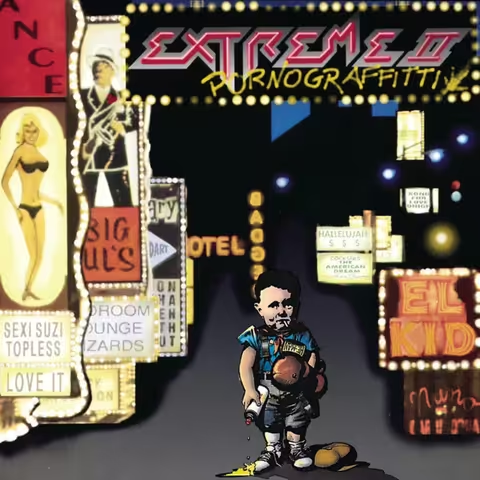
The cover was designed by Ioannis (Greek-American illustrator John Vagias, then trading as Third Image), a sleeve specialist responsible for record art for Boston, Loverboy, Dream Theater and Deep Purple. Ioannis's brief was to illustrate the Francis narrative, and the result is a comic-book panel collage in primary colours, each frame depicting a moment from a song: a money panel for "Money (In God We Trust)", a televangelist for the same, a "He-Man Woman Hater" cartoon, a lust panel, a Hollywood panel, all assembled around a central image of the protagonist. The inner sleeve doubled as a lyric sheet, with each song's lyric printed alongside a continuation of the panel art.

The packaging was unusually integrated for 1990. Most hair-metal records of the period went with a band-portrait sleeve plus a separate lyric insert. Pornograffitti's art was conceived alongside the music, with Ioannis given the demo tapes and Cherone's narrative notes early enough to design the album as a single piece. The subtitle on the spine and inner sleeve, "A Funked-Up Fairy Tale", spelled out the band's framing in case anyone missed it. The original CD long-box artwork, since lost to the format's extinction, doubled the cover panels across an extra panel each side.

Release and Reception

The album was released on 7 August 1990 and was met initially with respectful reviews. Steve Huey at AllMusic gave it four stars, noting that the band showed "a strong desire to experiment and push the boundaries of the pop-metal format". Martin Popoff, in The Big Book of Hair Metal, would later call it "a thinking man's hair metal album, with thoughtful lyrics and tasteful guitar work". The Daily Vault's Sean McCarthy gave it a B-minus on first review in 1997. Q magazine, in its August 1990 review issue, filed it under "promising", which in Q's vocabulary of the period was a compliment.

Commercial reception was slow. The first two singles, "Decadence Dance" and "Get the Funk Out", stalled in the US. By spring 1991 the album had begun to slip off the lower reaches of the Billboard 200, and A&M, somewhat against the band's wishes initially, agreed to push "More Than Words" to a number of US AOR and adult-contemporary stations. The single entered the Hot 100 at number 81 on 23 March 1991, climbed steadily over the spring, and hit number one on 8 June. The album promptly rebounded, peaking at number 10 on the Billboard 200 that same month, and was certified gold in May 1991 and double platinum in October 1992.

Internationally the album reached number 1 on Canada's RPM albums chart, number 10 in Switzerland, number 11 in Finland, number 12 in the UK, number 15 in Germany, number 16 in the Netherlands and number 17 in Austria. It hit Platinum in the UK on the BPI, 3x Platinum in Canada on Music Canada, and Gold in Australia, the Netherlands and New Zealand. Rolling Stone would later place it thirteenth on its 2019 list of the 50 greatest hair-metal albums of all time. Ultimate Classic Rock ranked it eighth on its Top 30 Glam Metal Albums list.

Singles and Music Videos

SingleReleasedB-sidesChart highsVideo director
"Decadence Dance"1990"Mutha (Don't Wanna Go To School Today)" (remix)UK 36; MTV Headbangers Ball rotation
"Get the Funk Out"1990; UK release 1991"Li'l Jack Horny", "Mutha (Don't Wanna Go To School Today)" remixUK 19 (June 1991); MTV Headbangers Ball rotationAndy Morahan
"More Than Words"12 March 1991 (US); 15 July 1991 (UK)"Nice Place to Visit", "Kid Ego" (live)US 1, UK 2, Canada 1, Netherlands 1, New Zealand 1, Belgium 1, Australia 2Jonathan Dayton and Valerie Faris
"Hole Hearted"15 September 1991 (US); 11 November 1991 (UK)"More Than Words" (a cappella with congas), "Suzi (Wants Her All Day What?)", "Sex N' Love", "Get the Funk Out" (12-inch remix)US 4, UK 12, Canada 2, Ireland 9
"Song for Love"1992Charted modestly in Europe

The "Get the Funk Out" video, directed by British music-video specialist Andy Morahan (George Michael's "Faith", Guns N' Roses' "November Rain" pre-production), placed the band in a stylised studio setting between horn-section close-ups and Cherone's mugging to camera. It was the band's first MTV Buzz Bin clip, and the song's riff and solo did most of the work in making Bettencourt a guitar-magazine cover star throughout 1991.

The "More Than Words" video was, in retrospect, the album's most consequential decision. A&M handed it to Jonathan Dayton and Valerie Faris, then a relatively unproven music-video team who would later direct Little Miss Sunshine (2006) and Battle of the Sexes (2017). The treatment was almost defiantly anti-glam: black-and-white, a single static room, Pat Badger turning off his amp and putting down his bass, Paul Geary laying down his sticks, then Cherone and Bettencourt alone with two acoustic guitars in close-up for the duration. MTV played it on near-permanent rotation through summer 1991. Jack Black and Jimmy Fallon would later recreate it shot-for-shot on The Tonight Show in May 2015, the kind of accolade only the most iconic videos earn.

The "Hole Hearted" video was shot in black-and-white outside the Boston Centre for the Arts at 551 Tremont Street, the street number visible on a number of the camera pans, a quiet hometown gesture from a band whose first instinct, fame notwithstanding, was Boston.

Touring and Live

The Pornograffitti Tour ran from late 1990 through the end of 1991, taking in the United States, the UK, Europe, Japan and Australia, with support slots that included opening for ZZ Top's Recycler Tour and David Lee Roth's A Little Ain't Enough tour. The band's live reputation, especially Bettencourt's stage presence with the prototype N4 guitar, did more than the early singles to push Pornograffitti past its first year on the racks. By mid-1991, when "More Than Words" went to number one, Extreme were headlining their own theatre tour in the US and arenas in Japan.

The single most consequential live performance of the album's afterlife was at the Freddie Mercury Tribute Concert at Wembley Stadium on 20 April 1992. Extreme, deep into recording the follow-up III Sides to Every Story, took a break from sessions to play a Queen medley followed by acoustic readings of "Love of My Life" and "More Than Words". Brian May introduced them with one of the most generous endorsements any band has received from a peer:

"Possibly more than any other group on this planet, the people that understand exactly what Queen have been about all these years, and what Freddie was about all these years."

Brian May introducing Extreme at the Freddie Mercury Tribute Concert, Wembley Stadium, 20 April 1992

The set was beamed to an estimated billion viewers worldwide on broadcasts on MTV, BBC and elsewhere, and gave Extreme a credibility transfer from one of rock's most universally loved bands at exactly the moment the third album was due.

One Pornograffitti-era touring anecdote captures the band's complicated relationship with their biggest song. Cherone has told the story in interviews more than once: by the mid-90s, on tour in Poland supporting Aerosmith, Extreme had decided to stop playing "More Than Words" live. Two nights in, Steven Tyler wrote across their dressing-room door in marker, in foot-high letters, "Play the fucking song!" The band relented.

In TV, Film and Media

"More Than Words" has had a long second life across media: as a karaoke standard, a wedding-band fixture, a Jack Black and Jimmy Fallon set piece in 2015, and as the source material for a parody music video performed by the cast of How I Met Your Mother in 2009 ("Best Night Ever", performed by Marshall Eriksen). "Money (In God We Trust)" featured in the Hulu series Love, Victor in 2020. The album's other tracks have made smaller dents in the sync world.

The most lateral cultural footprint is in Japan: the rock band Porno Graffitti, formed in Inno-shima in 1994, took its name directly from Extreme's record. They have since become one of the longest-running J-rock acts of their generation, an unintended monument to the Pornograffitti title.

Controversy and Censorship

The album carried a Parental Advisory sticker on its original US pressings, mainly for "Suzi (Wants Her All Day What?)" and "Li'l Jack Horny", whose double-entendre titles were probably more risque than their actual content. The cover art itself attracted no significant censorship, although a handful of conservative US retailers initially declined to rack the record in family-facing displays. There were no plagiarism suits filed against the album, no banned videos, no withdrawn pressings.

The closest the record came to genuine controversy was misinterpretation. Cherone's lyrics on "Money (In God We Trust)" and "When I'm President" were read by some reviewers as endorsements of the very values they were satirising. The band spent a good portion of their 1991 press cycle clarifying that Francis the narrator was not Cherone the songwriter, a distinction that concept albums perennially fail to convey.

Covers, Samples and Tributes

"More Than Words" has been covered by, among many others, Westlife (2000), who took it to number one in Sweden and number five in the UK; Frankie J (2005), whose Spanglish version reached number 16 on the US Hot Latin Songs chart; and Korean boy band Boyfriend. It has been performed by Lin-Manuel Miranda, recreated shot-for-shot by Jack Black and Jimmy Fallon, and parodied across television. The original recording has been sampled or interpolated less than the song's profile would suggest, although its harmonic structure has been borrowed quietly by countless 1990s and 2000s soft-rock writers.

"Hole Hearted" has been less frequently covered but is a regular acoustic-set fixture for solo singer-songwriters, particularly on the Christian rock circuit. Tributes to Bettencourt's playing on the album's heavier tracks turn up regularly: Tom Morello, Steve Vai, Steve Lukather and Mark Tremonti have all named Bettencourt's Pornograffitti-era guitar work as an influence, and Prince once described him as one of the top three guitar players in the world, an endorsement Bettencourt has spent decades politely deflecting.

Reissues, Remasters and Anniversaries

The first major reissue was a 25th anniversary 2-CD deluxe edition released on 19 January 2015 by A&M and Universal. Disc one was a remastered album. Disc two collected ten bonus tracks: the "More Than Words" remix from the CD single, "Nice Place to Visit", the "More Than Words" radio edit, the "Decadence Dance" single edit, an edit of "Money (In God We Trust)", a non-percussion version of "More Than Words", the "What the Funk?" mix of "Get the Funk Out", "More Than Words" a cappella with congas, the "Get the Funk Out" 12-inch remix, and "Sex N' Love" from the "Hole Hearted" EP.

To accompany the anniversary, Extreme toured the album in its entirety. Four Japanese dates in 2012 had been a soft launch for the concept. A 2014 European Pornograffitti Live run cemented it. A full North American 25th anniversary tour followed in 2015. The Las Vegas date at the Hard Rock Casino was captured as Pornograffitti Live 25: Metal Meltdown, released as an audio and video set in 2016, with all thirteen tracks performed in album sequence. A vinyl reissue programme followed in subsequent years, including coloured-vinyl variants for European fan clubs.

Legacy and Influence

Extreme followed Pornograffitti with III Sides to Every Story in September 1992, a sprawling concept album in three movements with full orchestral arrangements composed by Bettencourt. It was critically respected but sold a fraction of its predecessor, around 800,000 units to Pornograffitti's two million-plus. Waiting for the Punchline in February 1995 leaned into a darker, alt-rock-adjacent sound. Drummer Paul Geary had left in 1994 to pursue artist management and was replaced by Mike Mangini for three tracks. The album sold poorly. Extreme split amicably in 1996 when Bettencourt opted for a solo career. Cherone, on a recommendation from manager Ray Danniels, accepted an extraordinary call later that year and replaced Sammy Hagar as the singer of Van Halen, fronting the band on Van Halen III in 1998 before departing in 1999.

Pornograffitti's deeper influence is in guitar playing. Bettencourt's rhythm-and-funk attack reshaped the technical vocabulary of a generation of players. Tom Morello has cited him as an influence on his own thumb-percussive style. Steve Vai has called him one of the most important rock guitarists of the 1990s. Mark Tremonti's chord-voicing instincts have his fingerprints. The Washburn N4, designed by Bettencourt with Stephen Davies at Washburn around the time of Pornograffitti, was in continuous production for over three decades, making it one of the longest-lived signature guitar models in the company's history; in 2025 Bettencourt parted from Washburn to launch his own brand, Nuno Guitars.

The album also sits awkwardly across genre histories. It is regularly filed as "hair metal" or "glam metal" by retrospective lists because of the way it looked and where it sold, but musically it is closer to the funk-metal lineage of the Red Hot Chili Peppers, Living Colour, Faith No More, Dan Reed Network and Mr. Big than to Warrant or Poison. Both Wikipedia and AllMusic now list the album under funk metal, hard rock and glam metal in that order, an ordering Bettencourt would broadly agree with. "It both made us and ruined us" has been a recurring Bettencourt formulation about the success of "More Than Words", and it captures the album's paradox neatly: a band who wrote a thirteen-track funk-metal narrative were turned into pop balladeers by two acoustic songs they nearly did not release.

Things You Might Not Know

FactDetail
The bathroom breakBettencourt wrote most of "Hole Hearted" in the studio bathroom on a 12-string guitar that had only just been delivered, then walked out and announced he had a new song.
The "Play the fucking song" doorOn a 1990s European tour with Aerosmith in Poland, after Extreme dropped "More Than Words" from the set, Steven Tyler wrote "Play the fucking song!" in foot-high letters on the band's dressing-room door. They put it back in.
Nuno walked over the singleBettencourt briefly quit Extreme during the battle to have A&M release "More Than Words" as a single, telling Billboard in 2016 that the label kept asking, "Who's going to play it?"
The Little Miss Sunshine connectionThe "More Than Words" video was directed by Jonathan Dayton and Valerie Faris, who fifteen years later directed the Oscar-nominated Little Miss Sunshine.
The Dweezil Zappa cameoDweezil Zappa plays the classical "Flight of the Wounded Bumble Bee" intro and outro to "He-Man Woman Hater". Bettencourt produced Zappa's solo album Confessions the following year.
Brian May's medalBrian May has called Bettencourt's "Get the Funk Out" solo a "landmark in rock history" that deserved its own little medal struck for it.
The Steely Dan saxophoneTenor saxophonist Pete Christlieb, who plays in the Li'l Jack Horn Section on "Li'l Jack Horny" and "Get the Funk Out", played the famous solo on Steely Dan's "Deacon Blues" in 1977.
The Tower of Power hornsThe Li'l Jack Horn Section was directed by Andy Armer and stocked with Los Angeles brass veterans (Chuck Findley, Bill Watrous, Dick "Slyde" Hyde) whose credits ran from film scores to Tower of Power records.
The mirrored thunderThe album opens with the thunder that closes "Decadence Dance" and ends with the thunder that closes "Hole Hearted", deliberately mirroring start and finish.
The DX7 horn chartsBettencourt wrote the brass parts for "Get the Funk Out" on a Yamaha DX7 keyboard before handing them off to Andy Armer to charter for the horn section.
The Japanese namesakeThe long-running Japanese rock band Porno Graffitti, formed in 1994, took its name directly from this album.
The Freddie Mercury endorsementBrian May introduced Extreme at the 1992 Freddie Mercury Tribute Concert as "possibly more than any other group on this planet, the people that understand exactly what Queen have been about".
The five-single albumPornograffitti generated five singles between 1990 and 1992, an unusually high count for a 13-track album from that era.
The Bill & Ted footnoteExtreme's previous album closed with "Play with Me", the song used as the "mall chase" soundtrack in Bill & Ted's Excellent Adventure, which kept the band in some teenage record collections until Pornograffitti arrived.
The 2x Platinum delayThe album was certified Gold in May 1991 and only reached 2x Platinum in October 1992, almost entirely on the back of "More Than Words" pulling the album back up the Billboard 200 a year after release.

Listen On

The Riffology podcast goes long and slow on records like this one, the ones where the headline song hides the actual album. New episodes appear on Apple Podcasts, Spotify, Pocket Casts, Overcast and every other halfway-decent podcast app. If Pornograffitti was your gateway into Extreme or into funk metal full stop, you will find plenty of company there.