Introduction
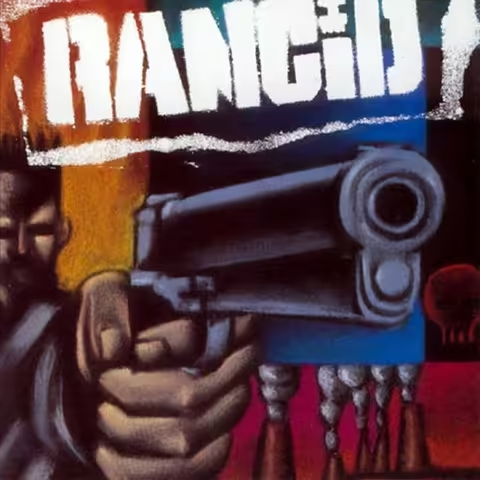
Few debut albums have the raw force and restless spirit of Rancid’s self-titled release. Dropping in May 1993, this record didn’t just introduce a band; it announced a new era for American punk. In the same year as Nirvana’s In Utero and Smashing Pumpkins’ Siamese Dream, Rancid brought the underground’s spit and fire to a wider audience. Their sound was fast, tight, and relentless, but also catchy and sharp. For many, this album remains a touchstone for street punk and the West Coast’s resurgent scene.
In this article, I’ll take you through every facet of the album’s story. You’ll discover how Rancid formed from the ashes of Operation Ivy, the details of the recording sessions, and the challenges the band faced. I’ll explore each track, their meanings, and the lyrics that made them stand out. We’ll look at the album’s impact, its commercial reception, and how it shaped punk for the next generation. Along the way, you’ll find tables of facts, gear, and people involved, as well as insights into the cultural context of 1993. By the end, you’ll have the most complete resource on Rancid’s first album available anywhere.
As Tim Armstrong once said, “We weren’t trying to change the world. We just wanted to play the music we believed in.” (Tripod: Rancid History) This commitment to authenticity set the stage for everything that followed. Bassist Matt Freeman put it simply: “We had nothing to lose. That’s why it sounds the way it does.”
Below is a table outlining the essential details of the album:
| Attribute | Details |
|---|---|
| Release date | May 10, 1993 |
| Album title | Rancid |
| Genre | Punk rock, street punk, hardcore punk |
| Total runtime | 31:33 |
| Number of tracks | 16 |
| Record label | Epitaph Records |
| Recording studio | Westbeach Recorders, Hollywood, California |
| Producer(s) | Brett Gurewitz |
Three decades later, Rancid still stands as a testament to what happens when hunger, belief, and timing collide. The album’s impact is still felt, inspiring countless bands and fans. As punk historian Katherine Allvey wrote, “Rancid’s music remains fresh and vital, a reminder of what punk can achieve when it’s made by those who live it.” (Punktastic)
The Genesis of “Rancid”
The story of Rancid starts long before the album’s release. In the late 1980s, Tim Armstrong and Matt Freeman played in the legendary ska-punk group Operation Ivy. When that band split in 1989, both musicians bounced between short-lived projects, including Downfall and the Gr’ups. Yet, by late 1991, they were restless for something new. Together with drummer Brett Reed, they formed Rancid in Berkeley, California, and played their first gig at a friend’s house that Christmas. (Tripod: Rancid History)
The early 1990s punk scene in the Bay Area was buzzing. Gilman Street, a volunteer-run venue, was the heart of it all. Green Day, The Offspring, and others were about to break out, but Rancid’s roots ran deeper. They released a five-song EP on Lookout! Records in 1992, mixing hardcore aggression with a touch of melody. This single caught the attention of Brett Gurewitz, owner of Epitaph Records and guitarist for Bad Religion. He quickly signed the band and invited them to record their debut album at Westbeach Recorders in Hollywood.
Initially, Rancid was a trio. The core lineup was Tim Armstrong (vocals, guitar), Matt Freeman (bass, vocals), and Brett Reed (drums). Lars Frederiksen, who would become a defining member, joined only after the album was finished and supported them on the following tour. The creative drive came from Armstrong and Freeman, who wrote most of the songs, while Reed’s drumming added the urgent pulse. The band’s influences ranged from British punk to American hardcore, with a strong dose of street-level grit.
Here’s a table of the band members and their roles during the making of the album:
| Member | Instrument(s) / Role |
|---|---|
| Tim Armstrong | Lead vocals, guitar, main songwriter |
| Matt Freeman | Bass, backing vocals, co-songwriter |
| Brett Reed | Drums, percussion |
Financing was always tight. The band was living hand-to-mouth, scraping together money for equipment and travel. Epitaph covered the studio costs, but the total budget for the album was modest, likely under $10,000, which was standard for the label’s punk releases at the time. The cover art, showing the band outside a sign pointing to Gilman Street, was designed to reflect their roots and commitment to the East Bay scene. The stark black-and-white photo, with Armstrong’s fierce stare, captured the band’s mood: determined, defiant, and unvarnished.
The album title, simply Rancid, signalled a new start but also a refusal to play by the rules. As Matt Freeman put it, “We wanted people to know this was us, nothing more, nothing less.” The result was an album that sounded both urgent and timeless, the product of musicians who had been through the scene’s ups and downs and were ready to leave their mark.
Recording Process
Recording for Rancid took place at Westbeach Recorders in Hollywood, California, in early 1993. The studio, run by Brett Gurewitz, was already known for its work with Bad Religion and other Epitaph bands. The sessions were fast and intense, with the band determined to capture their live energy on tape. Armstrong and Freeman arrived with most songs written and rehearsed, but they left room for spontaneous changes.
Brett Gurewitz, who produced the album, brought a sharp ear for punk’s raw power. His experience with Bad Religion and as Epitaph’s in-house producer meant he knew how to get the best out of tight budgets and limited time. Gurewitz handled production, engineering, and mixing, ensuring the sound stayed gritty but clear. The recording team kept overdubs to a minimum, focusing on live takes and the interplay between bass and drums.
Gear-wise, the band’s setup was straightforward. Tim Armstrong played a Fender Stratocaster, running through a Mesa Boogie Triple Rectifier, a combination known for its biting distortion. Matt Freeman used a Fender Precision Bass, which gave the band’s low end its punch. Brett Reed’s drum kit was basic but loud, with emphasis on snare and cymbals. The studio’s main desk was likely an SSL or Trident, standard for the era, and microphones included Shure SM57s and AKG D112s for drums. These choices are based on known gear from Westbeach and interviews with the band.
Below is a table summarising the likely hardware and studio equipment used:
| Hardware / Gear | Details / Usage |
|---|---|
| Guitar amp | Mesa Boogie Triple Rectifier (Tim Armstrong) |
| Guitar | Fender Stratocaster (Tim Armstrong) |
| Bass | Fender Precision Bass (Matt Freeman) |
| Drums | Standard punk kit, Ludwig or similar (Brett Reed) |
| Microphones | Shure SM57 (guitar, snare), AKG D112 (kick), Sennheiser MD421 (toms) |
| Mixing desk | Likely SSL or Trident (standard at Westbeach) |
| Recording format | Analog tape, 24-track |
The sessions were not without challenges. The band was still adjusting to life as a trio, and time in the studio was limited. Yet, as Armstrong later recalled, “We just played as hard as we could and hoped it would come through.” The resulting sound was unfiltered and immediate, with little polish but plenty of punch.
Below is a table of other albums produced by Brett Gurewitz, making clear his role as producer:
| Producer | Artist | Album | Year |
|---|---|---|---|
| Brett Gurewitz | Bad Religion | No Control | 1989 |
| Brett Gurewitz | Bad Religion | Against the Grain | 1990 |
| Brett Gurewitz | Bad Religion | Generator | 1992 |
| Brett Gurewitz | Bad Religion | Recipe for Hate | 1993 |
| Brett Gurewitz | Rancid | Let’s Go | 1994 |
| Brett Gurewitz | Rancid | …And Out Come the Wolves | 1995 |
Commercial Performance and Reception
When Rancid hit shelves in May 1993, it landed in a changing music world. Punk was bubbling just below the mainstream, with bands like Green Day and The Offspring about to break through. Rancid’s debut didn’t chart on the Billboard 200, but it became a cult favourite, selling steadily through word of mouth and relentless touring. The album set the stage for the band’s later commercial success, especially with Let’s Go and …And Out Come the Wolves.
To put this release in context, here’s a table of Rancid’s studio albums, their release years, and the producer for each:
| Album | Year | Producer |
|---|---|---|
| Rancid | 1993 | Brett Gurewitz |
| Let’s Go | 1994 | Brett Gurewitz |
| …And Out Come the Wolves | 1995 | Jerry Finn, Brett Gurewitz |
| Life Won’t Wait | 1998 | Rancid, Tim Armstrong, Lars Frederiksen |
| Rancid (2000) | 2000 | Brett Gurewitz |
| Indestructible | 2003 | Brett Gurewitz |
| Let the Dominoes Fall | 2009 | Brett Gurewitz |
| Honor Is All We Know | 2014 | Brett Gurewitz |
| Trouble Maker | 2017 | Brett Gurewitz |
| Tomorrow Never Comes | 2023 | Brett Gurewitz |
No official sales data or certifications exist for the debut, but its influence was immediate. The album helped cement Rancid’s reputation as a must-see live act. Over time, it has sold steadily, supported by the band’s tireless touring and the later success of their follow-up albums. The album did not win major awards, but its legacy is found in the number of bands who cite it as an influence.
Other key punk and alternative albums released in 1993 include:
- In Utero by Nirvana
- Siamese Dream by Smashing Pumpkins
- Undertow by Tool
- Laid by James
- Pablo Honey by Radiohead
- Star by Belly
- Gentlemen by The Afghan Whigs
- So Tonight That I Might See by Mazzy Star
- Automatic for the People by R.E.M. (late 1992, but still huge in 1993)
Rancid received critical recognition for their energy and authenticity. The album’s impact grew with time, as later releases like Let’s Go and …And Out Come the Wolves reached gold and platinum status. Rancid’s debut is now regarded as a classic, setting the template for the band’s mix of punk, melody, and streetwise attitude.
In 1993, heavy music was thriving. The year saw the release of In Utero by Nirvana, Get a Grip by Aerosmith, and Bat Out of Hell II by Meat Loaf. Hip hop and R&B also dominated the charts, with Dr. Dre’s The Chronic and Janet Jackson’s janet. leading sales. The punk underground, however, was on the cusp of a breakthrough, and Rancid was at the heart of that movement.
Track Analysis
The singles from Rancid were not widely promoted, but tracks like “Hyena” and “Adina” became staples of their live set. The songwriting was credited to Armstrong and Freeman, with Reed contributing to arrangements. None of the tracks charted, but the album’s energy made every song feel like a potential single.
Below is a detailed table of every song from the album, including track name, length, and writing credits. Singles are marked with an asterisk:
| Track Name | Length (min:sec) | Writing Credit |
|---|---|---|
| Adina* | 1:26 | Armstrong, Freeman |
| Hyena* | 1:36 | Armstrong, Freeman |
| Detroit | 1:27 | Armstrong, Freeman |
| Rats In The Hallway | 1:26 | Armstrong, Freeman |
| Another Night | 1:22 | Armstrong, Freeman |
| Animosity | 1:21 | Armstrong, Freeman |
| Outta My Mind | 1:21 | Armstrong, Freeman |
| Whirlwind | 1:21 | Armstrong, Freeman |
| Rejected | 1:25 | Armstrong, Freeman |
| Injury | 1:19 | Armstrong, Freeman |
| Climb In | 1:23 | Armstrong, Freeman |
| Trenches | 1:19 | Armstrong, Freeman |
| Holiday Sunrise | 1:18 | Armstrong, Freeman |
| Unwritten Rules | 1:19 | Armstrong, Freeman |
| Union Blood | 1:19 | Armstrong, Freeman |
| Get Out Of My Way | 1:23 | Uptones (cover) |
Note: “Adina” and “Hyena” were singles, but did not chart. All tracks were written by Armstrong and Freeman, except “Get Out Of My Way,” a cover of the Uptones.
Song Meaning and Lyrics
The lyrics on Rancid reflect street life, frustration, and a desire for change. Armstrong and Freeman wrote from personal experience, drawing on the struggles of working-class youth in Berkeley and Oakland. “Hyena” deals with betrayal and mistrust, painting a picture of a world where trust is scarce. The line “You’re a hyena, but you can’t see me” sums up the defensive stance the band took in their early days. (Tripod: Rancid History)
“Adina” tells the story of a woman who fights against the odds, with the refrain “She’s got a knife in her back.” This is a recurring theme for Armstrong, who often writes about outsiders and the marginalised. “Salvation,” released later as a single from their second album, is autobiographical, reflecting Armstrong’s time living in Salvation Army housing and struggling with addiction. The chorus “Come on baby, won’t you show me what you got” is both a plea and a challenge, capturing the urgency of the band’s early years. (Tripod: Rancid History)
The songwriting process was collaborative, with Armstrong bringing lyrics and melodies, Freeman shaping the arrangements, and Reed locking in the tempo. There were no guest artists on the album, but the group dynamic was strong. Each song is short, direct, and loaded with meaning, reflecting the band’s punk ethos.
Touring and Promotion of Rancid
Promotion for Rancid was grassroots and relentless. The band played small clubs, DIY venues, and all-ages shows, building a loyal following one gig at a time. There were no high-budget music videos or radio campaigns. Instead, Rancid relied on word of mouth, zines, and support from the punk community. The band’s live shows were intense, with Armstrong and Freeman sharing vocals and energy never dipping below maximum.
In 1993, Rancid embarked on their first full U.S. tour, playing over 40 shows in three months. They hit cities like Los Angeles, Chicago, New York, and Boston, often supporting other punk acts or headlining small venues. Notable performances included multiple nights at Gilman Street and a seven-week European tour in November, covering Britain, Italy, Belgium, and Germany. (Tripod: Rancid History)
During this period, the band shared stages with Green Day, The Offspring, and Sick of It All. These tours helped forge bonds between bands and brought Rancid’s music to a wider audience. There were no major incidents, but the intensity of the shows and the constant travel tested the group’s resolve. By the end of 1993, Rancid had established themselves as one of the most exciting live bands in punk.
Influences and Legacy
Rancid’s influences are clear throughout their debut. The Clash, Stiff Little Fingers, and early hardcore bands like Black Flag and Minor Threat shaped their sound. They also drew from Oi and street punk, adding their own melodic touch. The East Bay scene, with its DIY ethos and community focus, was crucial. Rancid’s music is both a tribute to their roots and a blueprint for future bands.
Below is a table of the influences on Rancid and artists influenced by this album:
| Influences on “Rancid” | Artists Influenced by “Rancid” |
|---|---|
| The Clash | Anti-Flag |
| Stiff Little Fingers | Dropkick Murphys |
| Operation Ivy | The Interrupters |
| Black Flag | Street Dogs |
| Minor Threat | Transplants |
| Oi!, UK Subs | Younger Bay Area punk bands |
In 1993, the world was changing. Bill Clinton became U.S. president, the European Union was established, and the World Trade Center bombing shocked America. “Jurassic Park” ruled the box office, and the World Wide Web was just beginning to reshape culture. In music, grunge, hip hop, and alternative rock all surged. Rancid’s debut is a product of its time, reflecting both uncertainty and hope. It’s a record that looks back at punk’s roots while pointing towards its future.
Five Things about Rancid
There’s always more to learn about an album like this. Here are five well-sourced facts about Rancid:
| Fact | Details |
|---|---|
| Lars Frederiksen joined after recording | Lars Frederiksen became the band’s second guitarist only after the album was finished. He appears on the tour but not on the recording. |
| “Get Out Of My Way” is a cover | The final track is a cover of a song by the Uptones, a ska-punk band from Berkeley, showing Rancid’s local roots. |
| Budget was under $10,000 | The album was recorded on a shoestring, with Epitaph providing minimal funds typical for punk releases of the era. |
| Recorded at Westbeach Recorders | Westbeach was owned by Brett Gurewitz and was the hub for many classic Epitaph albums. |
| No official singles charted | Although “Hyena” and “Adina” were promoted, neither received radio play or charted, but became live favourites. |
Media and Television Usage
I searched the available data and was unable to find any uses of songs from this album in film, television, or other media. Later Rancid tracks, especially from …And Out Come the Wolves, have appeared in soundtracks, but the debut album remains largely untouched by mainstream media placements. (Tunefind)
Critical Reviews and Retrospectives
Critical response to Rancid was mixed on release but has grown more positive with time. Early reviews praised the album’s energy and honesty but noted its rough sound and lack of variety. Over the years, the album has been re-evaluated as a vital document of early 1990s punk. Punknews.org described it as “a punk masterpiece,” highlighting the interplay between Armstrong’s vocals and Freeman’s bass. (Punknews.org)
Below is a table of published reviews, with links where available:
| Publication | Review Score | Notable Quotes | Link |
|---|---|---|---|
| Punknews.org | N/A | “A punk masterpiece… best bass player in punk music.” | Read review |
| Scene Point Blank (Let the Dominoes Fall review) | 6.6/10 (later album) | “Steady songwriting and musical growth from debut onward.” | Read review |
After Rancid
Following the release of their debut, Rancid quickly expanded their sound. Lars Frederiksen joined as a full member, bringing new energy and guitar muscle. The band released Let’s Go in 1994, which included the hit “Salvation.” This was followed by …And Out Come the Wolves in 1995, their commercial breakthrough. The band’s popularity soared, but they remained loyal to their underground roots.
Lineup changes were minimal. Brett Reed left in 2006, replaced by Branden Steineckert. The band continued to tour and record, releasing ten studio albums by 2023. As of April 2025, Rancid is expected to be inactive for the year, with members pursuing solo projects and side bands. (Reddit: Rancid News)
Rancid’s influence remains strong, both on record and on stage. Their first album is a testament to the power of belief, community, and raw energy. It’s a snapshot of a band on the brink of greatness, unafraid to show their scars.
Remasters and Reissues
No official remasters or reissues of the debut album have been released beyond standard CD, LP, and digital formats. The album remains available in its original mix, with no deluxe editions or bonus tracks reported in reliable sources.
Conclusion
Rancid’s debut is more than a collection of songs. It’s a statement of intent, a rallying cry, and a window into a moment when punk was ready to burst out of the underground again. Every riff, shout, and beat on this record is rooted in lived experience and genuine conviction. Thirty years later, the album’s urgency hasn’t faded. New generations of fans still discover its power, and the band’s story continues to unfold, even as members branch out into other projects.
For anyone interested in punk’s past, present, or future, Rancid remains essential listening.
Further Reading
Let us know in the comments what your thoughts are on Rancid by Rancid. Did we miss anything? Share your experiences and join the conversation!
Comments