Mark Knopfler spent the morning of 2 November 1984 not in a recording studio but in a 20-by-25 foot room in Salem, Montserrat, with virtually no acoustic isolation, a Neve 8078 console, an experimental Sony 24-track digital tape machine, and a guitar tech still working out where to point the microphones. The defective batch of tape that would eat parts of three songs and force a 4,000-mile salvage trip to New York was already in the rack. The drummer was about to be fired. The rhythm guitarist was about to walk out. And the song that would open MTV Europe two and a half years later had not yet been written, because the man who would write it had not yet stood at the back of a Manhattan appliance store with a borrowed pen, listening to a delivery man in a baseball cap rant about Hawaiian noises and earrings.
By the time Brothers in Arms left those rooms the following spring, it would change what an album could sound like, what an album could sell, and which physical format the world bought music on. Dire Straits walked into AIR Montserrat as the most acclaimed pub-rock graduates in Britain. They walked out as the band that broke the compact disc.
| Field | Detail |
|---|---|
| Artist | Dire Straits |
| Album | Brothers in Arms |
| Release date | 17 May 1985 |
| Label | Vertigo (international), Warner Bros. (US) |
| Producers | Mark Knopfler, Neil Dorfsman |
| Studios | AIR Studios (Salem, Montserrat), Power Station (New York City) |
| Engineer / mixer | Neil Dorfsman |
| Mastering | Bob Ludwig at Masterdisk, New York; John Dent at The Sound Clinic, London |
| Genre | Pop rock, roots rock |
| Track count | 9 |
| Total runtime | 55:11 (CD, cassette, double LP); 45:40 (single LP) |
| Billboard 200 peak | 1 (9 weeks) |
| UK Albums Chart peak | 1 (14 non-consecutive weeks) |
| Other notable peaks | 1 in Australia (34 weeks), Austria, Canada, Germany, France, Italy (No. 4), Netherlands, New Zealand, Norway, Spain, Sweden, Switzerland |
| Certifications | UK 15× Platinum, US 9× Platinum, Australia 17× Platinum, France Diamond, Canada Diamond, Switzerland 6× Platinum |
| Estimated sales | 30 million+ worldwide |
| Key singles | So Far Away, Money for Nothing, Walk of Life, Brothers in Arms, Your Latest Trick |
Cultural context: a stadium decade and a new shiny disc
Spring 1985 was the moment the 1980s tipped from new wave into stadium pop. Madonna was on her Virgin Tour, Bruce Springsteen was nine months into Born in the U.S.A., Phil Collins had just released No Jacket Required, and Michael Jackson was preparing Bad. In July, Live Aid would push a generation of British and American rock acts into a global television audience of nearly two billion people. The compact disc, launched commercially in 1982, was still considered an audiophile curiosity; only the well-heeled owned a player, and most albums were issued on the format as an afterthought to the LP and the cassette.
Brothers in Arms arrived at the precise hinge of that shift. Philips and PolyGram had spent two years trying to push the CD into the mainstream and had picked Dire Straits as their flagship act, partly because Mark Knopfler's obsession with audio quality made the band a natural fit and partly because Vertigo, the label, was a PolyGram imprint. The label, Knopfler and Dorfsman agreed early on that the record would be a full digital recording, an end-to-end DDD release at a time when most popular music was still being committed to analogue tape. They were not the first to record digitally, but they were the first to do it on a scale the wider record-buying public would notice.
Dire Straits before Brothers in Arms
The band came out of Deptford, south-east London, in 1977: brothers Mark and David Knopfler, John Illsley on bass and Pick Withers on drums. Mark was an English teacher in his late twenties; Illsley was studying at Goldsmiths' College; David was a social worker. They were the unfashionable opposite of everything happening that year, a four-piece who played long, finger-picked, narrative songs while London was busy throwing up on its own Doc Martens. The DJ Charlie Gillett played their demo of "Sultans of Swing" on his BBC Radio London show in 1977, Vertigo signed them, and the first album, produced by Muff Winwood at Basing Street Studios for £12,500, came out in 1978.
What followed was an unusually steep climb. Communiqué, produced in Nassau by Jerry Wexler and Barry Beckett in 1979, sold seven million. Making Movies in 1980, with Jimmy Iovine producing and Roy Bittan from the E Street Band on keys, was the record that proved Knopfler's ambitions extended well beyond pub rock; David Knopfler left mid-sessions. Love Over Gold in 1982 was Knopfler's first sole production credit, contained the fourteen-minute "Telegraph Road", and brought Neil Dorfsman into the band's orbit as engineer. Pick Withers left after Love Over Gold and was replaced by the Welsh drummer Terry Williams, formerly of Rockpile. The live double Alchemy followed in 1984. Hal Lindes was the rhythm guitarist, Alan Clark the keyboard player, and the band was, by any reasonable measure, already enormous.
Knopfler then spent 1983 and 1984 doing everything except making the next Dire Straits record. He scored Local Hero for Bill Forsyth, with Dorfsman engineering. He produced Bob Dylan's Infidels. He wrote "Private Dancer" and gave it to Tina Turner. He brought in Guy Fletcher, who had played on Aztec Camera's second album and on the Cal and Comfort and Joy soundtracks, as the band's second keyboard player. By the time Dire Straits convened in Montserrat at the end of 1984, the line-up had thickened, the studio costs were budgeted at over £1 million, and Knopfler had a notebook of finished songs.
The Falklands and the title track
"Brothers in Arms" the song was written during Britain's 1982 war in the South Atlantic, and the album took its name from it. Knopfler later said the song was a reflection on the senselessness of war and the bond between soldiers who fight it. It is the only track on the record that is openly anti-war in the way that British rock songs of the period rarely were, sitting alongside two other militarist meditations on side two ("Ride Across the River" and "The Man's Too Strong"), with the title track placed last so that the whole album exhales on its dying chord. In 2007, for the war's 25th anniversary, Knopfler re-recorded the song at Abbey Road Studios to raise money for British veterans, telling fundraisers they were "still suffering from the effects of that conflict". The song has since become a standard at military funerals.
The genesis of Money for Nothing
Knopfler told the writer Bill Flanagan in September 1985 exactly where the words came from.
"The lead character in Money for Nothing is a guy who works in the hardware department in a television, custom-kitchen, refrigerator, microwave appliance store. He's singing the song. I wrote the song when I was actually in the store. I borrowed a bit of paper and started to write the song down in the store. I wanted to use a lot of the language that the real guy actually used when I heard him, because it was more real."
Mark Knopfler, Musician magazine, September 1985
The bank of televisions at the back of the store was tuned to MTV. The delivery man, wearing a baseball cap, work boots and a checkered shirt, was muttering at the screen. Knopfler asked for a pen. What ended up on the record is most of what the man said, including a deliberately ugly second verse written from the point of view of someone Knopfler later described to Rolling Stone as "a real ignoramus, hard hat mentality, somebody who sees everything in financial terms". The slur in that verse, written verbatim from the appliance-store rant, has followed the song around ever since; in January 2011 the Canadian Broadcast Standards Council ruled the unedited version unacceptable for private Canadian radio, before an August 2011 review left the decision to individual stations. A radio edit that drops the second verse entirely has been the standard FM cut since the 1998 best-of compilation.
Sting arrived at the song almost by accident. He had been on a windsurfing holiday in Montserrat, came up to the studio for supper, was played the rough track, and offered his services on the spot. The "I want my MTV" hook he sings at the top quotes the melody of The Police's "Don't Stand So Close to Me"; Sting's publishers later insisted on the songwriting credit on those grounds. Years later, keyboardist Alan Clark told MusicRadar that the intro had originally been his idea, sung at a rehearsal piano before the song acquired its iconic riff. Accounts differ; the credit on the sleeve does not.
Personnel and credits
| Role | Player | Notes |
|---|---|---|
| Dire Straits | ||
| Lead vocals, guitars | Mark Knopfler | Producer; took on virtually all guitar parts after Hal Lindes left |
| Bass, backing vocals | John Illsley | Sidelined briefly by a wrist injury during the New York overdubs |
| Piano, Hammond organ | Alan Clark | The signature Hammond on "Walk of Life" and the piano figure on "Your Latest Trick" |
| Yamaha DX1, Synclavier, Roland synths, vocals | Guy Fletcher | First album as a full band member; second keyboard chair |
| Drums (selected) | Terry Williams | Drum intro on "Money for Nothing" and full kit on "Walk of Life" |
| Guitar synth | Jack Sonni | Only on "The Man's Too Strong"; recruited as Lindes's replacement in December 1984 |
| Guest and session musicians | ||
| Drums (rest of album) | Omar Hakim | Re-cut almost the entire drum chart in two to three days at AIR Montserrat |
| Guest vocals on "Money for Nothing" | Sting | "I want my MTV" hook and backing chorus; recorded during a Montserrat holiday |
| Saxophone on "Your Latest Trick" | Michael Brecker | The defining solo on the record |
| Trumpet on "Your Latest Trick" | Randy Brecker | With his brother on the New York horn dates |
| Trumpet on "Ride Across the River" | Dave Plews | Mariachi-styled lines |
| Saxophone | Malcolm Duncan | Average White Band veteran |
| Bass on "One World" | Neil Jason | Slap bassline cut at the Power Station while Illsley was injured |
| Chapman Stick on "Why Worry" | Tony Levin | Played the Stick rather than conventional bass on this track |
| Vibraphone on "Why Worry" | Mike Mainieri | Returning Love Over Gold contributor |
| Shaker, tambourine | Jimmy Maelen | New York percussion sessions |
| Production and engineering | ||
| Producer, engineer, mixing | Neil Dorfsman | Won the 1986 Grammy for Best Engineered Album, Non-Classical |
| Assistant engineers | Dave Greenberg, Steve Jackson, Bruce Lampcov | Across AIR and the Power Station |
| Mastering | Bob Ludwig (Masterdisk, NYC); John Dent (Sound Clinic, London) | Two parallel masters for the US and European markets |
| Artwork | ||
| Cover photography | Deborah Feingold | Knopfler's 1937 14-fret National Style "O" Resonator against a Caribbean sky |
| Back cover painting | Thomas Steyer | Same guitar, painted from the photograph |
| Sleeve design | Sutton Cooper | |
The single most-asked question about that personnel list is what happened to Terry Williams. Six weeks into the Montserrat sessions, Dorfsman and Knopfler decided his drum parts were not landing in the way the new digital sonic palette demanded. Williams later said the click track was the problem; Illsley, in his 2021 memoir My Life in Dire Straits, said it was studio nerves; Dorfsman in Sound on Sound was the most blunt. The session drummer Omar Hakim, who had just finished work on Sting's The Dream of the Blue Turtles, was flown out and re-cut the bulk of the drum chart in two to three days. Williams was credited only on his intro to "Money for Nothing" and on "Walk of Life", and he kept his job for the world tour that followed. Hakim, meeting Sting in the studio for the first time during the "Money for Nothing" vocal session, ended up drumming on the Blue Turtles tour as a result.
Producers: Knopfler and Dorfsman
By 1984, Knopfler trusted only a small handful of outside ears. Neil Dorfsman was one of them. The two had worked together on Love Over Gold and on Local Hero; both records demanded the kind of nuance and patience that Dorfsman had built his career on at the Power Station in New York. He had a producer's calmness around obsessive artists and an engineer's intolerance for nonsense, and he stayed with Knopfler through the whole arc of Brothers in Arms, from the November 1984 set-up at AIR through the February 1985 salvage runs in New York and the final mix. He came home with the 1986 Grammy for Best Engineered Album, Non-Classical, and a co-production credit on what would become one of the highest-selling records of the decade. He has spoken about the sessions on the record more than anyone else, and the May 2006 Sound on Sound classic-tracks piece by Richard Buskin remains the single best technical account of how the record was made.
AIR Studios Montserrat: George Martin's volcano
AIR Montserrat had opened in July 1979. George Martin, freshly cashed up from the 1975 sale of his Associated Independent Recording company to Chrysalis, had built a residential studio on a hilltop above Salem on a small volcanic island in the Lesser Antilles. The recording room itself was unremarkable; Dorfsman, in his Sound on Sound interview, described it as "nothing to write home about" and said "the sound of that studio was the desk", meaning the 56-channel Neve 8078 console. What clients came for was everything around it: the villas where they could stay between takes, the 26-acre farm of mango, citrus and coconut groves, the sea on three sides, and the studio diary populated by the Police (Ghost in the Machine, Synchronicity), Elton John, Paul McCartney, the Stones and Jimmy Buffett.
Dorfsman and Knopfler treated the limitations of the 20-by-25-foot live room as a creative constraint. They put the drum kit in the far left corner facing the control room, the piano in a tight booth in the far right corner miked with AKG C414s, and the Hammond B3 nearby, with its Leslie speaker either wedged into the soundproof entry to the control room or set up outside in the open air. Illsley's bass amp went into a small vocal booth with a Neumann FET 47 and a DI; Knopfler's amps were miked with Shure 57s, AKG 451s and Neumann U67s; Fletcher's synth rack lived in the control room. The first six weeks ran from 2 November to 21 December 1984, the band broke for Christmas, and a second tranche of recording followed from 3 January to 6 February 1985. AIR Montserrat itself would never enjoy a second decade. Hurricane Hugo would sweep over the island in September 1989 and, while the studio building suffered only minor damage, the wider industry had already started pulling its acts back to New York and London. Martin closed the studio. The buildings still stand as overgrown ruins above Salem.
The Power Station and the salvage trip
Brothers in Arms was being committed to a Sony 24-track digital tape machine, one of the very first major rock records to be tracked entirely on the new DASH format. The decision came from Knopfler's commitment to the cleanest sound he could buy, and the band had the budget to indulge him. What no one had budgeted for was a defective batch of the new digital tape itself, which dropped portions of three tracks somewhere along the way. The sessions moved to the Power Station in New York in February 1985, partly to re-cut what had been lost and partly to bring in a roster of east-coast players who could not have been flown to a tiny Caribbean island for an afternoon: Michael and Randy Brecker for the horns on "Your Latest Trick", Mike Mainieri on vibes, Jimmy Maelen on hand percussion, Dave Plews and Malcolm Duncan on more horns.
It was at the Power Station, too, that Illsley sprained his wrist falling while jogging in Central Park, taking him out of contention for the bass parts that still needed doing. Tony Levin came in to play Chapman Stick on "Why Worry"; Neil Jason cut the slap-funk bass on "One World" and the slides at the top of the extended "Money for Nothing". Jack Sonni laid down his guitar synth on "The Man's Too Strong". And Dorfsman tried, and failed, to recreate the Money for Nothing guitar sound that had happened by accident in Montserrat.
The Sony PCM-3324 and the digital revolution
The technology story matters more on this album than on almost any other. Wikipedia and others note that Brothers in Arms was not, strictly, the first all-digital popular album; multitrack digital recorders had been used since the late 1970s. What Brothers in Arms was, instead, was the first all-digital album that the wider record-buying public noticed. The marketing copy on the sleeve called it a full DDD recording. Audiophile magazines featured it on the cover. Philips toured a CD-equipped promotional bus around Europe with the album as its showcase. Rob Simonds of Rykodisc later wrote that in 1985 the entire world CD manufacturing capacity was overwhelmed by demand for a single rock title, and that title was this one.
The technical fingerprint of the record reflects all of that. The drums are unusually clean and bright. The cymbals shimmer. The bass has a low-frequency precision that LPs of the era struggled to reproduce. The signal path was Neve 8078 to Sony 24-track digital, with mixing on a Solid State Logic console and the final stereo master committed to digital. Mastering went to Bob Ludwig at Masterdisk in New York for the US release and John Dent at The Sound Clinic in London for the European one. The result is a record that essentially defined the early-CD sound for a generation of listeners, for better and for worse; the same crisp, scrubbed sonic palette would later become a stick to beat the whole genre with, when "audiophile rock" became shorthand for a certain bloodless mid-1980s slickness.
The songs: side one
"So Far Away" opens the record at a deliberately easy lope, a long-distance love letter wrapped around an Alan Clark organ pad and Knopfler's most restrained vocal of the album. It was the first single, released on 12 April 1985, a full month before the album, and a deliberate pre-positioning of the record as accessible.
"Money for Nothing" follows. The guitar tone on the studio version is one of the most famous on any rock record, and it is largely accidental. Knopfler was playing his Les Paul through a Laney amp; Dorfsman and guitar tech Ron Eve were setting up microphones in an attempt to capture the Billy Gibbons ZZ Top tone Knopfler had asked for. Eve was in the control room when the sound came through the monitors, and yelled at Dorfsman not to touch anything. Dorfsman later remembered the configuration:
"One mic was pointing down at the floor, another was not quite on the speaker, another was somewhere else, and it wasn't how I would want to set things up. It was probably just left from the night before, when I'd been preparing things for the next day and had not really finished the setup."
Neil Dorfsman, Sound on Sound, May 2006
What they printed is what is on the record. Dorfsman tried for weeks to replicate the sound at the Power Station and could not. Billy Gibbons told Timothy White in Musician in January 1986 that Knopfler had phoned him three or four times asking for tips and he had told Knopfler nothing of value. The drum part stitches together Terry Williams's tom intro from the original Montserrat take with Hakim's later fills, with Sting's falsetto "I want my MTV" hook draped across the top.
"Walk of Life" was nearly cut from the album. Neil Dorfsman wanted it gone. The rest of the band outvoted him. It became the UK's most successful single from the record, reaching number two, with Alan Clark's Hammond organ riff doing more work than it has any right to. The music video, full of sports bloopers, ran on heavy rotation throughout 1986.
"Your Latest Trick" closes side one of the original LP. Michael Brecker's saxophone solo is the most-quoted moment of light jazz on a Dire Straits album, and Randy Brecker plays the trumpet counter-line. The song is a bruised dawn after a night in the city, and it leans almost entirely on the horns and a slow Hammond pulse.
"Why Worry" rounds out the first side at eight and a half minutes, an unhurried lullaby in three sections, with Tony Levin's Chapman Stick threading the bottom end and Mainieri's vibes shading the chorus.
The songs: side two
"Ride Across the River" opens side two with the album's most consciously cinematic arrangement. A synthesised pan flute, Dave Plews's mariachi trumpet, a reggae-inflected drum part and unsettling backing textures, including synthesised cricket chirps, lay out a Latin American battlefield in sound. It is a song about a mercenary, told without judgement.
"The Man's Too Strong" is a folk ballad sung by an old war criminal who cannot admit to feeling. Jack Sonni's guitar synth, his only credited contribution to the album, sits in the bridge. The song builds from acoustic strum to a full electric mid-section and back to a hush.
"One World" is the closest the record comes to dance music: Neil Jason's slap bass, Hakim's drum kit at the front of the mix, an almost industrial guitar attack. It is also the shortest track on the record.
"Brothers in Arms" closes the album at seven minutes. The opening guitar figure, Knopfler's mournful vocal, the Alan Clark synth pad that sounds like a sky breaking open. It is the song that ends military funerals across the English-speaking world.
Tracklist
| # | Title | Writer(s) | Length | Single? | Notes |
|---|---|---|---|---|---|
| 1 | So Far Away | Mark Knopfler | 5:12 | Yes | First single; UK 20, US 19 |
| 2 | Money for Nothing | Mark Knopfler, Sting | 8:25 | Yes | US 1 (3 weeks), UK 4; Grammy for Best Rock Performance by a Duo or Group with Vocal |
| 3 | Walk of Life | Mark Knopfler | 4:12 | Yes | UK 2, US 7; nearly dropped from the album |
| 4 | Your Latest Trick | Mark Knopfler | 6:33 | Yes | UK 26; Michael Brecker sax solo |
| 5 | Why Worry | Mark Knopfler | 8:31 | Tony Levin on Chapman Stick | |
| 6 | Ride Across the River | Mark Knopfler | 6:58 | Dave Plews trumpet; synth pan flute | |
| 7 | The Man's Too Strong | Mark Knopfler | 4:40 | Jack Sonni guitar synth in the bridge | |
| 8 | One World | Mark Knopfler | 3:40 | Neil Jason slap bass | |
| 9 | Brothers in Arms | Mark Knopfler | 7:00 | Yes | UK 16; written during the 1982 Falklands War; reportedly the world's first CD single |
The cover, the guitar, the photographer
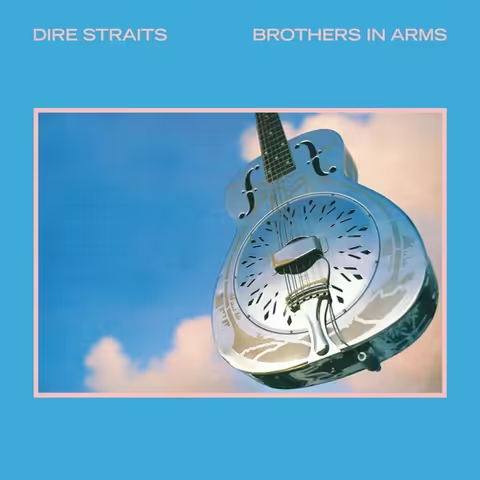
The image is one of the most reproduced album sleeves of the decade: a battered metal-bodied guitar floating against a blue sky. The guitar is Knopfler's own 1937 14-fret National Style "O" Resonator, made by the National String Instrument Corporation between 1930 and 1941. He had used the same guitar on "Romeo and Juliet" in 1981. The photographer was Deborah Feingold, who had built her reputation shooting jazz portraits in New York. The back cover is a painting of the same guitar by the German artist Thomas Steyer, working from the Feingold image. Sutton Cooper handled the sleeve design.
It is a sleeve that does very little, very deliberately. There is no band photo on the front. There is no title type running across the artwork. The guitar is doing all the work, and what it implies, looking back four decades later, is precisely the rootsiness that the album's polished production would be accused of betraying. The critic Robert Sandall wrote in 1996 that the image looked uncannily prophetic in hindsight: a six-stringed rocket heading up into the clouds with no obvious means of propulsion, which is more or less what happened to Dire Straits after the record came out.
Singles and music videos
| Single | Released | UK | US | Notes |
|---|---|---|---|---|
| So Far Away | 12 April 1985 | 20 | 19 | First single; released a month before the album |
| Money for Nothing | 28 June 1985 | 4 | 1 (3 weeks) | Grammy 1986 Best Rock Performance by a Duo or Group; B-side "Love over Gold" (live) |
| Walk of Life | 14 October 1985 (US) | 2 | 7 | Sports-bloopers video became an MTV mainstay |
| Brothers in Arms | 18 October 1985 (UK) | 16 | Issued in the UK in a tour-branded sleeve; reported as the world's first commercial CD single | |
| Your Latest Trick | 25 April 1986 | 26 | Final single; lifted by the Michael Brecker sax solo |
The music video for Money for Nothing is the one that mattered. Steve Barron, fresh from a-ha's "Take On Me" and Thomas Dolby's "She Blinded Me With Science", was hired by Warner Bros. to talk a reluctant Mark Knopfler into doing a concept video. Knopfler hated videos. Barron flew to Budapest to meet him during the tour. According to Barron's account, Knopfler was unmoved until his American girlfriend, who was in the room, told him the concept was excellent and that MTV needed more interesting videos. Knopfler did not say yes. He just did not call Barron back to stop him. Ian Pearson and Gavin Blair, working at the London post-production house Rushes, built the video on a Bosch FGS-4000 CGI system and a Quantel Paintbox, in what was one of the very first uses of computer-animated human characters in a music video. Pearson and Blair later founded Mainframe Studios, the Canadian animation house behind ReBoot.
The Money for Nothing video won Video of the Year and Best Group Video at the 1986 MTV Video Music Awards, on a haul of eleven nominations. On 1 August 1987, when MTV Europe launched, it was the first video the channel played, beamed into 1.6 million paying households. Sting's "I want my MTV" hook would, until 2026, continue to be used as the audio bed for the MTV Entertainment Studios production card.
Chart performance and certifications
Brothers in Arms went straight to number one in the UK on 19 May 1985, and held that position, on and off, for fourteen non-consecutive weeks, including a ten-week run from 18 January to 22 March 1986. In the United States, it spent nine weeks at the top of the Billboard 200. In Australia, where the band was a phenomenon out of all proportion to its size at home, it sat at number one for thirty-four weeks, a record that lasted until Adele's 21 finally broke it in 2012. It went to number one in Canada, Germany, France, the Netherlands, New Zealand, Norway, Spain, Sweden, Switzerland and Austria, and reached the top five in almost every European market.
The certifications tell their own story. In the UK it has been certified fifteen times platinum, for 4.5 million units shipped, and was the first album in history to receive a ten-times platinum certification from the BPI. In the US it is nine-times platinum, for nine million. In Australia it is seventeen-times platinum. In France it is Diamond, for over two million. In Canada it is Diamond. In Switzerland it is six-times platinum. In Brazil it is three-times platinum. As of July 2016 it was the eighth-best-selling album in UK chart history. Worldwide sales have been reported at more than thirty million copies. In the Netherlands, the album held the all-time record for most weeks on the Dutch Album Top 100, with 269 non-consecutive weeks, until Adele's 21 and the Buena Vista Social Club's debut overtook it in 2016.
The awards were just as dense. The album won the 1986 Grammy for Best Engineered Album, Non-Classical, with Dorfsman picking up the engineer's statuette. "Money for Nothing" took Best Rock Performance by a Duo or Group with Vocal at the same ceremony, and was nominated for Record of the Year and Song of the Year. The album won Best British Album at the 1987 Brit Awards (it had been nominated the previous year and lost to Phil Collins's No Jacket Required). At the 2006 Grammys, the 20th-anniversary 5.1 surround mix by Chuck Ainlay won Best Surround Sound Album.
Live Aid, Wembley, 13 July 1985
Brothers in Arms had been on sale for eight weeks when Dire Straits walked across the Wembley Stadium car park on 13 July 1985 from a residency at the adjacent Wembley Arena to play Live Aid. They had a two-song set: an extended ten-minute "Sultans of Swing" and "Money for Nothing", joined on stage by Sting for the falsetto hook he had recorded six months earlier in Montserrat. When the set was over, they walked back across the car park to play their Arena gig that evening. Live Aid was, depending on which survey you read, watched by between 1.5 and 1.9 billion people. The performance is one of the moments people who have never bought a Dire Straits album in their lives can still picture.
"It was a very special feeling to be part of something so unique. Live Aid was a unique privilege for all of us. It's become a fabulous memory."
John Illsley, quoted in Ed Bicknell's recollections, 2017
The Brothers in Arms World Tour
The tour ran for a full year, from 25 April 1985 in Split, Yugoslavia (now Croatia), to 26 April 1986 at the Sydney Entertainment Centre in Australia. It covered 248 shows in more than 100 cities across Europe, Israel, North America and Australasia. Dire Straits played to over 2.5 million ticket-buyers. In Australia and New Zealand alone, the band sold 900,000 tickets, the biggest run any rock act would do in Australasia until Ed Sheeran broke the record in 2017 and 2018. Jack Sonni was on stage as the full-time rhythm guitarist. Terry Williams, restored to the drum chair he had lost in the studio, played every show. Saxophonist Chris White joined the touring line-up.
The 21 consecutive nights the band played at the Sydney Entertainment Centre at the end of the tour remain a venue record. By the time the band took its bow in Sydney on 26 April 1986, the members were exhausted; Knopfler later said the experience had been "dehumanising" and announced an indefinite hiatus. The band would not record another album for five years, and the next one, On Every Street, would be their last.
Critical reception
The British music weeklies of 1985 hated Brothers in Arms. Mat Snow in NME called it "mawkish self-pity" and "the tritest would-be melodies in history". Eleanor Levy in Record Mirror dismissed it as part of "the tottering edifice of MOR rock". Barry McIlheney in Melody Maker bemoaned that the record sounded "just a bit too like the last Dire Straits album, which sounded not unlike the last one before that". Jack Barron in Sounds gave it three stars and called it "only a halfway decent album".
The Americans were warmer. Spin praised Knopfler's guitar work and the craftsmanship. Rolling Stone's Debby Bull found the production beautiful, even if the scenarios were not as interesting as those on Making Movies. AllMusic's Stephen Thomas Erlewine later gave it four stars out of five, attributing the album's success to Knopfler's "increased sense of pop songcraft" as much as to the Money for Nothing video.
By 1996, the critical wind had shifted. Q gave the remaster a full five stars. BBC Music's Chris Jones called it "a phenomenon on every level". Pitchfork, reviewing the studio-albums box in 2020, gave it 8.6 out of 10. Rolling Stone placed it at number 351 on the 2003 edition of its 500 Greatest Albums list, moved it to 352 in 2012 and 418 in the 2020 revision. Q's 2000 list of the 100 Greatest British Albums Ever put it at 51.
The retrospective consensus, captured most concisely by Classic Rock in 2018, is that the album made Dire Straits into superstars and simultaneously warped the world's perception of them. "Dire Straits became a byword for a certain sort of safe, homogenised music," the magazine wrote, "and Knopfler was turned into a caricature of the middle-aged rocker, with jacket sleeves rolled up and wearing a headband. It wasn't even as if he had contrived to make a blockbuster. In large part it was hushed and melancholy, a sigh rather than a roar. But it was damned by having its signature single explode out of context."
Reissues, remasters and anniversaries
The album has been remastered, reissued and remixed more than almost any other 1980s rock record. The major editions:
- 1996 worldwide remaster (Bob Ludwig at Gateway Mastering, Super Bit Mapping); 19 September 2000 US release of the same master
- 2000 XRCD2 edition remastered by Hiromichi Takiguchi with K2 20-bit technology
- 26 July 2005, 20th-anniversary Super Audio CD with a Chuck Ainlay 5.1 surround mix from British Grove Studios; the 3,000th SACD title, and the 2006 Grammy winner for Best Surround Sound Album
- 16 August 2005 DualDisc with the 5.1 mix plus a 24-bit/96-kHz DVD-Audio layer
- 2006 half-speed-mastered double vinyl by Stan Ricker, the first time the full-length CD versions of the songs were available on vinyl
- 2013 Mobile Fidelity hybrid SACD mastered by Shawn R. Britton from the original tapes
- 2014 Japan SHM-SACD by Mick McKenna and Richard Whittaker at FX Copyroom using Direct Stream Digital
- 19 May 2014 Vertigo double 180g vinyl reissue (Ludwig, Bernie Grundman, Chris Bellman)
- 2015 Mobile Fidelity double 45rpm vinyl by Krieg Wunderlich
- March 2021 Abbey Road half-speed master by Miles Showell, double 180g 45rpm
- 16 May 2025 40th-anniversary Blu-ray with Dolby Atmos plus 24-bit/96-kHz versions of the CD and vinyl mixes, released alongside a five-LP box set and triple CD containing a previously unreleased full-length 16 August 1985 concert from the Municipal Auditorium, San Antonio, the first official live release from the world tour
Legacy and influence
The most obvious legacy of Brothers in Arms is that it sold the world the compact disc. Every CD-format anniversary article from the late 1980s onwards points at this album as the moment the format crossed from audiophile niche to mass-market default. The Guardian ranked the album at number 38 in its list of the fifty key events in rock music history for precisely this reason. By 1990, more people in the developed world owned CD players than turntables, and Brothers in Arms was a meaningful part of the reason.
Its other legacy is sonic, and more ambivalent. The clean, scrubbed, digital sound that the record's session team fought to capture became the default production aesthetic of late-1980s soft rock, and was used as ammunition against the band by every subsequent generation of critics who wanted music to sound less polished. Knopfler himself was made into a caricature of the well-fed mid-1980s rocker, and seems to have spent the rest of his career trying to step out of the silhouette.
For Dire Straits the band, the album was the peak and the end. They took five years off after the world tour, returned for On Every Street in 1991, toured behind it for nearly two years and 300 shows in front of 7.1 million people, and then quietly disbanded in 1995. Knopfler has consistently refused offers to re-form, telling The Independent in April 2024 that he would never play with the group again. John Illsley, Alan Clark and Guy Fletcher attended the Rock and Roll Hall of Fame induction in 2018 without him; Dire Straits remain the only act ever inducted without an introduction speaker or a performance. Former members tour, on and off, as Dire Straits Legacy. Jack Sonni died in August 2023, aged 68.
Where Brothers in Arms sits in the Dire Straits catalogue
Of the six Dire Straits studio albums, Brothers in Arms is the only one that crossed over into the realm of cultural object as well as record. Dire Straits in 1978 established the band as a singular new voice. Communiqué in 1979 confirmed it. Making Movies in 1980 expanded the vocabulary. Love Over Gold in 1982 grew the scope and brought in Dorfsman. On Every Street in 1991 closed the book in a quieter register. Brothers in Arms sits in the middle of that arc as the moment when all the choices the band had been making suddenly aligned with the technology, the marketing and the audience appetite of the moment. Looking at the discography backwards from 2026, it is easy to read everything before it as preparation and everything after it as comedown.
Things you might not know about Brothers in Arms
| Fact | Detail |
|---|---|
| The defective tape | A bad batch of Sony digital tape at AIR Montserrat ate parts of three songs and forced the band to relocate to the Power Station in New York to re-cut them. |
| The Hawaiian-noises rant | Knopfler wrote most of the Money for Nothing lyrics on a piece of borrowed paper while standing in a New York appliance store, transcribing what a delivery man in a baseball cap was muttering at a wall of MTV televisions. |
| Sting on a windsurfing break | Sting was on holiday in Montserrat windsurfing, not booked for the session, when he was invited up to AIR for supper, played the Money for Nothing track and offered to sing on it that evening. |
| The drummer was fired in week six | Terry Williams was dismissed from the album sessions after six weeks; Omar Hakim, just off Sting's Blue Turtles dates, flew out and re-cut almost the entire drum chart in two to three days, but Williams kept his job for the tour and remained on the album's video shoots. |
| Walk of Life was nearly cut | Co-producer Neil Dorfsman voted against including Walk of Life on the album; the band outvoted him, and the song reached number two in the UK. |
| Tony Levin played a Chapman Stick | The bass on Why Worry is not bass; it is Tony Levin playing the Chapman Stick, a two-handed tapping instrument with five bass strings and five guitar strings. |
| Illsley's Central Park jog | Illsley sprained his wrist falling while jogging in Central Park during the New York sessions, which is why Tony Levin, Neil Jason and even Jack Sonni were drafted in to cover bass and bass-adjacent parts. |
| The guitar is older than rock and roll | The instrument on the cover is Mark Knopfler's 1937 14-fret National Style "O" Resonator, made in California more than two decades before the term "rock and roll" was widely used. |
| The first commercial CD single | The Brothers in Arms single is reported to have been the world's first commercial CD single, issued in the UK as a promotional item branded for the Live in '85 tour. |
| It launched MTV Europe | When MTV Europe went on air on 1 August 1987, beamed into 1.6 million paying households, the first video it played was the Money for Nothing CGI clip. |
| The animators went on to ReBoot | Ian Pearson and Gavin Blair, who built the Money for Nothing CGI on a Bosch FGS-4000 and a Quantel Paintbox, later founded Mainframe Studios and made the 1990s cartoon ReBoot, in which they referenced the video. |
| It broke ten times platinum | Brothers in Arms was the first album in history to be certified 10× Platinum by the BPI; it is now certified 15× Platinum and is the eighth best-selling album in UK chart history. |
| The studio is now a ruin | AIR Montserrat was severely affected by Hurricane Hugo in September 1989 and never reopened; George Martin's purpose-built residential studio above Salem still stands as an overgrown shell. |
| The Money for Nothing Les Paul | The 1983 Gibson Les Paul Standard reissue Knopfler played on Money for Nothing sold at Christie's in London in 2024 for £592,200, as part of an auction of his guitar collection that raised over $11 million in total. |
| Knopfler was a journalist first | Before he was a teacher, Knopfler had been a reporter on the Yorkshire Evening Post, and he later said his journalism training fed directly into the Money for Nothing lyric: "I was reporting, verbatim, what a particular guy thought about music." |
Final thoughts
Brothers in Arms is the rare album that managed to be simultaneously the biggest pop record of its year, the launchpad for an entire format, and a melancholy meditation on war and distance. It is the moment a British band that had spent eight years building a careful, finger-picked, narrative-rock vocabulary suddenly had the budget, the technology and the audience to do everything at once, and chose to do it on a hilltop in the Caribbean with a defective batch of tape and a drummer they were about to fire. The seams show, in places, four decades later. The sound is unmistakably of its moment. But the songs have not aged out, the band's reluctance to repeat itself is audible on every track, and the artwork still works.
For the Riffology podcast, this is one of the albums that essentially built the audience the show talks to. If you have ever stood at the back of a wedding and heard "Walk of Life", sat through a military funeral and heard "Brothers in Arms", or watched MTV in 1985 and seen the angular CGI delivery man swearing at his television, you have been inside the long shadow of this record. The Riffology podcast is available on Spotify, Apple Podcasts and all major platforms; episodes on the Dire Straits catalogue are well worth a listen if this article has sent you back to the album.
Comments