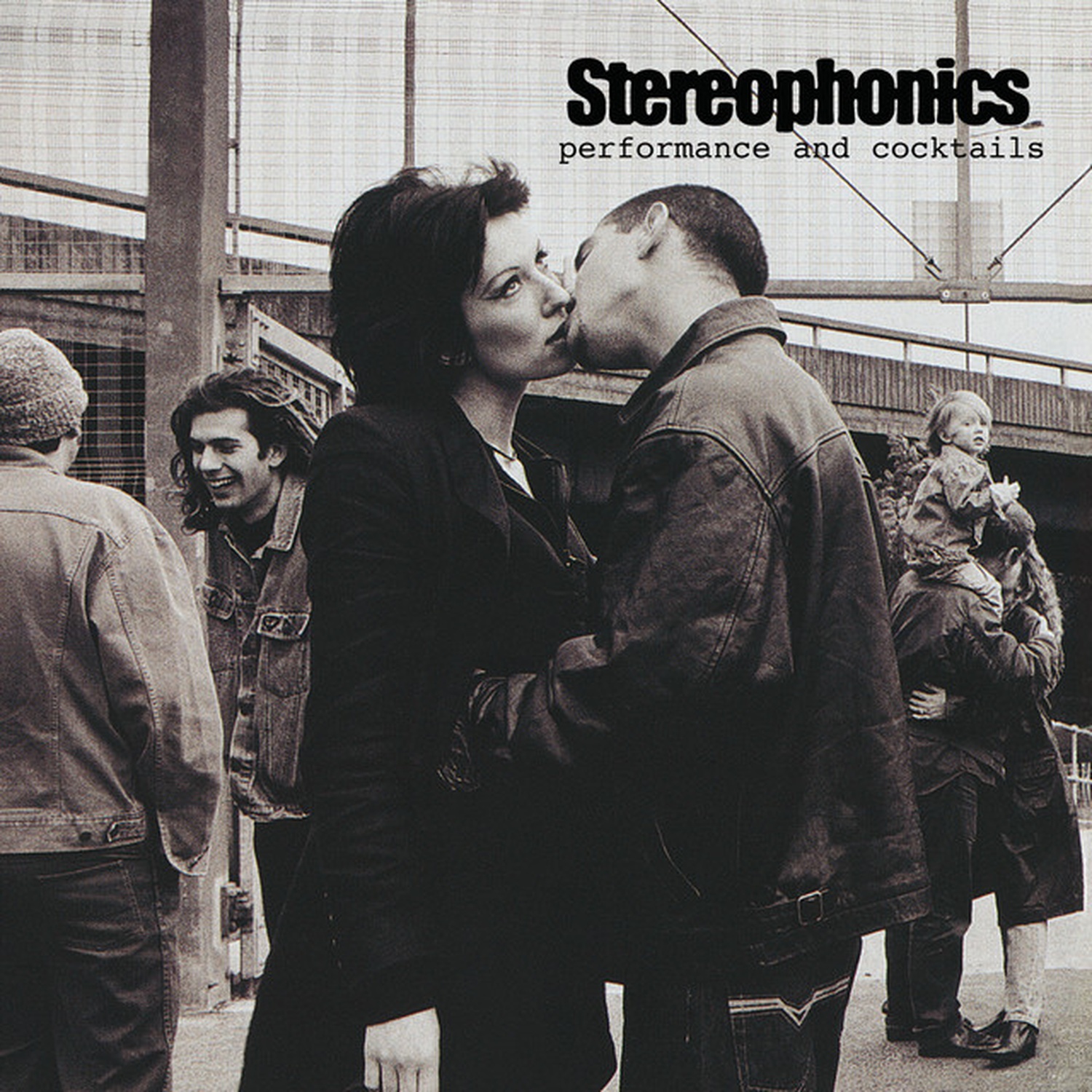
Performance and Cocktails by Stereophonics: The Making of a Modern Classic
Sometimes, an album arrives at just the right moment. Performance and Cocktails by Stereophonics landed in March 1999 and quickly became a defining record of its era. As the Britpop wave faded, Stereophonics captured the mood of late-90s Britain with raw storytelling and radio-ready hooks. Their second album, led by Kelly Jones’s distinctive vocals, brought them mainstream success and established their reputation as one of Wales’s most important rock acts. From the punch of “The Bartender and the Thief” to the introspective “Just Looking,” this album helped shape the landscape of British alternative rock at the turn of the millennium.
You can listen to our episode about Performance and Cocktails here:
This article explores every aspect of Performance and Cocktails. I’ll guide you through its creation, recording process, commercial journey, critical reception, and enduring legacy. We’ll examine the stories behind the songs, the meaning in the lyrics, the band’s promotional efforts, and the album’s impact on music and culture. You’ll find detailed data, anecdotes from the studio, and a close look at the album’s place in the Stereophonics discography.
As Kelly Jones once said, “We were just writing about what we knew, and suddenly people everywhere were singing along.” That simple honesty is a big part of why this album still matters today.
| Attribute | Details |
|---|---|
| Release date | 8 March 1999 (UK), 27 February 1999 (Japan) |
| Album title | Performance and Cocktails |
| Genre | Alternative rock, post-Britpop, pop rock |
| Total runtime | 50:55 |
| Number of tracks | 13 |
| Record label | V2 Records |
| Recording studio | Courtyard (Sutton Courtenay), Parkgate (Catsfield), Real World (Bath), Rockfield (Monmouth) |
| Producer(s) | Bird & Bush (Steve Bush and Marshall Bird) |
Performance and Cocktails didn’t just give Stereophonics their first UK number one album. It sold over 2.5 million copies worldwide, earned six times Platinum certification in the UK, and produced three consecutive top-five singles. It won “Best Album” at the 1999 Kerrang! Awards and was shortlisted for the Mercury Prize. As Richard Jones put it, “That record changed everything for us. We went from clubs to stadiums in a year.”
Now, let’s go back to where it all began.
The Genesis of “Performance and Cocktails”
To understand Performance and Cocktails, we need to look at the world of British music in the late 1990s. Britpop was fading, but its influence lingered. Bands like Oasis and Blur had dominated the charts earlier in the decade, but by 1999, a new wave of alternative rock was taking hold. Stereophonics, hailing from the Welsh village of Cwmaman, brought their own gritty perspective to this changing scene. Their debut, Word Gets Around, introduced their storytelling style, rooted in working-class life and small-town tales.
After the success of their first album, the band felt both excitement and pressure. Kelly Jones, the band’s main songwriter, was determined not to repeat himself. He wanted bigger sounds and broader themes. The group—Kelly Jones (vocals, guitar), Richard Jones (bass), and Stuart Cable (drums)—began writing new material while still touring their debut. Their chemistry was tight, and their ambition was clear. As Kelly later said in interviews, “We wanted to write songs people could sing at football matches, but that still meant something.”
Several tracks for the new album had been written during the Word Gets Around sessions, but others came from experiences on the road. Stereophonics worked closely with producers Steve Bush and Marshall Bird (Bird & Bush), who helped them refine their sound. Marshall Bird also contributed keyboards and arrangements, giving some songs extra colour. There were no major guest artists, but the band did bring in backing vocals from Astrid on “I Stopped to Fill My Car Up.”
Here is a breakdown of the main musicians and their roles on the album:
| Band Member | Instrument/Role |
|---|---|
| Kelly Jones | Lead vocals, guitar, main songwriter, artwork |
| Richard Jones | Bass guitar, harmonica, backing vocals |
| Stuart Cable | Drums, percussion |
| Marshall Bird | Hammond organ, Rhodes piano, piano, mellotron |
| Astrid | Backing vocals on “I Stopped to Fill My Car Up” |
V2 Records, Richard Branson’s label, financed the recording. The budget was larger than for their debut, but not extravagant. The band invested in better studios and more time, yet kept a tight rein on costs. Financially, they still faced the usual risks—if the album failed, the label would recoup its advance. There were no reports of serious money problems during these sessions, but the band worked hard to make every penny count.
The album’s title, “Performance and Cocktails,” comes from the lyrics of the opening track “Roll Up and Shine.” This followed a pattern set by their debut, where the album title was also taken from a song lyric. The cover art, shot by Scarlet Page under the Westway in London, shows a young couple in a passionate embrace. The image was inspired by an Annie Leibovitz photograph and became iconic. Lucy Joplin, the model in the foreground, later revealed she’d been paid £75 and had stayed up all night drinking absinthe and taking opium before the shoot—a story that only adds to the album’s mythos.
Every element of Performance and Cocktails was designed to reflect real life—gritty, messy, but full of hope. Next, we’ll step inside the studio.
Recording Process
The recording sessions for Performance and Cocktails spanned from April 1995 to January 1999. The band worked in several studios: Courtyard Studios in Sutton Courtenay, Parkgate in Catsfield, Real World in Bath, and Rockfield in Monmouth. Each studio offered its own atmosphere. Real World, for example, is famous for its lush surroundings and high-end gear, while Rockfield is legendary for classic rock albums by Queen and Oasis.
Bird & Bush (Steve Bush and Marshall Bird) produced, engineered, and mixed much of the album. Their approach was hands-on, encouraging the band to play live in the studio and capture the energy of their gigs. Al Clay mixed several tracks, and Ian Cooper mastered the album. The team’s previous experience included work with artists across the British indie and rock scene, bringing a blend of technical skill and creative flair.
Let’s look at the kind of equipment and techniques likely used during the sessions. While we don’t have a full inventory, we can make informed assumptions based on the studios and era:
| Hardware/Instrument | Studio/Use |
|---|---|
| Neve or SSL mixing desks | All studios likely had high-end analogue consoles for warmth and punch |
| Studer A800 tape machines | Standard for multitrack recording in the late 1990s |
| Neumann U87 microphones | Used for vocals and overheads |
| Shure SM57/SM58 microphones | For guitar amps and snare drums |
| Matchless DC30 amplifier | Kelly Jones’s main guitar amp, key to the album’s tone |
| Gibson SG, Fender Jaguar, Gibson Les Paul, Fender Stratocaster | Guitars used by Kelly Jones, providing a range of classic rock sounds |
| Hammond organ, Mellotron, Rhodes piano | Played by Marshall Bird for added texture |
| Compression (UREI 1176, LA-2A) | For drums, vocals, and guitars—assumed standard at these studios |
Sessions were often intense. The band wanted to capture the energy of their live shows, so they played together in the room, sometimes tracking songs in just a few takes. There were challenges—long hours, the pressure to deliver hits, and the struggle to balance perfection with rawness. But as Kelly Jones recalled, “We’d just come off the road, so we were tight as anything. Most of it was just us, playing loud and fast.”
Bird & Bush had worked with Stereophonics since their debut and brought continuity. With the tracks recorded and mixed, the band was ready to take on the world. What followed was a commercial triumph.
Commercial Performance and Reception
Upon release, Performance and Cocktails debuted at number one on the UK Albums Chart, selling 119,954 copies in its first week. It went on to become the fifth best-selling album in the UK in 1999. By 2025, the album had sold around 1.8 million copies in the UK and over 2.5 million worldwide. The singles “The Bartender and the Thief,” “Just Looking,” and “Pick a Part That’s New” all reached the UK top five. The album spent 101 weeks in the UK Top 100, re-entering the charts as late as 2004.
Here’s a table showing Stereophonics’ studio albums, with sales data where available. The row for Performance and Cocktails is highlighted for emphasis.
| Album | Year | Sales data |
|---|---|---|
| Word gets around | 1997 | 600,000 (UK) |
| Performance and cocktails | 1999 | 1,758,131 (UK) |
| Just enough education to perform | 2001 | 1,773,913 (UK) |
| You gotta go there to come back | 2003 | 600,000 (UK) |
| Language. sex. violence. other? | 2005 | 500,000+ (UK) |
| Pull the pin | 2007 | 200,000 (UK) |
| Keep calm and carry on | 2009 | 148,400 (UK) |
| Graffiti on the train | 2013 | 87,000 (UK) |
| Keep the village alive | 2015 | N/A |
| Scream above the sounds | 2017 | N/A |
| Kind | 2019 | N/A |
| Oochya! | 2022 | N/A |
| Make ’em laugh, make ’em cry, make ’em wait | 2025 | N/A |
The album won “Best Album” at the 1999 Kerrang! Awards and was shortlisted for the Mercury Music Prize. Stereophonics also took home “Best British Band” at Kerrang! that year. Performance and Cocktails is widely recognised as one of the top British rock albums of the 1990s, ranking #5 on Kerrang!’s Albums of the Year list for 1999 and #27 on Absolute Radio’s album of the decade poll.
Other notable albums released in 1999 by similar artists include:
- Everything Must Go by Manic Street Preachers
- 1977 by Ash
- Polythene by Feeder
- Stoosh by Skunk Anansie
- Formaledehyde by Terrorvision
- Gallus by Gun
- Young Gods by Little Angels
- Backstreet Symphony by Thunder
- Skeletá by Ghost
In 1999, the music world was in flux. Napster launched, changing how people accessed music. Woodstock ‘99 made headlines for chaos. Electronica, nu-metal, and alternative rock all fought for chart space. The Offspring’s “Why Don’t You Get a Job?” spent eleven weeks at number one on the UK Rock & Metal Singles Chart, while Rage Against the Machine, Def Leppard, and Skunk Anansie all scored major hits. Performance and Cocktails managed to stand out in this crowded field, a testament to its strength.
Track Analysis
Singles from Performance and Cocktails made a significant impact. “The Bartender and the Thief” (released 9 November 1998) reached UK #3. “Just Looking” (22 February 1999) hit UK #4. “Pick a Part That’s New” (3 May 1999) also reached UK #4. “I Wouldn’t Believe Your Radio” (23 August 1999) and “Hurry Up and Wait” (8 November 1999) both peaked at UK #11. All singles were written by Kelly Jones and credited to the band as a whole.
Here is a detailed table of every song from the album, including singles and writing credits:
| Track Name | Length | Writing Credit |
|---|---|---|
| Roll Up And Shine | 3:58 | Kelly Jones, Stereophonics |
| The Bartender And The Thief* | 2:54 | Kelly Jones, Stereophonics |
| Hurry Up And Wait* | 4:40 | Kelly Jones, Stereophonics |
| Pick A Part That’s New* | 3:34 | Kelly Jones, Stereophonics |
| Just Looking* | 4:13 | Kelly Jones, Stereophonics |
| Half The Lies You Tell Ain’t True | 2:56 | Kelly Jones, Stereophonics |
| I Wouldn’t Believe Your Radio* | 3:50 | Kelly Jones, Stereophonics |
| T-Shirt Sun Tan | 4:05 | Kelly Jones, Stereophonics |
| Is Yesterday, Tomorrow, Today? | 4:02 | Kelly Jones, Stereophonics |
| A Minute Longer | 3:46 | Kelly Jones, Stereophonics |
| She Takes Her Clothes Off | 3:55 | Kelly Jones, Stereophonics |
| Plastic California | 4:31 | Kelly Jones, Stereophonics |
| I Stopped To Fill My Car Up | 4:30 | Kelly Jones, Stereophonics |
Note: Tracks marked with * were released as singles. Chart positions: “The Bartender and the Thief” (UK #3), “Just Looking” (UK #4), “Pick a Part That’s New” (UK #4), “I Wouldn’t Believe Your Radio” (UK #11), “Hurry Up and Wait” (UK #11).
Song Meaning and Lyrics
Each single from Performance and Cocktails explores a different slice of life, with lyrics written by Kelly Jones. The songwriting process often started with personal experience, then expanded into wider themes. Let’s look at the meanings behind the main singles:
“The Bartender and the Thief” is a story of forbidden love and escape. The lyrics describe two lovers meeting in secret, stealing what they need, and starting again. Lines like “The bartender and the thief are lovers / Steal what they need like sisters and brothers” paint a vivid picture of risk and rebellion. The song’s driving riff and punchy chorus make it one of the band’s most recognisable tracks. (Source: AZLyrics)
“Just Looking” is more introspective. It’s about wanting more from life, but not quite ready to commit. The repeated line, “I’m just looking, I’m not buying,” sums up the sense of searching without settling. This track resonated with listeners who felt stuck or restless. (Source: Musixmatch)
“Pick a Part That’s New” takes a playful look at reinvention. It’s about trying on new identities and finding excitement in change. The upbeat tempo and catchy melody made it a live favourite. (Source: Genius)
“I Wouldn’t Believe Your Radio” is a bittersweet song about trust and doubt. The lyrics, “You can have it all if you like / You can be the first in line,” hint at both opportunity and scepticism. The track’s breezy sound contrasts with its underlying message of uncertainty. (Source: Genius)
Writing credits for every song go to Kelly Jones and the band. Collaboration was key—Stuart Cable’s drumming and Richard Jones’s bass lines helped shape the final sound. There were no major guest artists, but Marshall Bird’s keyboard work added depth to several tracks.
Touring and Promotion of Performance and Cocktails
Promotion for Performance and Cocktails was ambitious. Stereophonics released five singles, each with a music video and heavy radio play. The band performed on TV shows and played a series of high-profile gigs, including a huge homecoming show at Morfa Stadium in Swansea to 50,000 fans. This concert was later released on DVD, capturing the band at their peak.
The 1999 tour for the album was extensive. According to setlist.fm, Stereophonics played 93 concerts that year. They toured the UK, Europe, Australia, the United States, and Japan. Notable shows included V Festival at Weston Park, Reading and Leeds, and support slots for The Charlatans and U2 in the US. The band’s relentless touring schedule helped build their fanbase and cemented their reputation as a top live act.
During the 1999 tour, Stereophonics shared stages with a variety of artists. In the UK, they played with Ash, The Black Crowes, and The Crocketts at the “A Day at the Races” festival. In the US, they supported U2 at Madison Square Garden. Other support acts included Vibrolush, Adam Masters, Leaves, Howie Day, and Augustana. The band’s ability to connect with different audiences was a key factor in their success.
Influences and Legacy
Performance and Cocktails was shaped by a mix of influences. Stereophonics drew inspiration from classic rock acts like The Rolling Stones and The Who, as well as contemporary bands such as Oasis and Manic Street Preachers. Kelly Jones has often cited Bob Dylan and Neil Young as lyrical influences, especially in his storytelling approach.
The album’s success also paved the way for future British rock acts. Bands like Feeder and Ash benefited from the doors Stereophonics helped open. The record’s blend of big choruses and honest lyrics set a template for post-Britpop guitar bands.
Here’s a table summarising the album’s influences and those it later inspired:
| Influences on “Performance and Cocktails” | Artists Influenced by “Performance and Cocktails” |
|---|---|
| The Rolling Stones | Feeder |
| The Who | Ash |
| Bob Dylan | Kaiser Chiefs |
| Oasis | Embrace |
| Manic Street Preachers | The Enemy |
1999 was a year of major cultural shifts. The Euro was introduced, “The Matrix” changed cinema, and Napster began reshaping music consumption. In Britain, the Millennium Dome was completed, and the country celebrated Manchester United’s treble win. “Harry Potter and the Prisoner of Azkaban” was published, while TV saw the debut of “The Sopranos” and “Family Guy.” The music world saw Woodstock ‘99, the rise of teen pop, and the last hurrah of 90s alternative rock. Stereophonics, with Performance and Cocktails, captured the spirit of the time—uncertain, hopeful, and ready for change.
Five Things about Performance and Cocktails
Let’s highlight five remarkable facts about the album, all verified from reliable sources:
| Fact | Details |
|---|---|
| Title Origin | The album’s name comes from a lyric in the opening track, “Roll Up and Shine.” |
| Iconic Cover Photo | The cover was shot by Scarlet Page under the Westway in London and features Lucy Joplin, who was paid £75 for the session. |
| Platinum Status | Certified six times Platinum in the UK, with over 1.8 million sales. |
| Mercury Prize Nominee | Shortlisted for the 1999 Mercury Music Prize, one of the UK’s top music awards. |
| Longevity | Spent 101 weeks in the UK Top 100 and re-entered the charts in 2004. |
Media and Television Usage
Some albums become part of film and TV soundtracks, but for Performance and Cocktails, only a few tracks have been confirmed in media usage. Here’s what I found:
| Song Title | Media Appearance | Year |
|---|---|---|
| A Minute Longer | Long Way Up S1 E10 (“Nicaragua, Honduras, Guatemala & Mexico”) | 2020 |
| I Stopped to Fill My Car Up | Whatever It Takes (film) | 2000 |
| I Wouldn’t Believe Your Radio | Long Way Up S1 E2 (“Ushuaia”) | 2020 |
| Just Looking | Long Way Up S1 E4 (“The Andes”) | 2020 |
Critical Reviews and Retrospectives
Upon release, Performance and Cocktails received mixed reviews. AllMusic’s Jason Damas said the album “doesn’t match the consistency of Word Gets Around” but praised tracks like “T-Shirt Sun Tan” and “Pick a Part That’s New.” Pitchfork’s Brent DiCrescenzo was more critical, comparing the band to Oasis and calling the album “loud music for muddy British summer festivals.” Rolling Stone’s Barry Walters also saw Stereophonics as “Oasis trying to be Radiohead.” NME rated the album 6/10. Yet, public opinion was much more positive, with the album’s strong sales and enduring popularity proving its appeal.
| Publication | Review Score | Notable Quote | Link |
|---|---|---|---|
| AllMusic | Mixed | “Doesn’t match the consistency of Word Gets Around, but standout tracks shine.” | AllMusic |
| Pitchfork | Negative | “Oasis with louder guitars and less ambition.” | Wikipedia |
| Rolling Stone | Negative | “Oasis trying to be Radiohead.” | Wikipedia |
| NME | 6/10 | “Solid but not groundbreaking.” | Wikipedia |
After Performance and Cocktails
Following the success of Performance and Cocktails, Stereophonics released Just Enough Education to Perform in 2001, which became their best-selling album. The band continued to evolve, with lineup changes including the departure of drummer Stuart Cable in 2003. Despite critical ups and downs, Stereophonics remained popular, scoring multiple UK number one albums and singles like “Dakota.” As of July 2025, they are still active, with their thirteenth album, Make ‘Em Laugh, Make ‘Em Cry, Make ‘Em Wait, released in April 2025 and a major tour underway.
Conclusion
Performance and Cocktails remains a landmark album in British rock. Its blend of gritty realism and big choruses captured a moment in time and continues to resonate with listeners. Stereophonics used the album as a springboard, building a career that has lasted more than 25 years. Whether you’re revisiting the record or discovering it for the first time, its songs still ring true—proof that honest songwriting never goes out of style.
Further Reading
- The Making of Everything Must Go by Manic Street Preachers (Riffology blog)
- The Making of 1977 by Ash (Riffology blog)
- The Making of Polythene by Feeder (Riffology blog)
- Skeletá by Ghost – album review (Riffology blog)
- Wikipedia: Performance and Cocktails
- Official Stereophonics Website
- V2 Records
About the Author