
Introduction
Iron Maiden’s “Somewhere in Time” stands as a landmark in the band’s illustrious discography. Released on 29 September 1986, this album marked a significant evolution in their sound. With its introduction of guitar synthesizers, the album brought a fresh and futuristic vibe to the band’s heavy metal roots. This article delves into the making, impact, and legacy of “Somewhere in Time,” exploring its genesis, recording process, commercial performance, and much more.
| Attribute | Details |
|---|---|
| Release date | 29 September 1986 |
| Album title | Somewhere in Time |
| Genre | Heavy Metal |
| Total runtime | 51:18 |
| Number of tracks | 8 |
| Record label | EMI Records (UK), Capitol Records (US) |
| Recording studio | Compass Point (Nassau, Bahamas) and Wisseloord (Hilversum, Netherlands) |
| Producer(s) | Martin Birch |
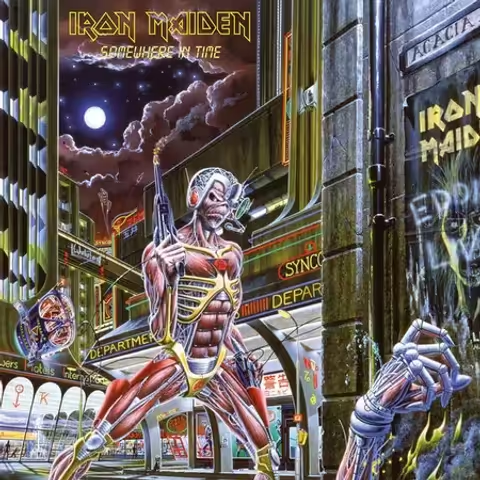
The album’s impact on the music industry was profound, setting a precedent for the use of synthesizers in metal. Adrian Smith, guitarist of Iron Maiden, remarked, “It was a brave move for us, but it paid off in spades.” The album’s themes of time and space resonated with fans, and its cover art, designed by Derek Riggs, is a masterpiece filled with Easter eggs referencing the band’s past. Although we have not yet covered this album in a podcast, we hope to explore its depth in future episodes.
The Genesis of “Somewhere in Time”
As the mid-1980s rolled on, Iron Maiden found themselves at a crossroads. Following the gruelling World Slavery Tour, the band members were physically and mentally exhausted. Yet, the pressure to innovate and evolve remained ever-present. “Somewhere in Time” was born from this period of introspection and transformation.
Prior to this album, Iron Maiden had established themselves as titans of heavy metal with albums like “The Number of the Beast” and “Seventh Son of a Seventh Son”. Their earlier works laid the groundwork for the band’s sound, characterised by intricate guitar work and epic storytelling. The introduction of guitar synthesizers in “Somewhere in Time” marked a departure from their traditional sound, pushing the boundaries of what was expected from heavy metal at the time.
The main creative contributors to the album included Steve Harris, Adrian Smith, and Dave Murray. Harris, the band’s bassist and primary songwriter, penned several tracks that explored themes of time and existentialism. Smith contributed significantly with songs like “Wasted Years” and “Stranger in a Strange Land,” both of which became fan favourites.
| Band Member | Instrument/Role |
|---|---|
| Bruce Dickinson | Lead vocals |
| Dave Murray | Guitars, guitar synthesiser |
| Adrian Smith | Guitars, guitar synthesiser, backing vocals |
| Steve Harris | Bass, bass synthesiser |
| Nicko McBrain | Drums |
The album’s recording was financed by EMI Records, with a substantial budget allocated to ensure the best possible production quality. Despite financial constraints faced by many artists during this period, Iron Maiden managed to deliver an album that met their high standards. The album title, “Somewhere in Time,” reflects its exploration of time and space, while Derek Riggs’ iconic cover art captures a futuristic cityscape filled with nods to the band’s history.
Recording Process
The recording of “Somewhere in Time” took place between January and June 1986 at Compass Point Studios in Nassau and Wisseloord Studios in Hilversum. These locations provided the band with the creative freedom needed to experiment with new sounds. Martin Birch, a long-time collaborator, returned as the producer, bringing his expertise to the project.
Birch, known for his work with bands like Deep Purple and Black Sabbath, played a crucial role in shaping the album’s sound. His experience with heavy metal production ensured that the synthesizers were integrated seamlessly into the band’s music. The recording sessions were challenging, with the band striving to balance their traditional sound with new technological advancements.
| Equipment | Details |
|---|---|
| Guitars | Fender Stratocaster, Gibson Les Paul |
| Amplifiers | Gallien-Krueger 250 RL |
| Drums | Ludwig 6.5″ Supraphonic snare, Ludwig Speed King pedal |
| Synthesizers | Roland JX-8P |
Interestingly, the album was recorded without the use of Marshall amps, a staple in the band’s previous recordings. Instead, they opted for Gallien-Krueger amplifiers, which contributed to the album’s distinctive sound. The use of guitar synthesizers was a bold move, as it was a departure from their established sound. However, it added a layer of depth and complexity to the music.
| Producer | Artist | Album | Year |
|---|---|---|---|
| Martin Birch | Iron Maiden | The Number of the Beast | 1982 |
| Martin Birch | Iron Maiden | Seventh Son of a Seventh Son | 1988 |
Commercial Performance and Reception
Upon its release, “Somewhere in Time” was met with both critical acclaim and commercial success. It reached number 3 on the UK Albums Chart and peaked at number 11 on the US Billboard 200. This success solidified Iron Maiden’s status as one of the leading heavy metal bands of the time.
The album’s commercial performance was impressive, selling over 4.5 million copies worldwide. This made it one of the band’s most successful albums in terms of chart performance. The following table outlines Iron Maiden’s studio albums, highlighting “Somewhere in Time.”
| Album | Year | Sales Data |
|---|---|---|
| Iron Maiden | 1980 | 2.8 million |
| Killers | 1981 | 4.0 million |
| The Number of the Beast | 1982 | 14.2 million |
| Piece of Mind | 1983 | 5.0 million |
| Powerslave | 1984 | 4.5 million |
| Somewhere in Time | 1986 | 4.5 million |
| Seventh Son of a Seventh Son | 1988 | 4.5 million |
| No Prayer for the Dying | 1990 | 3.0 million |
| Fear of the Dark | 1992 | 3.5 million |
The album received numerous awards and certifications, including Platinum status in the US and Gold in several countries. It was a testament to Iron Maiden’s enduring appeal and ability to innovate within the heavy metal genre.
In 1986, other notable albums released included Master of Puppets by Metallica, Reign in Blood by Slayer, and Slippery When Wet by Bon Jovi. These albums contributed to a landmark year in music, showcasing the diversity and creativity within the rock and metal scenes. “Somewhere in Time” received recognition for its bold experimentation and remains a beloved entry in Iron Maiden’s discography.
The year 1986 was eventful for heavy music, with many bands pushing the boundaries of their sound. The tragic loss of Metallica’s bassist Cliff Burton in a bus accident marked a sombre moment in the year. Meanwhile, Slayer’s Reign in Blood was hailed as one of the heaviest albums ever. These events underscored the dynamic and sometimes tumultuous nature of the music industry during this period.
Track Analysis
“Somewhere in Time” produced several singles that showcased the band’s evolving sound. The singles “Wasted Years” and “Stranger in a Strange Land” were released in August and November 1986, respectively. These tracks, written by Adrian Smith, highlighted the band’s lyrical depth and musical prowess.
The following table provides a detailed overview of the album’s tracks, including their length and writing credits.
| Track Name | Length | Writing Credit |
|---|---|---|
| Caught Somewhere in Time | 7:22 | Steve Harris |
| Wasted Years* | 5:06 | Adrian Smith |
| Sea of Madness | 5:42 | Adrian Smith |
| Heaven Can Wait | 7:24 | Steve Harris |
| The Loneliness of the Long Distance Runner | 6:31 | Steve Harris |
| Stranger in a Strange Land* | 5:43 | Adrian Smith |
| Deja Vu | 4:55 | Dave Murray, Steve Harris |
| Alexander the Great | 8:35 | Steve Harris |
*”Wasted Years” and “Stranger in a Strange Land” were released as singles. “Wasted Years” reached number 18 on the UK Singles Chart, while “Stranger in a Strange Land” peaked at number 22.
Song Meaning and Lyrics
The themes of “Somewhere in Time” revolve around time, space, and existential reflection. The singles “Wasted Years” and “Stranger in a Strange Land” offer profound insights into these concepts. “Wasted Years,” written by Adrian Smith, reflects on the passage of time and the sense of life slipping away. Its poignant lyrics, “So understand, don’t waste your time always searching for those wasted years,” resonate with listeners, encouraging them to cherish the present.
“Stranger in a Strange Land” draws inspiration from a real-life Arctic expedition, where a sailor was found preserved in ice. The song’s narrative explores themes of isolation and survival, capturing the haunting feeling of being lost in an unfamiliar world. Adrian Smith’s lyrics paint a vivid picture of this journey, inviting listeners to ponder their own experiences of feeling out of place.
These songs highlight the collaborative efforts of the band members, with Smith and Harris contributing significantly to the album’s lyrical depth. Their ability to weave storytelling with powerful music is a testament to Iron Maiden’s enduring appeal.
Touring and Promotion of Somewhere in Time
The promotion of “Somewhere in Time” was as grand as the album itself. Iron Maiden embarked on the “Somewhere On Tour” from 1986 to 1987, performing across Europe, North America, and Asia. The tour featured elaborate stage designs, complete with futuristic props and visuals that complemented the album’s themes.
The tour comprised over 150 shows, with notable performances in cities like London, New York, and Tokyo. Iron Maiden’s live performances were renowned for their energy and theatricality, drawing large crowds and solidifying their reputation as a premier live act. The band shared the stage with acts like W.A.S.P. and Anthrax, further enhancing the tour’s appeal.
During the 1986 tour, Iron Maiden performed alongside W.A.S.P., bringing together two heavy metal giants. The tour was not without its challenges, as the band faced the rigours of constant travel and performance. However, the success of the tour underscored the album’s impact and the band’s dedication to their craft.
Influences and Legacy
The influences behind “Somewhere in Time” were diverse, drawing from science fiction, literature, and the band’s own experiences. The use of synthesizers was inspired by the burgeoning electronic music scene, adding a new dimension to Iron Maiden’s sound.
The album has influenced countless artists in the years since its release. Bands like Dream Theater and Symphony X have cited Iron Maiden’s experimentation with synthesizers as a pivotal moment in progressive metal. The following table outlines the influences and those influenced by the album.
| Influences on “Somewhere in Time” | Artists Influenced by “Somewhere in Time” |
|---|---|
| Science Fiction | Dream Theater |
| Electronic Music | Symphony X |
In 1986, the world witnessed significant cultural and global events. The Chernobyl disaster in April had a profound impact on the world, highlighting the dangers of nuclear energy. Meanwhile, the Challenger space shuttle disaster in January was a sombre reminder of the risks of space exploration. These events shaped the cultural landscape of the year, influencing artists and musicians alike.
Five Things about Somewhere in Time
“Somewhere in Time” is rich with fascinating details that add to its allure. Here are five interesting facts about the album:
| Fact | Details |
|---|---|
| Cover Art | Designed by Derek Riggs, featuring numerous Easter eggs referencing past albums. |
| First Use of Synthesizers | Introduced guitar synthesizers, marking a departure from traditional metal sounds. |
| Recording Locations | Recorded at Compass Point and Wisseloord Studios, chosen for their creative environments. |
| Sales Success | Sold over 4.5 million copies worldwide, becoming one of the band’s best-selling albums. |
| Live Performances | The tour featured elaborate stage designs, reflecting the album’s futuristic themes. |
Media and Television Usage
Despite its influence, songs from “Somewhere in Time” have not been widely used in media. A search for their usage in television and film yielded no results, highlighting the album’s unique place as a musical rather than cinematic influence.
Critical Reviews and Retrospectives
Upon release, “Somewhere in Time” received positive reviews from critics, praising its innovation and musicality. Although there are no specific Metacritic scores available, the album is frequently lauded in retrospectives as a pioneering work in heavy metal.
After Somewhere in Time
Following the success of “Somewhere in Time,” Iron Maiden continued to evolve. Their next album, “Seventh Son of a Seventh Son”, released in 1988, was a concept album that further explored progressive themes. The band’s popularity remained strong, and they continued to tour extensively.
In the years that followed, Iron Maiden experienced lineup changes, with Adrian Smith leaving and later returning to the band. These changes influenced their sound and direction, but their legacy as pioneers of heavy metal remained intact. As of 2025, Iron Maiden continues to tour and release new music, with plans for their “Run For Your Lives World Tour” in 2025.
Conclusion
“Somewhere in Time” remains a testament to Iron Maiden’s ability to innovate and push the boundaries of heavy metal. Its themes of time and space continue to resonate with fans, and its influence can be seen in the work of countless artists. The album’s enduring appeal is a testament to the band’s vision and creativity.
Further Reading
For those interested in exploring more about Iron Maiden and similar albums, consider reading our articles on “The Number of the Beast” and “Seventh Son of a Seventh Son”. These articles delve into the band’s history and impact on the music world. Additionally, visit the Wikipedia page for “Somewhere in Time”, the official Iron Maiden website, and the record label’s website for more information.
        <blockquote class="wp-block-quote is-layout-flow wp-block-quote-is-layout-flow">
        <p>Let us know in the comments what your thoughts are on <em>Somewhere in Time</em> by Iron Maiden. Did we miss anything? Share your experiences and join the conversation!</p>
        </blockquote>

Comments