Liam Howlett built one of the biggest rock records of 1997 on a desk in Essex, working alone with a sampler, a battered Atari and a handful of synthesisers, and then watched it go straight to number one in the United States without his band ever fitting the shape of an American rock band. The Fat of the Land is what happens when a former rave producer decides his next record should sound like a punk gig, drags two dancers up to the front of the stage as vocalists and refuses to clean any of the dirt off the result.
By the time the album appeared on 30 June 1997, The Prodigy had already spent eighteen months priming the world for it. Firestarter had topped the UK chart in March 1996, sixteen months before the parent album existed in shops, and Breathe had followed it to number one that November. The Fat of the Land arrived as a record half the planet had already heard fragments of, and it still managed to debut at number one in twenty two countries in its first week.
| Field | Detail |
|---|---|
| Artist | The Prodigy |
| Album | The Fat of the Land |
| Release date | 30 June 1997 (UK), 1 July 1997 (US) |
| Label | XL Recordings (UK), Maverick (US) |
| Producer | Liam Howlett |
| Engineer / mixer | Neil McLellan |
| Studios | Liam Howlett home studio (Earthbound), Essex; additional work at Strongroom, London |
| Genre | Big beat, breakbeat, electronic rock |
| Track count | 10 |
| Total runtime | 56:21 |
| UK Albums Chart peak | 1 |
| Billboard 200 peak | 1 |
| Other number one positions | Australia, Canada, Germany, Ireland, New Zealand, Sweden, Switzerland and others |
| Certifications | 4x Platinum (UK), 2x Platinum (US), Platinum (Germany, Australia, Canada and more) |
| Estimated sales | Over 10 million copies worldwide |
| Singles | Firestarter, Breathe, Smack My Bitch Up |
Britain in 1997 and the state of The Prodigy
The summer the album appeared was the summer of Cool Britannia. Tony Blair had walked into Downing Street on 2 May, ending eighteen years of Conservative government, and the country still had its head in a long post-Britpop hangover. OK Computer had landed on 16 June, two weeks before The Fat of the Land, with The Verve's Urban Hymns four months behind it. Heavy guitar music was thinning out: Reload, Cryptic Writings and Sehnsucht were all months away, and the dance press had spent two years building up Underworld, Chemical Brothers, Leftfield and Daft Punk as the new mainstream.
The Prodigy walked into that landscape as the only act with a genuine claim to operate in both worlds. Music for the Jilted Generation, the 1994 second album, had gone straight to UK number one and given them their first crossover hit with No Good (Start the Dance). They had headlined the dance tent at Glastonbury 1995. Then Firestarter happened. The single was finished in late 1995 and released in March 1996, and within a fortnight Top of the Pops had Keith Flint's two horned haircut and union jack jumper on its hosts' minds for the rest of the year.
Howlett spent most of 1996 in two parallel universes. In one he was on tour with a band suddenly being treated as rock stars; in the other he was at home on his desk in Essex trying to write the album that the world now expected. He has been candid about how unsettling that pressure was.
"I knew there was no point trying to make Music for the Jilted Generation again. I wanted it to sound like a punk record made on machines, something that you would hear coming out of a kid's bedroom and be slightly scared of."
Liam Howlett, NME, 1997
Keith Flint's transformation was the other half of the story. Until Firestarter he had been a dancer, a hyperactive front of stage presence with no microphone. The decision to put him behind one had been almost accidental, born out of a track called Molotov Bitch where Flint shouted a few lines into a mic in the studio for fun. By the time The Fat of the Land was being assembled, the dancer with the green and orange hair was the most recognisable face in British music.
Firestarter, Breathe and the long runway
The two singles that arrived more than a year before the album did almost all of the heavy lifting. Firestarter, released on 18 March 1996, was built around a sample of the guitar squeal from The Breeders' S.O.S. and a vocal that Flint wrote in less than an hour. It went straight in at UK number one and stayed there for three weeks. The video, directed by Walter Stern in the disused Aldwych tube tunnel, became a fixture of MTV rotation and a nightmare for parents.
Breathe followed on 11 November 1996. Howlett had built it around a guitar riff sampled from Johnny "Guitar" Watson's Hot Little Mama and a drum loop from a 1970s funk record. Flint and Maxim shared the vocal and traded threats across the chorus. It also debuted at UK number one and gave the band their second number one single in eight months.
The pair of singles created an enormous amount of forward momentum, and when the album itself was finally announced for 30 June 1997 the appetite for it was unprecedented for a dance record. XL Recordings co-founder Richard Russell has said that pre-orders alone were enough to guarantee the album platinum status before a copy had been sold.
- Firestarter, March 1996, UK number one for three weeks, certified Platinum.
- Breathe, November 1996, UK number one, certified Platinum.
- Smack My Bitch Up, November 1997, UK number eight, banned in multiple territories.
How the album was made
Most of The Fat of the Land was made in Howlett's home studio in Essex, a converted space he called Earthbound. Sessions stretched intermittently from late 1995 to spring 1997. Engineer Neil McLellan, who had worked with the band since the Music for the Jilted Generation era, ran the desk. The setup was deliberately unfashionable for the period: a Mackie 32 channel desk, a couple of Akai S1100 samplers, a Korg Prophecy, an Atari ST running Cubase, a Roland Juno 106 and a wall of effects pedals borrowed from the band's growing live rig.
Howlett would write a track in days, then sit on it for weeks listening on tour buses, in cars, on cheap hi fi systems, and bring it back to be torn apart again. He has talked about treating his samplers the way a guitarist treats a pedal board, layering distortion until the source was unrecognisable.
"I would route everything back out through guitar amps and old valve gear. If a synth sounded too clean I would push it until it broke. The album had to feel like it had been recorded in a garage, not on a hard drive."
Liam Howlett, Mixmag, 1997
The sampling on the record is dense, and the cost of clearing it almost broke XL's accounts department. Smack My Bitch Up was built around the line "Smack my bitch up" lifted from Ultramagnetic MCs' Give the Drummer Some, recorded in 1988. Funky Shit drew on a Beastie Boys vocal hook. Diesel Power's groove leans on James Brown breaks. Climbatize uses a Sly and the Family Stone bass line. Each one had to be cleared, and several writing credits had to be amended at the last minute when samples that the team had assumed were obscure turned out to be subject to current publishing deals.
One sample in particular caused a much bigger problem. Narayan was originally built around a vocal hook that Howlett liked but could not place. When Crispian Mills of Kula Shaker came down to the studio to listen, he sang it back to Howlett unprompted and the two of them ended up rewriting the whole vocal from scratch with Mills sitting at the microphone. He is the lead voice on the finished nine minute closer.
Personnel and credits
| Role | Player | Notes |
|---|---|---|
| Core band | ||
| Programming, keyboards, samples | Liam Howlett | Sole writer of all music; produced the entire record |
| Vocals | Keith Flint | Lead on Firestarter and Serial Thrilla; co wrote Firestarter |
| Vocals | Maxim (Keith Palmer) | Lead on Breathe and Mindfields |
| Dancer (no studio role on the album) | Leeroy Thornhill | Live member; left the band in 2000 |
| Guests | ||
| Rap vocal | Kool Keith (Keith Thornton) | Diesel Power; recorded in New York and posted back to Essex |
| Lead vocal | Crispian Mills | Narayan; uncredited writing contribution acknowledged in liner notes |
| Vocal | Saffron (Republica) | Fuel My Fire |
| Guitar | Gizz Butt | Live guitarist; played on parts of Serial Thrilla and Fuel My Fire |
| Production and engineering | ||
| Producer | Liam Howlett | |
| Engineer and mixer | Neil McLellan | Mixed at Strongroom, London |
| Mastering | Tim Young | Metropolis, London |
| Artwork | ||
| Sleeve design | Alex Jenkins | Worked closely with the band on the visual identity |
The songs
The album runs ten tracks across fifty six minutes and twenty one seconds. The sequencing is brutal in a way no electronic record had attempted up to that point: it opens with the most controversial song, drops Firestarter at track eight after an hour of escalating pressure and closes with a punk cover. Howlett has said he wanted listeners to feel battered by the time the closing chords of Fuel My Fire faded out.
| # | Title | Length | Vocal | Single | Notes |
|---|---|---|---|---|---|
| 1 | Smack My Bitch Up | 5:42 | Shahin Badar (Indian classical vocal sample) | Yes (Nov 1997) | Sample of Ultramagnetic MCs |
| 2 | Breathe | 5:35 | Keith Flint, Maxim | Yes (Nov 1996) | UK number one |
| 3 | Diesel Power | 4:17 | Kool Keith | No | Recorded in New York |
| 4 | Funky Shit | 5:16 | Maxim | No | Beastie Boys hook |
| 5 | Serial Thrilla | 5:11 | Keith Flint | No | Skunk Anansie sample (Selling Jesus) |
| 6 | Mindfields | 5:40 | Maxim | No | Used in The Matrix Reloaded soundtrack in 2003 |
| 7 | Narayan | 9:05 | Crispian Mills | No | Longest track on the album |
| 8 | Firestarter | 4:41 | Keith Flint | Yes (Mar 1996) | UK number one |
| 9 | Climbatize | 6:38 | Instrumental | No | Cinematic interlude |
| 10 | Fuel My Fire | 4:24 | Keith Flint, Saffron | No | L7 cover, originally written by L7 and members of Theatre of Hate |
Smack My Bitch Up
The album's opening shot is a five minute escalation built on a hard drum loop and a Hindi vocal hook from singer Shahin Badar that arrives, almost as relief, after four minutes of breakbeat assault. Howlett has insisted in multiple interviews that the title was meant in a colloquial, party use sense rather than a violent one, but the controversy was inevitable. The song was banned from BBC daytime radio, stickered in retail in the United States and singled out by the National Organisation for Women in 1998 as the worst song of the year.
Breathe
The track most listeners point to as the sound of The Fat of the Land. Flint and Maxim trade lines with the rhythm of a wrestling promo, and the breakdown into the chorus's falling guitar riff is as instantly recognisable as anything in 1990s electronic music. It became a near unavoidable single in the autumn of 1996, soundtracking everything from football highlight reels to car adverts.
Diesel Power
A hip hop interlude that exists because Howlett sent a backing track to Kool Keith in New York via DAT in early 1996 and got the finished vocal back two weeks later. Kool Keith reportedly recorded it in a single take. It is the only track on the record that sits squarely in hip hop tempo and structure.
Serial Thrilla
Built around a sample of Skin's vocal from Skunk Anansie's Selling Jesus, this is Keith Flint at his most punk. The lyric is short, repetitive and threatening, and the production lifts a Nirvana style guitar squall into the choruses. Flint reportedly insisted on tracking the vocal at three in the morning to get the right level of exhaustion in his voice.
Narayan
The album's most surprising track and the one critics fought over most. Crispian Mills sings a meditative lyric pulled from the Bhagavad Gita over a track that builds for nearly four minutes before the breakbeat finally arrives. It is the longest song on the album at 9:05 and was originally going to be cut down for radio. Howlett refused.
"Liam played me the track and I started singing the chant my grandmother used to sing. Two days later it was a Prodigy song. The whole thing happened ridiculously fast."
Crispian Mills, Melody Maker, 1997
Firestarter
Sitting deliberately late in the running order, Firestarter feels almost like a reward when it arrives at track eight. Flint co wrote the lyric with Howlett, and the snarling guitar squeal that defines the song was sampled from S.O.S. by The Breeders, who received a writing credit. The video, shot in the Aldwych disused tube tunnel, is widely cited as one of the most influential music videos of the decade.
Climbatize
An instrumental that gives the album its only real moment of breathing space. Built on a slow descending bass line, it sits between the climax of Firestarter and the final assault of Fuel My Fire and operates as a comedown.
Fuel My Fire
A cover of L7's 1992 track from Bricks Are Heavy, sung by Flint with backing vocals from Saffron of Republica. The original was itself a co write involving Theatre of Hate's Brad Houser. Howlett kept the structure but slowed it down and ran the guitars through a wall of distortion. It is the only track on the album that began as someone else's song.
The Smack My Bitch Up video
The single was released on 17 November 1997, almost five months after the album, and it was always going to be the moment the controversy came to a head. The video, directed by the Swedish filmmaker Jonas Akerlund and shot from a first person point of view, follows a protagonist through a London night of drinking, drug taking, casual violence, a strip club and a casual sexual encounter, before revealing in the final shot that the protagonist is a woman.
MTV in the United States restricted it to late night rotation. The BBC banned it from daytime broadcast. The video nevertheless went on to win the MTV Video Music Award for Breakthrough Video in 1998 and is regularly cited in critics' lists of the greatest music videos ever made. Akerlund has spoken about the project in interviews as a deliberate piece of provocation that drew on his earlier work shooting Madonna and Metallica videos.
"We knew exactly what we were doing. The reveal at the end is supposed to disarm everyone who has been judging the character for five minutes. If it had been a man behind the camera the whole way through, the video would have meant nothing."
Jonas Akerlund, Spin, 1998
Release and reception
The album was released on 30 June 1997 in the UK and 1 July 1997 in the United States. It debuted at number one in both territories, the first British electronic album ever to do so on the Billboard 200, and topped the album chart in over twenty other countries in its first week. Within four weeks it had sold a million copies in the United States alone.
Critics largely fell into two camps. The first treated the record as the moment electronic music had finally produced a rock album. The second worried that the formula was less interesting than the noise around it.
"The Fat of the Land is the first dance record that demands to be played loud through a guitar rig. It is rude, slightly stupid and completely irresistible."
NME review, June 1997
Rolling Stone gave it four stars, Spin made it their album of the year for 1997 and Mixmag declared it the moment dance music finally took the United States. The album was nominated for the 1997 Mercury Music Prize and the 1998 Grammy for Best Alternative Music Album. It was named in Q's 100 Greatest British Albums in 2000 and was added to the third edition of 1001 Albums You Must Hear Before You Die.
Touring the record
The Prodigy spent most of 1997 and 1998 on the road. The pre album touring had already taken in two co headline runs in Europe and a 1996 tour with Lollapalooza in the United States. Once the record was out the band became a festival headline act in a way that no purely electronic group had managed before. Highlights of the tour included:
- A headline slot at Glastonbury 1997 on the Pyramid Stage in front of an estimated audience of 80,000.
- A run at Reading and Leeds 1997 where the band closed the main stage on the Saturday night.
- The Brixton Academy run in December 1997, covered live by NME and described as the loudest gig the venue had ever hosted.
- A US arena tour in early 1998 that put them in venues normally booked for hard rock acts.
- Headline appearances at Roskilde, Pukkelpop and Lowlands in 1997 and 1998.
The live show in this period was a five piece operation: Howlett behind a bank of keyboards on a riser, Flint and Maxim trading the front of stage, Leeroy Thornhill dancing and Gizz Butt on guitar. Howlett barely moved during the set; the spectacle was deliberately concentrated downstage.
Artwork and packaging
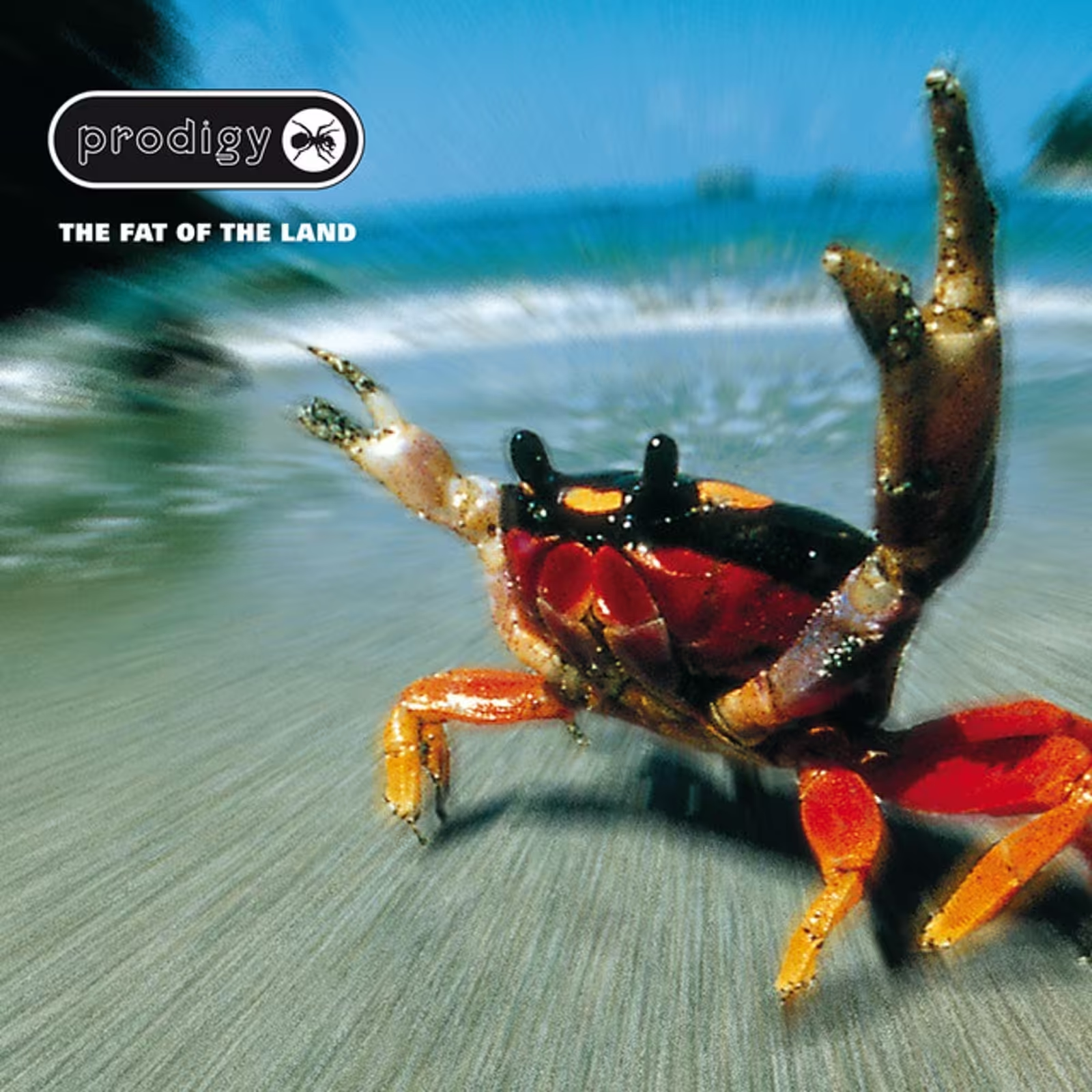
The bright red Christmas Island crab on the front of the sleeve became an instant visual trademark. The image was selected and designed by Alex Jenkins, who had worked with the band since the Music for the Jilted Generation era. The crab references the annual mass migration of Christmas Island red crabs across the island and was chosen for its sense of overwhelming, slightly threatening abundance, mirroring the album's title.
The packaging itself was unusually plain for a 1997 dance release: a single image, the band name in lower case and the album title in a slightly off kilter typeface. There were no liner notes beyond a short list of personnel and sample credits, and Howlett refused to put song lyrics in the booklet. He has explained the decision as a deliberate echo of the punk records he grew up with.
Legacy and influence
The Fat of the Land was the moment big beat went truly mainstream. Its commercial success opened doors for The Chemical Brothers' Dig Your Own Hole and Fatboy Slim's You've Come a Long Way, Baby in the same eighteen month window, and helped shift dance music from the singles charts into the album mainstream. It is also widely credited with making electronic acts plausible festival headliners in a way that had not been true before 1997.
The record has appeared on Q's, NME's and Rolling Stone's lists of the greatest albums of the 1990s. The Mercury Prize nomination in 1997 was a then unusual recognition for a dance record. Bands as varied as Pendulum, The Chemical Brothers, Bring Me the Horizon and Crystal Castles have cited it as a direct influence in interviews.
The album's afterlife was complicated by the death of Keith Flint on 4 March 2019. The band's subsequent decision to continue touring without him has been controversial among fans, but the live set has continued to lean heavily on The Fat of the Land. Firestarter and Breathe remain the two highest streamed tracks in the band's catalogue.
"That record changed what a dance act could be. We watched it happen and realised the rules were different now. You did not have to be faceless any more."
Tom Rowlands, The Chemical Brothers, in an interview with Mixmag, 2002
B sides, remixes and the Dirtchamber detour
The singles campaign threw off a small mountain of B sides, remixes and one offs that have never been collected on a single official release. Firestarter's CD single carried Molotov Bitch, the Keith Flint vocal experiment that effectively created the song in the first place, alongside Instrumental and Empirion remixes. Breathe came backed with Their Law and live takes recorded at Brixton Academy. Smack My Bitch Up was paired with two B sides, No Man Army and No Souvenirs, alongside a Jonas Akerlund video edit on the VHS single.
Howlett also took the brief gap between the album and the next record to release The Dirtchamber Sessions Volume One in January 1999, a sixty minute mix CD on XL that drew on his Beastie Boys, Public Enemy and Jane's Addiction record collection. It went to UK number one in its first week, technically the third Prodigy number one album in three years, although Howlett insisted in interviews that it should not be counted as a follow up to The Fat of the Land.
Anniversary and reissues
For the album's twentieth anniversary in 2017 XL Recordings reissued the record on heavyweight vinyl with restored sleeve artwork and a fold out poster. There has been no super deluxe box set with unreleased session material, partly because Howlett has been cautious about opening the archive while the band's set list still leans on the album. After Keith Flint's death in 2019 plans for an expanded twenty fifth anniversary edition were shelved, although XL did press a limited red vinyl run for the album's twenty fifth in 2022.
Bootleg session tapes do circulate. The most notable is a long form work in progress version of Narayan that runs over thirteen minutes and includes a discarded second verse from Crispian Mills. The band have never officially commented on its provenance.
Things you might not know
| Fact | Detail |
|---|---|
| The original title | The album was provisionally called Black Smoke until late in the recording process. Howlett changed it after stumbling on the phrase "live off the fat of the land" in a paperback edition of John Steinbeck's Of Mice and Men. |
| Madonna signed them in person | Madonna personally signed The Prodigy to her Maverick label for North America, flying to London in 1995 to negotiate the deal at a hotel meeting that Howlett later described as surreal. |
| Firestarter's tube tunnel | The Aldwych tube station used in the Firestarter video had been closed to passengers since 1994. The shoot took two nights and was almost cancelled when one of the lighting rigs tripped a section of the underground's emergency power. |
| Kool Keith's verse | Kool Keith's Diesel Power vocal was tracked in a single afternoon at a New York studio. He was paid a flat fee and waived back end royalties; he later said in interviews that he had no idea the album was going to sell ten million copies. |
| The crab is real | The Christmas Island red crab on the cover migrates in the millions every year between October and December. Alex Jenkins chose the image after seeing a David Attenborough documentary segment on the migration. |
| The Beastie Boys row | Adam Yauch publicly objected to the Smack My Bitch Up title at Reading 1998 and asked Howlett to drop the song from the set. Howlett refused, and the two acts did not appear on the same festival bill again until after Yauch's death. |
| Diana coverage clash | The week after Princess Diana's death in September 1997, the BBC pulled almost all upbeat music from daytime radio. The Fat of the Land's singles disappeared from the airwaves for the best part of a fortnight, briefly slowing what had been an unstoppable promotional run. |
| The L7 cover royalty | L7 received songwriter royalties on Fuel My Fire that reportedly funded the recording of their 1999 album Slap Happy. Donita Sparks of L7 has said the cheque was the largest single payment the band ever received. |
| The Atari survives | The Atari ST that Howlett used to sequence most of the album was still working as of 2015 and appeared in a behind the scenes feature on the band's website that year. |
| Mercury Prize loser | The album lost the 1997 Mercury Prize to Roni Size's New Forms. Howlett has since said he was happy with the result; he was a fan of the drum and bass scene and considered Size a contemporary rather than a rival. |
| The crab tattoo | So many fans had the album's crab logo tattooed in the year after release that the band's management briefly explored licensing the image to a tattoo studio chain. The deal never materialised. |
| Soundtrack afterlife | Tracks from the album have appeared in films and games including The Matrix Reloaded (Mindfields), Snatch, Charlie's Angels and the original Wipeout 2097 sequel, helping a new generation discover the record long after release. |
Listen to the Riffology Podcast
This album was the subject of a full Riffology podcast episode, in which Neil and Chris dig into Liam Howlett's bedroom production set up, Keith Flint's transformation from dancer to frontman, the Smack My Bitch Up controversy and what it was like to live through 1997 with this record on permanent rotation. Hit play below or find Riffology on your favourite podcast app.
Comments