By the closing months of 1996 The Offspring had a problem most bands would happily trade their van for. Smash, the band's third album, had sold its way into territory no independent-label record had ever reached, somewhere north of twelve million copies and still climbing, and had turned a four-piece skate-punk band from Garden Grove, California into the unlikely face of mid-1990s alternative radio. The follow-up they were about to put out, Ixnay on the Hombre, would not match those numbers. It was never going to. What it had to do instead was thread an almost impossible needle: prove the band could grow without selling out, prove they could leave Epitaph without becoming a major-label cliche, and prove that Dexter Holland, Noodles, Greg K. and Ron Welty still wanted to be a punk band on the other side of a hit.
Released on 4 February 1997, Ixnay on the Hombre is the most interesting record in The Offspring's catalogue precisely because it is the most awkward. It is the moment they stopped being Epitaph's biggest export and started being a Columbia Records act. It is the moment they swapped Thom Wilson, the producer who had shaped their first three albums, for Dave Jerden, the Los Angeles studio veteran behind Jane's Addiction and Alice in Chains. It is the moment they wrote a song called Gone Away that sounded nothing like a single and still ended up at number one on the US Mainstream Rock chart. And it is the album that made Americana, eighteen months later, possible.
This is the story of how a band built on no budgets and rented studio time learned to make a record with the money switched on, and what it cost them to do it.
The Smash aftershock and the Epitaph split
To understand why Ixnay on the Hombre sounds the way it does, you have to understand what happened to Epitaph Records in the eighteen months between Smash and the band sitting down to write its follow-up. Brett Gurewitz's label, until then a Los Angeles punk concern with a respectable but modest catalogue, had stumbled into a phenomenon. Smash went on to become the best-selling album ever released on a fully independent label, a record that still stands. Epitaph, suddenly, was making major-label money on an indie-label infrastructure.
What happened next was, depending on whose telling you trust, a sensible piece of business or a flat betrayal. Gurewitz approached Geffen, Capitol and Sony with a proposal: sell Smash to a major label, in return for what he described as a royalty override on the album. From a label point of view it was clean financial logic, a way of cashing in on a freak hit while the iron was hot. From the band's point of view it broke the unwritten contract Epitaph was supposed to represent. The whole point of being on Epitaph, in 1995, was that you were not on Geffen.
Holland, in interviews around the album's release, did not hide the bruise. He said the band would not record for someone who thought he could force them to, and that he would not record for a guy who was worse than a major label. Those are quotable, but they are also a statement of principle: if Epitaph was going to behave like a major in private, the band would deal with a major in public, and at least know where they stood. Several majors came in with offers. The Offspring signed to Columbia. Holland, pointedly, noted that they took less money than rival bids on the table. The point, he said, was who they trusted to put the record out.
There was one further awkwardness. Epitaph's European licensing rights to the band were still in force. The compromise, eventually, was that Ixnay on the Hombre would be a Columbia release in the United States and most of the world, and an Epitaph release in mainland Europe. It is one of the small details that explains why early European pressings carry an Epitaph spine and US copies do not. It is also a reminder that the split, however messy, was not absolute.
The financial backdrop matters too. By the time the band sat down to begin Ixnay on the Hombre, the indie-versus-major argument was no longer a philosophical question for the Offspring. It was a personal one. They had watched their own label owner try to monetise their breakthrough album in private, and they had had to decide, very quickly, what kind of band they were. The decision they made, that the only honest version of the move was an open major-label signing rather than a back-door sale, is the framing on which almost everything else about Ixnay rests. The album is a band publicly owning a transition that someone else had been quietly trying to make on their behalf. It is also, not coincidentally, the album on which Holland is at his most lyrically suspicious of the people around him.
Bringing in Dave Jerden
The other casualty of the move to Columbia was Thom Wilson. Wilson had produced The Offspring's self-titled debut in 1989, Ignition in 1992 and Smash in 1994. He was, in every meaningful sense, the band's fourth ear, the man who had translated their first three records to tape and who shared in the dirty, scrappy sound that defined them. To drop him after a sixteen-million-selling album was a significant call.
In his place came Dave Jerden, one of the most accomplished hard-rock producers in Los Angeles. Jerden's CV by 1996 was a who's who of the previous decade of American alternative and metal: Jane's Addiction's Nothing's Shocking and Ritual de lo Habitual, Alice in Chains's Facelift and Dirt, Anthrax's Sound of White Noise, work with Social Distortion and Mother Love Bone. He was the opposite of Wilson in almost every measurable way: a big-room producer with a big-room sound, capable of giving guitars a weight and a separation that Wilson's lean punk productions had deliberately avoided.
Sessions ran at Eldorado Recording Studios in Hollywood from June through October 1996. Bryan Carlstrom, Jerden's regular engineering partner across his Alice in Chains and Anthrax work, manned the desk. Brian Jerden (Dave's son) and Annette Cisneros assisted. Eddy Schreyer mastered. Bryan Hall took care of the guitar tech, an unusually formal credit for a band that, two albums earlier, had been their own crew.
That list of names is worth pausing on, because it represents a real change in the way The Offspring were operating. Noodles spoke at the time about what the major-label budget meant in practical terms, contrasting it with the way Smash had been put together. The earlier album, he said, had been done on no budget at all, with the band constantly phoning their studio to find out when it was empty so they could sneak in at a discount. Holland echoed it: this time, they had the time to get better sounds. For the first time, they were not making a record between the cracks of someone else's diary.
Noodles also offered a quietly self-aware verdict on what they had produced: he reckoned it was a great record, said they had recorded a few more songs than they needed, and added that maybe they would save the limb-walking for the next one. It is a telling sentence. The band knew, even as they handed it in, that Ixnay on the Hombre was a consolidation rather than a leap. That leap was being held back.
The title and the artwork
The title itself is a small piece of bilingual mischief. Ixnay is Pig Latin, the playground language of inserted syllables that had become a 1940s Hollywood-movie shorthand for nix, or no, or knock it off. Hombre is plainly Spanish for man, or guy. Put the two together and you have something that scans, deliberately, as nonsense to the casual reader and as a punk-rock fuck The Man to anyone willing to decode it. It is also a quiet acknowledgement of the band's Southern Californian geography, where the casual Spanish of Orange County life is as much a part of the vernacular as the Pig Latin nostalgia.
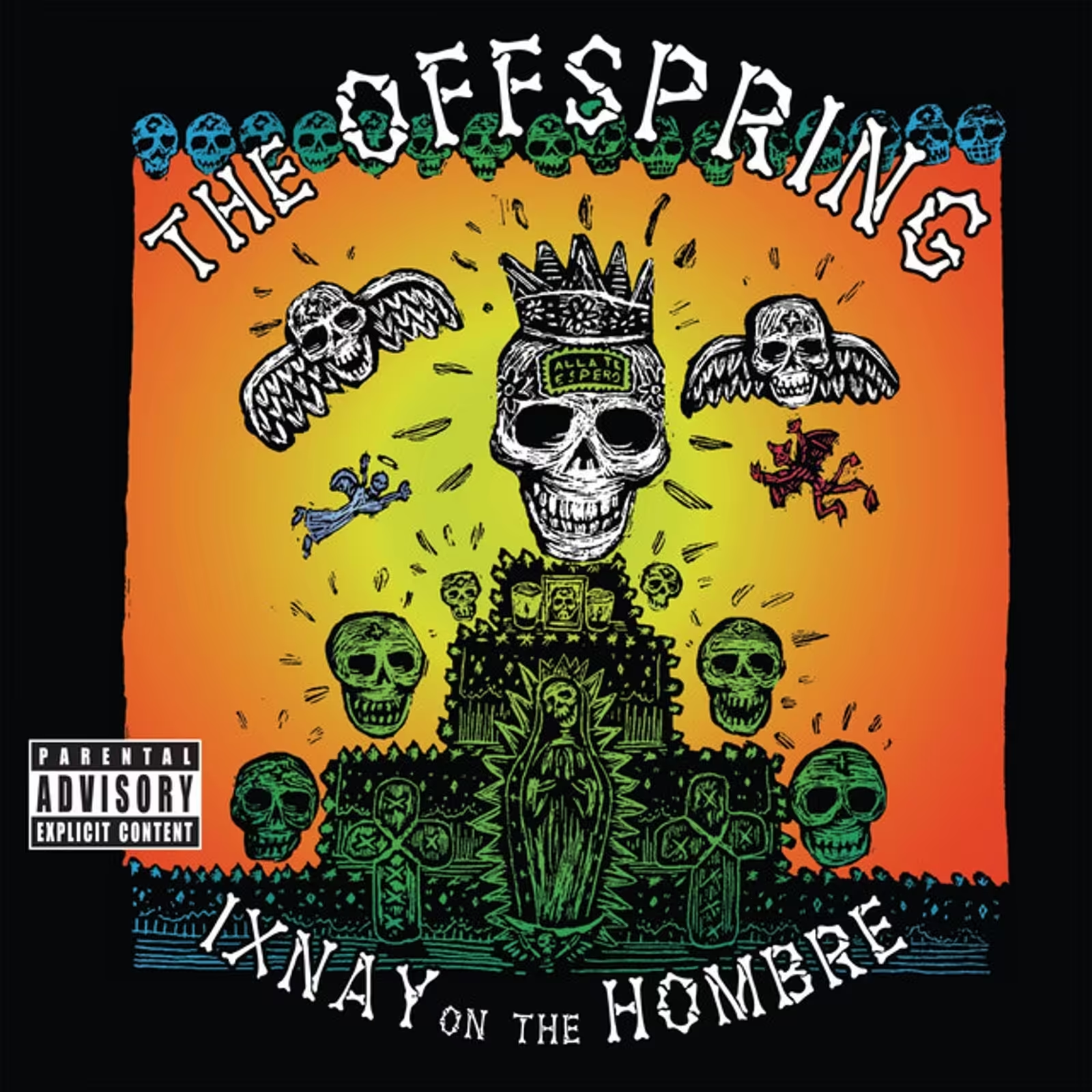
The cover sleeve is, if anything, the bolder statement. The band commissioned Enrique Chagoya, the Mexican-American artist whose print-based work pulled from pre-Columbian codices, Catholic iconography and American pop, to provide the central illustration. Chagoya's image, a cartoonish skeletal figure rendered in flat colour against a hot pink ground, sits somewhere between Day of the Dead imagery, underground comic art and political satire, all of which were continuous threads in his gallery work. Sean Evans handled art direction, with photography from Lisa Haun. The result was that rare thing in mid-1990s major-label punk: a sleeve that did not look like a record sleeve. There was no band logo across the top, no posed group photograph on the back, just a single piece of unsigned-looking artwork carrying the title in lower case.
That artwork choice mattered. It quietly signalled that The Offspring intended to be taken seriously as an aesthetic proposition as well as a singles-chart proposition. It also gave Columbia's marketing department something to push back against, which was, in 1997, an underrated thing for a major-label punk record to have.
Personnel and credits
The core four-piece are present throughout, with all songs except Intermission written by Dexter Holland. The guest list is one of the album's quietest pleasures, particularly the run of spoken-word voices Holland recruited to bookend the record's main statements.
| Role | Personnel |
|---|---|
| Core band | |
| Lead vocals, rhythm guitar | Dexter Holland |
| Lead guitar, backing vocals | Noodles |
| Bass | Greg K. |
| Drums | Ron Welty |
| Guest performers | |
| Spoken word, Disclaimer | Jello Biafra (Dead Kennedys) |
| Spoken word, Intermission | John Mayer (actor, not the singer-songwriter) |
| Spoken word, Cocktail and hidden track Kiss My Ass | Calvert DeForest, billed as Larry Bud Melman from Late Night with David Letterman |
| Additional vocals, Mota | Jason Blackball McLean |
| Backing vocals | Davey Havok of AFI, credited as Davey Havoc |
| Additional percussion | Paulinho da Costa |
| Production | |
| Producer, mixer | Dave Jerden |
| Engineer | Bryan Carlstrom |
| Assistant engineers | Brian Jerden, Annette Cisneros |
| Mastering engineer | Eddy Schreyer |
| Guitar technician | Bryan Hall |
| Artwork | |
| Cover illustration | Enrique Chagoya |
| Art direction | Sean Evans |
| Photography | Lisa Haun |
A note on the John Mayer credit, because it has been a source of confusion ever since the album came out. The John Mayer who reads Intermission is an actor; the singer-songwriter John Mayer of Room for Squares fame is a different person. The two have nothing to do with one another beyond a shared name.
Tracklist
The standard edition runs to fourteen tracks across forty-two minutes and seventeen seconds. A bonus track, Cocktail, appears on some pressings and pushes the runtime out to forty-three minutes and five seconds. The hidden coda Kiss My Ass sits inside the closing track Change the World, after a silent gap, and is not separately indexed on the disc.
| # | Title | Length | Note |
|---|---|---|---|
| 1 | Disclaimer | 0:45 | Jello Biafra spoken word |
| 2 | The Meaning of Life | 2:56 | Album opener proper |
| 3 | Mota | 2:57 | Spanish slang for marijuana |
| 4 | Me and My Old Lady | 4:33 | |
| 5 | Cool to Hate | 2:47 | Satire on teenage nihilism |
| 6 | Leave It Behind | 1:58 | |
| 7 | Gone Away | 4:28 | US Mainstream Rock number one |
| 8 | I Choose | 3:54 | |
| 9 | Intermission | 0:48 | Music by Irving Caesar and Vincent Youmans, additional lyrics by Dexter Holland; built on the Tea for Two melody |
| 10 | All I Want | 1:54 | Lead single |
| 11 | Way Down the Line | 2:36 | |
| 12 | Don't Pick It Up | 1:53 | |
| 13 | Amazed | 4:25 | |
| 14 | Change the World | 6:23 | Contains hidden track Kiss My Ass at 6:17, voiced by Larry Bud Melman |
| B | Cocktail (bonus track) | 0:48 | Larry Bud Melman spoken word, on select editions |
The songs, track by track
For an album so often described as transitional, Ixnay on the Hombre is structurally precise. Two short framing pieces, Disclaimer and Intermission, sit at the front and middle of the record. The big songs cluster around them in deliberately uneven runs. The closing track is a stretched-out, almost progressive thing that no one familiar only with the singles would have predicted.
Disclaimer. Jello Biafra opens the album with a forty-five-second sarcastic warning to listeners about how to use the record responsibly. Coming from the man who fought a major obscenity court case over a Dead Kennedys sleeve in the mid-1980s, the disclaimer parodies parental-advisory hand-wringing while granting the band an instant counter-cultural blessing. It also functions, neatly, as a statement of independence: the first voice on the major-label Offspring album is not the band's, and it is one of American hardcore's founding agitators.
The Meaning of Life. The album's true opener, and one of its strongest cuts. Holland sets out the album's loose thematic stall in the first verse, a refusal to march in step with the consensus the band suddenly found themselves on the inside of. Jerden's production is immediately legible: the rhythm guitar tone is fatter and more separated from the bass than anything on Smash, and the drum kit sits forward and dry rather than slammed back behind a curtain of compression. It sounds like a band who have been allowed into a real studio.
Mota. The title, again, is Spanish slang, this time for marijuana. The track is a brisk three minutes of skate-punk character study, the protagonist a small-time pothead going nowhere with great commitment. Jason Blackball McLean adds additional vocals. It is the most straightforwardly fun track on the record, and the closest the album comes to the throwaway pleasure of Smash's deeper cuts.
Me and My Old Lady. A four-and-a-half-minute lurch through domestic resentment, with a slower verse and an explosive chorus that Jerden's mix exploits more aggressively than Wilson would have. It is one of the songs that most rewards a louder listen than a streaming service is likely to give it.
Cool to Hate. Holland's best lyric on the album, and probably its most enduring satirical statement. The song is a pinpoint mockery of teenage nihilism as a fashion choice, the kind of pose that loathes everything in particular and nothing in general. The joke lands because the band sing it from the inside, not the outside; they understand the pose well enough to mock it precisely.
Leave It Behind. A two-minute hardcore blast that, in another running order, might have opened the album. It is one of the tracks Noodles seemed to have in mind when he said they had recorded more songs than they needed.
Gone Away. The album's emotional centre and, against most predictions, its biggest US rock-radio hit. A four-and-a-half-minute mid-tempo lament, far slower than anything The Offspring had previously released as a single, Gone Away deals with sudden bereavement in plain terms. Long-standing fan accounts have associated it with the death of a girlfriend in Holland's circle, although the band have generally declined to specify. What is not in doubt is the song's reach: it went to number one on the US Mainstream Rock chart and number four on Modern Rock, an extraordinary result for a song so far from punk orthodoxy. It has had a notable second life as a piano ballad, both in covers and in The Offspring's own occasional reworkings live.
I Choose. A near-four-minute mid-tempo rocker that became the album's fourth and final single in Australia in late 1997. It hit the US Mainstream Rock chart at number five and the Modern Rock chart at number twenty-four. Of all the Ixnay tracks, this is the one that most clearly points at the wider rock crossover the band would lean into on Americana.
Intermission. The album's stunt-piece and a quiet joke at its own seriousness. Holland takes the melody of Tea for Two, the 1924 Irving Caesar and Vincent Youmans show tune, and writes new lyrics over the top. The credit on the album sleeve is scrupulous: music by Caesar and Youmans, additional lyrics by Holland. The choice of Tea for Two sits oddly well with the Pig Latin and Spanish title work elsewhere on the record. It is another piece of pre-rock American vernacular pulled into a punk context.
All I Want. The lead single, released on 20 January 1997, fifteen days before the album itself. At one minute fifty-four it is also the shortest song on the record, a deliberate signal that the band were not planning to soften with success. Its chart performance was modest by Smash standards but solid: number thirteen on US Modern Rock, number eighteen on US Mainstream Rock, number fifteen in Australia, number twenty-five in Austria, number thirty-one in the United Kingdom. It is the song the band still open shows with on Ixnay-era tours.
Way Down the Line. A cycle-of-abuse character sketch that runs to two and a half minutes. Welty's drumming is at its most controlled here, a steady mid-tempo punch that lets the lyric land.
Don't Pick It Up. Under two minutes, almost a palate cleanser, and the kind of disposable second-side cut that any band who had recorded too many songs would have thrown on rather than thrown away.
Amazed. A four-and-a-half-minute slow-burner that builds to one of Noodles's most expressive solos on the album. Jerden's instinct for hard-rock dynamics, learned across his work with Alice in Chains, is most obviously useful here.
Change the World. The closer, at over six minutes, is the album's most ambitious single piece of writing. It also continues a small in-joke from Smash: that earlier album closed with an unnamed hidden track whose guitar riff followed the same melodic line as Genocide, the third song on Smash. Change the World develops that hidden-track riff into a fully formed song. After a long silence at the end of the track, the spoken-word coda Kiss My Ass arrives, delivered by Calvert DeForest as Larry Bud Melman, beginning around six minutes seventeen seconds. It is a deliberately undignified send-off and, in 1997, a recognisable in-joke for anyone who had watched late-night American television in the previous decade.
One more song belongs in this list by absence. Pay the Man, the eight-minute epic that would eventually close Americana in 1998, was recorded during the Ixnay sessions and held back. It is the clearest evidence that Noodles meant something specific when he talked about saving the limb-walking for next time.
Release and singles
The album arrived on 4 February 1997, with the Columbia/Epitaph territorial split intact: Columbia in the United States and most of the world, Epitaph in mainland Europe. Four singles followed across the year.
- All I Want, released 20 January 1997. Peaked at number thirteen on US Modern Rock, number eighteen on US Mainstream Rock, number fifteen in Australia, number twenty-five in Austria and number thirty-one in the United Kingdom.
- Gone Away, released March 1997. Peaked at number one on US Mainstream Rock, number four on US Modern Rock, number sixteen in Australia and number forty-two in the United Kingdom.
- The Meaning of Life, released August 1997 in Australia and Japan as a territorial single.
- I Choose, released December 1997 in Australia. Peaked at number five on US Mainstream Rock and number twenty-four on US Modern Rock from airplay alone.
The singles strategy is interesting in itself. All I Want is the shortest and angriest song on the record. Gone Away is the longest and most melancholy. Putting them out in that order, fewer than two months apart, was Columbia's way of telling rock radio that the band were not a one-tone proposition.
Tour and promotion
Touring for Ixnay on the Hombre was, by 1990s standards, relentless and globally distributed. The band kicked off the year in January and February 1997 by headlining the Big Day Out festival across Australia, sharing top billing with Soundgarden and The Prodigy. For a band who, two years earlier, had been a club act, that line-up alone was a measure of how far Smash had carried them.
The album's own tour started on 11 February 1997 at the Foothill in Long Beach, California, with the openers One Hit Wonder, a band signed to Holland's own Nitro Records label. That choice was telling. Even as The Offspring moved up to Columbia for the album itself, Holland used the tour to put a Nitro band in front of his audience night after night. Across the rest of the year the support bill rotated through some of the most committed names in mid-1990s punk and hardcore. The Joykiller, AFI and Strung Out took turns on the US east coast. The Vandals and Lunachicks did mainland Europe. L7, Voodoo Glow Skulls, Hagfish and Good Riddance handled different stretches of the United States. The Doughboys covered Canada. Charlie Brown Jr. came on for Brazil. The Living End covered Australia. Selected US dates added Social Distortion to the bill.
The tour ended on 18 December 1997, almost a year to the day after it had begun. By the time it wrapped, the band were already demoing what would become Americana.
One of the side effects of touring an album of this scale, with constantly rotating supports, was that the Ixnay live show became more elastic than its predecessors. The shorter Ixnay songs, All I Want, Mota, Cool to Hate, sat comfortably alongside Smash singles in the main set. The longer tracks, Gone Away and Change the World, gave the band their first real opportunity on a tour cycle to drop the tempo and let the room breathe. Gone Away, in particular, has held its place near the end of the set in Offspring shows ever since.
The geographical sweep of the run is worth pulling out on its own. The Australian Big Day Out leg, the long European stretch with The Vandals and Lunachicks, the US dates with L7 and Social Distortion, the Canadian dates with the Doughboys, the Brazilian dates with Charlie Brown Jr., the Japanese dates: in 1997 The Offspring were a properly global touring act for the first time. Ixnay on the Hombre was the album that paid for that internationalisation, and the tour was where the band first learned to operate at that scale.
Critical reception
Critics split, in 1997, exactly along the lines you would expect for a major-label follow-up to an indie phenomenon. Mainstream rock press were warm. Indie and broadsheet writers were cool. Reappraisal, when it came, was kinder.
Rolling Stone gave it three and a half stars. Entertainment Weekly's David Browne gave it a B+ in his 7 February 1997 review. Spin's RJ Smith gave it seven out of ten in February 1997. USA Today's Edna Gundersen offered three out of five on 11 February 1997. The Rolling Stone Album Guide eventually settled on three out of five. Sputnikmusic's Brandon Scott, writing in late December 2009, gave it a full five out of five, the highest mark of any major retrospective review.
The cooler verdicts came from AllMusic, NME and the Australian press. Bernard Zuel, writing in the Sydney Morning Herald on 21 February 1997, gave it one star out of five. NME gave it two out of ten. AllMusic's Stephen Thomas Erlewine handed down two and a half out of five, with a now-much-quoted line about the band's new direction:
"It sounds like a competent hard rock band trying to hitch themselves to the post-grunge bandwagon."
Stephen Thomas Erlewine, AllMusic
That criticism, read three decades on, says as much about 1997 as it does about The Offspring. Calling a punk band post-grunge in February 1997 was a way of saying they had crossed over, and crossing over remained, in the rock press of the day, a moral as much as a musical category. The album that Erlewine heard as a hitch was, in the longer view, a deliberate widening of the band's emotional and tempo palette, the work that made the larger experiments of Americana and Conspiracy of One coherent.
Charts and certifications
Whatever the critics thought, the record's chart performance was wide and durable.
| Territory | Peak position |
|---|---|
| US Billboard 200 | 9 |
| UK Albums Chart | 9 |
| Australia (ARIA) | 2 |
| New Zealand | 2 |
| Finland | 2 |
| Austria | 3 |
| France | 3 |
| Canada | 3 |
| Spain | 4 |
| Sweden | 4 |
| European Top 100 | 6 |
| Belgium (Wallonia) | 8 |
| Netherlands | 8 |
| Norway | 9 |
| Switzerland | 10 |
| Portugal | 12 |
| Iceland | 13 |
| Scotland | 13 |
| Germany | 15 |
| Japan | 20 |
| Hungary | 31 |
Certifications followed quickly and in volume.
| Territory | Certification |
|---|---|
| United States (RIAA) | Platinum (1,000,000+) |
| Canada | 2x Platinum |
| Australia | 2x Platinum |
| New Zealand | 3x Platinum |
| Japan (RIAJ) | Platinum |
| United Kingdom (BPI) | Gold |
| Finland | Gold |
| Spain | Gold |
| Europe (IFPI) | Platinum (1,000,000) |
Worldwide sales settled somewhere around three point two million copies. By any reasonable standard for a 1997 punk record that was not Smash, that is an outsized result.
Legacy and what came next
The follow-up to Ixnay on the Hombre was Americana, released on 17 November 1998. That record produced Pretty Fly (For a White Guy) and Why Don't You Get a Job, two of the most ubiquitous singles of the late 1990s, and pushed the band into a different commercial register entirely. It is the album most casual listeners think of when they think of The Offspring.
That popular memory has not always been kind to Ixnay on the Hombre. Sat between Smash and Americana, it is the record that gets skipped in the highlight reel. The reappraisal that began in the late 2000s, most loudly in Sputnikmusic's full-marks retrospective, has gradually corrected for that. The current consensus, audible across more recent retrospectives, is that Ixnay is the band's most coherent album front to back, and the one on which they sound most like a complete rock band rather than a singles outfit with album tracks attached. Gone Away's second life as a piano standard has done a great deal to entrench that view.
It is also the album that established the band's Columbia-era working method. The Offspring would remain a Columbia act through to 2013, releasing six further studio albums under the deal. Days Go By in 2012 was their last record for the label. Dave Jerden did not produce them again. Brendan O'Brien took over for Americana and Conspiracy of One; Bob Rock came in for Splinter, Rise and Fall, Rage and Grace and Days Go By. But the move into that world of professional producers, real budgets and full studio diaries was the move The Offspring made on Ixnay on the Hombre, with Dave Jerden as the man who showed them how the room could be used.
Looked at now, the album is both less and more than its reputation. Less, because it is not the singles juggernaut that Smash or Americana turned out to be. More, because it is the album on which the band became technically capable of making the records that followed. Without the Eldorado sessions of 1996, there is no Pretty Fly in 1998, and there is certainly no eight-minute Pay the Man closing Americana the year after that.
There is one further legacy worth marking, which is what Ixnay on the Hombre did for the rest of the 1990s punk scene's relationship with major labels. The Offspring were not the first punk band of their generation to sign to a major; Green Day had moved to Reprise for Dookie in 1994, and Bad Religion had been on Atlantic since 1993. But the Offspring's move was the most visibly contested, because it happened in the open and because it came with a public quarrel with their former label boss. The fact that the resulting album sold three million copies internationally, headlined Big Day Out and went to number one on US Mainstream Rock without sounding obviously compromised gave cover to a long list of bands who made similar moves over the following two or three years. Whether you regard that as a good thing or a bad thing for punk depends largely on what you thought of punk in the first place. What is harder to argue with is that Ixnay was the album that proved the move could be done without flinching.
Things you might not know
| Fact | Detail |
|---|---|
| Pay the Man's true home | The eight-minute closer of Americana was recorded during the Ixnay sessions in 1996 and held back for the next album rather than included here. |
| AFI's Davey Havoc | Davey Havok of AFI sings backing vocals on the record. The sleeve credits him as Davey Havoc, with an o, a misspelling that has stuck around in collector circles ever since. |
| Intermission is Tea for Two | The forty-eight-second Intermission uses the melody of the 1924 show tune Tea for Two, by Irving Caesar and Vincent Youmans, with new lyrics by Dexter Holland. Both writers are formally credited on the sleeve. |
| The title is Pig Latin | Ixnay is Pig Latin for nix or no, a piece of 1940s Hollywood slang. Paired with the Spanish hombre, it reads as a coded fuck The Man. |
| Kiss My Ass is a hidden Letterman cameo | The hidden coda at the end of Change the World is read by Calvert DeForest, better known as Larry Bud Melman from Late Night with David Letterman, who also voices the bonus track Cocktail. |
| The other John Mayer | The John Mayer credited on Intermission is an actor, not the singer-songwriter who later released Room for Squares. |
| Big Day Out 1997 line-up | The band headlined Big Day Out 1997 across Australia with Soundgarden and The Prodigy, before the Ixnay tour proper had even started. |
| One Hit Wonder opened the tour | The Ixnay tour kicked off on 11 February 1997 at the Foothill in Long Beach, with One Hit Wonder, a band on Holland's own Nitro Records label, as opener. |
| Dave Jerden's rolodex | Producer Dave Jerden's previous credits included Jane's Addiction's Nothing's Shocking and Ritual de lo Habitual, Alice in Chains's Facelift and Dirt, and Anthrax's Sound of White Noise. |
| The Carlstrom factor | Engineer Bryan Carlstrom was Jerden's long-standing studio collaborator, having engineered Dirt and Sound of White Noise. His presence at Eldorado explains much of why Ixnay sounds the way it does. |
| Enrique Chagoya's day job | The cover illustrator Enrique Chagoya is a Mexican-American printmaker and codex artist whose gallery work pulls from pre-Columbian, Catholic and American pop sources. The Ixnay sleeve is one of his few major commercial commissions. |
| Mota in translation | The third track's title is Spanish slang for marijuana, a piece of Southern Californian vernacular that English-only listeners often miss entirely. |
| The Smash hidden-track riff returns | Change the World develops a hidden-track guitar figure from the end of Smash, whose own melody mirrored the lead guitar in Smash's Genocide. Three songs across two albums share the same riff DNA. |
The Riffology podcast on Ixnay on the Hombre
The Offspring's Ixnay on the Hombre is the subject of RIFF018 of the Riffology podcast, where the album gets the full treatment across nearly an hour of close listening, context-setting and slightly contested opinions. The podcast is available on Apple Podcasts, Spotify, Pocket Casts, Overcast and every other major platform, and the episode page lives at riffology.co. If this album was a formative one, or if it has always been the Offspring record you skip, that episode is the one to argue with.
Comments