
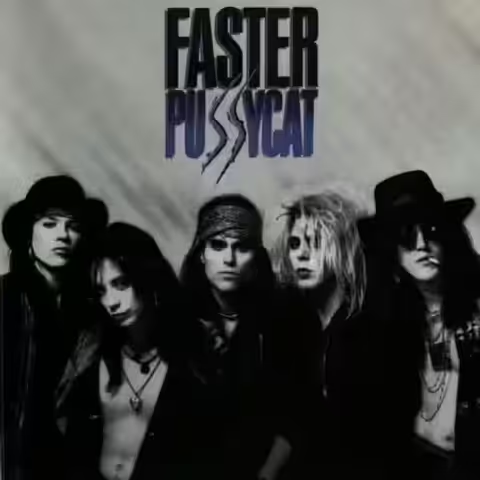
Taime Downe did not just sing about the Sunset Strip in 1987, he owned a piece of it. The Faster Pussycat frontman ran the Cathouse, the sleaziest, most notorious glam club on the boulevard, with his roommate Riki Rachtman, and when his band cut their self-titled debut album that summer they were effectively the house act bottling up their own nightclub and selling it on Elektra Records. The record even contains a song called "Cathouse", a love letter to the den the two of them built.
That is what makes Faster Pussycat, released on 7 July 1987, such a peculiar and enduring document. While Guns N' Roses were writing about wanting to escape the gutter and Bon Jovi were writing for the radio, Faster Pussycat were writing field notes from inside the party, named after a Russ Meyer skin flick and grubbier than anyone else on the Strip. It never broke past number 97 on the Billboard 200, but as a salacious snapshot of West Hollywood at its most decadent, nothing else from the era quite matches it.
| Field | Detail |
|---|---|
| Artist | Faster Pussycat |
| Album | Faster Pussycat |
| Release Date | 7 July 1987 |
| Label | Elektra |
| Producer(s) | Ric Browde |
| Genre / Subgenre | Glam metal, hard rock, sleaze rock |
| Track Count | 10 |
| Total Runtime | 36:13 |
| Billboard 200 Peak | 97 |
| UK Albums Chart Peak | Did not chart |
| Other Notable Chart Peaks | None charted internationally |
| Certifications | None (the band's next album went gold) |
| Estimated Sales | Part of over two million records the band sold worldwide |
| Key Singles | "Babylon", "Don't Change That Song", "Bathroom Wall" |
Cultural Context
By the summer of 1987 the Sunset Strip was at the absolute peak of its glam-metal gold rush. Record labels were signing anything with backcombed hair and a leather jacket, and the few miles of Sunset Boulevard running through West Hollywood had become a pilgrimage site for kids from Moscow to Milton Keynes. The same year that gave the world Guns N' Roses' Appetite for Destruction and Mötley Crüe's Girls Girls Girls also coughed up dozens of lesser-known acts scrabbling for the same record deal, the same girls and the same spot on the bill at the Whisky.
Faster Pussycat were right at the centre of it, not as tourists but as locals. The director Penelope Spheeris captured the moment in her 1988 documentary The Decline of Western Civilization Part II: The Metal Years, in which the band performed "Cathouse" and "Bathroom Wall" and sat for interviews alongside Aerosmith, Kiss, Poison and a vodka-soaked Chris Holmes of W.A.S.P. floating in a swimming pool.
"It was metal madness. You couldn't even walk down the sidewalk. You could barely drive down Sunset Boulevard because drunk people would spill out into the street and you had to be careful not to run over them. A couple of my drunk-stoned friends actually did get hit. Luckily, they lived and partied on, like good headbangers do."
Penelope Spheeris, Metal Hammer, 2020
This was the world the album documents. It is not a record about ambition or escape; it is a record about what was happening in the clubs every single night, written by people who were there until closing time and frequently well beyond it.
The Band's Story Up to This Point
Faster Pussycat formed in Hollywood in 1985, the brainchild of singer Taime Downe during the twin boom of glam metal and glam punk. The name was lifted straight from Russ Meyer's 1965 cult exploitation film Faster, Pussycat! Kill! Kill!, a piece of trash-cinema name-dropping that immediately marked the band out as scenesters with a knowledge of the hip and the esoteric, rather than just another set of pretty boys aping Led Zeppelin.
The earliest incarnation paired Downe with guitarist Greg Steele and guitarist Brent Muscat. After the usual flurry of early personnel changes, the band that earned an Elektra contract consisted of Downe on vocals, Steele and Muscat on guitars, Kelly Nickels on bass and Mark Michals on drums. In the feeding frenzy that followed labels snapping up other Strip acts like Guns N' Roses and Poison, Elektra took the plunge.
Then came the twist of fate that reshaped the lineup before a note of the album was committed to tape. Just before recording began, bassist Kelly Nickels was involved in a motorcycle accident and broke his leg in seven places. He was replaced by Eric Stacy, formerly of Champagne Darling Cool, and would go on to join L.A. Guns instead. It is one of those small accidents of history that quietly rewired two bands at once.
The Cathouse Connection
No part of the Faster Pussycat story matters more than the Cathouse. Taime Downe and his roommate Riki Rachtman opened the club as a glam-rock haven on the Strip, and it quickly became the beating heart of the sleaze scene, the place where the bands, the groupies and the hangers-on all collided. Rachtman would later parlay his profile into a job hosting MTV's Headbangers Ball, but in the mid-eighties he was simply Downe's flatmate and partner in the most debauched room in Los Angeles.
The club gave the band more than a song title. It gave them an identity and a built-in audience. While most acts were grinding the pay-to-play circuit hoping a label scout might wander in, Faster Pussycat could fill a room they themselves controlled. The album's "Cathouse" is a direct tribute, and the whole record carries the atmosphere of the club: cheap booze, cheaper perfume and the kind of stories you only half remember the next morning.
- Downe co-founded and ran the Cathouse, the Strip's most notorious glam club.
- His co-founder Riki Rachtman later hosted MTV's Headbangers Ball.
- The album track "Cathouse" is a direct tribute to the venue.
- The club gave the band a home crowd most rivals could only envy.
Pre-production and Demos
The songs that became Faster Pussycat were forged not in a rehearsal studio but in the clubs of the Sunset Strip, road-tested night after night in front of the very crowd they described. By the time the band signed to Elektra, the material had already been honed in front of audiences at the Cathouse and the other Strip venues, which is a large part of why the album sounds so lived-in. These were not songs written to a label brief; they were songs that had earned their place in a live set before anyone thought about recording them.
The major upheaval of the pre-recording period was not creative but logistical. With bassist Kelly Nickels sidelined by his motorcycle accident, the band had to integrate Eric Stacy into a tight, established unit at short notice. That he slotted in seamlessly enough to make the record without derailing the sessions is a quiet testament to how well-drilled the songs already were.
Creating the Album
Recorded across 1986 and 1987, the album was produced by Ric Browde, a name that crops up across the glam-metal landscape of the period; he worked on Poison's Look What the Cat Dragged In in the same era, another cheaply made, instantly disposable trash classic. Browde's job on Faster Pussycat was not to sand the band into something polished but to capture the rough, raucous charge of a group that lived and breathed the Sunset Strip.
The result is a lean record. Ten songs, just over thirty-six minutes, almost all of them written by Downe alone or with one of his two guitarists. There are no ballads of the House of Pain variety that would later define the band's biggest hit, no orchestras, no grand statements. What there is instead is a particular sleazy charge that drew on more than just the usual Strip influences. Where most of their peers paid lip service to creaky classic rockers, Faster Pussycat leaned heavily on late-seventies punk and Detroit motor-rock, giving them a street-credibility that bands like Poison simply did not have.
"Nobody was as sleazy as Faster Pussycat. That was basically their whole angle, they were grosser than everybody else. They were also mainstream rock's conduit to the underground. While most of the bands in LA paid lip-service to creaky old classic rockers like Zep and The Who, Faster Pussycat leaned heavy on late 70's punk and Detroit motor-rock. They had street-cred."
Sleazegrinder, Louder, 2015
That mix of glam gloss and punk grit is the album's secret weapon. It allowed the band to be both a legitimate hit-making prospect for Elektra and a credible favourite of the underground, a balancing act few of their hairsprayed contemporaries managed. Where Poison were too pretty to be anything other than lightweight, and L.A. Guns traded in a tougher, booze-soaked menace, Faster Pussycat occupied their own grubby corner, sleazier than the radio acts but more tuneful than the genuine underground.
The economy of the sessions is part of what gives the record its character. There is no sense of a band agonising over the perfect take or chasing a producer's sonic vision for months on end. These are songs that sound like they were played live in a room by people who played them live in clubs every week, then captured before anyone could sand the edges off. That immediacy is exactly what the retrospective lists keep responding to: the album sounds like the Strip, not like a studio's idea of the Strip.
Personnel and Credits
| Role | Player | Notes |
|---|---|---|
| Core band | ||
| Lead vocals | Taime Downe | Band founder and chief songwriter; co-owner of the Cathouse |
| Guitar, backing vocals | Greg Steele | Co-wrote "Don't Change That Song", "Babylon" and "Ship Rolls In" |
| Guitar, backing vocals | Brent Muscat | Co-wrote "No Room for Emotion", "Smash Alley" and others |
| Bass, backing vocals | Eric Stacy | Replaced Kelly Nickels just before sessions began |
| Drums, backing vocals | Mark Michals | Drummer through to his 1990 departure |
| Guest contributors | ||
| Scratching | Riki Rachtman | One-time club DJ; provided scratching on "Babylon" |
| Production | ||
| Producer | Ric Browde | Also worked on Poison's Look What the Cat Dragged In |
The most surprising credit on the album belongs to Riki Rachtman, who was at the time best known as a club DJ and Downe's Cathouse partner. His scratching turns up on "Babylon", a small but telling reminder of how intertwined the band and the club really were. Beyond him, the album is very much the work of the five core members and Browde, a tight unit cutting a record that needed no orchestral guests or hired-gun session players to make its point.
The Songs
| # | Title | Writer(s) | Length | Single? | Notes |
|---|---|---|---|---|---|
| 1 | Don't Change That Song | Downe, Steele | 3:40 | Yes | Video directed by Russ Meyer |
| 2 | Bathroom Wall | Downe | 3:40 | Yes | Later named a top hair metal anthem |
| 3 | No Room for Emotion | Downe, Muscat | 3:56 | ||
| 4 | Cathouse | Downe | 3:42 | Tribute to the band's own club | |
| 5 | Babylon | Downe, Steele | 3:14 | Yes | Features scratching by Riki Rachtman |
| 6 | Smash Alley | Downe, Muscat | 3:28 | ||
| 7 | Shooting You Down | Downe | 3:46 | ||
| 8 | City Has No Heart | Downe, Muscat | 4:19 | The album's longest track | |
| 9 | Ship Rolls In | Downe, Steele | 3:26 | ||
| 10 | Bottle in Front of Me | Downe, Muscat | 3:02 | A bleary closing toast |
The album opens with its two strongest cards. "Don't Change That Song" is a raucous, memorable opener, all swagger and hooks, while "Bathroom Wall" is the song the band are most remembered for, a grubby paean to the kind of girl whose number you might find scrawled in a club toilet. It is a song about scrawled phone numbers, cheap thrills and lower expectations, and it remains the definitive Faster Pussycat statement.
From there the record settles into its lane. "Cathouse" pays its dues to the home venue, a strutting tribute to the club that made the band, while "No Room for Emotion" and "Smash Alley" lean into the harder, punk-tinged side of the band's sound. "Babylon" rides Rachtman's scratching into the only real flirtation with studio trickery on the album, a small touch that nods to the band's roots in club culture rather than the rehearsal room. "Shooting You Down" and "City Has No Heart", the latter the album's longest cut at four minutes and nineteen seconds, give the second half a little more weight, and "Bottle in Front of Me" closes the record with exactly the bleary, last-orders attitude the title promises. It is not a concept album and it does not pretend to be; it is a tight collection of barroom anthems with a punk undertow.
What ties the whole thing together is Downe's voice and point of view. He is not a great technical singer in the mould of a Sebastian Bach, but he is a perfect narrator for this material, a snide, knowing presence who sounds like he has seen everything the Strip has to offer and is happy to tell you about it. The songwriting, almost all of it bearing his name alongside Steele or Muscat, keeps the focus tight on the world of the clubs: the girls, the booze, the after-hours regret. There is no reaching for profundity, and the album is stronger for it.
"While the groan-worthy power-ballad House of Pain became their biggest hit, this is the one they really meant. It still stinks up the room with the foul stench of whiskey, cigarettes and regret every time it plays."
Sleazegrinder on "Bathroom Wall", Louder, 2015
B-sides, Outtakes and Lost Songs
As a debut from a band that recorded quickly and cheaply, Faster Pussycat did not leave behind a vault of legendary outtakes. The album's afterlife in collectable form came much later, when the UK reissue specialists Rock Candy Records put out an expanded CD edition complete with new liner notes and additional photographs, the kind of loving archival treatment that the original budget release never received. For most fans, the ten album tracks plus the live performances captured in The Decline of Western Civilization Part II remain the complete picture of this era of the band.
Album Artwork and Packaging
The packaging matched the music: cheap, fast and unmistakably of its moment. The self-titled sleeve presented the band as the Strip scenesters they were, and the original Elektra pressing was a no-frills product designed to get a hot new act onto record-shop shelves quickly. The later Rock Candy reissue expanded the visual package considerably, adding the photographs and liner notes that placed the album in its proper historical context as a key document of the 1987 Sunset Strip scene.
Release and Reception
On release, the album peaked at number 97 on the Billboard 200, a modest showing that nonetheless got the band onto the national stage and onto the road. Critically, it was treated kindly for a glam-metal debut. AllMusic later awarded it four stars, the influential critic Robert Christgau handed it a "B", and the Swedish site Melodic gave it four and a half. Crucially, the album's reputation has grown rather than faded with time.
"Contemporaries of L.A. Guns and Guns N' Roses, Faster Pussycat were as brassy and sleazy as the Russ Meyer skinflick from which they took their name. Don't Change That Song was raucous and memorable, as was their other stand-out tune, Bathroom Wall, a touching paean to the kind of girl Taime picked up in the Cathouse. Faster Pussycat never quite broke out of LA, but this is a salacious documentation of their attempt."
Metal Hammer, Buyer's Guide, 2017
The retrospective honours stacked up over the years that followed, a steady drip of recognition that has done far more for the album's reputation than its original chart placing ever could:
- 2005: ranked number 498 in Rock Hard magazine's book The 500 Greatest Rock & Metal Albums of All Time.
- 2015: "Bathroom Wall" named one of Louder's twenty greatest hair metal anthems of all time.
- 2017: Metal Hammer included the album among the ten hair metal records you need in your collection.
- 2018: Consequence placed it on its list of "10 Hair Metal Albums That Don't Suck".
For a record that stalled at number 97, that is a remarkable second life, and it speaks to the way the album's honesty has aged better than the slicker, bigger-selling records that surrounded it. The standout reviews tend to agree on the same point: this is a record that means it, where so much of the genre was content to pose.
Singles and Music Videos
Three singles were drawn from the album in 1987: "Babylon", "Don't Change That Song" and "Bathroom Wall". The band built its early following largely through two promotional videos, for "Bathroom Wall" and "Don't Change That Song", which earned regular play among heavy metal, glam rock and sleaze rock fans.
The "Don't Change That Song" clip carries the album's single most delicious piece of trivia. It was directed by Russ Meyer, the very filmmaker whose 1965 movie had given the band its name. Having a cult exploitation auteur direct your debut video was a perfect closing of the loop, the band paying homage to their namesake and the namesake returning the favour. In November 1987, the band also landed the cover of the debut issue of Screamer Magazine, another sign of how quickly they had become faces of the scene.
Touring and Live
Faster Pussycat hit the road hard in support of the album, and the company they kept said a great deal about their standing. In the United States the band toured with Alice Cooper, David Lee Roth and Motörhead, a spread of bills that took them from glam to shock-rock to the grimy end of metal, which suited a band that had always sat between camps.
Their appearance in The Decline of Western Civilization Part II, performing "Cathouse" and "Bathroom Wall" for the cameras, captured the band in their natural habitat and preserved the era better than any official live release could. Sharing screen time with the likes of Aerosmith, Poison and Megadeth placed Faster Pussycat firmly among the faces of the scene, and the performances remain some of the most vivid surviving footage of the band at their peak. Within two years the band would record their most commercially successful album, Wake Me When It's Over, which earned gold status off the back of the hit "House of Pain". But the touring built around this debut is what turned a club act into a nationally known band.
In TV, Film and Media
The album's most significant media footprint is its starring role in The Decline of Western Civilization Part II: The Metal Years. Penelope Spheeris's documentary, released in 1988, has become the definitive screen record of the glam-metal Sunset Strip, and Faster Pussycat's presence in it, both performing and being interviewed, has kept the band visible to generations of fans who discovered the scene long after it ended. Decades later, the documentary still introduces new listeners to "Bathroom Wall" and "Cathouse".
Reissues and Anniversaries
The album's most significant reissue came courtesy of the UK label Rock Candy Records, whose remastered CD edition wrapped the original ten tracks in expanded liner notes and additional photographs. For a budget glam release that had originally been pushed out quickly to capitalise on a band's moment, the Rock Candy treatment was a form of belated respect, framing the album as the historical document it had become rather than the throwaway product it was first sold as. It is the version most serious collectors now seek out.
Controversy and Later Turmoil
The years after the debut brought their share of drama, much of it the kind that the album's hard-living world made almost inevitable. In 1990, drummer Mark Michals was arrested in Omaha after signing for a package of heroin and was fired from the band; a series of replacements followed, including the late Brett Bradshaw, who died in March 2021 at the age of fifty.
The most bitter chapter came later still. After the band reformed, a dispute over the Faster Pussycat name broke out between Taime Downe and founding guitarist Brent Muscat. Muscat, who had been diagnosed with oral cancer, eventually dropped his legal challenge in 2007, and reports from the period paint a sad picture of a friendship soured by business. None of this touches the music on the 1987 debut, but it is part of the long, complicated story of a band whose early chemistry proved hard to sustain.
Covers, Samples and Tributes
For all that the album has been embraced by retrospective lists, it has not generated a large body of cover versions or samples in the way that bigger glam-metal hits have. Its influence has been felt more as atmosphere than as direct quotation: a touchstone for later sleaze-rock and glam-revival acts who cite the band's unvarnished honesty and street-credible blend of glam and punk as a model. The songs live on most vividly through the band's own continued live performances and through their preservation in The Decline of Western Civilization Part II.
Legacy and Influence
Faster Pussycat never became superstars. The band broke up in 1993 as grunge swept their world away, reformed in 2001, and went through a tangle of lineup disputes and stylistic detours in the years that followed, leaving Taime Downe as the only constant member. Across their career they sold over two million records worldwide, a respectable tally for a band that is too often filed under "also-rans" of the hair metal boom.
The debut, though, has only grown in stature. It is now routinely cited as one of the genuinely good records to come out of a much-derided genre, a touchstone for anyone trying to argue that hair metal produced more than just disposable fluff. Its blend of glam sheen and punk grit, and its unvarnished honesty about the world that produced it, give it a staying power that slicker, bigger-selling records of the period have lost.
In 2020, the band was included in Yardbarker's list of the twenty greatest hair metal bands of all time, a recognition built largely on the foundations laid by this first album. The record's reputation now sits comfortably alongside the genuine classics of the era, a record that critics who once dismissed the whole genre return to as evidence that hair metal could be honest, dangerous and fun all at once.
\n\n\nMore than three decades on, Faster Pussycat stands as one of the most authentic artefacts of the Sunset Strip, the sound of a band documenting their own nightclub before the party finally ended. It is the rare debut that captured a scene from the inside rather than admiring it from the outside, and that is precisely why it endures.
Things You Might Not Know
| Fact | Detail |
|---|---|
| Named after a film | The band took its name from Russ Meyer's 1965 cult exploitation movie Faster, Pussycat! Kill! Kill!. |
| The director returned the favour | Russ Meyer himself directed the music video for "Don't Change That Song", closing the loop between film and band. |
| Singer ran a nightclub | Taime Downe co-owned the Cathouse, the Sunset Strip's most notorious glam club, with his roommate Riki Rachtman. |
| An MTV host on the record | Future Headbangers Ball host Riki Rachtman provided the scratching on the album track "Babylon". |
| A broken leg changed two bands | Original bassist Kelly Nickels broke his leg in seven places in a motorcycle crash before sessions, was replaced by Eric Stacy and went on to join L.A. Guns. |
| Same producer as Poison | Ric Browde, who produced this album, also worked on Poison's debut Look What the Cat Dragged In. |
| Documentary stars | The band performed "Cathouse" and "Bathroom Wall" in Penelope Spheeris's 1988 film The Decline of Western Civilization Part II. |
| A magazine's first cover | In November 1987 the band landed the cover of the very first issue of Screamer Magazine. |
| Ranked among the greats | Rock Hard magazine placed the album at number 498 in its 2005 book The 500 Greatest Rock & Metal Albums of All Time. |
| A grower, not a smash | The album stalled at number 97 on the Billboard 200, yet now appears on multiple "best hair metal albums" lists from Metal Hammer to Consequence. |
| Short and sharp | The whole album runs just 36 minutes and 13 seconds across ten tracks, with no ballads in sight. |
| Toured with shock-rock royalty | In support of the album the band toured the US with Alice Cooper, David Lee Roth and Motörhead. |
Listen to the Riffology Podcast
The Riffology podcast digs into the records that shaped rock and the scenes that produced them, and is available on all major podcast platforms. We would love to hear your memories of the Sunset Strip, the Cathouse and whether Faster Pussycat deserves its place among the best of the glam-metal era.
Comments