R.E.M. spent the spring of 1986 driving up to John Mellencamp's barn in rural Indiana to make their fourth album with a producer who had never knowingly listened to a college-rock record. That decision, more than any single song, is what Lifes Rich Pageant is about. The four members of the band, still in their mid-twenties and still recovering from the gloomy London winter that had birthed Fables of the Reconstruction, hired Don Gehman, the Bloomington-based producer who had given Mellencamp's Scarecrow its bone-dry acoustic thump, and let him do something nobody had previously been allowed to do on a Peter Buck guitar track: turn it up, sharpen it, comp the vocals, layer in overdubs. The record came out on I.R.S. on 28 July 1986, peaked at number twenty-one on the Billboard 200, and became R.E.M.'s first ever gold album. It was also the last album they made before Document, Green, and the leap to Warner Brothers turned them into the biggest American rock band of the next decade.

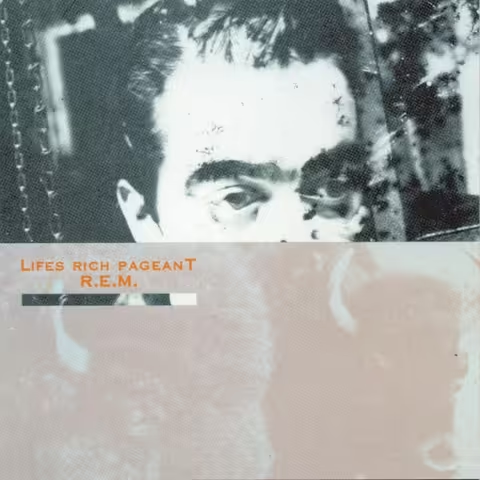
The official spelling has no apostrophe, a deliberate typographical choice by the band that has been confusing databases, search engines and CD spines for forty years. You will see it as Life's Rich Pageant in any review filed by a sub-editor who tidied it up; the band itself, on every sleeve, calls it Lifes Rich Pageant. Peter Buck lifted the phrase from Inspector Clouseau in the 1964 Blake Edwards film A Shot in the Dark, a movie reference that fits the album's slyly cheerful spirit better than anything more highbrow would have. The cover, a stark vertical split of drummer Bill Berry's eyes above a pair of grazing bison, was the first R.E.M. sleeve that openly declared a theme: pollution, the American landscape, Buffalo Bill, and the people doing the trampling. Inside the gatefold, the side labels read "Dinner side" and "Supper side". This is what an R.E.M. record sounded like at the precise moment they decided to stop being cryptic about it.

Album Facts

FieldDetail
ArtistR.E.M.
AlbumLifes Rich Pageant
Release date28 July 1986 (UK) · 29 July 1986 (US)
LabelI.R.S. Records (IRS-5783)
ProducerDon Gehman
Engineer(s)Jim Dineen, Rick Fetig, Ross Hogarth, Stan Katayama
MixingDon Gehman and Gregg Edward at Can-Am Recorders, Los Angeles
MasteringBob Ludwig at Masterdisc, New York City
StudioBelmont Mall Studio, Belmont, Indiana (album); John Keane's Studio, Athens, Georgia (demos)
Genre / subgenreJangle pop, college rock, alternative rock
Track count12
Total runtime38:23
Billboard 200 peak21 (32 weeks on chart)
UK Albums Chart peak43 (4 weeks on chart)
Other chart peaksAustralia (Kent Music Report) 73
CertificationsRIAA Gold (23 January 1987, band's first); CRIA Platinum, Canada (30 September 1987)
Estimated salesApprox. 1 million in the US by the early 1990s
Key singles"Fall on Me" (August 1986); "Superman" (November 1986)

Cultural Context

Summer 1986 was a strange moment for American rock. Bruce Springsteen's Born in the U.S.A. was still on the charts two years after release. Bon Jovi were about to launch Slippery When Wet and become a stadium band overnight. The compact disc was finally outselling the LP. MTV had stratified guitar music into either glossy hair-metal videos or the pre-grunge bands who weren't on MTV at all. Into that landscape walked a band that had spent four years building a fanbase entirely through college radio, three records with cryptic lyrics that nobody could decipher, and a refusal to do any of the things American major labels expected.

R.E.M. were, by mid-1986, no longer underground in any meaningful sense. Murmur had been Rolling Stone's album of 1983 and had sold around 200,000 copies. Reckoning had peaked at number twenty-seven on the Billboard 200 and turned college radio into a real format. Fables of the Reconstruction, recorded with Joe Boyd in London the previous winter, had nearly broken the band up. They were tired of being the critics' band that nobody could buy in any volume. Jay Boberg at I.R.S. was tired of it too. Both parties wanted a fourth album that did not sound like it had been mixed at the bottom of a fish tank.

  • Released the same week as Genesis's Invisible Touch, which sat atop the Billboard 200.
  • Three weeks ahead of Run-DMC's Raising Hell, which would shortly displace Genesis.
  • The Smiths, R.E.M.'s English jangle-pop opposite numbers, released The Queen Is Dead on 16 June 1986.
  • Husker Du's Candy Apple Grey and the Replacements' Tim were the other 1986 college-rock benchmark records.
  • The Cuyahoga River, the subject of one of Pageant's most explicit lyrics, had famously caught fire in 1969 and was still a touchstone of American environmental shame seventeen years later.

The Band Up to This Point

R.E.M. had formed in Athens, Georgia in January 1980 in the back of the Wuxtry Records shop, where Peter Buck worked and Michael Stipe shopped. Bill Berry and Mike Mills, who had played together in a Macon high-school band, completed the lineup; the four played their first show at a deconsecrated church on Oconee Street that April. By 1986 they had released three studio albums, an EP and a handful of singles on the Nottingham-but-California-distributed I.R.S. label, and had toured almost continuously across the United States, Canada and Europe.

Fables of the Reconstruction, released the previous summer, had been a turning point in the worst possible sense. Recorded in London with the legendary folk producer Joe Boyd, the sessions had been miserable; the band complained about the cold, the food, the dark, and a producer who had no template for what they were doing. The album sold respectably and was loved by some critics, but the band, by their own account, came close to breaking up while making it. Mike Mills, in a 1986 Chicago Tribune interview, put it as plainly as Mills ever puts anything: "We wanted to get away from the sort of murky feelings and sounds that we got out of Joe in London."

The Boyd record had also, despite Boyd's coaching of Michael Stipe to enunciate more clearly, done little to push Stipe's voice into a position where you could hear what he was actually singing. The four players knew that the next record would, one way or another, fix that or end them.

Pre-production and Demos

R.E.M. took the first half of 1986 off touring and used the time to write. The songs came together at the band's regular Athens rehearsal room and at John Keane's Studio on Oconee Street, the local facility where they had recorded demos for years. Keane's was a converted house with a control room the size of a kitchen and a tracking floor that sounded like a friend's living room, which it essentially was. The band laid down demo versions of the entire Pageant tracklist there in two short blocks of sessions in January and March 1986. Those demos, plus a handful of outtakes, were eventually released as a bonus disc on the 25th anniversary edition of the album in July 2011, under the title "The Athens Demos".

The decision to look outside their usual orbit of producers, Mitch Easter and Don Dixon for the first two records, Joe Boyd for the third, was deliberate. The band started searching for someone who could give them what they called "a really hard-driving record, but with a lot of things: pianos and organs and accordions and banjos and what-not". They found their man, improbably, in the dust and Indiana cornfields where John Mellencamp made his albums.

Don Gehman had produced Scarecrow in 1985 for Mellencamp, an album whose acoustic-electric textures and dry midwestern drum sound had become a national hit. Buck and Mills had heard the record and loved how it sat in the speakers. Mellencamp's heartland-rock world was not, on paper, a place an Athens college-rock band belonged. The band met with Gehman, were initially wary of his appetite for layering and overdubs, and then talked themselves into the experiment. Two weeks later they were driving north.

"I liked to spend time on the arrangement and layer in the overdubs and comp the vocals, all this process which to me was normal record-making. They had never been through it before. When they saw that kind of record-making process didn't take anything away, that it actually added another level of artistic expression, they were very excited by it."

Don Gehman, interviewed by Annie Zaleski for Diffuser.fm, July 2016

Creating the Album

Belmont Mall Studio, named for its location in Belmont, Indiana, was a barn that John Mellencamp had renovated into a working recording facility outside Bloomington. The room was larger than anywhere R.E.M. had previously recorded and was kitted out with newer tape machines and console gear than the Athens-and-Drive-In-Studio circuit had ever offered them. The band took rooms in Bloomington and spent the rest of April and May 1986 driving the forty minutes to Belmont every day, recording with Gehman and a small team of engineers (Jim Dineen, Rick Fetig, Ross Hogarth and Stan Katayama all worked the sessions).

Gehman's process was the opposite of how R.E.M. had previously made records. He wanted to track parts cleanly, overdub them in layers, comp the best vocal takes line by line, and build the arrangements out of components rather than capture a band-in-the-room performance. The early sessions involved some friction, mostly because the band had until that point treated overdubbing as a small ornamental afterthought. Gehman pushed them toward the idea that a Buck guitar part could be doubled in a way that gave it more weight without losing the jangle, that a Mills bass line could sit in front of the kick drum rather than behind it, and that Stipe's vocals deserved the kind of attention a Mellencamp lead vocal got.

The lyrical clarity that follows from this is one of the album's quietest revolutions. After three records on which Stipe had been more or less a sound source, deliberately blurred into Buck's arpeggios, here he is suddenly audible. You can hear the words on "Cuyahoga". You can hear the words on "Fall on Me". You can hear, more controversially, that the words are explicitly about pollution, American history, environmental collapse, the Cuyahoga River fire, the slaughter of the bison, the Guatemalan civil war. The Stipe of the previous three albums had occasionally been accused of hiding behind impressionism. The Stipe of Pageant is, for the first time, picking targets.

Recording was completed in May. The band took the tapes to Can-Am Recorders in Los Angeles, where Gehman and Gregg Edward mixed the record. Bob Ludwig mastered it at Masterdisc in New York City. Sleeve duties went to a small team of Southern visual artists, with cover photography by Sandra Lee Phipps (Stipe's sister), a back-cover painting by the self-taught Alabama folk artist Juanita Rogers, and packaging by R. O. Scarelli.

"Don is good at layering things so there can be a lot of things going on but you can still hear everything. And as far as Michael's vocals go, Michael is getting better at what he's doing, and he's getting more confident at it. The overall sound of everything was so good, we didn't mind having the vocals mixed as loud as they were."

Mike Mills, interviewed by Tom Popson, Chicago Tribune, 17 October 1986

Personnel and Credits

RolePlayerNotes
Core band
Drums, backing and lead vocalsBill BerryImage on the top half of the front cover.
GuitarPeter BuckDoubled and layered for the first time on an R.E.M. record.
Bass, backing and lead vocalsMike MillsLead vocal on "Superman".
Lead vocalsMichael StipeFirst R.E.M. album on which his lyrics are audibly intelligible throughout.
Production and engineering
Producer, mixerDon GehmanPreviously known for John Mellencamp's Scarecrow (1985).
EngineersJim Dineen, Rick Fetig, Ross Hogarth, Stan KatayamaBelmont Mall sessions.
MixerGregg EdwardAt Can-Am Recorders, Los Angeles.
Mastering engineerBob LudwigAt Masterdisc, New York City.
Artwork and packaging
Cover photographySandra Lee PhippsMichael Stipe's sister; took the upper-half image of Bill Berry.
Back-cover paintingJuanita RogersSelf-taught Alabama folk artist; died 1985, one year before release.
IllustrationsM. Bird and B. Slay
PackagingR. O. Scarelli
Studios
DemosJohn Keane's Studio, Athens, GeorgiaJanuary and March 1986.
RecordingBelmont Mall Studio, Belmont, IndianaApril and May 1986, in John Mellencamp's converted barn.
MixingCan-Am Recorders, Los Angeles
MasteringMasterdisc, New York City

One credit not on the sleeve is worth noting. R.E.M. had a longstanding practice of crediting all four band members for every song, regardless of who actually wrote what, an unusual arrangement that they maintained for their entire career. Pageant is no exception. Every original track is credited to "Berry, Buck, Mills, Stipe". The one exception is "Superman", a 1969 song by the Texas band the Clique that Mike Mills had loved since he was a teenager and that the band had been playing live for years.

The Songs

#TitleWriter(s)LengthSingle?Notes
Side one ("Dinner side")
1Begin the BeginBerry, Buck, Mills, Stipe3:28Opens with a chunky electric riff; performed at the band's Rock and Roll Hall of Fame induction in 2007.
2These DaysBerry, Buck, Mills, Stipe3:24One of the album's fastest tracks; Stipe shouting "all the people gather!" through the chorus.
3Fall on MeBerry, Buck, Mills, Stipe2:50Lead singleMichael Stipe's stated favourite from the record.
4CuyahogaBerry, Buck, Mills, Stipe4:19About the Cleveland river that famously caught fire in 1969.
5HyenaBerry, Buck, Mills, Stipe2:50Originally demoed during the Fables sessions.
6Underneath the BunkerBerry, Buck, Mills, Stipe1:25Instrumental, distorted-radio fake-Greek-folk pastiche; not listed at all on the original sleeve.
Side two ("Supper side")
7The Flowers of GuatemalaBerry, Buck, Mills, Stipe3:55About the Guatemalan civil war; one of Stipe's quietest political vocals.
8I BelieveBerry, Buck, Mills, Stipe3:49Opens with a banjo intro, then drops into a major-key rock song.
9What If We Give It Away?Berry, Buck, Mills, Stipe3:33Mid-album breather; Mills's backing vocal almost a duet.
10Just a TouchBerry, Buck, Mills, Stipe3:00Ends with Stipe screaming "I'm so young, I'm so goddamn young", quoting a live Patti Smith aside.
11Swan Swan HBerry, Buck, Mills, Stipe2:42Acoustic Civil War lament; the band's first sustained acoustic-folk track.
12SupermanMitchell Bottler, Gary Zekley2:52Second single1969 cover, the Clique. Mike Mills lead vocal. Album version opens with a Godzilla movie sample.

"Begin the Begin" is the album's mission statement, and the moment any old Carcass-grade R.E.M. fan knew that something had shifted. The opening riff is a Buck chord progression that punches rather than chimes, the snare cracks like a Mellencamp record, and Stipe is suddenly clear in the mix declaring "let's begin again". As a thesis, it could not be more direct.

"These Days" is faster still, all jumping eighths and Mills countermelodies, and is the song most likely to have been the second single in a parallel universe where Earache, in another parallel universe, had asked. Listen for the way Berry's drumming refuses to settle into one feel for more than eight bars at a time.

"Fall on Me" is the song that did the work. Released as a single in August 1986, the song reached number five on the Billboard Mainstream Rock chart and number ninety-four on the Hot 100, the band's highest pop placement to that point. Stipe has named it his favourite track on the album in multiple interviews. Gavin Edwards, writing in Rolling Stone in 2003, called it "the finest song in the R.E.M. canon. A lullaby of modern anxiety, it's flexible enough to serve as a potent metaphor for acid rain, nuclear warfare, satellite surveillance or any other modern phobia you choose." The promotional video, shot by Stipe himself in monochrome with backwards-running typography, became a college-TV staple.

"Cuyahoga" is the most explicit environmental lyric Stipe had yet written, named after the Ohio river that flows into Lake Erie at Cleveland and which famously caught fire in 1969, an industrial disaster that became one of the founding images of the modern American environmental movement. The song's line "we burned the river down" carries the actual historical weight of that 1969 fire. The drone-y open-tuning guitar part underneath is one of Buck's most patient pieces of writing on the record.

"Hyena" dates back to the Fables demo sessions and is one of the longest-gestating songs on the album. The band had played it live throughout 1985 before recording it.

"Underneath the Bunker" is the album's deliberate weird-piece, a ninety-second instrumental run through a Bin-Laden-on-a-shortwave radio filter that quotes Middle Eastern modes and was so anomalous that it was left off the original sleeve printing entirely (alongside "Superman"). Buck has joked in interviews that it was a leftover instrumental jam they refused to throw away.

"The Flowers of Guatemala" opens side two with one of Stipe's quietest vocals, but the song is about something appalling: the Guatemalan civil war, the disappeared, the mass graves the dictatorial Ríos Montt regime had been digging. The flowers of the title cover the unmarked graves. The arrangement, all minor-key arpeggio and brushed snare, is one of Buck and Berry's most patient pieces of work.

"I Believe" opens with a banjo intro Buck had been playing in soundchecks, then drops into a major-key rock song with one of Stipe's most generous lyrics. It is the song most often picked up by later acoustic-rock bands trying to learn how R.E.M. did what they did.

"What If We Give It Away?" is a mid-album breather and one of the closest the band ever came to writing a love song that did not feel awkward about being a love song.

"Just a Touch" is the album's most aggressive track. It ends with Stipe screaming "I'm so young, I'm so goddamn young", a deliberate quotation of Patti Smith's live cover of the Who's "My Generation", a song Stipe had been adoring publicly since his teenage years. The yelp is the album's loudest single second.

"Swan Swan H" is the band's first sustained acoustic track, a Civil War lament with hammered dulcimer, hand percussion and an open-tuned Buck acoustic. Stipe's lyric, full of bone-yards and "marching to the houses of the brides", was the first sign of the Southern-Gothic register he would push further on Document.

"Superman" closes the record in the most disarming way possible: a Mike Mills lead vocal on a 1969 bubble-gum song by the Texas band the Clique, written by Mitchell Bottler and Gary Zekley. The album version opens with a sample from one of the Godzilla movies (the single edit removes the sample). Mills had loved the song since high school in Macon and the band had been performing it live for years before they finally tracked it.

B-sides, Outtakes and Lost Songs

The Lifes Rich Pageant sessions, by R.E.M. standards, were unusually tight. The band tracked the album as a closed unit with very little material left over. The few outtakes that survived found homes on the band's well-loved 1987 compilation Dead Letter Office, an album-length collection of B-sides and obscurities that I.R.S. issued the following year. Of particular interest:

  • "Bandwagon", A 2:14 original recorded at Belmont Mall and released as the B-side to "Fall on Me". It later appeared on Dead Letter Office.
  • "Rotary Eleven", A short instrumental written and recorded during the Belmont sessions; surfaced on the "Fall on Me" 12-inch.
  • "White Tornado", A jokey surf-rock instrumental the band had been playing live for years and finally cut at Belmont; B-side to "Superman".
  • "Tighten Up", A cover of the Archie Bell & the Drells 1968 R&B hit, also from the Belmont tapes; another Dead Letter Office inclusion.
  • "Toys in the Attic", A cover of the Aerosmith track recorded for the "Fall on Me" 12-inch (although the band have given conflicting accounts of where exactly it was recorded).

The 25th anniversary edition, released by Capitol/EMI on 12 July 2011, added a full second disc titled The Athens Demos: nineteen tracks recorded at John Keane's Studio in January and March 1986. The disc captures the songs at the stage just before Don Gehman got his hands on them, with rough but already-arranged versions of every album track plus three further unreleased songs ("All the Right Friends" in an early form, "March Song" and "Mystery to Me"). The Athens Demos are the closest the catalogue gets to a true alternate-version Pageant, and the most valuable archival release the band have made for this album.

Album Artwork and Packaging

The Pageant sleeve is one of the most recognisable visual statements R.E.M. ever made. A vertical split: the top half a Sandra Lee Phipps black-and-white photograph cropped tight on drummer Bill Berry's eyes and prominent monobrow; the bottom half a Juanita Rogers painting of two American bison. The title sits between the two images in a slim typewriter font. The band logo is small and lower-cased on the spine.

The symbolism is layered. The bison are an environmental signifier, referencing the near-extinction of the American buffalo by colonial expansion. They are also, more slyly, a reference to Buffalo Bill Cody and to American mythmaking. Berry's face above them puts a contemporary human into the same frame as the historical animal: a deliberate visual rhyme. Pitchfork's Stephen Deusner, in his 2011 25th-anniversary review, called the artwork "Pageant in miniature".

The packaging contained one notorious printing error. The original LP and CD back covers gave the tracklist in the wrong order entirely, and listed the eleven-song running order as ending with "Swan Swan H" followed by a track called "+_______", which meant that "Underneath the Bunker" and "Superman" were not listed at all. Some pressings later corrected this; the original printings are now collectors' items because of the mistake, not despite it. Some early UK compact disc copies list "Superman" as "Superwoman", another printing-plant accident that has become beloved trivia.

Side labels read "Dinner side" (Side A) and "Supper side" (Side B), a piece of typically R.E.M. domestic-Americana whimsy that has nothing to do with the music and everything to do with the band's sense of humour.

Release and Reception

I.R.S. released Lifes Rich Pageant in the UK on Monday 28 July 1986 and in the United States the following day. Reviews were strong. Anthony DeCurtis, writing in Rolling Stone on 28 August 1986, called it "brilliant and groundbreaking, if modestly flawed... the most outward looking record R.E.M. has made". Robert Christgau gave the album a B+ in his typically dismissive house style, complaining of a lack of progress from the previous records. Stephen Thomas Erlewine at AllMusic later settled on four and a half stars out of five.

Commercially, the album was the first sign that R.E.M. could move beyond their college-radio base. It peaked at number twenty-one on the Billboard 200 in late summer 1986, spent thirty-two weeks on the chart, and was certified gold by the RIAA on 23 January 1987 for sales of more than 500,000 copies, the first R.E.M. record to hit that mark. CRIA in Canada certified it platinum on 30 September 1987 (an unusually high relative ranking for the band in that market). In the UK, the album reached number forty-three on the Albums Chart. Australia's Kent Music Report had it at seventy-three.

"Brilliant and groundbreaking, if modestly flawed, Lifes Rich Pageant is the most outward looking record R.E.M. has made. The lyric directness is new, the political consciousness is new, and the bracing musical attack is new. It paints a swirling, impressionistic portrait of a country at the moral crossroads."

Anthony DeCurtis, Rolling Stone, 28 August 1986

Retrospectively, the reviews have been more generous still. The 25th anniversary edition in 2011 carried a Metacritic score of 93 out of 100 (the magazine's "universal acclaim" bracket), based on twenty fresh review scores. Pitchfork's Stephen Deusner gave it 8.8 out of 10 in 2011, calling it "invigorating" and the band's "first transitional album, simultaneously their most pop-oriented and accessible album up to that point and their most overtly political collection". Alexis Petridis in The Guardian gave it five stars: "Lifes Rich Pageant may represent the band at their absolute zenith... imbued with a swaggering confidence absent from its murky predecessor."

Slant magazine ranked it at number fifty-two in its "Best Albums of the 1980s" list. PopMatters included it in their twelve essential alternative-rock albums of the 1980s. Colin Larkin's 2000 All Time Top 1000 Albums placed it at 162.

Singles and Music Videos

I.R.S. released two singles from the album.

SingleReleasedB-side(s)Chart highlightsVideo director
"Fall on Me"August 1986"Rotary Eleven" (12-inch added "Toys in the Attic")US Mainstream Rock #5 · Hot 100 #94Michael Stipe
"Superman"November 1986"White Tornado"US Mainstream Rock #17No official video; live footage used for MTV

The "Fall on Me" video is, by Stipe's standards, an early piece of his now-extensive directorial work. Shot in black and white with reversed typography running upward across the frame, the clip features the band performing in silhouette, intercut with Civil War-era engravings of falling objects. It was a deliberate refusal of the MTV performance-video template, and Stipe has cited it as the moment he realised he wanted to keep directing band videos. MTV's 120 Minutes, Channel 4's The Tube in the UK, and college-television outlets across the US played it heavily through autumn 1986.

"Superman" did not get an official video. Various live-performance clips circulated through MTV's late-night programming instead. Mills's lead vocal made it an early sign of the way the band's three vocalists would trade lead duties on later records, particularly "Don't Go Back to Rockville" and "Near Wild Heaven".

Touring and Live

R.E.M. supported the album with the Pageantry Tour, an autumn 1986 run through the United States and Canada plus a short European leg. The tour was bigger than anything the band had previously attempted: 1500-to-3000-capacity venues rather than the 800-capacity clubs that had defined the Reckoning and Reconstruction tours. The opening acts shifted by leg; Camper Van Beethoven, the Feelies and Robyn Hitchcock all picked up support slots.

For this tour the band added Buren Fowler as a second touring guitarist, the first time R.E.M. had ever played live as a five-piece. Fowler stayed on through the Pageantry and into the early Work Tour for Document the following year. The setlists drew heavily on the new album: "Begin the Begin" almost always opened, "Fall on Me", "Cuyahoga" and "Superman" were guaranteed, and "These Days" became a fan favourite live in a way it never quite did on record.

  • Pageantry Tour, US, September to December 1986, first arena-adjacent rooms the band had headlined.
  • Pageantry Tour, Europe, autumn 1986, short run including UK dates that pushed the album's UK profile.
  • Saturday Night Live, 11 April 1987, the band performed "The One I Love" and "Disturbance at the Heron House" on what was, by then, the early Work tour; Pageant material remained in rotation.
  • Bloomington and Indianapolis shows, autumn 1986, homecoming-of-sorts dates near where the album was made; Don Gehman attended at least one.
  • Rock and Roll Hall of Fame induction, 12 March 2007, Bill Berry reunited with the band to perform "Begin the Begin", "Man on the Moon" and "Gardening at Night".

Almost forty years later, the album's songs remain live touchstones. "Fall on Me" stayed in R.E.M.'s setlists across every era of the band; the original lineup also performed it together at unannounced reunion appearances after the breakup.

In TV, Film and Media

R.E.M. were never a synch-heavy band, but Pageant has had a quietly substantial afterlife in screen media. "Fall on Me" has soundtracked moments in shows ranging from the WB drama Felicity to the BBC's Spooks. "Superman" was used memorably in an episode of the cult animated series Daria. "Begin the Begin" has appeared on several political-documentary soundtracks (its title and lyric have made it a perennial choice for campaign-themed films).

"Swan Swan H" is the album's most curious media artefact: it was used on the soundtrack to Oliver Stone's 1989 film Born on the Fourth of July, in a scene set in the Vietnam War era despite the song's Civil War lyrical setting, a piece of period-flexible needle-dropping that Stone has done more than once.

The album cover is regularly cited in lists of the best album sleeves of the 1980s; Vinyl Factory, Discogs and Stereogum have all run features featuring it.

Controversy, Censorship and Lawsuits

There has never been any serious controversy attached to Lifes Rich Pageant. No songs were banned. No covers were censored. The Godzilla sample at the start of "Superman" was, surprisingly, never the subject of a clearance dispute (the rights to the sample were almost certainly not formally cleared in 1986 but no claim ever materialised, and the band still play the song live without issue).

The "Flowers of Guatemala" lyric, by referencing the disappeared of the Guatemalan civil war, drew quiet praise from Amnesty International, with whom the band were beginning to work; no political backlash followed. The closest the album came to outright controversy was the missing-apostrophe title, which a non-trivial number of music-press copy editors silently corrected in print throughout the late 1980s, an act of typographical impertinence that R.E.M. were too gracious to publicly complain about.

Covers, Samples and Tributes

  • The Clique's "Superman" is itself the only cover on the album, a 1969 Texas-bubblegum song by Mitchell Bottler and Gary Zekley that was a regional radio hit but never a national one until R.E.M. rescued it.
  • Pavement covered "Begin the Begin" live in several 1995 dates; Stephen Malkmus has called the song a foundational influence.
  • Surprise Your Pig: A Tribute to R.E.M. (Staplegun Records, 1992) featured covers of Pageant tracks by Skin Yard, the Spinanes and others.
  • Joseph Arthur's 2008 covers album Temporary People included a piano version of "Fall on Me".
  • Vampire Weekend have closed shows with "Begin the Begin" since 2013, with Ezra Koenig naming the album as a foundational text for his band's chiming guitar approach.
  • The Decemberists have covered "Cuyahoga" at multiple Cleveland dates over the years; Colin Meloy has cited Stipe's lyric as a model.

No track from Pageant has ever been formally sampled in a hip-hop hit, although Mike Mills's bass line on "Superman" has been quoted by several indie rock bands.

Reissues, Remasters and Anniversaries

The album has been reissued repeatedly across cassette, CD, vinyl and high-resolution audio formats since 1986. The notable editions:

  • I.R.S. Vintage Years CD (1993), added "Tighten Up", "Toys in the Attic" and other catalogue B-sides as bonus tracks; the first attempt at an expanded edition.
  • Mobile Fidelity Sound Lab Vinyl LP (22 November 2011), audiophile pressing on heavyweight vinyl, mastered by Krieg Wunderlich.
  • 25th Anniversary Edition (Capitol/EMI, 12 July 2011), two-disc package with the remastered album on disc one and nineteen previously unreleased Athens Demos on disc two; the most substantial archival release the album has ever received.
  • I.R.S. Vinyl LP reissue (29 July 2016), 30th-anniversary LP on standard black vinyl.

There has been no Atmos / spatial-audio version released. Bootlegs of the Pageantry Tour circulate in trading communities; the best-quality recordings are widely considered to be a Berkeley Greek Theatre show (October 1986) and an Atlanta Fox Theatre date from later the same tour.

Legacy and Influence

Lifes Rich Pageant is the bridge album in R.E.M.'s I.R.S. catalogue. It is the record on which the band stopped being a cult interest of college radio and started being a band the wider American mainstream could pick up. The next record, Document, would deliver them a million-seller and "The One I Love" as a Top 10 hit. The one after, Green, would be on Warner Brothers and would put them on stadium stages. Pageant is the album on which all of that became plausible.

Within the band's own arc, it is the record on which Stipe became audible. Producers throughout the 1990s talked about the "Gehman moment", the realisation that you could push the lead vocal forward without losing the band's character. Scott Litt, who took over for the next five albums, has cited Pageant as the template he was working from when he produced Document. Pat McCarthy, who came in for Up, has said similar things.

Within the broader alternative-rock scene, the album has been credited as a pivotal text. Slant called it the "nearly seamless transition between the band's formative period and their commercial dominance". Bands as varied as Pavement, the Decemberists, the Hold Steady, Cracker, Counting Crows and Death Cab for Cutie have cited the album as a foundational influence on their songwriting. The Hold Steady's Craig Finn has been particularly vocal about Pageant's political directness as a model for his own lyrical approach.

"Lifes Rich Pageant may represent the band at their absolute zenith... imbued with a swaggering confidence absent from its murky predecessor."

Alexis Petridis, The Guardian, 30 June 2011

In R.E.M.'s own ranking lists, the album occupies an interesting position. Consequence of Sound's 2017 retrospective ranked it sixth out of the band's fifteen studio albums. Rolling Stone's 2017 ranking placed it fifth. Mike Mills has said in interviews that he considers Pageant the most "underrated" album in the band's catalogue, lost between Fables and Document in most fans' memories.

Things You Might Not Know

FactDetail
The title is Inspector ClouseauPeter Buck took the phrase from a line spoken by Inspector Clouseau in the 1964 Pink Panther film A Shot in the Dark, when Clouseau falls into a fountain: "It's all part of life's rich pageant, you know."
Recorded in a barnBelmont Mall Studio was a working barn that John Mellencamp had converted into a recording facility outside Bloomington, Indiana, an environment as far from London Olympic Studios as 1986 American rock allowed.
First gold albumThe RIAA certified the album gold on 23 January 1987, the first R.E.M. record to reach the five-hundred-thousand-copy mark.
The cover photo is of Bill BerryThe eyes-and-monobrow image on the upper half of the sleeve is drummer Bill Berry, photographed by Michael Stipe's sister Sandra Lee Phipps.
The wrong tracklistThe original LP and CD back covers printed the tracklist in the wrong order and omitted "Underneath the Bunker" and "Superman" entirely, listing them only as "+_______".
The "Superwoman" misprintSome early UK compact disc copies list the closing track as "Superwoman" rather than "Superman", a pressing-plant error that has become beloved among collectors.
Godzilla sample, never clearedThe album version of "Superman" opens with a sample of dialogue from one of the original Toho Godzilla films; the single edit removes it. The clearance has never been the subject of a public dispute.
Patti Smith homageStipe's "I'm so young, I'm so goddamn young" scream at the end of "Just a Touch" quotes Patti Smith's live cover of the Who's "My Generation", a song he had loved since adolescence.
The "Dinner side" / "Supper side"R.E.M. labelled side one of the LP "Dinner side" and side two "Supper side", a typically R.E.M. piece of domestic-Americana whimsy.
Don Gehman's R.E.M. one-offGehman never produced another R.E.M. album; when the band asked him back for what became Document, he was unavailable and recommended a younger New York engineer named Scott Litt, who went on to produce the band's next five records.
Buren Fowler joined for the tourR.E.M. added Buren Fowler on second guitar for the Pageantry Tour, the first and last time the band toured as a five-piece.
Juanita Rogers died before releaseThe back-cover painting was by the self-taught Alabama folk artist Juanita Rogers, who died in 1985, a year before the album came out.
The Athens Demos as alternate albumThe 25th-anniversary edition's bonus disc contained nineteen previously unreleased songs from John Keane's Studio in early 1986, including three originals ("All the Right Friends", "March Song" and "Mystery to Me") that did not make the album proper.
The Cuyahoga River fire was 17 years earlierThe 1969 Cuyahoga River fire that Stipe's lyric references was already a piece of established American environmental folklore by 1986; the song treats it as historical record, not breaking news.

The Podcast

If this run through Lifes Rich Pageant has put you in the mood to hear the Riffology hosts spend an hour arguing about which side is the Dinner side, the Riffology podcast is available on Apple Podcasts, Spotify, Pocket Casts, Amazon Music and the rest. Subscribe, leave a rating if you have a moment, and tell us whether "Fall on Me" or "Begin the Begin" is the higher peak on R.E.M.'s I.R.S. catalogue.