
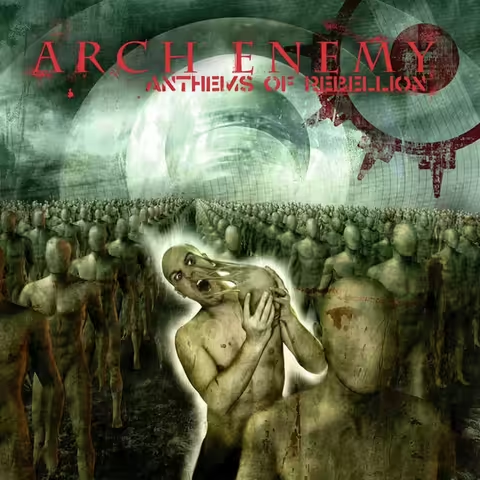
By the spring of 2003 Arch Enemy were no longer the same band that had spent the late 1990s as a respected but marginal corner of the Swedish melodic death metal scene. The arrival of Angela Gossow on _Wages of Sin_ the previous year had reset every assumption about the group, and the fifth studio album was the first chance to follow through on that reset. _Anthems of Rebellion_ is the sound of a band that knows it has the audience now, and is testing how far it can push them.
It was recorded with Andy Sneap at Backstage Studios in Derbyshire, released in stages between July and August 2003, and built around a leaner thirteen-track structure that included two instrumental interludes and, for the first time on any Arch Enemy record, clean vocals. Those clean vocals were sung not by Gossow but by guitarist Christopher Amott, on two consecutive tracks near the back of the album.
The fifth-album pivot
_Anthems of Rebellion_ sits in the catalogue at a particular hinge point. The four albums that preceded it (Black Earth in 1996, Stigmata in 1998, Burning Bridges in 1999 and Wages of Sin in 2002) had each moved Arch Enemy a step further from the death-thrash blueprint Michael Amott carried over from Carcass. The first three featured Johan Liiva on vocals; _Wages of Sin_ introduced Gossow and, with her, a wider European and North American audience.
The brief for the follow-up was not to reinvent. It was to consolidate. The songwriting axis remained the Amott brothers, the production chair stayed with Andy Sneap, and the line-up of Sharlee D'Angelo on bass and Daniel Erlandsson on drums was unchanged. What shifted was the confidence with which the band approached the studio, and the willingness to allow more melodic and structural variety than _Wages of Sin_ had attempted.
Album facts at a glance
| Field | Detail |
|---|---|
| Artist | Arch Enemy |
| Album | Anthems of Rebellion |
| First release (Japan) | 23 July 2003 |
| Worldwide release (UK, Germany, South Korea) | 25 August 2003 |
| United States release | 26 August 2003 |
| Label | Century Media |
| Producer | Andy Sneap |
| Studio | Backstage Studios, Derbyshire, England |
| Genre | Melodic death metal |
| Number of tracks (regular CD) | 13 |
| Total runtime | 43:19 |
| Lead single | "We Will Rise" (2003) |
| Second single | "Dead Eyes See No Future" (2 November 2004) |
| Music videos | "We Will Rise", "Dead Eyes See No Future" |
| Film and TV placements | Alone in the Dark (2005), Metal: A Headbanger's Journey (2005), Viva La Bam (MTV) |
| US Billboard Independent Albums peak | 15 |
| Sweden (Sverigetopplistan) peak | 60 |
| France (SNEP) peak | 83 |
| Netherlands (Mega Album Chart) peak | 97 |
| MusicBrainz release group | f3d65616-3061-3497-b795-2068a6c03f1e |
Backstage Studios and Andy Sneap
Andy Sneap had produced _Wages of Sin_ at Backstage Studios in Derbyshire, and the band returned to the same room for _Anthems of Rebellion_. Returning to Sneap and his facility gave Arch Enemy continuity of sound across the two records, while allowing room to expand the production palette.
The continuity matters because it is one of the reasons the two albums are so often discussed together. The same engineer, the same mixing environment and the same monitoring chain meant that any change in the result is attributable to the band rather than to the studio. The differences between _Wages of Sin_ and _Anthems of Rebellion_, where they exist, are differences of composition and arrangement rather than of fidelity.
Carl Begai, reviewing the album for Brave Words and Bloody Knuckles, gave it 9 out of 10 and called Sneap's production "ridiculously perfect". He went further, suggesting that "Metallica could learn a lot from listening to this album", which by 2003 was a common enough refrain in metal magazines but still a notable line in a label-friendly publication.
Sneap's reputation as a producer of clean, detailed metal records was still consolidating in 2003. The Backstage Studios sessions for Arch Enemy across 2002 and 2003 are part of the catalogue that established his standing, and _Anthems of Rebellion_ sits at the front edge of that work, before the production reputation he is now best known for had fully crystallised.
The practical effect on _Anthems of Rebellion_ is most audible in the separation of the two guitar parts and the placement of Gossow's vocal in the mix. The two guitars sit as distinct lines even during the densest passages, and the vocal stays forward enough for the consonants to register clearly despite the harsh delivery.
Angela Gossow in her second studio cycle
Gossow had joined Arch Enemy in 2000 after Liiva's departure, and _Wages of Sin_ had been her studio debut. By the time the band reconvened to write _Anthems of Rebellion_ she had completed a full international touring cycle with the line-up and was settled into the role.
The review consensus around her performance on the new record was strong. Blistering's Justin Donnelly judged that her "vocal delivery is a solid improvement" over _Wages of Sin_, and Sputnikmusic's Mike Stagno singled out her work as one of the album's most consistent strengths. Metal Review's Gregory Bradley described her vocals as "absolutely top notch" and the wider performance as "a vicious beast of millennium death/thrash".
The increased presence of melodic instrumental passages and clean backing vocals on the record makes Gossow's harsh delivery stand out more sharply than on the previous album. Where _Wages of Sin_ had a more uniform density, _Anthems of Rebellion_ uses contrast as a structural device, and her voice is the loudest element in that contrast.
The Amott brothers' writing partnership
The thirteen-track sequence on the regular edition was written largely by Michael and Christopher Amott, with bassist Sharlee D'Angelo and drummer Daniel Erlandsson picking up co-writing credits on individual tracks. Michael Amott is credited on the music for ten of the thirteen tracks; Christopher on eight. The lyrics are split between Gossow and Michael, with Gossow taking sole lyric credit on several of the harshest pieces.
The brothers' parts often function as conversation rather than as harmonised single voices. On many of the tracks one guitar carries the riff while the other contributes a counter-line, then they swap; on the lead breaks they trade phrases rather than play them in unison. It is a model that Arch Enemy continued to use across the rest of the decade, but its definitive form was established on this album.
Reviewing for Blabbermouth, Tony Daley scored the album 7.5 out of 10 and described Michael Amott as a "fantastic guitarist" while suggesting the album "still isn't quite what he and his band are realistically capable of", a sentiment that recurred in several less effusive reviews.
Sharlee D'Angelo and Daniel Erlandsson
D'Angelo had joined for _Wages of Sin_ and Erlandsson had been part of the band since the mid-1990s, including the original recording sessions for Burning Bridges. By 2003 they functioned as a settled rhythm section, and the album's structural variety relied on their ability to handle abrupt tempo shifts and switches between blast passages, mid-tempo grooves and more rock-oriented sections.
D'Angelo's co-writing credit on "Leader of the Rats" is one of the few non-Amott credits on the album. Erlandsson contributes a co-writing credit to "Exist to Exit" and "Despicable Heroes", the latter being one of the most overtly aggressive tracks on the record.
Gregory Bradley at Metal Review went out of his way to single out the backing-vocal arrangements that the rhythm section helped to anchor, calling the album "a vicious beast of millennium death/thrash" and treating its tight ensemble playing as one of its defining qualities. The wider critical consensus took the rhythm section's performance largely for granted, which is in its own way a measure of how settled the line-up had become by the time the album was tracked.
Per Wiberg's keyboards
Per Wiberg, best known at the time for his work with Spiritual Beggars (the other band Michael Amott was active in across the early 2000s) and later with Opeth, contributed keyboards to the sessions. His role on the album is textural rather than dominant. The keyboards sit underneath the guitars rather than competing with them, providing the discreet atmospheric layers that distinguish the cleaner sections of "End of the Line" and the instrumental interludes.
The decision to include a keyboard contribution at all was a small departure from the strict twin-guitar template that had defined the earlier Arch Enemy records. The role given to Wiberg is conservative, but its presence is one of the markers that distinguishes the album's mix from the harder, drier feel of _Wages of Sin_. It is one more piece of evidence that the band approached this album with a wider palette in mind, even if every individual choice on the record stays within recognisable melodic death metal conventions.
"Tear Down the Walls" and the opening
The album opens with "Tear Down the Walls", a 32-second instrumental written by Michael Amott. It functions as an overture rather than a song, setting the harmonic mood before "Silent Wars" arrives. Sputnikmusic's Mike Stagno considered both "Tear Down the Walls" and the later interlude "Anthem" unnecessary, but the band's use of short instrumental pieces to bracket sections of the album is one of the structural features that distinguishes _Anthems of Rebellion_ from its predecessor.
"Silent Wars"
"Silent Wars" is the first full song on the album, with lyrics by Gossow and music by both Amott brothers. It runs to 4:14 and serves as a statement of intent. The track was later picked up for inclusion in Sam Dunn and Scot McFadyen's 2005 documentary Metal: A Headbanger's Journey, which surveyed the global metal scene and used Arch Enemy as one of its case studies for the Scandinavian melodic strain.
Its placement at track two, immediately after the instrumental overture, gives the album what amounts to an extended opening, with the band's first proper riff figure introduced once the listener is already inside the record.
"We Will Rise" and the lead single
"We Will Rise" was the lead single. Lyrics were written by Michael Amott and music by both brothers, with the track running to 4:06. It became the album's most visible cut, both through its release as a single in 2003 and through the music video that accompanied it.
The video's concept was a legion of people racing across a beach under a darkened sky. According to the band, one of the participants hurt an ankle leaping off a large hill during filming, and reportedly did not sue. The video received moderate airplay on Headbangers Ball and Uranium, and it has a small footnote in television history: it was the first video played on the revived Headbangers Ball when the show returned to MTV in 2003 after a long hiatus.
The Headbangers Ball slot is worth dwelling on. The original Headbangers Ball had run on MTV from 1987 to 1995 and was, in its time, the most important televisual outlet for heavy metal in the United States. The 2003 revival was an attempt to re-engage with a metal audience that had largely moved to specialist magazines and the early internet during the intervening eight years. Opening the relaunched show with an Arch Enemy video was a statement about which strand of contemporary metal the new programme intended to foreground: melodic, technically detailed, European in origin, and unambiguously underground in its commercial profile.
"Dead Eyes See No Future" and the second single
"Dead Eyes See No Future" arrived as the second single on 2 November 2004, more than a year after the album's worldwide release. It was later reissued as the title track of the Dead Eyes See No Future EP, which paired the studio version with live recordings. The lyrics were written by Gossow and Michael Amott; the music by both Amott brothers.
The accompanying video was a live performance piece rather than a narrative film. The song had a second life on the soundtrack to the 2005 film adaptation of Alone in the Dark, the first of Uwe Boll's video-game adaptations.
The decision to release the second single more than a year after the album, and to do so as the spine of a dedicated EP rather than as a standalone, suggests that Century Media saw "Dead Eyes See No Future" as a song with longer-term commercial life. The EP repackaging gave the track a second commercial cycle and helped to extend the album's presence in record-shop racks well into 2005.
"Instinct"
"Instinct" is the shortest non-instrumental track on the regular edition at 3:36, and the only one with both lyrics and music credited solely to Michael Amott. It is also one of the album's most concise pieces of writing, structured around a single central riff and given little room to wander.
The song was one of four tracks from the album that recurred across MTV's Viva La Bam, the Bam Margera reality vehicle that ran from 2003 to 2005 and drew much of its musical backbone from the Century Media and Roadrunner rosters of the period.
"Leader of the Rats"
"Leader of the Rats" is the only track on which Sharlee D'Angelo takes a music co-writing credit, alongside Christopher and Michael Amott. Gossow and Michael Amott share the lyric. The song runs to 4:20 and is one of the more aggressive mid-album tracks. It was the second of the Viva La Bam placements.
"Exist to Exit"
"Exist to Exit" is the longest track on the album at 5:22, and the only one to break the five-minute mark. Erlandsson takes a music co-writing credit alongside the Amott brothers; Gossow and Michael Amott share the lyric. Its length and central placement (track seven of thirteen) give it the function of a structural anchor, and several reviewers picked it out as the album's most ambitious individual composition. The song also appears in the 5.1 surround mixes that shipped with the US jewel case and the European digipak edition.
The instrumental interludes
"Marching on a Dead End Road" arrives at track eight as a 1:16 instrumental written by Christopher Amott, providing a pause between "Exist to Exit" and the more direct "Despicable Heroes". "Anthem", at track twelve, is a 56-second instrumental by Michael Amott that leads into the closer "Saints and Sinners". With the 32-second opener "Tear Down the Walls", these three pieces give the album three short instrumental moments that divide its thirteen-track sequence into discrete chapters.
The presence of three short instrumental tracks on a 43-minute album is unusual for the genre and represents one of the structural choices that critics returned to most often. Sputnikmusic argued the album would be stronger without "Tear Down the Walls" and "Anthem"; other writers, including those at Metal Review and Brave Words and Bloody Knuckles, considered them effective as scene-setting devices.
"Despicable Heroes"
At 2:12, "Despicable Heroes" is the shortest non-instrumental track on the record. Gossow takes a sole lyric credit; Erlandsson and Michael Amott share the music. The brevity and the drum-driven arrangement give it the function of a controlled outburst between the slower "Marching on a Dead End Road" and the more melodic "End of the Line".
"End of the Line" and the first clean vocals
"End of the Line" is, alongside the following track, the most historically significant piece of music on the album. It contains the first clean vocals ever recorded for an Arch Enemy studio album, sung by Christopher Amott rather than by Gossow. The track is 3:35 long, with lyrics by Michael Amott and music by both brothers.
The decision to introduce clean vocals on the band's fifth album, and to assign them to one of the guitarists rather than to the lead vocalist, is one of the most discussed editorial choices on the record. Blistering's Justin Donnelly wrote that Christopher Amott's backing vocal "works surprisingly well", a guarded line that captures the period reception: the experiment was accepted, but with some caution.
"End of the Line" was the third of the four Viva La Bam placements, appearing specifically in the season two episode "Mardi Gras, Pt. 1".
"Dehumanization"
"Dehumanization" follows immediately at track eleven and is the second of the two clean-vocal tracks, again sung by Christopher Amott. Gossow takes the lyric; Michael Amott takes the music. At 4:15 it is the longer of the pair and the more developed in terms of arrangement.
The choice to place the two clean-vocal tracks consecutively at positions ten and eleven of thirteen, rather than scattering them across the album, gives _Anthems of Rebellion_ a clearly defined melodic chapter near its close. Whether read as a programme decision or simply as the order in which the songs ended up, it is one of the few sequencing choices on a melodic death metal album of the period that is worth talking about as a structural feature in its own right.
"Dehumanization" was the fourth and final Viva La Bam placement from the record.
"Saints and Sinners"
"Saints and Sinners" closes the album at 4:41, with lyrics by Gossow and Michael Amott and music by Michael alone. It is one of three tracks on the album where Michael Amott takes a sole music credit, and serves as a final statement after the brief instrumental "Anthem".
The bonus disc and the 5.1 mixes
The release configuration varied by territory, and is one of the more confusing aspects of the album's discography. The Japanese, Canadian and other CD editions of August 2003 contained the thirteen-track regular sequence. Higher-tier editions added a bonus disc.
Three bonus tracks recurred across editions: "Lament of a Mortal Soul" at 4:34, "Behind the Smile" at 3:23 with lyrics by Michael Amott and music by both brothers, and "Diva Satanica" at 4:10 with lyrics by Michael Amott and music by both brothers.
Some editions also added 5.1 surround mixes of "Exist to Exit", "Leader of the Rats" and "Dead Eyes See No Future". These appeared on the US jewel-case edition and the European digipak. The standard European jewel-case edition specifically omitted the 5.1 mix of "Exist to Exit", a regional variation that has caused minor confusion for collectors ever since.
Niklas Sundin's sleeve art
The album's artwork was designed by Niklas Sundin, who at the time was the guitarist of Dark Tranquillity and an active visual artist for the Swedish melodic death metal scene through his Cabin Fever Media studio. His sleeve work appeared on numerous albums of the period, and the link with Dark Tranquillity (one of the foundational bands of the Gothenburg sound that Arch Enemy emerged alongside) gives the cover an additional layer of scene context.
Critical reception
Reception was generally strong, with the range of scores reflecting how much weight individual critics placed on the album's expansion of the band's vocabulary. The highest scores treated the album as a definitive statement; the lower scores treated it as a competent consolidation of _Wages of Sin_ without quite the leap forward they were hoping for.
Jackie Smit at Chronicles of Chaos placed it at 8.5 out of 10, writing that "Arch Enemy have produced perhaps their best record to date". The Collector's Guide to Heavy Metal entry by Martin Popoff and David Perri scored it 8 out of 10. Brave Words and Bloody Knuckles, as noted, awarded 9 out of 10 alongside Begai's "ridiculously perfect" line about the production, and his comment that the album was "an excellent follow-up to their now classic breakthrough album", with the caveat that the band might never surpass "Enemy Within" from _Wages of Sin_.
Metal Rules ran a dual review, with Anders Sandvall calling the album "a masterpiece in their genre" and EvilG focusing his praise on Sneap's production. Lords of Metal's Ralph called it "a very complete metal record". David Atkinson at RevelationZ went further, comparing _Anthems of Rebellion_ to Metallica's Master of Puppets and Megadeth's Peace Sells But Who's Buying?, a comparison that several other writers reached for in similar terms.
Exclaim, in a co-bylined piece by Sean Palmerston and Laura Taylor, called the album the band's "finest album so far without a doubt" and described it as "a pretty delectable razor to the eardrums".
The dissenting voice was AllMusic's Todd Kristel, who awarded 2.5 out of 5 and judged the lyrics "aren't particularly impressive", while still concluding that it was a "reasonably solid album that should appeal to the band's fans". Blabbermouth's 7.5 from Tony Daley occupied similar middle ground, acknowledging Michael Amott's playing while suggesting that the band had not yet reached its ceiling.
Chart performance
The album's chart placings reflected its standing as a strong release from an independent label rather than a mainstream crossover. In the United States it reached 15 on the Billboard Independent Albums chart. In Sweden it reached 60 on Sverigetopplistan, in France 83 on the SNEP chart, and in the Netherlands 97 on the Mega Album Chart.
The absence of placings in territories such as the United Kingdom and Germany on the main album charts is in keeping with the position of melodic death metal in the European mainstream of the early 2000s. The genre's commercial centre of gravity was the independent retailers and the specialist press, both of which the album penetrated effectively.
Commercial significance for Century Media
The album's commercial significance is most clearly stated in label terms. At the time of release it gave Century Media its highest first-week SoundScan sales in the United States, a milestone that placed it ahead of the label's prior releases by both Arch Enemy themselves and by their stablemates. Over the longer term it became one of the top ten best-selling albums in the label's history.
Those two facts, taken together, mark _Anthems of Rebellion_ as the record on which Arch Enemy moved from being a notable Century Media act to being one of the label's commercial flagships, a position they retained through Doomsday Machine and the albums that followed.
The touring cycle and Live Apocalypse
Arch Enemy toured the album across Europe, North America and Japan through 2003 and 2004, with the line-up that had recorded it. The Live Apocalypse DVD, released in 2005, captures the Anthems era live show and is the principal video document of the band in this period. It was issued after the touring cycle for the album had concluded but before Doomsday Machine had been released, occupying the same archival role that several live releases from independent metal acts of the period fulfilled.
The Live Apocalypse setlist drew heavily from _Anthems of Rebellion_ and _Wages of Sin_, with the rest of the early catalogue represented selectively. The DVD reads as a closing document of the early Gossow era; by the time Doomsday Machine arrived, the band's set had begun to lean more on the newer material, with a smaller selection of _Anthems of Rebellion_ tracks holding their place in the live show.
Place in the Arch Enemy catalogue
_Anthems of Rebellion_ is the bridge album in the early Gossow era. _Wages of Sin_ introduced her; Doomsday Machine in 2005 consolidated the band's commercial position; the Dead Eyes See No Future EP that arrived between them sat physically alongside _Anthems of Rebellion_ on shelves and shared its title track. In the longer arc of the catalogue, it is the album on which Arch Enemy first allowed themselves the structural variety (instrumental interludes, clean vocals, a more rock-oriented set of arrangements) that would inform every subsequent record.
It is also the last Arch Enemy album that could plausibly be discussed as a follow-up rather than as a statement in its own right. Doomsday Machine and Rise of the Tyrant were received as major-label-scale releases on an independent label; _Anthems of Rebellion_ was the record on which that scale first became visible.
Legacy and the clean-vocals precedent
The most durable legacy of _Anthems of Rebellion_ is the editorial precedent it set within the band. Clean vocals would recur in the Arch Enemy catalogue from this point on, used sparingly but no longer treated as an experiment. The placement of the experiment on a vocalist other than the lead singer, and the willingness to do so on the band's commercial breakthrough album rather than as a side experiment, are both choices that helped to normalise the device for a generation of melodic death metal acts that followed.
For Century Media, the album marked the moment at which a melodic death metal record could be discussed in the same commercial terms as the major thrash and groove releases of the period. For Andy Sneap, it consolidated his position as the British producer of choice for the wave of melodic and technical metal that ran through the rest of the decade. And for Angela Gossow, it confirmed that the appointment of a female lead vocalist to a Swedish death metal band had not been a one-album curiosity but a long-term shift in the genre's range.
The wider melodic death metal scene around the album in 2003 was crowded, with the broader Gothenburg sound at its commercial peak in continental Europe and several established bands releasing new records that year. _Anthems of Rebellion_ landed in that context and held its own, both critically and in the trade press, without being mistaken for any of its peers. The clarity of its identity, even in a crowded year, is one of the qualities that has helped it remain in active rotation in retrospective discussions of the period.
Closing thoughts
Two decades on, _Anthems of Rebellion_ reads as one of the cleanest articulations of what melodic death metal could do at the point when it stopped being a regional Swedish concern and started becoming an international touring genre. It is not the most extreme Arch Enemy record, nor the most commercially successful, nor the most technically demanding. It is the one on which all three of those qualities are held in balance, with a producer who knew exactly what to do with each of them, and a line-up that had played together long enough to make the balance hold.
For more long-form coverage of Arch Enemy and the Gothenburg melodic death metal scene, browse the Album Deep Dive archive on Riffology.
Comments