
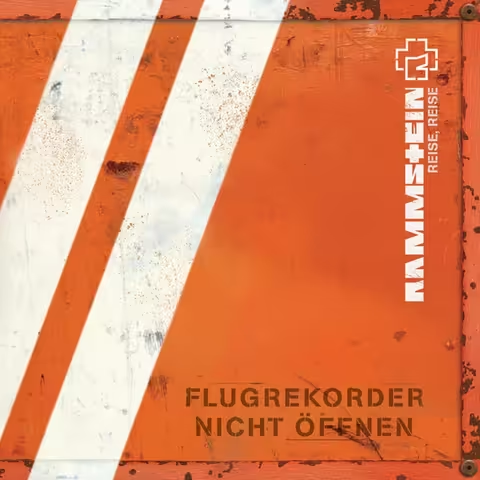
Rammstein began their fourth album by sampling the last thirty-six seconds of a cockpit voice recorder. The recording was real, the aircraft was real, and the 520 people who died with it were real. From that one editorial decision, made before a guitar was tracked, the rest of Reise, Reise grew outwards: the digipak modelled on a battered black box, the suitcase-and-pistols sleeve photo, the title that means both journey, journey and the old sailors' command rise, rise, and the closing image of the song Dalai Lama, where a father and son fly into a storm and only the father lands.
It is also the album on which a German industrial metal band, raised in the rehearsal rooms of East Berlin and the festival tents of the 1990s, recorded an oboe, a children's choir, a Russian counter-vocalist, a mandolin orchestra from Koepenick and the Deutsches Filmorchester Babelsberg, and then handed the tapes to a Swede in Stockholm to mix. The result reached number one in seven countries in a single week.
The crash that became a concept
On 12 August 1985, Japan Air Lines Flight 123 lifted off from Tokyo Haneda bound for Osaka with 524 passengers and crew on board. Twelve minutes into the climb, a Boeing 747 that had been incorrectly repaired seven years earlier following a tailstrike suffered an explosive decompression at altitude. The rear pressure bulkhead failed, the vertical stabiliser was torn away, and most of the hydraulic system bled out within seconds. The crew nursed the unflyable aircraft for thirty-two more minutes before it struck a ridge on Mount Takamagahara in the mountains around Mount Fuji. Five hundred and twenty people died. It remains the deadliest single-aircraft accident in aviation history.
Almost two decades later, with a fourth album in front of them and a working title that translated as journey, journey, Rammstein latched onto Flight 123 as a metaphorical spine. The disaster gave them the visual language of the sleeve, the hidden pregap track described later in this article, and the central image of Dalai Lama, in which Goethe's eighteenth-century ballad Der Erlkoenig is dragged out of its forest and reset at thirty thousand feet. None of that intent was telegraphed in the band's interviews at the time, which is consistent with how Rammstein have always treated their conceptual frames: present them as packaging and let the listener join the dots.
Album facts
| Field | Detail |
|---|---|
| Artist | Rammstein |
| Album | Reise, Reise |
| Release date | 27 September 2004 (Europe), 16 November 2004 (North America) |
| Label | Universal Music (Europe), Republic Records (North America) |
| Producers | Jacob Hellner and Rammstein |
| Studios | El Cortijo Studios, Malaga (recording, from November 2003); Toytown Studio, Stockholm (mixing, April and May 2004) |
| Genre | Industrial metal, Neue Deutsche Haerte |
| Track count | 11 (48:21 with the hidden Flugzeuglaerm pregap on 2004 pressings) |
| Total runtime | 47:45 |
| Billboard 200 peak | 61 |
| UK Albums Chart peak | 37 (number 3 on the UK Rock and Metal Albums Chart) |
| Other notable peaks | Number 1 in Germany, Austria, Switzerland, Iceland, Finland, Estonia and Mexico |
| Certifications | 7x Gold (Germany, BVMI), Platinum (Europe, IFPI), Gold (United Kingdom, BPI), 2x Platinum (Russia, NFPF), Platinum (Austria, Switzerland), Gold (Denmark, Sweden) |
| Estimated sales | 1.5 million copies shipped globally by February 2006 |
| Key singles | Mein Teil, Amerika, Ohne dich, Keine Lust |
Where Rammstein stood after Mutter
To understand what changed on Reise, Reise it helps to remember what Rammstein had become by the end of the previous album cycle. Mutter, released in 2001, had been the band's commercial coronation. It contained Sonne, Ich Will and Mein Herz Brennt and pushed the group's audience beyond German-speaking Europe into the United States, where the soundtrack placements that had begun with Du Hast on Sehnsucht continued to do the heavy lifting. By 2003 the six members were no longer a curiosity from the former East; they were a stadium proposition with a track record of broken pyrotechnic safety codes and one of the most recognisable visual signatures in heavy music.
The four years between studio albums were not idle. Live performances in Berlin, Nimes and across the European festival circuit fed into the band's collective memory, and a clutch of songs had begun to accumulate during soundchecks and downtime. By the time Till Lindemann, Richard Kruspe, Paul Landers, Oliver Riedel, Christoph Schneider and Flake Lorenz reconvened to write in earnest, they were carrying enough material for an album and a half. That surplus matters: it is the reason Rosenrot, released only fourteen months later in October 2005, recycles six tracks born in the Reise, Reise sessions.
They also carried a frustration with the studio environments they had used before. Both Sehnsucht and Mutter had been built in part at Studio Miraval in Provence and in the Stockholm complex that Jacob Hellner had long made his base of operations. For Reise, Reise the band wanted distance from both the German press and their own routine.
Sessions at El Cortijo in Malaga
Recording began in November 2003 at El Cortijo Studios, a residential facility outside Malaga in southern Spain. The choice was deliberate. The band wanted somewhere they could live together for months at a time, with no commute, no interruptions and no chance of an evening pint accidentally producing a tabloid photograph.
The work pattern was the one Rammstein had refined over their first three albums. Christoph Schneider went in first with drum patterns, with Flake Lorenz triggering the synthesised pads that have always sat under the guitars as a tonal carpet rather than a lead voice. Riedel laid down bass on top of those, and Kruspe and Landers then doubled or quadrupled their guitar parts to construct the slab of midrange grind that gives every Rammstein record its weight. Lindemann's lead vocals went last, after the music was effectively finished, in keeping with his preferred method of writing lyrics against a near-complete instrumental.
What the El Cortijo sessions produced that the previous albums had not was a willingness to leave space. Los, which sits in the middle of the running order, is built on a clean acoustic guitar figure that PopMatters compared to early Depeche Mode. Stein um Stein creeps rather than stomps. Amour, the closing track, ends on a guitar solo that no Rammstein record had quite featured before. The sessions ran through to spring 2004; by the time the band left Spain they had eighteen finished or near-finished songs on the drives.
Mixing at Toytown with Jacob Hellner
In April and May 2004 the project moved to Toytown Studio in Stockholm, where Jacob Hellner took the lead on mixing. Hellner had co-produced every Rammstein studio album to date and was the only outside collaborator with veto power over a guitar tone or a vocal comp. The eleven tracks that would make the final running order were chosen during this phase, with the other seven set aside for what eventually became Rosenrot.
It is worth pausing on Hellner's role. He is not a button-pusher. His Swedish contemporaries describe him as a producer in the older European sense, closer to a film director than an engineer, who watches the room and intervenes by suggestion rather than instruction. He had worked with Clawfinger and Apocalyptica and was instrumental in Rammstein's instinct that the keyboards should sit underneath the guitars rather than alongside them. His fingerprints on Reise, Reise are most audible on the dynamic restraint of Ohne dich and on the way the orchestral parts on Reise, Reise, Mein Teil and Stein um Stein never overpower the guitar sound.
The orchestral elements were a substantial undertaking in themselves. Sven Helbig wrote the string arrangements for the title track and for Stein um Stein and the choir arrangements for Mein Teil, Amerika and Morgenstern. Olsen Involtini scored the strings for Stein um Stein and Ohne dich. The Deutsches Filmorchester Babelsberg, conducted by Wolf Kerschek, played most of the orchestral parts; the Dresdner Kammerchor, conducted by Andreas Pabst, sang the choir lines. A children's choir, the Kinderchor Canzonetta, contributed to the chorus of Amerika. Michael Kaden played accordion on the title track and on Moskau. Baerbel Buehler played oboe on Ohne dich. The Koepenicker Zupforchester, a mandolin and zither ensemble based in the Berlin district of Koepenick, played the mandolin part on Ohne dich. The orchestral and choir sessions were coordinated by Nucleus and Jens Kuphal.
The cockpit voice recorder packaging
The first thing a buyer of the original 2004 Reise, Reise saw was the digipak. It was constructed to look like a battered cockpit voice recorder unit, complete with chipped paint and the German warning Flugrekorder, nicht oeffnen, which translates as Flight Recorder, Do Not Open. The legend appears on the front of every real CVR carried on a civil aircraft. Reproduced on a Rammstein sleeve, with no other marking and no song titles visible on the outside, it functioned as a closed object that the listener was instructed not to open and would then immediately open.
The inner sleeve shows the six band members in dark suits, carrying suitcases and weapons, walking away from the wreckage of a crashed aeroplane. The composition deliberately echoes Joel Schumacher's 1993 film Falling Down, in which Michael Douglas's character walks away from a traffic jam armed and in a white shirt and tie. The art direction was by Dirk Rudolph, who had handled Rammstein's sleeves since the late 1990s.
Bonus editions added a DVD with twenty minutes of Lichtspielhaus footage and a poster that mapped each band member to a piece of luggage from the cover shoot. A special Japanese edition, released on 21 April 2005, came in different artwork that depicted a ship trapped in Arctic ice, accompanied by the band photograph from the suitcase sequence. That artwork was originally commissioned for Reise, Reise but ultimately repurposed: when Rosenrot appeared at the end of 2005, the same image returned with the lettering on the ship altered from Reise, Reise to Rosenrot. The two sleeves are therefore the only Rammstein covers that share an image, a detail collectors still trade on.
The hidden Flugzeuglaerm pregap
On the original 2004 pressings, before track one began, the CD contained a thirty-six second hidden track called Flugzeuglaerm, which translates as Airplane Noise. It is the final cockpit voice recording from Japan Air Lines Flight 123, captured on the CVR before the aircraft hit Mount Takamagahara. With the pregap included, the album runs to 48:21 rather than the official 47:45.
Access to the pregap depended on the territory. On the European version, a listener with a CD player that supported negative seeking could rewind from the start of Reise, Reise into the hidden track. On the United States version, the Flugzeuglaerm audio plays at the very start of track one rather than as a pregap. The American iTunes release also included the recording. The 2005 reissue dropped the easter egg entirely, as did every pressing afterwards, which means later editions of the album have a noticeably more abrupt opening than the 2004 original.
The decision to use real cockpit voice recorder audio was, predictably, contested. Critics of the band pointed out that the use of a real disaster recording, however briefly, sat uncomfortably with the album's blacker theatrical jokes. Rammstein offered little public defence at the time. The pregap is also probably the reason the easter egg quietly disappeared from later editions: a record label working through repressing schedules is not a record label that wants to argue about CVR licensing.
Reise, Reise: the opener
The album proper begins with its title track, four minutes and eleven seconds of grinding two-chord drama anchored by Michael Kaden's accordion and Sven Helbig's strings. The title is older than the album: reise, reise is an archaic German naval order to wake the watch, a call to rise and turn out of the hammocks at the beginning of a shift. Reise also reads in modern German as journey, journey, which is why English-language coverage tends to favour that reading.
The lyrics belong squarely to the older sense. Lindemann writes from the perspective of a crew on the sea, of the captain at first light and the body that returns from below, and the song's framing is openly indebted to Herman Melville's Moby-Dick. Auch auf den Wellen wird gefochten, runs one line: even on the waves there is fighting. It is the most concise statement of theme on the record. The song's structure, with a long instrumental opening and a chorus that arrives only after the listener has heard the verses settle, signals from the first track that this is not Mutter Part Two.
Mein Teil and the Rotenburg case
The lead single, released on 26 July 2004, took the band's appetite for transgression to its operative limit. Mein Teil is about Armin Meiwes, the so-called Rotenburg cannibal, who had placed an advertisement on a fetish website in 2001 seeking a man willing to be killed and eaten and who, in March of that year, killed and ate a Berlin engineer named Bernd Juergen Brandes, who had answered the advertisement. The case had been working its way through the German legal system as the band wrote the song.
The music video, directed by Zoran Bihac, opens with a thirty-second spoken-word intro, voiced by Oliver Riedel, reading the original German online classified verbatim: Suche gut gebauten Achtzehn- bis Dreissigjaehrigen zum Schlachten. The Metzgermeister, or master butcher, sign-off was Meiwes's own. That intro is not on the album version of the song. Live, Lindemann customarily cooked Flake Lorenz in a large pot at the front of the stage during the chorus, an image that became one of the most photographed live tableaux of the band's career.
"One of our members brought a newspaper to rehearsal and it had a story about the cannibal guy in it. We were fascinated, shocked and amused at the same time."
Oliver Riedel, on the origins of Mein Teil
Lindemann was blunter when the Taipei Times asked him about the song in August 2004.
"It's so sick that it becomes fascinating and there just has to be a song about it."
Till Lindemann, Taipei Times, 29 August 2004
The single peaked at number two in Germany. It was remixed by the New York producer Arthur Baker, best known for his Afrika Bambaataa and New Order productions in the 1980s, and by the Pet Shop Boys, whose You Are What You Eat Edit appeared on the Japanese bonus disc and on the Mein Teil CD single. The Pet Shop Boys remix in particular is a useful object lesson in how flexible Rammstein's songwriting is once the wall of guitars is stripped away: under the dub treatment, the chorus melody is essentially a pop hook.
Amerika and the moon-set video
If Mein Teil was the album's calculated provocation, Amerika was its calculated grin. Released as the second single on 6 September 2004, three weeks ahead of the album, it pairs a stamping verse riff in German with an English-language chorus that became one of the most singable lines in the Rammstein catalogue: We're all living in America, Amerika ist wunderbar, We're all living in America, America, America. The subject is global Americanisation, name-checking Coca-Cola, Mickey Mouse and Santa Claus and resting the joke on the gap between the cheerful chorus and the slightly menacing verses.
The video, directed by Jorn Heitmann, was filmed in Berlin and on a reconstructed lunar set in early August 2004, and pastiches the Apollo television footage well enough that a careless viewer might briefly think they are watching genuine archive material. The band perform in mocked-up spacesuits planted on a soundstage moon, intercut with vignettes of Buddhist monks eating pizza, an African village receiving Mickey Mouse merchandise and Inuit families watching Coca-Cola advertisements. The clip is a more useful statement of intent than any of the band's interviews of the period.
Amerika charted across continental Europe on the back of the album's release and was a staple of the live set immediately. It remains in the rotation on every subsequent Rammstein tour.
Dalai Lama: Goethe at altitude
The third track is the conceptual hinge of the album. Dalai Lama takes Goethe's 1782 ballad Der Erlkoenig, in which a father gallops home through a forest with his sick son in his arms as the Alder King whispers to the boy, and transposes the journey from horseback to a passenger aircraft caught in a storm. The Alder King becomes a king of the air. The father, the listener gradually realises, will be the only one of the two to land alive. Sven Helbig's choir arrangements lift the chorus into something close to a funeral mass.
The song's title has invited the obvious question. The 14th Dalai Lama has spoken publicly about his fear of flying and the band have been content to let the listener draw the line between the title, the fear and the lyrics without confirming any of it. Other commentators have argued that the title is a wider allusion to Chinese rule in Tibet. The band have offered nothing definitive on either reading.
Musically, Dalai Lama is the most ambitious track on the album. There are passages in which the guitars drop out entirely and Lindemann sings against the choir alone, and the final chorus reintroduces the full band into a wall that recalls the climax of Mutter's title track without imitating it. At five minutes and thirty-eight seconds it is also the longest song on the record.
Moskau, Morgenstern and the orchestral guests
Moskau sits at the centre of the running order and is the only Rammstein song with substantial Russian-language vocals. The Russian-born singer Viktoria Fersh delivers the counter-vocals as a kind of city personified, answering Lindemann's German lyric of half-affectionate, half-disillusioned tourism. Michael Kaden's accordion returns. The Deutsches Filmorchester Babelsberg arrangement gives the track its lurching, parade-ground feel.
Morgenstern, the eighth track, is built on Dresdner Kammerchor harmonies and a lyric that runs in the opposite direction to most Lindemann themes: a hymn of solidarity with someone the world has deemed ugly. The morning star of the title is asked to shine on the unloved face. It is one of the few unambiguously tender lyrics in Rammstein's catalogue and one of the songs most often cited by fans as the moment the album opens out.
Both tracks demonstrate the underlying argument of Reise, Reise: that the Rammstein formula could carry far more orchestral and vocal weight than its critics assumed without losing its essential character. The choir does not soften the guitars. It throws them into relief.
Ohne dich, the ballad and its oboe
If Amerika was the singalong, Ohne dich was the ballad. Released as the third single on 22 November 2004, it is the closest thing on the album to a conventional power ballad, with Lindemann singing in his lower register against an arrangement built on Baerbel Buehler's oboe and the Koepenicker Zupforchester's mandolins. The central conceit is a paradox, paraphrased as: "without you I cannot be, with you I am alone also".
The video, directed by Jorn Heitmann, shows the six band members carrying the body of a fallen friend down a snow-covered alpine slope. There are no pyrotechnics, no stage blood and no theatrical violence; only the carrying. It functions as a deliberate counterpoint to the live show that the rest of the album was about to power. The single charted across Europe and produced one of the band's most-streamed studio recordings.
The track was later remixed by the Slovenian avant-garde group Laibach, whose stripped-down martial reading underscored how much of Ohne dich's emotional weight is carried by the words and the melody rather than by the production.
Keine Lust, Los, Stein um Stein and Amour
Around the four singles and Dalai Lama, the album balances on four more pieces that are arguably the most interesting in the long run.
- Keine Lust, the closing single, was released on 28 February 2005 with a Jonas Akerlund video that put each band member in a heavy prosthetic fat suit, a brutal piece of body comedy that played on every assumption an audience had about what a Rammstein video should look like. The lyric is a complaint about exhaustion and reluctance set against music that refuses to slow down.
- Los is the album's hidden compass. Built on a sparse acoustic guitar pattern, with Lindemann's vocal dropped almost to a spoken murmur, it plays on the multiple German senses of the title: the suffix -less, the adjective for off or loose, and the command for go. PopMatters compared its bluesy guitar tone to early Depeche Mode at their most exposed.
- Stein um Stein is the song that creeps. A first-person account by a builder who has bricked a partner into the walls of a house, it is the closest the album comes to a horror-story narrative, and Sven Helbig's string arrangement makes a virtue of restraint, holding the orchestra back until the final verses.
- Amour closes the album in French and German on the only Rammstein song to feature an extended Richard Kruspe guitar solo. After everything that has come before, the record signs off as a love song. It is also the only track in the running order on which Lindemann lets a single line repeat into silence rather than into a final chorus.
Singles and chart performance
The singles run from Reise, Reise was the most concentrated of Rammstein's career to date. Four singles in seven months, each with a dedicated video and a remix package, gave the album an unbroken presence on European radio and music television from late July 2004 into early spring 2005.
| Single | Release date | Director (video) | Notes |
|---|---|---|---|
| Mein Teil | 26 July 2004 | Zoran Bihac | Number 2 in Germany; remixed by Arthur Baker and the Pet Shop Boys |
| Amerika | 6 September 2004 | Jorn Heitmann | Moon-set pastiche shot in Berlin in early August 2004 |
| Ohne dich | 22 November 2004 | Jorn Heitmann | Alpine snow shoot; Laibach remix on the single |
| Keine Lust | 28 February 2005 | Jonas Akerlund | Band in prosthetic fat suits; final single of the cycle |
The album itself debuted at number one across the German-speaking world and across most of Scandinavia, the Baltic states and parts of Latin America. The full chart picture is one of the broadest Rammstein had assembled to that point.
- Number 1 in Germany, Austria, Switzerland, Iceland, Finland, Estonia and Mexico.
- Number 2 in the Netherlands and Sweden.
- Number 3 in the Czech Republic, Denmark and France; number 3 on the UK Rock and Metal Albums Chart.
- Number 4 in Belgium (Wallonia), Norway and Poland.
- Number 5 in Belgium (Flanders); number 6 in Portugal; number 7 in Spain.
- Number 17 in New Zealand; number 18 in Canada; number 19 in Australia.
- Number 21 in Hungary; number 31 in Scotland; number 37 on the UK Albums Chart.
- Number 54 in Ireland; number 61 on the US Billboard 200, with 26,716 copies sold in the first week.
Certifications followed quickly. The album holds 7x Gold from the BVMI in Germany (700,000 units), IFPI Platinum in Austria (30,000), IFPI Platinum in Switzerland (40,000), IFPI Gold in Denmark (20,000), GLF Gold in Sweden (30,000), NFPF 2x Platinum in Russia (40,000), BPI Gold in the United Kingdom (100,000) and IFPI Platinum across Europe (1,000,000). By February 2006 it had shipped 1.5 million copies worldwide.
Critical reception
The reviews split along familiar lines. The mainstream rock press treated the album as a confident continuation of Mutter and praised the singles; the heavier and the more leftfield outlets heard the album's restraint and gave it a second look.
David Jeffries at AllMusic awarded three stars out of five and wrote that the album offered "more of the same: the same grit, the same growl, and the same dramatic, orchestra choruses". Mein Teil, he argued, was "no Du Hast but the damning Amerika almost equals their breakthrough track", and he singled out Stein um Stein for creeping rather than stomping and Los for its bluesy guitar. He concluded that Reise, Reise was "a tight, free-of-filler album" that would "satisfy the faithful".
Vaz Malik at the BBC also awarded three stars out of five and observed that the German language "sounds a lot more threatening" than English, adding that "tracks like Amerika make the admission price worth while". Entertainment Weekly's Timothy Gunatilaka was less convinced and gave the album a C+. Stephen Ackroyd at DIY went to 3.5 out of 5. Kaj Roth at the Swedish outlet Melodic gave it 4.5 out of 5. Rolling Stone matched the three-star consensus.
The most useful review came from Tim O'Neil at PopMatters, who scored the album 8 out of 10.
"Reise, Reise revels in the type of paradoxical, multi-faceted existentialism which comes second nature to Germans but is persistently untranslatable to Americans. For those with the patience to look beyond the Teutonic bluster, Reise, Reise will be a uniquely rewarding experience."
Tim O'Neil, PopMatters, 2004
Release Magazine awarded 8 out of 10. Sputnikmusic eventually filed a 5 out of 5. Retrospective coverage has been kinder than the initial mid-three-star average, with Reise, Reise frequently cited in twenty-first-century best-of-Rammstein rankings alongside Mutter as one of the two indispensable studio albums from the band's first decade in the international market.
Rosenrot and what came next
Fourteen months after Reise, Reise came Rosenrot. The follow-up was originally conceived as Reise, Reise Vol. II and built around the six tracks left over from the Spanish sessions, supplemented with new material recorded in Berlin and Stockholm. The Arctic-themed sleeve that Rammstein had earmarked for Reise, Reise and used only on the 2005 Japanese edition was reused for Rosenrot with the lettering on the side of the trapped ship altered. For collectors that detail still functions as the cleanest demonstration that the two albums are siblings rather than cousins.
The band's first international touring cycle in support of Reise, Reise stretched into 2005 and produced the live document Voelkerball, filmed across performances in Nimes, London, Tokyo and Moscow. The Voelkerball setlists put Mein Teil, Amerika, Ohne dich, Keine Lust, Moskau and the title track at the centre of the live show and quietly established that Reise, Reise had supplied the band with as many tour staples as Mutter had three years earlier. Several of those songs remain in rotation more than twenty years later.
Reise, Reise marks the point at which Rammstein became, for many listeners outside Germany, the only contemporary heavy band who could put an oboe, a children's choir, a real cockpit voice recorder recording and a satirical English-language chorus on the same record without the seams showing. Almost everything the band has released since works inside the template the album set.
Personnel and credits
| Role | Player | Notes |
|---|---|---|
| Core band | ||
| Lead vocals | Till Lindemann | All tracks |
| Lead guitar, backing vocals | Richard Kruspe | All tracks; solo on Amour |
| Rhythm guitar, backing vocals | Paul Landers | All tracks |
| Bass guitar | Oliver Riedel | All tracks; voices the Meiwes classified at the start of the Mein Teil video |
| Drums | Christoph Schneider | All tracks |
| Keyboards | Flake Lorenz | All tracks |
| Guest and session musicians | ||
| Vocals | Viktoria Fersh | Russian counter-vocals on Moskau |
| Oboe | Baerbel Buehler | Ohne dich |
| Accordion | Michael Kaden | Reise, Reise and Moskau |
| String arrangements | Olsen Involtini | Stein um Stein and Ohne dich |
| String arrangements | Sven Helbig | Reise, Reise and Stein um Stein |
| Choir arrangements | Sven Helbig | Mein Teil, Amerika and Morgenstern |
| Children's choir | Kinderchor Canzonetta | Amerika |
| Choir | Dresdner Kammerchor | Mein Teil, Amerika and Morgenstern; conducted by Andreas Pabst |
| Orchestra | Deutsches Filmorchester Babelsberg | Conducted by Wolf Kerschek; coordination by Nucleus and Jens Kuphal |
| Mandolins | Koepenicker Zupforchester | Ohne dich |
| Production and engineering | ||
| Producers | Jacob Hellner and Rammstein | El Cortijo (recording) and Toytown (mixing) |
| Mixing studio | Toytown Studio, Stockholm | April and May 2004 |
| Recording studio | El Cortijo Studios, Malaga | From November 2003 |
| Artwork | ||
| Art direction and design | Dirk Rudolph | Cockpit-voice-recorder digipak; Falling Down-inspired band photograph on the inner sleeve |
Tracklist
| # | Title | Writer(s) | Length | Single? | Notes |
|---|---|---|---|---|---|
| 1 | "Reise, Reise" | Rammstein | 4:11 | Title is an archaic sailors' command; lyric references Moby-Dick | |
| 2 | "Mein Teil" | Rammstein | 4:32 | Yes (26 July 2004) | Based on the Armin Meiwes case; number 2 in Germany |
| 3 | "Dalai Lama" | Rammstein | 5:38 | Goethe's Der Erlkoenig relocated to a passenger aircraft | |
| 4 | "Keine Lust" | Rammstein | 3:43 | Yes (28 February 2005) | Akerlund video with the band in prosthetic fat suits |
| 5 | "Los" | Rammstein | 4:24 | Acoustic-led; title plays on -less, loose and go | |
| 6 | "Amerika" | Rammstein | 3:47 | Yes (6 September 2004) | English-language chorus; Apollo-pastiche video |
| 7 | "Moskau" (feat. Viktoria Fersh) | Rammstein | 4:16 | Russian counter-vocals; accordion by Michael Kaden | |
| 8 | "Morgenstern" | Rammstein | 4:00 | Dresdner Kammerchor on the chorus | |
| 9 | "Stein um Stein" | Rammstein | 3:52 | First-person narrator bricks a partner into a wall | |
| 10 | "Ohne dich" | Rammstein | 4:31 | Yes (22 November 2004) | Oboe by Baerbel Buehler; Koepenicker Zupforchester mandolins; Laibach remix on the single |
| 11 | "Amour" | Rammstein | 4:51 | Closes the album on a Richard Kruspe guitar solo |
Total runtime: 47:45. With the Flugzeuglaerm pregap on the 2004 pressings, 48:21. Japanese edition (21 April 2005) adds "Mein Teil (You Are What You Eat Edit)" remixed by Pet Shop Boys (4:07) and "Amerika (Digital Hardcore Mix)" remixed by Alec Empire (3:52), and a bonus DVD with twenty minutes of Lichtspielhaus footage.
Things you might not know
| Fact | Detail |
|---|---|
| The hidden track | Original 2004 pressings hide a 36-second pregap track called Flugzeuglaerm containing the closing seconds of the cockpit voice recorder of Japan Air Lines Flight 123. On the European CD it is accessed by rewinding past the start of track 1; on the US CD and the American iTunes release it plays at the front of track 1. The 2005 reissue dropped it. |
| One sleeve, two albums | The Arctic ship-in-ice artwork used on the 2005 Japanese edition of Reise, Reise was reused later that year for Rosenrot, with the lettering on the side of the ship altered from Reise, Reise to Rosenrot. They are the only two Rammstein sleeves to share an image. |
| Eighteen songs, eleven kept | The El Cortijo sessions produced enough material for a double album. The seven left over became the spine of Rosenrot fourteen months later. |
| Falling Down on the inner sleeve | The band photograph on the inner sleeve, with the six members in suits, carrying suitcases and weapons away from a crashed aeroplane, is a deliberate echo of Michael Douglas walking away from the traffic jam in the opening of Joel Schumacher's Falling Down. |
| The Pet Shop Boys remix | The Pet Shop Boys remixed Mein Teil as the You Are What You Eat Edit. Arthur Baker, the producer behind Afrika Bambaataa's Planet Rock and several New Order singles in the 1980s, also remixed the track for the single release. |
| Laibach took Ohne dich | The Slovenian avant-garde band Laibach contributed a stripped martial reading of Ohne dich to the single, underscoring how much of its weight is carried by melody rather than production. |
| A mandolin orchestra from Koepenick | The mandolin part on Ohne dich is played not by a session player but by the Koepenicker Zupforchester, an amateur and semi-professional plucked-string ensemble from the Berlin district of Koepenick. |
| The Meiwes voice on Mein Teil | The voice reading the Meiwes online classified at the start of the Mein Teil video is bassist Oliver Riedel, not Till Lindemann; the spoken intro does not appear on the album version of the song. |
| Reise, Reise's other meaning | Reise reads in modern German as journey, but the archaic naval order reise, reise meant rise, rise: a call to turn the watch out of their hammocks. The lyric of the title track is written squarely in the older sense, with a debt to Moby-Dick. |
| Number one in Mexico | Reise, Reise hit number one in Germany, Austria, Switzerland, Iceland, Finland and Estonia. It also went to number one in Mexico, the only Spanish-speaking territory to take a Rammstein album to the top in the band's first decade. |
| The Amour solo | Closing track Amour features one of the very few extended Richard Kruspe guitar solos on a Rammstein studio album, a quiet break with the band's general preference for layered rhythm parts over lead playing. |
| 26,716 in the first week | The album sold 26,716 copies in its first week in the United States in November 2004, enough to chart at number 61 on the Billboard 200 without a single English-language single attached, an unusual position for a non-English album of the period. |
How to listen now
Reise, Reise is available on every major streaming platform, including Spotify, Apple Music, Tidal, Amazon Music and YouTube Music. The widely available digital and current CD editions present the standard eleven-track running order at 47:45 without the Flugzeuglaerm pregap. Listeners chasing the hidden track will need an original 2004 European CD pressing for the negative-seek easter egg, or the original 2004 United States CD (or the 2004 American iTunes release) on which the cockpit voice recorder audio plays at the start of track one. The 2005 reissue and every subsequent edition open straight on the title track.
The 180-gram double-vinyl edition has been repressed several times since the album's tenth anniversary and is the format of choice for most listeners interested in the orchestral and choir layers; the dynamics on Reise, Reise, Mein Teil and Stein um Stein in particular reward the wider canvas. Voelkerball, the 2006 live document, contains performances of Reise, Reise, Mein Teil, Amerika, Ohne dich, Keine Lust and Moskau and is the natural companion piece for anyone working through the album for the first time.
The Riffology podcast covers Rammstein and the Reise, Reise era in detail across several episodes and is available on Apple Podcasts, Spotify and all the usual platforms.

Comments