
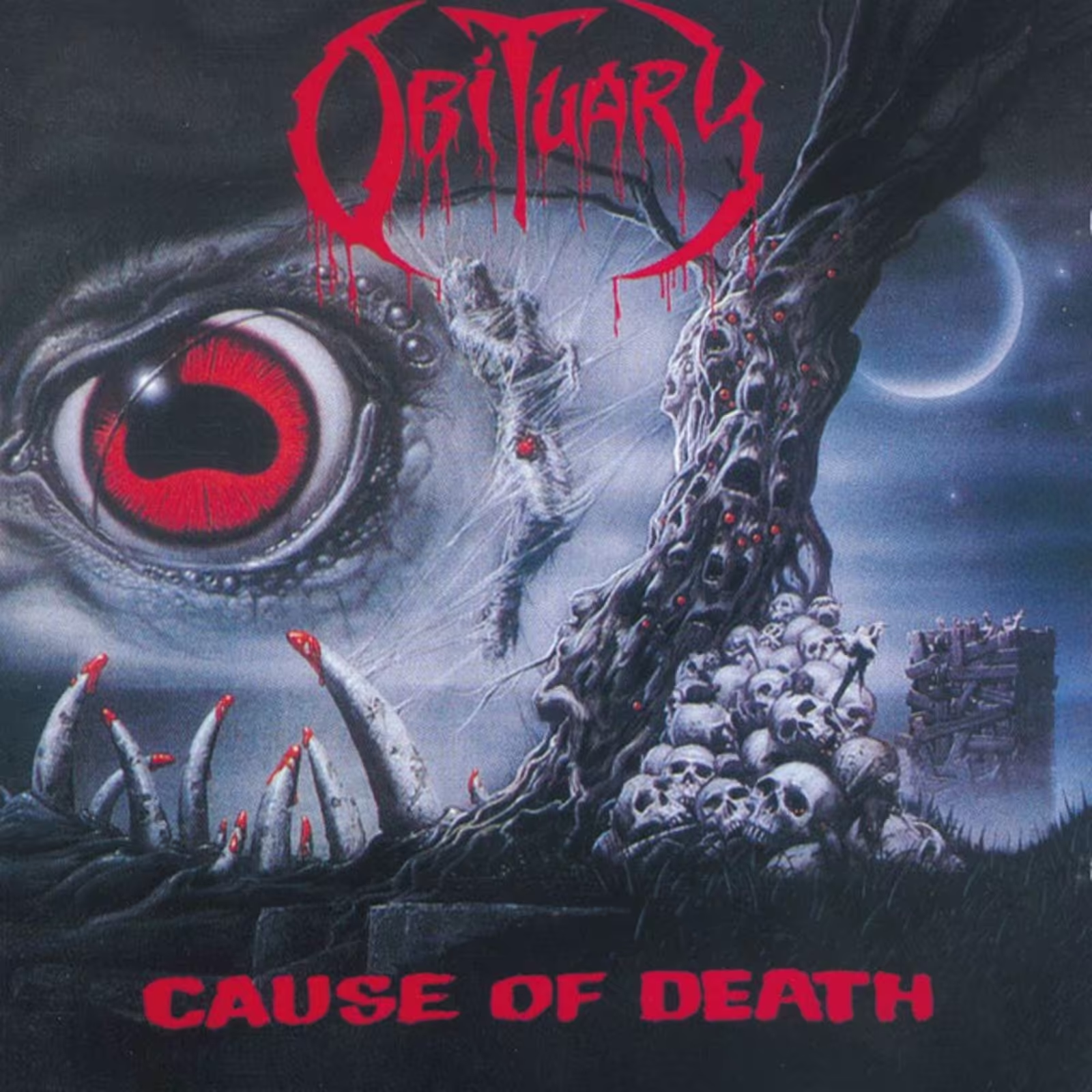
By the autumn of 1989 Roadrunner Records had a problem nobody outside the office knew about. Michael Whelan, the science fiction and fantasy illustrator whose work hung on the walls of more bedrooms than most Grammy winners had sold records, had been commissioned to produce a cover for Sepultura's third album, Beneath the Remains. The original painting, an oil-on-canvas piece titled Lovecraft's Nightmare A, was duly shipped out of Whelan's studio. It did not arrive in Brazil, and it did not arrive in Roadrunner's New York office. It arrived, by an administrative slip that the label has never fully explained, at the front door of a small house in Brandon, Florida, where five men in their early twenties were trying to work out what their second record should sound like.
That painting became the cover of Cause of Death. Sepultura were quietly handed a different Whelan canvas, Nightmare in Red, by A and R man Monte Conner, and told to live with it. Obituary, meanwhile, walked into Morrisound Recording in Tampa with a hooded skeletal figure already staring back at them from a piece of cover art, a borrowed lead guitarist from Death sitting in the corner with no songwriting credit and a head full of riffs he was saving for somewhere else, and producer Scott Burns asking them how slow they wanted it to be. The album that emerged on 19 September 1990 has never quite stopped sounding like a happy accident, in the very specific sense that almost nothing about it was supposed to happen the way it did.
Album facts
| Field | Detail |
|---|---|
| Artist | Obituary |
| Album | Cause of Death |
| Release Date | 19 September 1990 |
| Label | Roadrunner Records |
| Producer(s) | Scott Burns; Obituary (co-producers) |
| Studio(s) | Morrisound Recording, Tampa, Florida |
| Genre / Subgenre | Death metal, with audible Celtic Frost and Hellhammer influence and a groove-oriented rather than blast-beat-driven approach |
| Track Count | 9 |
| Total Runtime | 41:02 |
| Billboard 200 Peak | Did not chart |
| UK Albums Chart Peak | Did not chart |
| Other Notable Chart Peaks | None reported |
| Certifications | None reported |
| Estimated Sales | Figures not publicly reported by Roadrunner |
| Key Singles | Chopped in Half; Turned Inside Out (promo focus tracks rather than commercial singles) |
Florida, 1990
Death metal in 1990 had a postcode. The first wave that mattered commercially, the wave that gave the genre its house style, its in-jokes and its preferred snare sound, was concentrated almost entirely around a single building on North Nebraska Avenue in Tampa. Morrisound Recording, run by brothers Tom and Jim Morris, had become the studio of record for a scene that did not yet quite know it was a scene. Death cut Leprosy there in 1988. Sepultura, who were nominally Brazilian, flew up to make Beneath the Remains there in late 1988. Cannibal Corpse drove down from Buffalo to record Eaten Back to Life there in early 1990. Deicide were locals. Morbid Angel were locals. Obituary, from Brandon a few miles east, were locals too, and they had already made one record at Morrisound, the previous summer's Slowly We Rot.
The man behind the desk on most of those sessions was Scott Burns. Burns had started as an assistant engineer at Morrisound, ended up producing nearly everything brutal that passed through the building in a five year window, and by 1990 had become the closest thing extreme metal had to a Bob Rock or a Brendan O'Brien. He had a sound: thick rhythm guitars layered just shy of mud, kick drums that landed like dropped breeze blocks, vocals pushed forward enough that the words, where there were words, became another percussion instrument. He also had a roster that gave him a unique editorial position. He had heard what Sepultura were going to do that year. He had heard what Death were going to do. And in early 1990 he was about to find out what Obituary, fifteen months on from Slowly We Rot, were going to do.
What they were going to do, it turned out, was slow down. The first wave of American death metal had spent the back end of the 1980s trying to play faster than thrash. Obituary, almost alone, decided to play slower. Where their peers chased Slayer down a tunnel of double kick, Obituary looked sideways at Celtic Frost's To Mega Therion and Hellhammer's Apocalyptic Raids and pulled the tempo back to a swing. Alternative Press would later describe the record's aesthetic as a slow, groove-oriented approach to brutality. Loudwire's Joe DiVita, writing a 2025 ranking that put Cause of Death at the top of his death metal albums of 1990 list, called Obituary death metal's perennial cavemen, and meant it as the highest possible compliment.
The band before the album
Obituary had only existed under that name for about two years when Cause of Death sessions began. The Tardy brothers, John on vocals and Donald on drums, had been in a band called Executioner with rhythm guitarist Trevor Peres since the mid 1980s, gigging around Tampa and Brandon and recording demos with such determined ugliness that the local scene noticed. A name change to Xecutioner, then to Obituary, took them through a 1988 compilation appearance and on to a deal with Roadrunner. The debut, Slowly We Rot, was tracked at Morrisound in May 1989 with Scott Burns and released that June. Allen West played the leads on that record. By the time the band were ready to make a follow up, West was out of the band for personal reasons that the Tardys have always discussed in vague terms, and Obituary had two empty chairs to fill.
The bass chair went to Frank Watkins, a Tampa scene fixture who would go on to become the longest serving non-Tardy member of the group, staying until 2010. Cause of Death was his first studio appearance with the band, and his playing on it is essentially a thickening agent, locked unfussily to Donald Tardy's kick pattern rather than reaching for any audible counter-melody. The lead guitar chair was filled, briefly and consequentially, by James Murphy.
Murphy had played the leads on Death's Spiritual Healing, recorded at Morrisound earlier in 1990 and released in February of that year. He was, by the standards of the Tampa scene, a virtuoso, with a fluency in scalar runs and harmonic minor phrasing that placed him closer in spirit to Marty Friedman than to Trevor Peres. The arrangement with Obituary was unusual and clearly understood by both sides from the start. Murphy was hired purely as a lead player. He would not write riffs for the album. The band's compositional axis remained Peres and Donald Tardy, with one exception: the title track Cause of Death itself, whose music is credited jointly to Peres and Allen West, the very man Murphy was replacing. Murphy's own writing ideas, which by his account he played for the band during downtime, were politely declined and went into a drawer. Three years later most of them surfaced on the debut album by Murphy's post-Obituary project Disincarnate, Dreams of the Carrion Kind, released by Roadrunner in 1993. He played one record with Obituary and did not return.
Pre-production and demos
Material for Cause of Death took shape through the back half of 1989 and the opening months of 1990, in the Tardy garage in Brandon and in cheap rehearsal rooms around the Tampa scene. Trevor Peres and Donald Tardy worked as a writing pair, with Peres bringing in skeletal riff ideas and the pair shaping them into arrangements between them. John Tardy joined later in the process, picking the vocal approach for each track once the music was largely settled. Demo versions of three of those songs, Infected, Memories Remain and Chopped in Half, were eventually released as bonus tracks on the 1997 reissue and show how close the arrangements already were to their finished form before the band reached Morrisound.
By the time Scott Burns was booked in at Morrisound, the album was essentially written down to the bar. The one piece of late material was the title track, brought in with Allen West contributing music alongside Peres, even though West was not formally back in the band. Murphy joined the project late in the cycle, having just finished his Death commitments and recorded his lead parts inside a small number of focused sessions rather than across the full duration of the band's tracking dates.
Creating the album at Morrisound
Sessions for Cause of Death took place at Morrisound through the spring and early summer of 1990. Scott Burns produced, engineered and mixed; the band took a co-production credit reflecting the fact that the arrangements were essentially settled before they walked in. Compared with the wilder logistics of some of his other 1990 projects, the Obituary sessions ran with comparative calm, the band well rehearsed and the songs already cut down to fighting weight.
The record's most discussed production decision is also the simplest. Where Death and Morbid Angel were pushing the limits of what Tampa engineers could do with high-tempo double bass, Burns and Obituary leaned the other way. Tempos sat in the mid to low range. Riffs were given room to breathe and decay. Donald Tardy's kit was recorded with the toms forward in the mix and a snare crack that lands flat rather than ringing, the sound of a drummer hitting hard rather than fast. Trevor Peres's rhythm guitars are stacked but not scooped into the trebly buzz that other Morrisound clients preferred; the midrange is left intact, which is what gives the album its swamp quality.
The two surprises in the room were James Murphy's lead playing and John Tardy's vocal approach. Murphy treated the sessions as a session player would, asking what feel each track wanted and producing solos that worked as songs in miniature rather than as identity statements. His lead on Chopped in Half, which arrives just after the second chorus and exits before it has worn out its welcome, is the most quoted lead on the record, and the most uncharacteristic thing in the band's entire catalogue both before and after.
John Tardy's vocals are the other anomaly. There are lyric credits on the sleeve, attributed to John on every original track, but anyone trying to follow what he is actually singing will quickly give up. The vocal performance is largely non-lexical. Loudwire's Joe DiVita has called it a swamp-born guttural belch and described what comes out of the microphone as senseless gurgles, both phrases that the band and their fans have happily accepted as fair description. The official lyrics often bear only a phonetic relationship to what is on tape. Whether this was a deliberate aesthetic choice or simply the way John Tardy had always sung is a question the band tend to deflect; the answer is plainly both.
Personnel and credits
| Role | Player | Notes |
|---|---|---|
| Core band | ||
| Vocals | John Tardy | Lyrics on all original tracks; performance largely non-lexical |
| Lead guitar | James Murphy | Sole album with Obituary; previously of Death (Spiritual Healing); no songwriting credit |
| Rhythm guitar | Trevor Peres | Co-composer of all original music with Donald Tardy |
| Bass | Frank Watkins | First album with Obituary; remained until 2010 |
| Drums | Donald Tardy | Co-composer of all original music with Trevor Peres |
| Additional contributors | ||
| Additional music | Allen West | Co-wrote the title track Cause of Death with Trevor Peres; was not a member during these sessions |
| Sound effects | Kent Smith | Atmospheric textures and effects across the record |
| Production and engineering | ||
| Producer / Engineer / Mixer | Scott Burns | House producer of Morrisound Recording; co-produced with Obituary |
| Artwork | ||
| Cover painting | Michael Whelan | Lovecraft's Nightmare A, originally commissioned for Sepultura's Beneath the Remains |
| Back cover photo | Carole Segal | Band portrait |
| Logo design | Rob Mayworth | Obituary band logo |
The songs
The album runs forty one minutes and two seconds across nine tracks. The pacing is unusual for a 1990 death metal record: the two longest songs sit at positions one and two, the shortest sits dead in the middle, and the closer is the most groove-driven thing on the album. Decoded as a piece of sequencing it reads as a deliberate refusal of the genre's expected arc, which usually involves opening at a sprint and then trying to keep up with itself.
| # | Title | Writer(s) | Length | Single? | Notes |
|---|---|---|---|---|---|
| 1 | Infected | Peres / D. Tardy / J. Tardy (lyrics) | 5:34 | Promo focus | Opens the album at mid-tempo, not at a sprint |
| 2 | Body Bag | Peres / D. Tardy / J. Tardy (lyrics) | 5:49 | Longest song on the record | |
| 3 | Chopped in Half | Peres / D. Tardy / J. Tardy (lyrics) | 3:43 | Promo focus | Quoted by Loudwire as the record's quintessential song |
| 4 | Circle of the Tyrants | T.G. Warrior (music and lyrics) | 4:25 | Celtic Frost cover, originally on To Mega Therion (1985) | |
| 5 | Dying | Peres / D. Tardy / J. Tardy (lyrics) | 4:29 | Doom-leaning midpoint | |
| 6 | Find the Arise | Peres / D. Tardy / J. Tardy (lyrics) | 2:51 | Shortest track on the album | |
| 7 | Cause of Death | Allen West / Peres / J. Tardy (lyrics) | 5:38 | Title track; only original whose music was not written by Peres and Donald Tardy alone | |
| 8 | Memories Remain | Peres / D. Tardy / J. Tardy (lyrics) | 3:44 | Gives its name to the 1997 reissue's bonus booklet | |
| 9 | Turned Inside Out | Peres / D. Tardy / J. Tardy (lyrics) | 4:57 | Promo focus | Most groove-led song on the record; long-running setlist closer |
Infected opens the album with a refusal. There is no count-in, no escalating intro riff, no obligation to the speed of the times. Trevor Peres's rhythm guitar lurches in at a tempo that would have got the song laughed out of a Morbid Angel rehearsal, and stays there. John Tardy's first vocal entry is a syllable rather than a word. The arrangement does its work by accumulation, with the second guitar layering an octave above and Donald Tardy's floor tom acting as a metronome the rest of the band lean against. Five and a half minutes is a long time for a death metal opener in 1990; the song uses every second.
Body Bag is the longest piece on the record at five minutes forty nine seconds and the closest the album comes to a doom metal track in disguise. The verse riff is built on a single chord chug answered by a descending three-note figure, repeated for what feels like an unreasonable length of time before it suddenly is not unreasonable any more. James Murphy's solo, when it arrives, is one of his most considered on the record, phrased as if he had spent the verses listening rather than waiting.
Chopped in Half is the song most outsiders know. It is the shortest original on the album, the most direct, and the one Loudwire singled out in their 2025 retrospective as the quintessential Obituary song. The main riff is essentially two chords and a pause, and it works because of the pause. Donald Tardy's snare placement during the chorus, slightly behind the beat in a way that is impossible to notate but immediately audible, gives the whole song its limp. Murphy's lead break is the record's most quoted thirty seconds.
Circle of the Tyrants is the record's only non-original and the most overt sign of the band's listening habits. Celtic Frost had released the song on To Mega Therion in 1985, by which point the Tardy brothers were teenagers and Tom G. Warrior was, in the Tampa scene's view, a foundational figure. Obituary's version slows the song down further, thickens the riff, and lets John Tardy add his guttural reading over the top. Tom G. Warrior, asked about it in interviews ever since, has consistently endorsed the cover, and there is no version of the song's lineage where Obituary's reading is treated as anything other than respectful.
Dying sits at the centre of the record both physically and tonally. It is the most doom-adjacent of the originals, with a verse riff so deliberately drawn out that the first time the chorus arrives it lands as a relief rather than an escalation. The track is the clearest evidence of what the band had taken from Hellhammer; it could be a 1984 demo with better drums.
Find the Arise is the shortest piece on the record at two minutes fifty one seconds and the only track that approaches the tempos other Tampa bands were operating at. It is sequenced exactly halfway through, a deliberate burst of speed dropped between two slower pieces. Whether the running order was designed to set it up that way or it simply happened that way, the effect is the same.
Cause of Death is the title track and the only original on the album not written by the Trevor Peres and Donald Tardy axis alone. Allen West, who would later rejoin the band, supplied the music alongside Peres; John Tardy wrote the lyrics. The song is built around a recurring two-bar figure that descends and then snaps back into place, and it is the closest the album gets to a traditional death metal arrangement, with an extended instrumental section in the middle that gives Murphy room to stretch.
Memories Remain is the most concise original after Find the Arise. The phrase has had an unusual afterlife: it gave its name to the 1997 reissue's bonus booklet Memories Remain, supplied the title for Kory Grow's February 2019 Decibel Magazine oral history of the album, and has been adopted as shorthand by fans referring to the entire Cause of Death era.
Turned Inside Out closes the album and is the most groove-led thing on it. The main riff swings rather than chugs, and the song has become Obituary's most frequently played live track, used as either set opener or closer at the band's shows for decades. The studio version is the one most heard outside the venue; the live version, faster and less considered, is the one most heard within it.
The Michael Whelan cover saga
The story of how Cause of Death ended up with the cover it has is one of the better known anecdotes in death metal mythology, and one of the few that survives close examination. Michael Whelan, a multiple Hugo Award winning illustrator whose CV ran from Stephen King to Isaac Asimov, was already a familiar name to Roadrunner. He had been commissioned to produce a cover for Sepultura's third album Beneath the Remains, a piece titled Lovecraft's Nightmare A, a hooded skeletal figure in an oily green and brown landscape, drawn directly from Whelan's long fascination with the work of H.P. Lovecraft.
What happened next has been told two ways. In one version the original painting was simply mis-shipped, sent to Obituary's management in Florida rather than to Roadrunner in New York. In another, the band saw it, fell in love with it, and refused to give it back. The version Roadrunner's Monte Conner has stuck to in subsequent interviews is closer to the first: the painting ended up in Florida by an administrative error, and by the time the mistake was spotted, Obituary were several steps into using it as the visual identity of their second record. Conner then had to ring Whelan, ask him to produce another piece for Sepultura, and persuade Sepultura to accept it. The replacement, Nightmare in Red, is the cover that ended up on Beneath the Remains. It is a very good painting. It is not the painting Sepultura wanted, and Max Cavalera has said so on several occasions in the years since.
The story has a third panel. Whelan's Lovecraft's Nightmare sequence consists of more than one painting. Lovecraft's Nightmare B, the companion piece, was later used as the cover art for Demolition Hammer's second album Epidemic of Violence, released by Century Media in 1992. The two paintings, sitting on adjacent record sleeves, form one of the more elegant accidental diptychs in metal cover art history, despite belonging to two unrelated albums by two unrelated bands on two different labels. Whelan's painting also appeared as the cover of an H.P. Lovecraft fiction collection, which is the use the artist had originally had in mind when he painted it.
Release and reception
Roadrunner released Cause of Death on 19 September 1990 into a marketplace that had no chart for it. Death metal in 1990 was a genre that moved units in college radio bins and independent record shops; it did not yet register on the Billboard 200 or the UK Albums Chart, and Cause of Death did not appear on either. Sales figures of the sort that get reported in industry trade press do not exist for it. What the album did instead was move steadily through the underground for the next thirty five years, helped along by the album coming up in nearly every retrospective conversation about the early Florida death metal scene.
Contemporary review coverage was patchy and broadly enthusiastic. AllMusic awarded the album three and a half stars out of five in a retrospective entry that has since become the most cited critical assessment of the record. Martin Popoff's Collector's Guide to Heavy Metal scored it seven out of ten. In Britain, the short-lived but influential Select magazine carried a three out of five review by Neil Perry in its October 1990 issue, sitting incongruously between pieces about Happy Mondays and The Charlatans. There was no Kerrang! cover, no Metal Hammer feature spread, no MTV programming. The album was reviewed, filed, and left to do its own work.
"One of the most gut-wrenching, joint-twisting albums ever written; an awesome, brooding journey to the heart of death metal's development."
Kerrang!, 2019
That assessment, written nearly thirty years after the record came out, is closer to the consensus that has gradually built up around Cause of Death than anything published in 1990. Alternative Press, in a 2010s retrospective, singled out the record's slow, groove-oriented approach to brutality as a foundational moment for what would much later become the deathcore scene. Loudwire's Joe DiVita, ranking the death metal albums of 1990 for a 2025 feature, put Cause of Death at number one and described Obituary as death metal's perennial cavemen, identifying Chopped in Half as the record's quintessential song.
Singles, promo and packaging
Roadrunner did not work Cause of Death as a singles record in the conventional sense. There were no commercial seven inch singles in the manner that the major labels were still using for thrash bands of the period, no MTV video budget, and no Top of the Pops appearance to chase. Chopped in Half functioned as the de facto lead track in the press, with Turned Inside Out picked up as a secondary focus by college radio metal shows, but neither charted because neither was sold as a chart-eligible product.
The original packaging is straightforward. The front cover is the Whelan painting, full bleed, with the Rob Mayworth designed band logo and the album title set in white above it. The back cover carries Carole Segal's band portrait, the tracklist, and the personnel credits. The sleeve has been reused largely unchanged on every reissue.
Touring
Obituary supported the album on tour through the end of 1990 and into 1991. The first leg, launched in November 1990, was a US run with label-mates Sepultura headlining and the Californian thrash band Sadus opening. The tour kicked off in Florida, the home turf of two of the three bands on the bill, and worked its way north and west through the winter. It was Frank Watkins's first full tour as an Obituary member and James Murphy's only one. By the time the band crossed into Europe in mid 1991, Murphy was already on his way out.
- November 1990: US tour opening for Sepultura, with Sadus opening, launching in Florida
- Mid 1991: European leg in support of Cause of Death
- 2019: full album performance at the Decibel Metal and Beer Fest in Philadelphia, with Obituary's then current lineup
The Sepultura tour was a notable bill for several reasons. It paired the two bands whose Roadrunner releases had been so visually entangled the previous year, the album with the Whelan painting it was originally meant to have and the album with the Whelan painting it had ended up with, on the same stage every night. It introduced Obituary to audiences in cities the band had never visited. And it gave Sadus, who would go on to be best remembered as the band that gave Death and later Testament their bassist Steve DiGiorgio, their highest profile tour to that point.
Reissues, anniversaries and afterlife
The first significant reissue of Cause of Death arrived in 1997. Roadrunner had it remastered by George Marino at Sterling Sound in New York, a mastering engineer whose credits included Iron Maiden's The Number of the Beast and AC/DC's Back in Black. The 1997 reissue project was overseen by Jeff Daniel and accompanied by liner notes by Phil Alexander, then a senior figure at Kerrang! and later editor of Mojo. Those liner notes were packaged with the album as a booklet titled Cause of Death: A Personal History, the first sustained piece of writing on the record's back story to appear in any official capacity.
Subsequent vinyl and CD reissues have come at semi-regular intervals as part of Roadrunner's ongoing catalogue management, with the cover artwork, sleeve credits and 1997 master used unchanged on each. There has not, to date, been a super deluxe anniversary edition with demos, alternate mixes or outtakes; whether such material exists in the band's or Scott Burns's tape vaults is something the band have been asked about repeatedly and never confirmed.
The record's most prominent live afterlife came in April 2019, when Obituary played Cause of Death in its entirety at the Decibel Metal and Beer Fest in Philadelphia. The performance, the first time the band had played the album front to back in sequence, was the centrepiece of that year's festival and was extensively covered by Decibel itself. Kory Grow's oral history of the record's making, headlined Memories Remain: The Making of Obituary's Cause of Death, ran in Decibel's online edition on 6 February 2019 as part of the same coverage cycle.
Legacy and influence
Thirty five years on, Cause of Death sits in the early Florida death metal canon alongside its 1989 predecessor as the foundational Obituary pair. The band's subsequent records, beginning with 1992's The End Complete, sold more (in the case of The End Complete considerably more, making it one of the highest-selling pure death metal records of the early 1990s), but it is Slowly We Rot and Cause of Death that get cited first when newer bands name the records that pointed them at the genre.
The album's longest-running influence is on what would much later be called deathcore. Alternative Press has explicitly traced the lineage: a generation of bands who took Obituary's preference for groove over speed, doubled down on the breakdown, and built a subgenre on the half-tempo riff that Cause of Death had spent forty one minutes establishing as a viable approach. The Loudwire piece that put Cause of Death at the top of its 1990 death metal ranking made the same point in a different register: the record is what it is because Obituary stopped trying to outrun their peers and started trying to outweigh them.
James Murphy's post-Obituary trajectory is its own footnote. The riffs he played the band in downtime, declined by Obituary because they did not fit the second album's brief, formed the basis of Disincarnate's 1993 album Dreams of the Carrion Kind, also released by Roadrunner and also recorded at Morrisound with Scott Burns. The two records can be heard as a pair: the record that wanted Murphy's identity and the record that did not. Frank Watkins, by contrast, settled in. He stayed in Obituary for twenty years, leaving in 2010 and dying in 2015. Allen West rejoined the band shortly after Murphy's departure and played on most of the records that followed.
Things you might not know
| Fact | Detail |
|---|---|
| The Sepultura cover | The Michael Whelan painting on the front was originally commissioned by Roadrunner as the cover of Sepultura's Beneath the Remains. Sepultura had to use a different Whelan painting, Nightmare in Red, after the original was sent to Obituary. |
| The companion painting | Whelan's companion piece Lovecraft's Nightmare B ended up on Demolition Hammer's 1992 album Epidemic of Violence, making the two records an accidental diptych across two unrelated bands and labels. |
| The Lovecraft connection | Whelan's original commission for the painting was for an H.P. Lovecraft fiction collection, not for any record sleeve at all. |
| James Murphy's silent songbook | Murphy was hired strictly as a lead guitarist. The riffs he showed Obituary during sessions were declined and reappeared three years later on Disincarnate's Dreams of the Carrion Kind. |
| Allen West on the title track | The album was made without Allen West in the band, but he co-wrote the music for the title track Cause of Death with Trevor Peres. He rejoined after Murphy left. |
| The Celtic Frost endorsement | Tom G. Warrior of Celtic Frost personally endorsed Obituary's cover of Circle of the Tyrants, the only non-original on the album. |
| John Tardy's non-lyrics | The lyrics printed on the sleeve are credited to John Tardy but bear only a phonetic relationship to the vocal takes on tape. Loudwire's Joe DiVita has described the performance as a swamp-born guttural belch. |
| Frank Watkins's arrival | Cause of Death was Frank Watkins's first appearance on an Obituary album. He stayed for twenty years. |
| The 1997 reissue team | The 1997 reissue was produced by Jeff Daniel, remastered by George Marino and accompanied by liner notes from Phil Alexander, the future editor of Mojo. |
| The 2019 full-album set | Obituary played the album front to back for the first time at the Decibel Metal and Beer Fest in Philadelphia in April 2019, alongside an oral history of its making in Decibel. |
Listen on
Riffology is a podcast about the records that made rock and metal what it is, and the stories behind how those records actually got made. Episodes drop every week and are available on Apple Podcasts, Spotify, Amazon Music, Pocket Casts and every other major podcast platform. If Cause of Death is in your DNA, the rest of the Florida death metal episodes are waiting on the same feed.
Comments