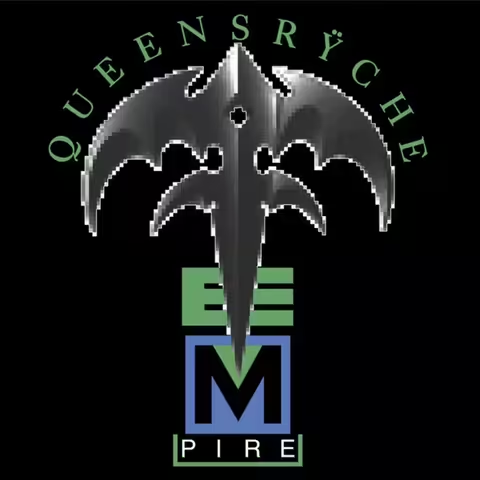
By the late summer of 1990 Queensrÿche had spent two years living inside Operation: Mindcrime, a concept album about brainwashing, addiction and political assassination that critics adored and roughly half a million Americans took home. It was a record that earned the band an arena-rock reputation without the arena-rock sales. They had opened for Metallica, played the songs in sequence to theatres full of people who knew every word, and watched their reviews compete with Pink Floyd and Rush in the year-end lists. They had not, however, broken through. On 4 September 1990, EMI USA released their fourth studio album, a record that pointedly was not a concept piece, was not a political tract and was not in any obvious sense a sequel to Mindcrime. It was called Empire, and within a year it had pushed a tender, orchestral ballad about lucid dreaming into the top ten of the Billboard Hot 100, sent the parent album to number seven on the Billboard 200, and become the only Queensrÿche album to ship three million copies in the United States.
The story of Empire is the story of a band deciding, with their producer, to write songs first and arguments second. After the labyrinthine plotting of Mindcrime, the brief was to compress every idea into five or six minutes and to let the songs carry the weight on their own. The five musicians involved already knew how to play; what Empire asked of them was restraint, melody and a willingness to be heard on FM radio without flinching. It worked. It also, in the long run, set in motion a series of choices about what the band wanted to be, choices that would shape every record they made afterwards and would eventually split the line-up apart.
Album facts
| Field | Detail |
|---|---|
| Artist | Queensrÿche |
| Album | Empire |
| Release date | 4 September 1990 |
| Label | EMI USA |
| Producer | Peter Collins |
| Studios | Vancouver Studios, Vancouver, Canada; Triad Studios, Redmond, Washington (tracks 6, 12, 14); mixed at Royal Recorders Studios, Lake Geneva, Wisconsin; mastered at Masterdisk, New York |
| Genre | Pop metal, progressive metal |
| Track count | 11 |
| Total runtime | 63:23 |
| Billboard 200 peak | 7 |
| UK Albums Chart peak | 13 |
| Other notable peaks | Canada 18, Norway 14, Finland 15, Japan 18, Germany 22, Switzerland 22, Sweden 26, Netherlands 56, New Zealand 50, Australia 127 |
| Certifications | RIAA 3x Platinum (US), Music Canada Platinum, BPI Silver (UK) |
| Estimated sales | Over three million in the United States |
| Key singles | Empire, Silent Lucidity, Best I Can, Jet City Woman |
From Seattle bedrooms to a Mindcrime aftermath
Queensrÿche were not a Seattle band in the grunge sense. They had been formed in Bellevue, a tidy suburb across Lake Washington from the city, in 1980 under the name The Mob. The original line-up paired guitarists Chris DeGarmo and Michael Wilton, bassist Eddie Jackson and drummer Scott Rockenfield with a singer called Geoff Tate, who was working in a club covering Cars songs at the time and was almost not interested. The five of them recorded a four-song demo on borrowed money, pressed it themselves as a self-titled EP under their new umlauted name in 1983, and watched it become a college-radio cult item before the major labels caught on.
EMI signed them on the strength of the EP and released The Warning in 1984, an ambitious, slightly stiff debut that announced their intention to be the next Queen-meets-Iron-Maiden art-metal proposition. Rage for Order followed in 1986, leaning into futurist science fiction and synthesisers and dividing the metal press right down the middle. Then in 1988 came Operation: Mindcrime, the record that fixed the band's identity in concrete. A dystopian narrative about a heroin addict turned political assassin, manipulated by a sinister figure called Dr X and obsessed with a former nun called Sister Mary, it was praised as the heaviest concept record since The Wall and toured as a full theatrical performance. The Mindcrime tour was the making of Queensrÿche as a live proposition. It also exposed the limits of what a sprawling progressive metal narrative could do at radio.
By the time the tour wound down in late 1989, Mindcrime had been certified gold but had nudged only as high as number 50 on the Billboard 200. The band were, in their own retrospective telling, in a strange spot. They were too thoughtful for hair metal, too song-oriented for the underground thrash crowd, and they had just made the most expensive and most ambitious record of their lives without quite cracking the mainstream. The conversations that began in early 1990 were about how to make a Queensrÿche album that did not need a libretto. Tate said in later interviews that the band wanted to prove they could write a self-contained song, not just a movement of a larger work. DeGarmo, who had emerged on Mindcrime as the band's most prolific composer, walked into the new sessions with a folder of material that pointedly stood on its own.
Picking up with Peter Collins again
Peter Collins was a British producer with an unusual CV for a band looking to make a harder, hookier rock record. He had begun in the early 1980s producing British pop singles for Musical Youth and Nik Kershaw before moving into rock with Gary Moore and, decisively, Rush, whose Power Windows in 1985 and Hold Your Fire in 1987 he had produced in the era when Geddy Lee and Alex Lifeson were chasing radio with synthesisers and shorter forms. Queensrÿche had brought him in to produce Mindcrime for exactly those instincts, and the album's success had cemented the relationship. When the band started thinking about the follow-up, Collins was a foregone conclusion.
Collins's working method was direct and a touch unforgiving. He believed in performances rather than overdubs. Instead of allowing the band to layer take after take and stitch a composite together in mixing, he made each musician play a part repeatedly until a clean, committed performance was on tape. He was unsentimental about songs that were not working and unembarrassed about asking for hooks. For a band who had spent the previous record building intricate cross-references between songs, the new instruction set was clarifying. Collins wanted them to think like songwriters, not like film composers.
His pop instincts also turned out to suit the material. DeGarmo's new songs were structurally simpler than the Mindcrime suites, organised around verse and chorus rather than around plot developments, and they wanted production that supported melody rather than concealed it. Collins came in with engineer James Barton, an English studio veteran who had cut his teeth at Sarm West with Trevor Horn and had handled Mindcrime alongside him. Together they would steer the band away from the dense theatrical staging of the previous record and toward a sound that was bigger, brighter and considerably more direct.
Recording at Vancouver Studios
The main sessions were booked at Vancouver Studios in Vancouver, Canada, a city the band knew from previous trips and one that gave them the geographical separation they wanted from home distractions. Vancouver in 1990 had a small but serious recording infrastructure, comfortably within a day's drive of Seattle, and Vancouver Studios in particular had the kind of large tracking room a five-piece with two guitarists and a drummer who hit hard would actually use. The choice has been repeatedly garbled in the years since into stories about the album being made in Redmond, Washington, but the bulk of the tracking was Canadian. Redmond, the band's home base just east of Seattle and the home of Triad Studios, came in for specific cuts rather than the main effort.
Three tracks on the extended edition of Empire were recorded at Triad with engineer Paul Northfield, the Canadian engineer best known at the time for his long working relationship with Rush. Those were the title track itself and the two extra cuts that appear on later editions of the album as tracks 12 and 14. Northfield's involvement reflected a wider habit of the period: bands with a primary studio and a primary engineer often picked up an additional room and a different ear for a handful of songs, partly for practical scheduling reasons and partly to keep the sonics from converging too much across an hour-long record.
James Barton handled most of the engineering and all of the mixing. Mixing happened not in Vancouver and not in Redmond but in Lake Geneva, Wisconsin, at Royal Recorders Studios, a residential complex on the shore of Geneva Lake that had become a favoured destination for rock acts looking to spend a quiet month finalising a record. Assistant engineer Marcus Ramaer worked alongside him, with Dan Harjung listed as the mixing assistant. Once the mixes were locked, the tapes travelled to New York, where Bob Ludwig mastered at Masterdisk, his name on the credits a near-guarantee of presence on rock radio at the time.
The recording itself stretched over several months in the first half of 1990, longer than any Queensrÿche album to date, with the band moving back and forth between rented accommodation in Vancouver and home in Washington. Collins's insistence on repeated, committed takes meant the calendar slipped, but the slip was deliberate. The band have spoken in subsequent interviews about Empire being the first record where they really felt comfortable with extended studio time, where the day-to-day grind of tracking stopped being a source of friction and started feeling like part of the job. None of them were married to the idea of capturing first takes. They wanted a record that sounded inevitable.
Writing for radio without losing the prog
If Mindcrime had been an ensemble piece, Empire was a Chris DeGarmo album in everything but name. The credits tell the story. DeGarmo has sole or co-writing credit on every one of the eleven tracks, and he is the only solo songwriter on the record, with Silent Lucidity. His co-writers shift song by song: Geoff Tate on most of the lyrics-led songs, Michael Wilton on the harder rock cuts, Scott Rockenfield on Della Brown, Eddie Jackson on Another Rainy Night (Without You). On Mindcrime there had been entire stretches where the band wrote together in a rehearsal room. On Empire, much more of the material arrived pre-formed, demoed by DeGarmo at home and brought into the band for arrangement.
The shift had musical consequences. The songs are tighter, the choruses are taller, and the lyrics turn outward. Tate's words on Empire are about specific things and specific people: a homeless woman in a Seattle alley, a disabled friend, a wife missed from the road, the cost of urban decay in the Reagan and Bush years. There is no overarching narrative and no character names beyond first names. Where Mindcrime had asked the listener to remember the politics of an entire fictional underground, Empire only asks them to listen to one song at a time.
What it does not do is abandon the band's progressive vocabulary. The longer tracks, Della Brown at seven minutes and Anybody Listening? at nearly eight, still take their time. The harmonic vocabulary is still drawn from the Queen and Rush playbooks the band had used from the start. Wilton's lead playing is still ornate. Tate's vocals still reach for operatic notes when the song calls for it. The trick of Empire is that it carries all of that inside containers radio can play. Three of its four singles got airplay in the United States not despite their structural ambition but because the arrangements never lose sight of the chorus.
Wilton and DeGarmo divided the lead guitar work song by song, an unusual arrangement for a twin-guitar band. Wilton took the leads on Empire, Resistance and Another Rainy Night (Without You). DeGarmo took Best I Can, Jet City Woman, Silent Lucidity and Anybody Listening?. Other tracks featured solos from both. The split kept the sonic palette varied across the record and reflected an internal etiquette in which whichever guitarist had brought the song in tended to take the lead break.
Silent Lucidity and the Michael Kamen orchestra
Silent Lucidity began as a Chris DeGarmo demo with acoustic guitar and a vocal sketch. He has cited his interest in lucid dreaming research as the lyrical starting point, the song addressed to a listener experiencing a nightmare and being talked through the realisation that they can control what happens next. The melody was unguarded in a way the rest of the album was not, and when DeGarmo first played it to the band there was, by several accounts, a long pause before anyone spoke. Putting it on a Queensrÿche record at all was not a foregone conclusion. Putting it on as the centrepiece of side two, with full orchestration, certainly was not.
The decision to orchestrate the song belonged to Collins and the band together, and the man brought in to do it was Michael Kamen. Kamen was already a celebrated arranger by 1990. He had scored The Wall stage shows with Pink Floyd in the early 1980s, written the orchestral parts of Pink Floyd's The Final Cut, conducted strings for Eric Clapton, and was about to embark on the run of Hollywood film scores, from Lethal Weapon to Robin Hood, that would define his next decade. He arrived in Vancouver, listened to the demo, wrote the chart on a flight back to London and conducted the orchestra himself when the strings were recorded.
The result was a song that almost every critic eventually compared to Comfortably Numb, sometimes admiringly and sometimes not, with Kamen as the obvious through-line. The comparison was not unfair, but it understated how unusual the arrangement felt at the time on an album sold in the metal racks. Silent Lucidity was released as a single in March 1991, six months after the parent album, and became Queensrÿche's only top-ten hit in the United States, peaking at number nine on the Billboard Hot 100 and topping the Mainstream Rock Tracks chart. It was nominated for two Grammys the following year, for Best Rock Song and Best Rock Vocal Performance by a Duo or Group with Vocals, and lost both. It also doubled the sales trajectory of the album in the United States almost overnight.
The orchestral instinct did not stop at Silent Lucidity. Strings appear on Della Brown and again on Anybody Listening?, the closing track, contributing to a record that, taken as a whole, sits considerably closer to art rock than the band's previous catalogue would have predicted. Listeners coming to Empire from Mindcrime sometimes had to be reminded that this was the same five musicians.
Track by track
| # | Title | Writer(s) | Length | Single? | Notes |
|---|---|---|---|---|---|
| 1 | Best I Can | DeGarmo | 5:30 | Single (June 1991) | DeGarmo lead guitar |
| 2 | The Thin Line | DeGarmo, Tate, Wilton | 5:42 | The line between clarity and madness | |
| 3 | Jet City Woman | DeGarmo, Tate | 5:20 | Single (August 1991) | DeGarmo lead guitar |
| 4 | Della Brown | DeGarmo, Rockenfield, Tate | 7:04 | Strings; portrait of a homeless woman | |
| 5 | Another Rainy Night (Without You) | DeGarmo, Jackson, Tate | 4:44 | Wilton lead guitar | |
| 6 | Empire | Tate, Wilton | 5:07 | Single (October 1990) | Wilton lead guitar; Randy Gane answering-machine intro; tracked at Triad |
| 7 | Resistance | Tate, Wilton | 4:47 | Wilton lead guitar | |
| 8 | Silent Lucidity | DeGarmo | 5:45 | Single (March 1991) | DeGarmo lead guitar; Michael Kamen orchestration |
| 9 | Hand on Heart | DeGarmo, Tate, Wilton | 5:30 | ||
| 10 | One and Only | DeGarmo, Wilton | 5:52 | ||
| 11 | Anybody Listening? | DeGarmo, Tate | 7:40 | DeGarmo lead guitar; strings; closing track |
Best I Can opens the record at a brisk five and a half minutes and sets out the new template without preamble. DeGarmo wrote it about a friend with a physical disability, casting the song as an interior monologue of someone determined to make the most of the body they have. The riff is one of the harder things on the record, and DeGarmo's solo near the end is the kind of melodic statement that the band would not have made in 1986. The Thin Line, second up, returns the band to the territory of mental fragility that Mindcrime had explored, with Tate's lyric circling the boundary between insight and breakdown.
Jet City Woman is Tate's love song to his then-wife, written from a tour bus and named after Seattle's old aviation nickname. It became one of the album's signature radio cuts, with a swung chorus and a guitar arrangement that has DeGarmo answering his own vocal lines. Della Brown, by contrast, is the album's pity-and-anger song. Written by DeGarmo, Tate and Rockenfield together, it is a portrait of a real or composite homeless woman in Seattle and uses Kamen's strings to widen the scale of what is, on paper, a small character study.
Another Rainy Night (Without You) is the band's gesture toward straight-ahead pop metal, an unguarded romantic song with Wilton's leads and a chorus that radio programmers in 1990 would have recognised on first listen. The title track Empire, written by Tate and Wilton, opens with a sampled news segment and a synthesised answering-machine voice supplied by Randy Gane, an old friend of the band, before launching into one of the heaviest grooves on the album. The lyric is a piece of late-Reagan social commentary about urban crime and police budgets that does not flinch from naming the politics; Tate cites statistics about the cost of incarceration over Rockenfield's bass-drum pattern. It was the first single, released a month after the album, and it set the lyrical seriousness of the record on the table immediately.
Resistance keeps the political mood with a faster tempo and a Wilton solo, and Hand on Heart and One and Only round out the harder material on the second half. Anybody Listening? closes the album at almost eight minutes, written by DeGarmo and Tate as a defence of the band's creative freedom against the pressures of the music business. The arrangement builds from acoustic guitar through Kamen's strings into a full electric coda. It is the album's emotional summing-up, and it pairs with Silent Lucidity as the two ballads that anchor side two of the LP.
Personnel and guests
| Role | Player | Notes |
|---|---|---|
| Core band | ||
| Lead vocals, keyboards | Geoff Tate | |
| Guitars | Chris DeGarmo | Lead on Best I Can, Jet City Woman, Silent Lucidity, Anybody Listening? |
| Guitars | Michael Wilton | Lead on Empire, Resistance, Another Rainy Night (Without You) |
| Bass, backing vocals | Eddie Jackson | |
| Drums, percussion | Scott Rockenfield | |
| Guest and session musicians | ||
| Orchestral arrangements, conductor | Michael Kamen | Strings on Silent Lucidity, with further string arrangements on Della Brown and Anybody Listening? |
| Answering-machine voice | Randy Gane | Intro to the title track Empire |
| Keyboards, keyboard programming | Robert Bailey | |
| Production and engineering | ||
| Producer | Peter Collins | |
| Engineer, mixing | James Barton | Mixed at Royal Recorders Studios, Lake Geneva, Wisconsin |
| Assistant engineer | Marcus Ramaer | |
| Mixing assistant | Dan Harjung | |
| Engineer (tracks 6, 12, 14) | Paul Northfield | Recorded at Triad Studios, Redmond, Washington |
| Mastering | Bob Ludwig | Masterdisk, New York |
The headline guest is Kamen, but the contribution of Robert Bailey on keyboards and programming is worth singling out. Tate handled some of the keyboard parts himself, as he had on previous Queensrÿche records, but Bailey filled in the textures Collins wanted across the album, particularly the synth pads that thicken the choruses on Best I Can and Hand on Heart. Randy Gane's contribution to Empire is brief but instantly recognisable: the synthetic voice that opens the title track was created and recorded by him as a favour to the band.
Paul Northfield's appearance in the credits is the technical curiosity of the record. The fact that the title track, the song that names the album, was tracked at Triad in Redmond with Northfield rather than in Vancouver with Barton is one of those small production decisions that has confused subsequent commentators. The reason was a mix of scheduling and acoustic preference; Triad had a different live room from Vancouver Studios and the band wanted a particular feel for the song. The two later additional cuts that share the Northfield credit were recorded in the same window and were originally B-sides or bonus material before being added to expanded editions of the album.
Release and reception
EMI USA released Empire on 4 September 1990. The campaign began with the title track as the first single in October, accompanied by a video built around the song's social commentary, and the album entered the Billboard 200 in the autumn. The initial sales were strong but unremarkable by the standards of what came later: the album moved on the back of the band's existing fan base, with the title track getting solid Mainstream Rock airplay and album-rock stations picking up Jet City Woman as a deeper cut. The real inflection point was the second single.
Silent Lucidity was issued in March 1991, six months into the album's life, and changed the trajectory completely. Within a few weeks it was on rotation at adult-contemporary and pop stations as well as rock, and the video became one of the few metal-adjacent clips in regular MTV daytime rotation that year. The song climbed steadily, eventually reaching number nine on the Hot 100 and number one on Mainstream Rock Tracks in the spring of 1991. The parent album, which had been settled in the middle of the chart, climbed back up to its peak of number seven on the Billboard 200 in the slipstream, and the year-end Billboard 200 for 1991 listed Empire at number nine. It returned to the year-end chart in 1992 at number 67.
Critical reception, then as now, split along familiar lines. Greg Henderson's AllMusic review awarded the record four-and-a-half stars out of five and praised its "song-oriented approach that is more art rock and less metal", noting that Queensrÿche had finally found a way to write hooks without compromising their musicianship. The Rolling Stone Album Guide rated it three-and-a-half. The Entertainment Weekly notice on 12 October 1990, written by Jim Farber, was unkind: he gave it a D and called the band "relentless killjoys", a phrase that has followed the album around for thirty-five years and is still wheeled out by detractors. The 20th-anniversary reappraisal in PopMatters by Adrien Begrand, published on 7 October 2010, settled at six out of ten and characterised the record as an "enigma", "beautifully produced" with "some of the band's quintessential songs" but also "rather bloated, conceptually scattershot piece of work containing filler that honestly has not aged very well". William Pinfold's anniversary piece for Record Collector gave it three out of five and described the record as "very pleasant, but only intermittently gripping".
The split is recognisable to anyone who has followed the band's reception. Listeners who came in for the songwriting and the production tended to praise it. Listeners who came in expecting another Mindcrime tended to find it diffuse. Both groups were right about what they heard.
Chart life, certifications and the Grammys
The chart performance of Empire is the strongest in the Queensrÿche catalogue by a clear margin. In the United States it peaked at number seven on the Billboard 200, the highest position any of their albums has ever reached, and it topped the Radio and Records AOR chart. Outside North America it became their first genuine international hit, reaching number 13 on the UK Albums Chart, number 14 in Norway, number 15 in Finland, number 18 in Japan and Canada, number 22 in Germany and Switzerland, number 26 in Sweden, number 50 in New Zealand, number 56 in the Netherlands and number 127 in Australia. The full territorial picture is laid out below.
| Territory | Chart | Peak |
|---|---|---|
| United States | Billboard 200 | 7 |
| United States | Radio and Records AOR | 1 |
| United Kingdom | UK Albums Chart | 13 |
| Canada | Top Albums | 18 |
| Japan | Oricon | 18 |
| Norway | VG-lista | 14 |
| Finland | Suomen virallinen lista | 15 |
| Germany | Offizielle Top 100 | 22 |
| Switzerland | Schweizer Hitparade | 22 |
| Sweden | Sverigetopplistan | 26 |
| Netherlands | Album Top 100 | 56 |
| New Zealand | RMNZ | 50 |
| Australia | ARIA | 127 |
Certifications followed the sales. The RIAA certified Empire three-times platinum in the United States, for three million units shipped, making it by some distance the biggest-selling album in the Queensrÿche catalogue. Music Canada certified it platinum for 100,000 sales north of the border, and the British BPI awarded silver for 60,000. No Queensrÿche record before or since has reached those numbers in any of those territories.
The Grammys nominated Silent Lucidity in two categories at the 1992 ceremony, Best Rock Song and Best Rock Vocal Performance by a Duo or Group with Vocals. The song lost in both, but the nominations themselves were a marker of the album's mainstream legitimacy: Queensrÿche had been a heavy rock band whose album sales had outpaced their critical reach, and the Grammys had pivoted to recognise a single song that could not really be classified as metal. Closer to home, the 1991 Northwest Area Music Awards named Empire the year's Best Metal Recording, a Pacific Northwest regional accolade that the band noted at the time was more meaningful to them than the trade press might assume.
- RIAA 3x Platinum (United States, three million units)
- Music Canada Platinum (100,000 units)
- BPI Silver (United Kingdom, 60,000 units)
- Billboard 200 year-end 1991: number 9
- Billboard 200 year-end 1992: number 67
- 1992 Grammy nominations for Silent Lucidity in two categories
- 1991 Northwest Area Music Award, Best Metal Recording
Building Empires Tour and what came next
The Building Empires Tour ran from late 1990 through to mid-1992 and was the band's first proper headlining arena tour. On the Mindcrime cycle they had supported Metallica in the Damaged Justice run, opening to audiences who were not always there to see them; on Building Empires they were on top of the bill in their own right, with their own stage production and their own choice of support. The set leaned heavily on Empire, of course, but the structure of the show built up to a complete performance of Operation: Mindcrime in sequence, the suite-form predecessor folded into the headline-act package. Several legs of the tour were filmed and released as the Building Empires home video.
What followed the tour was, in retrospect, the slow tilt of the band's commercial arc. Promised Land arrived in 1994 to strong reviews and respectable sales but never matched the Empire numbers; Hear in the Now Frontier in 1997 was the last record with the classic line-up, after which Chris DeGarmo left the band amid creative disagreements that have been reported in detail by both sides over the subsequent decades. Replacing DeGarmo proved difficult. The records that followed in his absence, including the second Mindcrime in 2006, found a smaller and more dedicated audience.
The most public rupture came in 2012, when Geoff Tate was legally separated from the band after a series of on- and off-stage incidents during the second Mindcrime cycle. The two parties spent two years in litigation over the Queensrÿche name. The settlement that emerged in 2014 left the original four instrumentalists, Wilton, Jackson, Rockenfield and the by-then long-departed DeGarmo on paper at least, with the rights to the name, fronted by new singer Todd La Torre. Tate continued under the name Operation: Mindcrime, releasing a trilogy of records under that banner before retiring it.
Through all of that, Empire has remained the commercial high-water mark and the cultural reference point. It is the album that introduces most listeners to the band, the one whose songs appear on hard-rock retrospectives, and the one whose anniversary editions sell. The 20th-anniversary edition in 2010 added bonus material, including live recordings and demos, and was the occasion for the wave of reappraisal pieces in PopMatters, Record Collector and elsewhere quoted earlier. The album sits, three and a half decades after its release, in a peculiar canonical position. It is too tuneful for the underground purists who prefer Rage for Order, too commercial for the Mindcrime devotees, and yet undeniably the record that put Queensrÿche in front of an audience large enough that the band's name became part of the standard 1990s rock vocabulary.
It is also, viewed from the present, a snapshot of what mainstream rock could still sound like in the months before grunge arrived. Nevermind would land less than a year after Empire, from a different Seattle, with a different set of values and a different label model behind it. The space that Empire occupied, an album of intelligent, well-produced, song-oriented hard rock that could go top ten without compromise, was a space that closed quite quickly after 1991. For one strange year, Queensrÿche were on the right side of that closing window, and the record they made for it has outlasted most of its contemporaries.
For listeners coming back to Empire now, the things that struck critics at the time still strike. Silent Lucidity remains the obvious entry point and the song that everybody knows; the title track is the political statement that has aged into period detail; Jet City Woman is the radio cut with a Seattle dateline; Anybody Listening? is the closing argument from a band that did not yet know how much of the music industry it was about to outlast. Empire was the record on which Queensrÿche made the transition from cult to mainstream, and the record on which they paid the deposit for everything that came afterwards. It remains, in commercial terms, the album by which the band is measured.
Comments