
In October 1995 the loudest sound in American rock was a year-old void. Kurt Cobain had been dead since the previous April, grunge was sliding into a long, awkward hangover, and the labels that had bet everything on flannel and feedback were quietly looking for whatever came next. In Anaheim, a ska band who had been signed to Interscope since 1991 were finishing a third album nobody at the label especially wanted, on a budget nobody at the label especially wanted to spend, with a producer the band had never heard of and a singer who had only recently agreed to write her own lyrics. Their self-titled debut had moved 30,000 copies. The self-funded follow-up, The Beacon Street Collection, was edging towards 100,000 out of the boot of the bassist's car. On 10 October 1995 they released a record called Tragic Kingdom. Within four years it would be certified Diamond and No Doubt would be one of the biggest bands in the world.
It is one of the strangest commercial trajectories in the modern history of major-label rock: a ska-punk record made in eleven different Los Angeles studios over thirty months, produced by a man best known for a 1984 synth-pop hit, written largely in the wreckage of a seven-year romance between two of its members, and held together by a singer whose older brother quit the band halfway through recording. Tragic Kingdom should have been a mess. Instead it became the album that made Gwen Stefani a household name and dragged the third-wave ska revival into the centre of mainstream pop. This is how it happened.
| Field | Detail |
|---|---|
| Artist | No Doubt |
| Album | Tragic Kingdom |
| Release date | 10 October 1995 |
| Label | Trauma Records, Interscope Records |
| Producer | Matthew Wilder |
| Studios | Total Access (Redondo Beach), The Record Plant (Hollywood), NRG, Rumbo Recorders, Mars (Burbank), Santa Monica Sound, Studio 4 (Santa Monica), Grandmaster (Hollywood), Clear Lake Audio (North Hollywood), Red Zone (Burbank), North Vine (Hollywood) |
| Genre / subgenre | Pop rock, alternative rock, ska punk, new wave, pop-punk |
| Track count | 14 |
| Total runtime | 59:35 |
| Billboard 200 peak | 1 (nine non-consecutive weeks, December 1996 onwards) |
| UK Albums Chart peak | 3 |
| Other notable peaks | Canada 1, New Zealand 1, Norway 1, Finland 1, Belgium (Fl) 1, Belgium (Wa) 1, Denmark 1, Austria 2, Germany 2, Netherlands 2, Australia 3, Sweden 3, Switzerland 3 |
| Certifications | US Diamond (RIAA, 5 February 1999), Canada Diamond, Australia 4x Platinum, New Zealand 5x Platinum, Sweden 2x Platinum, UK Platinum, France 2x Gold, Germany Gold |
| Estimated sales | 16 million worldwide (by April 2004) |
| Key singles | Just a Girl, Spiderwebs, Don't Speak, Sunday Morning, Excuse Me Mr., Happy Now?, Hey You! |
From Anaheim ska band to Interscope project
No Doubt began in 1986 as the side project of John Spence, a young singer working at a Dairy Queen in Anaheim, and his friend Eric Stefani, a keyboardist with a love of musical theatre, Madness and Oingo Boingo. Eric pulled in his younger sister Gwen to share backing vocals, and the band quickly built up a local following on the Orange County ska circuit, which by the late 1980s had blossomed into a genuine scene with two-tone and dancehall acts trading bills at the Marquee in Westminster and the Roxbury in Anaheim. The original lineup was a chaotic seven-piece with horns and percussion, anchored by Spence's frenetic stage presence and Eric's keyboard arrangements.
On 21 December 1987, three days before a planned showcase at the Roxy in Los Angeles, Spence took his own life at a park in Anaheim. The band considered breaking up. They did not. Within weeks Gwen Stefani, who had only ever sung harmonies, was promoted to co-lead alongside trumpeter Alan Meade, and when Meade himself left the following year she took over the front of the stage entirely. By 1988 the lineup had stabilised around the Stefani siblings, bassist Tony Kanal, who had joined that year as a teenager, and drummer Adrian Young, who replaced original drummer Chris Webb in 1989. Guitarist Tom Dumont, formerly of the metal band Rising, came in to replace Jerry McMahon in 1989. That core five would record everything No Doubt released for the rest of the decade.
Interscope Records signed the band in 1991 on the recommendation of Tony Ferguson, an A and R man who had caught them at a club night in Fender's Ballroom in Long Beach. The self-titled debut, produced by Dito Godwin and released in March 1992, sold around 30,000 copies, almost all of them in Southern California. Interscope, distracted by the runaway commercial success of Nirvana, Dr. Dre and the Geto Boys on its sister labels, effectively shelved the band. The label declined to fund a follow-up, the music press ignored them, and college radio, the band's natural home, was busy with the Pixies and Pavement and had no time for an Anaheim ska act with synthesised horns.
The band's response was to make a record anyway. Through 1993 and 1994 they self-funded what would become The Beacon Street Collection, named after the Anaheim house Tom and Tony shared, where most of it was tracked on a borrowed 16-track. Released in March 1995 on the band's own Beacon Street label, it eventually moved 100,000 copies, mostly through merch tables on tour. It was enough to convince Interscope, by then watching the lower reaches of the Modern Rock chart fill up with horns again, that a third No Doubt album might be worth one more roll of the dice. Tony Ferguson paired them with Matthew Wilder, the singer-songwriter best known for the 1984 synth-pop number five Break My Stride, and who had been quietly building a second career as a pop producer for Hollywood Records. The marriage was unobvious. It would also turn out to be exactly right.
Eric leaves and Gwen takes over
The architect of No Doubt's first decade was Eric Stefani. He had written or co-written almost every song on the debut, most of The Beacon Street Collection, and was the band's principal arranger and creative voice. He was also, by his own later admission and his bandmates' contemporary accounts, increasingly unwell. The long, fragmented Tragic Kingdom sessions, which began with demos in early 1993 and dragged on through 1994 into the autumn of 1995, coincided with a deepening depression. Eric's perfectionism, which had carried the band through their amateur years, curdled into a paralysis that the others could not reach.
By September 1994 he had stopped attending rehearsals at his own house, which had been the band's de facto headquarters. Tom Dumont later described the situation to Backstage Online with a candour the band rarely showed in print:
"Eric quit the band before the album was even finished. It was tough on all of us. He was the main songwriter for a long time, but his ideas were getting darker and he was withdrawing. He needed to do something else, so he left, and the rest of us had to figure out what kind of band we were going to be without him."
Tom Dumont, Backstage Online, 1997
Eric did not vanish completely. He remained credited as a writer or co-writer on five of the album's fourteen tracks, including the title song and the eventual breakout single Don't Speak, and he played keyboards on much of the record. But by the time the album appeared in October 1995 he had formally left the group to pursue a career as an animator on The Simpsons, where he would work for several years on the show's distinctive background art. His departure forced a structural change inside No Doubt that nobody had quite planned for: with Eric gone, Gwen Stefani became the band's principal lyricist.
The other catalyst was personal. Tony Kanal and Gwen had been in a relationship for almost the entire history of the band, an open secret on the Anaheim scene and a complicated dynamic inside a five-piece touring van. In the summer of 1994 Kanal ended it. The reasons he later cited, in interviews around the album's release, were straightforwardly mundane: he was twenty-three, he wanted to focus on the band, he was not ready for the level of commitment Gwen had assumed they were heading towards. The end of that relationship, more than any other single event, shaped what Tragic Kingdom became. Eight of its fourteen songs are about it in some form, three of them explicitly, and the album's emotional centre, Don't Speak, was originally an Eric Stefani love song that Gwen rewrote almost line by line into a breakup ballad. Adrian Young, by then the band's anchor as the only member uninvolved in the romantic implosion, would later describe the studio sessions as the most awkward of his life.
Recording across eleven Los Angeles studios
It is rare for a major-label rock album to be tracked across more than three or four studios. Tragic Kingdom was made in eleven. The list, taken from the album's gatefold credits, reads like a tour of every functioning room in Greater Los Angeles in the mid-1990s: Total Access in Redondo Beach, The Record Plant in Hollywood, NRG, Rumbo Recorders, Mars in Burbank, Santa Monica Sound, Studio 4 in Santa Monica, Grandmaster in Hollywood, Clear Lake Audio in North Hollywood, Red Zone in Burbank and North Vine in Hollywood. The reason, prosaically, was money. Interscope's commitment to the project was modest, the band's working schedule had to fit around Wilder's other production commitments, and rooms were booked piecemeal as budget and availability allowed. The result was a record made in fragments over thirty months, from early 1993 demos through to final overdubs in the autumn of 1995.
The engineering credits reflect the same patchwork. Phil Kaffel handled the bulk of the album, working on tracks three to ten and the closing title piece. George Landress engineered tracks three, six and seven. Matt Hyde, later a noted hard-rock producer, took tracks one, two and thirteen. John "Tokes" Potoker engineered tracks eleven to thirteen. Ray Blair engineered track five. Each room had its own quirks, its own house preamps, its own monitoring, and one of Wilder's quieter feats as producer was to make the finished album sound coherent across so many different rooms.
Wilder's production approach was, by his own description, unapologetically pop. He had grown up on Steely Dan and Carole King as much as on the post-punk of his own peer group, and he heard in the band's demos something closer to a Pretenders record than to the ska-revival sound they had built their reputation on. He tightened the arrangements, pulled the horn parts back from foreground to colour, pushed Gwen's vocals to the front of every mix, and encouraged the band to write songs with clear verses and choruses rather than the long jams that had marked the live show. Tom Dumont's guitar parts, which on the earlier records had been buried under keyboards and horns, were placed front and centre with a clean, mid-heavy tone modelled on Andy Summers and Johnny Marr. Adrian Young's drumming, looser than the genre usually allowed, was kept dry and close-mic'd. Tony Kanal's bass, which would carry much of the album's melodic weight, was DI'd as often as it was amplified.
Two other figures shaped the record from outside the room. The first was Paul Palmer, the British engineer and mixer who had recently finished work on Bush's Sixteen Stone, then in the middle of its slow climb up the American charts. Palmer's contemporary, radio-friendly mix template would be a major part of why Tragic Kingdom sounded current in 1996 rather than dated to 1993. The second was Rob Kahane, the manager whose Trauma Records imprint, distributed through Interscope, would take the contract for the album when the parent label hesitated. Trauma's commitment, modest but real, gave the band a champion inside the building. By the time the masters were delivered in the late summer of 1995, the record had passed through more hands and more rooms than any No Doubt project before or since.
The mix and the artwork
Mixing followed the same fragmented logic as tracking. The first single, Just a Girl, was mixed in isolation by David J. Holman, an engineer with a track record on punk-adjacent acts including L7 and the Offspring, who gave the song its bright, compressed radio sheen. When the rest of the record came to be mixed, Holman was paired with Paul Palmer at Cactus Studios in Hollywood, and the two of them worked through the remaining thirteen tracks across several weeks in mid-1995. Mastering was handled by Robert Vosgien at CMS Digital in Pasadena, a room better known for classical and jazz work, which is part of why the finished album has the unusual top-end clarity for a rock record of its era.
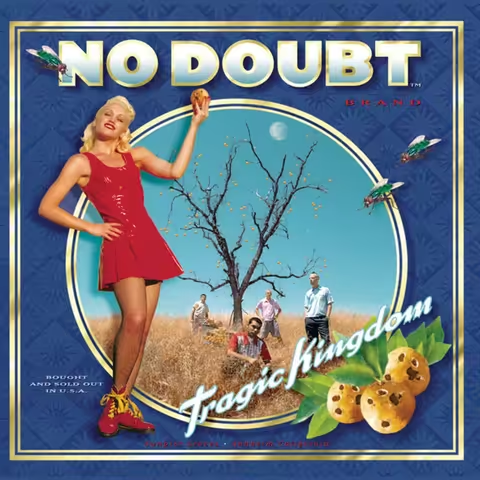
The title arrived late and from an unlikely source. Tom Dumont, asked in an interview years later where the name came from, attributed it to his seventh-grade teacher in Fullerton, who had referred to nearby Disneyland as the Tragic Kingdom rather than the Magic Kingdom. The joke had stuck in his head for fifteen years. The band liked the phrase because it was specific to where they came from. Disneyland sits in Anaheim, where all five of them had grown up, and the park's outsized presence in the local imagination, half employer, half exoskeleton, was something every Orange County kid understood. The album is in many ways about that part of California, and the title cemented it.
The cover photograph, shot by Daniel Arsenault, was taken in the orange groves on the edge of the City of Orange, a few miles east of Anaheim. The band stand in formation in the foreground, Gwen at the front in a striking red dress, Tony and Tom and Adrian behind her, and Eric placed deliberately at the back of the frame holding a half-eaten orange. Eric's inclusion in the photograph was Gwen's insistence: he had quit the band weeks before the shoot, but she did not want the cover to lie about who had made the record. The dress itself, designed for the shoot, was later donated to the Fullerton Museum Center, where it formed part of an exhibition on No Doubt and the local Orange County music scene. In January 2005 it was stolen from the exhibit and has never been recovered.
Track by track
| # | Title | Writer(s) | Length | Single | Notes |
|---|---|---|---|---|---|
| 1 | Spiderwebs | G. Stefani, T. Kanal | 4:28 | Yes (2) | Stephen Perkins on steel drum |
| 2 | Excuse Me Mr. | G. Stefani, T. Dumont | 3:04 | Yes (5) | Dumont's first major songwriting credit |
| 3 | Just a Girl | G. Stefani, T. Dumont | 3:29 | Yes (1) | Wilder on additional keyboards |
| 4 | Happy Now? | G. Stefani, T. Dumont | 3:43 | Yes (6) | About the end of the Kanal relationship |
| 5 | Different People | E. Stefani, G. Stefani, T. Kanal | 4:34 | No | Albhy Galuten credited as "director of paradigm" |
| 6 | Hey You! | E. Stefani, G. Stefani | 3:34 | Dutch only | Aloke Dasgupta on sitar |
| 7 | The Climb | E. Stefani | 6:37 | No | Longest track on the album |
| 8 | Sixteen | G. Stefani, T. Dumont | 3:21 | No | Melissa Hasin on cello |
| 9 | Sunday Morning | E. Stefani, G. Stefani, T. Kanal | 4:33 | Yes (4) | Reworked from a pre-breakup Eric song |
| 10 | Don't Speak | E. Stefani, G. Stefani | 4:23 | Yes (3) | Cello by Melissa Hasin |
| 11 | You Can Do It | E. Stefani, G. Stefani | 4:13 | No | One of the older songs in the set |
| 12 | World Go 'Round | E. Stefani, G. Stefani, T. Kanal | 4:09 | No | Heaviest reggae feel on the record |
| 13 | End It on This | G. Stefani, T. Kanal | 3:45 | No | One of two Stefani / Kanal-only co-writes |
| 14 | Tragic Kingdom | E. Stefani | 5:31 | No | The last song Eric wrote for the band |
Spiderwebs opens the album with a horn fanfare and a Tony Kanal bassline that almost no other ska-adjacent record of the period would have used as its lead instrument. The song was written by Stefani and Kanal about an unnamed admirer who had taken to calling Gwen's home phone at all hours, leaving lengthy answerphone messages she had no interest in returning. Stephen Perkins, the drummer from Jane's Addiction, plays steel drum on the track, a guest appearance arranged through Wilder; it is the only one Perkins makes on the album. The song's verse-to-chorus dynamics, built around a sudden lift into the title hook, became the template for the band's singles that followed.
Just a Girl is the song most listeners encountered first, partly because Interscope released it as the lead single three weeks before the album and partly because it became the album's enduring radio standard. The lyric, written by Gwen with music by Tom Dumont, has its origins in a specific domestic argument: Gwen's father had become increasingly anxious about her late-night drives home from Kanal's house in Yorba Linda to the Stefani family home in Anaheim, and had imposed an unofficial curfew. The song's frustration is specific and small, and that is precisely what made it work. It was one of the first major American radio hits in years to put the irritation of being a young woman in a contested public space at the centre of the chorus.
Don't Speak, the album's third single and the song that broke the band internationally, began life as a love song. Eric Stefani had written most of it as a tender ballad to a girlfriend, and the band had been performing it live in that form since 1994. After the Kanal and Gwen relationship ended, Gwen rewrote the lyric almost entirely, keeping Eric's melody and chord changes but turning what had been a song of devotion into a quietly devastating breakup. The final recording, with Melissa Hasin's cello shadowing the melody and a flamenco-style acoustic solo from Tom Dumont, has been covered hundreds of times and remains one of the most-played songs of the late 1990s on adult contemporary radio.
Sunday Morning has the most painful backstory on the record. Eric had written the original version as a sunny pop song before the Kanal breakup. Tony and Gwen are widely reported to have had their final argument as a couple in the bathroom of Kanal's parents' house in Yorba Linda, with Gwen on one side of the door and Tony on the other. Gwen then rewrote the lyric, with Eric and Tony both still credited as co-writers, into something far less sunny. The finished version, with its skipping bassline and one of Adrian Young's most playful drum parts, sits in the middle of side two like a hinge: it is the moment the album turns from the bright early singles into the heavier emotional material around it.
Sixteen, an under-discussed deep cut, is a Stefani / Dumont song about teenage powerlessness, with a string arrangement that is one of the album's quieter beauties. The Climb, written entirely by Eric and at six and a half minutes the longest track on the album, is the most overt nod to the band's earlier theatrical-ska sound; it is also the song that points most clearly towards the kind of work Eric would later do as a solo artist. Different People, credited to Eric, Gwen and Tony, carries the curious credit "director of paradigm" for Albhy Galuten, the veteran producer of the Bee Gees' Saturday Night Fever; the precise nature of his contribution has never been fully explained, but the song's polished disco-funk feel suggests he had a real hand in it.
The closing title track is the last song Eric Stefani wrote for the band. A slow, melancholy piano-led piece, it is not a single, has never been performed live in full, and sits at the end of the album like an exhalation. It is also, in retrospect, the most explicit statement on the record of where Eric was emotionally as the project was finishing. The album takes its name from this song as much as from Tom Dumont's seventh-grade teacher.
Personnel and guests
| Role | Player | Notes |
|---|---|---|
| Core band | ||
| Lead vocals | Gwen Stefani | Principal lyricist |
| Guitar | Tom Dumont | Songwriting credit on Spiderwebs, Just a Girl, Excuse Me Mr., Happy Now?, Sixteen |
| Bass | Tony Kanal | Co-writer on six tracks |
| Drums, percussion | Adrian Young | The only member without a writing credit |
| Piano, keyboards | Eric Stefani | Co-writer on five tracks; departed before completion |
| Horn section | ||
| Trumpet | Phil Jordan | Lead horn arrangements |
| Trombone | Gabrial McNair | Later a long-term touring member |
| Saxophone | Gerard Boisse | |
| Saxophone | Bill Bergman | |
| Trumpet | Les Lovitt | |
| Saxophone | Greg Smith | |
| Trombone | Nick Lane | |
| Guest musicians | ||
| Steel drum | Stephen Perkins | Track 1 (Spiderwebs) only; Jane's Addiction drummer |
| Sitar | Aloke Dasgupta | Track 6 (Hey You!) |
| Cello | Melissa Hasin | Tracks 8 (Sixteen) and 10 (Don't Speak) |
| Additional keyboards | Matthew Wilder | Tracks 3 (Just a Girl) and 6 (Hey You!) |
| Director of paradigm | Albhy Galuten | Credited on track 5 (Different People) |
| Production | ||
| Producer | Matthew Wilder | All tracks |
| Engineer | Phil Kaffel | Tracks 3 to 10 and 14 |
| Engineer | George Landress | Tracks 3, 6 and 7 |
| Engineer | Matt Hyde | Tracks 1, 2 and 13 |
| Engineer | John "Tokes" Potoker | Tracks 11 to 13 |
| Engineer | Ray Blair | Track 5 |
| Mixing | David J. Holman | Just a Girl in isolation, then the rest of the album with Palmer |
| Mixing | Paul Palmer | Cactus Studios, Hollywood |
| Mastering | Robert Vosgien | CMS Digital, Pasadena |
| Artwork | ||
| Photography | Daniel Arsenault | Orange groves, City of Orange |
The horn section deserves a paragraph of its own. Phil Jordan, who had played with the band since the Spence years, led the arrangements and is the trumpeter on most of the record. Gabrial McNair, then a young trombone and keyboard player, joined for these sessions and would go on to become a permanent touring fixture, playing on every subsequent No Doubt album and tour and eventually moving into a full keyboard role. The horn parts are deliberately more restrained than on the earlier records, used as a colour rather than a lead instrument on most tracks, and that restraint is part of why the album reads as pop rock rather than as ska.
Of the guest musicians, Stephen Perkins is the most surprising. The Jane's Addiction drummer was at Total Access on another project when Wilder asked him to play steel drum on Spiderwebs, and his percussion line is the song's quiet hook. Aloke Dasgupta's sitar on Hey You! is the album's most overt nod to the band's earlier two-tone instincts, and Melissa Hasin's cello on Sixteen and Don't Speak is the foundation of the album's two most string-heavy arrangements. Wilder himself plays additional keyboards on Just a Girl and Hey You!, filling out the spaces left by Eric's reduced involvement in the later sessions.
Release and slow burn
Tragic Kingdom went on sale on 10 October 1995. For the first three months almost nothing happened. The album entered the Billboard 200 at number 175 on 20 January 1996, three months after release, on the back of college radio and word of mouth in Southern California. Just a Girl, released to radio in late September, was climbing the Modern Rock chart but had not yet broken into the Hot 100. Interscope's marketing spend on the project was modest. Most of the early traction came from the band themselves, who toured the album relentlessly through the winter of 1995 and into the spring of 1996.
Two events accelerated the climb. The first was a Channel One News segment on Gwen Stefani that was broadcast into roughly 12,000 American school classrooms in late January 1996, putting the band in front of an audience that conventional music television could not reach. The second was an in-store appearance at a Blockbuster Music in Fresno in early February that produced lines around the block and a small flurry of regional press. Between them, those two unglamorous promotional pushes shifted the album from a slow-burn cult release into a record that radio programmers began to take seriously. By 3 February the album was at number 89 on the Billboard 200. By June it was in the top thirty.
The breakthrough came at the end of the year, when Don't Speak was released as the third single in November 1996 and adult contemporary radio finally caught up with what alternative radio had been playing for months. In the week of 21 December 1996, more than fourteen months after release, Tragic Kingdom reached number one on the Billboard 200 with 229,000 copies sold. It would hold the top spot for nine non-consecutive weeks across the winter and spring of 1997, and finish the year as the second-biggest album in America, behind the Spice Girls' Spice.
- 20 January 1996: debut on the Billboard 200 at number 175
- 3 February 1996: climbs to number 89
- May 1996: MuchMusic / HMV in-store global broadcast
- Summer 1996: Warped Tour main-stage slot
- 21 December 1996: number one on the Billboard 200 with 229,000 weekly sales
- 5 February 1999: RIAA Diamond certification
Singles and chart life
Seven singles were drawn from the album across two and a half years, an unusually long campaign for a rock record. Just a Girl, released on 21 September 1995, reached number 23 on the Billboard Hot 100 in its first run, and number three on the UK Singles Chart on a 1996 reissue. Spiderwebs followed on 9 September 1996, hitting number five on the Modern Rock chart and number 16 in the UK. Don't Speak, released on 8 November 1996, was held off the Hot 100 itself by an unusual technicality, since Interscope chose not to release it as a commercial single in the United States, but it spent sixteen consecutive weeks at number one on the Billboard Hot 100 Airplay chart, a record at the time. The mark stood until November 1998, when the Goo Goo Dolls' Iris broke it with eighteen weeks.
Sunday Morning, released on 27 May 1997, reached number 35 on the Top 40 Mainstream chart, number 21 in Australia and number 42 in New Zealand. Excuse Me Mr. arrived on 21 June 1997 and made number 17 on Modern Rock and number 11 in New Zealand. Happy Now?, released on 23 September 1997 as the album's campaign began to wind down, was a smaller hit but kept the record on radio playlists through the autumn. The seventh and final single, Hey You!, was released only in the Netherlands on 23 February 1998 and is one of the more curious singles in the band's catalogue.
| Single | Release date | US peak | UK peak | Other notable peaks |
|---|---|---|---|---|
| Just a Girl | 21 September 1995 | 23 (Hot 100) | 3 (1996 reissue) | Modern Rock 10 |
| Spiderwebs | 9 September 1996 | Modern Rock 5; Top 40 Mainstream 11 | 16 | UK 16 |
| Don't Speak | 8 November 1996 | 1 (Hot 100 Airplay, 16 weeks) | 1 | Number one in over a dozen countries |
| Sunday Morning | 27 May 1997 | 35 (Top 40 Mainstream) | not released | AU 21, NZ 42 |
| Excuse Me Mr. | 21 June 1997 | 17 (Modern Rock) | not released | NZ 11 |
| Happy Now? | 23 September 1997 | not charted | not released | |
| Hey You! | 23 February 1998 | not released | not released | Netherlands only |
The 1997 Grammy nominations told the same story of crossover. No Doubt were nominated for Best New Artist, which they lost to LeAnn Rimes, and for Best Rock Album. That the band were nominated in both categories at all, after a decade of releases, said something about the way the major-label apparatus had finally caught up with them.
Certifications and worldwide success
| Country | Certification | Notes |
|---|---|---|
| United States | Diamond | RIAA, 5 February 1999; 8.16 million Nielsen SoundScan plus 1.32 million BMG Music Club |
| Canada | Diamond | One of the first non-Canadian rock acts to hit Diamond in the country |
| Australia | 4x Platinum | ARIA |
| New Zealand | 5x Platinum | RMNZ; one of the highest per-capita selling rock albums in NZ history |
| Sweden | 2x Platinum | IFPI Sweden |
| United Kingdom | Platinum | BPI; 533,172 units shipped |
| France | 2x Gold | SNEP |
| Germany | Gold | BVMI |
By April 2004 the album had sold an estimated 16 million copies worldwide. The chart peaks tell the same story across more than fifteen national markets: number one in the United States, Canada, New Zealand, Norway, Finland, both Flemish and Walloon Belgium and Denmark; number two in Austria, Germany and the Netherlands; number three in Australia, Sweden, Switzerland and the United Kingdom; number five in Spain; number 14 in France. For a band who had sold 30,000 copies of their debut, the leap was almost vertical.
Critical reception caught up only gradually. Entertainment Weekly initially gave the album a C-plus, the Los Angeles Times three stars out of five, and most rock weeklies of the period treated it with polite indifference. The reappraisal began in the late 1990s, accelerated through the 2000s, and is now largely complete. AllMusic eventually settled on a four and a half star verdict, Sputnikmusic on four out of five, and Jillian Mapes' 2020 retrospective review for Pitchfork awarded the record 7.8 out of 10 and explicitly named it as a foundational influence on a generation of women in alternative pop. Rolling Stone placed the album at number 441 in its 2003 list of the 500 Greatest Albums of All Time.
Legacy
The Tragic Kingdom Tour was originally scheduled to last two months. It ran for two and a half years. The first leg, in small clubs through the autumn of 1995, was already booked when the album was released. By the middle of 1996 the band were headlining the Warped Tour main stage. By 1997 they were playing arenas across the United States, Europe, Japan and Australia, with a stage design by the Los Angeles production company Project X built around three anthropomorphic glowing-orange trees that became the tour's visual signature. The 1997 VHS release Live in the Tragic Kingdom, recorded at the Arrowhead Pond in Anaheim a few miles from where the band had grown up, captured the closing nights and went on to sell a quarter of a million copies in the US alone.
The album's commercial scale dragged the third-wave ska revival into the mainstream in a way that the genre's smaller, scrappier acts could not. Save Ferris, Reel Big Fish, Less Than Jake, Mighty Mighty Bosstones, Goldfinger and a dozen others enjoyed major-label attention in 1996 and 1997 in part because of what No Doubt had proved was possible. The revival itself did not last long; by 1999 most of the labels had moved on and most of the bands were back on independents. But the brief commercial peak of third-wave ska is unimaginable without the success of Tragic Kingdom.
For Gwen Stefani personally, the album was the foundation of a solo career that would, by the mid-2000s, eclipse the band's own commercial standing. Her debut solo album Love. Angel. Music. Baby. in 2004 and its follow-up The Sweet Escape in 2006 sold a combined eleven million copies and produced four top-three Hot 100 singles. None of that career, including her later return as a coach on The Voice, exists without the public persona she built in the videos and tours of 1996 and 1997.
No Doubt themselves followed Tragic Kingdom with Return of Saturn in 2000 and Rock Steady in 2001, both successful albums in their own right but neither approaching the cultural footprint of their predecessor. The band went on hiatus in 2008, reunited in 2012 for Push and Shove, and have continued to perform together intermittently since, including a headlining 2024 reunion at Coachella. Tom Dumont, Tony Kanal and Adrian Young have spent much of the years since playing in the band Dreamcar with Davey Havok of AFI.
Eric Stefani, the band's original creative engine, never returned to professional music. He worked as an animator on The Simpsons for several years and has lived largely outside the public eye since. His credit on five of the fourteen tracks on Tragic Kingdom, including its title song and its biggest single, remains one of the more poignant footnotes in modern pop. The record that broke his sister to the world was also, in a real sense, the last album he made.
Things you might not know
| Fact | Detail |
|---|---|
| Eric's last record | Eric Stefani co-wrote five of the fourteen tracks but had effectively left the band by September 1994, more than a year before the album was released. |
| The Disneyland joke | The album title came from Tom Dumont's seventh-grade teacher in Fullerton, who had nicknamed nearby Disneyland the Tragic Kingdom rather than the Magic Kingdom. |
| Eleven studios | The album was tracked across eleven different studios in Greater Los Angeles between early 1993 and late summer 1995, an unusually fragmented production for a major-label rock record. |
| Wilder's day job | Producer Matthew Wilder was best known as the singer of the 1984 synth-pop number five Break My Stride, an unobvious choice for a ska-punk record. |
| A Jane's Addiction guest | Stephen Perkins of Jane's Addiction plays the steel drum hook on Spiderwebs, his only credit on the album. |
| Director of paradigm | Albhy Galuten, the veteran producer behind the Bee Gees' Saturday Night Fever, is credited on Different People as director of paradigm, a title nobody has ever fully explained. |
| Sunday Morning's origin | Sunday Morning began as a sunny pre-breakup Eric Stefani song; Gwen rewrote the lyric after her final argument with Tony Kanal in the bathroom of his parents' house in Yorba Linda. |
| Don't Speak's first life | Don't Speak was originally an Eric Stefani love song; Gwen kept the melody and chord changes but turned it into a breakup ballad in 1994. |
| The airplay record | Don't Speak spent sixteen consecutive weeks at number one on the Billboard Hot 100 Airplay chart, a mark only broken in 1998 by Iris by the Goo Goo Dolls. |
| Eric on the cover | Eric Stefani had quit the band weeks before the album cover was shot in the orange groves of the City of Orange, but Gwen insisted he be photographed at the back of the group anyway. |
| The stolen dress | The red dress Gwen Stefani wore on the album cover was donated to the Fullerton Museum Center and stolen from a No Doubt exhibition there in January 2005. |
| The slow burn | The album entered the Billboard 200 at number 175 in January 1996 and did not reach number one until December 1996, fourteen months after release. |
| A school-TV breakthrough | A Channel One News segment broadcast into roughly 12,000 American classrooms in early 1996 is widely credited with the album's first major commercial jump, from number 175 to number 89 inside two weeks. |
| Grammys | The album was nominated for Best Rock Album and the band for Best New Artist at the 1997 Grammys; they lost both, the latter to LeAnn Rimes. |
| The two-and-a-half-year tour | The Tragic Kingdom Tour was originally planned to last two months; it eventually ran for two and a half years and ended with a homecoming arena run in Anaheim. |
For the riffology podcast hosts and anyone reading this as a standalone piece, the takeaway is the same. Tragic Kingdom is the album that turned a tenacious Anaheim ska band into one of the defining mainstream rock acts of the late 1990s, made a star of its frontwoman, briefly dragged an entire underground genre into the centre of pop, and managed all of it while the band itself was quietly imploding. It is, on every count, one of the strangest and most successful third albums in modern rock. The riffology podcast covers it in full, alongside hundreds of other album deep dives, on Apple Podcasts, Spotify and every other major platform.
Comments