Live Through This by Hole: The Story Behind a Grunge Classic
Some albums don’t just arrive they crash through the decade like a siren. Live Through This did exactly that. Released on 12 April 1994, less than a week after Kurt Cobain’s death, it’s an album forged under unbelievable pressure: a young band hardening into focus; a songwriter navigating fame, grief, and combat-ready ambition; and a scene that was exploding and imploding at once. Thirty years on, it still feels hot to the touch hooky and harrowing, poised and feral, a record that can cut you and then cauterize the wound.
Our podcast episode about this album is here:
This deep dive tells the whole story: the writing blitz from LA to Washington State, the breakneck sessions in Georgia, the cover that weaponised pageant glamour, the singles that burned through alt-radio, and the way the record has lingered in critics’ lists, in film and TV cues, and in the DNA of artists who followed. Along the way are the people who shaped it (and survived it): Courtney Love, Eric Erlandson, Patty Schemel, the late Kristen Pfaff, and key collaborators like producers Paul Q. Kolderie and Sean Slade, mixer Scott Litt, harmony ace Dana Kletter, and a brief but potent cameo from Kurt Cobain.
| Attribute | Details |
|---|---|
| Release date | 12 April 1994 |
| Album title | Live Through This |
| Genre | Alternative rock, grunge, punk rock |
| Total runtime | 38:16 |
| Number of tracks | 12 |
| Record label | DGC Records |
| Recording studio | Triclops Sound, Marietta, Georgia |
| Producers | Paul Q. Kolderie, Sean Slade |
| Mixing | Scott Litt (most tracks), J Mascis (“Gutless”) |
From the outset, the album carried its own weather system. Courtney Love wanted songs with melody that still hit like a brick “soft edge” without surrender. The result was a tight, combustible record that felt both immediate and completely considered: choruses that won’t leave, and verses that scratch at the scabs of beauty, power, shame, and survival.
The Genesis: From Jabberjaw to Carnation
After the abrasive triumph of Pretty on the Inside (1991), Hole splintered, then rebuilt. In April 1992, Love and Eric Erlandson recruited drummer Patty Schemel in Los Angeles and decamped north to the Carnation, Washington home Courtney shared with Cobain. Writing accelerated. Love wanted bridges and bigger hooks; Erlandson leaned into structure without losing noise. In 1993, the classically trained Kristen Pfaff joined on bass, and the band suddenly felt like a machine with all its teeth “a real band,” as Erlandson later put it.
Demos arrived in bursts: a Seattle session with Jack Endino in late ’92; a striking January ’93 detour in Rio de Janeiro (booked for Nirvana, with Love and Schemel cutting takes in the downtime) where early versions of “Miss World,” “She Walks on Me,” “I Think That I Would Die,” and “Softer, Softest” took shape. The sonic pivot was clear: the chaos was being corralled into songs that still bled.
The Sessions: 23 Days in Georgia
Recording began 8 October 1993 at Triclops Sound Studios in Marietta, Georgia a deliberate escape from West Coast static and a studio recently favoured by friends in the alternative scene. Producers Paul Q. Kolderie and Sean Slade moved fast: basic tracks in roughly five days; then a sprint of vocals, harmonies, and overdubs. Kristen Pfaff’s bass parts were so locked that they stood as the original basic takes; Love cut as many as a dozen vocal passes per song, with Kolderie/Slade assembling performances that kept the cracks in. When Geffen requested that the voice break in “Doll Parts” be smoothed out, the producers left it proof of life on tape.
Kurt Cobain dropped by mid-session. Initially reluctant (“How can I sing on it if I haven’t heard it?”), he was coaxed into instinctive harmonies. You can hear him ghosting the edges of “Asking for It” and “Softer, Softest.” Dana Kletter’s close, Appalachian-tinted harmonies became a secret weapon on seven tracks, deepening the melancholy of choruses like “You will ache like I ache.” The mixes landed with heavy hitters too: Scott Litt at Record One (LA) and Bad Animals (Seattle) shaped most of the record; Dinosaur Jr.’s J Mascis put a concrete-floor thump under “Gutless” from Sear Sound in New York. Bob Ludwig mastered it with clinical punch.
The Look: Pageant Glory, Mascara Tears
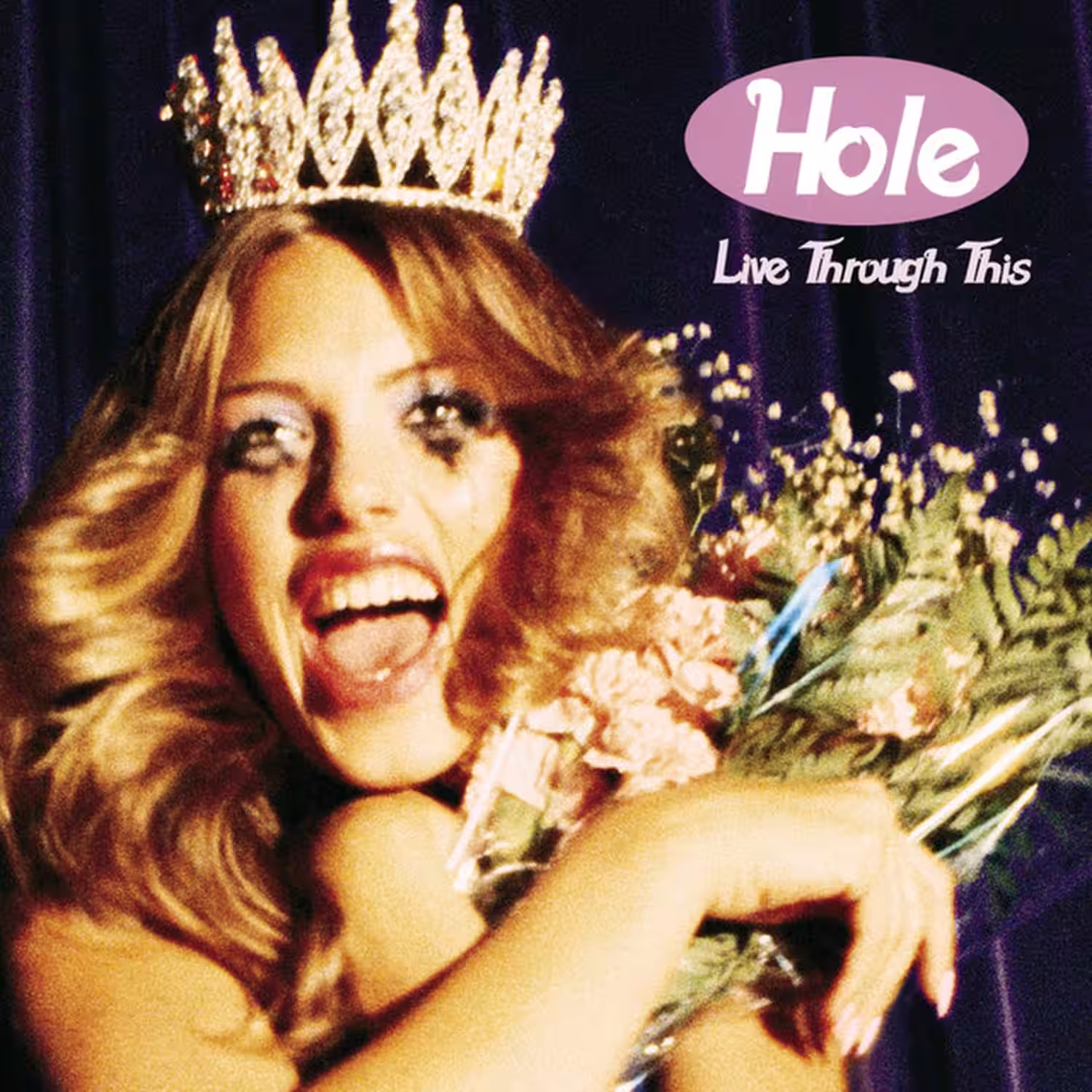
If the music stared down beauty myths, the cover sneered at them. Photographer Ellen von Unwerth shot model Leilani Bishop mid-crowning tiara, roses, mascara streaked with victory. The concept, pitched by Love, was part Carrie, part Miss Congeniality, part barbed Barbie. Flip the sleeve and the triumph curdles into a snapshot of Love as a child, the tracklist stamped in embossing tape. The visuals tell the album’s thesis at a glance: the cost of the crown.
Release Shockwave, Chart Run & Reputation
Live Through This arrived on 12 April 1994 with grief hanging in the air just days after Kurt Cobain’s death. It debuted at #55 on the Billboard 200, climbing to #52 and staying for 68 weeks. The UK and Australia took it to #13; Canada peaked at #29. By December ’94 it was Gold in the US; by April ’95, Platinum. In time it crossed 1.6 million sold in the States and pushed past two million worldwide. Critical response was electric then and remains so now: it topped the Village Voice Pazz & Jop poll in 1994, and decades later sits at #106 on Rolling Stone’s rebooted 500 and inside TIME’s All-Time 100.
| US (Billboard 200) | #52 | RIAA: Platinum |
| UK (OCC) | #13 | BPI: Gold |
| Australia (ARIA) | #13 | Platinum |
| Canada (RPM) | #29 | Platinum |
1994 was stuffed with giants Superunknown, Vitology, Jar of Flies, Dookie, Downward Spiral, Parklife and Live Through This elbowed its way into that conversation on merit alone. It wasn’t just another alt-rock breakthrough; it was a blueprint for how stark confession could ride pop instincts without dulling the blade.
Tracklist, Singles & Credits
Four singles drove the campaign: “Miss World” (21 Mar 1994), “Doll Parts” (10 Oct 1994), “Violet” (17 Jul 1995), and “Softer, Softest” (22 Jan 1996 in Australia). The closer carries a legendary quirk: the printed title “Rock Star” actually plays the song “Olympia” after a last-minute swap, leaving the sleeve forever at odds with the audio.
| Track | Length | Writers |
|---|---|---|
| Violet* | 3:24 | Love, Erlandson |
| Miss World* | 3:00 | Love, Erlandson |
| Plump | 2:34 | Love, Erlandson |
| Asking for It | 3:29 | Love, Erlandson |
| Jennifer’s Body | 3:42 | Love, Erlandson |
| Doll Parts* | 3:31 | Love |
| Credit in the Straight World | 3:11 | Stuart Moxham (Young Marble Giants) |
| Softer, Softest* | 3:28 | Love, Erlandson |
| She Walks on Me | 3:24 | Love, Erlandson |
| I Think That I Would Die | 3:36 | Love, Erlandson, Kat Bjelland |
| Gutless | 2:15 | Love, Erlandson |
| Rock Star (a.k.a. “Olympia”) | 2:42 | Love, Erlandson |
Band & guests: Courtney Love (lead vocals, rhythm guitar); Eric Erlandson (lead guitar); Kristen Pfaff (bass, backing vocals, piano); Patty Schemel (drums). Guests: Dana Kletter (additional vocals on multiple tracks); Kurt Cobain (backing vocals on “Asking for It” and “Softer, Softest”).
What the Songs Are Saying
“Violet” opens like a fuse lyrics sharpened by Love’s Chicago memories and a larger meditation on desire, power, and transactional love (“Go on, take everything…”). It’s venom and velvet in the same verse.
“Miss World” is a hollow coronation, fame’s mirror tilted at an angle. “I am the girl you know / Can’t look you in the eye” is as succinct a mission statement as the band ever wrote a pageant wave with blisters underneath.
“Doll Parts” predates the sessions by years, written in a Boston apartment and steeped in insecurity that calcifies into defiance. The chorus “Someday you will ache like I ache” is both curse and prophecy, a line that feels carved into the decade’s desk.
“Asking for It” frames the ugliest crowd-surfing moment imaginable violation turned into testimony. Listen close and Cobain’s harmony ghosts the refrain, a thin extra nerve running through an already raw song.
“Softer, Softest” is schoolyard cruelty remembered in painful detail. The chant of “Burn the witch” isn’t cosplay righteousness; it’s the mob logic that dogs girls and women into adulthood, now answered by arrangement and melody that refuse to back down.
“Credit in the Straight World”, a Young Marble Giants cover, isn’t reverent it’s a re-forging, swapping minimalism for iron filings. Even the original songwriter bristled at the transformation. That was part of the point.
“Rock Star” / “Olympia” is the great mislabel sleeve says one thing, tape plays another. Lyrically it jabs at scene conformity, especially the Olympia hive-mind myths. It’s a closer that snickers as it slams the door.
Touring Through Fire
Promotion was a gauntlet. Kristen Pfaff died in June 1994, and Hole paused, then returned with Melissa Auf der Maur on bass. At Reading Festival that August, Love strode out in a gold dress and sunglasses, flinging flowers and defiance at a crowd equal parts grieving and ghoulish. The set has become talismanic a public ritual of survival. Through the rest of ’94 and into ’95, Hole toured hard, sliding between radio festivals and their own headliners, the band getting meaner and tighter as the year wore on.
Influences In / Influence Out
Love name-checked The Breeders, Pixies, Echo & the Bunnymen, and Joy Division as compass points, and you can hear all four wink through the record not as copy, but as texture. The album, in turn, kicked open lanes for artists who’d weld confession to choruses without apology, from Garbage and Alanis Morissette to Paramore and Skunk Anansie. It made room on alt-rock radio for songs about the body and its politics that weren’t whispered or metaphor-washed.
| Influences on the album | Artists influenced by the album |
|---|---|
| Pixies, The Breeders | Garbage |
| Echo & the Bunnymen | Paramore |
| Joy Division | Skunk Anansie |
| Post-punk minimalism (via YMG) | Alanis Morissette |
Five Truths (to Cut Through the Myths)
| Fact | Details |
|---|---|
| Kurt’s role | Cobain sang backing vocals on two tracks (“Asking for It,” “Softer, Softest”). He did not write the album a rumor repeatedly disputed by band, producers, and biographers. |
| The cover star | Model Leilani Bishop, shot by Ellen von Unwerth, mid-pageant ecstasy, mascara tears and all. |
| Dedication | Dedicated to Joe Cole (Black Flag/Rollins Band roadie), murdered in 1991 after attending a Hole show. |
| “Rock Star” vs “Olympia” | Artwork printed “Rock Star,” audio pressed “Olympia” after a last-minute swap sleeve and grooves forever at odds. |
| Chart & plaques | US Platinum & long Billboard run; Gold/Platinum across the UK/Canada/Australia; critical canonised (Pazz & Jop #1; RS 500 #106; TIME All-TIME 100). |
Where You’ve Heard It (Film & TV)
Fragments of the record keep turning up: “Doll Parts” in Cold Case and Defiance (and even late-night TV), “Miss World” in Yellowjackets, “Violet” in everything from CSI to Bridesmaids and Jennifer’s Body. The songs travel well because the feelings do.
| Song | Placement | Year(s) |
|---|---|---|
| Doll Parts | The Tonight Show Starring Jimmy Fallon; Defiance; Cold Case | 2022; 2014; 2007 |
| Miss World | Yellowjackets (S1E1) | 2021 |
| Violet | CSI; Jennifer’s Body; Bridesmaids; Devil in Ohio | 2001; 2009; 2011; 2022 |
| She Walks on Me | High School (S1E1) | 2022 |
| Rock Star / “Olympia” | Stealing Beauty | 1996 |
Aftershocks
Hole resurfaced with Celebrity Skin (1998), glossy and lethal in a different way, then unraveled into line-up changes and legal dust-ups. A 2010 comeback under the Hole banner followed (Nobody’s Daughter), but the Live Through This quartet has never reconvened. In the broader story, though, the album remains the keystone the moment a band aligned, a voice cut through, and a scene heard itself with uncomfortable clarity.
Remasters & Reissues
As of October 2025, there’s still no deluxe reissue with vault scraps or a correction to the “Rock Star”/“Olympia” misprint. The call for one grows louder every anniversary not to sand the album down, but to frame its chaos with context.
Conclusion
Live Through This is melody with teeth. It made the intimate public and turned private ruin into public art without asking permission. The songs still feel lived-in and volatile, like they might change shape under your feet. That’s why it lasts: not as museum grunge, but as a living document of what it costs and what it gives back to live through this.
Further Reading
Explore more of our long-form dives on albums by Pixies, Nirvana, Pearl Jam, Alice in Chains, Soundgarden, and The Smashing Pumpkins plus our Hole archive.
Let us know in the comments what Live Through This means to you. Favorite deep cut? First time you heard “Doll Parts”? We’re all ears.
About the Author