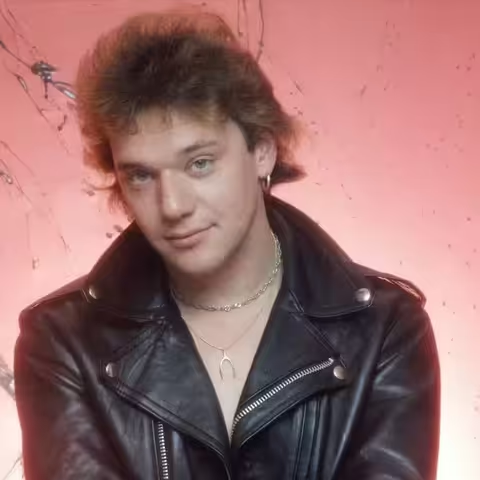
Paul Di'Anno was sacked from Iron Maiden in the autumn of 1981 at twenty-three years old, and he spent the next forty-three years touring on the back of two albums. He cut roughly thirty records of his own, fronted four working bands, married five times, fathered six children, was deported from the United States, did two months in Salisbury prison for benefit fraud, lost the use of his legs to MRSA in his spine, and still managed to play more than a hundred shows in his final eighteen months from a wheelchair. The boy from Chingford who sang on Iron Maiden and Killers ended his life as the most committed working stiff in heavy metal.
He died at home in Salisbury on 21 October 2024, aged sixty-six, of an aortic dissection. The tributes that followed, from Bruce Dickinson at the Xcel Energy Center in Saint Paul that very night to a memorial gig at Camden's Underworld two weeks later, made clear what fans had long known: the punk-throated kid on the cover of Live!! +one had quietly become the genre's most stubborn elder statesman, the man whose two records still bracket every conversation about the New Wave of British Heavy Metal.
Career at a Glance
| Field | Detail |
|---|---|
| Real name | Paul Andrews |
| Stage name | Paul Di'Anno (adopted in the late 1970s; he later claimed Italian descent to fit the surname, though his father was actually Brazilian) |
| Born | 17 May 1958, West Ham, London, England |
| Grew up in | Chingford, north-east London |
| Died | 21 October 2024, Salisbury, Wiltshire, aged 66 |
| Cause of death | Aortic dissection (confirmed by sisters Cheryl and Michelle in November 2024) |
| Buried | Manor Park Cemetery and Crematorium, East London |
| Best known for | Lead vocals on Iron Maiden's first two albums, Iron Maiden (1980) and Killers (1981) |
| Iron Maiden tenure | Late 1978 to 10 September 1981 (last show: Odd Fellow's Mansion, Copenhagen) |
| Replaced by | Bruce Dickinson, formerly of Samson |
| Post-Maiden bands | Di'Anno (1983 to 1985), Gogmagog (1985), Battlezone (1985 to 1989, 1998), Praying Mantis (1990 Tokyo tour), Killers (1991 to 2003), Rockfellas (2008 to 2010), Architects of Chaoz (2014 to 2015), Warhorse (2022 to 2024) |
| Autobiography | The Beast, Independent Music Press, 2010 |
| Final album | The Book of the Beast, Conquest Music, 27 September 2024 |
| Last live show | Hyde Park, Krakow, Poland, 30 August 2024 |
| Inductions | Metal Hall of Fame (2021); Rock and Roll Hall of Fame (2026, as a member of Iron Maiden) |
| Football team | West Ham United |
Born in East London
Paul Andrews was born in West Ham on 17 May 1958 and brought up a few miles north in Chingford, the working-class corner of north-east London where Steve Harris also came of age. His father was Brazilian, which gave the boy dual British and Brazilian citizenship and, decades later, an unusually warm reception every time he toured South America. The Italian-sounding surname Di'Anno that he later adopted as a stage name was a half-invention; he leaned into a claim of Italian heritage to make the spelling stick, but it was really a vanity decoration on a Brazilian-English childhood.
The Andrews household was not musical in any formal sense, but East London in the late 1960s and early 1970s was a noisy place to be a teenager. Paul left school early and worked as a butcher on Chingford's Station Road and as a chef in local hotels and restaurants, a curriculum vitae he would mention in interviews for the rest of his life. The butcher's shop sat directly behind his stage persona: he was always a bloke who could have been doing something rougher for a living, and he made sure his audiences knew it.
He married for the first time in his early twenties and would marry four more times across his life, fathering six children along the way. The early biographical detail that mattered most musically was simpler than any of this. He spent his teenage years singing, badly at first, in pub bands around the East End, and by the time the New Wave of British Heavy Metal began to gather in 1977 he was already a known face on a circuit that ran from the Cart and Horses in Stratford to the Bridgehouse in Canning Town.
Punk Roots and The Paedophiles
Before metal, there was punk. Di'Anno's first proper band of any notoriety was The Paedophiles, a name that was already too provocative for 1977 and is impossible to publish without flinching. The band were short-lived and barely recorded, but they mattered because of what they did to the singer's voice. He learned to bark rather than howl. He learned to spit consonants. He learned the trick of dropping into a half-spoken sneer mid-line and then snapping back up into pitch, a Joe Strummer move that would surface again and again on the Iron Maiden records.
The list of bands he idolised in those years was a classic East London mongrel mix: the Sex Pistols, the Clash and the Damned for attitude, the Ramones for economy, and then Deep Purple, Led Zeppelin, Black Sabbath, Slade and Bowie for everything else. He used to say in interviews that his audition for Iron Maiden was hampered by the fact that he turned up looking like a punk and refused to grow his hair. It was true. His short hair through 1979 and 1980 was a relic of a paint accident he never bothered to grow out, but it gave the early band a visual edge that none of their NWOBHM peers could match.
- The Pistols and the Clash taught him stagecraft and contempt for the audience.
- The Ramones taught him to write short songs you could shout along to on the third listen.
- Sabbath and Purple gave him the licks and the riffs he expected a band to play behind him.
- Slade gave him the cheerful working-class swagger that survived all the way through to the wheelchair years.
The NWOBHM Crucible
By 1978 the East End was producing a new generation of bands who were tired of stadium rock, suspicious of disco and not entirely sure what to do with punk's three-chord scorched earth. The promoter Neal Kay was running heavy metal nights at the Bandwagon Soundhouse in Kingsbury, and the cassette demos he played there became the seed of the chart that Sounds magazine would later codify as the New Wave of British Heavy Metal. Iron Maiden, Saxon, Def Leppard, Diamond Head, Angel Witch, Praying Mantis, Samson and a few dozen others were the wave; Di'Anno was about to become one of its loudest voices.
Iron Maiden, founded by bassist Steve Harris in late 1975, were one of the busiest bands on the circuit but they could not keep a vocalist. Paul Day had gone. Dennis Wilcock had gone too, in a flurry of fake-blood theatrics that Di'Anno later said he and his mate watched at the Cart and Horses while pissing themselves laughing. By the autumn of 1978 the drummer Doug Sampson, a Smiler bandmate of Harris's from years before, introduced the band to the loudmouth from Chingford. The match would be combustible, lucrative and brief.
Joining Iron Maiden in 1978
Di'Anno's audition is one of the founding myths of British heavy metal. He went to Steve Harris's house in Leytonstone, played through Deep Purple's "Dealer" and Free's "All Right Now" with the band, and was offered the gig more or less immediately. The first attempt at a formal audition for manager Rod Smallwood reputedly went south when Di'Anno was arrested for waving a pocket-knife in public, an early signal of the trouble that would follow him for the next forty years.
"I went to see them play at the Cart and Horses in East London, and their old singer had this silly sword and fake blood dripping from his mouth. Me and my mate were pissing ourselves laughing. When I got introduced to Steve Harris I couldn't keep a straight face. And when he talked about me going for an audition I thought, bleeding hell, why not."
Paul Di'Anno, speaking to Paul Brannigan, Metal Hammer, 2002
Once installed, he transformed the band's live presence. Maiden in 1979 were a fearsome unit but a slightly old-fashioned one, the prog-rock leanings of Harris occasionally showing through the speed. Di'Anno gave them a snarl and a connection to the punk crowd that doubled their reach overnight. The Soundhouse Tapes, the four-track demo EP they self-released in November 1979, sold out its first pressing of five thousand copies in a matter of weeks and became the most sought-after collectible in British metal. EMI signed the band a few weeks later.
Iron Maiden, the 1980 Debut
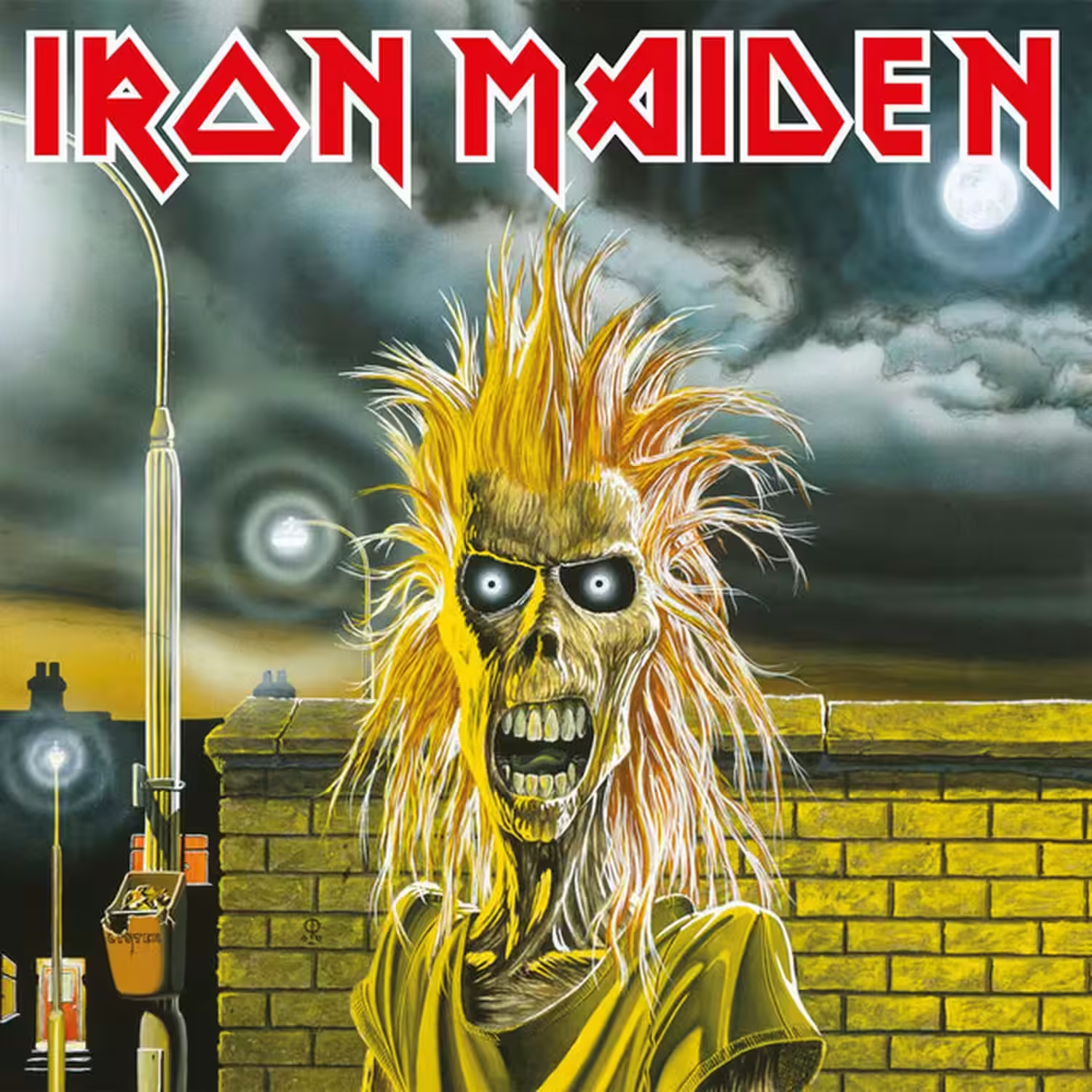
The self-titled Iron Maiden arrived on 14 April 1980 and went straight to number four in the UK album chart, a debut placing that nobody, including Harris, had expected. The album was produced in a fortnight at Kingsway Studios in Holborn by Wil Malone, who produced reluctantly and on a small budget; legend has it the band were so unhappy with the muddy mix that drummer Clive Burr and Harris remixed parts of it themselves. None of that mattered next to Di'Anno's voice, which sliced through Malone's gritty sound and gave the record its identity.
"Prowler" opened with a chugged guitar riff and Di'Anno's leering, half-spoken delivery. "Running Free" used the same trick at single length and became the first Iron Maiden top forty UK hit. "Phantom of the Opera" stretched to seven minutes and showed he could hold a melody across a Steve Harris prog-rock arrangement without losing the snarl. "Remember Tomorrow" proved he could do quiet, a slow-burn ballad that Metallica would later cover. The album was the blueprint not just for the rest of Maiden's catalogue but for thrash metal, speed metal and most of the British power-metal underground that followed.
"If there was a punk element to Iron Maiden at that point it probably came from me, especially onstage. There's no denying it, those songs are bloody fast, though they also have some proggy time-changes in them. That's what made us so unique."
Paul Di'Anno, Metal Hammer, 2020
On Tour with Iron Maiden
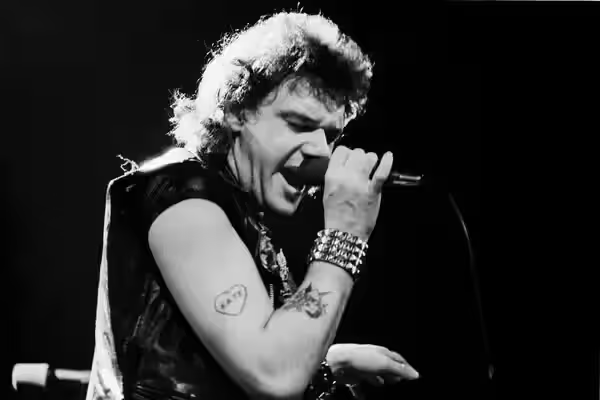
The eighteen months that followed the debut were one of the hardest touring schedules anyone in British rock had attempted. Iron Maiden played Reading 1980, supported KISS through Europe on their Unmasked tour, headlined their first UK theatre dates, then crossed the Atlantic for an opening slot in front of Judas Priest's North American audiences. They squeezed in the live mini-album Live!! +one for the Japanese market and shot the cover for what would become Killers in the few weeks they were home.
Di'Anno was the band's hardest worker on stage and the hardest reveller off it. He drank, took cocaine in industrial quantities, and developed a reputation for missing soundchecks, getting into fights with promoters and disappearing for hours at a time. The schedule never relented. By the time the band turned around and started recording the second album in late 1980, the singer was already running on fumes.
Killers, the 1981 Second and Final Album
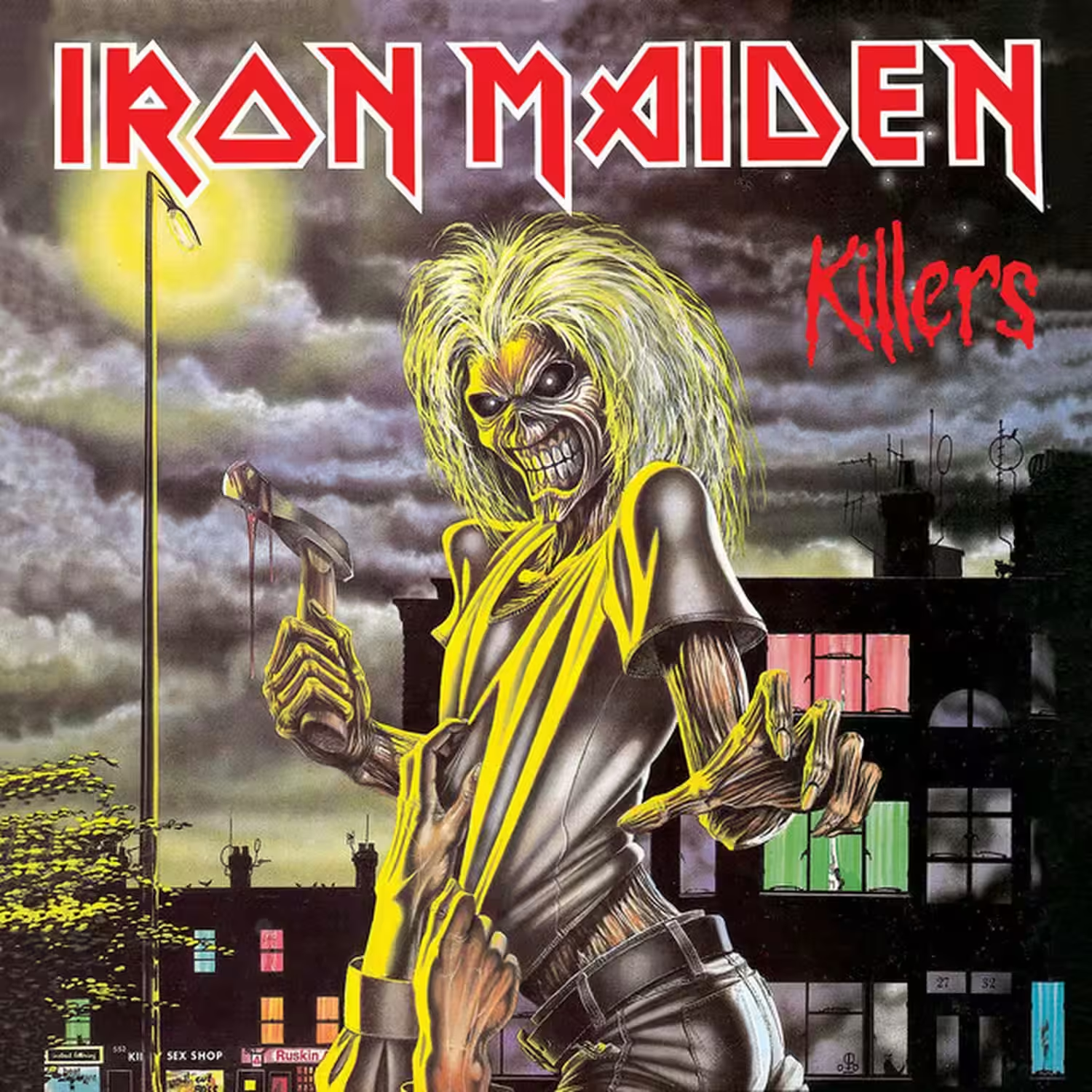
Killers, released on 2 February 1981, sounded like a different band. The decisive change was the arrival of producer Martin Birch, fresh from a decade working with Deep Purple, Rainbow and Whitesnake, who replaced Wil Malone behind the desk and gave Iron Maiden the clean, ringing, deep-bottomed sound that would define every subsequent record they made. Adrian Smith replaced Dennis Stratton on second guitar, the twin-lead Maiden style was born in earnest, and the songs were tighter, faster and more ambitious.
"Wrathchild" galloped along on the most famous Steve Harris bassline of all time. "Murders in the Rue Morgue" turned Edgar Allan Poe into a five-minute thrash blueprint. The title track gave Di'Anno his last great Iron Maiden vocal, a leering first-person serial-killer narrative that suited his bark exactly. "Innocent Exile" gave him space to do the half-melodic croon that "Remember Tomorrow" had hinted at. The album peaked at number twelve in the UK and broke the band properly in Japan and continental Europe.
The cracks were already visible. Di'Anno later admitted that he was so wrecked through parts of the Killers tour that he could not remember whole gigs. The live EP Maiden Japan, recorded at Kosei Nenkin Hall in Nagoya in May 1981 and rush-released by EMI in September, captured the band at its peak and its singer at his most chaotic at almost the same moment.
The Sacking in Copenhagen
Di'Anno's last show as the singer of Iron Maiden was on 10 September 1981 at the Odd Fellow's Mansion in Copenhagen. There was a band meeting with Harris and Smallwood shortly afterwards. He was paid off, kept his songwriting royalties, and was replaced by Bruce Dickinson, the operatic frontman of fellow NWOBHM band Samson, who debuted with Maiden on the Number of the Beast sessions a few weeks later.
The split was uglier in Di'Anno's telling than in Harris's, but neither side ever pretended it was anything other than a sacking. The singer's own account, delivered with the trademark Chingford bluntness in interview after interview, was that he could no longer drag himself through the schedule, that the cocaine was a problem, and that he and Harris had run out of things to say to each other.
"I don't blame them for getting rid of me. Obviously, the band was Steve's baby, but I wish I'd been able to contribute more. After a while that got me down. In the end I couldn't give one hundred per cent to Maiden anymore and it wasn't fair to the band, the fans or to myself."
Paul Di'Anno, Metal Hammer, 2002
He was more colourful elsewhere. He famously described life inside the Iron Maiden organisation as being like having Mussolini and Adolf Hitler running your band, by which he meant Smallwood and Harris and which, as bridge-burning quotes go, was hard to top. The friendship with Harris, despite the rancour, was always retrievable, and Iron Maiden quietly helped pay for his medical treatment thirty years later.
Di'Anno, the Solo Band, 1983 to 1985
For two years after the sacking Di'Anno disappeared into the kind of post-Maiden hangover that has finished off other singers entirely. The first band he assembled in 1983 was called Lonewolf, an earnest five-piece that pivoted away from the NWOBHM sound towards a polished, slightly Americanised hard rock not far from Journey or Foreigner. They had to drop the name when another act called Lone Wolf objected, and re-emerged as simply Di'Anno.
The self-titled Di'Anno album landed on Lipstick Records in 1984 and was treated kindly by NWOBHM holdouts but ignored by the rock press, who could not believe the singer of Iron Maiden and Killers was now doing slick AOR. The band toured Britain and Sweden, released a couple of singles, played a VHS-only live show at Kilburn's Gaumont State Theatre in 1984, and then quietly fell apart. It is the most overlooked record in the Di'Anno catalogue and, to anyone interested in his range as a singer, the most surprising.
Gogmagog, the 1985 Supergroup That Wasn't
In 1985 the producer and disc jockey Jonathan King decided that what British heavy metal needed was a supergroup, and assembled one with no original songs and tight control over what its members were allowed to write. Gogmagog was Di'Anno on vocals, Janick Gers on guitar, Pete Willis of Def Leppard on second guitar, Neil Murray of Whitesnake on bass and Clive Burr, freshly out of Iron Maiden himself, on drums. They released a single three-song EP, I Will Be There, on Food For Thought Records.
Reviews were polite, the EP did not chart, and the band imploded almost immediately. Di'Anno later dismissed the whole project as "nothing", said he had only done it for the money, and never spoke of it on stage again. It is a fascinating footnote rather than a record: Janick Gers would join Iron Maiden five years later, and Di'Anno would tour with Burr's ghost in the shape of post-Maiden tribute bills for the rest of his life.
Battlezone, 1985 to 1989
Battlezone is the band where Di'Anno started to build a post-Maiden body of work that mattered. The line-up settled in 1985 around Di'Anno, guitarists John Wiggins and John Hurley, bassist Laurence Kessler and drummer Bob Falck. Their debut album, Fighting Back, was released by Raw Power Records in 1986, and a club tour of the United States followed. The band signed to Atlantic's Powerstation imprint for the follow-up, Children of Madness, in 1987, which got the closest the post-Maiden Di'Anno ever came to a proper push from a major label.
"I Don't Wanna Know" got onto MTV's heavy-metal rotation in the United States and the band toured America properly for the first time. The album also generated the only critical scandal of Di'Anno's post-Maiden career: the song "Metal Tears" was accused in the metal press of being too close to "London" from Queensryche's Rage for Order the year before. Di'Anno shrugged it off in interviews and pointed out that the lyric was about a man who built a robot girlfriend and fell in love with her, which was nobody else's idea at the time.
Drugs and infighting wrecked the band by the end of the decade. Battlezone played their last show of the original incarnation on 10 December 1989 at Dynamo Open Air in Eindhoven, the Netherlands, with most of the line-up having walked or been pushed by then. Di'Anno would resurrect the name briefly in 1998 for a third album, Feel My Pain, recorded with John Wiggins and a mostly Brazilian backing band, and a sold-out three-week tour of Brazil that drew up to six thousand fans a night.
Praying Mantis and the Tokyo Renaissance
Praying Mantis, the Tino and Chris Troy NWOBHM band, had been dropped by BMG and were in stasis in 1989 when Di'Anno rang Dennis Stratton, the guitarist he had played alongside on Iron Maiden. A Japanese promoter wanted to stage a tenth-anniversary celebration of the New Wave of British Heavy Metal in Tokyo, and Stratton offered Di'Anno the singer's chair. The result was an April 1990 tour and the live album Live at Last, recorded at Nakano Sunplaza on 18 April 1990, which became a Japanese cult classic and reactivated Praying Mantis for the long career they have since enjoyed.
The Tokyo experience also gave Di'Anno his first taste of what the rest of his working life would look like. He could not headline arenas in Britain, but in Tokyo, Sao Paulo, Buenos Aires, Mexico City and the metal-mad cities of Eastern Europe, he was a star whose name on a poster guaranteed a sold-out house. He spent the next thirty years on a permanent international circuit that took him to dozens of countries every year and made him a kind of itinerant Iron Maiden ambassador.
Killers, the Band, 1991 to 2003
The Killers years are the longest single chapter of Di'Anno's post-Maiden life. The band formed in New York in the summer of 1991 around Di'Anno, ex-Battlezone drummer Steve Hopgood, guitarist Cliff Evans, second guitarist Ray Detone and the bassist John Gallagher of Raven on a short-term hire. They were named, with deliberate Iron Maiden provocation, after the second album.
BMG signed the band on the strength of an industry showcase where they played nothing but Iron Maiden covers. The debut album Murder One followed in 1992, recorded with Rob Fraboni producing at White Crow Audio in Burlington, Vermont and Powerstation in New York, and the band spent the next eighteen months on tour in Europe, Japan and across the United States.
The second album, Menace to Society in 1994, took its name from a Los Angeles judge's description of Di'Anno himself at sentencing. It was a heavier, grooved-up record, often compared in the German press to Pantera and Machine Head, and it picked up Metal Hammer Germany's Best New Album award for 1994. Two further studio records, several live albums (South American Assault Live in 1994 and Killers Live at the Whisky in 2001 among them) and a near-constant touring schedule followed, before the band finally disbanded in 2004.
Nomad, Rockfellas and the Brazilian Years
Di'Anno's Brazilian passport made him a regular in South America from the mid-1990s onwards, and by 2000 he had moved to Sao Paulo for a year and put together an all-Brazilian band initially called Nomad. The self-released album was repackaged and reissued as The Living Dead in 2006, with a video for the title track shot in the East London Docks by the Swedish director Mats Lundberg.
From late 2008 he was working with the Brazilian project Rockfellas, alongside drummer Jean Dolabella, who would shortly afterwards join Sepultura, guitarist Marcao Britto of Charlie Brown Jr. and bassist Canisso of Raimundos. They played covers of metal and rock classics across the southeast of Brazil, where Di'Anno was nicknamed Paulo Baiano. A parallel Swedish touring band, anchored by guitarist Mikael Fassberg of Bonafide, took him across thirteen countries between 2005 and 2014, and a Norwegian backing band did the festival circuit through Hard Rock Hell, Tons of Rock and Sweden Rock from 2008 onwards.
The American Arrest and Deportation
The American chapter of Di'Anno's life ended in court. Some time in the mid-1990s, after the Murder One tour, he had moved in with an American girlfriend in Los Angeles. A domestic argument escalated to a fight involving a knife and a firearm; he was arrested for spousal abuse, cocaine possession and firearms offences, and the judge at his sentencing reportedly described him as a menace to society, a phrase the band promptly stole for an album title. He served four months in jail and was deported back to Britain on release, banned from re-entering the United States for years afterwards.
It was the period when his behaviour was most clearly at its worst, and he never tried to pretend otherwise. In interviews from the 2000s and 2010s he was matter-of-fact about it, the way some musicians become about their younger excesses once enough time has passed. The American ban was eventually lifted; he returned to the United States to tour with the Pittsburgh band Icarus Witch on two trips in the early 2010s.
The Beast, a Life on the Page
In 2010 Independent Music Press published The Beast, Di'Anno's autobiography. It is one of the most frank rock memoirs of the era, in part because Di'Anno simply did not have the kind of management or publishing-house infrastructure that filters out the worst stories. He detailed the cocaine, the violence, his ban from the United States, his various failed marriages and his complicated relationship with Steve Harris in unsparing prose. The book included a chapter of comments and counterstories from former bandmates including Dennis Stratton, John Wiggins and Steve Hopgood, several of whom challenged Di'Anno's version of events from inside their own pages.
The book was controversial. Some of Di'Anno's stories about violence towards people were difficult reading, and his sometimes-glib treatment of his drug use earned criticism. But it also became a kind of reference text for anyone trying to understand the first Iron Maiden line-up, and it is impossible to imagine the Mick Wall and Greg Prato Maiden books that followed it without The Beast as their honest, scuzzy prologue.
Salisbury Crown Court, 2011
In February 2011 Di'Anno was convicted at Salisbury Crown Court on eight counts of benefit fraud, having claimed more than 45,000 pounds in incapacity benefit while still working and touring as a musician. On 11 March 2011 he was sentenced to nine months in prison. He served two of the nine, released early for good behaviour, but the conviction was a public humiliation he never quite shook. The British tabloids splashed it as a fall-from-Iron-Maiden-grace story; he himself rarely discussed it in detail in subsequent interviews, preferring to talk about the music.
The fraud case is the source of some confusion in the wider Di'Anno literature. It was not a United States benefits case, despite the occasional claim, and it was not connected to the earlier American arrest for spousal abuse, despite both involving courts and jail time. Both events happened to the same man. Neither caught up with the music.
The Wheelchair Years
Di'Anno's health began collapsing in 2014 and 2015. A long-standing knee problem, exacerbated by years of stage diving, turned out to be the visible tip of a much worse condition: MRSA had taken hold in his spine and around the joint, and the resulting cellulitis and septicaemia left him unable to walk. From 2015 onwards he performed almost exclusively from a wheelchair, often with one leg visibly swollen to the point that he could not put weight on it.
A planned final show at Beermageddon in Bromsgrove on 30 August 2020 was cancelled because of the COVID-19 pandemic. By January 2021 a crowdfunder had been launched to pay for knee surgery, which he eventually had in Croatia in November 2021. Iron Maiden, quietly and without publicity at the time, paid for the final stages of the treatment, a gesture Di'Anno only publicly acknowledged in 2023.
"They paid for the last couple of months' worth of treatments, which was good. I'll be forever grateful for that. I only had 45 minutes to live."
Paul Di'Anno, Loudersound, March 2023
From May 2022 onwards, starting with a show at the Bikers Beer Factory in Zagreb, Croatia, he was back on the road, wheelchair and all. He called himself Warhorse on the comeback dates. He referred to the wheelchair, in interview after interview, as the thing that had got him out of the house and back to work; he could not have toured a major arena tour as a frontman in his sixties, but he could absolutely do an hour of Maiden classics from a custom rig at a festival, and the demand was, if anything, growing.
Warhorse and the 2024 Comeback
In August 2023, BraveWords Records announced they had signed Di'Anno's new band, also called Warhorse, for a 2024 album. The label switched to Conquest Music ahead of release, and on 27 September 2024 the label put out The Book of the Beast, a career retrospective issued as a 2-LP coloured-vinyl set and a CD-plus-DVD package. It featured new masters of his best post-Iron Maiden recordings, a handful of previously unreleased tracks, and duets with Tony Martin of Black Sabbath's Tony Martin era and ZP Theart of Dragonforce.
The summer of 2024 was the busiest stretch he had played in a decade. He racked up well over a hundred shows since the start of 2023, headlined Stonedead Festival in Nottinghamshire, toured Eastern Europe with a Norwegian backing band, and played his first proper UK gig in ten years at KK's Steel Mill in Wolverhampton. The new music and the touring were on the same upward curve, with the Wes Orshoski documentary Di'Anno: Iron Maiden's Lost Singer shooting in parallel for a planned 2025 release through Cleopatra Entertainment.
Final Shows and Death in Salisbury
Di'Anno's final live performance was at the Hyde Park venue in Krakow, Poland, on 30 August 2024. The setlist, as it had been for most of the wheelchair years, was composed entirely of Iron Maiden songs from the 1980 and 1981 albums. He had once told interviewers he did not want to become an Iron Maiden karaoke act, but by the end he had made his peace with the fact that those two records were what people had come to hear. There were no final farewell speeches and no goodbye tour; he was supposed to be touring through the autumn and into 2025.
He died at his home in Salisbury on 21 October 2024, aged sixty-six. Conquest Music confirmed the death the same day, and his sisters Cheryl and Michelle confirmed in early November that the cause was an aortic dissection. He was buried at Manor Park Cemetery and Crematorium in East London, the borough he had grown up in, with a headstone placed in June 2025.
"Basically he had a tear in the sac around the heart and blood has filled inside it from the main aorta artery and that has caused the heart to stop."
Cheryl and Michelle Andrews, statement to Consequence, November 2024
Tributes from the Metal World
The first major tribute came the same night. Iron Maiden were playing the Xcel Energy Center in Saint Paul, Minnesota on 22 October 2024, on the North American leg of their Future Past tour, when Bruce Dickinson stepped to the microphone before the encore and gave a short speech about the man he had replaced.
"Paul was instrumental in the first two Maiden albums, groundbreaking with Killers and the first album. An amazing voice, devoted to rock and roll right up till the last minute of his life."
Bruce Dickinson, on stage at the Xcel Energy Center, Saint Paul, 22 October 2024
A formal memorial show took place at the Underworld in Camden on 7 November 2024, featuring Electric Gypsy, Gypsy's Kiss and Hi-On Maiden, all of whom had been booked as supports on the tour Di'Anno was supposed to be playing when he died. Steve Harris and the wider Maiden organisation kept their public statements brief and respectful; Conquest Music's official statement, written on the family's behalf, asked his legion of fans to raise a glass in his memory.
The tributes from the wider metal world were uniformly affectionate. James Hetfield of Metallica had cited Di'Anno's vocals on Iron Maiden as a formative influence as far back as the early 1980s. Tom Araya of Slayer had said similar things about the bark and snarl he had borrowed for his own delivery. The Brazilian and Argentine metal scenes, where Di'Anno had built a second home, treated his death as the passing of a national-adopted son.
Selected Discography
| Year | Band | Release | Type | Notes |
|---|---|---|---|---|
| 1979 | Iron Maiden | The Soundhouse Tapes | Demo EP | Self-released; first pressing of 5,000 sold out |
| 1980 | Iron Maiden | Iron Maiden | Studio LP | UK #4; produced by Wil Malone |
| 1980 | Iron Maiden | Live!! +one | Live EP | Japan-only mini-album |
| 1981 | Iron Maiden | Killers | Studio LP | UK #12; first Iron Maiden album produced by Martin Birch |
| 1981 | Iron Maiden | Maiden Japan | Live EP | Recorded at Kosei Nenkin Hall, Nagoya, May 1981 |
| 1984 | Di'Anno | Di'Anno | Studio LP | AOR-leaning solo album on Lipstick Records |
| 1985 | Gogmagog | I Will Be There | EP | Three-track Jonathan King supergroup misfire |
| 1986 | Battlezone | Fighting Back | Studio LP | Raw Power Records debut |
| 1987 | Battlezone | Children of Madness | Studio LP | Atlantic Powerstation release; MTV video for "I Don't Wanna Know" |
| 1991 | Praying Mantis | Live at Last | Live LP | Nakano Sunplaza, Tokyo, April 1990 |
| 1992 | Killers | Murder One | Studio LP | Produced by Rob Fraboni; BMG deal |
| 1994 | Killers | South American Assault Live | Live LP | Recorded in New York, sold as a South American tour document |
| 1994 | Killers | Menace to Society | Studio LP | Metal Hammer Germany Best New Album |
| 1998 | Battlezone | Feel My Pain | Studio LP | Reactivated line-up with Wiggins and Brazilian players |
| 2000 | Nomad / Di'Anno | Nomad | Studio LP | Brazilian-produced solo album, later reissued as The Living Dead |
| 2001 | Paul Di'Anno | The Beast | Live LP | Solo live retrospective |
| 2006 | Paul Di'Anno | The Living Dead | Studio LP | Reissue of Nomad with DVD video |
| 2015 | Architects of Chaoz | The League of Shadows | Studio LP | German-produced metal project |
| 2022 | Warhorse | "Stop the War" / "The Doubt Within" | Single | First Di'Anno release under the Warhorse banner |
| 2024 | Paul Di'Anno | The Book of the Beast | Career retrospective | Conquest Music; released 27 September 2024, less than four weeks before his death |
The Di'Anno Voice
Di'Anno's voice on the first two Iron Maiden albums is the most influential British metal vocal of its era after Ozzy Osbourne's, and it does its work in a startlingly narrow range. He is a baritone who rarely strays above the top of the staff. The fireworks come from texture: a constant rasp, a habit of breaking pitch into half-spoken phrasing at the ends of lines, a punk-derived willingness to shout consonants rather than sing through them, and a low-register growl on the menacing material like the title track of Killers.
What he did better than almost anyone else of his generation was the slow burn. "Remember Tomorrow", "Strange World", "Prodigal Son" and "Innocent Exile" all let him drop the bark and use the lower register cleanly, with a melancholy he was never given much credit for. The trick was that the same voice could turn around and snarl "Running Free" in the next song without it feeling like a different singer.
The post-Maiden records lean further into the snarl and away from the melody. As his life and his lungs got harder, the bark broadened and the upper end thinned. By the wheelchair years his voice was a more limited instrument than it had been in 1980, but he could still wring "Wrathchild" or "Phantom of the Opera" out of it in a way no other singer ever quite matched, including Bruce Dickinson on Iron Maiden's own occasional revisits to the early material.
The Di'Anno Versus Dickinson Debate
No Iron Maiden conversation runs longer or hotter than the question of which singer is the real Iron Maiden singer. The maths is unfair. Di'Anno fronted them for three years and made two studio albums. Dickinson has now fronted them for the best part of four decades across more than a dozen studio records and the band's entire arena and stadium career. Dickinson has the catalogue.
What Di'Anno has, and always will have, is the foundation. The two records that defined Iron Maiden's identity, and through them defined a chunk of what heavy metal became in the 1980s, are his. The thrash bands who later sold a hundred times more records, Metallica and Slayer and Megadeth among them, did not learn their craft from The Number of the Beast or Somewhere in Time. They learned it from Iron Maiden and Killers.
It is a debate where everyone is right and nobody loses. The Di'Anno camp has the punk-metal hybrid that lit the fuse. The Dickinson camp has the operatic vocal range and the catalogue that built the empire. The two singers themselves, by all accounts, got on well enough whenever they met, and Iron Maiden's quiet payment for Di'Anno's surgery told you everything you needed to know about how seriously the organisation took its founding line-up.
Legacy and Influence
Di'Anno's most direct influence is on the early American thrash generation. James Hetfield's bark on Kill 'Em All and the cleaner moments of Master of Puppets owes more to the snarl of Iron Maiden than any contemporary American vocal model. Tom Araya's Spanish-inflected shouting on Slayer's early records carries the same bones. Dave Mustaine of Megadeth has cited the two Di'Anno-era Maiden records as foundational. So have Anthrax's Joey Belladonna and Testament's Chuck Billy, both of whom inherit the trick of switching between menace and melody mid-song.
His indirect influence runs deeper. The notion that a heavy metal singer should sound like a working-class kid from a real city, rather than an opera school graduate or a Robert Plant impersonator, is largely a Di'Anno invention. Every gravel-voiced frontman to emerge from the British and European metal underground for the last forty years has had Paul Di'Anno somewhere in the ancestry.
The Metal Hall of Fame inducted Di'Anno in 2021. In April 2026 Iron Maiden were announced as Rock and Roll Hall of Fame inductees for the class of 2026, with Di'Anno listed posthumously as a member, a recognition that came two years too late to mean anything to the man himself but completed the circle of the story that started in Steve Harris's front room in Leytonstone forty-eight years earlier.
Things You Might Not Know
| Fact | Detail |
|---|---|
| The Italian fiction | The surname Di'Anno was a stage invention. Andrews leaned into a claim of Italian descent to make the spelling stick, but his father was Brazilian and his real heritage was dual British-Brazilian. |
| The day job | Before Iron Maiden, Di'Anno worked as a butcher in a shop on Chingford's Station Road and as a chef in local hotels and restaurants, a CV he mentioned in interviews for the rest of his life. |
| The first audition | His first attempt at a formal Iron Maiden audition for manager Rod Smallwood reputedly failed when Di'Anno was arrested for waving a pocket-knife in public on the way there. |
| The Cart and Horses moment | He first encountered Iron Maiden at the Cart and Horses pub in Stratford, where he and a friend stood at the back laughing at outgoing singer Dennis Wilcock's fake-blood theatrics. |
| The hair | The famously short hair he sported through 1979 and 1980 was the result of a paint accident, not a punk statement, and he never bothered to grow it out. |
| The Soundhouse Tapes sellout | The 1979 demo EP sold out its first pressing of five thousand copies in a few weeks and is now one of the most valuable NWOBHM collectibles in existence. |
| The Mussolini quote | His most famous broadside against Iron Maiden management, calling Smallwood and Harris "Mussolini and Adolf Hitler", was delivered in a 1980s interview and quoted back at him for the rest of his life. |
| The Gogmagog rationale | He later said he only joined Jonathan King's 1985 supergroup Gogmagog for the money and considered the project "nothing", a verdict reviewers largely shared. |
| The Menace to Society title | Killers's 1994 second album took its name from the Los Angeles judge's verbatim description of Di'Anno at sentencing for spousal abuse, cocaine possession and firearms offences. |
| The Salisbury sentence | He served two of nine months at Salisbury Crown Court in 2011 for fraudulently claiming more than 45,000 pounds in UK incapacity benefit while still touring as a working musician. |
| The Croatian surgery | Iron Maiden quietly paid for the final stages of his 2021 knee surgery in Croatia. Di'Anno only publicly acknowledged the gesture two years later in a 2023 interview. |
| The Brazilian nickname | In Brazil he toured under the affectionate nickname Paulo Baiano, a pun that worked because "Di'Anno" in Portuguese pronunciation sounds close to "Baiano", meaning "from Bahia". |
| The five marriages | Di'Anno was married five times and had six children, and gave contradictory interviews over the years on whether he had converted to Islam in the 1990s, considered himself Catholic, or simply rejected religion altogether. |
| The hundred-show comeback | Between January 2023 and August 2024, almost entirely from a wheelchair, Di'Anno played more than a hundred shows across three continents, a workload that would have killed most able-bodied singers half his age. |
| The Rock Hall posthumous | In April 2026, eighteen months after his death, Di'Anno was inducted into the Rock and Roll Hall of Fame as a member of Iron Maiden, alongside Steve Harris, Bruce Dickinson, Adrian Smith, Dave Murray, Janick Gers and Nicko McBrain. |
The Riffology Podcast
Paul Di'Anno is exactly the kind of subject the Riffology podcast was built for: a definitive, slightly unrepeatable life in heavy metal, told from the working-class end of the genre rather than the stadium end. If you have enjoyed reading this piece, the same conversational approach is what we bring to every episode. You can find the Riffology podcast on Spotify, Apple Podcasts, Pocket Casts and every other major platform, and a deeper dive into Iron Maiden's pivotal third album sits alongside it in our complete-story series.
Comments