Lights…Camera…Revolution! is the fifth studio album by American thrash/punk band Suicidal Tendencies, released in the summer of 1990. This record marked a pivotal moment for the band – capturing them at their peak blend of hardcore attitude and thrash metal musicianship, with a fresh dose of funky groove thrown in. In this blog, we’ll dive into the album’s key facts, the story of the band leading up to its release, lineup changes, how the album was made, its impact and legacy, and plenty of cool trivia along the way. Get ready to go “Lights, Camera…” and get Cyco! 🤘
We did a full length podcast about this album, if you’re curious you can listen here:
Album Facts at a Glance
To start, here’s a quick rundown of essential facts about Lights…Camera…Revolution! in one convenient table:
| Album | Lights…Camera…Revolution! (Suicidal Tendencies) |
|---|---|
| Release Date | July 3, 1990 |
| Genre | Thrash Metal, Funk Metal |
| Length (Runtime) | 42:52 |
| Label | Epic Records |
| Producer(s) | Mark Dodson and Suicidal Tendencies |
| Recording Period | December 1989 – April 1990 |
| Studios | Rumbo Recorders (Los Angeles) & Amigo Studios (Hollywood) |
| Tracks | 10 songs (see track list below) |
| Notable Singles | “You Can’t Bring Me Down”, “Send Me Your Money”, “Alone”, “Lovely” |
Track Listing: The album packs 10 tracks that showcase Suicidal Tendencies’ aggression, humor, and genre-blending style. Here are the songs in order:
- You Can’t Bring Me Down – A defiant, high-energy opener (and the album’s biggest anthem).
- Lost Again – Groove-laden thrash with Mike Muir’s signature angst.
- Alone – A melodic thrash ballad that’s both heavy and heartfelt.
- Lovely – A sarcastic punk/metal jab at censorship and moral panic.
- Give It Revolution – Urgent call-to-arms with a hardcore spirit.
- Get Whacked – Fast-paced and riff-heavy, classic ST attitude.
- Send Me Your Money – Funky crossover track satirizing greedy televangelists.
- Emotion No. 13 – Short, punchy track mixing melody with aggression.
- Disco’s Out, Murder’s In – Tongue-in-cheek title; a speedy thrasher rejecting trends.
- Go’n Breakdown – Thrashy closer made for headbanging and mosh pits.
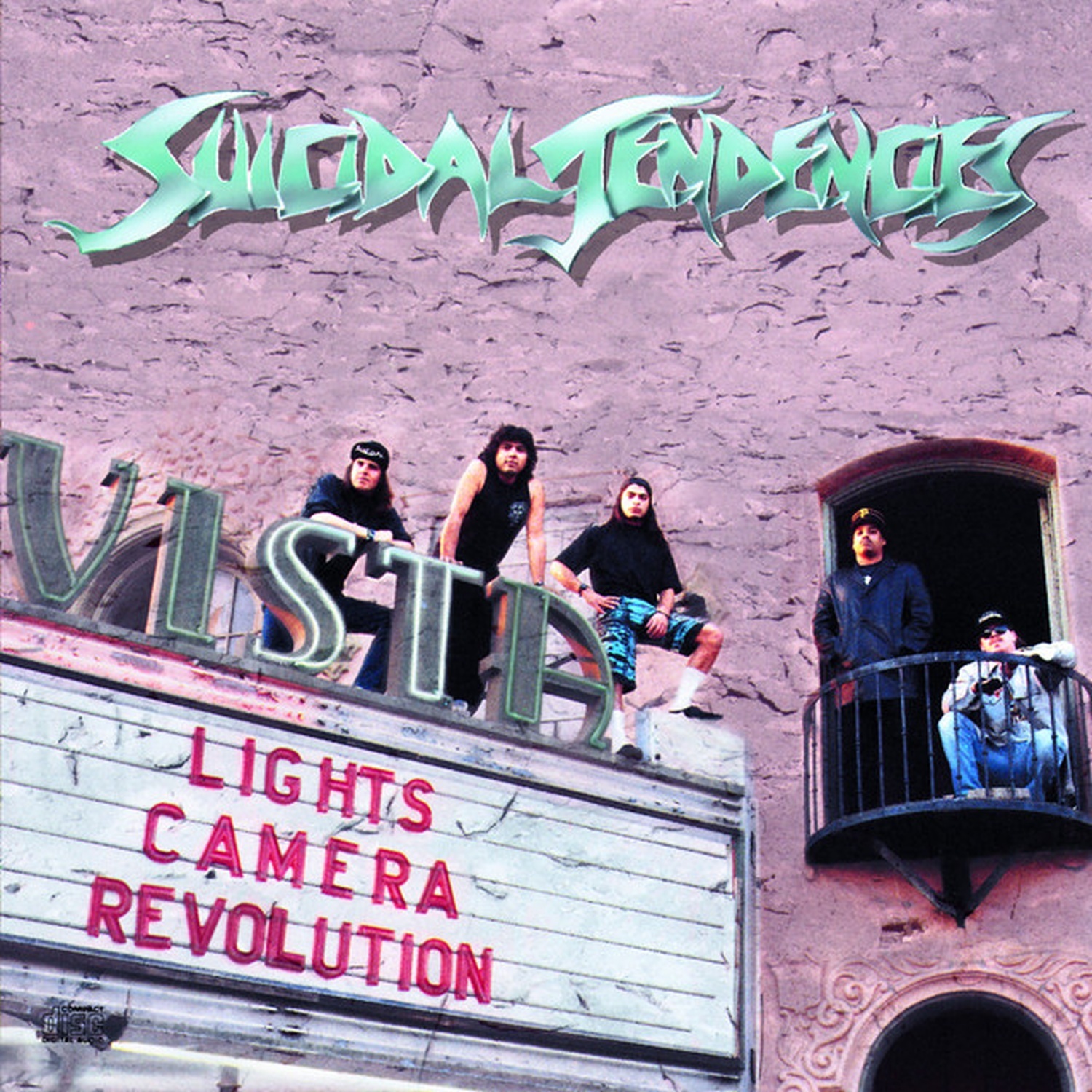
(Fun fact: The album’s cover photo was shot at the historic Vista Theatre in Los Angeles, with band members literally on the marquee and roof – truly “Lights, Camera…” ready!)
Backstory: Building Up to Lights…Camera…Revolution!
By 1990, Suicidal Tendencies had already traveled a wild road. Formed in Venice Beach, CA as a punk band in 1980, they spent the ’80s evolving from hardcore skaters to metal shredders. Their early years were infamous – the band gained notoriety for violent shows and rumored gang affiliations, leading to an outright ban on their concerts in Los Angeles for several years. Despite the controversy (or perhaps because of it), Suicidal Tendencies built a dedicated following. Their 1983 self-titled debut was a hardcore punk classic (featuring the MTV hit “Institutionalized”), but by the late ’80s they had embraced a crossover thrash style – combining punk attitude with thrash metal riffs.
The late ’80s saw Suicidal sign to a major label (Epic Records) and break into the metal scene. How Will I Laugh Tomorrow When I Can’t Even Smile Today (1988) was their first album on Epic and marked a full dive into thrash metal, wowing fans with its speed and complexity. They followed up with the EP/compilation Controlled by Hatred/Feel Like Shit…Déjà Vu (1989), which went on to become the band’s first Gold-certified record. This period was a transition for the group: longtime bassist Louiche Mayorga had departed after 1987, and by 1989 the band was between bassists, cycling through fill-ins until they found the right fit Enter Robert Trujillo – a young bass phenom whose funky playing style would soon become a secret weapon for Suicidal Tendencies.
By the time Lights…Camera…Revolution! was in the works, Suicidal Tendencies had a “classic” lineup locked and loaded and plenty of momentum. They had honed their thrash-metal chops on the previous records and were ready to push their sound further. The band’s notoriety was at a peak (even if they still couldn’t play a hometown L.A. show due to the ban!), and they had their fingers “on the pulse of the culture” in a way that would energize the new material. The stage was set for Lights…Camera…Revolution! to be a breakthrough – and that it was.
The Band Lineup & Notable Changes
One big reason Lights…Camera…Revolution! stands out is the lineup that created it. Suicidal Tendencies circa 1990 featured five members, each at the top of their game:
- Mike “Cyco Miko” Muir – Vocals: The founding frontman, known for his aggressive yet witty lyrics and charismatic snarl. Muir’s vocal delivery on this album ranges from spitfire rants to surprisingly melodic hooks. His humor and energy are a driving force throughout the record.
- Rocky George – Lead Guitar: Rocky’s blazing lead guitar work had been crucial to Suicidal’s metal evolution since the mid-’80s. On Lights…Camera…Revolution! he delivers searing solos and crunchy riffs that match Muir’s intensity note for note. Rocky’s shredding (eight-finger tapping solos, anyone?) is especially prominent on tracks like “You Can’t Bring Me Down”.
- Mike Clark – Rhythm Guitar: Having joined in 1987, Mike Clark brought additional riff power to the band. His tight, heavy rhythm guitar underpins the songs, and he co-wrote many of the riffs. Clark’s hardcore punk roots (he and Muir had played in the side project No Mercy) added extra crunch to Suicidal’s sound.
- Robert Trujillo – Bass: Lights…Camera…Revolution! was the first ST album to feature Trujillo on bass, and he made a big splash. Robert’s fluid, funky bass lines added a new dimension to the music – you can hear slapping and popping on “Send Me Your Money” and a general groove under the thrash. His presence ushered in subtle funk influences on this album. (Trujillo’s talent didn’t go unnoticed – years later he’d become the bassist for Metallica, but this record is where his journey with ST began.)
- R.J. Herrera – Drums: This album was the last to feature R.J. on drums. Herrera’s drumming is fast, aggressive, and precise – driving the thrash tempo but also capable of groove when needed. He left the band in 1991, shortly after Lights… came out, making this record a swan song for his tenure.
Notably, this lineup was identical to the one on the Controlled by Hatred… EP (except now Trujillo was actually performing, not just credited). Fans often consider it the definitive Suicidal Tendencies lineup, given the chemistry on display. The addition of Trujillo was the major change leading into the album – he replaced former bassist Bob Heathcote (who had played on the 1988 album) and brought a fresh spark. Meanwhile, the departure of R.J. Herrera after the album’s release would lead to some shuffling later, but on Lights…Camera…Revolution! you’re hearing a band firing on all cylinders with a stable unit.
Writing and Recording the Album
Lights…Camera…Revolution! was written and recorded in late 1989 and early 1990, during a creative high point for the band. The writing process saw Mike Muir and his bandmates pushing their songwriting to be more complex and ambitious than before. Many songs feature multiple sections, tempo changes, and more sophisticated arrangements than your average punk tune. Yet, true to Suicidal form, they also packed the tracks with attitude, humor, and social commentary.
Recording took place at two California studios – Rumbo Recorders in Canoga Park (Los Angeles) and Amigo Studios in Hollywood – between December ’89 and April ’90. The band teamed up with producer Mark Dodson (who had also produced their previous record) and co-produced the album themselves. Mark Dodson helped give the album a polished, powerful sound without losing the band’s raw edge. The mix was done at A&M Studios in Hollywood, ensuring the heavy guitars and funky bass all cut through clearly.
One notable aspect of the recording was the integration of Trujillo’s bass style. The band consciously allowed more groove to come into the songs – for instance, check out the intro of “Send Me Your Money,” which starts with a funky bass line before the thrash guitars kick in. This was a new flavor for Suicidal Tendencies, and it was handled carefully so as to enhance their sound rather than change it completely. In interviews, Muir later noted that when Lights…Camera…Revolution! came out, nobody called it “funk metal” per se – it was still viewed as a thrash/hardcore album – but in hindsight you can hear the groovier elements that foreshadowed their next moves.
The sessions were reportedly intense but fun. Mike Muir’s lyrics for this album show him balancing anger with tongue-in-cheek humor, and one imagines that vibe carried into the studio as well. The band even recorded some spoken asides and comedy bits (like Mike’s famous rant at the start of “You Can’t Bring Me Down”) that give the album character. All in all, the making of Lights…Camera…Revolution! captured Suicidal Tendencies at a time when they were hungry to prove themselves and willing to experiment just enough to keep things fresh.
Release and Commercial Performance
Lights…Camera…Revolution! hit the streets on July 3, 1990, right in time to crank it up for the summer. Despite Suicidal Tendencies’ underground reputation, the album performed quite well commercially – a sign that the crossover from punk clubs to the metal mainstream was succeeding. Here are some highlights of how the record fared:
- Billboard Charts: The album reached #101 on the Billboard 200 in 1990. Breaking into the top 200 was an accomplishment for a thrash/crossover record at the time (remember, this was before Nirvana made heavy music truly mainstream). It showed that Suicidal had a growing nationwide audience.
- MTV and Airplay: Perhaps even more impactful than the Billboard peak was the exposure on MTV. The music video for “You Can’t Bring Me Down” became a staple on MTV’s Headbangers Ball, receiving heavy rotation. This visibility introduced countless hard rock and metal fans to Suicidal Tendencies. Other videos like “Send Me Your Money” and “Alone” also got airplay on MTV’s late-night metal programming. Essentially, Lights…Camera…Revolution! turned Suicidal into music video stars of the thrash world, alongside bigger names of the era.
- Gold Certification: Thanks in large part to that MTV-fueled popularity, the album eventually achieved Gold certification in the U.S. (over 500,000 copies shipped). It was the band’s second Gold record (the first being the 1989 EP) and validated that Suicidal Tendencies could move units beyond just the punk underground. Going Gold was a big deal for a band once considered too “dangerous” for mainstream shows!
- Grammy Nomination: Suicidal Tendencies even earned some awards recognition. Lights…Camera…Revolution! was nominated for a Grammy Award in 1991 – in the Best Metal Performance category. They ultimately lost to Metallica’s cover of “Stone Cold Crazy,” but the nomination itself speaks volumes. Who would’ve thought a band that had been banned from playing L.A. clubs would be rubbing shoulders with Metallica at the Grammys? It’s a testament to the album’s impact that year.
- Tours and Live Success: Off the back of the album’s success, Suicidal Tendencies were able to do things that had been impossible for them in earlier years – like play a show in Los Angeles again. In fact, the success of Lights… directly led to their first L.A. gig in years (finally overturning the ban). They also scored prime touring slots: Suicidal headlined major U.S. tours with a diverse set of support acts (everyone from Pantera and Exodus to Jane’s Addiction and White Zombie) and joined the famous European “Clash of the Titans” tour in 1990 alongside Megadeth, Slayer, and Testament. They even opened for Queensrÿche on the big Empire tour. In short, the album catapulted Suicidal Tendencies into the big leagues of touring metal bands.
Critically, Lights…Camera…Revolution! was well-received in the metal community. Reviewers noted the band’s renewed focus and energy. AllMusic later hailed it as “one of [the band’s] best albums ever” and a “disc that no Suicidal fan should be without,” praising how confident and inspired the band sounded. Years on, it’s still held up as a high point: Loudwire ranked Lights…Camera…Revolution! at #8 on their list of top ten thrash albums not released by the Big 4 (Metallica, Megadeth, Slayer, Anthrax) – meaning it’s one of the genre’s classics outside the usual giants.
To sum up, this album didn’t make Suicidal Tendencies pop stars or anything, but it solidified their status as thrash/crossover heavyweights and broadened their fanbase significantly. From headbangers in the U.S. heartland to skate punks in Europe, a lot of folks discovered ST through Lights…Camera…Revolution!.
The Singles: Songs, Meanings, and Impact
The album had four singles – pretty ambitious, but each showcased a different side of Suicidal Tendencies and helped keep the album in listeners’ ears over 1990-91. Let’s break down the singles, what they’re about, and how they performed:
- “You Can’t Bring Me Down” (1990): This was the lead single and is arguably Suicidal Tendencies’ signature song from their metal era. What’s it about? In a word: defiance. It’s a ferocious rebuttal to naysayers, haters, and anyone who tried to censor or criticize the band. Mike Muir opens the track with an instantly memorable spoken rant: “Who the hell are you calling crazy? You wouldn’t know what crazy was if Charles Manson was eating Froot Loops on your front porch!” – simultaneously hilarious and in-your-face. The lyrics basically tell the band’s detractors that no matter what they do, they can’t keep Suicidal down. This was directly inspired by the band’s struggles with being banned and misunderstood. The music video drives it home: it depicts ST being arrested by authorities, with a newspaper headline “Suicidal Tendencies Banned In L.A.” popping up at the start. In the video’s climax, Muir is put in an electric chair by evil censors and “executed” – only for the Suicidal crew/fans to riot in protest. (Sharp-eyed viewers will notice the U.S. Constitution flashing in the background during the execution scene – a subtle jab at how censorship infringes on free speech!) On MTV, “You Can’t Bring Me Down” was a huge hit – it was on heavy rotation on Headbangers Ball and became an anthem for metalheads who felt society didn’t understand them. Even though it didn’t chart on the Hot 100, the song’s impact was massive in the rock community. It remains a live staple and earned Suicidal that Grammy nod in ’91. Talk about coming out swinging – this track brought them up, not down! 😎
- “Send Me Your Money” (1990): Next up, Suicidal Tendencies showed their satirical side with this funky thrasher. What’s it about? Televangelists – those TV preachers infamous for asking viewers to “sow a seed” (i.e. send money) for dubious causes. Mike Muir pulls no punches calling out the hypocrisy of these so-called holy men lining their pockets. The song’s tone is lighter and comedic, with a bouncing funk-metal groove powered by Trujillo’s bass. In fact, “Send Me Your Money” opens with a slap-bass line that immediately tells you something a little different is happening here. As the track kicks in, Muir adopts a semi-preacher vocal affectation, jokingly passing the collection plate. It’s catchy, irreverent, and full of fun musical touches (including two quick bass solo breaks). The music video amplified the humor: it shows the band performing, intercut with scenes of Muir hamming it up with a camera, a greedy preacher counting cash, and even the band members doing a mock gospel choir bit for the chorus. At the end of the video, Muir literally smashes a TV with a sledgehammer – poetic justice for all those late-night televangelist broadcasts!. On MTV, this video also got solid airplay (Headbangers Ball loved it), and notably, “Send Me Your Money” became Suicidal’s first and only single to ever chart in the UK. It seems the British audience appreciated the sarcasm – the song put Suicidal Tendencies on the UK map. In the U.S. it wasn’t a radio “hit” per se, but the video was popular enough that it even featured on an episode of Beavis and Butt-Head (the famous ’90s cartoon that riffed on music videos). Imagine Beavis and Butt-Head headbanging and laughing at Muir’s antics – that’s cultural impact! Importantly, this song had history: Suicidal had actually been playing “Send Me Your Money” live since 1985, years before it was recorded, as part of a medley. Fans finally got it on an album in 1990 – and it was worth the wait, becoming a fan favorite for its funky vibe and comedic bite.
- “Alone” (1991): Released as a single in early 1991, “Alone” showed a different, more emotional side of Suicidal Tendencies. What’s it about? Feeling isolated and misunderstood – a theme many fans could relate to. It’s a mid-tempo melodic thrash song with a moody atmosphere, almost a power ballad by Suicidal standards (though it still has plenty of crunch). Mike Muir’s lyrics in “Alone” are a bit more introspective, touching on the pain of being lonely even when surrounded by people. Interestingly, some have noted that “Alone” is like a more straightforward, accessible cousin to the band’s 1988 epic “How Will I Laugh Tomorrow…When I Can’t Even Smile Today” – it covers similar emotional ground but in a shorter, punchier form. The track starts off with a clean guitar intro that builds into a soaring chorus, showcasing that Suicidal could be melodic without losing power. A music video for “Alone” was made (featuring the band performing in a foggy, eerie setting), and while it didn’t get as much MTV rotation as the previous singles, it still popped up on Headbangers Ball now and then. All three of the album’s initial singles – “You Can’t Bring Me Down,” “Send Me Your Money,” and “Alone” – were successful enough that their videos became staples on MTV’s metal programming, helping the band reach a wider heavy music audience. “Alone” in particular struck a chord with fans who connected to its lonely-in-a-crowd sentiment. It proved Suicidal Tendencies could pull off a quasi-ballad and still keep it real (no cheesy love song here, just raw loneliness). Today, the “Alone” video is a bit of a rarity online (a holy grail for ST video collectors), but the song remains one of their more anthemic pieces.
- “Lovely” (1991): The fourth and final single, “Lovely” is a sharp dose of Suicidal sarcasm. What’s it about? Censorship and the PMRC (Parents Music Resource Center) – the group that in the ’80s was trying to blame rock/metal music for society’s ills and slap “Parental Advisory” stickers on albums. Instead of raging angrily, Suicidal went the tongue-in-cheek route on “Lovely.” Mike Muir sings from the perspective of the PMRC or a similar moral crusader, sarcastically talking about how “lovely” everything would be if we just removed all the bad influences from music. The tone is overly sweet and “happy” on purpose – essentially satirizing the censor’s mindset. One of the key lyrics: “So Tipper, babe, don’t you remember me? Now I’m kinder, gentler, and so happy!” – directly name-dropping Tipper Gore (who led the PMRC hearings) with a heavy dose of irony. It’s brilliant because the band is making a serious point (art imitates life, and censorship is misguided) but doing it with humor. Musically, “Lovely” is fast and punky, under 4 minutes, with cheerful backing vocals and even a funky break. In fact, “Lovely” gave listeners the first taste of the funk influence Trujillo brought in – there’s a groove under the chorus that was new for Suicidal. While “Lovely” wasn’t as prominently pushed as a single (it may have been more of a promo single to radio), it still got some attention. It perfectly encapsulates Suicidal Tendencies’ ability to be rebellious and playful at the same time. For many fans, hearing Mike Muir essentially mock the PMRC with a grin was refreshing – the band that had been targeted by censors was reclaiming the narrative. “Lovely” might not have climbed charts, but it remains a standout deep cut for its lyrical wit and the way it slyly flips the bird at censorship while sounding oddly… well, lovely!
Each of these singles contributed to the album’s story – from massive MTV hits to cult favorite tracks. Together, they kept Lights…Camera…Revolution! in the spotlight for over a year and showed the range that Suicidal Tendencies had developed. Whether confronting authority head-on, skewering corrupt leaders, pouring out feelings of alienation, or satirizing the powers-that-be, the album’s songs covered a lot of ground. And thanks to the singles’ success, Suicidal Tendencies gained a broader fanbase that included not just skate-punk teens but also headbangers, alternative rock fans, and even curious mainstream rock listeners.
Musical Style, Influences, and Legacy
When it comes to Lights…Camera…Revolution!’s musical style, the album is a thrash metal monster with a twist. Suicidal Tendencies had firmly moved away from their early pure-punk sound by this point, diving into thrash’s tight riffs and shredding solos. Songs like “You Can’t Bring Me Down” and “Disco’s Out, Murder’s In” can go toe-to-toe with any Bay Area thrash in terms of speed and technicality. However, what makes this album special is how it incorporates other influences seamlessly:
- There’s still a hardcore punk backbone in the attitude and simplicity of some choruses (you can chant along to many of these songs as if you’re at a punk show). Tracks like “Give It Revolution” carry that old-school hardcore spirit of rebellion and brevity, even while the guitar work is metallic.
- As noted, the album also lightly introduces a funk element. This wasn’t Suicidal going full Red Hot Chili Peppers or anything, but listen to the rhythm section on “Lovely” or the groove in “Send Me Your Money” – that bounce is funk-influenced. This came courtesy of Robert Trujillo’s style and the band being open to new ideas. It was a precursor to the emerging funk-metal trend of the early ’90s. In fact, Mike Muir loved the funk vibe so much that soon after, he and Trujillo started a funk metal side project called Infectious Grooves to fully dive into it. (Infectious Grooves’ debut in 1991 explored funky bass and humorous lyrics even further, with guests like Ozzy Osbourne – a direct legacy of what started on Lights…Camera…Revolution!).
- Lyrically and thematically, the album’s influences were the real-world issues the band was facing: censorship (PMRC hearings were mid-’80s and still a hot topic), societal pressure, personal alienation, and a general “question everything” ethos. Suicidal had always been about bucking authority – that punk mindset carried over, even as the music got more metal. You can hear the influence of the band’s Venice Beach skate culture too – a song like “Get Whacked” has that carefree, do-your-own-thing energy that defined the skatepunk attitude.
Now, speaking of legacy – Lights…Camera…Revolution! left a lasting mark on heavy music and on Suicidal Tendencies’ career trajectory:
- Fan Favorite & Critical Darling: The album is widely considered one of Suicidal Tendencies’ masterpieces. Fans who discovered the band through this record often cite it as their favorite. Critics have continued to praise it over the years; as mentioned, AllMusic’s Alex Henderson called it indispensable for fans. In the world of crossover thrash, it’s held up as a classic – on lists and in retrospectives, it frequently gets nods as an essential ’90s metal album. The Loudwire ranking (top 10 non-Big-4 thrash albums) underscores how Lights… is viewed as being in the elite company of the genre’s best.
- Broadening Metal’s Horizons: In 1990, thrash metal was dominated by the “Big 4” and a fairly narrow idea of what thrash sounded like. Suicidal Tendencies, with this album, showed that you could mix in funk grooves, inject a lot of personality and humor, and still be heavy and credible. In a way, Lights…Camera…Revolution! helped pave the way for the funk-metal and alt-metal explosion of the early ’90s. Bands like Infectious Grooves (the ST side project), 24-7 Spyz, Mordred, and even elements in bigger bands (Anthrax was getting funky around ’91 too) were part of that wave. Suicidal wasn’t copying anyone – they were in front of that curve, integrating funk organically into thrash. Mike Muir has pointed out that when Lights… came out, people didn’t label it “funk metal,” but after Infectious Grooves and others hit, folks retroactively noticed the funk in Suicidal’s sound. So, the album’s legacy includes being a blueprint for crossover done right.
- Influence on Fans and Culture: Suicidal Tendencies always had a strong identity – the bandanas, the “Cyco” slang, etc. This album took that identity worldwide. Suddenly, you had kids in far-flung places wearing Suicidal bandanas and flipping up the brims of their caps. The rebellious spirit of songs like “You Can’t Bring Me Down” resonated with youth facing their own authority figures. The album’s anti-censorship stance and refusal to be pigeonholed influenced many bands that followed to speak their minds. It also showed punk bands that you could get metal and still keep it real – something that influenced the ’90s punk-metal fusion in genres like skate punk and metalcore down the line.
- Career Legacy for ST: For Suicidal Tendencies themselves, Lights…Camera…Revolution! set up their 1992 album The Art of Rebellion to be an even bigger success. There were high expectations after Lights… went gold and earned acclaim, and indeed The Art of Rebellion charted higher (#52 Billboard) and gave ST their first true radio hits. Many argue that the groundwork laid by Lights… – winning over the metal crowd – allowed Suicidal to experiment more on Art of Rebellion and still have a receptive audience. Also, the fact that ST was accepted on tours with thrash and even hard rock bands (like the tours with Megadeth, Metallica, Guns N’ Roses in the early ’90s) is a legacy of this album’s success. It permanently elevated Suicidal’s status. Even after the band’s hiatus and reformation, songs from Lights…Camera…Revolution! remain mainstays in their live sets, and fans from multiple generations rock out to “You Can’t Bring Me Down” like it’s a timeless rallying cry.
In short, the album’s legacy is that of a game-changer for Suicidal Tendencies and a beloved piece of crossover thrash history. It’s the record where ST proved they could evolve without losing their soul – blending genres and social commentary into something uniquely them. Over three decades later, it still sounds fresh, and you can hear its influence echo anytime a metal band isn’t afraid to get a little funky or a punk band tightens up their musicianship.
Five Things You Might Not Know About Lights…Camera…Revolution!
Even if you’re a die-hard Cyco, here are five lesser-known trivia tidbits about the album that might surprise you:
- Grammy Nod for the Cycos: Yes, Suicidal Tendencies are Grammy-nominated artists thanks to this album. Lights…Camera…Revolution! was nominated for Best Metal Performance at the 33rd Grammy Awards in early 1991. They lost out to Metallica that year, but it’s still an impressive feat for a band once considered too unruly for the mainstream. Who would’ve thought the same group infamous for “Institutionalized” would be mingling with Grammy voters?
- Second Time Gold – and First Was an EP: The album earned a Gold certification (500,000 copies) from the RIAA a few years after its release, making it the second Suicidal Tendencies release to go gold. Interestingly, the first was not one of their full studio albums, but the 1989 compilation/EP Controlled by Hatred/Feel Like Shit…Déjà Vu, which also went gold. So Lights…Camera…Revolution! was the band’s first full album to hit that milestone. Not bad for a group that spent years on independent labels!
- Cover Shoot at a Classic Theater: The dramatic album cover photo – with Suicidal Tendencies looming over a theater marquee – was taken at the Vista Theatre in Los Angeles. That’s a historic single-screen movie theater in East Hollywood. Mike Clark, R.J. Herrera, and Robert Trujillo are actually standing atop the theater’s facade (just behind the “Vista” sign) while Rocky George and Mike Muir appear in the window to the right. It’s a pretty epic way to tie into the “Lights…Camera…” theme. Fans still swing by the Vista to snap photos where Suicidal stood – a little piece of ST history in L.A.
- Home Video Companion: In late 1990, Suicidal Tendencies released a VHS home video titled Lights…Camera…Suicidal as a companion to the album. It came out about four months after the record and features six of the band’s music videos (including those from this album), with Mike Muir introducing each one, plus a live performance of “War Inside My Head”. Essentially, it’s a video album. Lights…Camera…Suicidal even has some exclusives (like a live track and possibly the only official release of certain videos). It’s never been released on DVD and is long out of print, so it’s a true collectors’ item now. If you find an old VHS or LaserDisc copy, treasure it – that’s Suicidal in their prime, on film!
- UK Chart “Money”: Suicidal Tendencies never broke into the U.S. singles charts in a big way, but they did have a minor overseas hit from this album. “Send Me Your Money” is the only ST single to ever chart in the UK. It seems the Brits picked up on the song’s satirical edge – or maybe the funky feel stood out amid the thrash. This bit of trivia often surprises people, since you’d think “Institutionalized” or “You Can’t Bring Me Down” might’ve charted somewhere. Nope – it was “Send Me Your Money” making a little dent in the UK rankings. God save the Queen… and send her your money? 😜
(Bonus tidbit: There’s a fun Easter egg on the album – the end of “You Can’t Bring Me Down” features Mike Muir laughing maniacally and shouting “Suicidal!” as the music stops. It’s an uncredited little moment that became a trademark concert ending for the song. Fans love screaming “Suicidal!” along with that part live.)
Songs from Lights…Camera…Revolution! in TV, Film, and Media
Several tracks from Lights…Camera…Revolution! have popped up in media over the years, underscoring the album’s cultural reach. Here are a few notable occurrences where songs from this record made their way into TV shows, videos, or other media:
- Skateboarding Video (Danny Way – The DC Video): Suicidal Tendencies’ music has always been popular with skateboarders (no surprise, given the band’s skate-punk roots). The song “You Can’t Bring Me Down” was used in pro skater Danny Way’s segment of The DC Video, a famous skate video release in the early 2000s. The track’s aggressive energy made it a perfect soundtrack as Danny Way pulled off insane stunts. This placement introduced the song to a new generation of skate kids, proving its lasting appeal.
- Beavis and Butt-Head (MTV, 1993): As mentioned earlier, the “Send Me Your Money” music video was featured on an episode of MTV’s Beavis and Butt-Head (specifically the episode titled “Door to Door”). In the show, the animated duo watch and humorously comment on music videos. They were fans of Suicidal’s thrashy parts – and likely had a laugh at Muir’s preacher schtick in the video. Being lampooned by Beavis and Butt-Head in the ’90s was almost a badge of honor for rock/metal bands, indicating your video was getting noticed.
- Headbangers Ball and MTV rotations: Okay, this is more of a general media presence, but it’s worth noting that the videos for “You Can’t Bring Me Down,” “Send Me Your Money,” and “Alone” became staple content on MTV’s Headbangers Ball and similar programs. In the late ’80s/early ’90s era, that was essentially how metal fans got their “TV show” fix of music. Suicidal Tendencies’ persona (the bandana-wearing, slammed-cap, rebellious vibe) made them visually memorable on TV, and many kids first saw ST via those late-night MTV appearances.
While Lights…Camera…Revolution! didn’t have a Top 40 hit single to become ubiquitous in pop culture, its songs have had a healthy life beyond the album – especially in subcultures like skate videos and late-night metal TV. The defiant shout of “You can’t bring me dowwwwn!” echoing in a skate video or the satirical “Send me your money!” on a cult cartoon show just solidifies the album’s place in the broader cultural fabric of its time.
After Lights…Camera…Revolution! – What Came Next for Suicidal Tendencies
The era following Lights…Camera…Revolution! was an eventful one for Suicidal Tendencies, filled with both highs and lows. Here’s a quick chronicle of what the band went through after 1990:
- Lineup Changes: Not long after the album, in 1991, drummer R.J. Herrera left the band due to personal differences. Instead of immediately finding a new permanent drummer, Suicidal entered the studio as essentially a four-piece (Muir, Rocky, Clark, Trujillo) with session help. They brought in Josh Freese – a talented young drummer (from The Vandals and later a well-known session player and A Perfect Circle, Nine Inch Nails, Guns N Roses, Paramore, Sting, Weezer and more recently Foo Fighters) – to play on their next album. On tour, though, they needed a full-time member, so by 1992 they recruited Jimmy DeGrasso (formerly of Y&T and White Lion) as the new drummer. This was a significant change, as R.J. had been with the band since the mid-’80s. Meanwhile, the rest of the Lights… lineup stayed intact through the early ’90s.
- The Art of Rebellion (1992): Suicidal Tendencies followed up Lights…Camera…Revolution! with The Art of Rebellion in the summer of 1992. Thanks to the momentum from Lights…, The Art of Rebellion became the band’s biggest commercial success – it reached #52 on Billboard, their highest chart position, and yielded songs that got significant radio/MTV play. Notably, the singles “Nobody Hears” and “I’ll Hate You Better” were moderate hits (even cracking the Mainstream Rock top 40 – a first for ST). Musically, The Art of Rebellion saw Suicidal experiment more with alternative metal and progressive elements, dialing back the thrash in favor of moodier, more melodic songs. Mike Muir and Mike Clark have mentioned that the album wasn’t intentionally made to be more “alternative,” but it naturally evolved from the experimentation that began on Lights…Camera…Revolution!. The success of The Art of Rebellion in 1992, right as grunge and alt-rock were booming, showed that Suicidal Tendencies managed to adapt and survive where many ’80s thrash bands struggled.
- Peaking and Breakup (1993-1995): By 1993, Suicidal Tendencies were at their commercial peak – they were playing arenas and stadiums opening for giants like Metallica, Guns N’ Roses, and Queensrÿche, and holding their own. In ’93 they also released Still Cyco After All These Years, a fun album of re-recordings of their early songs (including fresh takes on “Institutionalized” and “I Saw Your Mommy”) to mark a decade since the debut. However, things took a turn with their 1994 album Suicidal for Life. At that point, Muir was uncomfortable with the band’s fame and felt they were losing their underground edge. In almost self-sabotaging fashion, Suicidal Tendencies intentionally made Suicidal for Life their least accessible album – the first four songs all have the F-word in the title, and the style is a return to a more abrasive, no-compromise sound. Critics panned it and many fans were mixed on it, though some appreciated the raw aggression. The strategy “worked” in the sense that the band shed its more casual mainstream listeners; Suicidal for Life did chart (peaking at #82) but quickly fell off. Feeling disillusioned, Suicidal Tendencies decided to disband in 1995, after a final tour and parting ways with Epic Records. It was the end of an era – Muir had effectively pulled the plug on the band at what he felt was the appropriate time, rather than letting it fizzle out.
- Infectious Grooves and Side Projects: During the early ’90s, concurrently with Suicidal activities, Mike Muir and Robert Trujillo were busy with their funky side band Infectious Grooves. Infectious released two albums (The Plague That Makes Your Booty Move… in 1991 and Sarsippius’ Ark in 1993) to critical acclaim in the funk-metal niche, and even had a minor hit with “Therapy” (featuring Ozzy Osbourne). This side project kept Muir and Trujillo artistically fulfilled and likely influenced some of Suicidal’s direction. After Suicidal broke up in ’95, Muir continued with Infectious Grooves for a bit, and Trujillo eventually went on to play with Ozzy Osbourne’s band in the late ’90s. Infectious Grooves in a way carried the Suicidal flag for a few years, keeping that extended “Suicidal family” vibe alive.
- Reformation and New Lineups: Suicidal Tendencies wasn’t gone for too long. By 1996, Mike Muir couldn’t resist resurrecting the band. He reformed Suicidal Tendencies in 1996/97 with Mike Clark back on guitar and a batch of new members (including drummer Brooks Wackerman for a time, then others). Notably, Rocky George (the lead guitarist) and Robert Trujillo did not rejoin at that time – Rocky went on to play with Fishbone, and Trujillo continued his journey eventually landing the Metallica gig in 2003. The “new” Suicidal lineup released the album Freedumb in 1999, which was a leaner, punkier record aligning with the skate-punk trend, and Free Your Soul and Save My Mind in 2000. They even did an album of old songs re-recorded (No Mercy Fool!/The Suicidal Family in 2010) and have continued to record and tour into the 2010s and 2020s.
- The Dave Lombardo Era (2016–2021):
A later but very cool chapter in the Suicidal story came when legendary Slayer drummer Dave Lombardo joined the band in 2016. Initially brought in as a touring drummer for Suicidal’s dates with Megadeth and European shows, Lombardo quickly became more than just a fill-in. He ended up recording with the band on their 2016 album World Gone Mad (as well as later releases like the Get Your Fight On! EP and Still Cyco Punk After All These Years), giving this era of Suicidal a harder, more precise thrash punch while still locking in with their funk and crossover groove. Lombardo stayed with Suicidal Tendencies through the latter half of the 2010s, touring heavily and helping reassert them as a contemporary live force rather than a legacy act, before eventually moving on from the band around 2021 to focus on his other projects. - Modern Lineup – Ben Weinman Joins (2018): In the late 2010s Suicidal Tendencies added guitarist Ben Weinman, best known as the founding guitarist of The Dillinger Escape Plan. His addition brought a burst of technical precision and chaotic, math-metal edge to the band’s live sound. Weinman joined longtime guitarist Dean Pleasants, who has been with ST since 1996, creating a powerful and eclectic modern guitar duo that bridges classic Suicidal groove with Dillinger-style intensity.
- Mike Muir remains the sole original member, the ever-present leader of the Suicidal army.
After the triumph of Lights…Camera…Revolution! the band hit an even bigger high, then intentionally dove back underground and split up – only to rise again later. It’s a tale of a band that tasted mainstream acceptance but ultimately stayed true to their core ethos. Importantly, Lights…Camera…Revolution! is seen as the springboard that launched Suicidal Tendencies into that tumultuous ’90s journey – without it, they likely wouldn’t have had the opportunity to experiment on Art of Rebellion or the clout to go out on their own terms in ’95.
Remasters, Reissues, and Lasting Celebrations
For a classic album like Lights…Camera…Revolution! you might expect deluxe reissues or remasters over the years. Surprisingly, the album hasn’t seen a lot of fancy re-release treatment – at least not in the way some classic rock albums have. Here’s what to know on this front:
- No Major Remastered Deluxe Edition (Yet): As of now, there isn’t an official CD/digital remastered deluxe edition with bonus tracks or outtakes for Lights…Camera…Revolution! The original mix and mastering are still the standard. The album’s production holds up well, so it hasn’t needed a remaster urgently, but who knows – maybe a 35th or 40th anniversary remaster could happen down the line. Suicidal Tendencies did re-record a few songs from this era (for example, “Send Me Your Money” was re-cut for the Still Cyco After All These Years compilation in 1993), but a full reissue of the album itself with new content hasn’t been done.
- Vinyl Reissues: Vinyl lovers have had some treats. The album was originally issued on vinyl in 1990. You can pick up a VGC original copy for around $20-30. Over the years it’s been repressed a few times. Notably, a 35th Anniversary edition has been announced (or released) in 2025 on red coloured vinyl, limited to 2000 individually numbered copies. This special edition (by the Music on Vinyl label in Europe) celebrates the album as an essential crossover classic, complete with a deluxe sleeve finish and 180-gram vinyl quality. It’s a testament to the album’s enduring popularity that it gets such treatment decades later. Earlier, in 2013, there was also a vinyl reissue (Music on Vinyl did a standard black press around that time too). Original vinyl pressings are collectible, especially with the iconic cover art.
- Compilation Inclusions: Tracks from Lights…Camera…Revolution! have been included on various Suicidal Tendencies “best of” compilations, such as Prime Cuts (1997) and Playlist: The Very Best of Suicidal Tendencies (2010). So the album’s songs have been remastered in the context of those releases (for example, “You Can’t Bring Me Down” on Prime Cuts may have a slight remastering). But the differences are subtle to the casual ear.
- Anniversary Acknowledgments: The band themselves often acknowledge the album’s anniversaries in live shows or social media. In 2020, fans and music sites celebrated the 30th anniversary of Lights…Camera…Revolution! with retrospective articles and posts. It’s clear that for many, this record is something worth revisiting on milestone birthdays.
- No Full Album Live Release: While Suicidal has put out live recordings, we haven’t yet seen a live album where they play Lights…Camera…Revolution! in its entirety or anything (though that would be awesome!). However, live albums/DVDs like Live at the Olympic Auditorium (recorded in 2005) feature a couple of Lights… tracks and show that the material still goes down a storm with crowds.
In essence, Lights…Camera…Revolution! hasn’t needed a flashy reissue to remain relevant – it continues to sell steadily and find new fans as-is. The occasional vinyl re-release keeps collectors happy, and the music sounds as hard-hitting today as it did in 1990. With the 35th anniversary vinyl out in 2025, it’s a reminder that this album is truly a timeless piece of crossover thrash – one that’s still being cranked loud by both old-school Cycos and new listeners discovering Suicidal Tendencies for the first time.
Lights…Camera…Revolution! captures Suicidal Tendencies at their peak – blending metal, punk, funk, and humor into an album that’s as much a statement as it is a collection of songs. From the band’s struggle-filled beginnings to the MTV-fueled success of this record, it’s a real-life “rags to (bandana) riches” story, albeit with many twists. The album’s legacy lives on in every “CYCO” chant at their concerts and every time a kid picks up a skateboard with Suicidal blasting in their headphones. Over 30 years later, we can still cue up this album and feel that surge of adrenaline when the intro of “You Can’t Bring Me Down” hits – and that’s a beautiful thing. In the spirit of the album’s closer: it’s not time to Go’n Breakdown… it’s time to Go’n celebrate a bona fide classic.
About the Author