On 24 February 1975, the biggest rock band on the planet finally pulled the velvet curtain back. Physical Graffiti by Led Zeppelin was not just an album, it was a fifteen track, eighty two minute statement that the four men behind Stairway to Heaven could do absolutely anything they wanted, on their own label, on their own time, with no one to answer to. It was their first release on the newly minted Swan Song imprint, their first double LP, their first proper attempt to gather up the studio offcuts of an extraordinary five year run and make them sit alongside brand new material recorded in a draughty Hampshire poorhouse with a mobile truck parked on the gravel.
It is the album that gave the world Kashmir, In My Time of Dying, Trampled Under Foot, Ten Years Gone and the title song that gave its parent album its name two years earlier. It debuted at number one on the Billboard 200, hit number one in the United Kingdom, sent every previous Zeppelin record back into the chart simultaneously and has gone on to be certified sixteen times Platinum in the United States alone, the highest American certification of any Zeppelin studio album. This is the story of how it came together, what it actually contains, and why almost everyone who writes about rock music tends to circle back to Physical Graffiti when they are asked what Led Zeppelin sounded like at their absolute peak.
Album Facts
| Field | Detail |
|---|---|
| Artist | Led Zeppelin |
| Album | Physical Graffiti |
| Release Date | 24 February 1975 |
| Label | Swan Song Records (distributed by Atlantic) |
| Producer(s) | Jimmy Page |
| Studio(s) | Headley Grange, Hampshire (with Ronnie Lane’s Mobile Studio); Olympic Studios, London; Island Studios, London; Electric Lady Studios, New York |
| Genre / Subgenre | Hard rock, blues rock, folk rock, with detours into funk, country, progressive rock and what would later be called world music |
| Track Count | 15 |
| Total Runtime | Approximately 82 minutes |
| Billboard 200 Peak | Number 1 (debut at number 3, climbed to 1 by 29 March 1975, six weeks at the top) |
| UK Albums Chart Peak | Number 1 |
| Other Notable Chart Peaks | Number 1 in Australia and Canada, top 5 across most of Western Europe and Japan |
| Certifications | 16 times Platinum (RIAA, USA, counted as a double album), Platinum (BPI, UK), multi Platinum across Canada, Australia and most major European territories |
| Estimated Sales | Conservatively 8 million in the US and around 16 million worldwide |
| Key Singles | Trampled Under Foot (US number 38), Houses of the Holy (US promo single, no commercial release) |
Led Zeppelin Before Physical Graffiti
To understand why Physical Graffiti is such a sprawling beast, you have to remember the position the band were in by late 1974. Led Zeppelin had been a ruthlessly efficient album machine since their self titled debut on 12 January 1969. Five studio records in four and a half years. Led Zeppelin, Led Zeppelin II, Led Zeppelin III, the untitled fourth album in 1971 that almost everyone calls IV, then Houses of the Holy in March 1973. They had outsold every contemporary in hard rock, broken attendance records previously held by The Beatles, and become the touring act every other band measured itself against.
By the end of the 1973 American tour, on which they grossed roughly four million dollars and were robbed of around two hundred thousand of it from a safe deposit box at New York’s Drake Hotel, they were also exhausted. They took most of 1974 off as a touring entity. Manager Peter Grant used the time to negotiate Led Zeppelin out of their original Atlantic deal and into a self owned vanity label called Swan Song, distributed by Atlantic but giving the band complete creative and commercial control. Swan Song was launched at parties in New York and Los Angeles in May 1974 and the label’s first signings included Bad Company, the Pretty Things and Maggie Bell. The label’s second album release, after Bad Company’s debut, would be the album they were now writing.
Crucially, Zeppelin did not arrive at the Physical Graffiti sessions empty handed. They had a backlog. The Houses of the Holy sessions in 1972 had produced more good material than would fit on a single LP. Going further back, songs from the III and IV sessions had been started, shelved and forgotten. By late 1973 Jimmy Page had begun talking publicly about wanting to do a double album, partly because the band finally had enough quality unreleased music to fill the second disc, and partly because the format itself, four sides of vinyl, suited the maximalist mood they were in.
Cultural Context: The Rock Establishment in 1975
Pulling the camera back, 1975 was a year when rock’s first generation was settling into mid life. The Beatles had been split for five years. The Rolling Stones were about to lose Mick Taylor and would record Black and Blue without a settled lead guitarist. Pink Floyd had just released The Dark Side of the Moon two years earlier and were preparing Wish You Were Here. The Who would put out The Who by Numbers in October. Bruce Springsteen was about to release Born to Run in August.
Outside the dinosaurs, punk had not yet broken cover, although it was rumbling. The Ramones were forming, the Sex Pistols’ future members were in the audience at pub rock gigs. Disco was taking hold. Bob Marley and the Wailers had released Natty Dread. Queen would release A Night at the Opera in November. Pink Floyd’s Wish You Were Here would knock Physical Graffiti off the top of the British chart in September.
In other words, when Physical Graffiti landed in late February 1975 it landed in the most competitive year that classic rock would ever have. Zeppelin’s response was not to slim down, sharpen up and beat the competition at one specific genre. Their response was to put out a record so wide ranging that it dared anyone to keep up. Funk, blues, folk, prog, country pastiche, raga rock, all in one package, with a die cut sleeve that turned the record itself into a toy.
Creating Physical Graffiti
Writing began in the autumn of 1973, with proper band rehearsals at Headley Grange in Hampshire from late November and into early 1974. Headley Grange was a former eighteenth century workhouse turned rural retreat that Zeppelin had used during the IV sessions in 1971, where Bonham’s drum kit set up in the entrance hall produced the cavernous boom heard on When the Levee Breaks. They went back for the same reason. The acoustics were unrepeatable, the location was remote enough to keep the press away, and the place was cheap.
The first Headley Grange sessions for the new album, in November and December 1973, fell apart almost immediately. John Paul Jones either could not or would not commit to the dates, with stories at the time claiming he was suffering from exhaustion or nervous breakdown, and stories since suggesting he had quietly told Peter Grant he was thinking of leaving the band to take a job as choirmaster at Winchester Cathedral. Grant talked him round, but the sessions had to be postponed.
The proper sessions began in January 1974 at Headley Grange, this time with Ronnie Lane’s Mobile Studio, the converted Airstream caravan owned by the Faces’ bassist, parked on the gravel outside. Engineer Ron Nevison ran the truck. Andy Johns, who had been on Houses of the Holy and IV, came in for some of the sessions. Keith Harwood and George Chkiantz also engineered at various points. Some overdubs were tracked at Olympic and Island in London, and Page later mixed the album in part at Electric Lady Studios in New York with Eddie Kramer, who had engineered Hendrix’s records at the same room.
Sonically, the new material at Headley Grange was built around the same room sound that had served them on IV. A drum kit in a stairwell or hallway, mics far enough away to capture air, very few overdubs of percussion. Page was producing himself again, which he had done from the start, but by 1974 he had become fanatical about layered guitar tones. He overdubbed acoustics, electrics, slide parts and bowed sections, sometimes onto the same track, building songs the way a renaissance painter built up varnish.
The first batch of finished new songs ran to roughly forty minutes. A standard LP at the time held around forty five. Rather than cut anything, Page suggested they raid the vault. The band sifted through outtakes from Houses of the Holy, IV and even III, and found seven tracks they thought were strong enough to release. Most of those were already finished or close to finished. They were remastered and in some cases overdubbed, then sequenced alongside the new 1974 material.
That decision is the single thing that defines Physical Graffiti. It is not a record made in one place at one time with one mood. It is a snapshot of a band recorded over five years, sequenced as if it were one continuous flowing statement. The cohesion is mostly down to Page’s mixing and to the strangely consistent sonic fingerprint of the band themselves, but it is also a record where you can hear the years 1970, 1971, 1972 and 1974 sitting side by side and somehow agreeing.
The Songs
Physical Graffiti runs to fifteen tracks across four sides of vinyl. It is a record built for the LP era, where each side has its own arc and you flip the disc as part of the listening ritual.
Tracklist
| # | Title | Writer(s) | Length | Single? | Notes |
|---|---|---|---|---|---|
| 1 | Custard Pie | Page, Plant | 4:13 | No | Opening track, recorded 1974 at Headley Grange. Plant on harmonica, clavinet by Jones. Sampled by Beastie Boys on She’s Crafty. |
| 2 | The Rover | Page, Plant | 5:36 | No | Originally an acoustic blues from Houses of the Holy sessions in 1972, rearranged as electric rock for this album. |
| 3 | In My Time of Dying | Page, Plant, Jones, Bonham | 11:04 | No | Their longest studio track. Traditional gospel blues, also recorded by Bob Dylan on his 1962 debut. Page on slide. |
| 4 | Houses of the Holy | Page, Plant | 4:01 | US promo single | Title track of the previous album, recorded during those sessions in 1972 but held back for this LP. |
| 5 | Trampled Under Foot | Page, Plant, Jones | 5:36 | Yes (April 1975, US number 38) | Funk workout built around Jones’s clavinet, lyrically inspired by Robert Johnson’s Terraplane Blues. |
| 6 | Kashmir | Page, Plant, Bonham | 8:37 | No | The album’s centrepiece. Page and Bonham riff over Plant’s Moroccan inspired lyric, with strings and brass arranged by Jones. |
| 7 | In the Light | Page, Plant, Jones | 8:46 | No | Opens with Jones’s drone synth intro, performed on a VCS3. Some sources suggest its bones come from a Headley Grange jam called Take Me Home. |
| 8 | Bron-Yr-Aur | Page | 2:06 | No | Solo acoustic instrumental named after the Welsh cottage where Page and Plant wrote much of III in 1970. Recorded at the time, finally released here. |
| 9 | Down by the Seaside | Page, Plant | 5:14 | No | Folky waltz held over from the IV sessions in 1971, with electric piano from Jones. |
| 10 | Ten Years Gone | Page, Plant | 6:31 | No | Plant’s lyric reflects on a former girlfriend. Page layered roughly fourteen guitar overdubs on the central section. |
| 11 | Night Flight | Page, Plant, Jones | 3:36 | No | Bright piano led rocker, also a IV outtake from 1971. |
| 12 | The Wanton Song | Page, Plant | 4:06 | No | New 1974 track. Page’s main riff is fed through a Leslie speaker in the chorus. |
| 13 | Boogie with Stu | Bonham, Jones, Page, Plant, Stewart, Mrs Valens | 3:51 | No | Loose Headley Grange jam from 1971 with the Rolling Stones’ Ian Stewart on tack piano. |
| 14 | Black Country Woman | Page, Plant | 4:24 | No | Acoustic blues recorded outdoors at Stargroves in 1972, with an aeroplane audible at the start that Page deliberately left in. |
| 15 | Sick Again | Page, Plant | 4:43 | No | Closes the album. Plant’s lyric is about the underage groupies on the LA scene during the 1973 tour. |
That is the spine. What follows is the meat.
Side One: The Statement of Intent
Custard Pie kicks the album open with a Page riff that nods to Bukka White’s Shake ‘Em On Down and Sleepy John Estes’s Drop Down Mama. It is a deliberate flag in the ground. Zeppelin are still, at heart, a blues band. Plant plays harmonica, Jones is on clavinet, Page peels off a wah heavy solo, and the whole thing struts. When the Beastie Boys sampled the main riff for She’s Crafty on Licensed to Ill in 1986, they were borrowing one of the most muscular rhythm parts on the record.
The Rover follows, and it is the first of the album’s archival tracks. It started life in 1970 as an acoustic blues at the Bron-Yr-Aur cottage, was tried as an electric track during Houses of the Holy in 1972 with engineer Andy Johns, then was finally finished and remixed for this album. Page’s main riff is one of his most memorable, all chunky fifth chords and a soaring middle eight, and Plant’s lyric is a yearning piece of hippie utopianism.
In My Time of Dying is then where the album opens up properly. Eleven minutes and four seconds of slide guitar and prophetic blues, based on a traditional gospel song variously attributed to Blind Willie Johnson and recorded by Bob Dylan on his 1962 debut album. Zeppelin took a writing credit, which has caused some grumbling over the years, but the arrangement is entirely theirs, with Page on slide guitar and Bonham giving one of the most physical drum performances of his career. The studio chatter at the end, Bonham coughing and joking “Oh, that’s gotta be the one, hasn’t it”, was kept in deliberately and remains one of the most charming sign offs on any Zeppelin album.
Side one closes with the title song from the previous album. Houses of the Holy was recorded in 1972 for the LP that bore its name, then bumped at the last minute. Hearing it on Physical Graffiti is the first time the listener really registers what kind of album this is. It is a chronological jumble that nonetheless flows.
Side Two: Funk and Mountains
Trampled Under Foot, side two’s opener, is one of the most surprising things Zeppelin ever released. A pure funk groove led by John Paul Jones’s clavinet, the same instrument Stevie Wonder had been making famous on Superstition two years earlier. Plant’s lyric uses car parts as sexual euphemisms, a direct lift from the imagery of Robert Johnson’s 1936 song Terraplane Blues. It was released as a single in April 1975 in the United States, where it reached number 38 on the Billboard Hot 100, and as a promo only single in the UK. Page’s solo, played on a Telecaster through a Leslie speaker, may be the funkiest moment on any Zeppelin record.
Then Kashmir. Eight minutes thirty seven seconds of John Bonham’s slow, deliberate groove, Jimmy Page’s hypnotic riff in DADGAD tuning, Robert Plant’s lyric about driving across the Moroccan Sahara, and a string and brass arrangement by John Paul Jones with session musicians from London’s Indian community. Plant has said in many interviews that he wrote the lyric in 1973 after a long drive with Page from Goulimine in southern Morocco towards Tan-Tan, in the period after their Marrakech holiday. The song’s title has nothing to do with the Indian region of Kashmir, it just sounded right.
Page and Bonham reportedly worked out the central riff together at Headley Grange in late 1973, with Bonham’s drum part being the sound of the song landing. Page has called it the song he is most proud of writing. Plant has called it the definitive Led Zeppelin song. It became the centrepiece of every live show they did afterwards, and Jimmy Page has spent the last fifty years collaborating with everyone from Sean Combs to the Black Crowes on versions of it.
If side two had only Trampled Under Foot and Kashmir on it, side two of Physical Graffiti would still be one of the best forty minutes Zeppelin ever pressed.
Side Three: The Long Side
In the Light opens side three and is one of the album’s most polarising tracks. John Paul Jones’s drone intro, played on a VCS3 modular synthesiser, runs for almost two minutes before the band crash in. The song was reportedly developed from a Headley Grange jam called Take Me Home, with sections rebuilt in the studio. Plant has said it is one of his favourite tracks from his Zeppelin years. Page has said he has never been entirely happy with the mix. They never played it live in full.
Bron-Yr-Aur is the second piece named after the cottage in mid Wales where Page and Plant retreated in May 1970 to write the bulk of Led Zeppelin III. The cottage had no electricity. They wrote on acoustics around an open fire. This particular instrumental was recorded in 1970 during the III sessions at Island Studios with engineer Andy Johns, did not make III, did not make Houses of the Holy, and finally surfaced here. It is two minutes and six seconds of Page on a steel string acoustic, in a custom tuning, doing one of the most beautiful things he ever did.
Down by the Seaside sits in the middle of the side. A folky waltz with a brief electric burst in the middle, it is a IV outtake from 1971. Plant’s lyric, sung in his lower register, has been read as a quiet protest at the despoiling of the British coast.
Then Ten Years Gone, the heart of side three. The lyric, by Plant, is a meditation on a former girlfriend who had given him an ultimatum in his pre Zeppelin days, music or her, and who he had reluctantly walked away from. Page built the arrangement around fourteen overdubbed guitar parts in the central instrumental section, woven into what is effectively a chorale of electric guitars. It is one of the band’s most patient, most layered ballads.
Side Four: The Junk Drawer of Genius
Side four is where the album doubles down on its archival nature. Night Flight is a IV outtake from 1971, a bright Hammond led rocker that would have sat happily on the second side of that record. The Wanton Song is one of the few brand new 1974 tracks on this side, with a heavily compressed Page riff fed through a Leslie speaker for the choruses.
Boogie with Stu is the most relaxed thing Zeppelin ever released. A loose Headley Grange jam from the IV sessions in 1971 with Ian Stewart, the original Rolling Stones pianist and lifelong road manager, on a Headley Grange tack piano. The melody borrows from Ritchie Valens’s 1958 song Ooh, My Head, which itself reused Little Richard’s Ooh, My Soul. When the song was finally released in 1975, Zeppelin tried to do the right thing and added a co write credit to “Mrs Valens”, meaning Ritchie’s mother Concepcion Valenzuela, hoping she would pick up royalties. The Valens estate was controlled by Bob Keane at Del-Fi Records, who sued anyway. The matter was settled out of court.
Black Country Woman is the album’s most relaxed acoustic blues, recorded outdoors in the garden of Stargroves, Mick Jagger’s country house, in 1972 during the Houses of the Holy sessions, with engineer Eddie Kramer. The aeroplane audible at the very start of the song was passing overhead during the take. Kramer offered to drop a note in for them to retake. Plant said “leave it, yeah” and the moment is preserved on the record.
Sick Again closes the album and brings it crashing back into 1974. The lyric, by Plant, is a tired and slightly disgusted look at the underage groupies who had attached themselves to the band on the 1973 American tour, particularly in Los Angeles. Plant later said in interviews he felt complicit in the scene he was describing. Musically the song is one of the heaviest on the album, with Page playing two interlocking guitar parts and Bonham giving a closing fill that ranks with the best of his career.
Album Artwork & Packaging
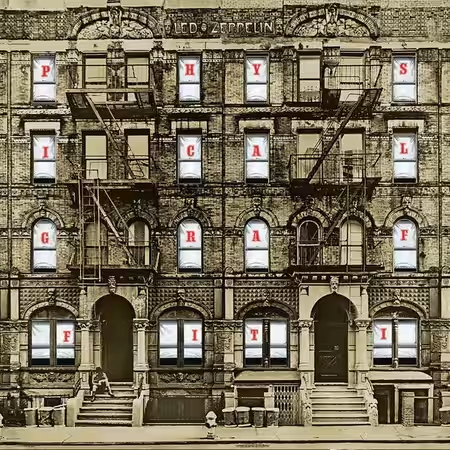
Physical Graffiti’s sleeve is one of the most recognisable in rock. The exterior is a die cut photograph of two adjacent five storey tenement buildings on St Mark’s Place in New York City’s East Village, numbers 96 and 98. The buildings were originally six storeys, but designer Peter Corriston and his collaborator Mike Doud cropped the top floor and the basement to make the building square enough to fit a vinyl sleeve. The windows of the buildings are die cut holes.
Behind the outer sleeve sits an inner sleeve printed with rotating images. As you slide the inner sleeve in and out, different faces and pictures appear in the windows, including the band themselves dressed in drag in some shots, King Kong from the original 1933 film, Lee Harvey Oswald, the Pope, Queen Elizabeth II, Charles Atlas and various clowns and characters. The album title only appears in one specific configuration, with the windows arranged so that PHYSICAL GRAFFITI reads across the front of the building. It was the most elaborate Zeppelin sleeve since III’s wheel.
Corriston, who would go on to design Some Girls, Emotional Rescue and Tattoo You for the Rolling Stones, won a Grammy for the package the following year. The buildings themselves became a tourist destination almost overnight. They later appeared on the cover of the Rolling Stones’ Physical Graffiti contemporary single Waiting on a Friend in 1981, and the steps in front of them have since been used in countless photo shoots.
The 2015 deluxe reissue, supervised by Jimmy Page, restored a number of session outtakes including a rough mix of In My Time of Dying with no vocal, an instrumental cut called Brandy and Coke that became Trampled Under Foot, and a rough mix of Boogie with Stu titled Sunset Sound Mix.
Release & Reception
Swan Song put Physical Graffiti out on 24 February 1975 in both the UK and the US, with a tour to support it already in full swing on the American side. Pre orders alone were enough to push the album to a Gold certification before release in the US. It debuted on the Billboard 200 at number 3 the week of 15 March 1975 and climbed to number 1 by 29 March, where it stayed for six weeks. In the UK it went straight to number 1 on the Albums Chart.
In a quirk of the era, the release was so heavily anticipated that all five of Led Zeppelin’s previous studio albums re entered the Billboard 200 at the same time, a feat almost no other band has matched. Houses of the Holy went back to number 79, Led Zeppelin IV to 83, Led Zeppelin II to 104, Led Zeppelin to 113 and Led Zeppelin III to 124, all in the same week.
The reviews were strong. Jim Miller, writing in Rolling Stone in April 1975, called the album “Led Zeppelin’s bid for artistic respectability” and said it was “the band’s Tommy, their Beggars Banquet, their Sgt Pepper”. He praised Kashmir as “majestic” and singled out In My Time of Dying as the finest blues performance the band had ever recorded, while noting that, like all double albums, it had passages that “could have benefited from pruning”. In the NME, Nick Kent called Physical Graffiti “an embarrassment of riches” and one of the monumental albums of the seventies. Robert Christgau in the Village Voice was characteristically grudging, giving it a B+ and accusing the band of grandiosity.
The popular response was unambiguous. The album was certified Gold and Platinum by the RIAA on the same day, 18 April 1975, and has gone on to be certified sixteen times Platinum, which under RIAA double album rules represents 8 million copies shipped in the United States alone. Worldwide sales are estimated at around 16 million.
Critical reappraisal has only burnished it. Q magazine, Mojo, Uncut and Rolling Stone have repeatedly placed it among the greatest rock albums ever made. In Rolling Stone’s most recent revision of its 500 Greatest Albums of All Time, Physical Graffiti sits comfortably inside the top hundred.
Singles & Music Videos
Zeppelin famously refused to release singles in the UK as a matter of principle through almost their entire career, and this album was no exception. Trampled Under Foot was issued as a single in the United States on 2 April 1975 with Black Country Woman on the B side. It peaked at number 38 on the Billboard Hot 100, a respectable showing for a band that did not promote singles. There was no music video, because the band did not make videos at this point in their career. Houses of the Holy was issued as a US promo only single to radio, with no commercial release.
The closest thing to a contemporary visual document is the band’s appearance in The Song Remains the Same, the concert film released in October 1976, which was filmed at Madison Square Garden during their July 1973 run and so predates this album. Footage from the May 1975 Earl’s Court shows, eventually released on the 2003 Led Zeppelin DVD, is the best record of Physical Graffiti material being performed live in its prime, with definitive versions of Kashmir, In My Time of Dying, Trampled Under Foot and Sick Again.
Touring & Live: The 1975 World Tour
Zeppelin’s 1975 tour, often called the Physical Graffiti tour even though half of it preceded the album’s actual release, was their tenth North American tour. It opened on 18 January 1975 at the Met Center in Bloomington, Minnesota, and ran through 27 March 1975 at the Forum in Inglewood, California. The setlist was rebuilt around the new material. Sick Again opened most shows after Rock and Roll. Kashmir, In My Time of Dying, Trampled Under Foot and the Houses of the Holy title track were all in the main set. Stairway to Heaven was the closer.
The tour was the band’s most lucrative to date. Robert Plant performed the early dates with influenza and a partially functioning voice. Jimmy Page broke the ring finger of his left hand in the door of a train carriage on the way from London to Victoria Station before the tour, and adapted his playing accordingly, dropping Dazed and Confused for Since I’ve Been Loving You until his finger healed.
After a short break, the band moved on to five sold out shows at Earl’s Court Arena in London on 17, 18, 23, 24 and 25 May 1975. Around 85,000 tickets in total. The Earl’s Court shows are widely regarded as the high water mark of Led Zeppelin live, with Plant’s voice fully recovered, Page back to full strength, and the band running through three and a half hour sets that included extended versions of Kashmir and No Quarter.
Then disaster. On 4 August 1975, while on holiday on the Greek island of Rhodes, Robert Plant and his wife Maureen were involved in a serious car accident when their hire car left the road. Plant broke his right ankle and elbow, Maureen suffered a fractured skull and was in critical condition. The band’s planned autumn tours of America, Europe and Asia were cancelled. Plant spent months in a wheelchair. The next album, Presence, was written and recorded in November and December 1975 in part with Plant singing from a wheelchair at Musicland Studios in Munich. Zeppelin would not tour again until April 1977.
In TV, Film & Media
Kashmir is the most syncable track on Physical Graffiti and its use is legion. Sean Combs, performing as Puff Daddy, recorded Come With Me for the soundtrack to the 1998 Roland Emmerich Godzilla film, with Jimmy Page playing live guitar on the track and on the subsequent Saturday Night Live performance. The single reached number 4 on the Billboard Hot 100. It was the first time Page had played on a top 10 American single since Whole Lotta Love in 1969.
Kashmir has appeared in Fast Times at Ridgemont High in 1982, in episodes of The Sopranos, in commercials for Cadillac in the early 2000s, in Almost Famous in 2000 in scenes set in the Continental Hyatt House, in the Heineken commercial that ran during the 2008 Super Bowl, and in countless trailers for action films.
In My Time of Dying soundtracks the closing scenes of more than one prestige drama. Trampled Under Foot has appeared in Almost Famous and several Cadillac and Volkswagen commercials. Boogie with Stu turns up in Cameron Crowe films. The Beastie Boys’ She’s Crafty, on Licensed to Ill in 1986, samples Custard Pie, and the song has since been sampled by acts including Aesop Rock and various producers in the underground hip hop scene.
In video games, Kashmir has appeared in Rock Band, In My Time of Dying in Guitar Hero, and tracks from the album turn up routinely on golden oldies setlists in any Grand Theft Auto game set in the 1970s.
Things You Might Not Know
| # | Fact |
|---|---|
| 1 | The aeroplane heard at the start of Black Country Woman was real. The track was being recorded outdoors in the garden of Mick Jagger’s country house Stargroves in 1972 when a plane flew overhead. Engineer Eddie Kramer asked Plant if he wanted to start again. Plant’s exact words on tape were “Nah, leave it, yeah”, which were also kept in the final mix. |
| 2 | John Paul Jones almost left the band before the sessions started. In late 1973 he told Peter Grant he was thinking of accepting a job as choirmaster at Winchester Cathedral. Grant took the request seriously, told the others Jones was simply ill, and gave him a few weeks to think it over. Jones came back. |
| 3 | The album’s cover building was originally six storeys. Designer Peter Corriston and Mike Doud removed the top floor and the basement so the building would fit on a square sleeve. The actual buildings, 96 and 98 St Mark’s Place in New York’s East Village, are still standing and remain one of the most photographed addresses in Manhattan. |
| 4 | Boogie with Stu is partly credited to “Mrs Valens”, meaning Concepcion Valenzuela, the mother of Ritchie Valens. The credit was an attempt by the band to get royalties to her, since the melody borrows from Ritchie’s Ooh, My Head. The Valens estate sued anyway, and the case was settled out of court. |
| 5 | The album’s release made Led Zeppelin the first band to have all six of their existing studio albums on the Billboard 200 in the same week, in March 1975. |
| 6 | Bron-Yr-Aur, the two minute solo guitar piece on side three, was actually recorded in July 1970 during the sessions for Led Zeppelin III. It sat unused for almost five years before being included here. The cottage of the same name in Gwynedd, Wales, has no electricity to this day. |
| 7 | The song Houses of the Holy, on side one of Physical Graffiti, was recorded for the album of the same name in 1972 but cut at the eleventh hour. Jimmy Page felt it sat oddly with the rest of that record’s material. It is the only Zeppelin song to share its title with an entirely different album. |
| 8 | In My Time of Dying, at 11 minutes 4 seconds, is the longest studio track Led Zeppelin ever released. The closing studio chatter, with Bonham coughing and joking “Cough, Cough. That’s gotta be the one, hasn’t it?”, was kept in deliberately at Page’s request. |
| 9 | Peter Corriston’s sleeve design won the 1976 Grammy for Best Album Package. Corriston went on to design Some Girls, Emotional Rescue and Tattoo You for the Rolling Stones in the next half decade. |
| 10 | The Trampled Under Foot riff was directly inspired by Stevie Wonder’s Superstition, which had been a US number one in January 1973. John Paul Jones plays the same Hohner D6 clavinet that Wonder used on the original. |
| 11 | The DADGAD tuning Page uses on Kashmir is the same alternate tuning he used on Black Mountain Side on the first album. He picked it up in the mid sixties from Davey Graham, the British folk guitarist who had used it to play Moroccan and Indian melodies. |
| 12 | Despite being released on Zeppelin’s own Swan Song label, the album was distributed in the US and most of the world by Atlantic, the band’s previous label. The Swan Song imprint was a vanity label rather than a fully independent operation. |
Legacy & Influence
Physical Graffiti is the album that, more than any other in the Zeppelin catalogue, set the template for what a “classic rock double album” was supposed to be. The Beatles’ White Album in 1968, The Rolling Stones’ Exile on Main St in 1972 and The Who’s Quadrophenia in 1973 had all defined the form, but Physical Graffiti was the moment a hard rock band claimed the form for themselves and used it not for a concept piece but as a sprawling unedited self portrait. Every double album by every arena band in the years since, from Pink Floyd’s The Wall in 1979 to Guns N’ Roses’ Use Your Illusion volumes in 1991, owes something to the way Physical Graffiti is structured.
Within Zeppelin’s own discography, the album is the pivot. Everything before it, the run from the debut through Houses of the Holy, is the band ascending. Everything after it, Presence in 1976, the live film soundtrack The Song Remains the Same later that year, In Through the Out Door in 1979, and the posthumous odds and ends collection Coda in 1982, is the band managing the consequences of having gone as high as a rock band can go. Plant’s car accident in August 1975, Bonham’s death on 25 September 1980, and the band’s subsequent decision to dissolve, all happened in the long shadow of Physical Graffiti’s release.
Its influence on younger bands is everywhere. Soundgarden, Alice in Chains and Jane’s Addiction all picked up Page’s habit of layering guitar parts. Tool’s Maynard James Keenan has cited Kashmir as a structural model for the Tool ballads. The White Stripes’ Jack White has talked at length about In My Time of Dying as the recording that turned him on to slide guitar. Robert Plant’s solo career, including the 1994 No Quarter album with Page and the 2007 Raising Sand album with Alison Krauss, has repeatedly drawn on the folk and world music threads first laid down on Physical Graffiti.
The 2007 Led Zeppelin reunion show at the O2 Arena in London on 10 December 2007, with John Bonham’s son Jason on drums, included Kashmir, Trampled Under Foot and In My Time of Dying. The reunion remains the band’s only full performance since 1980, and Physical Graffiti material made up roughly a third of the set.
In 2015 Jimmy Page supervised a deluxe reissue of the album for its 40th anniversary, with a companion disc of rough mixes and outtakes. The reissue went straight to number 3 on the Billboard 200, four spots short of the original.
Why Physical Graffiti Still Matters
What Physical Graffiti finally proves about Led Zeppelin is that they were not, despite their reputation, a band of one trick. They could write twelve bar blues better than anyone outside Chicago. They could write English folk better than the English folk scene. They could play funk well enough to chart with it in the United States. They could write a song that fused North African modes, Indian string arrangements and a Birmingham drummer’s swing into eight and a half minutes of music that nobody before or since has been able to imitate convincingly. They could throw a piano around with Ian Stewart on a wet afternoon in Hampshire and have the result hold its own next to all of that.
It is a record for people who like to dig. It rewards repeated listening because it was made out of repeated listening, of Page going back through reels and finding the gold that previous album sequencers had missed. It is the album where Zeppelin stopped trying to top themselves and started trying to make sense of themselves, and the result is the closest thing to a definitive Led Zeppelin album that exists.
Listen to the Riffology Episode
If you have made it this far, you already know how much there is to chew on with Physical Graffiti. The Riffology podcast episode on the album goes deeper into the 1974 Headley Grange sessions, the politics of Swan Song, the Earl’s Court shows, the Rhodes accident and the long shadow this record threw over the rest of the seventies. You can find Riffology wherever you get your podcasts, including Apple Podcasts, Spotify, Amazon Music and YouTube. Pour something dark, drop the needle on side two, and join us.
About the Author