Introduction
Prong’s 1994 album Cleansing stands as a cult classic of 90s metal – a groove-laden, industrial-tinged record that captured a moment in heavy music when genres were colliding and evolving. For many fans, Cleansing was their introduction to Prong’s unique blend of hardcore attitude, thrash energy, and mechanized industrial groove. Released on January 25, 1994, it was the band’s fourth studio album and their most successful release to date. The lead single “Snap Your Fingers, Snap Your Neck” became an underground anthem – its chunky riffs and headbang-worthy groove earning heavy rotation on MTV and even a shout-out from Beavis and Butt-Head. This deep dive will explore the story of Prong leading up to Cleansing, the making of the album, its artwork, reception, and the aftermath, with a fan’s passion and a storyteller’s eye for detail.
Prong emerged from the New York hardcore and thrash scene in the late 1980s, led by frontman Tommy Victor, who famously worked as a soundman at the legendary CBGB’s club before focusing on his own music. By the early 90s, the trio – at that time consisting of Victor on vocals/guitar, Ted Parsons on drums, and a revolving cast of bassists – had begun steering their sound away from straight thrash. They embraced a “groove metal” approach with tighter, mid-tempo riffs, and dabbled in industrial programming. This evolution set the stage for Cleansing, an album that Tommy Victor later called “one of the great underground alternative metal records of the ’90s”. In this article, we’ll look at how Prong got to this pivotal point, what went into making Cleansing, how it was received, and some lesser-known facts and stories that make the album’s era so intriguing for fans.
Our deep dive podcast episode on Cleansing is here:
Album Facts
| Field | Details |
|---|---|
| Album Title | Cleansing |
| Band | Prong |
| Release Date | January 25, 1994 |
| Recorded | 1993 |
| Label | Epic Records |
| Producer | Terry Date (with Prong) |
| Studio | Bad Animals (Seattle); Magic Shop (NYC); Mixed at Electric Lady Studios (NYC) |
| Genre | Groove Metal / Industrial Metal / Alternative Metal |
| Length | 58:02 |
| Band Line-up | Tommy Victor (vocals, guitar); Paul Raven (bass); Ted Parsons (drums); John Bechdel (keyboards/programming) |
| Notable Singles | “Snap Your Fingers, Snap Your Neck” “Whose Fist Is This Anyway?” “Broken Peace” |
| Chart Performance | #126 on the Billboard 200 (US); “Snap Your Fingers…” reached #80 on the UK Singles Chart |
| Critical Reception | Widely regarded as Prong’s strongest release; praised for its heavy grooves and polished production |
| Reissue | Reissued in 2008 by SPV/Steamhammer (with bonus tracks) |
Discography Context: Where Cleansing Fits In
By the time Cleansing hit the shelves in early 1994, Prong had already built a solid (if somewhat underground) reputation in the metal world. It was their fourth studio album, following a progression of records that each marked a step in the band’s evolution:
- 1989 – Force Fed: Prong’s first full-length was a raw, low-budget hardcore/thrash effort recorded for “pennies” on a small tape machine. It showcased their New York hardcore roots and abrasive thrash tendencies. While influential in the underground (especially among grindcore/thrash fans), Force Fed suffered from lo-fi production, and the band was still finding its footing.
- 1990 – Beg to Differ: Their major-label debut on Epic, Beg to Differ introduced a more refined sound. Prong slowed down the tempos slightly and locked into a groove-metal style that would later influence bands like Pantera and White Zombie. The title track “Beg to Differ” got them some exposure on MTV’s Headbangers Ball. However, this shift alienated some of their early hardcore fanbase, “We lost the hardcore fans with Beg To Differ,” Tommy Victor recalled, as some felt it was “too metal.”
- 1991 – Prove You Wrong: On their third album, Prong experimented further, adding industrial and electronic elements into the mix. The track “Prove You Wrong” and especially “Unconditional” got moderate airplay, and an EP of remixes (Whose Fist Is This Anyway?, 1992) hinted at the band’s interest in industrial sounds. Prove You Wrong featured bassist Troy Gregory (the only Prong album he played on) and continued to broaden their style, so much so that “we lost some of the metal fans… they thought it was too weird,” in Victor’s words. The band was evolving quickly, even if it meant some fans fell off along the way.
- 1994 – Cleansing: Entering the studio for Cleansing, Prong was poised to make their boldest statement yet. This album brought in ex-Killing Joke members Paul Raven and John Bechdel, cementing an industrial-metal influence on top of the groove metal foundation. It’s considered the culmination of the musical direction Prong had been steering towards, a stripped-down, hook-filled heaviness that was accessible yet aggressive. As Tommy Victor later put it, “Cleansing was so breakthrough – it was something new”, a style and sound that really suited them. Indeed, Prong themselves view Cleansing as a high point: Victor ranked it as the second-best Prong album in their entire catalog.
In the context of Prong’s discography, Cleansing stands out as the record where all the experimentation and genre-blending clicked into place. It bridged the gap between the thrash/hardcore of their 80s beginnings and the industrial-groove metal that would define the mid-90s. The album’s success (while modest in mainstream terms) set a benchmark for the band, one they’d strive to surpass on the next album, Rude Awakening (1996), and one that many fans and critics still see as Prong’s defining moment.
Lead-Up to Cleansing: The Road to 1994
The early 90s were a turbulent yet fertile time for Prong. After Prove You Wrong, the band’s lineup and musical approach were in flux. Troy Gregory (bass) departed after the 1991 tour, and Prong needed a new bassist as they began writing for the next album. Enter Paul Raven, former bassist of post-punk/industrial legends Killing Joke. Interestingly, Raven had already been connected to Prong, he contributed a remix on the Whose Fist Is This Anyway? EP in 1992. By 1993, Raven officially joined Prong on bass, bringing not only his thunderous low-end but also a deep knowledge of industrial rock. Along with Raven came keyboardist/programmer John Bechdel, another veteran of the industrial scene (having worked with Ministry, Killing Joke and others). This revamped lineup signaled Prong’s full embrace of an industrial-metal hybrid sound.
Songwriting for Cleansing took place in a rather unglamorous setting: Tommy Victor has revealed that much of the record was written “on Powers Street in Williamsburg [Brooklyn] in my bathroom on an acoustic guitar, at night”. Trying not to disturb his neighbours in a working-class Brooklyn neighbourhood, Victor would hide out in the bathroom late at night, strumming quietly on an acoustic as riffs and ideas came to him. This unorthodox writing environment ultimately yielded some of the band’s most iconic riffs and songs.
While Prong was crafting new songs, the musical climate around them was shifting. The early 90s “alternative revolution” was in full swing, Nirvana’s success had labels scrambling to sign heavy bands, and MTV’s Headbangers Ball and Beavis and Butt-Head were showcasing metal and alternative acts to mainstream audiences. Prong, having been on a major label (Epic Records) since 1990, were in a strange position. By 1993 they felt frustrated that they hadn’t broken through bigger. Each album evolved their sound, but also confused segments of their fanbase. “More people got lost with [1994’s] Cleansing. I’m not sure why, maybe it was too radio-friendly or something! Apparently, we sold out!” Victor joked, reflecting on how their stylistic shifts were perceived. In truth, Prong was simply ahead of their time, blending genres before it was cool and Cleansing would embody that forward-thinking approach.
Another motivation for the new direction was burnout with thrash metal. By the 90s, Prong were “sick of the whole thing” with thrash, according to Victor. They were looking for a new path. “We didn’t want to do thrash or crossover,” Tommy explained. “We didn’t know what to do, but we knew we didn’t want to do that. So we thought, ‘Let’s go back to floor-danceable metal, the kind of thing that people wanted to listen to in clubs. Regular songs rather than Master of Puppets.’”. In other words, Prong aimed to write heavy music with groove songs you could almost dance to, or at least bang your head in a rhythmic way. This mindset led to simpler, hookier song structures built around riffs that groove rather than gallop. The first song written with this philosophy was “Snap Your Fingers, Snap Your Neck”, which set the tone for the entire album.
As Prong honed their new material, they also had to decide on a producer for the album. Their previous two records were produced by Mark Dodson, but this time the band had Terry Date in mind. Terry Date was famous for producing Pantera’s Vulgar Display of Power and Soundgarden albums, a guru of big guitar tones and powerful mixes. The label initially opposed hiring Terry Date, perhaps preferring a more “known quantity” or someone cheaper. But Prong stuck to their guns. “Everybody wanted to produce the band,” Victor said of the buzz around Cleansing, “and we eventually went with Terry Date. The label was completely opposed to him, but they eventually came around and supported us.”. Bringing in Date proved to be a masterstroke, his production gave Cleansing a cleaner, punchier sound than any previous Prong record. The guitars were tight and percussive, the drums pounding, and every electronic texture placed just right. One journalist noted that the album “tightens up their trademark drilling guitars while adding some slight techno and industrial touches,” heightening the tension while “strengthening [Prong’s] already muscular metallic roar.”.
By late 1993, Prong were in Seattle tracking the album at Bad Animals Studio (famously owned by the Wilson sisters of Heart) and back in New York at Magic Shop studio for additional recording. Fittingly, the final mixes were done at Electric Lady Studios in NYC, Jimi Hendrix’s legendary studio, a fact that Tommy Victor still gushes about. “Ultimately, and this is probably the greatest thing in my whole career – it was mixed at Electric Lady Studios in New York. How could you go wrong with that?” he said proudly. Surrounded by top-notch production talent and inspired by their newly refined style, Prong were ready to deliver the album of their career.
Album Artwork and Visuals
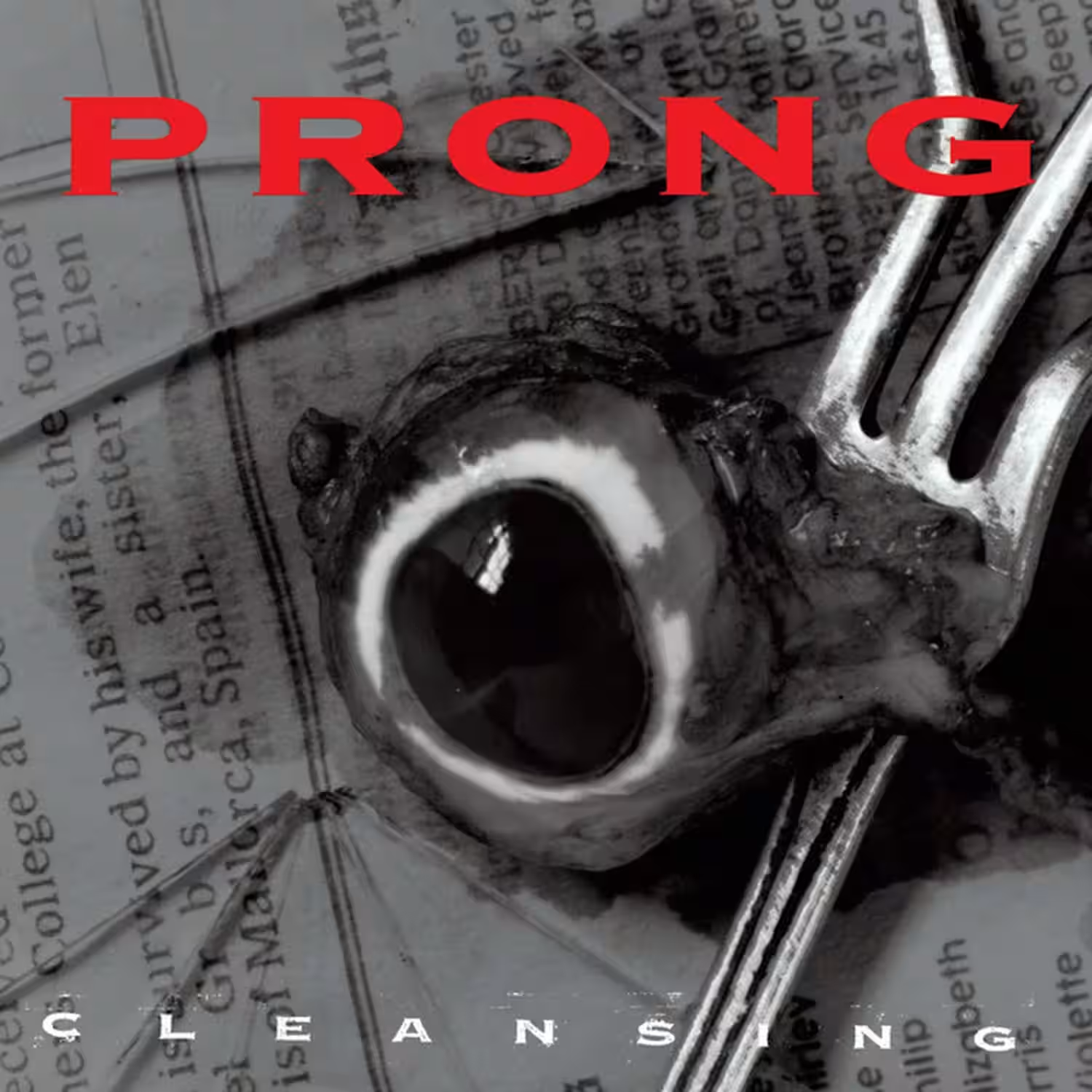
Album cover of Prong’s Cleansing (1994), featuring the distinctive fork (“prong”) and eyeball imagery.
The artwork for Cleansing is as striking and off-kilter as the music itself. The album cover features a surreal, slightly disturbing image: what appears to be a human eyeball impaled on the tines of a metal fork, set against a background of printed text (newspaper or book pages) and rendered in stark, high-contrast tones. It’s an image that literally embodies the band’s name (a “prong” digging into an eye) and perhaps metaphorically suggests a kind of brutal clarity or “cleansing” vision – albeit a violent one. The concept for the cover was developed by Prong, with photography by Ken Schles and art direction by Carol Chen. The result is a cover that certainly grabbed attention in record stores: it practically leaps out with its bold, monochromatic contrast and that unnerving eyeball staring back at the viewer.
Fans have long found the Cleansing cover memorable. In a 2014 retrospective, one writer reminisced about crafting a DIY version of the Prong logo seen on the album cover – literally bending and sharpening a fork to mimic the trident-like Prong logo – and wearing it as a necklace. The logo itself (three sharp prongs converging in a circular design) is subtly integrated into Cleansing’s visuals. On the cover, the letter “O” in the band’s name PRONG resembles that three-pronged symbol, reinforcing the band’s branding.
The album’s visual presentation – from the cover to the band’s imagery in music videos matched the music’s mix of grit and precision. The eyeball on a fork could be interpreted as a statement: perhaps a critique of media consumption (the eye pierced by a utensil, against a backdrop of text), or simply an arresting icon of pain and awareness. The title Cleansing juxtaposed with that image suggests that the band saw this album as a purging of something impure or a raw catharsis. Indeed, an independent record label description later noted that the album was “aptly titled, the album indeed cleansed their sound, resulting in 12 stripped down, highly effective musical precision bombs.”. In other words, Prong were wiping the slate clean and delivering something sharper and more focused, a thematic echo of scrubbing away excess, even if the cover art portrays a more literal and brutal kind of cleansing!
The packaging inside likely included stark imagery of the band and possibly more of the urban-industrial aesthetic. Unfortunately, Cleansing’s liner notes aren’t widely reproduced online aside from credits, but it’s known that Prong’s visual style around this time featured a lot of black & white, heavy contrasts, and industrial motifs, complementing songs that reference machinery, societal issues, and personal struggle. All in all, the artwork of Cleansing remains iconic for fans, it’s unsettling yet compelling, just like the music.
Release and Initial Reception
When Cleansing was released in January 1994, it entered a metal scene that was splintering into new subgenres. Prong’s blend of groove metal and industrial was both timely and slightly ahead of its time. The album didn’t explode on the charts, but it made a respectable dent. In the U.S., Cleansing reached #126 on the Billboard 200 albums chart, a moderate showing that marked Prong’s highest album chart position up to that point. It also garnered attention abroad; for instance, the single “Snap Your Fingers, Snap Your Neck” spent a couple of weeks on the UK Singles Chart, peaking at #80. While these numbers didn’t make Prong a household name, they indicated that Cleansing was breaking out of the strictly underground scene and into wider awareness.
Critically, Cleansing was very well received. Reviewers noted the band’s evolution and the album’s impactful production. AllMusic’s Stephen Thomas Erlewine praised it as “the band’s most varied and best record yet,” commenting on how Prong “tightens up their trademark drilling guitars while adding some slight techno and industrial touches,” which heightened the tension and “strengthens their already muscular metallic roar.”. In other words, the experiments with programming and samples never watered down Prong’s heaviness, they accentuated it. The album’s huge guitar grooves and clean mix made it stand out. Cleansing sounded razor-sharp compared to many of the era’s muddy metal releases.
Not every old-school fan was onboard initially, some long-time thrash fans found the sound too modern or too polished. But broadly, the album earned Prong new fans who were drawn in by those fat riffs and memorable hooks. Jason Roche, writing for the Village Voice, later included Cleansing in a list of top New York metal albums, noting that it “proved to be as catchy as it was heavy.” This encapsulates the album’s appeal: Cleansing marries infectious, almost toe-tapping rhythm (“catchy”) with punishing guitar and shout-along vocals (“heavy”). Tracks like “Whose Fist Is This Anyway?” and “Cut-Rate” get your blood pumping with groove, while “Broken Peace” and “Test” show a darker, grinding side.
In the UK and European press, the album also got favorable reviews (Kerrang!, Rock Hard, etc., gave positive scores). Record Collector’s Joel McIver in 2008 reflected that Cleansing “sounds great to this day, all slablike, noise-gated riffs and pulsating beats,” though he noted it ended up “a respectable seller rather than a monster” in commercial terms. In essence, critics felt Prong delivered a high-quality record that arguably should have been a bigger hit than it was. There was a sense that Cleansing deserved to break out in the way that some contemporaries did, but just didn’t get the final push.
Indeed, one retrospective piece argued that Cleansing “should have redefined a genre. It should have rocketed them to superstar status… and it’s a tragedy that it didn’t.” The same article suggests Cleansing might have been “too far ahead of its time to be truly appreciated by the masses”, it didn’t fit neatly into any single trend in 1994. Prong weren’t grunge, they weren’t exactly in the Pantera-style groove-metal camp (they lacked the southern rock macho vibe), they weren’t purely industrial like Nine Inch Nails/Ministry, and they weren’t alternative rock either. Cleansing kind of stood at a unique crossroads, which is partly why it didn’t skyrocket commercially. But those very qualities made it a lasting favourite for those who did get it. The first five tracks on the album, in particular, are often cited as a flawless run of songs that still sound fresh years later.
On release, “Snap Your Fingers, Snap Your Neck” was the song that got the most buzz (more on that in the Singles section below). Its success on MTV gave Prong unprecedented exposure. Fans who saw the video on Headbangers Ball or Beavis and Butt-Head rushed to check out the album. Many were impressed to find that Cleansing had depth beyond just the single, it was a consistently strong record front-to-back.
The initial reception of Cleansing can be described as critically acclaimed but commercially underappreciated. It didn’t turn Prong into superstars, but it did solidify their reputation as innovators. Over time, the album’s status has only grown, with many present-day metal musicians citing Prong as an influence and Cleansing as a landmark that helped shape the groove metal and nu-metal sounds to come.
Touring and Promotion: How Prong Supported Cleansing
To support Cleansing, Prong hit the road hard in 1994, landing some coveted opening slots that put them in front of huge crowds. As part of the album’s promotional push, Prong toured with Sepultura and Pantera, serving as the opening act on Sepultura’s Chaos A.D. tour and Pantera’s Far Beyond Driven tour. These were prime tours in ’94 – Sepultura and Pantera were both at peak popularity in the metal world – which meant Prong got exposure to thousands of potential new fans each night. It was an enviable position for a band pushing a new sound.
Fans who caught those shows still reminisce about Prong’s live power. With the new lineup, the band on stage consisted of Tommy Victor barking vocals and chugging on his guitar, Paul Raven headbanging with his bass grooves, Ted Parsons delivering tight drum beats, and John Bechdel adding an eerie electronic layer from behind a keyboard/sampler setup. Songs like “Snap Your Fingers, Snap Your Neck” and “Whose Fist Is This Anyway?” were tailor-made for the live environment – their stomping rhythms would get mosh pits roiling. One contemporary account noted that even before Cleansing was released, when Prong played “Snap Your Fingers…” live, “people would open this big pit… when that kick drum started coming in, people start going crazy.”. The music was floor-danceable metal, just as the band intended, and it translated to a powerful live impact.
Touring with Pantera, in particular, placed Prong in front of die-hard groove metal fans. Pantera’s audience loved heavy riffs and mosh parts, and Prong could deliver plenty of those. Pantera themselves were fans of Prong (there’s a photo that circulated of Pantera members wearing Prong shirts back then), and Dimebag Darrell even cited Prong as a band he was listening to. On the Far Beyond Driven North American tour, Prong was the first of three (the band Sepultura was also on some of those bills, creating a powerhouse lineup). Similarly, supporting Sepultura in Europe and elsewhere on the Chaos A.D. tour gave Prong credibility with the thrash and tribal-metal crowd.
Aside from those major tours, Prong also did their own club shows and hit the summer festival circuit where possible. 1994 didn’t have Ozzfest yet (that would start in ’96), but there were European festivals like Dynamo Open Air, etc., where a band like Prong might pop up. Promotionally, Epic Records did invest in at least two music videos (which was significant – videos are expensive). The heavy MTV rotation of “Snap Your Fingers…” was the biggest promotional tool, and it worked to an extent: it got people talking and gave Prong their most recognizable song.
An interesting note: Prong’s time on Epic was a double-edged sword. Tommy Victor has often lamented that being on a major like Epic (a label known more for pop acts) meant they didn’t always get the right support. “Epic was Michael Jackson’s label… the people that worked there mostly thought that alternative, heavy music was garbage… we were never accepted. Epic just didn’t know why we were on the label and they wanted to get rid of us,” Victor recalled of that era. Even so, Epic did see potential in “Snap Your Fingers…” – when they heard its demo, “their ears pricked up and they felt like they had something they could work with.”. The label poured resources into those tours and video promotion in hopes of a breakthrough.
During the Cleansing tour cycle, Prong’s live performances further solidified their reputation. They were seasoned road warriors by then, and contemporary reviews of their shows mention the band’s precise, crushing sound. Fans might remember Tommy Victor’s intense stage presence, often sporting a shaved head around that time and Paul Raven’s imposing figure on bass, locking in groovy riffs. The combination of touring with big names and delivering solid performances ensured that Prong’s fanbase grew, even if incrementally, through 1994.
Singles and Music Videos
Cleansing spawned three singles in 1994, each showcasing a different side of the album:
- “Snap Your Fingers, Snap Your Neck” – This was the lead single and is undoubtedly Prong’s signature song. Built on an insanely catchy downtuned riff and a steady, pounding groove, “Snap Your Fingers…” exemplified the band’s new “danceable” metal approach. The song’s structure is simple but effective: a head-bobbing verse, a shout-along chorus, and a pit-starting breakdown. The music video, directed by Thomas Mignone, received heavy rotation on MTV, especially on Headbangers Ball. It even earned a spot on an episode of Beavis and Butt-Head, where the titular duo gave it a thumbs-up (a big endorsement in those days). Suddenly, millions of kids heard Beavis growl “This song kicks ass!” while watching Prong riff out in the video, which immeasurably raised the song’s profile. “Snap Your Fingers…” didn’t chart on the U.S. Hot 100, but it did get significant radio play on rock stations and, as noted, charted in the UK. Over the years, its legacy has grown; the track is often cited as an influence on the emerging nu-metal scene (with that chugging riff regarded as ahead of its time). To this day, Prong closes most concerts with “Snap Your Fingers, Snap Your Neck,” as it remains a fan favorite and a metal club DJ staple.
- “Whose Fist Is This Anyway?” – The second single (sharing its title with the earlier EP) showed the heavier, more frenetic side of Cleansing. It’s a fast-paced track with a thrashy riff, shouty vocal trade-offs, and some industrial sounds bubbling underneath. While not as hook-oriented as “Snap…”, it exemplifies Prong’s blend of hardcore aggression and mechanical groove. A music video for “Whose Fist Is This Anyway?” was also made (available on Prong’s VEVO, interestingly) – it features the band performing in a dim, warehouse-like setting intercut with chaotic imagery, matching the song’s intensity. Though it didn’t get as much MTV play as the lead single, “Whose Fist…” still resonated with fans who appreciated Prong’s harder edge. The song’s title and attitude also embodied the band’s streetwise toughness.
- “Broken Peace” – The third single from the album is a mid-tempo, brooding track that carries a dark melody atop its grinding riff. “Broken Peace” has a bit more of a moody atmosphere, almost veering into alternative metal territory with its slightly sung vocal parts and a gloomy vibe. A music video was produced for this song as well, making use of stark black-and-white visuals and close-ups of the band. While “Broken Peace” wasn’t as immediately popular as the first single, it demonstrated Prong’s range – that they could slow things down and still sound heavy as hell. The track builds to a great climax and features some of Victor’s more introspective lyrics on the album. In later interviews, Tommy Victor mentioned “Broken Peace” as a song he’s proud of for its different feel.
All three singles had promo CD releases and even some remix versions floating around. In fact, remixes were a theme of that era for Prong; the band embraced remix culture, working with industrial artists to re-imagine tracks. For example, the “Snap Your Fingers, Snap Your Neck” single/EP included multiple remixes (“Harder Than Hardcore” mix, etc.) a nod to how their music could cross into the industrial and club scenes.
Additionally, songs from Cleansing like “Another Worldly Device” (the album’s explosive opener) were not singles but got attention. That particular track opened the album with a fast, adrenaline-charged riff, almost thrash-like but with a groove breakdown. It set the tone that Prong meant business. Some fans consider “Another Worldly Device” one of Prong’s best album-openers, even though it wasn’t a single.
The presence of three music videos in one album campaign was significant, it showed that Epic Records had faith in the material to invest in visual promotion. By comparison, many metal bands of similar status in the ’90s got maybe one or two videos, if any. Prong making three indicates that the label really tried to break them into heavier rotation. While true stardom eluded them, these videos have since become YouTube classics, each racking up views and serving as a time capsule of mid-90s metal style (lots of performance shots, quick edits, and moody lighting).
In summary, the singles from Cleansing helped define the album’s legacy: “Snap Your Fingers, Snap Your Neck” gave Prong an enduring hit that still “doesn’t go away” (as Tommy Victor said, “it keeps selling – it just doesn’t go away, that record”), and the follow-up singles reinforced that this album had depth beyond one song. If someone discovered Prong through “Snap…” and then checked out Cleansing, they usually became a fan, the singles were the gateway to an album with no shortage of hard-hitting content.
Appearances in Media and Pop Culture
One measure of Cleansing’s impact is how its songs have popped up in various media and been kept alive in pop culture. The most famous instance, as mentioned, was the Beavis and Butt-Head episode (“Manners Suck”) where Beavis and Butt-Head watch the “Snap Your Fingers, Snap Your Neck” video. Unlike some videos that the animated duo mercilessly mocked, Prong’s video received enthusiastic approval, a moment that many ’90s metalheads remember fondly. “Beavis and Butt-Head liked it, that was always a big thing!” Tommy Victor would later joke, acknowledging how that MTV show’s endorsement gave them cred.
Beyond TV, Prong’s music has found its way into video game soundtracks. The cult favourite game Brütal Legend (2009) which has a soundtrack composed of metal classics, features “Snap Your Fingers, Snap Your Neck” as one of the playable tracks. This inclusion introduced the song to a new generation of gamers who might not have been alive during Prong’s heyday. Similarly, The Darkness II (2012), a video game with a dark, metal-infused vibe, also included “Snap Your Fingers…” on its soundtrack. Hearing Prong’s riff while slaying demons in a video game is a testament to how well the music holds up as adrenaline-pumping accompaniment.
In terms of film or TV soundtracks in the ’90s, Prong nearly had a presence: around the time of Cleansing’s follow-up, they recorded a track for the Strange Days movie soundtrack in 1995 (the song “Thunderkiss ’65” cover, if memory serves, or an original? Actually, it might have been an original track for that OST). While that was after Cleansing, it shows Prong was on the radar for media placements. The Cleansing songs themselves, aside from the MTV exposure, aren’t widely known to have been in movies or shows back then. However, their continued popularity on compilation albums and playlists is notable. For instance, “Snap Your Fingers…” keeps appearing on metal compilation CDs and streaming playlists, it’s become a staple “workout song” or “pump-up track” on platforms like Spotify (Victor noted the streaming numbers for that song remain strong even decades later)simple.wikipedia.orgsimple.wikipedia.org.
Another facet of media presence is cover versions by other artists. “Snap Your Fingers, Snap Your Neck” has been covered by several bands, confirming its status as a metal classic. Groove metal band Demon Hunter covered it on their album The Triptych, death metal group Six Feet Under did a version on Graveyard Classics 3, and even Australian rock band Grinspoon released a cover on an EP. While none of these covers quite match the primal force of the original (one reviewer quipped that the covering bands “failed to capture the x-factor which made the original so memorable”), they nonetheless spread Prong’s influence. It’s not every day that a relatively under-the-radar band sees their song covered multiple times; it speaks to the respect Prong commands among fellow musicians.
Overall, Cleansing’s presence in media may not have been ubiquitous, but it has had a persistent afterlife. The album’s standout song continues to appear in games and cover albums, and references to Prong pop up in discussions of 90s metal influences. It’s fair to say that Prong didn’t fade into obscurity after the album – instead, they became a band that other artists name-drop as unsung heroes of the era.
Five Things You Might Not Know About Cleansing
Even if you’re a Prong fan, here are a few interesting or surprising tidbits about Cleansing and its creation that you might not have known:
- Bathroom Writing Sessions: Many of the riffs and songs on Cleansing were literally conceived in Tommy Victor’s bathroom. Victor wrote much of the album at night in the bathroom of his Williamsburg, Brooklyn apartment – quietly strumming an acoustic guitar so as not to disturb neighbors. This unusual songwriting locale was born out of necessity, but it clearly worked, yielding Prong’s biggest anthem. It’s amusing to picture such a fierce metal song like “Snap Your Fingers, Snap Your Neck” first coming to life in a tiny bathroom!
- Ex-Killing Joke Members on Board: Cleansing features two members of the influential post-punk/industrial band Killing Joke in its lineup. Bassist Paul Raven had been in Killing Joke in the ’80s, and keyboardist John Bechdel toured with them as well. Their presence brought a distinct industrial flavor to Prong. In fact, Prong’s move toward industrial metal was very much strengthened by Raven and Bechdel’s input, they weren’t just hired guns; they helped shape the album’s sonic direction (Raven even co-wrote some tracks uncredited). So, Cleansing has a bit of Killing Joke’s DNA in it, which is pretty cool trivia for fans of both bands.
- The Label Didn’t Want Terry Date: It’s hard to imagine Cleansing without the pristine yet pummeling production of Terry Date, but initially Epic Records was against hiring him. The label likely had a list of approved producers and might have thought Date, known for heavier acts like Pantera, wasn’t the right fit or was too expensive. Prong insisted on Terry Date and eventually got their way. The result speaks for itself: Date’s production gave Prong a cutting-edge sound. It’s a good thing the band stuck to their guns on this decision.
- Beavis and Butt-Head Boost: Not every band can say they got a seal of approval from Beavis and Butt-Head. Prong can. The MTV cartoon famously featured “Snap Your Fingers, Snap Your Neck” and, rather than mercilessly mock it, the dim-witted duo banged their heads enthusiastically. This was actually significant in the 90s, that exposure introduced Prong to a huge youth audience. Many fans discovered the song (and band) thanks to that episode. It’s a pop culture footnote that underscores how Cleansing found love in unexpected places.
- Precursor to Nu-Metal: Prong is rarely credited in mainstream conversations about nu-metal, but they probably should be. The band’s use of drop-tuned riffs, groove-centric songs, and even some hip-hop-esque rhythm in riffing predated the nu-metal explosion. Metal Hammer noted that “Snap Your Fingers…” had a downtuned, chugging riff that would later become a staple of the emergent nu metal scenel. Bands like Korn and Static-X (Evil Disco) took a page from this playbook. Tommy Victor even observed that they wanted Cleansing to have a “club” appeal, focusing on beats people could move to, which is something nu-metal embraced a few years later. So, one might not know that Cleansing quietly helped pave the way for a new generation of heavy music.
(Bonus!) Chart and Aftermath Oddity: Here’s a sixth “thing” for free – Cleansing was Prong’s best-known album, but its follow-up Rude Awakening (1996) actually charted slightly higher in Billboard (#107), possibly due to momentum. However, Rude Awakening didn’t have a hit single and ended up being a disappointment sales-wise (Tommy Victor even had a friend bluntly tell him “this record will bomb” upon hearing it). Sadly, that prophecy came true, and Prong was dropped from Epic soon after and went on hiatus. It’s a reminder that Cleansing was a peak that, in some ways, the band couldn’t immediately capitalise on but it remains the cornerstone of Prong’s legacy.
Stories and Anecdotes from the Cleansing Era
The era around Cleansing is filled with interesting stories – from the band’s internal changes to their experiences on the road and in the studio:
- “Epic had Pearl Jam – and that was us done”: Tommy Victor has quipped about how once Epic Records found mega-success with Pearl Jam, their attention to smaller metal bands waned. Prong felt like a low priority despite Cleansing showing promise. Victor recollected how Epic’s staff weren’t fans of heavy music and didn’t “get” Prong. This corporate dynamic weighed on the band; by the time they made Rude Awakening, they felt the label had one foot out the door. It’s a classic tale of a band on a major label that didn’t quite know how to market them.
- Chasing the Next “Snap”: After Cleansing’s relative success, the pressure was on to deliver another hit. “The taskmasters wanted another ‘Snap Your Fingers…’ immediately. Sadly for Prong, it never came,” Victor admits. He describes how they tried to recapture that magic formula but couldn’t replicate it. This led to frustration and perhaps overthinking in the next songwriting sessions. It’s interesting to hear the band’s perspective that “Snap” was almost a happy accident that couldn’t be reverse-engineered on command.
- Strange Days Soundtrack Detour: During the making of Rude Awakening in 1995, Prong were pulled away to contribute a song to the Strange Days film soundtrack. Tommy Victor called that experience “a disaster”. The song (titled “Deep Cover” a.k.a. “Playback”, featuring Ray Manzarek of The Doors) took a month to record and cost a whopping $50,000 of the label’s money. It derailed the momentum of recording Rude Awakening. Victor ended up walking out on the mixing sessions, and the whole ordeal is something he rues. While this isn’t directly about Cleansing, it’s a behind-the-scenes story from the same era that shows the band’s mounting frustrations and industry struggles.
- Breakup and Hiatus: Not long after touring for Rude Awakening, Prong effectively disbanded (circa 1997). Tommy Victor was “beaten down by it all” – the lack of support, the industry grind, and perhaps personal issues. He ended up playing as a sideman for other artists (like Ministry and Danzig) for a few years. Meanwhile, Paul Raven went on to join other projects (even rejoining Killing Joke eventually), and Ted Parsons moved abroad. The story goes that one day in 2002, Tommy got a phone call out of the blue from someone asking if he’d do a new Prong record – he was initially hesitant, then realized he had nothing to lose. Thus Prong was reborn later, but with different personnel. This anecdote highlights how Cleansing was kind of the pinnacle of Prong’s first life. After that, things fell apart until a resurrection years later.
- Tommy Victor’s Pride in Cleansing: Despite any negative experiences with the business, Tommy looks back on Cleansing fondly. He calls the making of it “an amazing experience” and the album itself “great”. He’s humble enough to admit not every song was perfect (“there’re a couple of duds on there… But that’s okay, because we’ve got the hits on that record”). That kind of candid reflection is endearing to fans – he recognizes the strength of the album but also its role as a vehicle for a few standout tracks that defined their career.
- Fan Memories: Around the 20th anniversary of Cleansing, many fans and journalists shared personal stories of what the album meant to them. One writer confessed that Cleansing was integral to his “musical evolution,” pulling him away from mainstream rock towards heavier music. He even crafted a custom Prong logo necklace from a fork – inspired by seeing Soundgarden’s Chris Cornell wear a similar utensil-as-jewelry and by Prong’s logo on the album art. It’s a quirky fan story that illustrates the dedication Prong’s music can spark. Other fans will tell you about hearing “Snap Your Fingers…” for the first time – often via MTV – and being floored by its intensity, sending them on a quest to get the album. For many, Cleansing was a gateway into heavier underground music at a time when grunge and alternative ruled the airwaves.
Looking back, the Cleansing era (1994-1995) is a mix of triumph and turbulence for Prong. They created a piece of work that outlasted its contemporaries in many ways, but they also faced the harsh realities of the music industry. As Tommy Victor eloquently summed up decades later, “Back then, Prong, a bunch of guys from the East Side of Manhattan who were clueless, could put a band together with no money, jump in a van… and get that far – it was really cool. I’m happy that we do have that one song… that is a serious A-level banger.”. The story of Cleansing is ultimately a story of a cult favourite album – one that may not have topped charts, but made a permanent mark on those who experienced it, and still has heads snapping to its infectious neck-breaking groove all these years later.
Sources:
- Krovatin, Chris. “Every Prong Album Ranked From Worst to Best by Tommy Victor.” Kerrang! (2019)kerrang.comkerrang.com.
- Pirtle, Dave. “Whose Fist Is This Anyway? – 20 Years of Prong’s Cleansing.” Last Rites (2014)yourlastrites.comyourlastrites.com.
- Hill, Stephen. “How Prong got massive for a minute in the 90s with Snap Your Fingers, Snap Your Neck.” Metal Hammer/Louder (2023)loudersound.comloudersound.com.
- Cleansing album page – Wikipediaen.wikipedia.orgen.wikipedia.org.
- Snap Your Fingers, Snap Your Neck song page – Simple Wikipediasimple.wikipedia.orgsimple.wikipedia.org.
- Enjoy The Ride Records – Cleansing LP descriptionenjoytheriderecords.comenjoytheriderecords.com.
- Rivadavia, Eduardo – Prong Biography, AllMusicen.wikipedia.org.
About the Author