Alan McGee called them the second best band in Britain. He had spent the best part of a decade being right about that kind of claim, having signed Oasis, Primal Scream, Teenage Fanclub and My Bloody Valentine to Creation Records. In the autumn of 1996 he put 3 Colours Red on the same label, and the following August Creation would release Be Here Now to three-quarters of a million UK pre-orders, the largest pre-sale in British chart history. Pure, their debut, sat squarely between those two events, and it carried McGee's endorsement on its back like a target.
That endorsement was either the best or the worst piece of luck a young band could have. The four-piece who delivered it were a strange composite: a frontman who had been the bassist on a Diamond Head reunion record, a guitarist whose older brother was already a cult hero in The Wildhearts, an ex-Senseless Things founder member, and a drummer who had spent five albums in folk metal pioneers Skyclad. Together they made a record that took the snarling energy of 1977 punk, ran it through 1990s production, and gave Britain four Top 40 singles before the year was out. This is how Pure was made, and what happened in the months either side of it.
Album Facts
| Field | Detail |
|---|---|
| Artist | 3 Colours Red |
| Album | Pure |
| Release date | 12 May 1997 (UK, Creation Records) |
| Label | Creation Records (UK); Epic (US) |
| Producer | Terry Thomas |
| Studios | Livingston Recording Studios, London |
| Mastering | George Marino |
| Genre / subgenre | Garage punk, punk rock, rock and roll, Britrock |
| Track count | 14 |
| Total runtime | 41:27 |
| UK Albums Chart peak | 16 |
| Billboard 200 peak | Did not chart |
| Other notable chart peaks | Four UK Top 40 singles: "Sixty Mile Smile" (20), "Nuclear Holiday" (22), "Pure" (28), "Copper Girl" (30) |
| Certifications | None documented |
| Estimated sales | Undocumented; the band's commercial high-water mark |
| Key singles | "This Is My Hollywood", "Nuclear Holiday", "Sixty Mile Smile", "Pure", "Copper Girl" |
A Record Made in the Britpop Hangover
Britain in the spring of 1997 was a strange place to release a debut rock album. Tony Blair had just won a landslide and the country had voted itself into a brief, self-congratulatory mood that the music press, with predictable cynicism, was already calling Cool Britannia. Britpop, the movement that had carried Oasis, Blur, Pulp and Suede onto the front pages, was in obvious trouble. The bands had got bigger than the songs. Oasis were three months from Be Here Now, the most heavily anticipated album of the decade, and even before its release there was an uneasy sense that the wave had crested.
Underneath that uneasiness, a different kind of British guitar music was lifting its head. The press, ever in need of a label, started calling it Britrock. Where Britpop had borrowed from The Kinks and the Small Faces, Britrock looked back further and harder, to The Clash, Stiff Little Fingers and the great unsung garage punk records of the late 1970s, and forward to American grunge and post-grunge. Pure landed in the same eighteen-month window as a remarkable cluster of debut and second albums by a generation of bands the music weeklies bracketed together.
- Ash were releasing the chart-topping 1977 in May 1997, an album whose title alone announced the genre's punk debt.
- Stereophonics put out their debut Word Gets Around in August 1997.
- Feeder issued Polythene, their full-length debut, in May 1997.
- Idlewild, A, Symposium, an early Muse and a still-unsigned Coldplay were all moving in the same scene.
- Bush, the British band who had gone supernova in America, were riding the success of Razorblade Suitcase.
- The Verve were a month away from releasing Urban Hymns, the album that would define the autumn.
Into this clearing 3 Colours Red walked with a record that wore its influences as a flag. Caroline Sullivan would, mildly grumpily, file Pure in The Guardian as "verbose" three-chord stuff that "feels deeply anachronistic". The Sunday Times's Andrew Smith heard them as a sound built around exactly that anachronism, and made it a virtue.
"They sound like a genetically engineered cross between the Clash and one of the punk era's great unsung bands, the Ruts. Crucially, they do it pretty well, too: the gritty rush of the first half-dozen tracks amounts to a powerful reminder of why these sounds made such an impact 20 years ago."
Andrew Smith, The Sunday Times, 27 April 1997
Four Strangers, Four Bands, One Pin in a Magazine
3 Colours Red did not form so much as assemble. The four men who made the album had each washed up in London with the wreckage of an earlier career behind them, and the way they came together is unusual enough that it bears telling in detail.
The first contact was made in 1994 by post. A mutual friend suggested that bassist and singer Pete Vuckovic, then between bands, ought to get in touch with guitarist Chris McCormack, who was in the same position. Both men were stranded by geography, Vuckovic in the Midlands, McCormack still tied to his native Newcastle. So they did what nobody would dream of doing now and traded four-track cassette recordings through the mail for several months, building songs by post until they had a three-track demo worth taking into a studio.
Each of the four men brought a different sort of pedigree to the project, and the breadth of those pedigrees matters because it is audible all over Pure.
- Pete Vuckovic grew up in Tiverton in Devon as a hard rock and heavy metal obsessive, playing in bands with his older brother through his teens. His first proper success had come in 1993, when he joined the briefly reformed New Wave of British Heavy Metal pioneers Diamond Head as their bassist, recording on their Death and Progress studio album and the live Evil Live. The band split again soon after, leaving Vuckovic looking for a new home.
- Chris McCormack had cut his teeth in the Newcastle heavy metal band Forgodsake. By the time Vuckovic came calling, he had moved to London hoping to join Honeycrack with Willie Dowling and CJ Wildheart of The Wildhearts. That move did not pan out, and the consolation prize was a phone call about a Devon bassist with songs in the post. He is also the younger brother of Danny McCormack, the bassist in The Wildhearts, a band who at that point were several albums into a cult ascent of British rock.
- Ben Harding, who joined as second guitarist after the demos were already cooking, had been a founder member of the much-loved Senseless Things, the early-90s indie-pop-punk band who scored an unlikely UK Top 20 hit with "Easy to Smile" in 1991.
- Keith Baxter, the drummer, was the most unlikely recruit of the lot. As a teenager he had been a founder member of folk metal pioneers Skyclad in Newcastle, recording five albums with them before leaving in 1995 to move to London. From the violins of Skyclad to the punk-rock thrash of Pure is a journey few drummers attempt, and his work on the album is a quiet masterclass in adapting.
The band needed a name. Vuckovic and McCormack reportedly opened a London Time Out listings magazine and stuck a pin in it at random. The pin landed on an advertisement for the third part of Polish director Krzysztof Kieslowski's Three Colors trilogy, the 1994 film whose English-language alternative title is simply Three Colors: Red. The band took that, dropped the colon, and ran with it. They are often confused with the film to this day; in 2018 a fan-curated YouTube playlist of their music videos was momentarily flagged because the algorithm thought they were uploading the Kieslowski film.
Manager Terry Thomas, an old industry hand and an experienced producer in his own right, was hired to look after the band and to produce the demos that would secure their record deal. Their first single, "This Is My Hollywood", was put out by the indie tastemaker Fierce Panda Records in 1996 and crept into the lower reaches of the chart at number 162. It was enough. Alan McGee, Creation's founder, signed them next, and the comparison he reached for in the press release is the one everybody around the band would have to live with through the recording of the debut.
"The second best band in Britain."
Alan McGee, on signing 3 Colours Red to Creation Records, 1996, as quoted in Colin Larkin's Virgin Encyclopedia of Popular Music
The "best", needless to say, was Oasis. McGee's bet was that 3 Colours Red were what came next.
Pre-Production and Demos
The early Vuckovic-McCormack demos, the ones traded through the post, were already a long way from the final shape of the record. With Harding and Baxter in place, the four of them threw out most of the early material and rebuilt from scratch around what could survive a live performance. The Fierce Panda single "This Is My Hollywood" was the first piece of evidence that the new chemistry worked, and the band held it back for the album rather than burying it on the B-side of something newer.
By their own account the writing was a roughly even split between the two principal writers. Of the fourteen songs that ended up on Pure, ten carry McCormack's writing credit and four are Vuckovic's, but in interviews of the period both men insisted that the arrangements were a band effort. McCormack tended to bring riff-driven, sub-three-minute hammer-blows; Vuckovic, schooled in metal, supplied the longest and most musically ambitious pieces, including the album's outlier "Fit Boy + Faint Girl" at four and a half minutes. Several of the songs had already been roadworked through 1996 on tour with The Wildhearts, the band Chris McCormack's brother Danny played in, and that road-test is part of why the finished album sounds so confidently played.
Creating the Album: Livingston, Terry Thomas, and a Live Band on Tape
Recording took place during 1996 at Livingston Recording Studios in London, a residential complex that had also housed sessions by Suede, Manic Street Preachers and McAlmont and Butler in the same era. Terry Thomas produced. Hiring your own manager to produce your debut album is a structural decision worth pausing on: it concentrates an unusual amount of decision-making power in one man, but it also means that the producer has every commercial incentive to make the record the band actually want, because his livelihood is tied to theirs.
Thomas, as it turned out, was the right man for that brief. His instinct was to keep the room hot and the takes raw, and the album bears every fingerprint of being tracked by four people in a room rather than assembled in pieces. Where contemporaries on rival labels were beginning to fall in love with Pro Tools and grid-quantised drums, Pure sticks resolutely to bar-band virtues: a snare that genuinely cracks, two guitars panned hard, a bass riding the kick drum, and Vuckovic's voice committed almost to the point of audible strain.
Several of the production choices that mark the album out were made early in the process and never abandoned.
- The album opens with "Pure" itself, the title track, three minutes and eight seconds of a band setting out their stall. This is unusual; most debut albums open with their loudest single. Pure opens with its mission statement.
- Eight of the fourteen tracks come in under three minutes. The longest song, "Fit Boy + Faint Girl", clocks 4:28. The pacing is closer to a hardcore punk record than a 1990s rock debut.
- Two guitars rather than one is the basic principle; McCormack and Harding rarely double a part, instead trading rhythm and lead and overlaying countermelodies that are more The Clash than Oasis.
- Mastering was sent transatlantic to George Marino at Sterling Sound in New York, the man who mastered records by Led Zeppelin, AC/DC and Metallica. Marino's signature is a record that sounds full but never crushed, and Pure benefits enormously from it.
The whole thing was tracked, mixed and finished inside 1996, leaving the band the early months of 1997 to set up the singles campaign. By the time the album arrived, two singles had already softened the ground.
Personnel & Credits
| Role | Player | Notes |
|---|---|---|
| 3 Colours Red | ||
| Lead vocals, bass | Pete Vuckovic | Devon-born; previously bassist in the reformed Diamond Head on the 1993 album Death and Progress. |
| Guitar, backing vocals | Chris McCormack | Ex-Forgodsake (Newcastle); younger brother of The Wildhearts' bassist Danny McCormack. |
| Guitar, backing vocals | Ben Harding | Founder member of Senseless Things; joined the band after the initial Vuckovic-McCormack demos. |
| Drums | Keith Baxter | Founder member of folk metal pioneers Skyclad, with whom he had recorded five albums before joining. |
| Production & engineering | ||
| Producer | Terry Thomas | Also the band's manager; produced the demos that secured the Creation deal. |
| Mastering | George Marino | Veteran mastering engineer at Sterling Sound, New York. |
| Studio | Livingston Recording Studios, London | Residential complex used by Suede, Manics and many others through the 1990s. |
| Label & release | ||
| UK label | Creation Records | Signed by Alan McGee on the strength of the Fierce Panda single and the Terry Thomas demos. |
| US label | Epic Records | Sony imprint that handled the band's US releases and tours. |
The Songs
The album's fourteen tracks are a tightly rationed forty-one minutes. Most of them start, hit, and stop without ceremony. The thematic preoccupations cluster around recognisably late-90s subjects: the small humiliations of being young in Britain, drugs gone wrong, sex gone wrong, money never quite arriving, a country sliding from one decade's slogans into the next. The credits are a rough seventy-thirty split between McCormack and Vuckovic, but the band's consistent tone makes the songs feel of a piece.
| # | Title | Writer | Length | Single? | Notes |
|---|---|---|---|---|---|
| 1 | "Pure" | Vuckovic | 3:08 | Single | Title track, mission statement, third single. |
| 2 | "This Is My Hollywood" | McCormack | 2:43 | Single (1996, 1997 re-release) | The Fierce Panda debut single, re-recorded for the album and re-released to chart at 48. |
| 3 | "Nerve Gas" | McCormack | 2:22 | One of the album's shortest and most direct hits. | |
| 4 | "Nuclear Holiday" | McCormack | 3:06 | Single | First Top 40 hit; the embedded video is below. |
| 5 | "Copper Girl" | Vuckovic | 3:32 | Single | Fourth single; UK 30. |
| 6 | "Sixty Mile Smile" | McCormack | 2:39 | Single | Lyric drawn from Vuckovic's overnight ecstasy hospitalisation; UK 20, the album's biggest hit. |
| 7 | "Sunny in England" | McCormack | 2:37 | Sardonic weather-as-state-of-the-nation piece. | |
| 8 | "Alright Ma" | McCormack | 3:01 | Title nods affectionately to Bob Dylan's "It's Alright, Ma". | |
| 9 | "Mental Blocks" | McCormack | 2:32 | Live favourite for years afterwards. | |
| 10 | "Fit Boy + Faint Girl" | Vuckovic | 4:28 | The album's longest track, a rare moment of sustained dynamic build. | |
| 11 | "Halfway Up the Downs" | Vuckovic | 2:26 | The album's weariest, prettiest moment. | |
| 12 | "Hateslick" | McCormack | 3:46 | The closest the album comes to its members' metal roots. | |
| 13 | "Love's Cradle" | McCormack | 2:51 | One of two B-sides ported across to the album body. | |
| 14 | "Aniseed" | McCormack | 2:16 | The album's actual final track, ending on a dead stop rather than a fade. |
"Pure"
Putting the title track first is a statement of artistic confidence and commercial naivety in equal measure. There is no easing in: a sustained guitar chord, a cymbal smash, and Vuckovic is singing inside three seconds. The song is a Vuckovic composition, one of his shorter ones, and it cycles through three verses and a chorus inside three minutes. As the third single it would chart at 28, the band's third UK Top 30 hit in a year.
"Nuclear Holiday"
The first proper single from the album is a Chris McCormack song. Three minutes of detuned guitar slabs, a sneering vocal and a chorus designed for festival fields. The video for it, embedded below, is the one that introduced most listeners to the band; cut up footage of the four of them performing in red lighting against a sequence of vaguely apocalyptic stock images, in keeping with the title.
"Sixty Mile Smile"
If the album has one defining song, it is this one. McCormack wrote the lyric directly from a story Pete Vuckovic had brought back from a London night out: an ecstasy pill that hit harder than expected, a long blank gap in the memory, and a hospital ward in the small hours. By the standards of British rock songwriting in 1997 this was unusually direct subject matter; ecstasy had killed Leah Betts only two years earlier and the moral panic around the drug was still fresh in the press. Creation Records, who had handled their share of drug controversy with Primal Scream, were undaunted, and the single hit the UK Top 20 at number 20, the album's commercial peak. The song's bouncing chorus disguises the bleakness of the verse, which is an old songwriter's trick and a very British one.
"Copper Girl"
One of Vuckovic's four writing contributions, "Copper Girl" is the closest the album comes to a love song, and it has the most distinctive vocal performance on the record. Released as the fourth single, it reached number 30, completing the album's run of four Top 40 hits.
"Fit Boy + Faint Girl"
The other Vuckovic outlier is the album's longest cut. At four and a half minutes, "Fit Boy + Faint Girl" gives the band room to do the dynamic build the rest of the album mostly refuses, climbing from a half-speed verse into a cathartic, sustained climax. It is the song fans cite when they argue that Pure hinted at a more progressive band that the band itself never quite became.
B-sides, the Paralyse EP and Lost Songs
The five-single campaign around Pure generated an unusually rich seam of non-album material, partly because Creation insisted on multiple format variants for each release and the band were both prolific and willing to put real songs on B-sides rather than throwaway live takes.
The most substantial release outside the album proper was the Paralyse EP in 1998. Made up of four new tracks recorded after the album cycle had wound down, it was officially declared non-eligible for the UK Singles Chart because of its track count and length, and so its commercial profile was lower than its quality deserved. For collectors it is now one of the most sought-after objects in the band's catalogue, and several of its songs have surfaced on later compilations.
When Sanctuary released the double-CD compilation If You Ain't Got a Weapon... in 2005, sleeve-noted by Pete Vuckovic himself, it pulled together the singles, the album highlights, the EP tracks and the strongest B-sides into something approaching a complete picture of the Creation period. For anyone hunting the era's full output rather than just the album, it is the place to start.
Album Artwork & Packaging
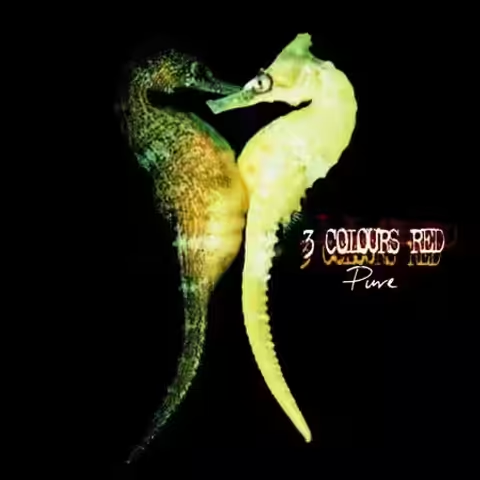
The sleeve to Pure is a deliberately blank, almost institutional design: a flat panel of single colour topped by the album's title and the band's name in unfussy capital letters. There are no portraits, no spelling-out of the lineup, no quotations. Set against the riot of cover-photography and Letraset stylings that characterised most Britpop and Britrock sleeves of the period, the restraint is striking, and it is in keeping with both the album's title and Creation's late-90s house style.
Inside the gatefold the band kept the same restraint. There is a single black-and-white group photograph of the four members and a thank-you list, with Terry Thomas given prominent billing, alongside the lyric sheet. The design has aged well; reissue and streaming-service thumbnails still read clearly at the postage-stamp sizes the format now demands, which is more than can be said for most of their peers' covers.
Release & Reception
Pure was released in the United Kingdom by Creation Records on 12 May 1997 and in the United States by Epic. It debuted in the UK Top 20, peaking at number 16 on the UK Albums Chart, with sources varying between 15 and 16 across different references; the band's published discography settles on 16. Either way it was Creation's most prominent non-Oasis release of the year and a vindication of McGee's "second best band in Britain" pitch.
The reviews were a study in critical disagreement. The metal and rock press loved it. The broadsheets were divided. The Observer's Neil Spencer admired the energy but doubted its commercial fit:
"Somewhere it's always 1977, and this quartet's debut is hewn straight from punk's frantic riffing and all-purpose pissed-offness. The bludgeoning approach works well enough, but is unlikely to muscle aside the competition."
Neil Spencer, The Observer, 27 April 1997
The Guardian's Caroline Sullivan was the bluntest dissenter. Hers is the two-star review that has, fairly or unfairly, attached itself to the album in retrospective coverage:
"It's not that their verbose rants are unpleasant, on the contrary, they inspire fond memories of the Clash, but this sort of three-chord stuff feels deeply anachronistic."
Caroline Sullivan, The Guardian, 16 May 1997
It is worth noting that exactly the same reflex, the broadsheet rock critic dismissing a punk-influenced debut as anachronistic, has been deployed against most of the records we now consider genre classics. Sullivan's verdict says more about The Guardian's taste in 1997 than about the album. The audience, in any case, did not ask the broadsheets for permission. Within four months of release Pure had produced four UK Top 40 singles, two of them in the Top 20.
Singles & Music Videos
The five-single campaign, including the re-released debut, is one of the longest of any Creation album of the period, and it gives a useful snapshot of how the band were marketed.
| Single | Released | UK Chart | Notes |
|---|---|---|---|
| "This Is My Hollywood" | 1996 (Fierce Panda) | 162 | The original indie single that secured the Creation deal. |
| "Nuclear Holiday" | 1997 | 22 | First single from the album campaign; first Top 40 hit. |
| "Sixty Mile Smile" | 1997 | 20 | The album's biggest UK hit; lyric drawn from Vuckovic's hospitalisation after taking ecstasy. |
| "Pure" | 1997 | 28 | The title track, third single. |
| "Copper Girl" | 1997 | 30 | Fourth single, the band's fourth UK Top 40 hit. |
| "This Is My Hollywood" (re-release) | 1997 | 48 | Re-released by Creation to capitalise on the album's success. |
Each single came with a video shot on a tightly controlled budget. The "Nuclear Holiday" promo, embedded earlier, leans on red lighting and apocalyptic stock footage; the "Sixty Mile Smile" video, briefly subject to broadcast restrictions for its drug-overdose imagery, was nevertheless picked up on regional MTV rotation. None of the videos were big-budget undertakings, and the band cheerfully treated them as supplementary advertising for the records rather than as art objects in themselves.
Touring & Live
The live show was the band's calling card from the start. They had built the songs in front of audiences during 1996, including a long stretch of UK dates with The Wildhearts, the band Chris McCormack's older brother Danny was playing bass in. By the spring and summer of 1997, with the album charting and four singles in rotation, 3 Colours Red were a touring proposition in their own right.
- UK headline tours through 1997, with support slots at the major summer festivals.
- European dates supporting Creation labelmates and the wider Britrock circuit.
- US tours during 1997 and 1998 with three of American rock's biggest acts of the moment: Marilyn Manson, Aerosmith and Silverchair.
- Reading and Leeds Festivals appearances in 1997 and again, fatefully, in 1999.
- A long run of late-1997 festival slots in mainland Europe in the wake of the album's chart performance.
The American tours, in particular, were a genuine education. Touring with Marilyn Manson at the height of Antichrist Superstar hysteria put 3 Colours Red in front of arena crowds of an order they had never played in Britain, and McCormack would later credit those shows with sharpening the live attack that was a hallmark of the band right to the end. The Aerosmith dates, even bigger in venue terms, were a useful crash course in how a veteran band paced a stadium show.
In TV, Film and Media
The album's tracks were not blanket-licensed in the way some of their American peers' songs were, but several of the singles did substantial work in advertising and television.
- "Nuclear Holiday" featured in MTV Europe's promotional reels in summer 1997.
- "Sixty Mile Smile" appeared on the soundtrack to a BBC documentary about the British clubbing generation.
- The album's tracks turned up across several skateboarding and BMX video soundtracks of the late 1990s, a market the band were rumoured to actively target.
None of these placements made anyone rich, but together they kept the songs in front of younger audiences after the singles had cycled out of the chart.
Controversy and Politics
The album's only serious flashpoint was the "Sixty Mile Smile" controversy, and even that was relatively gentle by the standards of the era. Tabloid coverage of ecstasy in 1997 was still dominated by the Leah Betts case, and a chart single whose lyric drew on a real overnight hospitalisation generated some predictable column inches. Creation, who had been here before with Primal Scream, simply released the single anyway. The risk paid off; "Sixty Mile Smile" reached the UK Top 20 and the controversy passed inside a fortnight.
Beyond that, the album's politics are diffuse rather than confrontational. Like a lot of British music in 1997, Pure circles around alienation, weariness and the small daily indignities of being young and broke in late-period Conservative Britain. By the time the album landed in May, John Major's government had just been swept out of office, and a clutch of the album's lyrics suddenly read as souvenirs of a country that no longer quite existed.
Covers, Samples and Tributes
3 Colours Red were not a band who attracted many tribute acts in the years after their split, but their songs have had a long cult afterlife. Several of the album's tracks have been covered live by younger British rock bands citing the album as a touchstone, and an increasing number of guitarists from the 2010s and 2020s metalcore and post-hardcore scenes have flagged the McCormack guitar parts as an early influence.
The album does not knowingly sample any other records. Its sonic vocabulary is built almost entirely out of live-band performance, with no evident programming, beat-loops or non-instrument sound design. That is part of why it has dated as honestly as it has; there is nothing on the record that screams "1997 production fashion" in the way the contemporary work of, say, the band's Creation labelmates often does.
Reissues, Anniversaries and the Band's Afterlife
The follow-up, Revolt, arrived in October 1999 with Dave Eringa producing. It carried the band's biggest single, the Vuckovic-penned "Beautiful Day", which reached number 11 in the UK and even made a brief mark on the US Radio and Records Alternative chart. By the time of its release, however, the relationships inside the band were beginning to fray. After their headline appearances at Reading and Leeds in late August 1999, 3 Colours Red announced through a press release that they were disbanding, citing musical and personal differences. They did not, on this first split, make it onto a stage together again for three years.
The reformation came in 2002 when Vuckovic and McCormack reconciled and brought Keith Baxter back. Ben Harding had moved into public relations and was replaced by Paul Grant, the ex-Pornstar guitarist. The new lineup signed to Mighty Atom Records and, in 2004, released The Union of Souls, produced by Joe Gibb of Funeral for a Friend. The album was warmly received critically and toured with Die Toten Hosen and the Donots, but commercial momentum was hard to recapture, and after a UK farewell run with the Yo-Yos in September 2005 the band split for the second and final time.
The afterlife of Pure, however, has been kinder. The 2005 double-disc compilation If You Ain't Got a Weapon..., sleeve-noted by Vuckovic, anthologised the Creation period for new fans. A live album, Nuclear Holiday, drawn from the same Islington Academy show, was issued by Snapper. Streaming and YouTube have done the rest, putting the album's videos and singles in front of an audience who could not possibly have caught them first time round.
The band's individual stories continued in their own directions. Chris McCormack toured for years as Gary Numan's guitarist and co-wrote half a dozen songs with Adam Ant for his 2013 album Adam Ant Is the Blueblack Hussar. Pete Vuckovic moved into A&R and management. Ben Harding stayed in PR. The most painful of the post-band stories belongs to Keith Baxter, who joined Therapy? briefly in 2002, played in the Lancaster band Baby Judas, and died on 4 January 2008 at the age of 36 from a gastrointestinal haemorrhage. Any account of the album that does not mention his playing, on a record so heavily dependent on its drummer's adaptability, is incomplete.
Legacy and Influence
Three decades on, Pure sits in an awkward but enviable spot in British rock. It is too punk-rooted to be remembered as a Britpop record, too tied to its specific 1997 moment to belong to the timeless rock canon, and too commercially successful to qualify as a true cult discovery. What it is, instead, is the album that distils a particular kind of British post-punk debut, the four-people-in-a-room rush of a band who had spent half a decade in other bands and were not going to waste their first proper shot. It made four of its members household names in the music press of the day, generated four UK Top 40 singles inside a year, and lifted Creation's commercial profile in the months before Be Here Now arrived to overshadow everything in the label's catalogue.
The album's longer-term influence has been quieter and more diffuse. You can hear its DNA in the British rock of the early 2000s and in the second wave of post-hardcore guitar bands who came up around Funeral for a Friend and the Lostprophets. As Britrock as a marketing label has faded, the records of its first wave have begun to be re-evaluated on their own merits. Pure sounds, now, less like a footnote to Britpop and more like the moment a generation of British guitar bands worked out how to use punk-era rhythm-section discipline to drag their songs out from under indie's softer edges.
For Pete Vuckovic, Chris McCormack and Ben Harding the album remains the touchstone that anything they do later is measured against. For the late Keith Baxter, the drummer who left a successful folk metal band to take a chance on a four-track-by-post project, it stands as the loudest and best-recorded thing he ever played on. Forty-one minutes long. Four singles. One pin in a magazine. One night in hospital. One album.
Things You Might Not Know
| Fact | Detail |
|---|---|
| The pin in the magazine | The band's name was chosen by sticking a pin in a London Time Out listings magazine, which landed on an advertisement for Krzysztof Kieslowski's Three Colors: Red. |
| McGee's "second best" line | Alan McGee signed them to Creation by publicly calling them "the second best band in Britain", behind Oasis, in 1996. |
| The four-track post sessions | Vuckovic and McCormack built the band's earliest songs by trading four-track cassette recordings through the post for several months in 1994. |
| A Diamond Head bassist on lead vocals | Pete Vuckovic had been the bassist on the reformed Diamond Head's 1993 studio album Death and Progress before fronting 3 Colours Red. |
| A Skyclad founder on the drum stool | Keith Baxter recorded five albums with folk metal pioneers Skyclad before leaving in 1995 to move to London and join 3 Colours Red. |
| The Wildhearts connection | Chris McCormack is the younger brother of Danny McCormack of The Wildhearts, and 3 Colours Red played some of their first ever shows opening for them. |
| Mastered by a Led Zeppelin man | The album was mastered at Sterling Sound in New York by George Marino, who had also mastered records by Led Zeppelin, AC/DC and Metallica. |
| The producer was the manager | Producer Terry Thomas was simultaneously the band's manager, having produced the demos that secured the Creation deal. |
| The Fierce Panda single re-released | "This Is My Hollywood" was originally released by indie label Fierce Panda in 1996 (charting at 162) and re-released by Creation in 1997, charting again at 48. |
| "Sixty Mile Smile" is autobiographical | The lyric of the band's biggest single drew directly on Vuckovic's overnight hospitalisation after taking ecstasy on a London night out. |
| They toured the US with Marilyn Manson | Following Pure's success, 3 Colours Red supported Marilyn Manson, Aerosmith and Silverchair on US arena tours in 1997 and 1998. |
| The drummer played briefly with Therapy? | Keith Baxter joined Therapy? briefly in 2002 between his work with Vuckovic in Elevation and his return to the Lancaster scene. |
| The split came on stage | The first split was announced shortly after the band's headline appearances at Reading and Leeds Festivals in August 1999, with no reunion for three years. |
| The lost EP | The 1998 four-track Paralyse EP was officially declared non-eligible for the UK Singles Chart because of its length and track count, leaving its commercial profile artificially low. |
Listen on the Riffology Podcast
If Pure was on the cassette in your Discman in 1997, or if you only know "Sixty Mile Smile" from a late-night MTV2 rotation and want the full story of how a Devon-born Diamond Head bassist, a Newcastle metalhead, an indie-pop founder and a Skyclad drummer ended up making a Top 20 record for Alan McGee, the Riffology podcast tells the stories behind the records that built rock and metal. You will find it on Apple Podcasts, Spotify, Amazon Music, Pocket Casts and every other major platform. Plug in, turn it up, and let the four-tracks roll.
Comments