Riffology Score: 82/100
Manuel Gagneux built Zeal & Ardor on a dare, a 4chan provocation and a refusal to swallow it; eight years later he has handed the most distinctive band in modern metal to the five people who toured the previous three records and asked them to help him write the fourth. GRIEF is what happens when the man behind the scratch tracks finally gets out of his own way.
The result is the least heavy, most musically curious and most argued-about record in the Zeal & Ardor catalogue. Fourteen tracks, forty-two minutes, no guests, no fashionable producer, no concept-album scaffolding, no chase for a viral single. Just Gagneux, four other musicians, a drummer who has anchored every album since 2018, and an album title that means both a Basel carnival creature and the English word it sounds like.
The Album in Brief
GRIEF is Zeal & Ardor's fourth studio album, released on 23 August 2024 through Redacted. It is the first the band recorded as a band rather than as a Gagneux solo project with sessioneers, and it is the first to almost entirely abandon the black-metal-meets-spirituals shorthand that the music press settled on around the time of 2018's Stranger Fruit. There are still blast beats. There are still slave-song call-and-response vocals. But they sit alongside funk, alt-rock, prog, country-flecked guitar, chiptune electronica and a piano ballad that wouldn't sound out of place on a Nine Inch Nails record.
It earned mostly positive reviews on release, sat near the top of plenty of 2024 end-of-year lists, and earned the band the Swiss Music Prize for Music in 2024. It also drew the first wave of genuinely mixed notices in the band's discography, with several outlets writing variations on the same observation: ambitious, sometimes too ambitious, the price of variety is cohesion.
Album Facts
| Field | Detail |
|---|---|
| Artist | Zeal & Ardor |
| Album | GRIEF (stylised Greif on the sleeve) |
| Release date | 23 August 2024 |
| Label | Redacted |
| Producer | Manuel Gagneux |
| Recorded | 2023 to early 2024, with the full live lineup in attendance for the first time |
| Genres | Avant-garde metal, black metal, post-metal, gospel, soul, alternative rock |
| Track count | 14 |
| Total runtime | 42:29 |
| Songwriting | All 14 tracks written by Manuel Gagneux |
| Singles | To My Ilk, Clawing Out, Fend You Off, Hide in Shade (plus Kilonova music video on release week) |
| Predecessor | Zeal & Ardor (self-titled, February 2022) |
| Critical reception | Generally positive; Kerrang! 4/5, Metal Hammer 4.5/5, Distorted Sound 9/10, Wall of Sound 9.5/10, Blabbermouth 7.5/10, Metal Storm 5.8/10, Metal Injection 6/10 |
| Notable accolade | Swiss Music Prize for Music, 2024 (awarded to the band on the back of the album) |
Where Zeal & Ardor Were Before GRIEF
To understand why GRIEF sounds the way it does, it helps to remember where the band came from. Manuel Gagneux is a Swiss-American musician born in Basel in 1989 to an African-American mother and a Swiss father. After moving to New York in 2012 he started a chamber-pop project called Birdmask, posting works in progress to 4chan for unfiltered feedback. One thread asked him to fuse two genres in half an hour; the genre pairing that arrived was, in part, a racist slur. His response was to write a song that proved the combination could work, and Zeal & Ardor began.
The 2016 debut Devil Is Fine, a self-released Bandcamp project written, performed and recorded almost entirely by Gagneux, became an unlikely critical sensation. Stranger Fruit followed in 2018, expanding the palette and adding a live band who, until GRIEF, were a touring entity rather than a recording one. The 2020 EP Wake of a Nation, written in direct response to the murder of George Floyd, marked a shift in tone, less spectacle and more anger. The 2022 self-titled album made good on every promise the band had been making for half a decade, distilling the project to its sharpest, most muscular form.
That record was the artistic peak. The dilemma it presented was an old one for any band whose sound is defined by a clever formula: do it again and look like a tribute act to yourself, or break the formula and risk losing the audience that found the formula in the first place. GRIEF is the answer.
From One-Man Project to Full Band
For most of Zeal & Ardor's recorded life, the credits told a misleading story. The albums said "Zeal & Ardor". The actual session said "Manuel Gagneux plus, eventually, Marco Von Allmen on drums". Tiziano Volante played lead guitar on tour from 2017. Marc Obrist and Denis Wagner sang backing vocals on tour from 2017. Lukas Kurmann took over on bass after Mia Rafaela Dieu's departure in 2019. None of them had played on a studio Zeal & Ardor record.
On GRIEF, all of them are credited band members on the album sleeve. The full lineup tracks:
- Manuel Gagneux on lead and backing vocals, lead and rhythm guitar, bass, synthesizer and programming
- Marco Von Allmen on drums
- Tiziano Volante on rhythm and lead guitar
- Lukas Kurmann on bass
- Denis Wagner on backing vocals
- Marc Obrist on backing vocals
Gagneux has been candid in interviews about why it took eight years. Speaking to Matt Mills at Guitar.com in September 2024, he framed it as a fairness issue:
"Until not too long ago, it was, for instance, 'Here is a tour, take it or leave it,' and that is not fair to people who have dedicated seven years to this project. Now everyone is at the table when decisions are made. Everyone has a say as to whether or not we do something. It feels good not to be a shitty person."
Manuel Gagneux, Guitar.com, September 2024
Volante put the same shift in less self-deprecating terms in the same interview, calling it a gradual build of trust after enough album and tour cycles for everyone to know each other's strengths. The mechanics of that trust shaped the record in ways the production credits do not make obvious.
The Basel Folklore Behind the Title
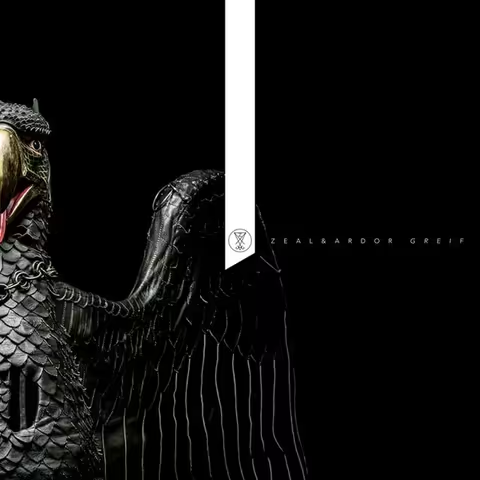
The title Greif, stylised as GRIEF in the band's typography and on the streaming services, is the German word for griffin, the mythical hybrid of eagle and lion. Specifically it refers to Der Vogel Greif, a winged figure from Basel's Vogel Gryff carnival, a centuries-old tradition Gagneux grew up watching in his hometown. The pun on the English word grief is intentional; the German word arrived first, the emotional resonance second.
The thematic throughline that follows from that pun, loss, defiance, the working-class refusal to accept what is happening to you, runs through the lyrics in waves rather than as a strict concept. Several songs are addressed to a specific kind of antagonist: the boss, the landlord, the system, the well-meaning ally who is also in the way. Several others read as inward-facing, processing what it costs to keep choosing to make music about hard things in front of an audience that includes the people you are making it about.
Recording and Production
Gagneux produced GRIEF himself, as he has every Zeal & Ardor release. The mechanical difference this time was who was in the room when the songs were tracked. Scratch tracks remained Gagneux's domain, written and demoed alone before the rest of the band arrived; the band then took those demos and rebuilt them as a group, with parts being rewritten, reinterpreted and in several cases pulled apart entirely.
Speaking to Guitar.com, Gagneux described the shift in studio culture as the harder part of the change:
"Historically, we would never talk about things that we think could make for a weird atmosphere. But now I think we are better at expressing ourselves. In the studio specifically, Tizi came in with tracks he had done for the record, and they sounded fantastic. It was like, this is rad. This is something I never could have done alone. I was enthused."
Manuel Gagneux, Guitar.com, September 2024
The gear side of the record is unglamorous and deliberate. Volante played his signature Gabriel Aeschbach custom, a Strandberg-meets-Ibanez-Iceman hybrid with twin humbuckers and a hardtail bridge. Gagneux tracked most of his parts on an Aristides 060, the resin-bodied instrument the band has used live for years. Both are tools designed to survive the band's stage show as much as to capture a particular timbre. The synth and programmed elements that thread through une ville vide, 369 and Solace are all Gagneux, recorded as scratch parts and kept once everyone agreed nothing organic was going to beat them.
What is missing from the production conversation is as instructive as what is present. There is no celebrity mix engineer, no expensive analogue chain anecdote, no signature studio. The record was made in Switzerland by the band, the way the previous three were, only with more chairs.
Personnel and Credits
| Role | Player | Notes |
|---|---|---|
| Core band | ||
| Lead vocals, guitar, bass, synth, programming | Manuel Gagneux | Sole songwriter on all 14 tracks; produced the album |
| Drums | Marco Von Allmen | Has played drums on every studio release since Stranger Fruit (2018) |
| Rhythm and lead guitar | Tiziano Volante | First studio credit on a Zeal & Ardor album, having played the live show since 2017 |
| Bass | Lukas Kurmann | Joined the live band in 2019 after Mia Rafaela Dieu's departure; first studio credit |
| Backing vocals | Denis Wagner | First studio credit; in the live band since 2017 |
| Backing vocals | Marc Obrist | First studio credit; in the live band since 2017 |
| Production and engineering | ||
| Producer | Manuel Gagneux | Self-produced, consistent with every Zeal & Ardor release to date |
| Artwork and design | ||
| Concept | Manuel Gagneux | Inspired by Der Vogel Greif, a winged figure from the Basel Vogel Gryff carnival |
Two things stand out from this list. There are no outside session players, no guest vocalists and no celebrity name-checks. And the new credits all went to people who had already played hundreds of shows under the Zeal & Ardor name. The expansion is best read as paperwork catching up with reality.
The Singles
The promotional campaign for GRIEF was paced unusually slowly for a 2024 metal release. Four singles, one a month from April to July, deliberately staked out different corners of the record before the album landed.
| Single | Released | Style | Notes |
|---|---|---|---|
| To My Ilk | 22 April 2024 | Folk, choir, no metal | Lead single; closes the album. Intentionally chosen to confound expectations. |
| Clawing Out | 24 May 2024 | Prog, off-kilter rhythms, synth-led | Second single; the one critics most often flagged as the album's risk-taking centrepiece. |
| Fend You Off | 21 June 2024 | Anthemic, choir-driven, big choruses | The single most likely to win over listeners who came for the 2022 self-titled. |
| Hide in Shade | 19 July 2024 | Hardcore-adjacent, blast beats, gospel breakdown | The "this is still a metal record" single, dropped a month from release. |
| Kilonova (video) | 27 August 2024 | Post-album music video | Released four days after the album to keep the momentum going; not a single in the traditional sense. |
That a band would lead with their gentlest song is a confidence move. That the second single is the album's most divisive track is a heavier one. Compare it to the playbook around the 2022 self-titled, where Run, Erase and Bow set out a clear, focused identity: aggressive, melodic, song-shaped. The GRIEF singles deliberately do not do that. They tell you, in order, here are four different bands and they are all us.
Tracklist
| # | Title | Writer | Length | Single? | Notes |
|---|---|---|---|---|---|
| 1 | The Bird, the Lion, and the Wildkin | Gagneux | 1:33 | Whistled motif opener, no drums, sets the carnival-procession tone | |
| 2 | Fend You Off | Gagneux | 3:52 | Single | Anthemic, choir-driven; one of the record's clearest crowd-pleasers |
| 3 | Kilonova | Gagneux | 4:07 | Video released post-album; ranges from hardcore chug to country bend in one song | |
| 4 | Are You the Only One Now? | Gagneux | 4:26 | Acoustic folk that turns frantic; Radiohead and Darkthrone in the same paragraph | |
| 5 | Go Home My Friend | Gagneux | 1:56 | Industrial undertow; the album's first sub-two-minute interlude | |
| 6 | Clawing Out | Gagneux | 3:42 | Single | Off-kilter, synth-led prog; the album's biggest swing |
| 7 | Disease | Gagneux | 4:34 | Longest track on the record, slowest burn | |
| 8 | 369 | Gagneux | 0:55 | Spoken-word and synth interlude; numerology nod | |
| 9 | Thrill | Gagneux | 2:27 | The single the band did not release; pop-punk-adjacent, hookiest song on the record | |
| 10 | une ville vide | Gagneux | 2:04 | Instrumental, chiptune-flavoured; the first all-electronic Zeal & Ardor piece since Devil Is Fine interludes | |
| 11 | Sugarcoat | Gagneux | 2:58 | Soul-led, slow groove, restrained drums | |
| 12 | Solace | Gagneux | 3:52 | Piano ballad; Gagneux's most exposed vocal performance on the album | |
| 13 | Hide in Shade | Gagneux | 3:38 | Single | The metal release-week reassurance single; blast beats and a gospel breakdown |
| 14 | To My Ilk | Gagneux | 2:25 | Single | Closing track and lead single; folk guitar and a choir, no metal at all |
The Songs: A Closer Listen
The shape of GRIEF is unusual for a Zeal & Ardor record. Previous albums tended to open hard and close on a moment of strange beauty. This one opens on a procession, the 93-second The Bird, the Lion, and the Wildkin, a whistled motif over field-recorded percussion that has more in common with a Tom Waits intro than a black metal one. Fend You Off, the second track and the warmest single, then arrives like the album has changed bands. A massive choir refrain, a tight guitar riff, the band's classic call-and-response push, played at scale.
Kilonova in the three slot is where the new band's hand becomes obvious. The song moves through hardcore chugs, melodic post-metal openings and an almost country-flecked bend in the lead guitar without ever feeling like a medley. It is the kind of track that Gagneux, by his own admission, would not have written for a session he was tracking alone.
Are You the Only One Now? takes the album somewhere stranger. It opens on a folk-guitar figure that could be a Sufjan Stevens outtake, then breaks into a panicked, second-wave black metal mid-section before resolving into a chorale. The transitions are abrupt by design, and the song works because the band commits to each section as if it is the whole song.
Go Home My Friend is the album's first short break, an industrial fragment under two minutes that points the way to Clawing Out. That single, the album's most polarising, plays in odd time signatures with a synth lead replacing what would normally be a guitar hook. The off-kilter feel is the point. Anyone expecting Run's linear rage will leave irritated; anyone willing to sit with it will hear one of the band's most rhythmically interesting songs.
Disease is the album's heaviest sustained run, a slow burn that lives in the band's signature mode. It is the song that proves Zeal & Ardor have not abandoned the territory they made famous; they have simply stopped doing it for the whole album.
Standout Tracks
Three songs do the heaviest lifting in pulling the record together.
Thrill, slot nine, is the song that ought to have been a single and was not. It is the catchiest thing on the album, a hardy chord progression and a hoarse vocal line that lands somewhere between pop punk and the band's gospel mode. At two and a half minutes it does not outstay its welcome; at one play it stays in your head for a week.
Solace, slot twelve, is the album's emotional centre. A piano ballad with Gagneux's voice unsupported for long stretches, it is the most exposed performance he has put on a record. The lyric reads as a private grief, addressed to nobody in particular and therefore to anyone willing to listen.
To My Ilk, slot fourteen, is the lead single that doubles as the album closer. A folk-guitar figure under a choir, no percussion until a series of soft claps in the second half, no metal anywhere in its 2:25. As an opening salvo for an album cycle it was provocative. As an ending, it is gently devastating, the album's last word a refusal to do what is expected.
The Sound of GRIEF
Sonically the album sits a half-step quieter than the 2022 self-titled. The drums are mixed less aggressively. The walls of guitar are thinner, in service of giving the choir parts room to breathe. The bottom end is warmer and rounder, sitting under the kick rather than alongside it. None of this is accidental; it is what happens when the songs themselves are less reliant on heaviness as their primary effect.
What you lose, and a few reviewers picked up on this, is some of the head-snapping impact of the band's earlier mode. What you gain is space. Songs like Sugarcoat, une ville vide and Solace are unimaginable on Devil Is Fine, Stranger Fruit or even the 2022 self-titled in the same form. Whether you prefer that trade is largely the question that decides whether you love GRIEF or only respect it.
Themes: Grief, Resistance, Defiance
The thematic vocabulary of the album draws from several wells at once. There is the personal grief that the album title plays on, which surfaces most clearly on Solace and To My Ilk. There is the class anger that has been a feature of Gagneux's writing since Wake of a Nation, audible in Fend You Off and Hide in Shade. And there is the older project animating thread, the refusal to let other people decide the terms on which Black music and metal can meet, which sits underneath everything whether or not it is named.
The album does not preach. It does not present itself as a concept record. It assumes the listener will join the dots, and trusts the songs to do the work.
Critical Reception
The press response was broadly positive with a thin band of measured disappointment. Metal Hammer's Rich Hobson gave it 4.5 out of 5, framing it as the band stepping past the formula on purpose:
"The sound of a band seeking to reinvent themselves and innovate beyond their roots. By expanding their remit, the laser focus of the previous records is naturally lost."
Rich Hobson, Metal Hammer, August 2024
Kerrang! came in at 4/5 and made the same observation in shorter form, calling the album less heavy than the band's earlier work but adding that "it goes further and deeper than anything Zeal & Ardor have done before." Distorted Sound gave it a straight 9/10, praising the consistency of craft across the catalogue. Wall of Sound went higher still at 9.5/10.
The harder notices were not unkind, just measured. Metal Storm came in at 5.8/10, citing "an excessive level of lethargy" across the back half and a handful of tracks that miss their mark. Metal Injection, at 6/10, appreciated the experimentation but felt the songwriting and "the hallmark passion of Zeal & Ardor just didn't come together on this release". Blabbermouth, at 7.5/10, gave the most concise verdict: "Diverse, daring and occasionally wasteful with its charms."
Taken together those reviews chart roughly the same conversation. The band swung at a different kind of record, mostly connected, occasionally did not, and the swings are the point.
Where It Sits in the Discography
Each of the four Zeal & Ardor albums has a different function. Devil Is Fine (2016) is the proof of concept, made alone, released onto Bandcamp, an unlikely critical sensation. Stranger Fruit (2018) is the band record made by one person; the project's signature sound emerged in its final, defining form. Zeal & Ardor (2022) is the distillation; the album where the band's identity is at its most concentrated and its most ferocious.
GRIEF is the pivot. It is the record where the band stops being a solo project with sessioneers and becomes a band, and where Gagneux deliberately surrenders the central feature that made the early records so easy to write about. It is not the best Zeal & Ardor album. It might be the most interesting one. It is almost certainly the most consequential, because it is the album that decides what the next decade of the band looks like.
The Live Show
The full-band shift on the record was matched by a more theatrical live show on the GRIEF touring cycle. Zeal & Ardor played dates across Europe and North America through 2024 and 2025, headlining venues including Shepherd's Bush Empire in London and the Gothic Theater in Denver, with Heilung sharing a portion of the European run and Gaerea opening the North American leg.
The setlists leaned harder on the 2022 self-titled material than on the new record, which is the smart move for a band whose audience knows the older songs by heart. Fend You Off and Hide in Shade entered the set early and stayed; Clawing Out appeared and disappeared; Solace made occasional appearances as the encore stripped-down moment. The whistled intro of The Bird, the Lion, and the Wildkin opened most shows on the tour, performed by Obrist alone in a single spotlight before the rest of the band joined for Fend You Off.
What GRIEF Says About Where Zeal & Ardor Are Going
The defining question for any Zeal & Ardor album from this point is whether the band can write outside the formula that made them and still feel like themselves. GRIEF is the answer that says yes, with reservations. The records that follow will tell us whether the band can write inside the new freedom they have given themselves and not lose what made the project distinctive in the first place.
The hint in the album's structure is that Gagneux knows exactly which question he is asking. To My Ilk, the closing track, is the lead single and the strangest pick for one. It is the album telling you, in a final 2:25 of folk guitar and choir, that the band who used to be summarised by two genres is not going to be summarised that way any more.
The Riffology Score Breakdown
| Category | Score | Notes |
|---|---|---|
| Songwriting | 9/10 | Gagneux remains one of the sharpest writers in modern metal; the hook count per minute is high even on the experimental tracks. |
| Performance | 9/10 | The full band sound tighter than any previous Zeal & Ardor lineup, and the new vocal credits are not decoration. |
| Production | 8/10 | Self-produced, deliberately under-glamorous, occasionally a touch dry; the choir mixes are the production highlight. |
| Cohesion | 7/10 | The album's biggest weakness. Genre detours are individually fascinating; sequenced together they sometimes pull the record off its own thread. |
| Replay value | 8/10 | Grows on repeat listens; songs that initially seem like outliers reveal their place in the running order around the third spin. |
| Importance | 9/10 | The pivot record. Decides what Zeal & Ardor become next. |
| Overall | 82/100 | A bold, restless, occasionally messy record that refuses to repeat itself, by a band who have earned the right to make it. |
Where to Start (For New Listeners)
If you are coming to GRIEF without having heard Zeal & Ardor before, the album is a defensible entry point because it is also where the band reset their own expectations of themselves. That said, the order that gives you the fullest sense of what the band is doing on the record is roughly this:
- Start with Fend You Off for the band's classic mode at scale
- Move to Hide in Shade for the heaviness
- Try Thrill for the pop instincts
- Sit with Solace for the emotional weight
- End with To My Ilk for the band's range
- Then play the whole record from the top in sequence; the interludes start to make sense
If you bounce off the experimental tracks on a first listen, that is the record working as designed. Zeal & Ardor are no longer optimising for the first listen.
Things You Might Not Know
| Fact | Detail |
|---|---|
| The title is a homophone | Greif is the German word for griffin, the mythical hybrid of eagle and lion. The pun on the English word grief is deliberate, and the album cover refers to Der Vogel Greif, a winged figure from Basel's Vogel Gryff carnival that Gagneux watched as a child. |
| First studio album as a full band | Despite Zeal & Ardor releasing four studio albums before 2024, this is the first one on which Tiziano Volante, Denis Wagner, Marc Obrist and Lukas Kurmann appear as credited band members rather than touring sessioneers. |
| Lead single chosen for shock value | To My Ilk, the first single, contains no metal at all. The band chose it deliberately to reset expectations before the album cycle began. |
| The 4chan origin story | The entire Zeal & Ardor project began with a racist 4chan user suggesting Gagneux fuse "black metal" with a slur for Black music. Rather than fight the comment, he wrote the first Zeal & Ardor song to prove the combination worked. |
| Album won a Swiss state prize | Zeal & Ardor won the Swiss Music Prize for Music in 2024, the state-funded national award, on the back of GRIEF. |
| 369 is one of the shortest tracks they have released | At 55 seconds, slot eight 369 is among the briefest pieces in the Zeal & Ardor catalogue and sits between two of the album's longest songs. |
| Gagneux's main guitar is plastic | The Aristides 060 that Gagneux uses on most of GRIEF is built from a synthetic composite material rather than wood, which is why he can hit it onstage without breaking it. |
| Volante had never recorded with the band before | Despite playing lead guitar in the live show since 2017, the Italian-born guitarist's first Zeal & Ardor studio credit is on GRIEF, seven years into his tenure. |
| une ville vide is the first electronic instrumental since 2016 | The chiptune-flavoured slot-ten piece is the first all-electronic instrumental Zeal & Ardor have released since the interludes on Devil Is Fine. |
| Kerrang! and Metal Hammer rated it almost identically | Kerrang! gave it 4/5, Metal Hammer 4.5/5. Both reviews independently focused on the loss of "laser focus" as the price of the album's expanded range. |
| The cover plays with carnival typography | The stylised "GREIF" logo on the sleeve borrows visual cues from the centuries-old Vogel Gryff carnival paraphernalia Gagneux grew up watching. |
| No outside guests appear on the record | Despite the band's growing profile, GRIEF features zero credited guest musicians, vocalists or producers. Every sound on the album is made by the six-person band. |
Final Verdict
GRIEF is a Zeal & Ardor record that does not sound like a Zeal & Ardor record half the time, and that is the entire point. It is the album where Manuel Gagneux stops being the only voice in the room, where Marco Von Allmen's drums are joined by four other people's instruments and ideas, and where the band stops asking themselves the question that defined their first eight years. The answer is uneven in places, fearless in most, and occasionally astonishing.
At Riffology we rate it 82/100. Not the best Zeal & Ardor album. The most interesting one. The one that decides what comes next.
Listen on the Riffology Podcast
If you would rather hear two of us argue about GRIEF than read another paragraph about it, the Riffology podcast covers album releases like this every week. You can find Riffology on Spotify, Apple Podcasts, Amazon Music, Pocket Casts and every other major podcast platform; subscribe in whichever app you already use and the next episode lands automatically. Send us your own GRIEF score and tell us which song we got wrong.
Comments