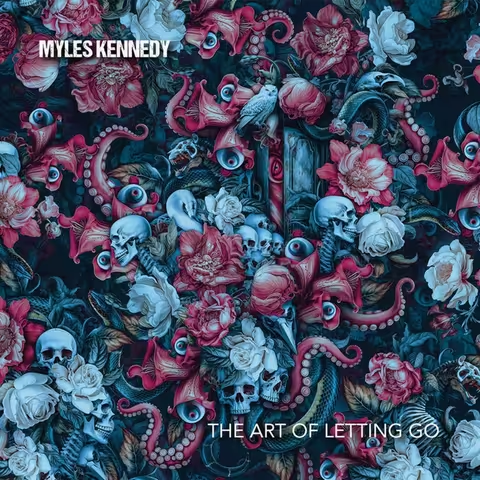
Most singers in Myles Kennedy's position simply do not bother with a third solo album. He fronts a stadium-tested rock band in [Alter Bridge](/posts/alter-bridge-by-alter-bridge-album-review/), he is the recording and touring voice of Slash and the Conspirators, and the calendar in any given year is full enough without manufacturing reasons to add to it. The Art of Letting Go is therefore unusual before a note plays. It is a record made not because anyone was waiting for it, but because Kennedy had a folder of riff ideas that simply would not work for either of his other two outlets, and he was unwilling to let them sit on a hard drive for another half-decade.
What arrives on 11 October 2024, via Napalm Records, is the album his first two solo outings never were. Year of the Tiger and The Ides of March were quiet, introspective and acoustic-leaning in equal measure. The Art of Letting Go is a hard-rock trio record, tracked at Michael Baskette's Studio Barbarosa in Orlando with a three-piece line-up, written start to finish by Kennedy on his new PRS signature guitar, and built on what he himself has described as a "full-on riff-based" approach. It does not sound much like Alter Bridge. It does not sound at all like Slash. It sounds like a singer-guitarist who has spent his entire adult life filing serviceable songs away into other people's projects and has finally decided, in his mid-fifties, to keep some for himself.
Album Facts
| Field | Detail |
|---|---|
| Artist | Myles Kennedy |
| Album | The Art of Letting Go |
| Release Date | 11 October 2024 |
| Label | Napalm Records |
| Producer | Michael "Elvis" Baskette |
| Studio | Studio Barbarosa, Orlando, Florida |
| Engineer | Jef Moll |
| Mastering | Brad Blackwood |
| Genre | Hard rock, alternative rock |
| Track Count | 10 |
| Total Runtime | 46:22 |
| UK Albums Chart Peak | 98 |
| UK Rock and Metal Albums Peak | 2 |
| UK Independent Albums Peak | 2 |
| Scottish Albums Peak | 9 |
| US Top Album Sales Peak | 10 |
| US Top Hard Rock Albums Peak | 16 |
| Other Notable Peaks | Austria 10, Switzerland 20, Germany 36, France Rock and Metal 23 |
| Key Singles | Say What You Will, Nothing More to Gain, Miss You When You're Gone, Saving Face |
Where It Sits in the Solo Catalogue
The first thing to understand about The Art of Letting Go is what it deliberately is not. Year of the Tiger, released in March 2018, was built around acoustic guitar, lap steel and Americana shading, with Kennedy multi-tracking himself across almost every instrument and pitching the whole project as a personal record about his father's early death. The Ides of March, three years later, expanded the palette without abandoning it: still acoustic-rooted, still confessional, but with more electric guitar and a wider production scope thanks again to Baskette. Both records made a virtue of restraint, both were widely praised for letting fans hear Kennedy's voice in a setting his bands could not provide, and neither did anything to suggest the third album in the sequence would arrive at a sprint.
That is exactly what it does. The Art of Letting Go opens at full volume, leans on distorted rhythm guitar from the first bar of the title track, and never really steps off the throttle until the album's closing minutes. The acoustic moments are now embedded within bigger arrangements rather than carrying songs on their own. The trio format means there is no string section to hide behind. The result is a record that sits with the rest of the solo catalogue chronologically but feels temperamentally closer to Kennedy's day jobs, while still being identifiably its own thing.
The Run-Up to Release
Kennedy announced the album publicly on 10 June 2024 with a Loudwire interview, describing the project as a "full-on riff-based rock record" and confirming it would open heavy and close in a more haunting register. The following day, lead single Say What You Will arrived with an accompanying video. The release schedule that followed was the textbook modern rock playbook: a single roughly every six weeks, each one chosen to flag a different facet of the record rather than to bunch the heaviest material at the front.
Nothing More to Gain landed on 30 July, Miss You When You're Gone on 13 September, and the brisk, hooky Saving Face on 9 October, just 48 hours before the full album. The campaign also doubled as the announcement of a 2025 touring cycle, with the trio of Kennedy, Tim Tournier and Zia Uddin set to take the material through Europe and North America rather than absorbing it into either of his other live operations. By the time the album hit shelves, four of its ten tracks were already in circulation, but the running order placed all of them well away from the opening pair, meaning even pre-release devotees were not getting a front-loaded record.
Producer Michael Baskette and the Sonic Through-Line
Any review of The Art of Letting Go has to deal with Michael "Elvis" Baskette. Baskette has produced every Alter Bridge studio album since Blackbird in 2007, the World on Fire, Living the Dream and other key Slash and the Conspirators records, both Kennedy solo albums before this one, and a large slice of the modern Tremonti catalogue. In other words: practically every studio recording Kennedy has made in the past 17 years has been routed through the same producer, the same room and, for long stretches, the same engineering setup. That is unusual, and it has consequences that bear directly on this record.
The most obvious is sonic consistency. Vocally, this album sounds like Kennedy as captured anywhere else: dry, present, very slightly compressed, with the upper register left clean rather than slathered in plate reverb. The drum tone leans on the same big, identifiable kick and snare profile Baskette has favoured since the back half of the Alter Bridge run, and the guitars sit in a familiar low-mid pocket. If you can identify a Tremonti record by its production fingerprint, you can identify this one too.
The interesting question is whether that continuity is a strength or a limitation. On The Art of Letting Go it largely works in the album's favour. The trio format risks sounding thin, and Baskette's instinct for layering one or two rhythm guitars under the obvious lead part keeps the bottom end full without overcooking it. Where the production occasionally gives the game away is on the more atmospheric material in the second half, where a different ear might have pushed further from the Alter Bridge sound. But that is a comparative quibble. As a record made fast, well and within budget by a producer who knows the singer as well as anyone alive, this is hard to fault.
The Florida Trio
The line-up Kennedy brings into Studio Barbarosa is not assembled from session-musician central casting. Zia Uddin, on drums and percussion, has played with Kennedy on and off since the late 1980s, going back to their Spokane high-school heavy-metal band Bittersweet and through The Mayfield Four in the mid-1990s. Tim Tournier handles bass duties, completing a working three-piece that has held together across both of the previous solo albums and the touring that supported them.
That continuity matters. The Art of Letting Go is fundamentally a power-trio record dressed in rhythm-guitar overdubs, and it needs a rhythm section that can carry the weight without sounding like hired help. Uddin's drum performances are unfussy, dynamic and deferential to the song. He pushes when the song wants pushing and steps back when the vocal needs the room, in a way that suggests a long shared shorthand rather than a click-track read-through. Tournier's bass holds the bottom end steady on the heavier numbers and finds melodic counter-lines on the softer ones, particularly on the album's mid-record stretch. Engineering and digital editing came from Jef Moll, with Brad Blackwood mastering at Euphonic, a long-standing combination across multiple Baskette projects.
The Singles Campaign
The four-single rollout is worth examining on its own merits because of what it tells you about how Kennedy wants the album to be heard. The lead-off, Say What You Will, is brisk, melodic and built around a high, ascending vocal hook in the chorus. It is the most obvious radio entry point on the record but it is also the shortest song on the album, an early signal that this is not going to be a sprawling, songwriter-y record.
Nothing More to Gain, second out, picks up the riff-driven thread and stretches it to over five minutes. Miss You When You're Gone is the curveball pick, leaning quieter and more wistful, almost as a deliberate corrective for anyone who feared the album would be ten tracks of mid-tempo distorted rock. Saving Face, the closest to release, is the record's most direct nod to Alter Bridge mid-period: pummelling rhythm, a sing-along chorus, a guitar solo that comes in on time and gets out before it overstays its welcome. As a sequence, the four singles do exactly the job a singles campaign should: they trail the album without describing it.
The Art of Letting Go (Title Track)
The album's opener has the heaviest job on the record: announcing in 30 seconds that the rules have changed. It earns its keep. A staccato, slightly twangy main riff sets the tempo, with Uddin's kick driving underneath, and Kennedy's vocal enters in his mid-range rather than reaching for the rafters. The chorus is wide rather than tall, a deliberate choice that leaves him plenty of head-room on later tracks. At 4:38 it is also the second-longest of the early sequence, giving the song space for an instrumental section that brings the trio's interplay forward.
Thematically, the title sets the lyrical agenda for the rest of the record: an acceptance that grief, public expectation and one's own fixed ideas about identity are all things that one can, with effort, decide to release. The performance is straightforwardly excellent. As a statement of intent it is unambiguous.
Say What You Will
The shortest track on the record, at 3:33, and arguably its catchiest. The verse riff is a tight, palm-muted figure in the upper-mid range, the chorus opens up into a soaring four-bar phrase that is engineered to be sung back in a venue, and the bridge resolves into a guitar solo that prizes melody over flash. As a pre-release single it told fans exactly what they needed to know about the heavier direction without giving away the more nuanced material lurking in the second half of the album.
Mr. Downside
If The Art of Letting Go has a wild card, it is this one. The riff is gnarled, almost lurching, with a deliberately ugly bend that recurs through the verse. Kennedy's vocal is at its most playful on the record, leaning into a slightly arch, almost theatrical phrasing that draws a clear line under the song's narrator, a self-pitying pessimist of the kind every band knows. It is the most fun thing on the album and the one that benefits most from headphones. At 4:17 it is also exactly the right length: long enough to develop the joke, short enough to leave the riff intact in the listener's head.
Miss You When You're Gone
The first quiet moment on the record and a single, which is a brave call given how heavy the surrounding material is. The arrangement leans on clean guitar and a much lighter rhythm section, and the vocal sits closer to the listener than anywhere else on the album. Lyrically it is a straightforward farewell, the closest thing here to a Year of the Tiger holdover in spirit, and it is sequenced cleverly at track four to break up what would otherwise be a four-track block of distorted rock. The 4:10 running time is taut. Less restrained writers would have pulled it to five and a half.
Behind the Veil
At 5:48 the longest cut on the record and the one that comes closest to Alter Bridge mid-album territory, with a slow, modal verse riff that builds through a long chorus into a clear coda section. The guitar arrangement is at its densest here, with multiple overdubs stacking up a wall of melody by the back half of the song. Lyrically it is the most cryptic thing on the album, all curtains and half-glimpsed truths, and the impression is of a song that wants to invite a few different readings rather than nail any single one down. A late-record listener favourite by the end of the album cycle.
Saving Face
The closest thing on the record to a straight-line rock anthem and, by some margin, the most efficient. A sub-four-minute verse-chorus-verse-chorus-bridge-chorus structure, a guitar solo placed exactly where convention demands it, and a vocal hook that arrives in the first 30 seconds and refuses to leave. As the last single before release it primed the rock-radio market neatly. As an album track it provides the lift in the back half that the slower material around it needs to land.
Eternal Lullaby
Five and a half minutes, and the album's emotional centre of gravity. Built on a clean-toned arpeggio in the verse, with the chorus rising into one of Kennedy's better top-line melodies of the past five years, it scans clearly as a song about loss. Speculation has long pointed to Chris Cornell as the dedicatee, given Cornell's close professional connections to the wider Kennedy circle and the song's haunted phrasing, though Kennedy himself has been deliberately careful to leave the lyric open rather than pin it to one person. Either way, the performance is among the most restrained on the album, and the better for it.
Nothing More to Gain
The second single, and a useful five-minute argument that Kennedy's solo material does not have to read as Alter Bridge offcuts. The verse has a clipped, almost mechanical groove that the Conspirators would not touch and Alter Bridge would arrange very differently, leaving the song in a space that is unmistakably the property of this record alone. The lyric, about the moment one realises a particular pursuit will not deliver what was promised, is the most direct line of writing on the album.
Dead to Rights
Track nine and one of the more interesting deep cuts. A loping mid-tempo groove that takes its time getting to a chorus, with a verse melody that telegraphs nothing about where the song is going. The guitar work here is some of the album's most considered, with the solo section in particular allowing Kennedy to draw on the jazz-fusion vocabulary that informed his pre-Mayfield Four years without anyone in the trio needing to play to a click. At 4:19 it stays the right side of indulgence.
How the Story Ends
The closing track and exactly the kind of finish Kennedy promised back in June: haunting, almost grungy in places, with a slow build that earns its final crescendo. The vocal sits high in the mix and the rhythm guitar work is at its sparest, leaving room for one last guitar solo to take the album out. The closing minute is the only point on the record where the arrangement leans fully on atmosphere over riff, and after 45 minutes of largely uniform energy levels it is a genuinely useful change of pace. As a sign-off, it makes the record feel deliberately shaped rather than tracked in song order and shipped.
Lyrical Threads Across the Record
Three things recur often enough across the album to count as themes rather than coincidences. The first is the title concept itself: the conscious effort to let go of something that no longer serves, whether that is grief, an unhelpful version of one's own identity, or a fixed assumption about how the world should reward effort. It surfaces in the title track, in Eternal Lullaby, in How the Story Ends and arguably in Behind the Veil. The second is the gap between what one says publicly and what one privately believes, which underpins both Saving Face and Mr. Downside, two superficially very different songs that share a narrator who is not telling the truth. The third is straightforwardly mortality, handled with the slightly weary practicality of a writer in his mid-fifties rather than the operatic awe a younger lyricist might bring to the same material.
- Acceptance of loss as opposed to the resistance more typical of Alter Bridge lyrics.
- Public mask vs private self, particularly across the middle of the album.
- Mortality, calmly approached, in a register notably different from Year of the Tiger's grief.
- Quiet self-knowledge, including a recurring willingness to admit when the narrator has been wrong.
Vocal Performance
Kennedy is one of the most reliably four-octave singers in modern rock and this album is calibrated around what that means in his mid-fifties rather than what it meant on Blackbird. The high register is still there, used on the title track, on Saving Face and on the climbing chorus of Say What You Will, but the bulk of the record sits in a comfortable mid-range with the high notes deployed as accents rather than as the default. That makes for performances that feel inhabited rather than auditioned. The phrasing is more conversational than fans of the Alter Bridge ballads might be expecting, particularly on Mr. Downside and Miss You When You're Gone. It is also a record that, perhaps not coincidentally, will be very playable live on consecutive nights.
Guitar Work and the PRS Signature
One detail that bears mentioning: a large part of the album was written and recorded on Kennedy's new PRS signature guitar, released alongside the album campaign. The instrument's voicing, mid-rich and articulate without being overly bright, is audible in the rhythm tone throughout the record. The lead playing is dexterous, melodic and refreshingly free of widdle for its own sake, which is consistent with a guitarist who started in jazz-fusion bands and who has spent two decades sharing a stage with Slash without ever feeling the need to out-shred him. The trio format gives Kennedy more solo space than he ever gets in Alter Bridge, and he uses it sparingly, which is the right call.
Tracklist and Personnel
| # | Title | Writer | Length | Single? | Notes |
|---|---|---|---|---|---|
| 1 | The Art of Letting Go | Myles Kennedy | 4:38 | No | Title track; opens the album at full volume. |
| 2 | Say What You Will | Myles Kennedy | 3:33 | Yes (June 2024) | Lead single; shortest track on the record. |
| 3 | Mr. Downside | Myles Kennedy | 4:17 | No | Lurching riff; the album's wild card. |
| 4 | Miss You When You're Gone | Myles Kennedy | 4:10 | Yes (Sept 2024) | The first quiet song; breaks up the heavy opening run. |
| 5 | Behind the Veil | Myles Kennedy | 5:48 | No | Longest track; densest arrangement. |
| 6 | Saving Face | Myles Kennedy | 4:10 | Yes (Oct 2024) | Closest to Alter Bridge mid-period. |
| 7 | Eternal Lullaby | Myles Kennedy | 5:24 | No | Emotional centre of gravity; widely read as elegiac. |
| 8 | Nothing More to Gain | Myles Kennedy | 5:04 | Yes (July 2024) | Second single; the album's most independent voice. |
| 9 | Dead to Rights | Myles Kennedy | 4:19 | No | Loping groove with the most considered solo on the record. |
| 10 | How the Story Ends | Myles Kennedy | 4:59 | No | Atmospheric closer that earns its final crescendo. |
| Role | Player | Notes |
|---|---|---|
| Core band | ||
| Lead vocals, lead and rhythm guitars | Myles Kennedy | Wrote every track alone; played on his new PRS signature guitar. |
| Drums, percussion | Zia Uddin | Has worked with Kennedy since their 1980s Spokane band Bittersweet and through The Mayfield Four. |
| Bass | Tim Tournier | Holds the trio's bottom end; also the touring bassist for the 2025 album cycle. |
| Production and engineering | ||
| Producer, mixing | Michael "Elvis" Baskette | Long-standing collaborator across all three solo records and the wider Kennedy catalogue. |
| Engineering, digital editing | Jef Moll | Regular Baskette engineering partner at Studio Barbarosa. |
| Mastering | Brad Blackwood | Mastered at Euphonic Masters. |
Chart Performance
For a self-financed-feeling indie rock release on Napalm, the album charted well across the territories where Kennedy's audience is concentrated. In the UK it reached number two on both the Rock and Metal Albums Chart and the Independent Albums Chart, with a number nine peak in Scotland and a more modest 98 on the all-genres UK Albums Chart, the latter a reflection of the rock-album market more than any failure of the record itself. In the US it took number 10 on the Top Album Sales chart and number 16 on the Top Hard Rock Albums chart, with a 41 placing on the Independent Albums chart. Continental Europe produced its strongest result in Austria, where it landed at 10, and a number 20 finish in Switzerland. Germany returned a 36, while France placed it 23rd on the Rock and Metal chart specifically.
None of this is Alter Bridge or Slash-and-the-Conspirators territory in absolute terms, and that is the point. As a third solo album, after two records that did not pretend to be commercial events, this is unmistakably a step up in reach and visibility.
Critical Reception
The press response was warm without being uniform. The rock-press consensus was that the heavier direction suited Kennedy and that the album was the strongest of his three solo outings on those terms, with particular praise going to the title track, Saving Face and Eternal Lullaby. Those reviewers who came from the singer-songwriter end of the spectrum, having loved Year of the Tiger, were more measured, noting that some of the more confessional intimacy of the first two albums had been traded for power-trio impact. Almost no one disliked the record, which in itself is a fair barometer of where it sits: it is unlikely to be anyone's favourite Myles Kennedy album, and equally unlikely to be anyone's least favourite.
A useful frame is to think of it less as a competitor to Year of the Tiger and more as a companion piece, with each of the three albums occupying a different point on the same triangle: acoustic Americana on one corner, expansive mid-tempo songwriting on the second, and the riff-driven hard-rock trio on the third. On those terms, The Art of Letting Go does the job it was made to do.
How It Sits Alongside Alter Bridge and Slash
The most natural comparison point is Alter Bridge's Pawns and Kings, released two years earlier in 2022 and the band's most recent studio album going into this record. Pawns and Kings is a denser, more orchestrated record with two guitarists, a fuller-sounding rhythm section and a producer (Baskette again) given a wider tonal canvas to work on. The Art of Letting Go is, by deliberate design, the opposite: leaner, harder-panned, fewer overdubs, more space for the vocal. They are clearly products of the same writer and the same producer, but they do not sound alike.
The comparison with Slash and the Conspirators is less direct. The Conspirators records tend to lean on Slash's guitar voice and on the swagger of a 1970s-inflected rock band; this album is at no point trying to sound like that. Where Kennedy's vocal sits in the Conspirators mix is roughly where Slash's guitar sits here. As a result, the solo album reads, perhaps for the first time, as a fully independent third lane in Kennedy's working life rather than as either a side project or a holiday from his other commitments.
Touring The Art of Letting Go
The tour cycle behind the record kicked off in early 2025 with European dates announced alongside the album release and North American legs following through the spring. Crucially, Kennedy chose to take the same trio that recorded the record on tour, rather than augmenting the line-up with additional musicians or treating the solo material as an acoustic interlude. That makes for a leaner stage show than fans of Alter Bridge will be used to, with no second guitarist to harmonise leads and no keyboard player to fatten the chorus pads. It also makes the songs work the way they were tracked, which is the right artistic call even where it costs a little stadium-style impact.
Setlists across the cycle leaned heavily on the new record, naturally, with a handful of cuts from the previous two solo albums for variety and the occasional acoustic reinterpretation of an Alter Bridge or Slash and the Conspirators song to keep audiences with one foot in each camp on side. Reviews from the early shows praised the trio's tightness and the relative intimacy of a venue size considerably smaller than Kennedy's other touring outfits play.
Things You Might Not Know
| Fact | Detail |
|---|---|
| His third solo album, his eleventh studio overall | Counting the Alter Bridge records and the Slash and the Conspirators records, The Art of Letting Go is somewhere around the 11th full studio album Kennedy has been the lead singer on. |
| The PRS signature | The album was written and recorded largely on Kennedy's own newly released PRS signature electric guitar, and the instrument is audible across the rhythm tracks throughout. |
| Long-time drummer | Zia Uddin has been playing in bands with Kennedy intermittently since their late-1980s Spokane outfit Bittersweet, predating even The Mayfield Four. |
| Same producer for 17 years | Michael Baskette has produced every Alter Bridge album from Blackbird (2007) onwards, both of Kennedy's previous solo records, and several Slash and the Conspirators records, making him the single most consistent musical collaborator of Kennedy's adult career. |
| No outside co-writes | Every track on the album is credited to Myles Kennedy alone, with no co-writes from Tournier, Uddin, Baskette or anyone else. |
| Florida, not Spokane | Despite Kennedy famously still living in Spokane, the album was tracked in Orlando at Studio Barbarosa, the same Baskette-run room responsible for the bulk of the modern Alter Bridge catalogue. |
| Four singles in four months | Napalm rolled out a single roughly every six weeks from June through to early October 2024, an unusually patient release campaign by current rock-album standards. |
| Lead single is the shortest track | At 3:33, Say What You Will is the briefest cut on the album by some way, despite being the first taster fans got to hear. |
| UK indie chart entry | The album hit number two on the UK Independent Albums Chart, kept off the top by an act outside the rock world; a number one would have been unprecedented for Kennedy as a solo artist. |
| Mastering by Brad Blackwood | The album was mastered by Brad Blackwood, a long-standing partner of Baskette who has handled mastering across much of the wider catalogue including Alter Bridge releases. |
| Almost named differently | Kennedy has hinted in interviews that the album's working sequencing went through several rounds, with the eventual title track surviving as the obvious anchor only late in the process. |
| Self-described as full-on riff-based | In the June 2024 Loudwire interview that announced the album, Kennedy described the project in exactly those words, flagging the change of direction before any music had been heard. |
The Final Verdict
The Art of Letting Go is the album Myles Kennedy has been quietly threatening to make for the better part of a decade. It is the heaviest of his three solo records, the most musically confident, and the one most clearly positioned as a peer to his work in his two main bands rather than as a quieter alternative to them. The trio format suits him. Baskette's production gives the record a familiar polish without smothering the rougher edges that make a power-trio album worth making in the first place. The lyrics are calmer and more grown-up than Kennedy has perhaps allowed himself to be in either of his other outlets, and the singing is among the best he has put on tape since the second half of the 2010s.
None of which is to overstate things. The Art of Letting Go is not going to displace Blackbird in the Kennedy canon for anyone who came to him through Alter Bridge, and it does not try to. What it does, very capably, is establish that Kennedy's solo career is not a hobby and not a one-shape project. Year of the Tiger told you he could carry a quiet record. The Ides of March told you he could broaden the canvas. This one tells you he can build a hard-rock album with a three-piece, write every word and note himself, and stand it up next to the rest of his work without flinching. Three records into a solo career most people would never have predicted, that is a meaningful thing to have proved.
For anyone tracking the modern hard-rock release calendar, The Art of Letting Go belongs on the shelf next to Pawns and Kings and the most recent Slash and the Conspirators record. The Riffology podcast covers album reviews and deep dives of this kind every week, and you can find it on Apple Podcasts, Spotify and every other major platform; the back catalogue is the obvious next stop if this album has done its job and sent you looking for more.

Comments