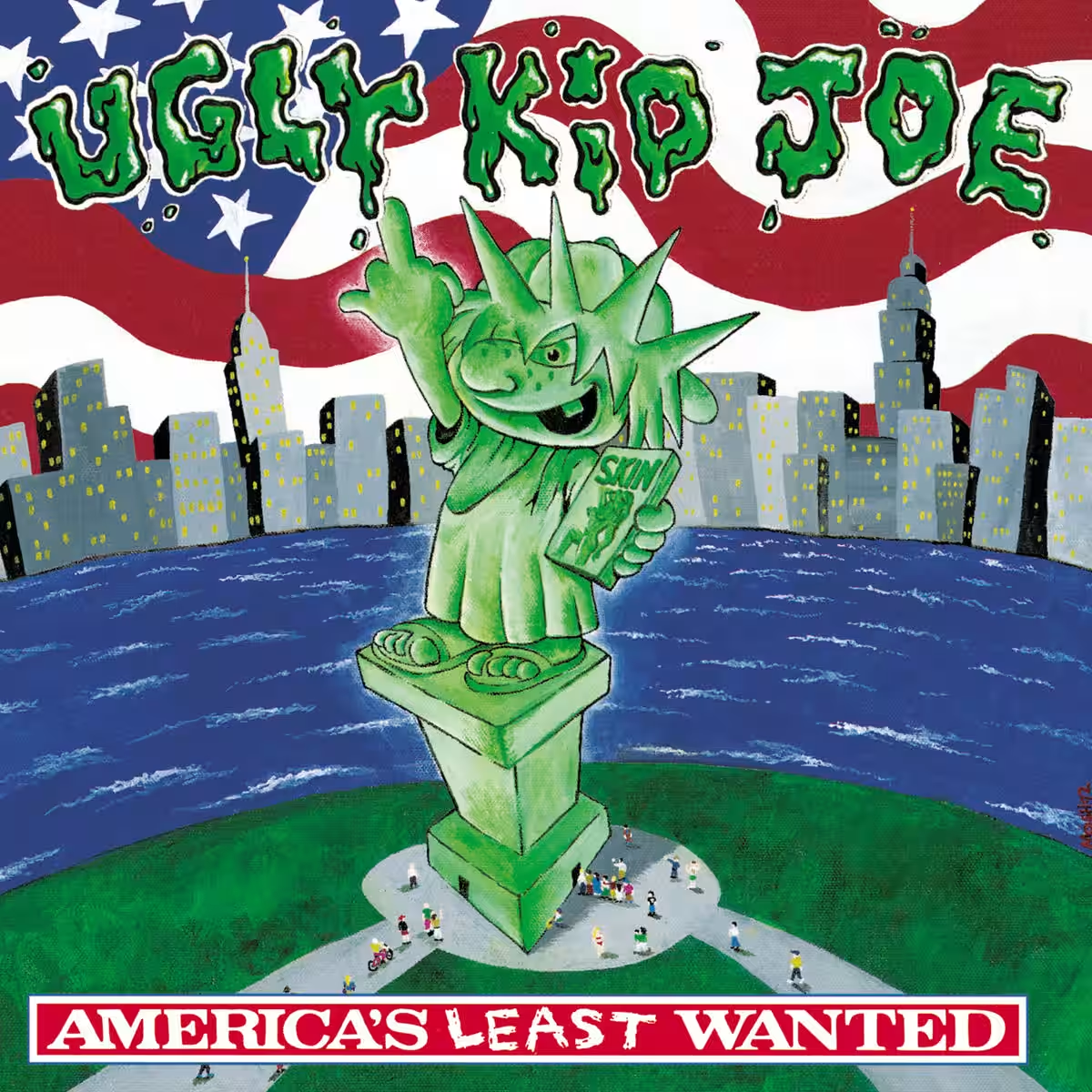
In the autumn of 1992, the rock world was being remade in flannel. Nirvana’s Nevermind had spent the previous winter rewriting the rulebook, Pearl Jam’s Ten was still climbing, and the major labels were quietly burying any band whose hairspray budget exceeded their songbook. Into that exact moment, four scruffy goofballs from a college town in California dropped a debut album with a cartoon brat flipping the bird on the cover and a Harry Chapin cover tucked between songs about freeloading housemates and the devil. America’s Least Wanted by Ugly Kid Joe had no business being the success it became, and that is precisely why it remains one of the most affectionately remembered hard rock records of the early nineties.
This is the full story of how a band that started as a one-off joke ended up double platinum, sharing stages with Ozzy and Def Leppard, and pulling Rob Halford into a vocal booth to scream like a demon.
The Album at a Glance
| Field | Detail |
|---|---|
| Artist | Ugly Kid Joe |
| Album | America’s Least Wanted |
| Release Date | 8 September 1992 |
| Label | Stardog / Mercury Records |
| Producer(s) | Mark Dodson and Ugly Kid Joe |
| Studio(s) | Sound City Studios (Van Nuys, California) and Devonshire Studios (North Hollywood, California) |
| Genre / Subgenre | Hard rock, funk metal, post-glam alternative metal |
| Track Count | 13 |
| Total Runtime | Approximately 51 minutes |
| Billboard 200 Peak | No. 27 |
| UK Albums Chart Peak | No. 11 |
| Other Notable Chart Peaks | Australia No. 8, Canada Top 20, Germany Top 30, Sweden Top 30 |
| Certifications | 2× Platinum (USA, RIAA), 2× Platinum (Australia, ARIA), Platinum (Canada), Gold (France, Switzerland, Austria) |
| Estimated Sales | Around 2.4 million copies worldwide reported in the mid-1990s; total exceeds three million by most modern estimates |
| Key Singles | “Everything About You” (re-promoted), “Neighbor”, “So Damn Cool”, “Cats in the Cradle”, “Busy Bee” |
Before the Album: How Ugly Kid Joe Even Happened
To understand why Americas Least Wanted felt like such an outlier, you need to understand how unlikely the band itself was. Ugly Kid Joe formed in 1989 in Isla Vista, the lively student enclave wedged against the University of California at Santa Barbara. The founding pair was vocalist Whitfield Crane and guitarist Klaus Eichstadt, two friends who started knocking around riffs without any clear ambition beyond beer money and party gigs. The name was a deliberate two-finger salute to Pretty Boy Floyd, a Sunset Strip glam outfit whose look and posturing the Isla Vista lads found ridiculous. Calling yourselves the ugly kid was a manifesto in three words.
The classic lineup that recorded America’s Least Wanted settled as Whitfield Crane on lead vocals, Klaus Eichstadt and Roger Lahr on guitars, Cordell Crockett on bass, and Mark Davis on drums. Dave Fortman would join later in the cycle as guitarist, eventually replacing Lahr and going on to a hugely successful production career with Evanescence, Mudvayne and Slipknot. Drummer Mark Davis would be replaced after this album by Shannon Larkin, later of Godsmack.
Their break did not come from grinding club tours. It came from a six-track EP. As Ugly As They Wanna Be, released in 1991 on Stardog, was meant to be a low-stakes calling card. Then “Everything About You” exploded. The song was written by Crane and Eichstadt as a sarcastic litany of small-minded irritations, the chorus essentially shouting “I hate everything about you” at every domineering parent, boss and traffic warden in suburban America. MTV played it relentlessly. It got a placement in Wayne’s World and resurfaced in Encino Man. The EP became, depending on which RIAA accounting you trust, the first EP ever to be certified double platinum in the United States, shifting more than two million copies on the strength of one chorus.
That is the momentum the band carried into the studio. They had a hit single, a fanbase, and a record label suddenly very interested in a full-length follow-up. The pressure to produce America’s Least Wanted was enormous, and the timeline was brutally tight.
Cultural Context: Landing Between Two Worlds
Pinpointing where Ugly Kid Joe America’s Least Wanted sat in 1992’s landscape is half the fun of revisiting it. By September of that year, Nirvana’s Nevermind had already knocked Michael Jackson off the top of the Billboard 200, Pearl Jam’s Ten had finally cracked the upper reaches, and Alice in Chains were prepping Dirt. Grunge was not just a sound, it was a wholesale rejection of the bands Ugly Kid Joe shared festival bills with.
At the same time, the older guard had not vanished. Def Leppard’s Adrenalize was a multi-platinum smash that spring. Bon Jovi were touring Keep the Faith. Guns N’ Roses were still digesting the Use Your Illusion twins. And funk metal had its own moment courtesy of Faith No More’s Angel Dust and the Red Hot Chili Peppers riding BloodSugarSexMagik.
Ugly Kid Joe slotted awkwardly into all of it. They were too funny and too funky for traditional metalheads, too riff-driven for the alternative crowd, and too irreverent for the earnest grunge faithful. What saved them was that the songs were tight, the vocals were charismatic, and the band genuinely did not care which scene they offended. That outsider stance, weirdly, made them the perfect band for a confused transitional moment.
Making America’s Least Wanted
The producer chair went to Mark Dodson, a name that mattered to the band well before the first session. Dodson had cut his teeth engineering for Judas Priest, working on Ram It Down and Painkiller, and he brought a metal sensibility to a band that wanted heaviness without losing the wink. The sessions were split principally between Sound City Studios in Van Nuys, the legendary Neve room where Fleetwood Mac’s Rumours and Nirvana’s Nevermind had been tracked, and Devonshire Studios in North Hollywood. Additional work happened at A&M and other Los Angeles facilities during overdubs and mixing.
Dodson’s brief, in interviews the band gave at the time, was straightforward. Capture the live energy that had made the EP work, but tighten the songwriting and broaden the sonic palette so the album would not feel like an extended joke. He pushed the band to record live in the room where possible, with Mark Davis’s drums and Cordell Crockett’s bass tracked together to keep the swing intact. Eichstadt and Lahr layered guitars after the rhythm beds were down, and Crane cut most vocals quickly, leaning into the loose, almost conversational delivery that defined his style.
The most-told studio story concerns “Goddamn Devil”. Mark Dodson called in a favour and got Rob Halford himself to come in and lay down the high, demonic vocal cackles that punctuate the song. The band were Judas Priest fans to a man. Halford, by all accounts, knocked out the parts in a single afternoon and left the band slightly star-struck. There were other guests too. Julia Sweeney, then a Saturday Night Live cast member best known as the androgynous character Pat, contributed spoken word. Stephen Perkins of Jane’s Addiction added percussion. Dean Pleasants, who would later join Suicidal Tendencies and Infectious Grooves, contributed additional guitars on certain cuts.
Sonically, the band wanted weight without losing the bounce. The guitars are denser than the EP, the bass sits higher in the mix to do funk metal duty, and the production has a clean nineties sheen that has actually aged better than a lot of its contemporaries. There is no obvious grunge influence. If anything, the touchstones are Aerosmith’s swing, Faith No More’s sense of mischief, and the kind of pre-grunge LA hard rock that bands like Mr. Big or Extreme had been making.
The Songs: A Track-by-Track Walk-Through
Here is the full America’s Least Wanted tracklist with credits and notes.
| # | Title | Writer(s) | Length | Single? | Notes |
|---|---|---|---|---|---|
| 1 | Neighbor | Crane / Eichstadt | 4:13 | Yes | Lead single, scathing portrait of the housemate from hell, opens the album with attitude |
| 2 | Goddamn Devil | Crane / Eichstadt / Lahr | 4:42 | No | Features Rob Halford on backing vocals, the album’s heaviest moment |
| 3 | Come Tomorrow | Crane / Eichstadt | 5:02 | No | Slower, swinging mid-tempo with a soulful chorus |
| 4 | Panhandlin’ Prince | Crane / Eichstadt / Crockett | 4:11 | No | Funk metal workout with Cordell Crockett’s bass front and centre |
| 5 | Busy Bee | Crane / Eichstadt | 3:51 | Yes | Released as a UK single in 1993, reached No. 39 on the UK Singles Chart |
| 6 | Don’t Go | Eric Phillips | 4:08 | No | An outside cut from songwriter Eric Phillips, gives the album a power-ballad heart |
| 7 | So Damn Cool | Crane / Eichstadt | 3:23 | Yes | Re-promoted from the EP, where it had been an early radio favourite |
| 8 | Same Side | Crane / Eichstadt / Crockett | 4:09 | No | Bouncy mid-album cut with a sing-along chorus |
| 9 | Cats in the Cradle | Harry Chapin / Sandy Chapin | 3:54 | Yes | The breakout cover, a US No. 6 and UK No. 7 hit |
| 10 | I’ll Keep Tryin’ | Alan Reed | 4:17 | No | Another outside song, melodic and earnest |
| 11 | Everything About You | Crane / Eichstadt / Whitey | 4:20 | Yes | The breakthrough hit, originally on the EP, included for new listeners |
| 12 | Madman (’92 Remix) | Crane / Eichstadt | 4:55 | No | A heavier remix of an EP track, repositioned for the album |
| 13 | Mr. Recordman | Crane / Eichstadt | 3:35 | No | A sneering closer aimed squarely at the music industry |
The opening one-two punch is no accident. “Neighbor” introduces the album’s worldview, comic outrage delivered with a slacker grin, while “Goddamn Devil” plants a flag about the band’s heaviness with that Halford-assisted chorus. From there the album wanders pleasingly. “Panhandlin’ Prince” leans into the funk metal lineage of the moment, Crockett’s bass syncopating against Davis’s drums in a way that owes something to Faith No More and something to early Extreme.
“Busy Bee” deserves more credit than it usually gets. It was an actual hit single in several territories, a proper hooky alt-rock song with a riff that sticks immediately. “Don’t Go” and “I’ll Keep Tryin'” are the album’s softer flank, both written by outside contributors, and they were a deliberate choice to give the record dynamic range and broaden its potential audience.
Then there is “Cats in the Cradle”. Picking the Harry Chapin classic was Whitfield Crane’s idea. The band were nervous about the whole concept, conscious of how easily it could come across as either disrespectful or cloyingly sincere. Their solution was to play it almost completely straight, just slightly heavier, with Crane delivering the verses with surprising tenderness. Sandy Chapin, Harry’s widow and co-writer of the song, gave her blessing to the cover, and proceeds from the single contributed to the Harry Chapin Foundation. It became, to nearly everyone’s surprise, the biggest hit of the album.
The record closes with “Mr. Recordman”, a snarky shot at the music business that, listened to today, sounds almost prophetic given how the band’s relationship with Mercury would unravel by the mid-nineties.
The Artwork: A Rude Cartoon and a Lawsuit That Never Came
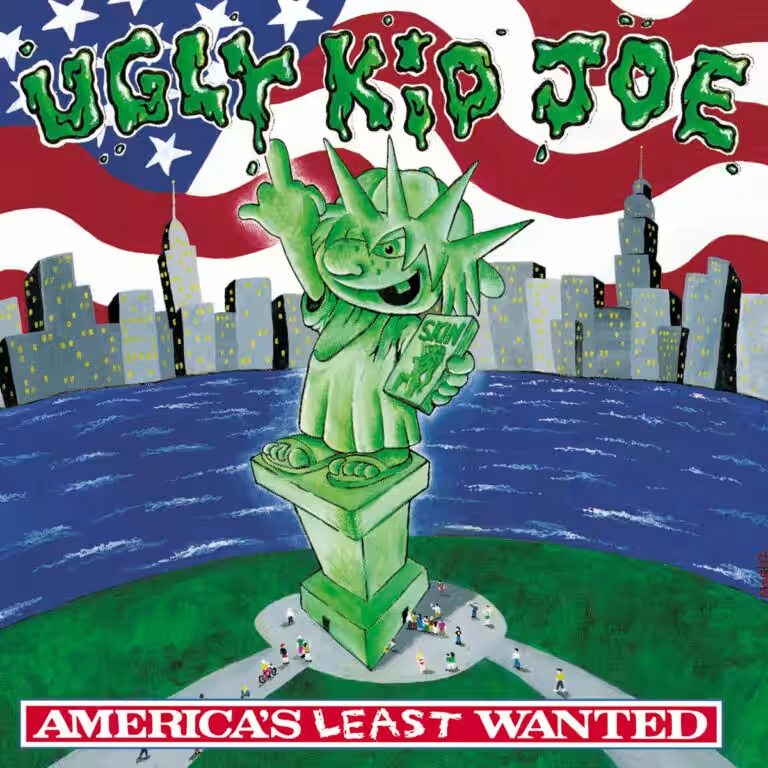
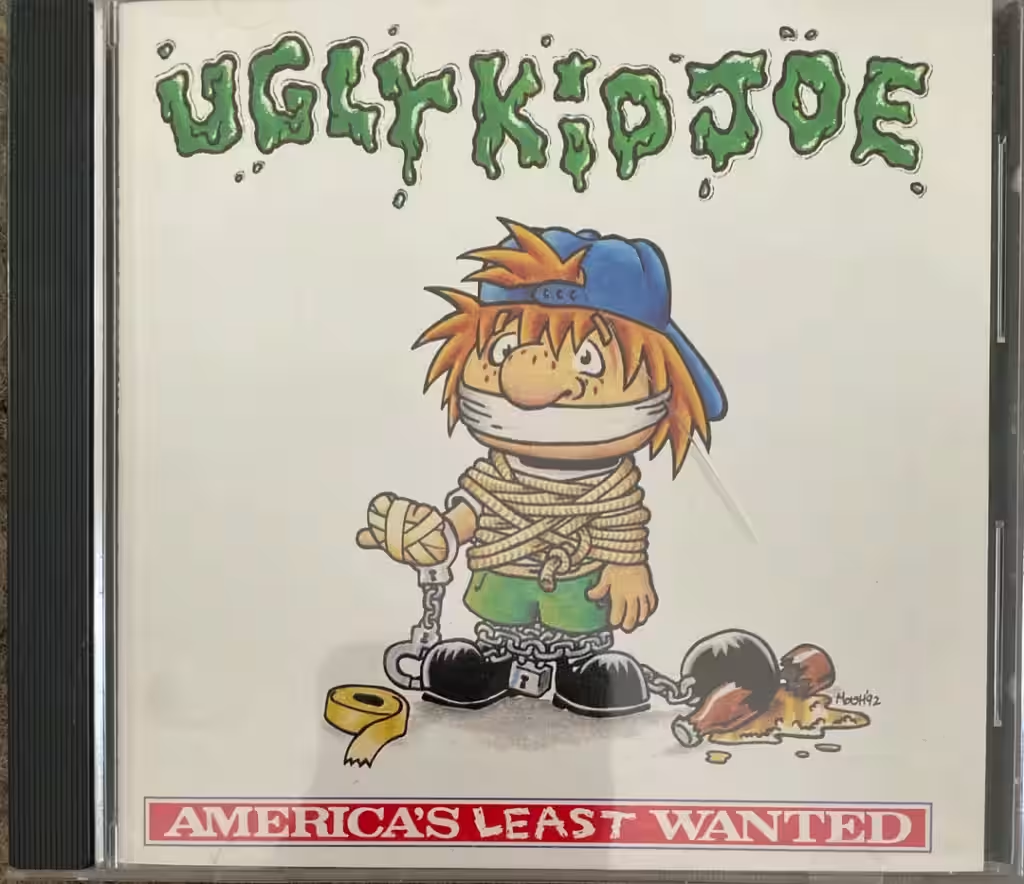
The cover of Americas Least Wanted is an instantly recognisable thing. A grinning, gap-toothed, freckled cartoon kid in a backwards baseball cap, raising his middle finger straight at the buyer. The character had already appeared on the As Ugly As They Wanna Be EP and effectively functioned as the band’s mascot. He was created by artist Mo Brennan, who would continue to design Ugly Kid Joe imagery throughout their original run.
The visual is a clear, deliberate echo of Alfred E. Neuman, the Mad magazine mascot, with the same idiot-savant grin and freckled cheek. EC Publications, the publisher of Mad, never pursued legal action, perhaps because the differences in the figure’s design were just enough to dodge a clear infringement claim, perhaps because suing a band whose entire selling point was being annoying would have been a brand mismatch.
Different territories handled the cover differently. Some pressings, particularly those bound for retail chains uncomfortable with the raised middle finger, swapped the gesture or pixelated it. The Australian release, conversely, leaned into the album’s Antipodean appeal with a sticker celebrating its platinum status. The visual identity tied the EP and the album together neatly, and the cartoon kid became almost as recognisable as any of the band members themselves.
Singles, Music Videos and Radio
The single campaign for America’s Least Wanted was carefully sequenced to maximise the Ugly Kid Joe brand the EP had built.
“Neighbor” went first as the lead single in late summer 1992. It hit No. 29 on the US Mainstream Rock Tracks chart and No. 28 on the UK Singles Chart, a respectable but not earth-shattering opening. The video introduced the band to MTV viewers who had only known them as a one-song novelty.
“Everything About You” was effectively re-promoted off the album in some territories, which is why its chart entries straddle 1991 and 1992. At its peak it reached No. 9 on the Billboard Hot 100 and a remarkable No. 3 on the UK Singles Chart, making it the band’s calling card in Britain.
“So Damn Cool” received a fresh push as an album single in the United States, leaning on the rock radio audience.
The genuine moment came with “Cats in the Cradle”, released as a single in early 1993. The video was directed by Matt Mahurin, the celebrated visual artist whose work for U2, Metallica, REM and Sting helped define the look of MTV’s golden age. Mahurin’s video for “Cats in the Cradle” took the song’s themes seriously, weaving images of fathers and sons and absent presence rather than playing the band for laughs. The single peaked at No. 6 on the Billboard Hot 100 and No. 7 on the UK Singles Chart, and went Top 10 in multiple European territories.
“Busy Bee” rounded out the campaign in the UK and parts of Europe in 1993, reaching No. 39 on the UK Singles Chart and No. 22 on the US Mainstream Rock Tracks chart.
Across the cycle, the videos all leaned on the band’s natural irreverence, except for “Cats in the Cradle”, whose tonal shift was probably the clincher in convincing sceptical critics that there was more to Ugly Kid Joe than the cartoon mascot suggested.
Release & Reception
When America’s Least Wanted dropped on 8 September 1992, the critical response was, predictably, mixed. AllMusic later assessed the record kindly, praising its “fizzy, fuzzy riffs, sing-song melodies, and calculated obnoxiousness” while warning that listeners with a low tolerance for the band’s brand of humour might find it wearing. Entertainment Weekly was less generous, scoring it 43 out of 100 with the brutal sign-off that “these kids should have quit while they were ahead”. The British press, traditionally fond of underdogs and outliers, was warmer. Kerrang! and Metal Hammer both gave the album substantial coverage, and the band’s appearance on the cover of Kerrang! became one of the iconic UK rock magazine covers of the year.
The chart performance told the more important story. America’s Least Wanted entered the Billboard 200 strongly and peaked at No. 27. In the UK it reached No. 11 on the Albums Chart, in Australia it climbed to No. 8, and it placed inside the Top 30 in Canada, Germany and Sweden. The RIAA certified it 2× Platinum in the United States, the ARIA certified it 2× Platinum in Australia for shipments above 140,000 copies, and Music Canada awarded a Platinum disc for sales above 100,000. France, Switzerland and Austria all certified it Gold. Industry estimates from the mid-nineties put worldwide sales at around 2.4 million copies in just six tracked countries; the true global figure is comfortably north of three million by most modern reckoning.
The perception of the album shifted over time. On release, plenty of critics treated it as a light comedic novelty trying to catch the last train out of the hair metal era. Two decades on, it gets reappraised more often as a smartly written, well-produced hard rock record that simply happened to land in the worst possible commercial moment for everything it sounded like. Modern aggregator scores from places like Album of the Year sit in the 65 to 70 range, which is roughly where it deserved to be all along.
Touring: Between Hair Metal Sunset and Grunge Sunrise
The touring story behind Ugly Kid Joe Americas Least Wanted is genuinely impressive, because the band kept getting handed support slots that no rational A&R department would have predicted. Through 1992 and 1993 they opened for Def Leppard on portions of the Adrenalize world tour, an arena-level slot that put them in front of audiences five times the size of any club they had headlined. They opened for Ozzy Osbourne on the original No More Tours run, his self-styled retirement trek, exposing them to the metal core they were not always sure they were aiming for. They picked up European dates supporting Van Halen during the For Unlawful Carnal Knowledge and Right Here, Right Now live era. And they slotted into festival bills across Europe, including Donington’s Monsters of Rock undercards.
When they headlined themselves, it was theatre and large club tours through the UK, mainland Europe, North America, Japan and Australia. Australian crowds in particular took to the band, helping push the album to its double-platinum status there. They appeared on television regularly, including Saturday Night Live, The Tonight Show, and a memorable run of British TV including Top of the Pops. Their live show was loose, funny and surprisingly heavy, with Crane’s frontman charisma and Eichstadt’s riffing carrying the night.
In TV, Film and Wider Media
The album’s afterlife in syncs has been generous. “Everything About You” remains one of the most licensed early-nineties rock tracks, having appeared in Wayne’s World and Encino Man in 1992, then resurfacing in films and television regularly across the following decades. It has popped up on shows including The Goldbergs and in trailers for nostalgia-driven nineties programming.
“Cats in the Cradle” took on a second life as a go-to soundtrack cue for any drama wanting an instantly recognisable shorthand for father-son estrangement. The Ugly Kid Joe version, specifically, has been used in television dramas, documentaries and adverts because it carries both the original song’s emotional weight and a slightly grungier sonic profile that suits a nineties setting.
Ugly Kid Joe themselves were ubiquitous on MTV during the album’s cycle. Beavis and Butthead reviewed the “Neighbor” video on their show, with predictable results, mocking the band’s name and look while being grudgingly entertained by the song. That kind of cross-pollination was the dominant currency of nineties American rock, and Ugly Kid Joe were on the right side of it.
Things You Might Not Know About America’s Least Wanted
| # | Fact |
|---|---|
| 1 | The band’s name is a direct, deliberate parody of Pretty Boy Floyd, the LA glam metal band, and was originally meant as a one-off joke before “Everything About You” forced it to become a real band |
| 2 | Rob Halford recorded his vocals for “Goddamn Devil” in a single afternoon as a personal favour to producer Mark Dodson, who had engineered Judas Priest’s Painkiller and Ram It Down |
| 3 | The freckled, middle-finger-flipping mascot on the cover, drawn by Mo Brennan, narrowly avoided a Mad magazine lawsuit despite its obvious Alfred E. Neuman lineage; some retail pressings censored or altered the rude gesture |
| 4 | Sandy Chapin, Harry Chapin’s widow and co-writer of “Cats in the Cradle”, personally approved Ugly Kid Joe’s cover, and proceeds from the single supported the Harry Chapin Foundation’s anti-hunger work |
| 5 | Julia Sweeney, then a Saturday Night Live cast member best known as the character Pat, contributed spoken word to the album, an unusual cameo that almost no review at the time mentioned |
| 6 | The preceding As Ugly As They Wanna Be EP is widely credited as the first EP in history to be certified double platinum in the United States, a record that propelled the deal for America’s Least Wanted |
| 7 | Stephen Perkins of Jane’s Addiction added percussion to the album, a guest appearance that reflected the cross-pollination of LA’s late eighties and early nineties alternative scenes |
| 8 | Dave Fortman, who joined the band’s touring lineup in this era, would go on to produce platinum records for Evanescence, Mudvayne and Slipknot, including Fallen and All Hope Is Gone |
| 9 | Drummer Mark Davis was replaced shortly after the album cycle by Shannon Larkin, who decades later would become the long-serving drummer for Godsmack |
| 10 | The cover was recorded at Sound City Studios on the same Neve console that had previously captured Fleetwood Mac’s Rumours and Nirvana’s Nevermind, an unlikely sonic ancestry for a record this irreverent |
| 11 | The album’s closing track “Mr. Recordman” is a barely-veiled attack on the music industry, written before the band’s relationship with Mercury Records soured during the underperforming follow-up Menace to Sobriety |
| 12 | Whitfield Crane briefly joined Anthrax as a touring vocalist after Ugly Kid Joe’s first split in 1997, making him one of very few singers to have fronted both bands |
Legacy & Influence: What Happened Next
The story of America’s Least Wanted does not have a tidy victorious ending, which is part of why fans remain so attached to it. The band followed up in 1995 with Menace to Sobriety, a heavier, more ambitious record that sold a fraction of the debut. By 1996’s Motel California the wheels were coming off, and Mercury parted ways with the band shortly thereafter. They officially split in 1997, with members scattering to other projects: Whitfield Crane briefly fronted Medication and toured with Anthrax, Dave Fortman moved into production, Klaus Eichstadt continued writing and playing, and Cordell Crockett took session work.
Ugly Kid Joe reunited in 2010 for a series of European festival shows. The chemistry was clearly intact, and they have since released the Stairway to Hell EP in 2012, the album Uglier Than They Used Ta Be in 2015, and Rad Wings of Destiny in 2022. The reunion era has been genuinely fruitful and has reframed the original albums as the start of a longer arc rather than a brief flash.
The influence of Ugly Kid Joe America’s Least Wanted on subsequent acts is real if often unspoken. The blend of riff, melody and humour that the band championed was picked up by everyone from Bowling for Soup to Buckcherry to, in a slightly different form, the early Foo Fighters records. The album is a frequent reference point in nineties nostalgia podcasts, listicles and YouTube retrospectives, and “Everything About You” and “Cats in the Cradle” have only grown in cultural footprint as the streaming era has surfaced them to entirely new generations.
If grunge was the great commercial story of 1992, America’s Least Wanted is one of the more interesting subplots: a record that should not have worked, a band that should have been swept aside, and an album that has steadily refused to disappear. Its modest critical standing on release has slowly flipped into something closer to affectionate respect, helped by streaming numbers that prove the songs themselves have aged perfectly fine.
Why America’s Least Wanted Still Matters
Strip away the cartoon kid, the middle finger, the Wayne’s World placement and the Halford cameo and you are left with a debut album that does the basic job extremely well. It has hits. It has deep cuts that hold up. It has a clear personality. It has a producer who knew how to translate live energy onto tape. It has a closing run, from “Cats in the Cradle” through “Mr. Recordman”, that genuinely surprises a first-time listener. It captures a band on the precise edge of becoming something bigger and never quite stepping over.
For the hosts of this week’s Riffology, the joy of revisiting America’s Least Wanted is going to be in those small moments. The way Crockett’s bass walks under the verses of “Panhandlin’ Prince”. The Halford howl in the “Goddamn Devil” chorus. The unexpected gentleness of the “Cats in the Cradle” cover. The cheek of putting “Everything About You” eleven tracks in, like a band that knows you will get there eventually.
Listen to the Riffology Podcast on America’s Least Wanted
If this has whetted your appetite, the full Riffology episode unpicks America’s Least Wanted by Ugly Kid Joe track by track, with the kind of digressions, arguments and obscure trivia that only a podcast about a single album per week can really indulge. You will hear the hosts wrestle with where this record sits in the 1992 landscape, why “Cats in the Cradle” works as well as it does, and whether the cartoon mascot is a stroke of genius or the reason the band were never taken as seriously as the songs deserved. The Riffology podcast is available on Apple Podcasts, Spotify, Amazon Music, Pocket Casts and every other major platform. Hit follow, settle in, and join the conversation.
About the Author