Picture a man in Erie, Pennsylvania. He has fallen asleep and woken up moments later with four words ringing in his head: “back in the atmosphere.” His mother has been dead for roughly a year. He is in a failing marriage. He is on the road more than he is home. And in the time it takes most people to boil a kettle, he writes the song that will define Train’s career, win two Grammy Awards, and earn RIAA Diamond certification for over ten million sales and streams. That song is “Drops of Jupiter (Tell Me),” and the album it anchors, Drops of Jupiter, released on 27 March 2001, is one of the most commercially successful rock records of the early 2000s. This is the complete story of how it got made, what it sounded like, and why it still resonates more than two decades on.
Album Facts: Drops of Jupiter by Train
| Field | Detail |
|---|---|
| Artist | Train |
| Album | Drops of Jupiter |
| Release Date | 27 March 2001 |
| Label | Columbia Records |
| Producer(s) | Brendan O’Brien |
| Studio(s) | Southern Tracks Recording, Atlanta, Georgia (main recording); Capitol Studios, Hollywood, CA (string arrangements for “Drops of Jupiter (Tell Me)”); Ocean Way Nashville (string arrangements for “Something More”) |
| Genre / Subgenre | Pop rock / Roots rock / Adult alternative |
| Track Count | 11 (standard edition); 20th Anniversary Edition adds 6 bonus tracks |
| Total Runtime | 48:29 (standard edition) |
| Billboard 200 Peak | #6 |
| UK Albums Chart Peak | #8 |
| Other Notable Chart Peaks | Australia #3 (ARIA); Netherlands #3; Scotland #3; Norway #9; UK Rock & Metal Albums #1 |
| Certifications | US 3x Platinum (RIAA); Canada 2x Platinum; Australia 4x Platinum; UK Gold |
| Estimated Sales | Over 3 million in the US alone; band has sold over 10 million albums worldwide across their catalogue |
| Key Singles | “Drops of Jupiter (Tell Me)” (US #5), “Something More”, “She’s on Fire” |
The Band Before the Storm: Train Up to 2001
The story of Train is, at its core, the story of two guys who refused to give up. Pat Monahan grew up in Erie, Pennsylvania, where he fronted a Led Zeppelin cover band called Rogues Gallery. Restless and ambitious, he moved to California in late 1993 and landed in San Francisco, where he crossed paths with Rob Hotchkiss, a Berklee College of Music alumnus who was playing the coffeehouse circuit. Their early configuration was essentially a duo, with Hotchkiss on guitar and harmonica and Monahan on a modified conga attached to a kick-drum pedal, playing covers and originals wherever they could get a gig.
They wanted to go bigger. Hotchkiss had previously been the lead singer of the L.A.-based Apostles, and he knew two of his former bandmates were available: Jimmy Stafford, a gifted lead guitarist who also played mandolin, and Charlie Colin on bass. Scott Underwood, who had been drumming with Colin, came along too. By 1994 the full five-piece lineup of Train was locked in, and the city of San Francisco had a new band to adopt.
Getting a record deal was harder than it should have been. The band pressed an independent self-titled debut in 1996 and toured relentlessly, opening for Barenaked Ladies, Hootie & the Blowfish, Counting Crows, and Blues Traveler. Columbia Records had actually passed on signing them in 1996, an early rejection that would look fairly embarrassing in hindsight. A year later, they caught the attention of Aware Records, a smaller label with a track record for nurturing bands like the Dave Matthews Band and Hootie & the Blowfish. Aware struck a deal that ran through Columbia and Sony, and in February 1998 the band re-released their debut under the Aware/Columbia banner.
That reissued self-titled album peaked at number 76 on the Billboard 200 and eventually went platinum on the back of “Meet Virginia,” a roots-rock radio staple that hit number 20 on the Hot 100 in October 1999 and spent 27 weeks on the chart. It was a solid start. But by 2000, with no follow-up hit materialising, Train were starting to look like a one-album act, the kind of band that provides a familiar song for mid-2000s nostalgia playlists but never quite escapes the gravitational pull of their debut. Columbia’s president, Donnie Ienner, was pushing for something bigger. What came next was beyond anyone’s expectations.
Creating Drops of Jupiter: Grief, Dreams, and a Georgian Producer
The dream that started everything
Monahan has been remarkably candid about the emotional conditions that produced Drops of Jupiter. He was stretched thin, travelling constantly, in a difficult marriage, and had been watching his mother deteriorate from cancer on tour. He would stop at payphones backstage to call her. She died in December 1998, and by early 1999 Train were under serious label pressure to deliver new material. Monahan had moved his family back to Erie in an attempt to salvage his home life, and it was there, falling asleep one night, that the song arrived.
“I fell asleep and woke up and it was like my mom tapped on the shoulder, and she was like, ‘Let’s go. I’ve got it for you,'” Monahan told GRAMMY.com in 2021. He wrote the song in roughly fifteen minutes. When he played Donnie Ienner a demo in New York, the Columbia president’s reaction was immediate and emphatic: this was the Grammy song.
Almost Famous, Paul Buckmaster, and Chuck Leavell
Ienner’s instinct pointed him straight to a specific sonic reference. Cameron Crowe’s film Almost Famous had just opened to widespread acclaim in September 2000, and its soundtrack was a love letter to the grand, string-drenched rock of the 1970s. Audiences were rediscovering Elton John’s orchestral sweep and the warmth of that era’s production. Ienner saw the connection immediately: “Drops of Jupiter” needed Paul Buckmaster.
Buckmaster was one of the most respected string arrangers in rock history, having worked with Elton John, David Bowie, and the Rolling Stones. Bringing him in to orchestrate a song by a San Francisco pop-rock band was not an obvious move, but it was the right one. The cascading string arrangement he built around Monahan’s vocal is the song’s emotional backbone. Buckmaster recorded the strings at Capitol Studios in Hollywood.
Then came a fortuitous coincidence of geography. Brendan O’Brien, the album’s producer, is a native of Georgia. So is Chuck Leavell, the pianist who spent decades as the Rolling Stones’ touring and session keyboardist and who had been a founding member of the Allman Brothers Band’s extended family. O’Brien made the introduction, and Leavell came in to play piano on “Drops of Jupiter.” It is his percussive, bouncing touch on the keys that gives the song its momentum beneath the strings, a detail that rewards close listening.
Working with Brendan O’Brien
O’Brien’s involvement with Train had begun after he heard the band’s cover of Led Zeppelin’s “Ramble On” on the radio and was impressed enough to seek them out. He went on to produce three consecutive Train albums, beginning with the re-released debut. His pedigree was hard rock royalty: he had produced Pearl Jam’s Vs. and Vitalogy, Stone Temple Pilots’ Core, and Bruce Springsteen’s The Rising, among many others. For Train, his value was in keeping the sound raw and honest, generous with mandolin, harmonica, acoustic guitars, and slide, but never so precious that the band’s loose, Southern-inflected energy got squeezed out.
The main body of the album was recorded at Southern Tracks Recording in Atlanta, Georgia between January and March 2001. Mastering was handled by Bob Ludwig at Gateway Mastering in Portland, Maine. The title track’s orchestral elements were layered in separately at Capitol Studios in Los Angeles, while string arrangements for “Something More” were recorded at Ocean Way Nashville, giving different songs their own textural character.
Monahan told Billboard that recording the title track itself was “fucking awesome.” He felt he probably sang it eight times and had it nailed. The real work had been the writing and the demo. Once they had Buckmaster and Leavell locked in, the session was more celebration than struggle.
The Songs: A Walk Through Drops of Jupiter
Drops of Jupiter opens at full throttle and gradually peels back to its most contemplative corners. The sequencing matters: the album earns its quieter moments because it hasn’t been quiet for long enough.
Tracklist
| # | Title | Writer(s) | Length | Single? | Notes |
|---|---|---|---|---|---|
| 1 | She’s on Fire | Train | 3:28 | Yes (third single, Feb 2002) | Hard-rocking opener; Adult Top 40 airplay |
| 2 | I Wish You Would | Train | 4:27 | No | Features bongos; fan favourite deep cut |
| 3 | Drops of Jupiter (Tell Me) | Train | 4:21 | Yes (lead single, Jan 2001) | 5x Grammy nominated, 2x Grammy winner; RIAA Diamond |
| 4 | It’s About You | Train | 4:29 | No | Midtempo pop-rock; album standout |
| 5 | Hopeless | Train | 4:33 | No | One of the album’s strongest melodic cuts |
| 6 | Respect | Train | 3:26 | No | Previously appeared on the Dawson’s Creek soundtrack (Songs From Dawson’s Creek Vol. II, 2000) |
| 7 | Let It Roll | Train | 5:02 | No | Features slide guitar; praised by Rolling Stone |
| 8 | Something More | Train | 4:41 | Yes (second single, Oct 2001) | Music video shelved after 9/11; Adult Top 40 success |
| 9 | Whipping Boy | Train | 4:28 | No | Darker in tone; one of the album’s harder-edged moments |
| 10 | Getaway | Train | 4:28 | No | Melodic summer-evening feel; fan favourite |
| 11 | Mississippi | Train | 5:07 | No | Closing epic; tribute to Jeff Buckley; features saxophone |
20th Anniversary Edition bonus tracks (2021):
| # | Title | Length | Notes |
|---|---|---|---|
| 12 | Sweet Rain | 5:20 | Previously unreleased |
| 13 | It’s Love | 4:21 | B-side; appeared on European single |
| 14 | This Is Not Your Life | 5:02 | B-side |
| 15 | Ramble On (acoustic) | 4:40 | Led Zeppelin cover; the cover that got O’Brien’s attention |
| 16 | Sharks | 3:34 | B-side |
| 17 | Drops of Jupiter (live at The Warfield, San Francisco, May 2001) | 4:43 | From the Midnight Moon concert |
Song by song
She’s on Fire kicks the album off at a pace that makes a statement: whatever else this record might be, it is not timid. Crunching guitars, a snare that cracks like a starting pistol, and Monahan in full-throated mode. It would eventually become the third single from the album, achieving modest chart success, but its primary function is to announce the band’s presence.
I Wish You Would is a looser, more relaxed affair, with bongos and acoustic guitar in conversation and Monahan’s voice stretching out across a spacious midtempo groove. It has become a genuine fan favourite precisely because it does not announce its ambitions. It just plays beautifully.
Drops of Jupiter (Tell Me) is, of course, the album’s centrepiece and the reason we are all here. Written in fifteen minutes from a dream, inspired by the death of Monahan’s mother, adorned with Buckmaster’s strings and Leavell’s piano, the song took roughly five months to reach its peak on the Billboard Hot 100 and a full 49 weeks to crack the Adult Contemporary top ten. When Monahan got up to accept the Grammy for Best Rock Song in February 2002, he thanked his mother. There was not a more appropriate award acceptance speech that night.
The lyrics deserve a moment. The song works on at least two levels simultaneously. On the surface it reads as a tender interrogation of a woman who has left to find herself: “Did you sail across the sun? / Did you make it to the Milky Way?” But Monahan wrote it as a conversation with his dead mother, imagining her journey through the cosmos after death. The bridge with its “deep-fried chicken” and “best soy latte you ever had” lines was reportedly seen by some at the label as insufficiently masculine. Monahan ignored that feedback, and those grounded, everyday images are precisely what stop the song from floating away into abstraction.
It’s About You and Hopeless occupy the album’s midsection with a slightly more introspective energy. Both sit in that space between pop hook and emotional honesty that Train navigated better than most of their contemporaries.
Respect, which preceded the album by appearing on the Songs From Dawson’s Creek Vol. II soundtrack in 2000, was a smart piece of marketing strategy dressed up as a deep cut. It holds its own on the album proper.
Let It Roll is the song Rolling Stone highlighted in their review for its mournful slide guitars and loose rhythmic feel, a Southern rock influence that Monahan absorbed from years on the road listening to acts like Jeff Buckley and the Allman Brothers. It is one of the album’s most sonically satisfying tracks and one of its most underrated.
Something More carries a weight of personal regret. “The entire album, and the following album too, is apologies,” Monahan told Apple Music. “Thinking that if I just went home, that maybe my life would be good, maybe my marriage would be good and everything would be happy.” It was planned as the second single from the album, a rollout that was derailed entirely by September 11, 2001.
Getaway has a warmth and ease that feels like a summer evening running out of light, one of those album tracks that never gets the credit it deserves for keeping the emotional temperature consistent.
Mississippi, the closing track, runs just over five minutes and is the most musically ambitious thing on the record. Monahan has explained that it is a tribute to Jeff Buckley, who drowned in the Mississippi River in May 1997 while preparing to record his second album. “At the time that we were touring that first album, we were listening to a lot of Jeff Buckley’s Grace,” Monahan told Apple Music. “That song is like a love song about the fact that such a beautiful artist was lost in a beautiful river. It was a tragedy.” The track features saxophone alongside the usual guitar-and-mandolin palette, giving it an almost cinematic quality that makes it an unexpectedly powerful closer.
Album Artwork and Packaging
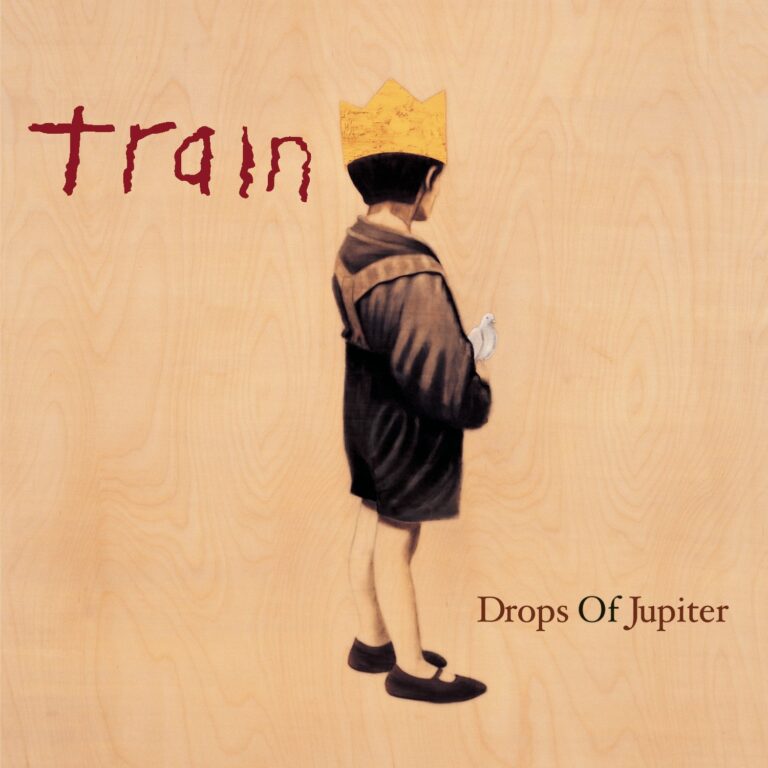
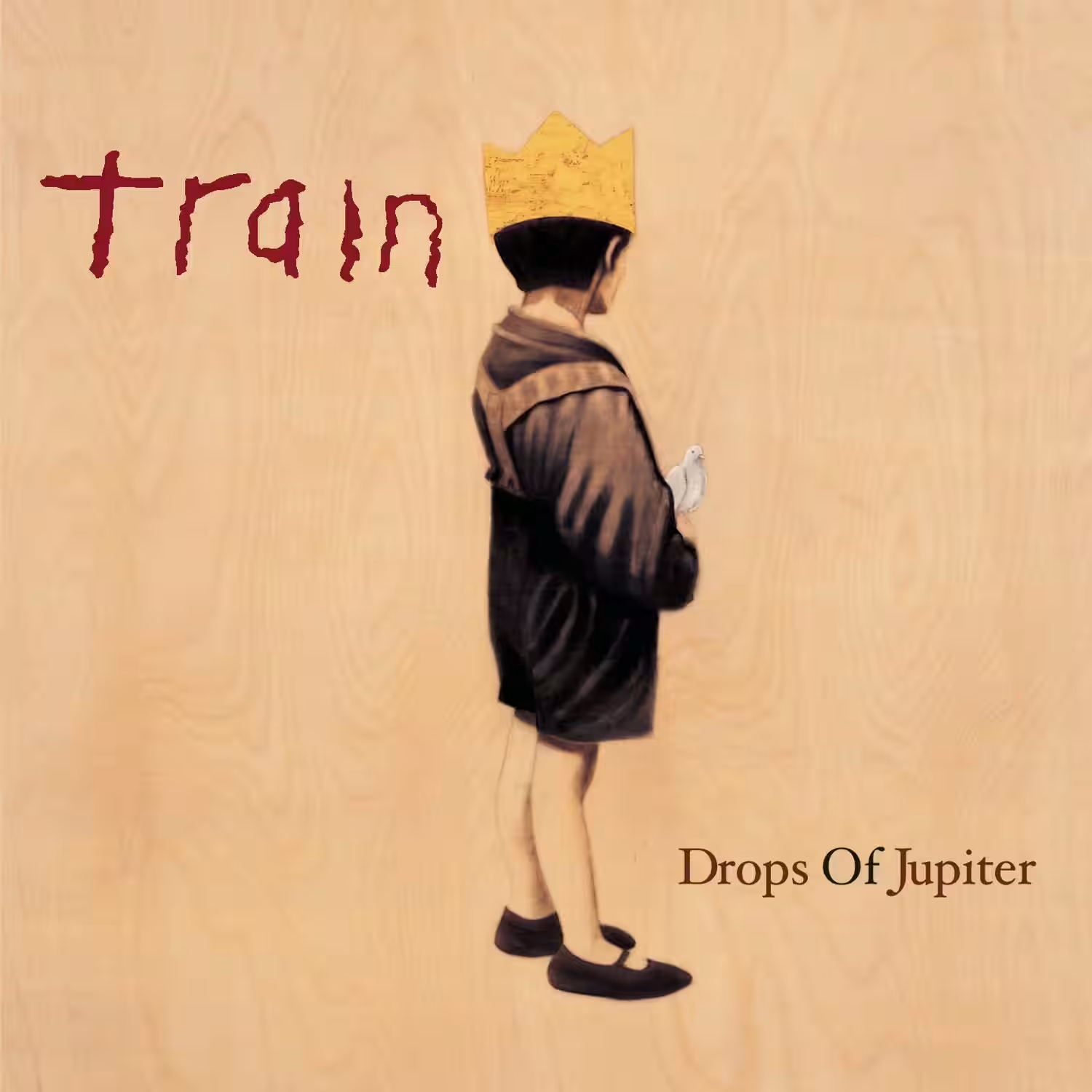
The cover of Drops of Jupiter takes a more humanising approach than the title might suggest. Rather than a cosmic image of the planet itself, the artwork features a young boy seen almost from behind, holding a dove and wearing a paper crown. It is an oddly tender image, quiet and slightly melancholy, that in retrospect fits the album’s emotional register well. This is a record built around grief, longing, and questions directed at someone who is no longer there; a child-like figure with his back turned, clutching something fragile, is not an inappropriate cover for that.
No art director or photographer credit has been widely documented in publicly available sources. The 20th Anniversary Edition, released on 26 March 2021, was made available as a bronze-coloured vinyl pressing alongside a digital edition with six bonus tracks; detailed packaging information for the anniversary editions has not been extensively documented in mainstream sources.
The 9/11 Effect: How a Terrorist Attack Reshaped the Album Cycle
This deserves its own section because it had a significant impact on how the album was experienced commercially. The planned second single from Drops of Jupiter was “Something More.” Train had already shot a music video for it, one that featured Monahan climbing up the exterior of a high-rise building. On 11 September 2001, that video became unreleasable overnight.
“We shot a music video for it where I was climbing up a skyscraper and 9/11 happened and everything changed,” Monahan told GRAMMY.com in 2021. “So we went to ‘She’s on Fire,’ but it was years. It seemed like two years after ‘Drops of Jupiter.'”
The practical effect was a significant gap in the promotional cycle at the precise moment when momentum from the title track was beginning to ebb. “Something More” was eventually released to radio in October 2001, without a video, and performed modestly on the Adult Top 40. “She’s on Fire” came out as the third single in February 2002, by which point the album had been out for almost a year. The title track had been so dominant, so all-consuming, that recovering a normal singles campaign from under its shadow proved almost impossible. As Monahan put it, sometimes a song can be so big that it consumes the entire album.
Singles and Music Videos
“Drops of Jupiter (Tell Me)” (January 2001)
The lead single was released on 29 January 2001 (some sources cite 20 February; dates vary slightly depending on region and format). It entered the Billboard Hot 100 in March 2001 and reached its peak of number five on 23 June 2001, spending 29 consecutive weeks in the Top 40. On the Adult Contemporary chart it was even more remarkable, ascending to the top ten in its 49th week on the chart, the longest climb to the top ten by any act in that chart’s history to that point, and remaining on the ranking for a total of 54 weeks. In the UK it debuted and peaked at number ten on 5 August 2001.
Two music videos were made. The first is a performance clip intercut with imagery of a woman in various locations reflecting the song’s celestial lyrics. The second, more widely remembered version was directed by Nigel Dick and filmed at Union Station in Los Angeles. It shows the band performing on a stage backed by a full string ensemble, as audience members gradually accumulate around them. A narrative subplot involving a runaway girl who returns home upon hearing the song was filmed but cut during editing, a detail that adds a layer of creative history to what became one of the defining music videos of 2001.
The song has since been certified RIAA Diamond, reflecting over ten million sales and streams in the United States alone. In the UK it has reached triple platinum certification from the BPI.
“Something More” (October 2001)
See the section above regarding the 9/11 impact. Released without its intended video, “Something More” achieved moderate Adult Top 40 chart performance. It is the more introspective of the singles, and in a different timeline, with its original video and a normal release schedule, it might have performed considerably better.
“She’s on Fire” (February 2002)
The album’s most direct rock track arrived as a single nearly a year after the parent album’s release. It achieved moderate chart success in Australia and the UK, giving the album a late push in those markets. By the time it was released, the Drops of Jupiter cycle was winding down, and the single largely served to remind casual listeners that the album contained more than one song.
Release and Reception: Beloved, Scorned, and Eventually Vindicated
Drops of Jupiter debuted at number six on the Billboard 200 upon its release in March 2001, a strong opening for a band whose previous album had peaked at 76. Internationally it reached number three in both Australia and the Netherlands, number three on the Scottish Albums chart, and number nine in Norway. In the UK it peaked at number eight and spent time at number one on the UK Rock and Metal Albums chart.
Critical reception was another matter. The album received a Metacritic aggregate score of 60 out of 100, which is the polite way of saying reviewers were divided. AllMusic’s Mark Morgenstein offered a two-and-a-half-star review and described Train as “a classic rock wannabe band in the mould of Counting Crows, although that’s not always a bad thing.” Billboard’s review was blunter, suggesting the music failed to gain momentum until the seventh track and expressing hope that if Train got a third album they would fill it with “clearly discernible songs.” Drowned in Sound gave it four out of ten. Entertainment Weekly awarded a C+. Robert Christgau at the Village Voice gave it a C-.
The more generous notices came from critics who were willing to take the music on its own terms. Rolling Stone‘s Aidin Vaziri drew a comparison to Counting Crows’ Recovering the Satellites and highlighted “Mississippi” and “Let It Roll” as evidence that the band had more depth than their detractors were willing to credit. The Los Angeles Times was broadly positive. A reviewer on Amazon captured the spirit of the casual listener response: “a blend of thoughtful guitar riffs, eclectic soundscapes, earthy melodies, and great rock tunes.”
The divide between critical reception and public enthusiasm would prove to be quite large. While publications were hedging their bets, the title track was becoming a genuine cultural phenomenon. By the time Train collected two Grammy Awards at the 44th Grammy ceremony in February 2002 (Best Rock Song going to Monahan as the songwriter, Best Instrumental Arrangement Accompanying Vocalist(s) going to Buckmaster), the critical establishment largely had to accept that something was happening here that exceeded their initial assessments.
Monahan’s own memory of that Grammy night is complicated. The song had been nominated for five awards including Song of the Year, Record of the Year, and Best Rock Performance by a Duo or Group with Vocal. Alicia Keys and U2 had cleaned up the headline categories. “By the time we got rock song I was a bit disappointed,” he told Billboard in 2021. “But now, looking back, it was just as incredible to go up there as a bunch of idiot guys that started a band in San Francisco.” When he thanked his mother from the Grammy podium, the room got very quiet.
Touring and Live: The Warfield and Beyond
Train toured extensively behind Drops of Jupiter throughout 2001 and into 2002. The campaign included significant television appearances, radio promotion, and one notable live event that became a permanent document of this era: on 26 May 2001, the band played a sold-out concert at The Warfield in San Francisco, their hometown. The show was filmed and released as a live DVD titled Midnight Moon, capturing performances of material from both albums. The Warfield concert recording of “Drops of Jupiter (Tell Me)” was also included as a bonus track on expanded editions of the album.
One particularly memorable television moment came at the 44th Grammy Awards ceremony itself in February 2002, where the band performed “Drops of Jupiter” with a cello prelude by Denise Djokic and a full orchestra, an arrangement that expanded even on the already lavish album version.
The touring cycle was productive commercially but corrosive personally. Monahan has reflected that the entire Drops of Jupiter period, despite its enormous professional success, was one of the more difficult stretches of his life. “I was writing songs that were like, ‘I need help,'” he told Billboard. “I was losing my biggest fan and supporter in my mother.”
Tensions within the band were also building. The question of who was writing the songs and how much input each member had was becoming a source of friction. Rob Hotchkiss, who co-wrote six of the eleven tracks on the band’s next album My Private Nation (2003), would leave the band shortly before its release citing creative differences. He later told interviewers that he had felt increasingly pushed aside as a songwriter. Bassist Charlie Colin followed in October 2003. The band that had recorded Drops of Jupiter essentially dissolved within two years of its release.
In TV, Film, and Media
The title track has accumulated a remarkable second life in screen and popular culture long after its chart run ended.
- “Respect” / Songs From Dawson’s Creek Vol. II (2000): Before the album even came out, “Respect” appeared on this tie-in soundtrack, giving the band a pre-release presence in one of the most-watched American teen dramas of the era. Smart placement, good timing.
- “Drops of Jupiter (Tell Me)” / Daredevil S1 E10 “Nelson v. Murdock” (Netflix, 2015): The song plays during a flashback showing Matt Murdock and Foggy Nelson meeting as college roommates for the first time. The AV Club’s review of the episode noted it “works very well at establishing the early ’00s.” It is a telling choice: for an entire generation, the song functions as a cultural timestamp as precisely as a headline or a fashion choice.
- “Drops of Jupiter (Tell Me)” / Other People (2016): SNL head writer Chris Kelly’s semi-autobiographical debut feature uses the song as a recurring motif throughout. Jesse Plemons plays a struggling comedy writer returning to Sacramento to care for his dying mother (Molly Shannon), and “Drops of Jupiter” keeps surfacing on local radio as a wry joke about the city’s cultural belatedness. Kelly confirmed in interviews that the detail came directly from his own experience caring for his mother there. The film was nominated for four Independent Spirit Awards including Best First Feature. Given that Monahan wrote the title track in response to losing his own mother, the thematic echo is not subtle.
- “Drops of Jupiter (Tell Me)” / Charlie Sheen arrest (December 2009): Not a sync placement, but one of the stranger entries in the song’s cultural history. Actor Charlie Sheen was arrested on domestic violence charges on Christmas Day after an argument with his then-wife Brooke Mueller that was reportedly partly triggered by the song; she allegedly objected to the fact that Sheen and his daughter shared an emotional connection to it. Monahan responded on Twitter with characteristic good grace.
- “Drops of Jupiter (Tell Me)” / The Voice UK (April 2012): Contestant Phil Poole performed the song on the show, sending it back into the UK Singles Chart more than a decade after its original run, peaking at number 34 in the week ending 28 April 2012.
- Drops of Jupiter wine range (2011): Train launched a California red wine bearing the album’s name, with other varieties including Soul Sister Pinot Noir and Calling All Angels Chardonnay. Probably the only Grammy-winning rock album to have also inspired a commercial wine range.
Cultural Context: What Drops of Jupiter Was Competing Against
Early 2001 was a specific moment in rock radio. The post-grunge wave of the mid-1990s (Pearl Jam, Stone Temple Pilots, Alice in Chains) had mostly run its commercial course. Alternative rock was fracturing: nu-metal was everywhere, with Linkin Park’s Hybrid Theory having arrived in October 2000 on its way to shifting 27 million copies worldwide, while at the other end of the spectrum, adult alternative acts were finding enormous audiences. Matchbox Twenty were a radio fixture. Dave Matthews Band were selling out arenas. Counting Crows were the critical touchstone for every earnest singer-songwriter with an acoustic guitar.
Train occupied an interesting middle ground: they were too roots-influenced to be alternative, not slick enough to be pure pop, and too melodic to satisfy anyone looking for aggression. The Counting Crows comparison was thrown at them repeatedly by critics, and it was not entirely wrong. Both bands shared a love of generous guitar textures, emotionally exposed vocals, and a willingness to put sincerity ahead of cool. The comparisons to Elton John, particularly in the title track’s string arrangements, also placed them in a tradition of classic songwriting that their contemporaries mostly avoided.
Drops of Jupiter debuted on the same Billboard 200 chart as albums from Destiny’s Child, Linkin Park, and the Dave Matthews Band. Pop was in the middle of its Neptunes-and-Timbaland-driven commercial peak. Nelly, Jay-Z, and Outkast were all having enormous years. The fact that a five-piece San Francisco rock band with mandolin and slide guitar could chart at number six in that environment and sustain commercial traction for over a year says something meaningful about the audience that was waiting for exactly this kind of record.
The Almost Famous effect deserves a mention again here. Cameron Crowe’s film, released in September 2000, had sent a generation of listeners back to the warm analogue rock of the 1970s and reminded a younger audience why those string arrangements and that kind of grand-gesture songwriting had been so powerful. The timing of “Drops of Jupiter,” arriving just months after that cultural reset, was as fortunate as it was deliberate.
Things You Might Not Know About Drops of Jupiter
| # | Fact |
|---|---|
| 1 | Monahan wrote the entire “Drops of Jupiter (Tell Me)” lyric in approximately fifteen minutes after waking from a dream. It is reportedly the most quickly written song in Train’s catalogue, yet it became their most successful by a considerable margin. |
| 2 | The “soy latte” and “deep-fried chicken” lines in the bridge of “Drops of Jupiter” were considered by some at the label to be insufficiently masculine for a rock song. Monahan pushed back and kept them in. They became the lines most likely to make a first-time listener do a double take and then rewind. |
| 3 | Chuck Leavell, who played piano on the title track, is most famous for his decades of work as the Rolling Stones’ touring pianist and was a founding member of the extended Allman Brothers Band family. His involvement in a 2001 adult alternative album by a San Francisco five-piece is not the connection most rock fans would make. He got involved because Brendan O’Brien, also from Georgia, made the introduction. |
| 4 | The original music video for “Something More,” planned as the second single, featured Monahan climbing the exterior of a high-rise building. After 11 September 2001, it was deemed unreleasable and scrapped entirely. The video has never been publicly released, and its removal significantly disrupted the album’s promotional cycle. |
| 5 | “Drops of Jupiter (Tell Me)” holds a notable record on the Billboard Adult Contemporary chart: it climbed to the top ten during its 49th week on the ranking, marking the longest climb to the top ten by any act on that chart. It then spent a total of 54 weeks on the Adult Contemporary tally, an extraordinarily sustained presence for a rock song. |
| 6 | Donnie Ienner, the Columbia Records president who championed the song, told Monahan before recording was completed that it was his Grammy song. He was right: it won Grammy Awards for Best Rock Song and Best Instrumental Arrangement Accompanying Vocalist(s), and was also nominated for Record of the Year, Song of the Year, and Best Rock Performance by a Duo or Group with Vocal. Train were in the running for five categories simultaneously. |
| 7 | The closing track “Mississippi” is a tribute to Jeff Buckley, who drowned in the Mississippi River in May 1997 aged 30. Train had been listening extensively to Buckley’s Grace during the touring cycle for their debut album, and his death affected the band deeply. The song features saxophone alongside the album’s usual guitar palette, a nod perhaps to the more jazz-inflected textures in Buckley’s own music. |
| 8 | Paul Buckmaster, who arranged the strings for the title track, had previously worked with Elton John on landmark albums including Madman Across the Water and Tumbleweed Connection, the very records that were being rediscovered via the Almost Famous soundtrack when Columbia president Donnie Ienner decided to bring him in. The choice was highly deliberate. |
| 9 | The album cycle generated a somewhat unusual piece of celebrity trivia: actor Charlie Sheen told police in December 2009 that his then-wife Brooke Mueller had objected to the fact that he and his daughter shared an emotional connection to “Drops of Jupiter.” The ensuing argument resulted in Sheen’s arrest on Christmas Day. Monahan responded on Twitter with characteristic equanimity, choosing to regard the song’s role in their relationship as a positive thing. |
| 10 | Train launched a wine range in 2011 partly branded around this album’s legacy, with Drops of Jupiter California Red as the flagship. This may be the only Grammy-winning rock record to have directly inspired a commercial winemaking venture. |
Legacy and Influence: What Happened After the Storm
The immediate legacy of Drops of Jupiter was commercial consolidation followed by personal and creative upheaval. The follow-up album, My Private Nation (2003), was also produced by Brendan O’Brien and went platinum in the United States on the strength of “Calling All Angels.” But Rob Hotchkiss had left before its release, and Charlie Colin departed in October 2003. The original lineup, the quintet that recorded Drops of Jupiter, was gone within two years.
The band eventually went on hiatus in November 2006. Monahan released a solo album, Last of Seven, during the break. Train regrouped in 2009 with a new lineup and scored their biggest-ever chart hit with “Hey, Soul Sister” (number three on the Billboard Hot 100 and number 18 in the UK), showing that the core of what the band did, melodic and emotionally straightforward pop-rock with acoustic instrumentation, still had enormous mainstream appeal in the streaming era.
Drops of Jupiter itself has aged into something like classic status by a combination of streaming longevity and nostalgia. The title track sits comfortably alongside other adult alternative landmarks of the era (Counting Crows at their best, Matchbox Twenty’s Mad Season, Dave Matthews’ Everyday) as the sound of a moment when rock music and genuine emotional vulnerability were not considered incompatible. The song’s Diamond certification, recognising over ten million sales and streams, is a number that many critically celebrated albums of the same era can only look up at.
Monahan himself has been reflective about what the album cost him personally. “I’m a lot happier than I was back then,” he told GRAMMY.com in 2021. “I think that whole album is based on a lot of sadness and questions and really not having faith in the future, but now it’s a different life that I live.” He described the record as his attempt to “get my baggage out in the open so I could try to sort it.” That he managed to package that much private grief into something as genuinely uplifting as “Drops of Jupiter (Tell Me)” is the closest thing the album has to a miracle.
The 20th Anniversary Edition, released on 26 March 2021 with six additional tracks, confirmed that there was still an audience willing to revisit this material seriously. The Mobile Fidelity Sound Lab hybrid SACD edition, mastered from the original master tapes and limited to 2,000 numbered copies, further suggests that a certain cohort of listeners regard this record as worth investing in at an audiophile level, not bad for an album the critics largely met with a shrug.
Podcast Call-to-Action
If this has whetted your appetite for a deeper dive, the Riffology podcast has a full episode dedicated to Drops of Jupiter by Train, covering everything from the dream that sparked the title track to the 9/11 disruption that derailed the single campaign, all the way through to Chuck Leavell, Paul Buckmaster, and the complicated personal circumstances that made the record what it is. You can find Riffology on Spotify, Apple Podcasts, and all major podcast platforms. Give it a listen.
About the Author