A deep dive into R.E.M.’s landmark 1991 album, featuring the story of “Losing My Religion,” the making of a classic, and why Out of Time still matters over three decades on.
A Mandolin, a Prayer, and 18 Million Records Sold
Here is a riddle for you. How does a band from a small college town in Georgia, armed with a mandolin, a rapper, a funeral organ, and a deliberate refusal to tour, end up selling 18 million copies of a record and winning three Grammys? The answer is Out of Time, R.E.M.’s seventh studio album, released on 12 March 1991 through Warner Bros. Records. It is the record that did something almost nobody in the music industry thought was possible: it turned a beloved cult act into one of the biggest bands on the planet, without them having to change who they fundamentally were.
Out of Time is not a rock album in any conventional sense. It barely has any electric guitar on it. Its lead single is five minutes long, has no chorus, and is led by a mandolin. Its second single is so relentlessly cheerful that the band themselves spent years pretending to be embarrassed by it. And tucked away in its second half is a song so raw, so improvised, so emotionally devastating that its own singer calls it his favourite R.E.M. track. This is an album of beautiful contradictions, and every single one of them is worth talking about.
Album Details
| Item | Value |
|---|---|
| Artist | R.E.M. |
| Album | Out of Time |
| Released | 12 March 1991 |
| Recorded | July – October 1990 |
| Genre | Alternative rock, pop rock, folk rock, jangle pop |
| Length | 44:18 |
| Label | Warner Bros. Records |
| Catalogue No. | 9 26496 |
| Producers | R.E.M. and Scott Litt |
| Engineer | Scott Litt |
| Mastered by | Stephen Marcussen (Precision Mastering, California) |
| Art direction | Michael Stipe and Tom Recchion |
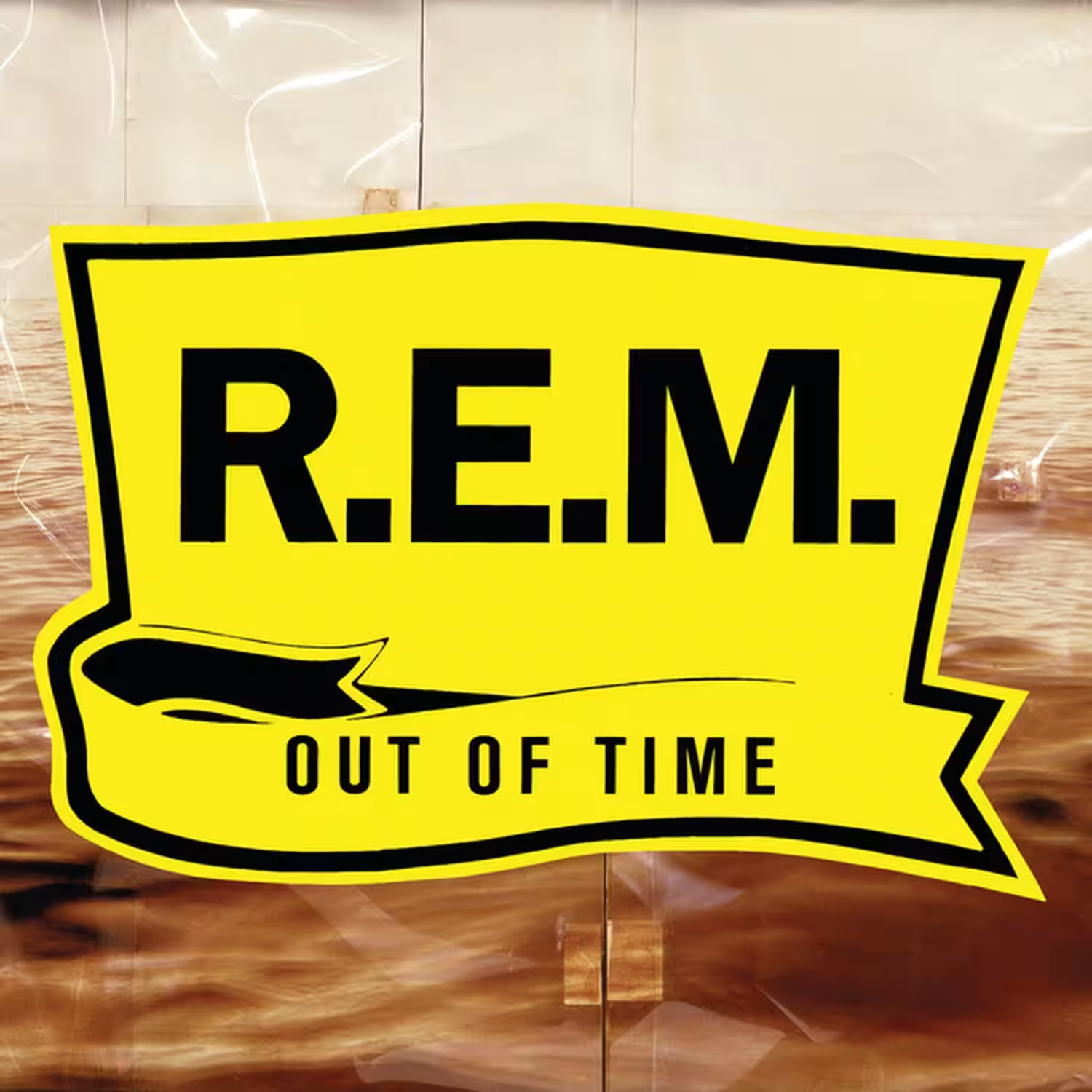
| Cover art | “Yellow Seascape with Film and Wood Blocks” by Doug and Mike Starn (1988/89) |
| Songwriting | All tracks written by Bill Berry, Peter Buck, Mike Mills and Michael Stipe |
| Previous album | Green (1988) |
| Next album | Automatic for the People (1992) |
From Athens, Georgia to the Edge of the Mainstream
R.E.M. had been building towards something like this for a decade. Formed in 1980 by singer Michael Stipe, guitarist Peter Buck, bassist Mike Mills, and drummer Bill Berry, the band had spent the 1980s on the independent label I.R.S. Records, steadily growing from a scrappy college rock outfit into one of the most critically revered bands in America. Albums like Murmur (1983), Reckoning (1984), and Life’s Rich Pageant (1986) had established a template: jangly guitars, cryptic lyrics, and a sound that felt both intimate and anthemic.
Then came the major label leap. In 1988, R.E.M. signed with Warner Bros. and released Green, their sixth album and first for the new label. It spawned their first proper pop hits, including “Stand” and “Orange Crush,” and the accompanying world tour was their biggest to date. But the experience left the band exhausted and restless. After nearly two years of relentless gigging, they were physically and creatively drained. Something had to change.
As Mills later told Pitchfork, the seeds of that change had already been planted. Buck was growing tired of playing electric guitar and wanted to try something different. He had bought a mandolin on tour in 1987 and had been tinkering with it ever since. When the band reconvened to write new material, the instruction was simple: swap instruments, try new textures, and see where it leads. Nobody could have predicted where it would lead.
Building Out of Time: Woodstock, Athens, and Prince’s Studio
The making of Out of Time was a deliberately scattered affair, spread across multiple studios and several months. It began in the summer of 1990, with demo sessions at John Keane’s studio in Athens, Georgia, where the band had a long history and a comfortable working relationship. Stipe was absent for many of the early instrumental sessions, off on a low-key tour of Europe with Billy Bragg and Natalie Merchant. When he returned to Athens, he was handed a rough demo tape of nearly 20 instrumentals to listen to in his car. He drove around town, sketching vocal melodies and lyrics on the move.
There was a conscious shift in Stipe’s approach this time around. Tired of being pigeonholed as a political writer, he challenged himself to write love songs instead. The results, as we shall see, ranged from the ecstatic to the utterly devastating.
The principal recording sessions took place from 3 to 22 September 1990 at Bearsville Sound Studios in Woodstock, New York, a studio the band knew well, having mixed Green there. Working once again with co-producer Scott Litt, who had been their studio partner since 1987’s Document, R.E.M. threw themselves into an album that was deliberately, almost defiantly, eclectic. Buck played mandolin on multiple tracks. Mills shifted between bass, Hammond organ, piano, and harpsichord. Berry stepped out from behind the drum kit to play bass and congas. Everyone was out of their comfort zone, and that was precisely the point.
Overdubs were added back at John Keane’s in Athens. Strings, arranged and conducted by Mark Bingham, were recorded at Soundscape Studios in Atlanta, performed by members of the Atlanta Symphony Orchestra. And then the whole lot was mixed at a rather unlikely location: Paisley Park Studios in Minneapolis, the legendary compound belonging to Prince. It was during these mixing sessions, in late 1990, that the band also demoed early versions of tracks that would end up on their next album, Automatic for the People, including “Drive” and “Nightswimming.” The creative momentum was that strong.
The Guest List
For the first time in their career, R.E.M. brought in a significant number of outside collaborators. Rapper KRS-One appeared on the opening track “Radio Song.” Kate Pierson of fellow Athens band The B-52s provided vocals on three tracks, including the inescapable “Shiny Happy People.” Saxophonist Kidd Jordan contributed tenor, alto, and baritone saxophone across several songs. Peter Holsapple, formerly of the dB’s and R.E.M.’s touring guitarist on the Green tour, played acoustic guitar and supplementary bass. And flugelhorn player Cecil Welch, who had worked with Henry Mancini, added brass textures. It was the most collaborative record R.E.M. had ever made.
The Music: From Funk to Funeral Parlour
What makes Out of Time so endlessly fascinating to revisit is just how much ground it covers in eleven tracks. This is not a record that sits in one mode. It veers from funk to folk, from bubblegum pop to country dirge, from spoken-word experimentation to orchestral grandeur. And yet, somehow, it holds together.
“Radio Song” and the Unlikely Opener
The album kicks off with “Radio Song,” easily the most unexpected track R.E.M. had ever recorded at that point. Built on a funky guitar riff from Buck, with Mills on Hammond organ channelling the spirit of Stax Records, it features KRS-One rapping alongside Stipe in a sardonic commentary on formulaic radio programming. Jordan’s baritone saxophone anchors the groove. It is loose, slightly confrontational, and a clear signal that this was not going to be business as usual.
“Losing My Religion”: The Five-Minute Miracle
And then comes track two. “Losing My Religion” is one of those rare songs where the backstory is almost as good as the music itself. It began with Buck’s mandolin. Having bought the instrument in 1987, he was still learning to play it in 1990. He kept a tape recorder running during practice, and when he listened back, he found a riff buried among the noodling that sounded like something special. He later compared it to the theme from the 1983 film Merry Christmas, Mr. Lawrence.
The band worked up the song in a matter of minutes. The music was written in about five minutes, Buck later recalled, and the first time the full band played it through, it fell into place instantly. The early demo, recorded in Athens under the working title “Sugar Cane,” featured Hammond organ, banjo, and bass lines that Mills later admitted were inspired by Fleetwood Mac’s John McVie. By the time the band reached Bearsville, the arrangement had been stripped back and refined.
Holsapple was brought in on acoustic guitar to fill the gap between the high mandolin and the low bass. Stipe recorded his vocal in a single take. By some accounts, he stripped off most of his clothing in the booth because he got so physically worked up delivering the performance. The mandolin was also recorded live with no overdubbing. Buck was proud of this, noting there is even a spot where he muffled a note, but he refused to punch it in because the whole point was to capture the live feel.
The title, of course, is not about religion at all. It is a Southern American expression meaning to be at the end of one’s patience, to be at your wits’ end. Stipe described it as a song about unrequited love and obsession, and said he was inspired by the emotional tone of The Police’s “Every Breath You Take,” which he called one of the most beautiful and creepy songs ever written. The lyrics were also influenced by the writing of Gabriel Garcia Marquez, particularly Love in the Time of Cholera.
Warner Bros. were initially sceptical about releasing it as the lead single. It was five minutes long, had no chorus, and was built around a mandolin. It did not exactly scream radio hit. The band pushed back and won. “Losing My Religion” reached number 4 on the Billboard Hot 100, becoming R.E.M.’s highest-charting single in the US. Its music video, directed by Tarsem Singh and drawing on religious imagery inspired by the paintings of Caravaggio, won six MTV Video Music Awards and two Grammys.
As Mills put it with characteristic understatement: “If you want to talk about life-changing, ‘Losing My Religion’ is the closest it gets.”
The Joyful Outlier: “Shiny Happy People”
“Shiny Happy People” is the song that launched a thousand arguments in sixth form common rooms. Is it a masterpiece of ironic pop? Is it a genuine expression of joy? Is it a knowing tribute to The B-52s? The answer is probably all three.
The song began life as a darker piece written by Mills on acoustic guitar, but morphed into something unabashedly upbeat during the sessions. Pierson was invited to sing on it, and when she arrived at the studio, the band had already recorded the track. Their direction to her was simply: “Do whatever you want.” She later said she felt the song was an homage to her own band. The phrase “shiny happy people” itself was reportedly drawn from Chinese propaganda posters issued after the 1989 Tiananmen Square massacre, which gives the whole thing a rather different flavour if you think about it too hard.
Halfway through, the song switches to waltz time, a trick Buck suggested to give the relentlessly upbeat arrangement somewhere to go. He told Guitar School that the shift gives it a “Saturday in the Park” feel, referencing the Chicago hit. Despite the band’s later ambivalence about the track, “Shiny Happy People” reached number 10 in the US and number 6 in the UK, making it R.E.M.’s only single to crack the top 10 in both countries. In 1999, they reworked it as “Furry Happy Monsters” for a memorable appearance on Sesame Street, complete with a Muppet Kate Pierson.
“Country Feedback”: The Heart of the Album
If “Shiny Happy People” is Out of Time’s public face, “Country Feedback” is its private soul. It is, by almost universal agreement among R.E.M. devotees, one of the greatest things the band ever recorded. Stipe himself has repeatedly called it his favourite R.E.M. song.
The track originated almost by accident. Buck and Berry were killing time at John Keane’s studio, waiting for the others to arrive. Buck suggested they flesh out a chord progression he had been playing with. Buck handled acoustic guitar and layered it with electric guitar feedback. Berry played percussion and bass. Keane himself added pedal steel. When Mills arrived, he contributed a funereal organ part. The title is entirely literal: the two types of guitar overdub are country (the pedal steel) and feedback (Buck’s electric). The following day, Stipe arrived to record vocals.
What happened next has become one of the great stories in alternative rock lore. Stipe walked into the studio with a scrap of paper bearing a handful of words, essentially fragments from an unsent letter about a failed relationship. He semi-improvised the rest in a single take, then walked out. Buck later said simply: “It’s exactly what was on his mind that day. It was real.” Berry listened to the playback and told the band: “I think this song is finished. We don’t need to re-record this one.” They never did.
Pitchfork later described “Country Feedback” as “the rawest expression of sheer remorse the band ever captured on tape.” In 1998, Neil Young joined R.E.M. on stage at his Bridge School Benefit concert for a legendary performance of the song that stretched to over nine minutes, with Stipe visibly overwhelmed by the experience.
Deep Cuts That Deserve Your Time
Beyond the big hitters, Out of Time is packed with tracks that reward close attention. “Low” is a gorgeous, subdued piece built on Mills’s eerie organ, with Berry on congas, Jordan on bass clarinet, and Holsapple on bass. It has a funereal, almost hymnal quality. “Half a World Away” features harpsichord and strings, with Berry on bass instead of drums, creating something that sounds like a lost Baroque pop gem.
“Near Wild Heaven” is notable for being the first R.E.M. original on a studio album to feature Mills on lead vocals. His delivery perfectly suits the track’s jangly, Beach Boys-influenced pop. It is pure sunshine, and an early indicator of just how gifted a melodicist Mills was. “Texarkana” is another Mills lead vocal, a bouncy number named after the city that straddles the Texas-Arkansas border, though the lyrics have nothing to do with the place. According to Buck, Stipe started writing it, got stuck, and Mills finished the lyrics and recorded his vocal in about half an hour.
“Belong” is one of the album’s most experimental moments. Stipe’s vocal is a spoken-word piece, recorded into producer Scott Litt’s Walkman in a garage to achieve a lo-fi, reverberant quality. It tells the story of a woman whose world collapses one Sunday morning, set against a single bass note and a slowly building instrumental backdrop. It is strange, moving, and unlike anything else in the R.E.M. catalogue.
The album closes with “Me in Honey,” a rollicking country-folk duet between Stipe and Pierson that brings things full circle with an infectious energy, and “Endgame,” a brief orchestral instrumental that Stipe described as an attempt to evoke the feeling of a film’s closing credits.
The Cover Art and the Name That Almost Wasn’t
The album’s packaging was overseen by Stipe himself, alongside designer Tom Recchion. The cover photograph, “Yellow Seascape with Film and Wood Blocks,” is a work by twin brothers Doug and Mike Starn, dating from 1988 to 1989. It shows a bisected, manipulated photograph of the Pacific Ocean that appears stained, scratched, and distorted, affixed with push pins. Over this, the band placed a large, rounded banner bearing the album title in a style that some critics have compared, unkindly, to a Denny’s restaurant logo. Amazon’s own review famously described it as R.E.M. “matching their ugliest album cover with some of their most sublime music.” The interior featured comic-style illustrations by Ben Katchor, hand-lettered song titles by Ed Rogers, and additional photography by the Starn twins.
As for the title itself, it arrived at the very last second. The band had seriously considered leaving the album untitled, but with I.R.S. having already released a compilation called Eponymous, a nameless record would have caused confusion. Other titles reportedly under consideration included “Imitation Crab Meat,” “Borehole,” and “Trolling for Olives.” Stipe is also said to have pitched “Cat Butt.” When a desperate phone call came from the Warner Bros. office explaining that the album would be delayed without a title, someone in the room said “we’re out of time.” And that was that. The title works on two levels: literally, as a statement about the deadline, and poetically, as a description of music that feels untethered from any particular era.
Release, Reception, and the Decision Not to Tour
Out of Time was released on 12 March 1991, and its commercial performance was staggering. It topped the album charts in both the US and the UK, spending 109 weeks on the American charts with two separate spells at number one, and 183 weeks on the British charts. It has been certified four times platinum in the United States and has sold over 18 million copies worldwide.
Critics were overwhelmingly enthusiastic. Rolling Stone praised the band for branching out while consolidating their strengths. NME highlighted the album’s eclecticism. Select magazine called it R.E.M.’s finest album to date. At the 1992 Grammy Awards, Out of Time won Best Alternative Music Album, while “Losing My Religion” took home Best Pop Performance by a Duo or Group with Vocal and Best Short Form Music Video. It remains R.E.M.’s only album to win a Grammy.
Perhaps the boldest decision the band made around Out of Time was what they chose not to do: tour. Exhausted from the Green tour cycle and keen to protect their creative energy, R.E.M. made the radical choice not to take the album on the road. They did make sporadic television appearances, including a memorable Saturday Night Live performance on 13 April 1991 where they played “Losing My Religion” and “Shiny Happy People” with Pierson, but there was no conventional tour. The album’s US longbox packaging even carried a petition for Rock the Vote, encouraging buyers to support the Motor Voter Act and making practical use of the then-standard (and widely despised) CD longbox format.
The album also featured in Time magazine’s 2006 list of the “All-Time 100 Albums” and was voted number 49 in Colin Larkin’s All Time Top 1000 Albums. Its influence was immense: it demonstrated that an alternative rock band could achieve massive mainstream success without sacrificing artistic integrity, paving the way for the likes of Green Day, Smashing Pumpkins, Blur, and Oasis in the years that followed.
Fast Facts: 10 Things You Might Not Know About Out of Time
| # | Fact |
|---|---|
| 1 | The album was mixed at Paisley Park Studios, Prince’s legendary Minneapolis compound. It was during these mixing sessions that R.E.M. demoed early versions of “Drive” and “Nightswimming,” both of which would appear on the follow-up, Automatic for the People. |
| 2 | “Losing My Religion” was nearly never a single. Warner Bros. were unconvinced by a five-minute mandolin-led track with no chorus. The band insisted, and it became their biggest ever hit, peaking at number 4 in the US. |
| 3 | Michael Stipe recorded the vocal for “Country Feedback” in a single improvised take, working from a scrap of paper with a few words drawn from an unsent letter about a failed relationship. The band decided the take was good enough and never re-recorded it. |
| 4 | “Shiny Happy People” was reportedly considered as the theme song for a major American TV sitcom. The phrase “shiny happy people” itself may have originated from Chinese propaganda posters issued after the 1989 Tiananmen Square protests. |
| 5 | The album title was chosen at the very last moment. Under pressure from Warner Bros. to provide a name before production was delayed, someone in the room said “we’re out of time.” Other rejected titles included “Cat Butt,” “Imitation Crab Meat,” and “Trolling for Olives.” |
| 6 | Peter Buck’s mandolin playing on “Losing My Religion” was entirely live with no overdubs. There is a spot where he muffles a note, which he deliberately left in to preserve the feel of a live performance. |
| 7 | R.E.M. chose not to tour in support of Out of Time, making it one of the best-selling albums of the early 1990s to succeed almost entirely on the strength of its singles, videos, and word of mouth. Their promotional activities were limited to TV spots and print interviews. |
| 8 | Courtney Love has claimed that “Country Feedback” was written about her, citing specific lyrics she says Stipe talked her through. Stipe has described it more broadly as a song about the ugly side of love and the end of a relationship. |
| 9 | The spoken-word vocal on “Belong” was recorded into Scott Litt’s personal Walkman in a garage, deliberately seeking a lo-fi, reverberant sound that would contrast with the rest of the album’s polished production. |
| 10 | The album’s CD longbox packaging in the US doubled as a petition for Rock the Vote, encouraging young buyers to support the Motor Voter Act. It was a creative use of a format that most artists and fans considered wasteful. |
Why Out of Time Still Matters
More than three decades on, Out of Time holds a strange and fascinating place in the R.E.M. catalogue. It is sandwiched between Green, the album that proved they could handle the big stage, and Automatic for the People, the album that most critics consider their masterpiece. It would be easy to treat it as a stepping stone, a transitional record. But that would be doing it a serious disservice.
Out of Time is the sound of a band discovering that their best work comes from following their instincts rather than meeting expectations. It is the record where Buck put down the electric guitar and picked up the mandolin, where Mills stepped up to sing lead, where Stipe poured out an improvised heartbreak in a single take and never looked back. It sold 18 million copies not because it played safe, but precisely because it did not.
If you have never listened to it all the way through, do yourself a favour and set aside 40 minutes. Start with the funky swagger of “Radio Song,” let “Losing My Religion” work its familiar magic, ride the sugar rush of “Shiny Happy People,” and then sit with “Country Feedback” and feel it break your heart. It is one of the great albums of the 1990s, and it sounds as vital now as it did in 1991.
We cover Out of Time in full on this week’s episode of the Riffology podcast. Find us at riffology.co and on all major podcast platforms. Hit play, and let us know what you think.
About the Author