Riffology Score: 88/100
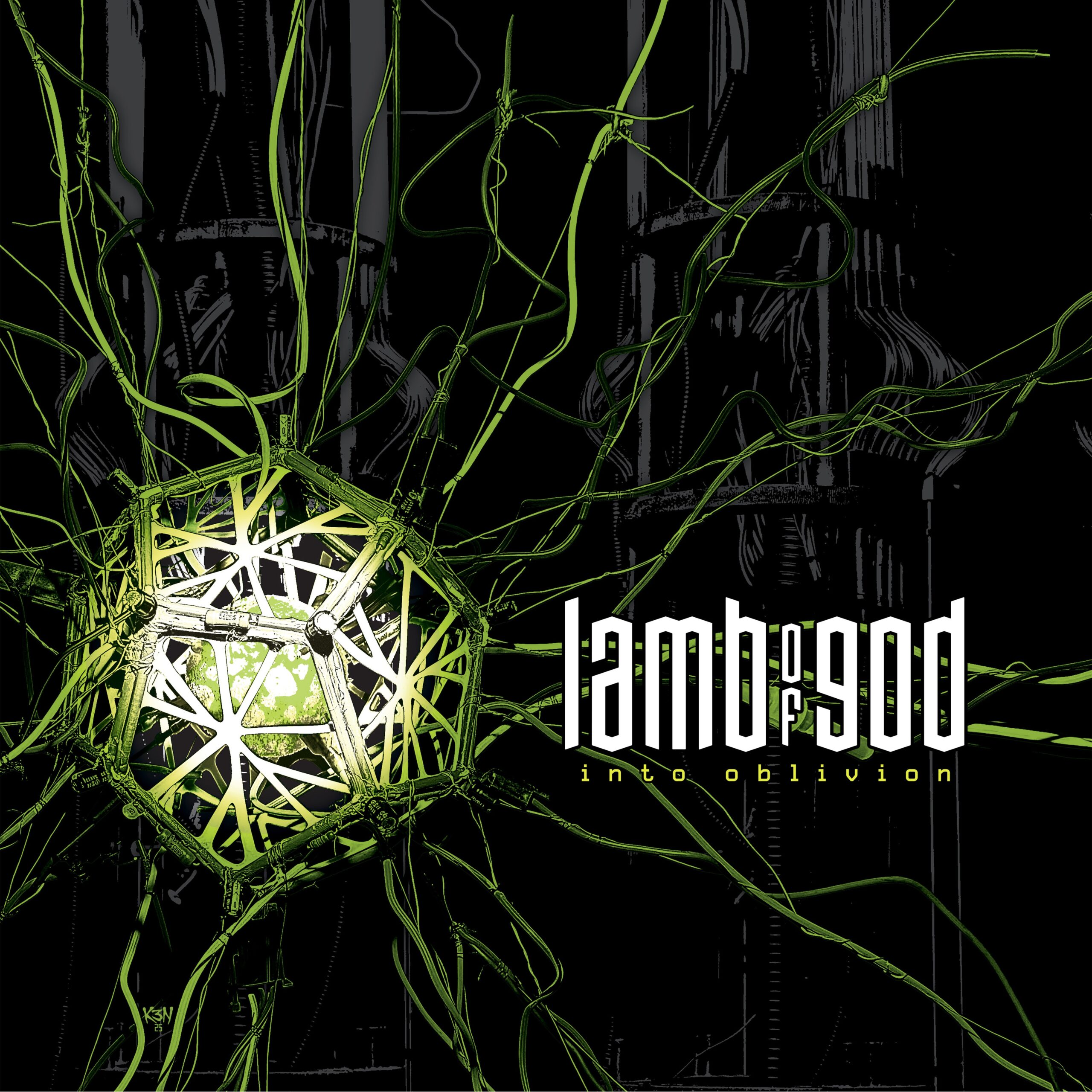
Thirty years into a career built on sheer bloody-minded heaviness, Lamb of God could easily have coasted. Instead, they’ve done something far more interesting. Into Oblivion is an album that sounds genuinely angry, not at the industry, not at critics, but at the actual state of the world. It’s a record that hits you like a fist to the chest and then makes you think about why you deserved it. This is Lamb of God at their sharpest, their most varied, and arguably their most vital in years.
The Basics
Into Oblivion is Lamb of God’s tenth studio album, scheduled for release on 13th March 2026 through Century Media and Epic Records. It was produced and mixed by Josh Wilbur, who has been behind the desk for the band on several previous records. Recording took place across multiple locations. Drums were tracked in Richmond, Virginia, the city that made them. Guitars and bass were laid down at guitarist Mark Morton’s home studio. Meanwhile, vocalist Randy Blythe headed to Total Access Recording Studios in Redondo Beach, California, to lay down his vocals.
That last location is worth noting. Total Access is legendary in punk circles. Black Flag recorded there. So did Hüsker Dü and the Descendents. There’s a raw, no-nonsense energy baked into those walls. Furthermore, the fact that Blythe chose to record there tells you something about where his head was at. This wasn’t a band trying to sound polished. This was a band trying to sound real.
Background and Context
Lamb of God formed in Richmond, Virginia, back in 1994, originally under the name Burn the Priest. Over the following three decades, they became one of the defining forces in American heavy metal. The current line-up is Randy Blythe on vocals, Mark Morton and Willie Adler on guitars, John Campbell on bass, and Art Cruz on drums. Cruz replaced founding drummer Chris Adler in 2019, and has now been fully bedded in since the self-titled album in 2020.
Into Oblivion follows 2022’s Omens, which was itself a strong record. However, four years is a long time. A lot has changed in the world. Subsequently, Blythe has clearly been watching and what he’s seen has clearly got under his skin. He’s described the album as being about the collapse of the social contract. In his own words, things are acceptable now that would have horrified people twenty years ago. That’s not a political slogan it’s a blunt observation from a man approaching his mid-fifties who reads books, keeps notebooks, and takes words very seriously.
The Sound
Right from the opening title track, this album means business. Into Oblivion arrives with a riff from Morton that grabs you by the collar. Blythe delivers his vocals with a raw, throaty intensity as if he’s yelling directly into your ear. At just three minutes and thirty-four seconds, it’s lean and purposeful. There’s no fat on it whatsoever.
The album moves between two distinct but complementary modes. On one hand, there are the heavier, more crushing tracks. Sepsis, the first single, released back in October 2025 nods towards the Richmond underground scene of the early nineties. It has a deliberate, bruising quality. Similarly, The Killing Floor and Bully are unrelenting and full of well-timed breakdowns. On the other hand, tracks like El Vacío, St. Catherine’s Wheel, and A Thousand Years show a different side. They’re riff-heavy but more melodic, with Blythe experimenting with different vocal approaches, less guttural, more raw shouting and occasional softer moments.
Parasocial Christ is a three-minute detonation of classic Lamb of God energy. It’s sharp, fast, and absolutely to the point. Blunt Force Blues, the fourth single, is perhaps the most personal track on the record. It’s a tribute to the Richmond music scene that shaped the band, the local bands, the cramped venues, the community that taught them everything. It’s a homecoming song dressed in heavy clothes. Furthermore, at just over four minutes, it’s one of the longer tracks and earns every second.
Themes and Lyrics
Lyrically, this album is dense with ideas. Blythe has always been a thoughtful writer. He keeps notebooks, reads voraciously, and doesn’t like explaining his words he’d rather let listeners find their own meaning. That said, the themes on Into Oblivion are not hard to pick out. The title itself tells you everything. The album is about a world in freefall.
The Killing Floor tackles American decay head-on. St. Catherine’s Wheel deals with the erosion of truth and the slow rewiring of how people think and feel. El Vacío (Spanish for “the void”) is genuinely fascinating. It apparently references Hunter S. Thompson and the late GWAR frontman Dave Brockie, contemplating what figures like that would make of the world today. It’s part eulogy, part horror story. In addition, Parasocial Christ takes aim at the attention economy, who we worship, why we worship them, and what that says about us. These aren’t throwaway metal slogans. They’re the words of someone paying close attention.
Meanwhile, Morton offers a different perspective on the album’s creation. For him, it was about creative freedom and making music without worrying about trends or expectations. He’s described feeling untethered, free to simply make something they found cool. That looseness comes through in the music. Consequently, the album has a sense of space and confidence that some of their more recent records perhaps lacked.
How Does It Stack Up?
Lamb of God have an impressive catalogue to measure this against. Ashes of the Wake (2004) remains a landmark record, it debuted at number 27 on the Billboard 200 and earned Gold certification. Sacrament (2006) went one better, debuting at number 8. Wrath (2009) hit number 2. These are the records most fans hold up as the gold standard. However, VII: Sturm und Drang from 2015 was also exceptional, many consider it their best work of the second half of their career.
So where does Into Oblivion sit? Honestly, it belongs in that top tier. It’s their most diverse record in years, moving confidently between styles without ever losing focus. Furthermore, the production from Wilbur is excellent, every instrument is clear, every riff lands with the weight it deserves. It doesn’t try to reinvent the band. Instead, it reminds you of exactly why Lamb of God matter. Overall, it feels like their best album since VII: Sturm und Drang.
Standout Tracks
It’s hard to pick just a few. Nevertheless, El Vacío is something special, layered, unusual, and genuinely moving in places. A Thousand Years builds brilliantly. Devise/Destroy, the closer, ends the album with a fractured, dualistic energy that feels fitting. The sequencing of the album deserves credit too. It reads like a descent from the opening plunge of the title track through to that restless, searching finale.
In addition, Sepsis rewards repeated listens. What initially sounds like a slow-burn heavy track reveals more texture each time you hear it. Similarly, Blunt Force Blues grows on you in a way that few heavy metal songs manage. It’s personal and specific, which paradoxically makes it universal.
On Tour
Lamb of God hit the road in support of the album on 17th March 2026, kicking off a major North American tour. They’re joined by Kublai Khan TX, Fit For An Autopsy, and Sanguisugabogg. This is genuinely one of the strongest support packages around right now. The tour runs through April, taking in cities from Montreal to Boston, Los Angeles to Houston. Full tour dates are available on the band’s official website.
Beyond North America, they’re lined up for a string of major European festivals over the summer. Notably, they headline the Friday night at Bloodstock Open Air on 7th August 2026. They’ll also appear at Wacken Open Air, Summer Breeze, Hills of Rock, and a headline show in Leipzig. Moreover, for the truly committed, there’s the annual Headbangers Boat cruise, sailing from Miami on Halloween with a jaw-dropping guest list including The Dillinger Escape Plan, GWAR, In Flames, and Zakk Sabbath.
Final Thoughts
Into Oblivion is the sound of a band with nothing to prove and everything to say. Lamb of God aren’t chasing trends. They’re not trying to stay relevant by changing who they are. Instead, they’ve doubled down on what makes them great, the groove, the riffs, the fury, and the words. The result is an album that feels both deeply rooted and completely alive to the moment we’re living in.
Clearly, this is a band still operating at the top of their game. Indeed, after thirty years, that’s remarkable. Into Oblivion is heavy, smart, and occasionally devastating. It’s the kind of record that makes you want to put your fist through a wall and then sit quietly and think about why. That’s a difficult trick to pull off but Lamb of God make it look effortless.
Let us know in the comments what your thoughts are on Into Oblivion by Lamb of God. Did we miss anything? Share your experiences and join the conversation!
About the Author