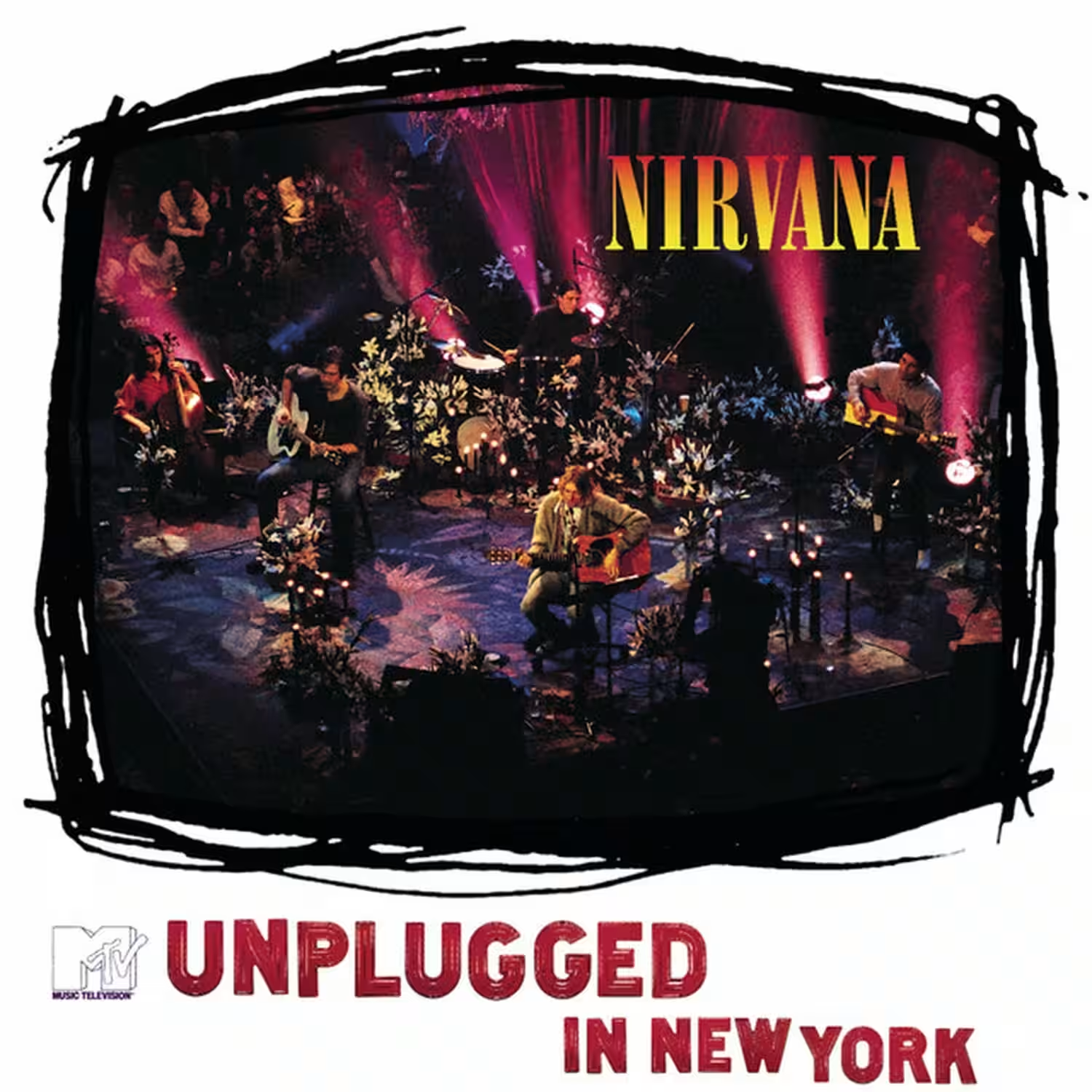
On 18th November 1993, Nirvana walked into Sony Music Studios in Hell’s Kitchen, Manhattan, and, surrounded by stargazer lilies, black candles, and a crystal chandelier, delivered the most devastating acoustic performance in rock history. Five months later, Kurt Cobain was dead. This is the story of MTV Unplugged in New York.
There’s a moment, right at the end of “Where Did You Sleep Last Night,” where Kurt Cobain closes his eyes, tilts his head back, and screams the final verse with such ferocity that Neil Young would later describe it as “unearthly, like a werewolf, unbelievable.” Then it’s over. The camera catches Cobain’s eyes, pale, piercing, somewhere else entirely, and the audience sits in stunned silence. Alex Coletti, the show’s producer, begged him to do an encore. Cobain refused. “I can’t top that last song,” he said. He was right. Nobody could.
MTV Unplugged in New York wasn’t supposed to be a farewell. It wasn’t supposed to be anything more than a taping for a popular MTV series. But history has a way of rewriting the script, and what emerged, first as a television broadcast, then as a posthumous album, is one of the most extraordinary live recordings ever committed to tape. Not just in grunge. Not just in rock. In music, full stop.
Album Info
| Artist | Nirvana |
| Album | MTV Unplugged in New York |
| Recorded | 18th November 1993 |
| Location | Sony Music Studios, Hell’s Kitchen, Manhattan, New York |
| Released | 1st November 1994 |
| Label | DGC Records |
| Producer | Scott Litt |
| Director | Beth McCarthy-Miller |
| Genre | Acoustic rock, folk rock, grunge, alternative rock |
| Length | 53 minutes (album), 66 minutes (full unedited performance) |
| Format | CD, cassette, vinyl, DVD (2007) |
| Personnel | Kurt Cobain (vocals, acoustic guitar), Dave Grohl (drums, backing vocals, bass on track 3), Krist Novoselic (bass, accordion, guitar), Pat Smear (rhythm/lead guitar), Lori Goldston (cello) |
| Guest musicians | Curt Kirkwood (guitar, tracks 10-12), Cris Kirkwood (bass, backing vocals, tracks 10-12) |
| Chart peak | No. 1 (US Billboard 200), No. 1 (UK Albums Chart) |
| First week sales | 310,500 copies (US) |
| Certification | 8x Platinum (US, RIAA) |
| Awards | Grammy Award for Best Alternative Music Performance (1996) |
| Singles | “About a Girl” (1994) |
| TV broadcast | 16th December 1993 (MTV) |
“You Mean Like a Funeral?” – Setting the Stage
To understand why MTV Unplugged in New York hits the way it does, you need to understand where Nirvana were in late 1993. Their third album, In Utero, had been released in September to strong sales but a more fractious critical reception than Nevermind. Cobain had deliberately sought a rawer, more abrasive sound with producer Steve Albini, partly as a reaction against the polished sheen that Butch Vig had given Nevermind. The message was clear: Nirvana were not going to be the band the mainstream wanted them to be.
The In Utero tour was already proving volatile. Shows were either transcendent or disastrous, depending heavily on Cobain’s state of mind and his ongoing battle with addiction and chronic stomach pain. Cancellations were frequent. The band’s inner circle never quite knew which Nirvana would turn up on any given night.
MTV’s Unplugged series had been running since 1989, and by 1993 it was one of the most coveted slots on American television. Eric Clapton’s Unplugged album had been a monster hit, and the format (acoustic instruments, intimate setting, celebrity audience) was proven commercial gold. MTV had been courting Nirvana for some time. Cobain was deeply sceptical. He and the band had watched other Unplugged tapings and found them underwhelming. As Dave Grohl put it, most bands treated them like stadium shows, just with acoustic guitars. That wasn’t going to fly.
Cobain finally accepted the invitation whilst on tour with a then-little-known band from Arizona called the Meat Puppets. But this was going to be done his way. He had very specific ideas about how the stage should look, requesting stargazer lilies, black candles, and a crystal chandelier. When Coletti asked, “You mean like a funeral?”, Cobain simply said yes.
In hindsight, the imagery is almost unbearable.
Rehearsals, Rows, and a Stolen Office Chair
Nirvana rehearsed for two days at SST Rehearsal Facility in Weehawken, New Jersey, and by all accounts it was tense going. The band were struggling to adapt their sound to an acoustic setting. Grohl, a powerhouse drummer who Beth McCarthy-Miller (the show’s director) memorably compared to “Animal from The Muppet Show,” had real difficulty dialling back his playing. He eventually settled on brushes and dowels to get the dynamics right.
But the bigger battles were political. When MTV saw the proposed setlist, alarm bells rang. Beyond “Come as You Are,” there were no major Nirvana hits. No “Smells Like Teen Spirit.” No “In Bloom.” No “Lithium.” Instead, Cobain had loaded the set with deep cuts, lesser-known album tracks, and, most controversially, six cover versions. The network pushed hard for recognisable names as guest performers, suggesting the likes of Eddie Vedder or Tori Amos. Cobain wanted the Meat Puppets. MTV were not impressed.
The day before filming, Cobain refused to play at all. He was suffering from drug withdrawal and was visibly unwell. Crew members reported there were no smiles, no jokes, just an overwhelming sense of worry about whether the performance would even happen. But Cobain turned up at Sony Studios the following afternoon, wearing a ratty green cardigan over a Frightwig t-shirt, jeans, and Converse trainers. One label representative noted he hadn’t washed his hair in over a week. He disliked the stool MTV had provided and went off to steal a swivel office chair from somewhere in the building.
The three-hour pre-show rehearsal and soundcheck revealed trouble spots. Songs were run through, restarted, debated. Producer Scott Litt, who had previously worked with R.E.M. and had remixed two tracks from In Utero, was up in the sound booth overseeing the audio. Despite the “unplugged” premise, Cobain insisted on running his acoustic guitar through his Fender Twin Reverb amplifier and effects pedals. Coletti had a fake box built in front of the amp to disguise it as a stage monitor. It was Cobain’s security blanket. He needed to hear his guitar through that amp with those effects. You can hear it clearly on “The Man Who Sold the World,” where the acoustic takes on a distinctly driven, almost electric quality.
And then something remarkable happened. As Grohl recalled: “Then we sat down and the cameras started rolling and something clicked.”
One Take, Fourteen Songs, and a Room Full of Ghosts
The performance was taped in essentially a single take, a rarity for MTV Unplugged, where most artists would stop and restart multiple times. Nirvana played fourteen songs straight through, with only brief pauses and between-song banter from Cobain, who proved to be a surprisingly witty and self-deprecating host despite his anxiety.
The lineup on stage was expanded beyond the core trio. Pat Smear, the former Germs guitarist who had joined Nirvana as a touring member, played rhythm guitar on most tracks, notably using an inexpensive, red-white-and-blue Buck Owens model acoustic belonging to Krist Novoselic, which had been extensively reworked by guitar tech Earnie Bailey to make it sound like a proper instrument. Cellist Lori Goldston, who had been touring with the band on the In Utero tour, added a mournful, classical dimension that became one of the performance’s defining textures. And for three songs in the middle of the set, Curt and Cris Kirkwood of the Meat Puppets joined the band on stage.
What Cobain played the performance on would become one of the most famous guitars in rock history: a 1959 Martin D-18E, purchased from Voltage Guitar in Los Angeles for $5,000 earlier that autumn. It was one of only 302 such models ever built, and Cobain had it modified with a Bartolini soundhole pickup and had the nut recut for left-handed playing. According to Courtney Love, it was the last guitar he ever played.
The setlist broke down as follows: one track from Bleach (1989), four from Nevermind (1991), three from In Utero (1993), and six covers. It was a bold, almost confrontational curatorial statement. This wasn’t going to be a greatest hits victory lap. This was Cobain saying: this is who we really are.
The Music: Fragile, Fierce, and Utterly Unforgettable
The Originals
The set opened with “About a Girl,” the most openly pop-leaning track from Bleach, and in this stripped-back setting its Beatles-esque melodic sensibility shone even brighter. It set the tone beautifully: intimate, unhurried, subtly devastating.
“Come as You Are” was the only genuine hit single performed, and in acoustic form it took on an entirely different character. Without the swirling chorus effect of the studio version, the melody stood nakedly exposed, and it turned out to be more than strong enough to carry itself. The same was true of “Polly,” already a spare, acoustic-driven song on Nevermind, which here felt even more uncomfortably close and confessional.
From In Utero, Cobain chose “Dumb,” “Pennyroyal Tea,” and “All Apologies.” Each was a revelation. “Pennyroyal Tea” was performed entirely solo by Cobain, just voice and guitar, and it’s one of the most quietly harrowing moments on the record. “All Apologies,” which had not yet been released as a single from In Utero, would become far better known in this version, its weary refrain gaining an almost liturgical quality with Goldston’s cello and Grohl’s harmonies.
“On a Plain” and “Something in the Way” were also performed but cut from the original television broadcast. Both were restored for the 2007 DVD release.
The Covers: Cobain’s Secret Jukebox
If the originals showed a different side of Nirvana, the covers were a revelation. They functioned as a guided tour of Cobain’s record collection, and in doing so, revealed far more about his artistic DNA than any interview ever could.
The Vaselines’ “Jesus Doesn’t Want Me for a Sunbeam” was a gorgeous, aching rendition that featured Novoselic swapping his bass for accordion (the first instrument he’d ever learned) while Grohl took over bass duties. It was a masterclass in reinvention.
David Bowie’s “The Man Who Sold the World” was, for many listeners, the first time they’d heard the song. Cobain’s reading transformed it into something almost ghostly, the lyric about meeting a stranger who had died years ago taking on an awful prescience. There’s a lovely moment at the start where Cobain warns the audience he’ll probably mess it up before delivering a near-flawless performance. Bowie himself later spoke warmly of the cover, though reportedly joked that a generation of fans assumed it was a Nirvana original.
The three Meat Puppets covers, “Plateau,” “Oh Me,” and “Lake of Fire,” were performed with the Kirkwood brothers on stage, Novoselic switching to guitar. These were the tracks that had made MTV most nervous, and they turned out to be among the set’s highlights. The songs’ surreal, countrified psychedelia suited the acoustic format perfectly, and Cobain deliberately sang them in uncomfortable keys, straining his voice for emotional effect.
And then there was “Where Did You Sleep Last Night.”
The Final Song
Cobain introduced it by saying it was written by “my favourite performer,” Lead Belly, before Novoselic chipped in with a quip about passing a donation basket around so Cobain could buy Lead Belly’s guitar, which the folk legend’s estate had reportedly offered to sell him for $500,000. Cobain added that he’d even asked David Geffen to buy it for him, and been turned down.
What followed was one of the most extraordinary vocal performances in recorded music. The song, actually a traditional folk standard though commonly attributed to Lead Belly’s arrangement, builds from a quiet, measured verse to a final, screaming climax that is genuinely hair-raising. Cobain’s eyes, caught in close-up by the cameras, seem to glaze over entirely in the final moments, as if he’s channelling something from somewhere else entirely.
The audience sat in stunned silence afterwards. MTV executive Amy Finnerty later explained that Cobain misread their response: “Kurt, they think you are Jesus Christ.” But Cobain was convinced he’d failed. He thought the silence meant disapproval. He refused the encore. And the cameras stopped rolling.
The Cover, the Cardigan, and a $6 Million Guitar
The album’s iconic cover photograph was taken by Frank Micelotta, and it captures Cobain mid-performance: hunched over his Martin, eyes closed, that green cardigan draped over his narrow frame. It’s become one of the most reproduced images in rock photography, a visual shorthand for vulnerability, authenticity, and loss.
That olive-green Manhattan-brand mohair cardigan, complete with cigarette burn holes, stains, and one missing button, has become a cultural artefact in its own right. After Cobain’s death, Courtney Love gave it to Jackie Farry, Frances Bean Cobain’s nanny. It eventually found its way to auction, selling for $334,000 in 2019. It has never been washed.
The Martin D-18E guitar has an even more dramatic backstory. After Cobain’s death it passed to his daughter Frances Bean Cobain, who kept it in a vault in Seattle. It became the subject of a protracted legal battle during Frances Bean’s divorce from Isaiah Silva, ultimately ending up in Silva’s possession as part of the settlement. Silva then put it up for auction, and in June 2020, Australian entrepreneur Peter Freedman (founder of RØDE Microphones) purchased it for $6.01 million, at the time the most expensive guitar ever sold at auction. In late 2025, Freedman donated the guitar permanently to the Royal College of Music in London, where it had been the centrepiece of the Kurt Cobain Unplugged exhibition earlier that year.
Release, Reception, and the Weight of Grief
The MTV Unplugged episode first aired on 16th December 1993. It was 45 minutes long, with “Something in the Way” and “Oh Me” cut for time. Reactions were overwhelmingly positive.
Then, on 5th April 1994, Kurt Cobain died. He was 27 years old.
MTV aired the Unplugged episode repeatedly in the weeks that followed. The network and DGC Records initially planned a more ambitious posthumous release: a double live album called Verse Chorus Verse, compiling performances from throughout Nirvana’s career including the Unplugged set. But the project proved too emotionally devastating for Novoselic and Grohl to work on, and it was abandoned just a week after being announced. Instead, they opted to release the Unplugged performance as a standalone album, with Scott Litt returning to produce the record.
MTV Unplugged in New York was released on 1st November 1994, nearly seven months after Cobain’s death. It debuted at number one on the Billboard 200, selling 310,500 copies in its first week, the highest first-week sales of Nirvana’s career, surpassing both Nevermind and In Utero. By March 1995, it had sold 6.8 million copies, outstripping In Utero entirely. It has since been certified 8x platinum in the United States.
“About a Girl” was released as a single from the album, and “The Man Who Sold the World,” “Where Did You Sleep Last Night,” and “Lake of Fire” all received significant radio play and MTV rotation.
Critical reception was rapturous. Nirvana’s acoustic sound was praised as possessing “a ragged glory.” Rolling Stone called the record “stirring and occasionally brilliant.” In a later retrospective, AllMusic described it as “fearlessly confessional,” noting that it found Cobain “on the verge of discovering a new sound and style.” Journalist Charles M. Young called it Nirvana’s “second masterpiece,” arguing that Cobain could have revolutionised folk music in the same way he’d transformed rock.
The album won the Grammy Award for Best Alternative Music Performance in 1996, Nirvana’s only Grammy. A DVD release followed in 2007, featuring the complete unedited performance including the two songs cut from the original broadcast, five rehearsal tracks, and a 1999 MTV documentary, Bare Witness: Nirvana Unplugged.
The album consistently appears on greatest live albums lists and is regularly cited as one of the finest entries in the MTV Unplugged series, if not the definitive one.
Fast Facts: Nirvana – MTV Unplugged in New York
| # | Fact |
|---|---|
| 1 | The entire 14-song performance was filmed in a single take, a first for MTV Unplugged. Most artists stopped and restarted multiple times during their tapings. |
| 2 | Cobain requested the stage be decorated like a funeral, with stargazer lilies, black candles, and a crystal chandelier. Producer Alex Coletti asked, “You mean like a funeral?” Cobain said yes. |
| 3 | MTV pushed hard for Nirvana to play their biggest hits and invite star guests like Eddie Vedder or Tori Amos. Cobain refused on both counts, choosing the Meat Puppets instead, a band most of the MTV production team had never heard of. |
| 4 | “Smells Like Teen Spirit” was not performed. In fact, the only contemporary hit in the entire setlist was “Come as You Are.” |
| 5 | Dave Grohl struggled so much with playing quietly that director Beth McCarthy-Miller compared him to “Animal from The Muppet Show.” He eventually solved the problem by using brushes and dowels instead of drumsticks. |
| 6 | Cobain’s acoustic guitar was secretly amplified. Despite the “unplugged” premise, he insisted on running his Martin through a Fender Twin Reverb and effects pedals. Coletti had a fake box built to disguise the amp as a stage monitor. |
| 7 | The day before taping, Cobain refused to play at all. He was suffering from withdrawal and was visibly unwell. He eventually turned up at Sony Studios the following afternoon. |
| 8 | Cobain stole an office chair from somewhere in the building because he disliked the stool MTV had provided for him. |
| 9 | Krist Novoselic played accordion on “Jesus Doesn’t Want Me for a Sunbeam”, the first instrument he’d learned as a child. When Novoselic picked it up during rehearsals and started playing, Cobain immediately saw how it could work in the set. |
| 10 | Pat Smear played a cheap Buck Owens model guitar belonging to Novoselic, which had been so extensively reworked by guitar tech Earnie Bailey that it barely resembled the original instrument. Bailey’s brief was to make it “sound like a guitar and not a kid’s toy.” |
| 11 | Cobain deliberately sang the Meat Puppets covers in uncomfortable keys, choosing to strain his voice rather than finding keys he could sing comfortably. Producer Coletti noted this was entirely intentional. |
| 12 | “Where Did You Sleep Last Night” was originally planned as a B-side for the “Pennyroyal Tea” single, but the single was cancelled following Cobain’s death. |
| 13 | Neil Young described Cobain’s vocal on the final song as “unearthly, like a werewolf, unbelievable.” Young, of course, would later be forever linked to Cobain after the singer quoted his lyrics in his suicide note. |
| 14 | Cobain refused to perform an encore, telling Coletti, “I can’t top that last song.” Coletti recalled that the pleading went on for about five minutes before he backed off, knowing Cobain was right. |
| 15 | Cobain believed the performance was a disaster. He misread the audience’s stunned silence as disapproval. MTV executive Amy Finnerty later explained: “That’s what Kurt misinterpreted. That the silence was disapproval. It was just respect.” |
| 16 | The album debuted at number one on the Billboard 200 with 310,500 first-week sales, the highest opening week of Nirvana’s entire career, surpassing both Nevermind and In Utero. |
| 17 | It was originally planned as part of a double live album called Verse Chorus Verse, but Novoselic and Grohl found the compilation process too emotionally difficult and scrapped the project just one week after it was announced. |
| 18 | The album won the Grammy for Best Alternative Music Performance in 1996, Nirvana’s one and only Grammy Award. |
| 19 | Cobain’s 1959 Martin D-18E guitar sold at auction in 2020 for $6.01 million, making it the most expensive guitar ever sold at auction. It was purchased by RØDE Microphones founder Peter Freedman, who in 2025 permanently donated it to London’s Royal College of Music. |
| 20 | The green cardigan Cobain wore during the performance sold at auction for $334,000 in 2019. It has never been washed. The stains and cigarette burns are still intact. |
| 21 | Cobain wore a Frightwig t-shirt under his cardigan. Frightwig were an all-female punk band from San Francisco, a typically Cobain touch, using the biggest platform of his career to champion an obscure band he admired. |
| 22 | Several songs rehearsed for the show didn’t make the final set, including a cover of the Velvet Underground’s “Here She Comes Now,” which Meat Puppets guitar tech Troy Meiss described as the best song Nirvana played that didn’t make the cut. |
| 23 | Cobain introduced cellist Lori Goldston by the wrong surname during the performance, calling her “Lori Goldstein” on camera, a moment left in the final broadcast and album. |
| 24 | Courtney Love was not in the studio audience. Producer Coletti noted this appeared to be a deliberate choice: “I think he was a little too nervous to have Courtney and the baby there.” |
| 25 | The 2007 DVD release included five full-band rehearsal tracks: “Come as You Are,” “Polly,” “Plateau,” “Pennyroyal Tea,” and “The Man Who Sold the World,” offering a fascinating glimpse into how the performance came together. |
Why You Should Listen to This Album Today
Strip away the mythology. Forget, for a moment, everything you know about what happened five months later. Listen to MTV Unplugged in New York purely as a piece of music, and what you’ll hear is a band discovering that their songs, born in feedback and fury, were strong enough to stand naked. You’ll hear a songwriter of rare, intuitive brilliance. You’ll hear covers chosen with impeccable taste that reveal the beating heart behind the noise. And you’ll hear a room full of people holding their breath.
Then remember the context, and it becomes something else entirely. It becomes one of the most quietly shattering recordings in rock history, a beautiful, accidental goodbye from an artist who didn’t know he was saying it.
This is the album we’re covering on the Riffology podcast. Head over to your podcast app of choice and search for Riffology, or visit riffology.co to find the episode. We’d love to hear what this record means to you.
About the Author