It is October 1996. Grunge is fading, Britpop is burning bright across the Atlantic, and American rock radio is desperately searching for its next chapter. Out of Orlando, Florida, five guys nobody has heard of release a debut album that sells just 610 copies in its first week. Two years later, that same record, Yourself or Someone Like You by Matchbox Twenty, is one of the biggest albums on the planet, on its way to selling over 15 million copies worldwide and achieving the coveted Diamond certification from the RIAA. Rob Thomas described it perfectly: a really long overnight success.
This is the story of how a band born from the ashes of an Orlando bar act, armed with brutally honest songs about depression, domestic turmoil, and loneliness, became the defining post-grunge rock act of the late 1990s.
Album Facts
| Field | Detail |
|---|---|
| Artist | Matchbox Twenty (originally styled Matchbox 20) |
| Album | Yourself or Someone Like You |
| Release Date | 1 October 1996 |
| Label | Lava Records / Atlantic Records (Melisma Productions) |
| Producer(s) | Matt Serletic |
| Studio(s) | Triclops Recording, Atlanta, Georgia (recorded); House of Blues Studios, Memphis (mixed); Precision Mastering (mastered by Stephen Marcussen) |
| Genre / Subgenre | Post-grunge / alternative rock / pop rock |
| Track Count | 12 (standard edition); 15 (deluxe edition) |
| Total Runtime | 46:51 (standard edition); approx. 59 minutes (deluxe) |
| Billboard 200 Peak | No. 5 |
| UK Albums Chart Peak | No. 50 |
| Other Notable Chart Peaks | Australia (ARIA): No. 1; Canada: No. 11; New Zealand: No. 3; Germany: No. 21; Netherlands: No. 50; Switzerland: No. 46 |
| Certifications | US: 12x Platinum (Diamond); Australia: 10x Platinum; Canada: 8x Platinum; New Zealand: 5x Platinum; UK: Gold |
| Estimated Sales | 15+ million copies worldwide (12 million in the US alone) |
| Key Singles | “Long Day” (Sept 1996), “Push” (June 1997), “3AM” (Oct 1997), “Real World” (March 1998), “Back 2 Good” (Sept 1998) |
From Tabitha’s Secret to Matchbox 20: The Origin Story
Before Matchbox Twenty existed, there was Tabitha’s Secret. Based in Orlando, Florida, the band featured Rob Thomas on vocals, Brian Yale on bass, and Paul Doucette on drums, alongside Jay Stanley, Brandon Goldwaite, and John Goff. They were a fixture on the local club circuit in the early 1990s, building a loyal following but never quite breaking through.
Rob Thomas had arrived in Orlando in 1993 after what can only be described as a rough start to life. Born on 14 February 1972 at Ramstein Air Base in Landstuhl, Germany, to parents serving in the US military, Thomas grew up between Gainesville, Florida, and Turbeville, South Carolina. His parents divorced when he was young. As a young teenager, he helped care for his mother through her battle with cancer, an experience that would become the foundation for one of the album’s biggest songs. He dropped out of high school during his senior year at seventeen and spent several years sleeping on friends’ couches and park benches before landing in Orlando.
Tabitha’s Secret was where Thomas honed his craft, but the band’s trajectory changed when Atlantic Records A&R representative Kim Stephens came to an Orlando show to see another band entirely. Stephens spotted something special in Thomas and kept coming back every few months to check on the group’s progress. When Tabitha’s Secret eventually split, Atlantic approached Thomas directly. As Thomas told The A.V. Club, Stephens “liked my songs and asked me if I wanted to sign a record deal, so I brought in me and Brian and Paul, and that was the beginning of Matchbox 20.”
The trio needed to fill out their lineup. They recruited lead guitarist Kyle Cook from the Atlanta Institute of Music and rhythm guitarist Adam Gaynor from Criteria Recording Studios in Miami. The name “Matchbox 20” came courtesy of Doucette, who combined two words he spotted on a patron’s softball jersey at the restaurant where he was waiting tables. It was random, meaningless, and perfect.
The newly formed five-piece quickly earned a seven-album recording contract with Atlantic Records. It was 1995, and the hard work was about to begin.
Creating the Album: Storage Sheds, Hotel Rooms, and Triclops Recording
Rob Thomas wrote the songs for Yourself or Someone Like You over a five- to six-month period. He felt driven, he later explained, by a contentious relationship with his previous band and a determination to be completely prepared when Matchbox 20 entered the studio. Several songs had their roots in the Tabitha’s Secret days, most notably “3AM,” which Thomas had originally written about caring for his cancer-stricken mother as a twelve-year-old.
The band contributed to the arrangements collectively, convening to review Thomas’s demos and selecting material through group consensus. Thomas cited R.E.M., U2, Live, Bush, and Counting Crows among his influences, blending the raw introspection of post-grunge with more accessible, radio-friendly hooks.
Before entering the studio, the band rehearsed intensively for a month in a storage shed in Orlando. “We as a band went into a storage shed and brought our gear in there,” Thomas told The A.V. Club. “For a month we just played it over and over and over, so that when we went in the studio we were ready and prepared, because it was a whole different world for us.”
That preparation paid off. Recording took place in May and June 1996 at Triclops Recording in Atlanta, Georgia, with producer Matt Serletic at the helm. Serletic was a canny choice. He had previously produced Collective Soul’s 1993 debut Hints Allegations and Things Left Unsaid, and he understood how to balance gritty alternative energy with commercial polish. He had first encountered the band in Winter Park, Florida, and was immediately drawn to Thomas’s distinctive voice.
Serletic’s role extended beyond traditional producing. He played keyboards and percussion on the record, co-wrote two tracks (“Push” and “Girl Like That”), and handled mixing alongside Greg Archilla. His production vision emphasised Thomas’s vocal presence while maintaining the band’s raw energy, layering instrumentation and building dynamic arrangements that shifted from intimate verses to explosive choruses.
The engineering was handled by Jeff Tomei, with John Nielsen serving as assistant engineer. Mixing took place at House of Blues Studios in Memphis, with Malcolm Springer assisting. Stephen Marcussen mastered the album at Precision Mastering. Notably, the track “Back 2 Good” featured a woodwind arrangement by Serletic, performed by a small ensemble including Elizabeth Burkhardt on bassoon, Amy Porter on flute, Yvonne Powers on oboe, Ted Gurch on clarinet, and Douglas Smith on bass clarinet.
The band also worked with vocal coach Jan Smith, and band photographer Chris Cuffaro captured the group images, while art direction and design were handled by Valerie Wagner.
The Songs of Yourself or Someone Like You
The tracklist reads like a greatest hits collection for a band that had not yet released a single note to the public. Thomas’s songwriting is confessional and direct, drawing on themes of adolescence, adultery, loneliness, domestic violence, psychological abuse, depression, anger, and alcoholism. It is an unflinching look at the messier corners of human experience, delivered with enough melodic punch to make it palatable for mainstream radio.
Tracklist
| # | Title | Writer(s) | Length | Single? | Notes |
|---|---|---|---|---|---|
| 1 | Real World | Rob Thomas | 3:50 | Yes (4th single, March 1998) | Sarcastically optimistic opener |
| 2 | Long Day | Rob Thomas | 3:47 | Yes (1st single, Sept 1996) | West coast radio hit; semi-acoustic feel |
| 3 | 3AM | Rob Thomas, Brian Yale, John Goff, Jay Stanley | 3:46 | Yes (3rd single, Oct 1997) | Written about Thomas’s mother’s cancer; originated in Tabitha’s Secret |
| 4 | Push | Rob Thomas, Matt Serletic | 3:58 | Yes (2nd single, June 1997) | Controversial lyrics; topped Modern Rock Tracks; Grammy nominated |
| 5 | Girl Like That | Rob Thomas, Matt Serletic | 3:39 | No | Power pop sleeper; fan favourite deep cut |
| 6 | Back 2 Good | Rob Thomas | 5:39 | Yes (5th single, Sept 1998) | Features woodwind arrangement; peaked No. 24 on Hot 100 |
| 7 | Damn | Rob Thomas | 3:29 | No | Raw, aggressive; fan-cited deep cut |
| 8 | Argue | Rob Thomas | 3:20 | No | Relationship conflict theme |
| 9 | Kody | Rob Thomas | 4:04 | No | Reportedly about a troubled child Thomas knew; emotionally intense |
| 10 | Busted | Rob Thomas | 4:08 | No | Energetic rocker |
| 11 | Shame | Rob Thomas | 3:34 | No | Acoustic-tinged introspection |
| 12 | Hang | Rob Thomas | 3:37 | No | Closing ballad; co-lead vocals with Kyle Cook; Thomas plays acoustic guitar |
| Deluxe Edition Bonus Tracks | |||||
| 13 | Push (Acoustic) | Rob Thomas, Matt Serletic | 4:20 | No | Stripped-back reworking |
| 14 | Busted (Live from Australia) | Rob Thomas | 4:36 | No | Live recording |
| 15 | Shame (Acoustic) | Rob Thomas | 3:40 | No | Acoustic version |
“Real World” opens proceedings with a deceptively upbeat strut, Thomas delivering lyrics dripping with sarcasm about a world that refuses to live up to expectations. It is a mission statement of sorts: polished enough for radio, barbed enough to reward closer listening.
“Long Day” was the first song the public ever heard from Matchbox Twenty, released as the lead single in September 1996. It was a radio success on the US West Coast but did not break nationally. Its semi-acoustic, mid-tempo feel set a tone that the heavier “Push” would soon blow apart.
“3AM” is the album’s emotional centrepiece. On the surface, it sounds like a song about a quirky love interest who only sleeps when it rains. In reality, Thomas wrote it about the period when he was twelve or thirteen and his mother was fighting cancer. She was given six months to live and, during treatment, would often be awake at 3am, needing her son. Thomas originally penned an early version of the song while in Tabitha’s Secret, which is why the writing credits include former bandmates Jay Stanley, John Goff, and Brian Yale. The original Tabitha’s Secret version is acoustic and significantly slower; Rob sped it up for Matchbox 20, which helped make it a pop hit.
“Push” is arguably the album’s defining moment. Co-written with Matt Serletic during a songwriting exercise in a New York City hotel room, the song was born when Serletic opened a book and told Thomas to point at a word. Thomas landed on “rusty.” From that single word, they built the entire song in one night. The lyrics sparked immediate controversy: at least one feminist group tried to ban the song, interpreting lines like “I wanna push you around” as encouraging violence against women. Thomas consistently pushed back, explaining that the song is told from the perspective of a man who feels emotionally manipulated and pushed around by his partner, not the other way round. The controversy, if anything, only fuelled the song’s momentum.
“Girl Like That” is a power pop gem that fans frequently cite as an underrated highlight. “Back 2 Good” is the album’s longest track, featuring that distinctive woodwind arrangement and a sprawling, rustic groove built around themes of failed romance. “Damn” and “Argue” keep the album’s energy high through the middle stretch, while “Kody” is a darker, more emotionally intense track reportedly inspired by a troubled child Thomas knew. “Busted” brings incendiary energy, and “Shame” offers an acoustic-tinged breather before “Hang” closes the album with a sparse, affecting ballad that features Kyle Cook sharing lead vocal duties.
Album Artwork and the Frank Torres Saga
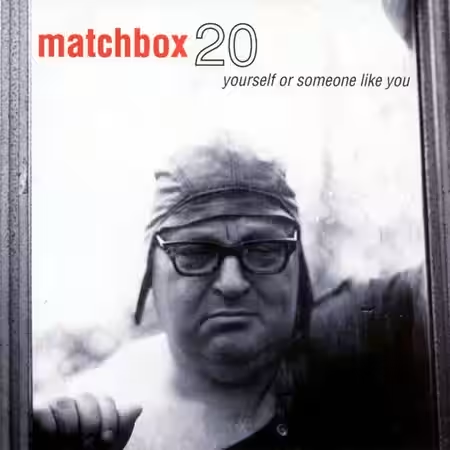
The cover of Yourself or Someone Like You features a solitary figure walking along a sun-bleached road, his shadow stretching behind him. The image was photographed by Katrin Thomas (no relation to Rob), with art direction and design by Valerie Wagner. Band photos were taken by Chris Cuffaro.
The man on the cover is Frank Torres, and his story became one of the album’s most unusual footnotes. In 2005, nearly a decade after the album’s release, Torres sued the band, claiming they had never sought his permission to use his image. Torres alleged he had been walking down the street, was asked to pose for a photograph, and never consented to his likeness appearing on a record that would go on to sell millions of copies. He claimed the photo had caused him emotional distress and justified the nine-year delay in filing the lawsuit by saying he had only become aware of the album within two years of the litigation. Torres passed away in 2016 at the age of 73.
The album was not always called Yourself or Someone Like You, either. Thomas originally wanted to title it Woodshed Diaries. The change came when Thomas and Paul Doucette attended a performance at Cafe Largo in Los Angeles, where a singer said from the stage, “this song is for you, or someone like you.” Thomas and Doucette loved the phrase so much they insisted on changing the title, despite the fact that 3,500 copies of the album had already been manufactured with the original name. The labels agreed, but the title change delayed the release.
Matchbox Twenty’s Yourself or Someone Like You: Singles and Music Videos
The album’s commercial trajectory was driven by an extraordinary run of five singles released over a two-year period. Each built on the momentum of the last, keeping the album in the public consciousness long enough for it to become a phenomenon.
“Long Day” (released 16 September 1996) was the opening salvo. It found an audience on West Coast rock radio but did not cross over nationally. It served its purpose as an introduction.
“Push” (released 10 June 1997) changed everything. The song topped the Billboard Modern Rock Tracks chart (now Alternative Airplay) and peaked at No. 5 on the Hot 100 Airplay chart. Crucially, because Atlantic Records chose not to release it as a commercial single (the album was selling so well they did not want to cannibalise those numbers), “Push” was ineligible to chart on the main Billboard Hot 100 under rules that were in effect at the time. In Australia, it reached No. 6, and in Canada, it became a top-ten hit. The music video was directed by Nigel Dick and features the band performing in an industrial setting, with imagery of a man manipulating a marionette, a visual metaphor for the song’s themes of control and manipulation. “Push” was nominated for a 1998 Grammy Award for Best Rock Performance by a Duo or Group with Vocal.
“3AM” (released 6 October 1997) continued the assault on radio. It peaked at No. 3 on the Hot 100 Airplay chart and topped the Canadian RPM 100 Hit Tracks chart for two weeks. Like “Push,” it was not eligible for the main Hot 100 due to the lack of a physical single release in the US. Outside North America, it reached No. 31 in Australia. The music video was directed by Gavin Bowden and filmed in Los Angeles, featuring Thomas wandering city streets at night, with the video switching between colour footage and black-and-white stills. Bowden captures the song’s nocturnal loneliness perfectly, with supermarkets and car lots standing in for suburban isolation.
“Real World” (released 24 March 1998) broadened the band’s appeal, crossing over to pop and adult contemporary formats. By this point, Billboard had changed its rules to allow airplay-only tracks onto the Hot 100, meaning “Real World” became the band’s first actual Hot 100 entry, though it peaked modestly at No. 38.
“Back 2 Good” (released 22 September 1998) was the album’s final single. Its release coincided with the rule change, and it peaked at No. 24 on the Hot 100. As Tom Breihan noted in his Stereogum column, “Back 2 Good” happened to be the current single when Billboard started listing airplay-only tracks, giving it chart placement that “Push” and “3AM” never received despite being far bigger cultural moments.
The fact that four singles from this album reached the top 10 of Billboard’s Radio Songs chart tells you everything about Matchbox Twenty’s radio dominance during this period. Atlantic did not need to rush a second album because the debut simply would not stop selling.
Chart Performance and Commercial Success
The sales trajectory of Yourself or Someone Like You is one of the great slow-burn success stories in modern rock. The album sold a reported 610 copies in its first week. It did not debut on the Billboard 200 in any meaningful position. And then it just kept growing.
Driven by relentless radio play and heavy MTV rotation, the album climbed steadily through 1997 and into 1998, eventually peaking at No. 5 on the Billboard 200. It spent 119 weeks on that chart. At year-end, it placed No. 22 on the 1997 Billboard 200 annual chart and No. 6 in 1998. For the entire decade of the 1990s, it finished at No. 28 on the Billboard Decade-End chart.
In Australia, the album was even bigger, reaching No. 1 on the ARIA Albums Chart and finishing as the No. 1 album of the entire year in 1998 (having also placed at No. 40 for 1997). It achieved 10x Platinum certification there, representing 700,000 units shipped. In Canada, it peaked at No. 11 and went 8x Platinum (800,000 units). In New Zealand, it reached No. 3 and earned 5x Platinum status (75,000 units).
The UK was a tougher market, with the album peaking at No. 50 and earning a Gold certification (100,000 units). The album also charted in Germany (No. 21), the Netherlands (No. 50), and Switzerland (No. 46).
In the United States, the album was certified 12x Platinum by the RIAA, qualifying for Diamond status (one of a relatively small number of albums to achieve this). Total worldwide sales are estimated at over 15 million copies.
Critical Reception: Then and Now
Critical response to Yourself or Someone Like You was mixed at best on release, a disconnect that would only widen as the album’s commercial success snowballed. AllMusic’s Stephen Thomas Erlewine gave it a generally positive review, describing it as the standard-bearer for post-alternative rock’n’roll. The Times gave it 7 out of 10. Q and Uncut both reviewed the album, with the former giving qualified praise.
Robert Christgau, never one to heap praise on mainstream rock, was characteristically dismissive. The Rolling Stone Album Guide gave it a tepid assessment.
The critical narrative around the album has always been complicated. Matchbox Twenty were frequently grouped with bands like Hootie & the Blowfish, Counting Crows, and the Dave Matthews Band as part of a post-grunge, radio-friendly cohort that serious music critics loved to dismiss. As Thomas himself acknowledged, “There was a whole period during the ’90s where the more successful we got, the bigger target we were. We were an easy takedown.”
Retrospective assessments have been kinder. Many critics and fans now acknowledge the album as a genuinely well-crafted collection of songs, often comparing it favourably to Third Eye Blind’s self-titled debut as the finest album of the entire crossover post-grunge movement. The production holds up well, Thomas’s voice remains instantly recognisable and emotionally compelling, and songs like “3AM” and “Push” have proven themselves as genuine classics of the era.
Touring the Album: From Storage Sheds to Arenas
Matchbox Twenty toured relentlessly in support of Yourself or Someone Like You, playing approximately 160 shows across the album cycle from late 1996 through to 1998. The Yourself or Someone Like You tour is documented at setlist.fm with dates spanning from 1996 to late 1998.
The band started as openers, most memorably supporting The Lemonheads. Thomas told a legendary anecdote about arriving at the Five Points Music Hall in Birmingham, Alabama, a roughly 1,000-capacity venue, and seeing a line of people outside the door clamouring to get in. “We thought, ‘Wow, The Lemonheads are having a good night,'” Thomas recalled. It was only later they realised the crowd was there for them.
As the album’s popularity exploded, the band graduated from support slots to headlining their own shows, and eventually co-headlined amphitheatre runs. In the summer of 1998, they toured with Soul Asylum and Semisonic as support, playing sheds and amphitheatres across the United States. They also performed at Hurricane Festival in Germany in June 1998, expanding their reach into Europe.
The band’s live reputation grew quickly. They were known for energetic, tight performances, bolstered by all those hours rehearsing in the Orlando storage shed. They also endeared themselves to fans by incorporating cover songs into their sets, including Cyndi Lauper’s “Time After Time” and The Beatles’ “Don’t Let Me Down.”
In 1997, Rolling Stone and Performance magazines both named Matchbox 20 Best New Band in their readers’ polls. They were nominated for a Best Rock Performance Grammy and the Favourite New Artist and Favourite Album American Music Awards in 1998. Thomas was named one of People magazine’s Most Beautiful People in 1998.
In 1998, the band also recorded a live version of “3AM” for the charity album Live in the X Lounge, with proceeds benefiting United Cerebral Palsy research. They contributed a cover of Fleetwood Mac’s “Never Going Back Again” to the Legacy: A Tribute to Fleetwood Mac’s Rumours album.
Cultural Context: Post-Grunge, Radio Rock, and the Late 90s
To understand why Yourself or Someone Like You resonated so deeply, you need to understand what was happening in rock music in 1996 and 1997. Kurt Cobain had been dead for two years. Grunge’s original wave had crested and broken. But the appetite for guitar-driven, emotionally honest rock music had not disappeared; it had simply shifted.
The mid-to-late 1990s saw the rise of what is now called post-grunge: bands who absorbed grunge’s emotional directness and guitar-heavy sound but smoothed the edges for mainstream consumption. Acts like Bush, Collective Soul, Gin Blossoms, Hootie & the Blowfish, and the Goo Goo Dolls were all working similar territory. Alanis Morissette’s Jagged Little Pill (1995) had proven there was a massive audience for confessional, angsty songwriting with pop hooks.
Matchbox Twenty landed squarely in this sweet spot. AllMusic described the band’s sound as “a blend of Tom Petty and Pearl Jam,” which captures it well: sturdy American rock songwriting with a 90s alternative edge. Thomas’s Southern upbringing, steeped in country storytellers like Willie Nelson and Merle Haggard, gave the songs a narrative directness that set them apart from the more oblique lyrics favoured by many alt-rock contemporaries.
On the shelves in late 1996 and through 1997, Matchbox Twenty were competing against the Spice Girls’ global domination, Radiohead’s OK Computer, the ongoing Britpop wars, and the emerging electronica buzz around The Prodigy and The Chemical Brothers. In the American rock mainstream, Third Eye Blind, Foo Fighters, and The Wallflowers were all vying for the same audience. That Matchbox Twenty outsold nearly all of them speaks to the universal accessibility of Thomas’s songwriting and the band’s knack for delivering it with enough grit to satisfy rock fans and enough polish to win over pop listeners.
In TV, Film, and Media
The most high-profile sync placement for Yourself or Someone Like You came decades after its release. In 2023, director Greta Gerwig selected “Push” for a pivotal scene in the Barbie movie. In the film, Ryan Gosling’s Ken serenades Margot Robbie’s Barbie with the song at a campfire, and soon all the Kens in Barbie Land are singing it in unison at their respective Barbies for hours. The scene satirises performative masculinity and bro culture, with Matchbox Twenty positioned as the quintessential “dude rock” band.
Gerwig explained her reasoning: “I was like, well, if Barbies loved Indigo Girls’ ‘Closer to Fine,’ which is one of my favourite songs of all time, the Kens might really attach to Matchbox Twenty.” She was also a genuine fan of “Push” as a teenager. Gosling recorded a full cover of the song, mimicking Thomas’s vocal inflections, which appeared on the Barbie: Best Weekend Ever Edition soundtrack.
Thomas, characteristically good-humoured about it, recalled: “When I got the call for Barbie, they told me, ‘Ken’s by the fireside, he’s playing the song and it’s his favourite band.’ So I did this thinking I’d be the butt of the joke, and I was fine with that. I’m pretty thick-skinned.” He was pleasantly surprised to discover the scene was actually rather affectionate. Atlantic Records executive Julie Greenwald told him after seeing the film, “You come out of it loving Ken and loving ‘Push.'”
Thomas also referenced an earlier pop culture jab: in the 2000 film Bring It On, Kirsten Dunst’s character has a “douchey boyfriend” whose dorm room features a Matchbox Twenty poster in the background.
The Barbie placement gave “Push” a massive streaming boost and introduced the song to a generation who were not yet born when the album was released, a remarkable second life for a track from 1997.
Things You Might Not Know About Yourself or Someone Like You
| # | Fact |
|---|---|
| 1 | The album was originally titled Woodshed Diaries. Thomas and Doucette changed it after hearing a singer at Cafe Largo in LA say “this song is for you, or someone like you,” despite 3,500 copies already being manufactured with the original title. |
| 2 | “3AM” was originally written when Thomas was in Tabitha’s Secret and is about caring for his mother during her cancer treatment when he was twelve. Tabitha’s Secret’s remaining members released their own version on Don’t Play with Matches, and later sued Thomas, Doucette, Yale, and Serletic for a share of the profits. |
| 3 | “Push” was born from a single word. During a songwriting exercise in a New York hotel room, Serletic opened a book and told Thomas to point at a random word. He pointed at “rusty.” They wrote the entire song that night. |
| 4 | The album sold just 610 copies in its first week. It eventually shifted over 12 million in the US alone. |
| 5 | Neither “Push” nor “3AM” were eligible to appear on the Billboard Hot 100 because Atlantic refused to release them as commercial singles (the album was selling too well to risk cannibalising sales), and pre-1998 rules required a physical single release for Hot 100 eligibility. |
| 6 | Frank Torres, the man on the album cover, sued the band in 2005 claiming he never consented to his image being used. He said the photo caused him emotional distress. Torres died in 2016 aged 73. |
| 7 | The band rehearsed for a solid month in a storage shed in Orlando before entering the studio, which is why the recording sessions in Atlanta took only about six weeks. |
| 8 | Producer Matt Serletic also played keyboards and percussion on the record and co-wrote “Push” and “Girl Like That.” His brother Dean Serletic and Tabitha Kahlhamer served as assistant co-producers. |
| 9 | Thomas grew up listening to country legends like Willie Nelson and Merle Haggard. When early reviewers detected a Southern influence in the band’s sound, Thomas was initially amused, being the only Southerner in the group, before realising those Nashville storytelling instincts had genuinely shaped his writing. |
| 10 | The band’s name came from a softball jersey. Paul Doucette spotted “Matchbox” and the number “20” on a patron’s shirt at the restaurant where he waited tables and simply combined them. |
| 11 | In 2023, Ryan Gosling recorded a full cover of “Push” for the Barbie soundtrack after the song was featured in a pivotal scene. Director Greta Gerwig chose it because she was a genuine teenage fan of the track. Thomas initially expected to be the butt of the joke but was delighted when audiences came away from the film loving both Ken and the song. |
Legacy and Influence: What Came After
The success of Yourself or Someone Like You set up an almost impossible challenge for album two. Rather than rush a follow-up, the band spent years touring the record and let it sell. Thomas used the downtime between albums to collaborate with Itaal Shur on a song called “Smooth” for Carlos Santana’s comeback album Supernatural. Thomas was originally intended as the songwriter only, but Santana insisted he sing on it after hearing the demo. “Smooth” became one of the biggest singles in pop history, topping the Billboard Hot 100 for twelve consecutive weeks and winning Thomas three Grammy Awards: Record of the Year, Song of the Year, and Best Popular Music Collaboration with Vocals.
When Matchbox 20 finally released their sophomore album, Mad Season, in 2000 (now styling themselves “Matchbox Twenty” with the number spelled out), they were a genuine cultural force. The lead single “Bent” became their first and only No. 1 on the Hot 100, and tickets for a Madison Square Garden show sold out in fifteen minutes. Mad Season was certified 4x Platinum. Their third album, More Than You Think You Are (2002), went 2x Platinum and featured a co-write with Mick Jagger (“Disease”).
The band went on hiatus in 2004 after Adam Gaynor’s departure, during which Thomas launched a successful solo career with …Something to Be (which debuted at No. 1 on the Billboard 200). They reunited for 2007’s compilation Exile on Mainstream, released North in 2012 (their only album to actually top the Billboard 200), and Where the Light Goes in 2023. They continue to tour and sell out venues.
Yourself or Someone Like You remains the commercial peak of their career and one of the best-selling debut albums in rock history. Its influence can be traced through the wave of post-grunge and alternative rock acts that followed in the late 1990s and early 2000s, from Lifehouse and Vertical Horizon to Train and Hinder. The template of emotionally confessional, melodically hooky, radio-friendly guitar rock that Matchbox Twenty perfected on this record became a blueprint for a generation of bands.
In 2018, “Smooth” was named the second-most successful song in Billboard Hot 100 history, further cementing Thomas’s status as one of the most commercially successful songwriters of his generation. But it all started here, in a storage shed in Orlando and a studio in Atlanta, with twelve songs that refuse to go away.
Listen to the Riffology Podcast
Want to hear us dig even deeper into Yourself or Someone Like You? The Riffology podcast episode covering this album is available now on all major platforms, including Apple Podcasts, Spotify, Amazon Music, and wherever you get your podcasts. Two mates, one album, and more 90s nostalgia than you can shake a flannel shirt at. Give it a listen and let us know what you think.
About the Author