It’s early 1995, and somewhere on a cramped studio set in Los Angeles, the Goo Goo Dolls are standing on a fake desert island surrounded by crew members in shark costumes. They’re filming a music video for “Only One,” the lead single from their fifth album, A Boy Named Goo. Nearly a decade into their career, these three scrappy punks from Buffalo, New York, are still chasing the crossover moment that will push them into the mainstream. Then somebody runs onto set with news: KROQ, the most influential rock radio station in America, has just added a different song from the album to its playlist. A bittersweet semi-ballad called “Name.” Everything is about to change, and nobody in that room has the faintest idea just how much.
A Boy Named Goo wasn’t supposed to be a blockbuster. The Goo Goo Dolls had been grinding since 1986, releasing four albums of increasingly polished punk-influenced rock to modest returns. But this record, released on 14 March 1995, would sell over two million copies in the United States alone, make the band household names, spark a bitter legal battle with their record label, get banned from Walmart, and set the stage for one of the biggest singles of the entire 1990s. Not bad for a bunch of lads who were still buying their own recording tape to save a few quid.
Album Facts: A Boy Named Goo by the Goo Goo Dolls
| Field | Detail |
|---|---|
| Artist | Goo Goo Dolls |
| Album | A Boy Named Goo |
| Release Date | 14 March 1995 |
| Label | Metal Blade Records / Warner Bros. Records |
| Producer(s) | Lou Giordano (tracks 1-11), Rob Cavallo & Goo Goo Dolls (tracks 12-13) |
| Studio(s) | BearTracks Studios, Suffern, NY; Trackmaster Studios, Buffalo, NY; Soundcastle, Los Angeles, CA (tracks 12-13) |
| Genre / Subgenre | Alternative rock / power pop / post-grunge / punk rock |
| Track Count | 13 |
| Total Runtime | 42:14 |
| Billboard 200 Peak | No. 27 |
| UK Albums Chart Peak | Did not chart |
| Other Notable Chart Peaks | No. 15 Canada Top Albums (RPM); No. 62 US Billboard 200 year-end chart (1996) |
| Certifications | 2x Platinum (US, RIAA); Platinum (Canada, Music Canada) |
| Estimated Sales | Over 2 million copies (US) |
| Key Singles | “Only One” (Feb 1995), “Flat Top” (12 Jun 1995), “Name” (26 Sep 1995), “Naked” (Jan 1996), “Long Way Down” (Mar 1996) |
From Sex Maggots to Almost-Stars: The Goo Goo Dolls Before A Boy Named Goo
To understand why A Boy Named Goo mattered, you need to understand where the Goo Goo Dolls came from. The band formed in Buffalo, New York in 1986, originally under the rather less radio-friendly name “Sex Maggots.” When a club owner insisted they change it because the local paper couldn’t print it, they grabbed a name from an advert for a toy in True Detective magazine. As John Rzeznik later admitted, it’s “kind of a stupid name,” but it stuck.
The original lineup featured Robby Takac on bass and lead vocals, John Rzeznik on guitar, and George Tutuska on drums. Takac and Tutuska had been school friends; Rzeznik came into the fold through Takac’s cousin. Their early influences read like a who’s who of punk and post-punk royalty: the Ramones, Husker Du, The Replacements, Cheap Trick, the Buzzcocks, and the Damned. They started out playing covers of everything from Prince to Creedence Clearwater Revival before developing their own sound.
Their self-titled debut came out in 1987 on Mercenary Records, later picked up by Celluloid Records. It was raw, scrappy stuff. Then came Jed in 1989, followed by Hold Me Up in 1990, which saw Rzeznik step into the lead vocal role on several tracks for the first time. By their fourth record, Superstar Car Wash in 1993, the band had signed with Metal Blade Records (distributed by Warner Bros.) and were beginning to smooth out some of the rough punk edges. The single “We Are the Normal,” with lyrics contributed by Paul Westerberg of The Replacements himself, got solid airplay on college and independent radio, and its video appeared on MTV’s 120 Minutes. “Fallin’ Down” even landed on the soundtrack for Pauly Shore’s film Son in Law.
Still, by early 1995, the Goo Goo Dolls remained what their own record company described as “America’s best unknown band.” Each album had sold roughly twice as many copies as the last, a promising trajectory, but nobody was getting rich. The band members were still holding down part-time jobs. Rzeznik was working as an independent radio promoter when he wrote the songs that would change everything.
Making A Boy Named Goo: BearTracks, Brawls, and Boom Boxes
The band headed across New York state to BearTracks Studios in the town of Suffern, just outside Woodstock, to record with producer Lou Giordano. It was a shrewd choice. Giordano had serious credentials in exactly the kind of music the Goo Goo Dolls loved, having worked with Husker Du, Sugar, the Smithereens, and Pere Ubu. He brought a raw, rough power-pop sensibility that suited the band’s evolving sound perfectly.
Money was tight. Rzeznik has recalled buying recording tape himself because it was half the price of the tape the studio provided. The band booked themselves into the cheapest motels they could find. But there was enough left over for a good time. As Takac later told Classic Rock, “At that point in our life the party never stopped. It usually degenerated into a drunken brawl by the end of the night.”
The songwriting approach was deliberately stripped back. Rzeznik explained in a 1995 interview that the band initially tried a high-tech approach with various bells and whistles, but quickly realised the best results came from a simpler method: grabbing a boom box, hitting record, and just banging away. Basic tracks were cut at BearTracks, with additional recording and overdubs completed at Trackmaster Studios back home in Buffalo. Armand John Petri provided pre-production and arrangement assistance, helping the band shape their ideas before committing them to tape.
The finished record was something new for the Goo Goo Dolls. It still sounded recognisably like them, but more confident and polished than anything they’d done before. Rzeznik’s songs had a gleaming quality, shot through with blue-collar authenticity. Takac’s contributions brought a touch of the old raucousness. And then there was “Name,” sitting quietly in the middle of the album like a time bomb nobody had noticed yet.
There was, however, a significant sour note during the sessions. Tensions between drummer George Tutuska and his bandmates came to a head. As Takac later put it, Tutuska was “a little resistant to what we wanted to do, and it slowed the process an awful lot.” The dispute ran deeper than creative differences. Tutuska had raised the issue of royalty splits, specifically questioning why Rzeznik had been receiving royalty cheques for the Superstar Car Wash single “Fallin’ Down” without sharing them. Tutuska told band management he wouldn’t tour behind the new album unless royalties were split evenly, something he claimed had been standard practice since their debut. Tutuska finished recording drums for the album, but by the time A Boy Named Goo hit shelves on 14 March 1995, he was no longer a member of the Goo Goo Dolls. His replacement was Mike Malinin, who debuted live with the band at the Dragonfly club in Los Angeles on 4 February 1995.
Two additional tracks were produced separately by Rob Cavallo (who had made his name working with Green Day) with engineering by Jerry Finn, recorded at Soundcastle in Los Angeles. These were the cover songs “Disconnected” and “Slave Girl,” which replaced the original tracklist’s “Stand Alone” (a song written solely by Tutuska) on the wide-release version. Rzeznik didn’t want to exploit Tutuska’s songwriting after his dismissal, so “Stand Alone” appeared only on promotional copies.
The Songs of A Boy Named Goo
A Boy Named Goo is a record of two halves in terms of songwriting. Rzeznik penned the majority of tracks, with Takac contributing vocals and co-writing credits on several others. The album title itself is a playful nod to Johnny Cash’s novelty classic “A Boy Named Sue,” though the Goo Goo Dolls’ version of the story is considerably less lighthearted.
Tracklist
| # | Title | Writer(s) | Length | Single? | Notes |
|---|---|---|---|---|---|
| 1 | Long Way Down | John Rzeznik | 3:39 | Yes (Mar 1996) | Featured on the Twister soundtrack; performed on Beverly Hills, 90210 |
| 2 | Burnin’ Up | Rzeznik, Takac, Tutuska | 2:29 | No | Takac on lead vocals |
| 3 | Naked | John Rzeznik | 3:44 | Yes (Jan 1996) | Hit No. 1 on Mainstream Rock chart |
| 4 | Flat Top | John Rzeznik | 4:30 | Yes (Jun 1995) | Second single; video production halted when “Name” took off |
| 5 | Impersonality | Rzeznik, Takac, Tutuska | 2:40 | No | Takac on lead vocals |
| 6 | Name | John Rzeznik | 4:31 | Yes (26 Sep 1995) | The breakthrough hit; No. 5 Billboard Hot 100, No. 1 Modern Rock & Mainstream Rock |
| 7 | Only One | John Rzeznik | 3:18 | Yes (Feb 1995) | Lead single; video featured fake desert island set |
| 8 | Somethin’ Bad | Rzeznik, Takac, Tutuska | 2:31 | No | Takac on lead vocals |
| 9 | Ain’t That Unusual | John Rzeznik | 3:22 | No | Featured on the Angus film soundtrack; labelled “Someday” on promo copies |
| 10 | So Long | Rzeznik, Takac, Tutuska | 2:33 | No | Takac on lead vocals |
| 11 | Eyes Wide Open | Rzeznik, Takac, Tutuska | 3:57 | No | Last original track; effectively the album’s true closer |
| 12 | Disconnected | The Enemies | 2:49 | No | Cover of a Buffalo punk band; replaced “Stand Alone” on wide release |
| 13 | Slave Girl | Lime Spiders | 3:41 | No | Cover of a Sydney, Australia punk band |
The album opens with “Long Way Down,” a brooding, mid-tempo rocker that became one of its biggest eventual singles. Rzeznik’s lyrics hint at depression and isolation, and he’s been open about drawing from dark personal places. The song later found a second life on the Twister soundtrack in 1996.
“Burnin’ Up” and “Impersonality” showcase Takac’s rawer vocal style, a reminder that the Goo Goo Dolls had always been a two-vocalist band. These tracks keep the punk flame alive amid the album’s increasingly polished sound.
“Naked” is one of the album’s heaviest moments, a grinding rocker that hit No. 1 on the Billboard Mainstream Rock chart. “Flat Top” is a catchy, driving number about media obsession that was initially being pushed as a major single before “Name” hijacked everything.
And then there’s “Name” itself. Positioned at track six, this bittersweet acoustic-driven ballad was, by Rzeznik’s own admission, composed “quite accidentally.” He’s said the song was written about Lisa Kennedy Montgomery, known simply as Kennedy, who was an MTV VJ from 1992 to 1997. The guitar tuning is notably unusual: D-A-E-A-E-E, achieved by replacing the B string with a high E string. Rzeznik explained to Guitar World that regular B strings would simply snap when tuned that high. The result is a shimmering, almost hypnotic acoustic texture that gives the song its distinctive character. Nobody in the band thought it was a single. Radio programmers disagreed.
The album closes with two punk covers. “Disconnected” by Buffalo punk band The Enemies and “Slave Girl” by Sydney’s Lime Spiders were originally B-sides to the “Only One” single. They replaced “Stand Alone” when Tutuska was fired, adding two minutes of fast, snarling energy as a coda to an album that had otherwise been the band’s most refined work.
The Artwork That Got Banned from Walmart
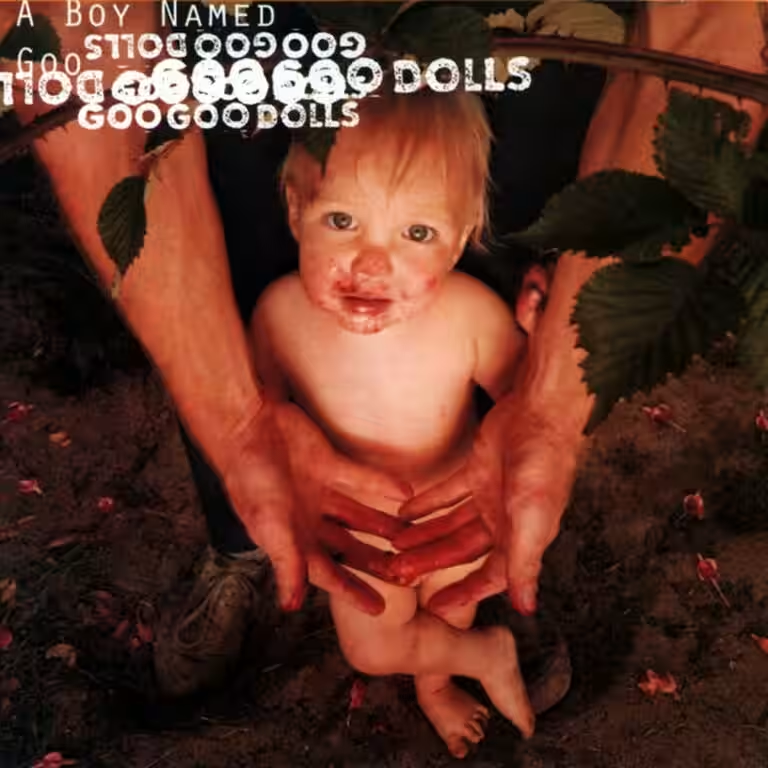
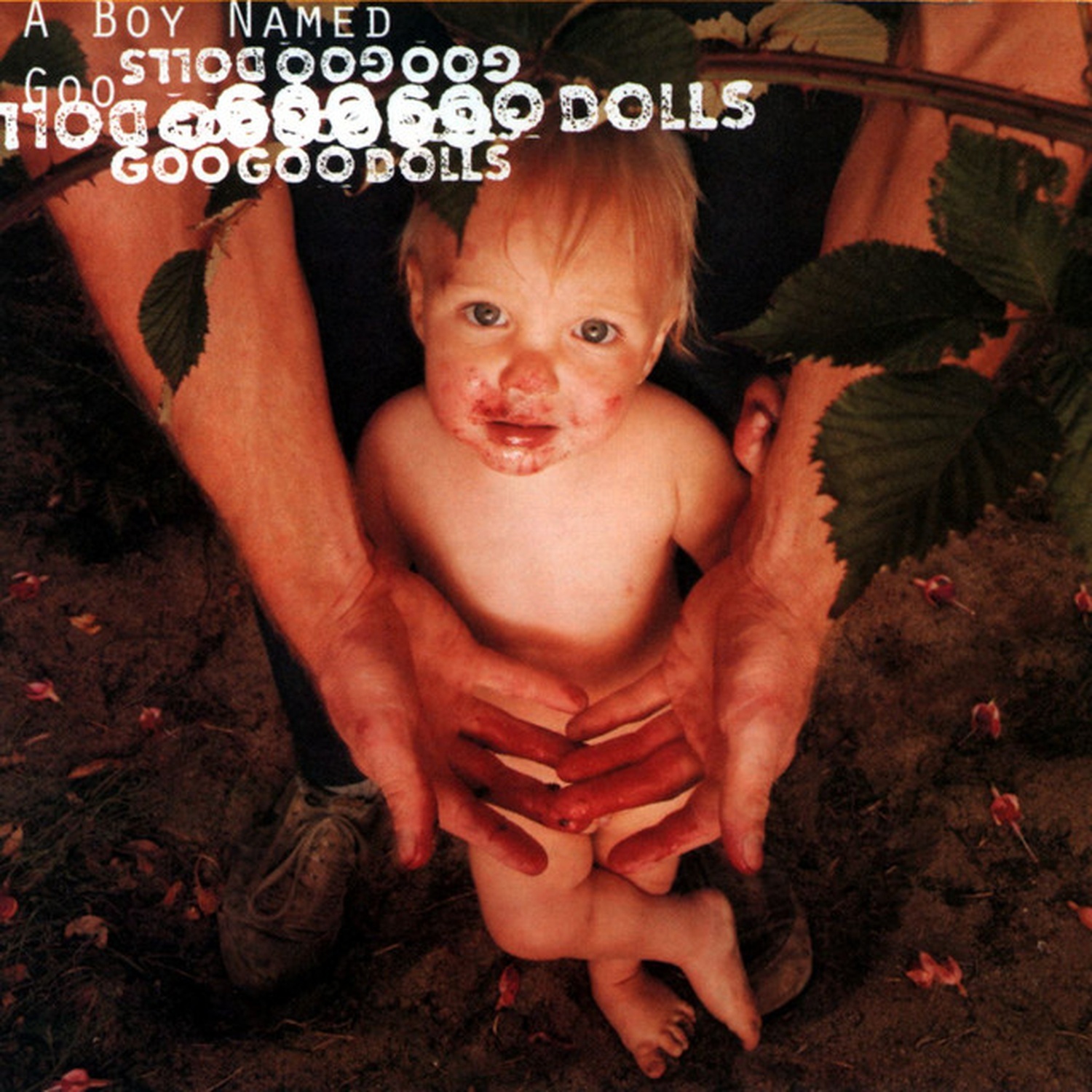
The cover of A Boy Named Goo features a young boy with a dark, sticky substance smeared across his face and hands. The child in the photograph was Carl Gellert, who was just two years old when his father, a professional photographer, snapped the image. Gellert was twelve by the time the photo appeared on the album cover. The dark substance was blackberry juice, tying neatly into the album’s title: a boy, covered in goo.
Additional photography credits on the album include Nancy J. Parrisi (credited for the “tattooed man” image) and Kim Biggs (credited for “torso and finger photo”). The overall aesthetic was raw and unglamorous, fitting the band’s blue-collar identity.
The cover became the centre of a minor controversy in June 1996. Warner Bros. released a statement claiming that Walmart had decided to stop stocking A Boy Named Goo because customers had complained the image was offensive, mistaking the blackberry juice for blood and interpreting the cover as depicting child abuse. Walmart acknowledged pulling the album but denied the reason was customer complaints about the artwork, instead blaming weak sales. At the time of the ban, Walmart had sold roughly 51,000 copies.
Rzeznik’s response was characteristically blunt: “The name of the album is A Boy Named Goo. The picture is of a boy covered with goo. What part of this concept are they unclear on?” When the story hit the media, it arguably generated more publicity for the album than the cover itself ever could have. A 20th anniversary vinyl reissue arrived on 27 November 2015, the first time the album was pressed on vinyl, and a 30th anniversary deluxe edition followed on 14 March 2025, featuring 34 tracks across two CDs including a previously unreleased live concert from Las Vegas recorded on 10 March 1996.
“Name” Changes Everything: Singles and Chart Performance
A Boy Named Goo spawned five singles across 1995 and 1996, but the story of the album’s commercial life is really the story of one song.
“Only One” came first, released in February 1995 as a straightforward rock single. Its video, the one with the fake island and the shark-suited extras, got decent MTV play but didn’t set the charts on fire. “Flat Top” followed in June 1995 as the second single, and the band were in the middle of filming its video when the call came through about KROQ.
Kevin Weatherly at KROQ in Los Angeles had started playing “Name” in heavy rotation. In 1995, KROQ was the undisputed tastemaker for American rock radio. As Rzeznik later explained to Grammy.com, “When they added you, every station in the country added you.” Production on the “Flat Top” video was halted so the band could rush out a clip for “Name” instead.
Released as a single on 26 September 1995, “Name” became a monster. It topped both the Billboard Modern Rock Tracks chart and the Mainstream Rock Tracks chart, and climbed to No. 5 on the Billboard Hot 100 by early 1996. In Canada, it peaked at No. 2 on the RPM 100 Hit Tracks chart and topped the RPM Alternative 30. The music video, directed by Geoff Moore, featured the band performing interspersed with footage of passengers on a bus, capturing a sense of wistful disconnection that perfectly matched the song’s themes of identity and loss.
Crucially, “Name” crossed over. Although the Goo Goo Dolls were considered an alternative group, the song found traction on pop and adult contemporary radio, vastly expanding their audience. As Rzeznik later acknowledged, this was a double-edged sword. Some core fans felt betrayed by the shift toward a softer sound.
“Naked” followed in January 1996, hitting No. 1 on the Mainstream Rock chart and No. 47 on the US Radio Songs chart. “Long Way Down” came last, in March 1996, peaking at No. 7 on Mainstream Rock and No. 25 on Modern Rock Tracks. Its inclusion on the Twister soundtrack gave it an additional commercial boost, and the band filmed a memorably dizzying video featuring them performing on a revolving stage. Takac recalled having to stop every fifteen minutes because everyone was getting vertigo.
The album itself peaked at No. 27 on the Billboard 200 and finished the year 1996 at No. 62 on the year-end chart. By the end of that year, it had been certified double platinum by the RIAA, representing over two million copies shipped in the United States, the first album in Metal Blade Records’ history to achieve that status.
The Lawsuit: Two Million Sold, Zero Royalties
Here’s the part of the A Boy Named Goo story that should make any musician’s blood run cold. Despite selling over two million copies of their breakthrough album, the Goo Goo Dolls did not receive a single penny in royalties.
The problem traced back to a contract the band had signed with Metal Blade Records in 1987 when they were young, inexperienced, and desperate to get a deal. The terms were, to put it politely, extremely unfavourable. The band’s initial royalty rate was 8% of the suggested retail price, far below the industry standard. After producer royalties were deducted, each band member earned roughly 25 cents per CD sold, less than 30% of what a typical artist would receive. On top of that, royalties were calculated on only 75% of the retail price for CDs, with an additional 25% “packaging” deduction. Overseas rates were even worse.
In November 1996, Rzeznik and Takac filed a breach-of-contract lawsuit against Metal Blade in Los Angeles Superior Court. (Malinin wasn’t named because he’d joined after the album was recorded.) The suit alleged that the contract was “grossly unfair, one-sided and unenforceable” and that it extended beyond the seven-year limit permitted by California law for personal services contracts. As Rzeznik later told Metro, “I wish I hadn’t signed that first record deal because I wound up having millions of dollars stolen from me.”
The band had to tour relentlessly just to pay the bills. They even joined the Bush/No Doubt tour, which Takac memorably compared to “having a dentist enter through your ass to pull your wisdom teeth out.” After a nine-month legal battle, a settlement was reached in 1996 that freed the band from their Metal Blade contract and signed them directly to Warner Bros. Records. Their attorney, Peter Paterno, called the new deal “twice as good” as the old one. It was this freedom that allowed them to make Dizzy Up the Girl for Warner Bros. in 1998, the album that would contain “Iris” and push them into genuine superstardom.
On the Road: Touring the A Boy Named Goo Era
The success of “Name” transformed the Goo Goo Dolls’ live career overnight. According to setlist.fm data, the band played around 110 shows in 1995 and a staggering 132 in 1996, a grinding schedule that served the dual purpose of promoting the album and keeping the band financially afloat given their royalty situation.
Early in the cycle, the band supported acts like Hootie and the Blowfish, including a November 1995 date at the Shrine Auditorium in Los Angeles. They played festival bills alongside the likes of Seven Mary Three, Bush, Lisa Loeb, and Ben Folds Five. The setlist.fm archives list both an “A Boy Named Goo” tour leg and an “A Boy Named Goo Summer Tour” as distinct touring phases.
The band appeared on KROQ’s Almost Acoustic Christmas in December 1995, sharing a bill with Bush, and supported Bush directly on dates from February through May 1996, a pairing that placed them in front of exactly the mainstream rock audience “Name” was converting. Other notable shared bills during this era included dates with Belly, Rusted Root, and Barenaked Ladies.
Television appearances became a significant part of the promotional push. The band performed on The Tonight Show with Jay Leno in 1996, and perhaps most memorably, they appeared on Beverly Hills, 90210. When the producers of the glossy teen soap invited them to perform, Rzeznik and Takac accepted without hesitation. The band performed “Long Way Down” aboard a ship during the episode “You Say It’s Your Birthday: Part 2,” which aired on 22 May 1996.
The Goo Goo Dolls also performed on MTV programmes including 120 Minutes and Sound FX, which helped introduce them to a broader alternative rock audience. They appeared on Modern Rock Live during this period, six songs from which were included on the 30th anniversary deluxe edition in 2025.
In TV, Film, and Media
Songs from A Boy Named Goo found their way into several notable media placements during and after the album cycle. “Ain’t That Unusual” was featured on the soundtrack of the 1995 teen comedy Angus, starring Charlie Talbert and George C. Scott. A remix of “Long Way Down” appeared on the soundtrack to the 1996 blockbuster disaster film Twister, where it can be heard blaring from the storm chasers’ car radio. The Twister soundtrack was a massive commercial success in its own right.
“Name” appeared on Beverly Hills, 90210 (season 6, episode 32), and the song later turned up in the Canadian TV series Being Erica in 2009. The band’s general visibility during this period also led to guest appearances where they presented an award to Michael Jackson, a surreal moment for a group that had been playing punk clubs just a few years earlier.
The Musical Landscape of 1995: Cultural Context
A Boy Named Goo landed in a fascinating moment for rock music. The post-grunge era was in full swing. Kurt Cobain had died in April 1994, and the alternative rock landscape was shifting rapidly. The year 1995 saw major releases from bands occupying similar territory: Bush’s Sixteen Stone was already a hit, Alanis Morissette’s Jagged Little Pill would arrive in June, and Oasis’s (What’s the Story) Morning Glory? dropped in October. Foo Fighters released their self-titled debut that July. The Smashing Pumpkins’ Mellon Collie and the Infinite Sadness came in October. It was a crowded, competitive field.
The Goo Goo Dolls occupied an interesting space within it. They were too melodic and pop-leaning for the harder grunge crowd, but too rough-edged for pure pop radio. “Name” bridged that gap in a way few songs managed, sitting comfortably on alternative, rock, pop, and adult contemporary stations simultaneously. In some ways, the Goo Goo Dolls were ahead of the curve. The post-grunge power ballad would become a dominant radio format by the late 1990s, with bands like Matchbox Twenty, Third Eye Blind, and the Wallflowers following a similar path. A Boy Named Goo was one of the records that helped create that template.
The band’s Buffalo roots also set them apart. While Seattle, Los Angeles, and the UK dominated rock headlines, the Goo Goo Dolls represented a Rust Belt working-class sensibility that gave their songs a grounded, unpretentious quality. As one reviewer noted, their music sounded like it came from a city where a pitcher of beer was pocket change and everybody owned their own bowling shoes. Rzeznik’s father was, reportedly, a three-time bowling champion.
Legacy and Influence: What Came After A Boy Named Goo
The immediate aftermath of A Boy Named Goo set the Goo Goo Dolls on a trajectory that few could have predicted. Once free of Metal Blade, the band signed directly with Warner Bros. and began work on Dizzy Up the Girl. Rzeznik, battling severe writer’s block, was asked to contribute a song to the City of Angels soundtrack. The result was “Iris,” which spent 18 consecutive weeks atop the Billboard Hot 100 Airplay chart and became one of the defining songs of the decade. Dizzy Up the Girl went quadruple platinum.
The Goo Goo Dolls have continued recording and touring ever since, releasing albums including Gutterflower (2002), Let Love In (2006), Something for the Rest of Us (2010), Magnetic (2013), Boxes (2016), Miracle Pill (2019), and Chaos in Bloom (2022). Their total album sales exceed 15 million worldwide. They hold the record for most top ten hits at the Hot AC radio format in history.
A Boy Named Goo’s influence extends beyond the band’s own career. Metalcore band Haste the Day covered “Long Way Down” on their 2005 album When Everything Falls. Members of The Lawrence Arms have cited the Goo Goo Dolls as a formative influence. In 2012, “Name” was ranked No. 24 on Billboard’s “Top 100 Pop Songs 1992-2012” chart, the only artist to place three songs on that list (alongside “Iris” at No. 1 and “Slide” at No. 9).
Perhaps most tellingly, John Rzeznik has looked back on the album with clear-eyed appreciation. In a 2015 “Rank Your Records” feature for Vice, he discussed the record’s place in the band’s catalogue, acknowledging it as the turning point that made everything else possible. It remains the record where the Goo Goo Dolls stopped being Buffalo’s best-kept secret and became something much, much bigger.
Things You Might Not Know About A Boy Named Goo
| # | Fact |
|---|---|
| 1 | The album’s promo version had a different tracklist: “Stand Alone,” written solely by fired drummer George Tutuska, appeared instead of the two cover songs, and “Ain’t That Unusual” was listed under the title “Someday.” |
| 2 | “Name” uses a highly unusual guitar tuning of D-A-E-A-E-E, requiring Rzeznik to replace the B string with a second high E string because a standard B string would snap at that tension. |
| 3 | Rzeznik has said “Name” was written about MTV VJ Kennedy (Lisa Kennedy Montgomery), who hosted on the network from 1992 to 1997. |
| 4 | Despite selling over 2.1 million copies in the US, the band members never received a single penny in royalties from the album due to their original Metal Blade contract, which paid them roughly 25 cents per CD after deductions. |
| 5 | The album cover photo was taken by the father of two-year-old Carl Gellert, who was twelve by the time the image was actually used. The “blood” that upset Walmart customers was blackberry juice. |
| 6 | A Boy Named Goo was the first album in Metal Blade Records’ history to achieve double-platinum certification. |
| 7 | The “Flat Top” music video was already in production when KROQ started playing “Name,” forcing the band to halt filming and rush out a “Name” video instead. Rzeznik told Grammy.com they literally stopped one video to make another. |
| 8 | Each of the Goo Goo Dolls’ first five albums sold roughly twice as many copies as the one before it, a remarkably consistent growth curve that culminated in A Boy Named Goo’s breakthrough. |
| 9 | The two cover songs that close the album represent bands from opposite sides of the world: “Disconnected” by The Enemies from Buffalo, and “Slave Girl” by Lime Spiders from Sydney, Australia. |
| 10 | The band were so broke during the album’s success that they toured with Bush and No Doubt partly to cover legal bills from their Metal Blade lawsuit. Takac compared that tour to having dental surgery performed through an unusual anatomical route. |
Listen to the Riffology Podcast
Want to hear even more about A Boy Named Goo, including the stories that didn’t make it into this article? The Riffology podcast episode covering this album digs deep into every track, every controversy, and every twist in the tale. You can find Riffology on Apple Podcasts, Spotify, and all major podcast platforms. Hit subscribe so you never miss an episode.
About the Author